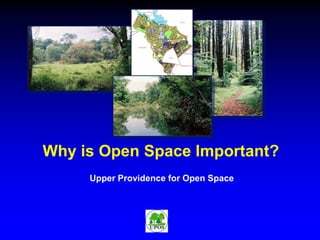
Why is Open Space Important?Upper Providence for Open Space
AgendaWhy Is This an Issue For Upper Providence?What do our residents want?Comprehensive Plan resultsUPOS – Mission for Open SpaceRole in the communityCurrent Open Space and How It Is UsedRole of Scott Park as a Township Asset
Open Spaces Are Our Treasures!Residents value the “green” quality of the  TownshipRose Tree Park and Ridley Creek State Park are the most-identified UP “treasures.”  These treasures are cited as treasures by residents across all five districts.10 of the top 15 treasures identified are “Open Space” type of facilitiesComprehensive Plan of 2005 – Public Survey Results p.15
Willingness to Pay Additional Taxes for Various InitiativesResidents have already voted in favor of the $6M bond for Open SpaceComprehensive Plan of 2005 – Public Survey Results p.11
Residents Recognize Sensitivity of Maintaining Open SpaceCommunity Vision:“There was strong support for keeping permanent open spaces in a more or less natural condition, as formal recreational facilities attract more use and exacerbate the traffic problem.” (Comprehensive Plan of 2005 Chapter 3, p.4)Weaknesses:“There is increasing inappropriate development of environmentally sensitive lands: steep slope areas and lands containing or immediately adjacent to floodplain areas are of particular concern.” (Comprehensive Plan of 2005 Chapter 5, p.2)
Protection of Natural Resources“The natural resources noted by the Municipalities Planning Code are wetlands and other aquifer recharge zones, woodlands, steep slope areas, prime agricultural land, floodplains, and ‘unique natural areas.’ The MPC adds that municipalities are not limited by this list, but may provide for the protection of other resources of local importance.”“Extensive loss of wooded area could lead to serious problems for the Township: woods are not only scenic, but provide tangible benefits by controlling stormwater runoff and the effects of erosion (critical in steep areas), modulating extreme temperatures, controlling windborne dust, and converting carbon dioxide into oxygen.”  (Comprehensive Plan of 2005 Chapter 10, p.2-3)
Township Plan Recognizes Importance of Balancing Needs“The development of recreational facilities – for both active and passive use – will be designed to respect and to protect environmentally sensitive areas.”
“The Township will pursue the development of additional facilities for active recreation (such as improved playing fields, courts, and other support infrastructure), seeking out opportunities to partner with like-minded public and private organizations, including the Delaware County Parks Department regarding utilization of Rose Tree Park.”(Comprehensive Plan of 2005 Chapter 6, p.4-5)
Policies to Protect UP Resources“Township development regulations may include provisions to preserve, protect, and enhance environmentally sensitive areas.”
“The Township may develop and enforce regulations that will assure that development is executed in an environmentally sensitive manner.”
“The Township may seek funding to assist with the preservation and protection of environmentally sensitive areas, including but not necessarily limited to funding to conduct studies supporting environmental preservation policies, site-specific plans, and acquisition.”
“The Township desires to protect its water resources particularly and may implement regulations and/or seek funding as appropriate to develop plans and regulations to protect groundwater, wetlands, and stream corridors, as well as regulations to assure proper flood control, stormwater management, and maintenance of flood control and stormwater management facilities.”
“Public access and recreational use of public open spaces will generally be subsidiary to the environmental preservation function.”(Comprehensive Plan of 2005 Chapter 6, p.4-5)
AgendaWhy Is This an Issue For Upper Providence?What do our residents want?Comprehensive Plan resultsUPOS – Mission for Open SpaceRole in the communityCurrent Open Space and How It Is UsedRole of Scott Park as a Township Asset
Upper Providence for Open SpaceMission:To assist in preserving and protecting open space, including wetlands, watersheds, flora, and fauna.  The primary goal of the group is the conservation of ecosystems and landscapes of regional and local value for the benefit of this and future generations.We like the plan, and we expect the Township  to follow it!!
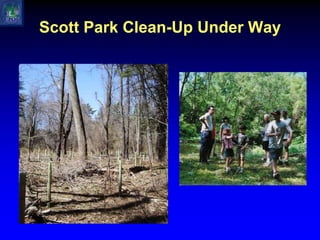
What UPOS Has DoneFormed in 2001 – 100+ Concerned citizens/residentsPrime mover in getting out the vote in support of ballot initiative resulting in $6M for open space acquisitionsActive involvement in the township acquisition of the Lavin TractMonitoring the development of additional tracts to ensure resource preservation and open space issues are considered fullyBegun the process of site maintenance and improvement at Scott ParkIncreased UP citizens’ awareness of open space issuesCreek clean-up activitiesWorking with CRC currently on Crum and Ridley Creek Clean-Up Day
What UPOS Would Like to DoWork hand-in-hand with the Township to implement the resource conservation and open space policies spelled out in the 2005 Comprehensive PlanHelp the township manage its open spaces through the acquisition of grants to develop and manage open space landsServe as a resource to the Township as stewards of our open spacesEducate the citizens of UP and future generations regarding open space and conservation issuesObtain needed environmental assessments of sensitive areas
AgendaWhy Is This an Issue For Upper Providence?What do our residents want?Comprehensive Plan resultsUPOS – Mission for Open SpaceRole in the communityCurrent Open Space and How It Is UsedRole of Scott Park as a Township Asset
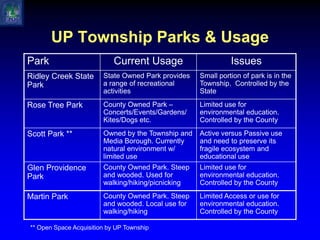
Upper Providence ParksRose Tree ParkRidley Creek State ParkBerman ParkRay Roche ParkScott ParkMartin ParkCherry Street FieldGlen Providence ParkWeldon ParkHoutman ParkThompson Park
UP Township Parks & Usage** Open Space Acquisition by UP Township
UP Township Parks & Usage
Balancing Usage DemandsScenic VistaConcertsSoftballSoccerEventsDogsFishingEach site has specific uses dictated by the nature of the site itself.  Not all sites are appropriate for all uses!!FootballLacrosseKitesNatureHikingBirdingEducationBaseball
UP As Part of a Larger Watershed
Crum CreekCrum Creek WatershedRidley CreekRidley Creek WatershedBalancing Conservation DemandsWatersheds do not recognize municipal boundariesBalancing Conservation DemandsCurrently ~ 60% of Upper Providence residents get their water from Ridley Creek via the Media pumping stationRidley Creek water is rated “high quality” 2nd highest ranking; Crum Creek is rated significantly lowerMaintaining excellent water quality is closely related to conservation practices regarding:Storm water run-offGround water recharge and filtrationErosionOpen Spaces contribute significantly to high quality aquatic ecosystemsFor “High Quality” designated resources, DEP “requires that new or expanded activities do not degrade existing water quality”
Pressure for DevelopmentAnticipated need for an additional 390 housing units within the next 15 years.“During the public participation stage, many residents expressed their objection to subdivision of existing residential lots, even when subdivision was clearly permitted by the zoning…even when such infill development was well designed – they objected to the increase in density.”(Comprehensive Plan of 2005 Chapter 7, p. 5)More importantly, the plan highlights that, “Typically, residential uses do not generate sufficient tax revenue to pay for the municipal services that they consume.  The preponderance of residential property suggests that the Township will find it increasingly difficult to sustain the current level and quality of municipal services.”(Comprehensive Plan of 2005 Chapter 15, p. 5)
Planning Implications“The current extent of development in the Township leaves little vacant land for new construction. As a result, new development must be accommodated on lots carved from existing developed parcels, on lands previously deemed unsuitable for development, and on developed property that has been cleared.”
“If the demand for housing in the Township remains strong, developers will continue to maximize the yield of available land, erecting new homes wherever physically possible, and expanding the definition of what is considered ‘developable land.’ This is likely to result in increasing pressure upon the Township to raise allowable density and to relax restrictions based upon environmental considerations.” (Comprehensive Plan of 2005 Chapter 15, p. 5)
DEP Issues Guidelines“The DEP's new guidance document will require that developers control the amount of storm water discharged when development is complete. To do so, DEP now requires real estate developers to construct less impervious surfaces than before and create more opportunities for storm water to soak into the ground - requirements that go beyond the federal requirements to control storm water. The state also places even more regulatory restrictions on storm water discharges arising from new real estate developments that are located in watersheds with very high water quality, known as ‘special protection’ watersheds in regulatory parlance.”Philadelphia Inquirer, March 19, 2007
UPOS ConcernsExpand open space opportunities through acquisitionRetain “green” feel to the TownshipEnsure environmentally sensitive areas are not compromisedStrictly enforce current codes and ordinancesExpand codes/ordinances to maintain aspects of the community which are so valued today.Ensure protection of high quality aquatic ecosystem
AgendaWhy Is This an Issue For Upper Providence?What do our residents want?Comprehensive Plan resultsUPOS – Mission for Open SpaceRole in the communityCurrent Open Space and How It Is UsedRole of Scott Park as a Township Asset
Upper Providence Township Water SupplyScott ParkRoute 1 By-PassRidley Creek RoadBaltimore Pike
The Media WetlandsIdentified in the Delaware County Natural Areas Inventory (1992) as “an area of local significance worthy of preservation.”Found by the EPA’s Delaware Estuary Program to be of sufficient importance for inclusion in a list of worthy restoration and enhancement projects within the entire estuary.Source: Media Wetlands Resource Conservation Plan,Natural Resources Conservation Service, December 1999
The Media Wetlands“Supports a diverse assemblage of wetland plants, as well as animal species increasingly uncommon in the Philadelphia suburbs.”“Its location in the densely developed suburbs of central Delaware County is remarkable. …”Source: Media Wetlands Resource Conservation Plan,Natural Resources Conservation Service, December 1999
It is important to provide an appropriate setting for environmental education to occur.Peter WilliamsonNatural Lands TrustNational Science Standards call for children to have skills to posit theories based upon direct observation and data collection.  Education should be hands on, participatory and informed by a “more tender trotting upon the land.” Lynn OberfieldHead, Media Providence Friends School
Scott Park: Unique in Having the Five Major EcosystemsScott Park has the five ecosystems that are the subject of environmental studies in PA:MeadowStreamPondWoodsWetlandsProposed legislation would mandate environmental study as part of science testing in 2007.
Scott Park: Meadow
Scott Park: Stream
Scott Park: Pond
Scott Park: Woods
Scott Park: Wetlands
A natural area with few improvements provides the best learning environment across a range of curricula.Meg Barney, Ed.D.Research & Development SpecialistRose Tree Media School District, Education Center
Signage
Access to Protected Areas
Observation Posts for Wildlife Monitoring
Outdoor Classroom

Upos Jan 10

  • 1.
    Why is OpenSpace Important?Upper Providence for Open Space
  • 2.
    AgendaWhy Is Thisan Issue For Upper Providence?What do our residents want?Comprehensive Plan resultsUPOS – Mission for Open SpaceRole in the communityCurrent Open Space and How It Is UsedRole of Scott Park as a Township Asset
  • 3.
    Open Spaces AreOur Treasures!Residents value the “green” quality of the TownshipRose Tree Park and Ridley Creek State Park are the most-identified UP “treasures.” These treasures are cited as treasures by residents across all five districts.10 of the top 15 treasures identified are “Open Space” type of facilitiesComprehensive Plan of 2005 – Public Survey Results p.15
  • 4.
    Willingness to PayAdditional Taxes for Various InitiativesResidents have already voted in favor of the $6M bond for Open SpaceComprehensive Plan of 2005 – Public Survey Results p.11
  • 5.
    Residents Recognize Sensitivityof Maintaining Open SpaceCommunity Vision:“There was strong support for keeping permanent open spaces in a more or less natural condition, as formal recreational facilities attract more use and exacerbate the traffic problem.” (Comprehensive Plan of 2005 Chapter 3, p.4)Weaknesses:“There is increasing inappropriate development of environmentally sensitive lands: steep slope areas and lands containing or immediately adjacent to floodplain areas are of particular concern.” (Comprehensive Plan of 2005 Chapter 5, p.2)
  • 6.
    Protection of NaturalResources“The natural resources noted by the Municipalities Planning Code are wetlands and other aquifer recharge zones, woodlands, steep slope areas, prime agricultural land, floodplains, and ‘unique natural areas.’ The MPC adds that municipalities are not limited by this list, but may provide for the protection of other resources of local importance.”“Extensive loss of wooded area could lead to serious problems for the Township: woods are not only scenic, but provide tangible benefits by controlling stormwater runoff and the effects of erosion (critical in steep areas), modulating extreme temperatures, controlling windborne dust, and converting carbon dioxide into oxygen.” (Comprehensive Plan of 2005 Chapter 10, p.2-3)
  • 7.
    Township Plan RecognizesImportance of Balancing Needs“The development of recreational facilities – for both active and passive use – will be designed to respect and to protect environmentally sensitive areas.”
  • 8.
    “The Township willpursue the development of additional facilities for active recreation (such as improved playing fields, courts, and other support infrastructure), seeking out opportunities to partner with like-minded public and private organizations, including the Delaware County Parks Department regarding utilization of Rose Tree Park.”(Comprehensive Plan of 2005 Chapter 6, p.4-5)
  • 9.
    Policies to ProtectUP Resources“Township development regulations may include provisions to preserve, protect, and enhance environmentally sensitive areas.”
  • 10.
    “The Township maydevelop and enforce regulations that will assure that development is executed in an environmentally sensitive manner.”
  • 11.
    “The Township mayseek funding to assist with the preservation and protection of environmentally sensitive areas, including but not necessarily limited to funding to conduct studies supporting environmental preservation policies, site-specific plans, and acquisition.”
  • 12.
    “The Township desiresto protect its water resources particularly and may implement regulations and/or seek funding as appropriate to develop plans and regulations to protect groundwater, wetlands, and stream corridors, as well as regulations to assure proper flood control, stormwater management, and maintenance of flood control and stormwater management facilities.”
  • 13.
    “Public access andrecreational use of public open spaces will generally be subsidiary to the environmental preservation function.”(Comprehensive Plan of 2005 Chapter 6, p.4-5)
  • 14.
    AgendaWhy Is Thisan Issue For Upper Providence?What do our residents want?Comprehensive Plan resultsUPOS – Mission for Open SpaceRole in the communityCurrent Open Space and How It Is UsedRole of Scott Park as a Township Asset
  • 15.
    Upper Providence forOpen SpaceMission:To assist in preserving and protecting open space, including wetlands, watersheds, flora, and fauna. The primary goal of the group is the conservation of ecosystems and landscapes of regional and local value for the benefit of this and future generations.We like the plan, and we expect the Township to follow it!!
  • 16.
    What UPOS HasDoneFormed in 2001 – 100+ Concerned citizens/residentsPrime mover in getting out the vote in support of ballot initiative resulting in $6M for open space acquisitionsActive involvement in the township acquisition of the Lavin TractMonitoring the development of additional tracts to ensure resource preservation and open space issues are considered fullyBegun the process of site maintenance and improvement at Scott ParkIncreased UP citizens’ awareness of open space issuesCreek clean-up activitiesWorking with CRC currently on Crum and Ridley Creek Clean-Up Day
  • 17.
    What UPOS WouldLike to DoWork hand-in-hand with the Township to implement the resource conservation and open space policies spelled out in the 2005 Comprehensive PlanHelp the township manage its open spaces through the acquisition of grants to develop and manage open space landsServe as a resource to the Township as stewards of our open spacesEducate the citizens of UP and future generations regarding open space and conservation issuesObtain needed environmental assessments of sensitive areas
  • 18.
    AgendaWhy Is Thisan Issue For Upper Providence?What do our residents want?Comprehensive Plan resultsUPOS – Mission for Open SpaceRole in the communityCurrent Open Space and How It Is UsedRole of Scott Park as a Township Asset
  • 19.
    Upper Providence ParksRoseTree ParkRidley Creek State ParkBerman ParkRay Roche ParkScott ParkMartin ParkCherry Street FieldGlen Providence ParkWeldon ParkHoutman ParkThompson Park
  • 20.
    UP Township Parks& Usage** Open Space Acquisition by UP Township
  • 21.
  • 22.
    Balancing Usage DemandsScenicVistaConcertsSoftballSoccerEventsDogsFishingEach site has specific uses dictated by the nature of the site itself. Not all sites are appropriate for all uses!!FootballLacrosseKitesNatureHikingBirdingEducationBaseball
  • 23.
    UP As Partof a Larger Watershed
  • 24.
    Crum CreekCrum CreekWatershedRidley CreekRidley Creek WatershedBalancing Conservation DemandsWatersheds do not recognize municipal boundariesBalancing Conservation DemandsCurrently ~ 60% of Upper Providence residents get their water from Ridley Creek via the Media pumping stationRidley Creek water is rated “high quality” 2nd highest ranking; Crum Creek is rated significantly lowerMaintaining excellent water quality is closely related to conservation practices regarding:Storm water run-offGround water recharge and filtrationErosionOpen Spaces contribute significantly to high quality aquatic ecosystemsFor “High Quality” designated resources, DEP “requires that new or expanded activities do not degrade existing water quality”
  • 25.
    Pressure for DevelopmentAnticipatedneed for an additional 390 housing units within the next 15 years.“During the public participation stage, many residents expressed their objection to subdivision of existing residential lots, even when subdivision was clearly permitted by the zoning…even when such infill development was well designed – they objected to the increase in density.”(Comprehensive Plan of 2005 Chapter 7, p. 5)More importantly, the plan highlights that, “Typically, residential uses do not generate sufficient tax revenue to pay for the municipal services that they consume. The preponderance of residential property suggests that the Township will find it increasingly difficult to sustain the current level and quality of municipal services.”(Comprehensive Plan of 2005 Chapter 15, p. 5)
  • 26.
    Planning Implications“The currentextent of development in the Township leaves little vacant land for new construction. As a result, new development must be accommodated on lots carved from existing developed parcels, on lands previously deemed unsuitable for development, and on developed property that has been cleared.”
  • 27.
    “If the demandfor housing in the Township remains strong, developers will continue to maximize the yield of available land, erecting new homes wherever physically possible, and expanding the definition of what is considered ‘developable land.’ This is likely to result in increasing pressure upon the Township to raise allowable density and to relax restrictions based upon environmental considerations.” (Comprehensive Plan of 2005 Chapter 15, p. 5)
  • 28.
    DEP Issues Guidelines“TheDEP's new guidance document will require that developers control the amount of storm water discharged when development is complete. To do so, DEP now requires real estate developers to construct less impervious surfaces than before and create more opportunities for storm water to soak into the ground - requirements that go beyond the federal requirements to control storm water. The state also places even more regulatory restrictions on storm water discharges arising from new real estate developments that are located in watersheds with very high water quality, known as ‘special protection’ watersheds in regulatory parlance.”Philadelphia Inquirer, March 19, 2007
  • 29.
    UPOS ConcernsExpand openspace opportunities through acquisitionRetain “green” feel to the TownshipEnsure environmentally sensitive areas are not compromisedStrictly enforce current codes and ordinancesExpand codes/ordinances to maintain aspects of the community which are so valued today.Ensure protection of high quality aquatic ecosystem
  • 30.
    AgendaWhy Is Thisan Issue For Upper Providence?What do our residents want?Comprehensive Plan resultsUPOS – Mission for Open SpaceRole in the communityCurrent Open Space and How It Is UsedRole of Scott Park as a Township Asset
  • 31.
    Upper Providence TownshipWater SupplyScott ParkRoute 1 By-PassRidley Creek RoadBaltimore Pike
  • 32.
    The Media WetlandsIdentifiedin the Delaware County Natural Areas Inventory (1992) as “an area of local significance worthy of preservation.”Found by the EPA’s Delaware Estuary Program to be of sufficient importance for inclusion in a list of worthy restoration and enhancement projects within the entire estuary.Source: Media Wetlands Resource Conservation Plan,Natural Resources Conservation Service, December 1999
  • 33.
    The Media Wetlands“Supportsa diverse assemblage of wetland plants, as well as animal species increasingly uncommon in the Philadelphia suburbs.”“Its location in the densely developed suburbs of central Delaware County is remarkable. …”Source: Media Wetlands Resource Conservation Plan,Natural Resources Conservation Service, December 1999
  • 34.
    It is importantto provide an appropriate setting for environmental education to occur.Peter WilliamsonNatural Lands TrustNational Science Standards call for children to have skills to posit theories based upon direct observation and data collection. Education should be hands on, participatory and informed by a “more tender trotting upon the land.” Lynn OberfieldHead, Media Providence Friends School
  • 35.
    Scott Park: Uniquein Having the Five Major EcosystemsScott Park has the five ecosystems that are the subject of environmental studies in PA:MeadowStreamPondWoodsWetlandsProposed legislation would mandate environmental study as part of science testing in 2007.
  • 36.
  • 37.
  • 38.
  • 39.
  • 40.
  • 41.
    A natural areawith few improvements provides the best learning environment across a range of curricula.Meg Barney, Ed.D.Research & Development SpecialistRose Tree Media School District, Education Center
  • 42.
  • 43.
  • 44.
  • 45.
    Observation Posts forWildlife Monitoring
  • 46.