Shoreline Master Program

   Kitsap Alliance
Comments and Concerns
        Bob Benze
         2-15-12
Kitsap Alliance Goals

   Ensure the Kitsap County SMP update is done
    in strict compliance with the law – Chapter
    90.58 RCW and WAC 173-26
   Ensure that where science is used to support
    decision-making, that the science is defensible.
       Our purpose is to ensure that regulations
          restricting the use of private property
                        are justified.
Government and Private Property

Government has no other end, but the
preservation of property. – John Locke
Let the people have property, and they will have

power. – Noah Webster
No person… shall be deprived of life, liberty, or

property, without due process of law; nor shall
private property be taken for public use without
just compensation. (Amendment V)
Property rights.

 Bundle of Rights: to possess, to control, to
  exclude others, to enjoy, and to dispose.
 When government decides they own some

  of the Bundle of Rights, they have exercised
  a “taking” which reduces the value of the
  bundle held by the property owner.
 Such takings should be limited and justified.

  The SMP is a case in point.
The SMA and Private Property

The Shoreline Management Act gives the state
the power to control some aspects of shoreline
private property, specifically to “foster all
reasonable and appropriate uses” while
“protecting against adverse effects to public
health, the land and its vegetation and wildlife,
and the waters of the state and their aquatic
life…”
Protecting the nearshore

The SMA is not an environmental protection law
per-se. Other laws to do that. By almost all
measures, including water and sediment quality
and habitat, the health of Puget Sound has been
improving substantially in recent decades. The
existing regulatory system appears to be doing a
remarkably good job of protecting the nearshore
waters.
The real SMP update question

   The question then is whether the county’s
    update process is doing what the law intends it
    to do, or is it now placing pointless restrictions
    on private property that are not supported by
    science and which will not improve the
    environment
   The following slides suggest it is the latter.
Some Big SMP Update Issues

   It would impose large, native vegetation
    shoreline buffers without sound scientific
    justification.
   Its proposed land use controls, could make
    existing structures legally non-conforming.
   It identifies properties as candidates for
    restoration based on faulty science.
Some More Big SMP Issues

   It dramatically increases the number of parcels
    under the most restrictive shoreline
    designations of “natural” and “conservancy”
    with inadequate justification
   It uses an unscientific approach to assess and
    control the cumulative impacts of future
    development.
Are Big Buffers Justified?

   Per the WAC SMP guidelines, shoreline buffers
    are not required, but may be used to separate
    incompatible uses from critical saltwater
    habitats.
   In its CAO, the county originally supported
    35 ft. buffers. Then 50 ft. buffers (urban) and
    100 ft. (rural) when the hearings board
    rejected 35 ft. Decision not science based.
Are Big Buffers Justified?

In the SMP update, the county is basing much of
its regulation on a study of only 14 out of 1000
Kitsap beaches. A review by Dr. Vincent Gallucci
of the UW pointed out that even in this hand-
picked sample, the county was unable to
demonstrate that hypothetical “stressors” such
as lawns or piers had any clear effect on
nearshore environmental health.
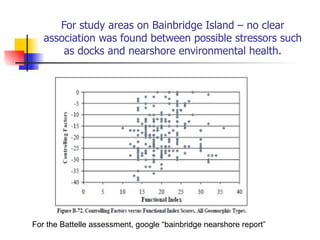
For study areas on Bainbridge Island – no clear
   association was found between possible stressors such
       as docks and nearshore environmental health.


For the Battelle assessment, google “bainbridge nearshore report”
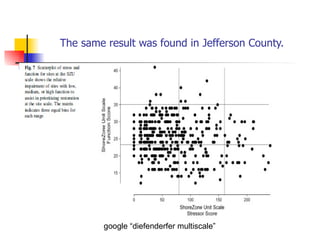
The same result was found in Jefferson County.


        google “diefenderfer multiscale”
Are Big Buffers Justified?

Rather than heeding their own data that
suggested big buffers are not needed, the
county, attempting to justify 85-ft. buffers,
published a Technical Memorandum that
averages buffer widths found in the literature.
It assumes buffer functions that include
microclimate, shade, sediment-filtration,
pollution filtration, large woody debris, and
wildlife habitat protection.
Are Big Buffers Justified? No!

In its 10-page buffer technical memorandum, the
county not only fails to show its work, it
misrepresents key studies. For example, it says
Desbonnet, et. al., 1994 recommends a 148-ft
buffer (“adequate”). But on page 31, Desbonnet
also says: “…a multiple-use vegetated buffer of
five meters (16 ft.) could be considered a
reasonable minimum-buffer-width standard.”
Are Big Buffers Justified? No!


Listed buffer functions and the widths will not
stand up to close scrutiny. A nationally recognized
expert, Dr. Kenneth Brooks, commented on the
memo: “There is no science reviewed – only a list
of mostly not peer reviewed papers by government
agencies.” He recommended minimum buffer
widths of 15–25 ft. unless some environmental
harm can be demonstrated. None has.
Is non-conformance a problem?

   The concern is that structures and property
    uses not in conformance with the new SMP
    ordinance (e.g. homes in buffer zones) will
    have potential problems with expansion,
    rebuilding, value, and the ability to use and
    enjoy property as desired.
   The county says they will include language that
    allows existing structures to be considered
    legally conforming.
So is non-conformance still
              a problem? Yes!
              a problem? Yes!

The county’s proposed wording would allow
rebuilding in case of fire, but it would not provide
grandfathering of the use of the property –
so permits for remodeling or other property
modifications would still trigger the new SMP
controls, potentially requiring replanting lawns
with native vegetation, establishing view
corridors, and other unwanted property
restrictions and controls.
Unjustified Shoreline Restoration
           Does it affect you?

Based on a (discredited) model that supposes
shoreline residential development “stresses” the
nearshore environment, the county’s Inventory
and Characterization Report identifies the
majority of the shoreline as needing restoration
to its “natural” condition.
Yet WAC guidelines clearly state the baseline for
ensuring “no net loss of ecological function” is the
date of SMP approval.
Department of Ecology’s Real
      Restoration Goal could be Radical

   Some people in the Department of Ecology
    and elsewhere view the SMP process as a tool
    to eventually restore the entire shoreline to its
    original condition.
   For example, in an October 2007 presentation,
    Betty Rencor of Ecology stated that the long
    term goal is to “eliminate” non-conforming
    structures and uses (i.e. those that are in
    buffer zones).
Unsubstantiated Shoreline Re-
      Designation – does it affect you?

   The county is increasing the number of
    parcels designated Natural from 94 to 500.
   And the number of parcels designated
    Conservancy from 1,238 to 3,789.
   Even though there is virtually no change in their
    definitions or management policies.
   1/3 of shoreline owners will find themselves
    subject to far more stringent property
    restrictions – for no apparent reason.
Unscientific use of Proxies in
         Cumulative Impacts Approach
   Department of Ecology guidelines require that
    future development impacts on water quality,
    water quantity, and habitat function must be
    avoided or mitigated to ensure no “cumulative”
    net loss of ecological function.
   But the county will not measure habitat function
    directly, but will instead use “proxies” such as
    the area that docks occupy as a proxy for
    eelgrass or other habitat loss.
Unscientific use of “proxies” in
       Cumulative Impacts Approach

   This approach is simply wrong.
   No clear scientific rationale for this use of
    proxies is presented.
   Indeed, the data from three major studies
    shows no clear relationship between proposed
    environmental “stressors” such as docks or
    bulkheads and harmful impacts to the
    nearshore environment.
Unscientific use of “proxies” in
        Cumulative Impacts Approach

   Consider that most small residential docks
    are actually built in nearshore areas where
    no eelgrass grows.
   Homeowners asked to spend money to
    mitigate the harm of such docks might
    reasonably wonder what environmental
    harm they are mitigating.
Current regulations are
               clearly working.
               clearly working.

   A review of Bainbridge Island hydraulic permit
    applications from 1997 to 2010 showed a net
    gain of ecological functions using Ecology’s
    proxies (linear feet of bulkheads, square ft. of
    overwater structures, number of creosoted
    pilings, square ft. of native vegetation, etc.) -
    under existing practices. So why are more
    stringent mitigation controls required?
Communications problems.

   Kitsap Alliance has given the county
    thoughtful and well-researched input on the
    Shoreline Master Program update, pointing out
    where they haven’t complied with the law and
    where their science is just plain wrong. These
    have largely been ignored.
    See kitsapalliance.org for the documents and
    the county’s response.
Scientific input ignored.

   The law (WAC 173-26) requires that
    information, including that from private parties,
    be assembled into the most current, accurate,
    and complete scientific and technical
    information that is available.
   But the county says input from Kitsap Alliance
    scientists is just their “opinion”, apparently
    given the same weight as uninformed emotional
    opinions on science.
Who’s looking out for the
                 environment?

   Department of Ecology, Department of Fish
    and Wildlife, Department of Natural Resources,
    40+ environmental organizations, tribes, the
    Puget Sound Partnership, and the Puget Sound
    Regional Council.
   All encourage strict shoreline regulations to
    protect the “fragile” ecosystem.
   None emphasize property rights.
Who’s looking out for the property
 owner and the environment?


      KitsapAlliance.org
Do the environmental agencies
           have a bias? You bet!

   It is difficult to get a man to understand
    something when his salary depends on his not
    understanding it. -- Upton Sinclair
   The grant money from Ecology, EPA, the
    Puget Sound Partnership almost entirely flows
    to organizations whose existence depends on
    ever-increasing regulation of the environment
This bias is reflected in policy.

   UN Agenda 21 and sustainable development
    policies are designed to emphasize government
    control over private property and to ultimately
    remove people from the rural environment and
    the shoreline.
   The Growth Management Act and its Vision 2040
    interpretation by the Puget Sound Regional Council
    implements these policies, as do Ecology’s SMP
    guidelines.
There is no clear rationale for
            more restrictive regulations.
   As data from the Bainbridge HPA permits shows,
    existing controls already provide clear benefits to the
    shoreline environment.
   Insistence on ever more restrictive regulations,
    without evidence they will actually help the
    environment, does not meet either the letter or the
    intent of the law.
   The county is not authorized to increase SMP
    environmental controls unless it has new information
    or changed circumstances.
Impact on Property Owners

As a mandatory condition of permit approval:

Dedicate from 50 to 200 feet of their waterfront
property for public use as a conservation buffer.
Record the servitude in a notice to title that is

perpetual in duration and binding on all future
owners
The County’s legal problem with its
       proposed buffer dedications:

   Must satisfy the nexus and proportionality tests
    of Nolan and Dolan, demonstrating that such
    dedication is sufficiently related to identified
    impacts of the development to justify
    appropriation of private property for public use
    without payment of just compensation.
   The County’s science is flawed to the point that
    it is cannot meet these legal tests.
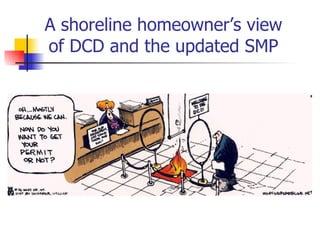
A shoreline homeowner’s view
of DCD and the updated SMP
What can you do?

 Get informed. Get involved.
 Visit kitsapalliance.org

 Ask questions. Demand answers.

"Government is not reason, it is not eloquence, it
  is force; like fire, a troublesome servant and a
  fearful master. Never for a moment should it be
  left to irresponsible action.” — George Washington
The End
Thank you!

Kitsap Alliance Critique of the County's SMP

  • 1.
    Shoreline Master Program Kitsap Alliance Comments and Concerns Bob Benze 2-15-12
  • 2.
    Kitsap Alliance Goals  Ensure the Kitsap County SMP update is done in strict compliance with the law – Chapter 90.58 RCW and WAC 173-26  Ensure that where science is used to support decision-making, that the science is defensible. Our purpose is to ensure that regulations restricting the use of private property are justified.
  • 3.
    Government and PrivateProperty Government has no other end, but the preservation of property. – John Locke Let the people have property, and they will have power. – Noah Webster No person… shall be deprived of life, liberty, or property, without due process of law; nor shall private property be taken for public use without just compensation. (Amendment V)
  • 4.
    Property rights.  Bundleof Rights: to possess, to control, to exclude others, to enjoy, and to dispose.  When government decides they own some of the Bundle of Rights, they have exercised a “taking” which reduces the value of the bundle held by the property owner.  Such takings should be limited and justified. The SMP is a case in point.
  • 5.
    The SMA andPrivate Property The Shoreline Management Act gives the state the power to control some aspects of shoreline private property, specifically to “foster all reasonable and appropriate uses” while “protecting against adverse effects to public health, the land and its vegetation and wildlife, and the waters of the state and their aquatic life…”
  • 6.
    Protecting the nearshore TheSMA is not an environmental protection law per-se. Other laws to do that. By almost all measures, including water and sediment quality and habitat, the health of Puget Sound has been improving substantially in recent decades. The existing regulatory system appears to be doing a remarkably good job of protecting the nearshore waters.
  • 7.
    The real SMPupdate question  The question then is whether the county’s update process is doing what the law intends it to do, or is it now placing pointless restrictions on private property that are not supported by science and which will not improve the environment  The following slides suggest it is the latter.
  • 8.
    Some Big SMPUpdate Issues  It would impose large, native vegetation shoreline buffers without sound scientific justification.  Its proposed land use controls, could make existing structures legally non-conforming.  It identifies properties as candidates for restoration based on faulty science.
  • 9.
    Some More BigSMP Issues  It dramatically increases the number of parcels under the most restrictive shoreline designations of “natural” and “conservancy” with inadequate justification  It uses an unscientific approach to assess and control the cumulative impacts of future development.
  • 10.
    Are Big BuffersJustified?  Per the WAC SMP guidelines, shoreline buffers are not required, but may be used to separate incompatible uses from critical saltwater habitats.  In its CAO, the county originally supported 35 ft. buffers. Then 50 ft. buffers (urban) and 100 ft. (rural) when the hearings board rejected 35 ft. Decision not science based.
  • 11.
    Are Big BuffersJustified? In the SMP update, the county is basing much of its regulation on a study of only 14 out of 1000 Kitsap beaches. A review by Dr. Vincent Gallucci of the UW pointed out that even in this hand- picked sample, the county was unable to demonstrate that hypothetical “stressors” such as lawns or piers had any clear effect on nearshore environmental health.
  • 12.
    For study areason Bainbridge Island – no clear association was found between possible stressors such as docks and nearshore environmental health. For the Battelle assessment, google “bainbridge nearshore report”
  • 13.
    The same resultwas found in Jefferson County. google “diefenderfer multiscale”
  • 14.
    Are Big BuffersJustified? Rather than heeding their own data that suggested big buffers are not needed, the county, attempting to justify 85-ft. buffers, published a Technical Memorandum that averages buffer widths found in the literature. It assumes buffer functions that include microclimate, shade, sediment-filtration, pollution filtration, large woody debris, and wildlife habitat protection.
  • 15.
    Are Big BuffersJustified? No! In its 10-page buffer technical memorandum, the county not only fails to show its work, it misrepresents key studies. For example, it says Desbonnet, et. al., 1994 recommends a 148-ft buffer (“adequate”). But on page 31, Desbonnet also says: “…a multiple-use vegetated buffer of five meters (16 ft.) could be considered a reasonable minimum-buffer-width standard.”
  • 16.
    Are Big BuffersJustified? No! Listed buffer functions and the widths will not stand up to close scrutiny. A nationally recognized expert, Dr. Kenneth Brooks, commented on the memo: “There is no science reviewed – only a list of mostly not peer reviewed papers by government agencies.” He recommended minimum buffer widths of 15–25 ft. unless some environmental harm can be demonstrated. None has.
  • 17.
    Is non-conformance aproblem?  The concern is that structures and property uses not in conformance with the new SMP ordinance (e.g. homes in buffer zones) will have potential problems with expansion, rebuilding, value, and the ability to use and enjoy property as desired.  The county says they will include language that allows existing structures to be considered legally conforming.
  • 18.
    So is non-conformancestill a problem? Yes! a problem? Yes! The county’s proposed wording would allow rebuilding in case of fire, but it would not provide grandfathering of the use of the property – so permits for remodeling or other property modifications would still trigger the new SMP controls, potentially requiring replanting lawns with native vegetation, establishing view corridors, and other unwanted property restrictions and controls.
  • 19.
    Unjustified Shoreline Restoration Does it affect you? Based on a (discredited) model that supposes shoreline residential development “stresses” the nearshore environment, the county’s Inventory and Characterization Report identifies the majority of the shoreline as needing restoration to its “natural” condition. Yet WAC guidelines clearly state the baseline for ensuring “no net loss of ecological function” is the date of SMP approval.
  • 20.
    Department of Ecology’sReal Restoration Goal could be Radical  Some people in the Department of Ecology and elsewhere view the SMP process as a tool to eventually restore the entire shoreline to its original condition.  For example, in an October 2007 presentation, Betty Rencor of Ecology stated that the long term goal is to “eliminate” non-conforming structures and uses (i.e. those that are in buffer zones).
  • 21.
    Unsubstantiated Shoreline Re- Designation – does it affect you?  The county is increasing the number of parcels designated Natural from 94 to 500.  And the number of parcels designated Conservancy from 1,238 to 3,789.  Even though there is virtually no change in their definitions or management policies.  1/3 of shoreline owners will find themselves subject to far more stringent property restrictions – for no apparent reason.
  • 22.
    Unscientific use ofProxies in Cumulative Impacts Approach  Department of Ecology guidelines require that future development impacts on water quality, water quantity, and habitat function must be avoided or mitigated to ensure no “cumulative” net loss of ecological function.  But the county will not measure habitat function directly, but will instead use “proxies” such as the area that docks occupy as a proxy for eelgrass or other habitat loss.
  • 23.
    Unscientific use of“proxies” in Cumulative Impacts Approach  This approach is simply wrong.  No clear scientific rationale for this use of proxies is presented.  Indeed, the data from three major studies shows no clear relationship between proposed environmental “stressors” such as docks or bulkheads and harmful impacts to the nearshore environment.
  • 24.
    Unscientific use of“proxies” in Cumulative Impacts Approach  Consider that most small residential docks are actually built in nearshore areas where no eelgrass grows.  Homeowners asked to spend money to mitigate the harm of such docks might reasonably wonder what environmental harm they are mitigating.
  • 25.
    Current regulations are clearly working. clearly working.  A review of Bainbridge Island hydraulic permit applications from 1997 to 2010 showed a net gain of ecological functions using Ecology’s proxies (linear feet of bulkheads, square ft. of overwater structures, number of creosoted pilings, square ft. of native vegetation, etc.) - under existing practices. So why are more stringent mitigation controls required?
  • 26.
    Communications problems.  Kitsap Alliance has given the county thoughtful and well-researched input on the Shoreline Master Program update, pointing out where they haven’t complied with the law and where their science is just plain wrong. These have largely been ignored. See kitsapalliance.org for the documents and the county’s response.
  • 27.
    Scientific input ignored.  The law (WAC 173-26) requires that information, including that from private parties, be assembled into the most current, accurate, and complete scientific and technical information that is available.  But the county says input from Kitsap Alliance scientists is just their “opinion”, apparently given the same weight as uninformed emotional opinions on science.
  • 28.
    Who’s looking outfor the environment?  Department of Ecology, Department of Fish and Wildlife, Department of Natural Resources, 40+ environmental organizations, tribes, the Puget Sound Partnership, and the Puget Sound Regional Council.  All encourage strict shoreline regulations to protect the “fragile” ecosystem.  None emphasize property rights.
  • 29.
    Who’s looking outfor the property owner and the environment? KitsapAlliance.org
  • 30.
    Do the environmentalagencies have a bias? You bet!  It is difficult to get a man to understand something when his salary depends on his not understanding it. -- Upton Sinclair  The grant money from Ecology, EPA, the Puget Sound Partnership almost entirely flows to organizations whose existence depends on ever-increasing regulation of the environment
  • 31.
    This bias isreflected in policy.  UN Agenda 21 and sustainable development policies are designed to emphasize government control over private property and to ultimately remove people from the rural environment and the shoreline.  The Growth Management Act and its Vision 2040 interpretation by the Puget Sound Regional Council implements these policies, as do Ecology’s SMP guidelines.
  • 32.
    There is noclear rationale for more restrictive regulations.  As data from the Bainbridge HPA permits shows, existing controls already provide clear benefits to the shoreline environment.  Insistence on ever more restrictive regulations, without evidence they will actually help the environment, does not meet either the letter or the intent of the law.  The county is not authorized to increase SMP environmental controls unless it has new information or changed circumstances.
  • 33.
    Impact on PropertyOwners As a mandatory condition of permit approval: Dedicate from 50 to 200 feet of their waterfront property for public use as a conservation buffer. Record the servitude in a notice to title that is perpetual in duration and binding on all future owners
  • 34.
    The County’s legalproblem with its proposed buffer dedications:  Must satisfy the nexus and proportionality tests of Nolan and Dolan, demonstrating that such dedication is sufficiently related to identified impacts of the development to justify appropriation of private property for public use without payment of just compensation.  The County’s science is flawed to the point that it is cannot meet these legal tests.
  • 35.
    A shoreline homeowner’sview of DCD and the updated SMP
  • 36.
    What can youdo?  Get informed. Get involved.  Visit kitsapalliance.org  Ask questions. Demand answers. "Government is not reason, it is not eloquence, it is force; like fire, a troublesome servant and a fearful master. Never for a moment should it be left to irresponsible action.” — George Washington
  • 37.
  • 38.

Editor's Notes

  • #2 Good evening and thank you for the invitation. My name is Bob Benze and I represent the Kitsap Alliance – an organization that looks out for the interests of private property owners. I spent the early part of my career in the Navy Nuclear program where I managed shipyard engineering programs such as disposal of submarine reactor plants at Hanford. In the latter part of my career I worked for Navy headquarters as an environmental protection expert, primarily in the area of the Clean Water Act. I have always been an advocate of using leading-edge science to understand and solve environmental problems. For example, I initiated the ENVVEST program to demonstrate the use of advanced science to protect Sinclair and Dyes Inlets. In my last project with the Navy I coordinated the Navy and EPA efforts to develop Uniform National Discharge Standards for Navy ships. I received a letter of thanks signed by two EPA office directors for my efforts. I say all this not to brag, but simply to establish my credentials.
  • #3 I am a member of the county’s Shoreline Master Program citizen’s task force. In this, my objectives were simple: To
  • #4 I am aware that all of you know your civics, but humor me a bit while I talk about property rights. First let me give you two quotes: (quote slide) And both our state and federal constitutions emphasize that protection of property rights is essential in a free society. For example, the Fifth Amendment to the Constitution says: (quote slide) John Locke 1632 – 1704 English Philosopher and Physician – Father of Classical Liberalism who’s philosophy is embedded in our Declaration of Independence and our Constitution. James Madison also insisted that the proper role of government was to protect property rights
  • #5 (read slide)
  • #6 (start) Many environmental regulation give government some control over private property. For example (read slide)
  • #7 (after reading second sentence) For example, there is the Clean Water Act; the Marine Mammal Protection Act; The Endangered Species Act; the Federal Insecticide, Fungicide, and Rodenticide Act; the Coastal Zone Management Act; the National Environmental Policy Act; the State Environmental Policy Act; the Oil Pollution Act; the Toxic Substance Control Act; the Resource Conservation and Recovery Act; the Cops of Engineers Master permit process for construction of structures in or over the water; and state laws and local ordinances that regulate things like septic systems and protect shellfish beds. (read rest of slide)
  • #8 (read slide)
  • #9 (start) Let me mention some specific issues of concern. The SMP update would (read slide)
  • #10 (read slide then say) The following slides will look at these issues in detail.
  • #11 (read the heading and only the first paragraph, then say) And looking back at a little history -- When the county revised its Critical Areas Ordinance several years ago, they actually supported 35 ft. buffers. But these buffers were challenged and the hearings board agreed they were not adequate. The county then adopted rural and semi-rural buffers of 100-ft. and urban buffers of 50-ft. These were not science-base but the county said they were more than adequate and that they would perform the science when they did the SMP update. The Kitsap Alliance brought a lawsuit challenging these oversized buffers and for about 6 years the case has been in the courts – now at the US Supreme Court for review.
  • #12 (start) The county had the Battelle Marine Science Laboratory conduct a nearshore assessment. Unfortunately, the data provided with the report does not support its stated conclusions. (then read the slide starting The study examined only 14 … (then say ) This result was not unique. An examination of two other studies conducted by Battelle, one in Jefferson County, and one on Bainbridge Island also failed to show that supposed stressors had any clear effect on the health of the nearshore environment.
  • #14 (After showing slide say) It is clear that Dr. Thom’s hypothesis that nearshore environmental health is measurably affected by “stressors” associated with shoreline residences is not supported by the real world data found in their own studies.
  • #15 (read slide then say ) Note that the 85-ft. buffers are for residential designations, but the proposed buffers actually range from 50-ft. in high-intensity designations to 200-ft. in natural designations.
  • #16 (read the slide, then say) In fact, the four peer reviewed studies cited by the county are actually from agricultural science. One of these, the Desbonnet study looked at such things as stormwater runoff from Midwest feedlots with over a hundred cattle per acre, and the vegetated buffers needed to capture the nasty constituents. Shoreline residences bear no resemblance to such studies and have no significant source term of pollution that needs to be captured by a buffer.
  • #17 (after reading the slide, say;) The Kitsap Alliance has submitted extensive documentation of the failure of the county to justify large buffers. Neither they, the Department of Ecology, or anyone else has been able to show that shoreline residential property poses measurable risk to the nearshore. Indeed, studies we have provided show the opposite – that the health of habitat in front of residential property is essentially the same as in front of undeveloped property. We will be submitting additional information to the county on this subject. .
  • #18 (start by saying: Is non-conformance an issue?
  • #19 (read the slide, then say) In fact, one of our attorneys argues that “vegetation conservation” provisions should not be applied to developed properties at all, citing WAC 173-26-221(5)(a) which states “Like other master program provisions, vegetation conservation standards do not apply retroactively to existing uses and structures…”
  • #20 (say) Now lets consider shoreline restoration:
  • #21 (read the slide, then say ) I would suggest that the thousands of people that own shoreline property that is colored red on the Inventory and Characterization maps should be concerned about the long term implications of their property being listed as a candidate for restoration – and they should question why they received such a designation in the first place.
  • #22 (start with) And let’s talk about how the shoreline is designated. The county was not required to change their shoreline designation system, but they chose to do so. However, in the new system, the old Natural and Conservancy designations, which are the most restrictive, were retained. The problem is that (read slide then say ) Since most of the county’s shoreline is already developed and trying to classify land that is already built or platted as residential into a more restrictive designation is clearly inappropriate. Old designation: Urban; Semi-rural; Rural; Conservancy; Natural New designation: High-Intensity; Shoreline Residential; Urban Conservancy; Rural Conservancy; Natural
  • #23 (first say) Now let’s consider what owners who want to do something to improve their property, like build a dock or extend their home will encounter. They will find they have to do some mitigation – that is, compensate for the loss of ecological function their improvements will cause to the environment. And this will be viewed as a cumulative impact on the shoreline. (read slide)
  • #24 (read the slide, then say) In identifying the environmental consequences of an activity, the key requirement is to identify the important cause-and-effect relationships between human activities and the ecosystem. To date, no significant cause-and-effect relationship has been demonstrated for the low-density residential shoreline development of Kitsap County.
  • #25 For example:
  • #26 (start with ) Even using proxy data, existing shoreline controls appear adequate to ensure no net loss . For example (read slide) (then say) The study was provided to Kitsap County who declined to do a similar HPA review for county shorelines. No net loss was not a requirement during the 1997-2010 time period.
  • #27 (start) And there are some real communication problems. (read the slide)
  • #28 (start with) One of our major concerns is that we have provided scientific information to the county, but that information has largely been ignored. This is in clear contradiction of (read slide).
  • #29 (read the heading and the slide, then say) Regarding the number of organizations that champion the environment, Terri King of the Sea Grant program once counted over a hundred organizations participating in the Hood Canal Coordinating council. Environmental reporters in the news media also champion environmental protection without much thought to the rights of property owners. And as to the fragile ecosystem, History shows the system is actually quite resilient. For example, around 1890 there were almost no trees left on the shorelines – they had all been cut down. Yet the shorelines in Kitsap Co. today are now lined with trees. Much of the sediments of Puget Sound were highly contaminated by historical industrial discharges – but are now recovering nicely – largely on their own. For example, Battelle studies show the Sound’s sediments started to recover around 1965 and that they will be back to pre industrial levels for things like heavy metals within the next couple of decades. (Jill Brandenberger, Eric Crecelius)
  • #30 (start) So who’s looking out for both the environment and the rights of property owners? The only organization that comes to mind is the Kitsap Alliance, the organization I represent. This decidedly unequal representation makes it very difficult to balance the rights of property owners with the need to protect the environment.
  • #31 (read the header and the slide, then say) The way this works is to convince the public that there is an environmental crisis so the money will continue to flow. The goal is not to fix problems and declare them solved – because if it were, a lot of people on the bureaucratic environmental payroll wouldn’t be needed. Indeed, it doesn't matter that a lot of the problems have actually been solved, such as meeting the original goals of the Clean Air Act. The show must go on.
  • #32 (read the header and the slide, then say) If you have any doubt about this, I would suggest you read some of the United Nations reports, starting with the 1976 Habitat I conference in Vancouver -- and then familiarize yourself with with the Puget Sound Regional Council’s Vision 2040 Report which applies to Kitsap County.
  • #33 (read header and slide --(before third bullet say) And one of our attorneys tells us (Then say ) As this presentation suggests, no such information has been presented. Quite the opposite, the existing controls appear to be working quite well. The county needs to rethink their new, more stringent controls that they are proposing -- controls that take away more of the rights of property owners with no clear benefit.
  • #34 (after) As I mentioned before the Shoreline Management Act was never intended to restore the shoreline to its natural condition over time – as this SMP update clearly intends. The Act was only enacted to foster all reasonable and appropriate uses, while protecting against adverse effects to public health, land, vegetation, wildlife, and the rights of navigation. ( RCW 90.58.020)
  • #35 (Close) Thank you for listening.
  • #36 I think this carton is self explanatory – with my apologies to Wiley Miller for the subtle change.
  • #37 (Close) Thank you for listening.