Community Based
Wetland Mitigation and
  Watershed Planning
           Nolan Center, 10/17/11
Objectives
—  Introduce the Southeast Alaska Watershed
    Coalition and what we do

—  Compensatory Mitigation for Losses of Aquatic
    Resources- 2008 Final Rule

—  Our work to support Wetland Management on the
    local level

—  Watershed Assessments and Planning for
    Mitigation
Southeast Alaska Watershed Coalition
(SAWC)
                     •  Focuses on the watershed
We advocate on the
 local, state and
                     •  Uses science, local
 federal level for      knowledge and research
 Community-based        to inform decision-making

 Watershed
                     •  Emphasizes collaborative
 Management             problem solving, and
 (CBWM)
                     •  Local citizens, institutions
                        and organizations are the
                        primary stakeholders
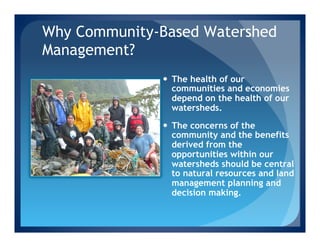
Why Community-Based Watershed
Management?
              —  The health of our
                  communities and economies
                  depend on the health of our
                  watersheds.

              —  The concerns of the
                  community and the benefits
                  derived from the
                  opportunities within our
                  watersheds should be central
                  to natural resources and land
                  management planning and
                  decision making.
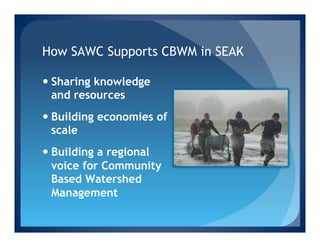
How SAWC Supports CBWM in SEAK

—  Sharing knowledge
    and resources
—  Building economies of
    scale
—  Building a regional
    voice for Community
    Based Watershed
    Management
Why is wetland mitigation management on
 the local, state and federal level
 important to us?
—  Watershed practitioners on the local level are
    mitigators.

—  The majority of the projects these groups
    develop and carry-out support the development
    of community-based mitigation priorities and/or
    are forms of mitigation
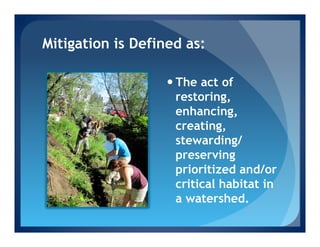
Mitigation is Defined as:

                   — The act of
                      restoring,
                      enhancing,
                      creating,
                      stewarding/
                      preserving
                      prioritized and/or
                      critical habitat in
                      a watershed.
Compensatory Mitigation-2008
Federal Rule

— Mitigation projects were not
   achieving functional lift of habitat
   and the nation was failing to reach
   its goal of “no net loss”
— State to state and within states there
   were vast discrepancies in how
   wetland mitigation was being carried
   out
What is the Intention of the New Rule?

 —  Provided a standard “outlined” process for
     federal, state and local agencies to utilize in
     developing management strategies for wetland
     mitigation
 —  Use of best available science
 —  Predictability and efficient
 —  Improves the planning, implementation and
     management of compensatory mitigation
     projects
 —  Clarifies the Watershed Approach
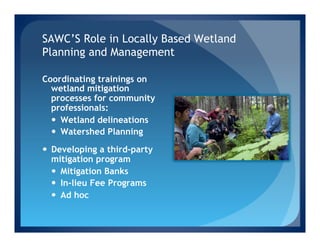
SAWC’S Role in Locally Based Wetland
Planning and Management

Coordinating trainings on
  wetland mitigation
  processes for community
  professionals:
  —  Wetland delineations
  —  Watershed Planning

—  Developing a third-party
    mitigation program
    —  Mitigation Banks
    —  In-lieu Fee Programs
    —  Ad hoc
SAWC’S Role in Locally Based Wetland
Planning and Management

—  Working with communities to identify mitigation
    opportunities
    —  Mitigation Programs
    —  Mitigation Projects

—  Working with state and federal agencies to shape
    policy strategies that respond to the unique
    characteristics of SE communities
Who/What Benefits from Wetland Mitigation
Management and Programs

Community                 Economy
                          —  Jobs
—  Developers
                          —  Less money, resources, time wasted
—  Landowners                during permitting and constructing

                          —  Improve recreational/tourist sites
—  Local citizens  
                          —   Mitigate important habitat for
—  Local governments         commercial species

                          —   Flood prevention
—  Tribes  
                          —  Water quality
—  Subsistence users     —    Subsistence
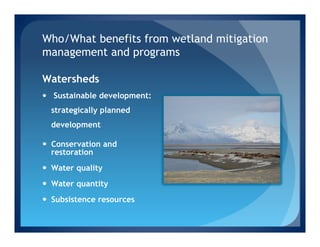
Who/What benefits from wetland mitigation
management and programs

Watersheds
—  Sustainable development:
  strategically planned
  development

—  Conservation and
    restoration  
—  Water quality
—  Water quantity  
—  Subsistence resources 
Questions or
 Comments?
Juneau Watershed Partnership
—  Formed in 1998, local
    citizen and agency
    stakeholder group

—  Non-profit organization
    that works to promote
    sustainable use and
    community stewardship of
    Juneau’s watersheds

—  Raised over $1 million in
    grant and individual
    donations since 1998
Objectives
—  Community Based Wetland Mitigation and
    Watershed Planning in Juneau

—  Benefits of Community Based Watershed Planning

—  Case Study: Auke Lake Watershed Assessment

—  Identifying and Prioritizing Restoration and
    Enhancement Activities for Mitigation
Juneau’s Community Based Wetland
Mitigation and Watershed Management

—  Watershed Assessments and Management Plans
—  Community Events and Community Meetings
—  Support Local Restoration, Enhancement and
    Mitigation Trainings

—  Evaluating Past Restoration, Enhancement and
    Mitigation Projects (REM Report)

—  Prioritizing and Digitizing Restoration, Enhancement
    and Mitigation Opportunities. (REM Part 2)

—  Partnering with SAWC on regional efforts
Benefits of Watershed Assessments
—  Engaging Community/ Stakeholders Proactively

—  Participation and Collaboration

—  Ecological/ Landscape Approach

—  Baseline “Snapshot of Time” = Documenting
    Existing Conditions

—  Framework for grant opportunities, planning
    priorities, mitigation
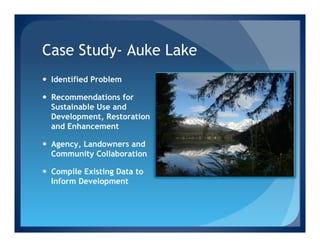
Case Study- Auke Lake
—  Identified Problem

—  Recommendations for
    Sustainable Use and
    Development, Restoration
    and Enhancement

—  Agency, Landowners and
    Community Collaboration

—  Compile Existing Data to
    Inform Development
First Steps
—  Identified Goals and   —  Assembled an Advisory
    Objectives                 Group

—  Key Stakeholders       —  Hosted meeting, - GIS
                               maps, Outline, Past
—  Project Scope              Research
—  Baseline Maps
Project Partners
—  Municipalities       —  Non-Profits
—  US Forest Service    —  University of
                             Alaska
—  AK Fish and Game
                         —  Wetland Review
—  AK DEC                   Board
—  NRCS                 —  User Groups
—  Tribal Governments   —  Neighbors
Components of a Watershed Assessment

Watershed Delineation   Hydrology/ Hydrological
 and Description         Function

—  Land Ownership      —  Contributing Water
                            Sources
—  Land Use Planning
                        —  Rivers, Stream, Tribs,
                            Lakes, Wetlands
Components of a Watershed Assessment
 (Cont.)
Water Quality           Landforms/ Geology
                          Habitat Conditions
—  Water Use
    Designations        —  Channel Alterations

—  Water Rights        —  Bank/Riparian
                            Disturbances
—  Known Pollutants-
    Point Source        —  Fish Passage

—  Other Pollutants-
    Non-Point Source
Components of a Watershed Assessment
(Cont.)

Fish and Fish Habitat       Geology, Plants,
                             Wildlife
—  Species Present
                            —  Invasive Plants
—  Seasonal Distribution
                            —  Wildlife Corridors and
—  Studies, Counts,            Habitat
    Hatchery Stocking
Components of a Watershed Assessment
(Cont.)

Cultural, Historical and   Management, Recovery,
  Current Human Use         Stewardship

—  Land Use/              —  Goals and Action
    Development                Items

—  Recreational/          —  Restoration,
    Commercial Use             Enhancement
Community Involvement
Neighborhood Survey

—  Activities (Use), Values, Concerns, Suggestions
    for Change

Community Meeting

—  Feedback on draft plan and maps

—  Concerns, Uses (Past and Present), Values
Project Outcomes
—  Distributed to municipality, local agencies,
    community groups

—  Posted online on our Electronic Watershed
    Resource Library

—  Auke Lake Action Plan

—  Mitigation Planning
Other Forms of Watershed Plans
—  Total Maximum Daily Loads (TMDLs)

—  Watershed Assessments

—  Watershed Management Plans

—  Watershed Conservation Plans

—  Watershed Action Plans

—  Wetland Function and Values Analysis

—  Comprehensive Plans
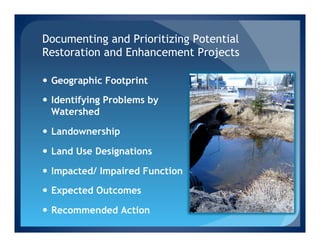
Documenting and Prioritizing Potential
Restoration and Enhancement Projects

—  Geographic Footprint

—  Identifying Problems by
    Watershed

—  Landownership

—  Land Use Designations

—  Impacted/ Impaired Function

—  Expected Outcomes

—  Recommended Action
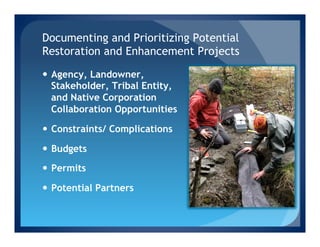
Documenting and Prioritizing Potential
Restoration and Enhancement Projects

—  Agency, Landowner,
    Stakeholder, Tribal Entity,
    and Native Corporation
    Collaboration Opportunities

—  Constraints/ Complications

—  Budgets

—  Permits

—  Potential Partners
Questions or
                                Comments?
alaskawatershedcoalition.org       Thank you!

Community Based Wetland and Watershed Management

  • 1.
    Community Based Wetland Mitigationand Watershed Planning Nolan Center, 10/17/11
  • 2.
    Objectives —  Introduce theSoutheast Alaska Watershed Coalition and what we do —  Compensatory Mitigation for Losses of Aquatic Resources- 2008 Final Rule —  Our work to support Wetland Management on the local level —  Watershed Assessments and Planning for Mitigation
  • 3.
    Southeast Alaska WatershedCoalition (SAWC) •  Focuses on the watershed We advocate on the local, state and •  Uses science, local federal level for knowledge and research Community-based to inform decision-making Watershed •  Emphasizes collaborative Management problem solving, and (CBWM) •  Local citizens, institutions and organizations are the primary stakeholders
  • 4.
    Why Community-Based Watershed Management? —  The health of our communities and economies depend on the health of our watersheds. —  The concerns of the community and the benefits derived from the opportunities within our watersheds should be central to natural resources and land management planning and decision making.
  • 5.
    How SAWC SupportsCBWM in SEAK —  Sharing knowledge and resources —  Building economies of scale —  Building a regional voice for Community Based Watershed Management
  • 6.
    Why is wetlandmitigation management on the local, state and federal level important to us? —  Watershed practitioners on the local level are mitigators. —  The majority of the projects these groups develop and carry-out support the development of community-based mitigation priorities and/or are forms of mitigation
  • 7.
    Mitigation is Definedas: — The act of restoring, enhancing, creating, stewarding/ preserving prioritized and/or critical habitat in a watershed.
  • 8.
    Compensatory Mitigation-2008 Federal Rule — Mitigationprojects were not achieving functional lift of habitat and the nation was failing to reach its goal of “no net loss” — State to state and within states there were vast discrepancies in how wetland mitigation was being carried out
  • 9.
    What is theIntention of the New Rule? —  Provided a standard “outlined” process for federal, state and local agencies to utilize in developing management strategies for wetland mitigation —  Use of best available science —  Predictability and efficient —  Improves the planning, implementation and management of compensatory mitigation projects —  Clarifies the Watershed Approach
  • 10.
    SAWC’S Role inLocally Based Wetland Planning and Management Coordinating trainings on wetland mitigation processes for community professionals: —  Wetland delineations —  Watershed Planning —  Developing a third-party mitigation program —  Mitigation Banks —  In-lieu Fee Programs —  Ad hoc
  • 11.
    SAWC’S Role inLocally Based Wetland Planning and Management —  Working with communities to identify mitigation opportunities —  Mitigation Programs —  Mitigation Projects —  Working with state and federal agencies to shape policy strategies that respond to the unique characteristics of SE communities
  • 12.
    Who/What Benefits fromWetland Mitigation Management and Programs Community Economy —  Jobs —  Developers —  Less money, resources, time wasted —  Landowners   during permitting and constructing —  Improve recreational/tourist sites —  Local citizens   —   Mitigate important habitat for —  Local governments   commercial species —   Flood prevention —  Tribes   —  Water quality —  Subsistence users  —    Subsistence
  • 13.
    Who/What benefits fromwetland mitigation management and programs Watersheds —  Sustainable development: strategically planned development —  Conservation and restoration   —  Water quality —  Water quantity   —  Subsistence resources 
  • 14.
  • 15.
    Juneau Watershed Partnership — Formed in 1998, local citizen and agency stakeholder group —  Non-profit organization that works to promote sustainable use and community stewardship of Juneau’s watersheds —  Raised over $1 million in grant and individual donations since 1998
  • 16.
    Objectives —  Community BasedWetland Mitigation and Watershed Planning in Juneau —  Benefits of Community Based Watershed Planning —  Case Study: Auke Lake Watershed Assessment —  Identifying and Prioritizing Restoration and Enhancement Activities for Mitigation
  • 17.
    Juneau’s Community BasedWetland Mitigation and Watershed Management —  Watershed Assessments and Management Plans —  Community Events and Community Meetings —  Support Local Restoration, Enhancement and Mitigation Trainings —  Evaluating Past Restoration, Enhancement and Mitigation Projects (REM Report) —  Prioritizing and Digitizing Restoration, Enhancement and Mitigation Opportunities. (REM Part 2) —  Partnering with SAWC on regional efforts
  • 18.
    Benefits of WatershedAssessments —  Engaging Community/ Stakeholders Proactively —  Participation and Collaboration —  Ecological/ Landscape Approach —  Baseline “Snapshot of Time” = Documenting Existing Conditions —  Framework for grant opportunities, planning priorities, mitigation
  • 19.
    Case Study- AukeLake —  Identified Problem —  Recommendations for Sustainable Use and Development, Restoration and Enhancement —  Agency, Landowners and Community Collaboration —  Compile Existing Data to Inform Development
  • 20.
    First Steps —  IdentifiedGoals and —  Assembled an Advisory Objectives Group —  Key Stakeholders —  Hosted meeting, - GIS maps, Outline, Past —  Project Scope Research —  Baseline Maps
  • 21.
    Project Partners —  Municipalities —  Non-Profits —  US Forest Service —  University of Alaska —  AK Fish and Game —  Wetland Review —  AK DEC Board —  NRCS —  User Groups —  Tribal Governments —  Neighbors
  • 22.
    Components of aWatershed Assessment Watershed Delineation Hydrology/ Hydrological and Description Function —  Land Ownership —  Contributing Water Sources —  Land Use Planning —  Rivers, Stream, Tribs, Lakes, Wetlands
  • 23.
    Components of aWatershed Assessment (Cont.) Water Quality Landforms/ Geology Habitat Conditions —  Water Use Designations —  Channel Alterations —  Water Rights —  Bank/Riparian Disturbances —  Known Pollutants- Point Source —  Fish Passage —  Other Pollutants- Non-Point Source
  • 24.
    Components of aWatershed Assessment (Cont.) Fish and Fish Habitat Geology, Plants, Wildlife —  Species Present —  Invasive Plants —  Seasonal Distribution —  Wildlife Corridors and —  Studies, Counts, Habitat Hatchery Stocking
  • 25.
    Components of aWatershed Assessment (Cont.) Cultural, Historical and Management, Recovery, Current Human Use Stewardship —  Land Use/ —  Goals and Action Development Items —  Recreational/ —  Restoration, Commercial Use Enhancement
  • 26.
    Community Involvement Neighborhood Survey — Activities (Use), Values, Concerns, Suggestions for Change Community Meeting —  Feedback on draft plan and maps —  Concerns, Uses (Past and Present), Values
  • 27.
    Project Outcomes —  Distributedto municipality, local agencies, community groups —  Posted online on our Electronic Watershed Resource Library —  Auke Lake Action Plan —  Mitigation Planning
  • 28.
    Other Forms ofWatershed Plans —  Total Maximum Daily Loads (TMDLs) —  Watershed Assessments —  Watershed Management Plans —  Watershed Conservation Plans —  Watershed Action Plans —  Wetland Function and Values Analysis —  Comprehensive Plans
  • 29.
    Documenting and PrioritizingPotential Restoration and Enhancement Projects —  Geographic Footprint —  Identifying Problems by Watershed —  Landownership —  Land Use Designations —  Impacted/ Impaired Function —  Expected Outcomes —  Recommended Action
  • 30.
    Documenting and PrioritizingPotential Restoration and Enhancement Projects —  Agency, Landowner, Stakeholder, Tribal Entity, and Native Corporation Collaboration Opportunities —  Constraints/ Complications —  Budgets —  Permits —  Potential Partners
  • 31.
    Questions or Comments? alaskawatershedcoalition.org Thank you!