
Version 2
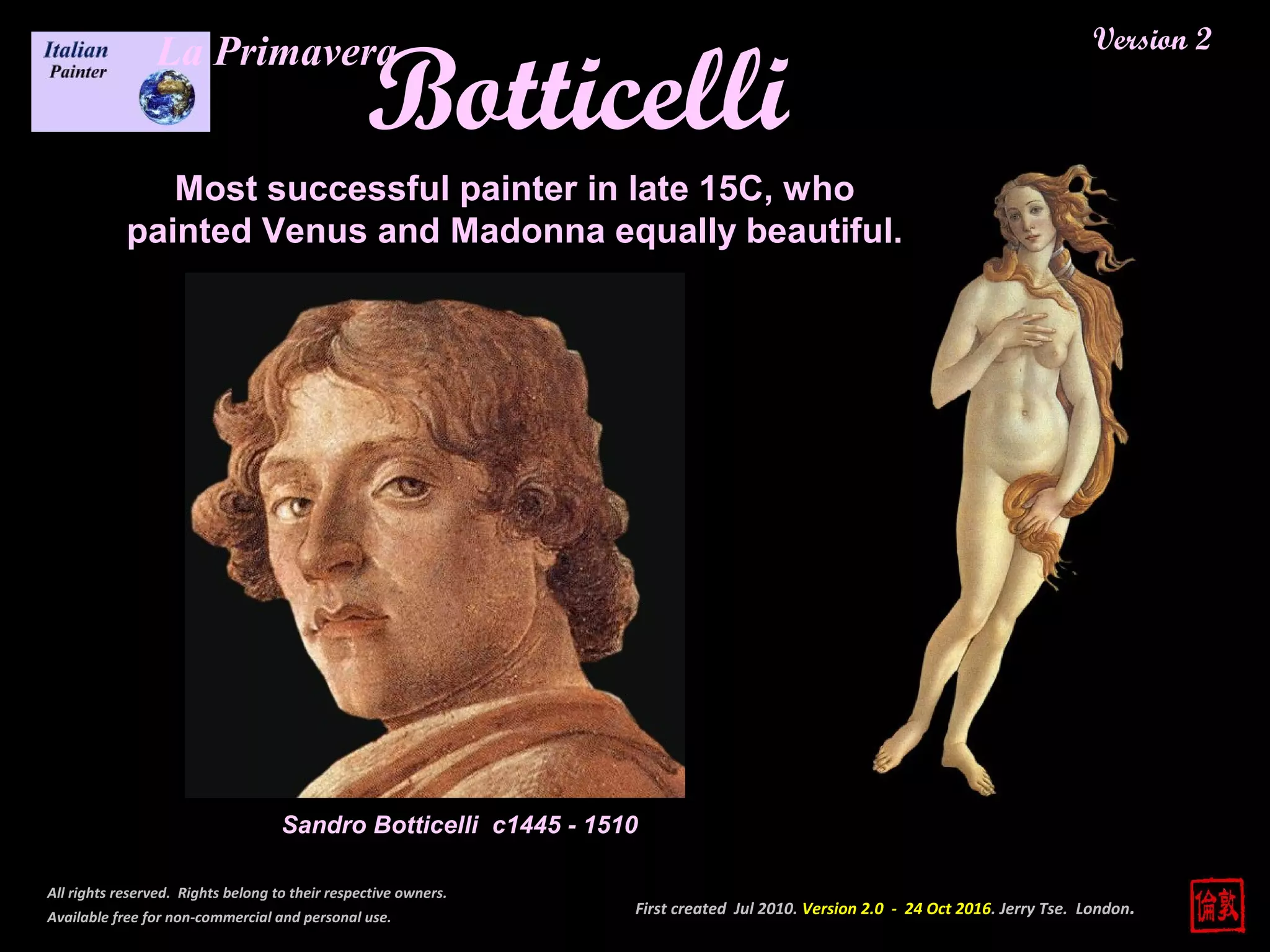
Botticelli
Most successful painter in late 15C, who
painted Venus and Madonna equally beautiful.
Sandro Botticelli c1445 - 1510
All rights reserved. Rights belong to their respective owners.
Available free for non-commercial and personal use.
First created Jul 2010. Version 2.0 - 24 Oct 2016. Jerry Tse. London.
La Primavera
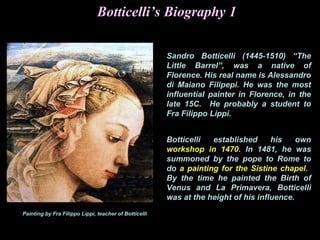
Painting by Fra Filippo Lippi, teacher of Botticelli
Botticelli’s Biography 1
Sandro Botticelli (1445-1510) “The
Little Barrel”, was a native of
Florence. His real name is Alessandro
di Maiano Filipepi. He was the most
influential painter in Florence, in the
late 15C. He probably a student to
Fra Filippo Lippi.
Botticelli established his own
workshop in 1470. In 1481, he was
summoned by the pope to Rome to
do a painting for the Sistine chapel.
By the time he painted the Birth of
Venus and La Primavera, Botticelli
was at the height of his influence.
Botticelli’s Biography 2
Botticelli never married and
expressed a strong aversion to the
idea of marriage, a prospect he
claimed gave him nightmares. It is a
popular belief that he was in love
with Simonetta Vespucci (1453-
1476), who became known as the
most beautiful woman in Florence.
When asked Botticelli said that he
would like to be buried at her feet,
when he died. His wish was fulfil
some 34 years later.
In later life, he was a followers of
Savonarola, who ruled Florence in 1494
until he was overthrown in 1498. He was
known for his burning of books and
paintings, against the moral corruption of
the Renaissance Humanists. After that
Botticelli’s fortunes and his arts never fully
recovered. He finally died in obscurity and
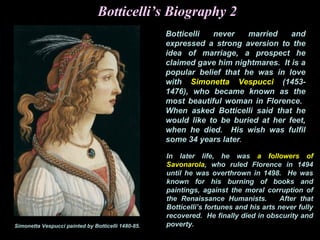
poverty.Simonetta Vespucci painted by Botticelli 1480-85.
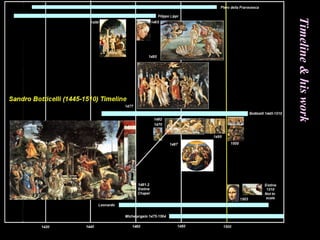
Timeline&hiswork
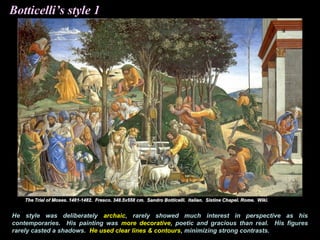
Botticelli’s style 1
He style was deliberately archaic, rarely showed much interest in perspective as his
contemporaries. His painting was more decorative, poetic and gracious than real. His figures
rarely casted a shadows. He used clear lines & contours, minimizing strong contrasts.
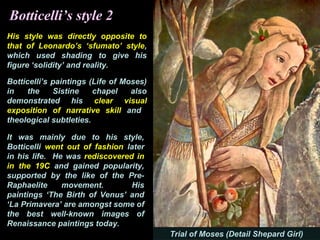
Botticelli’s style 2
His style was directly opposite to
that of Leonardo’s ‘sfumato’ style,
which used shading to give his
figure ‘solidity’ and reality.
Botticelli’s paintings (Life of Moses)
in the Sistine chapel also
demonstrated his clear visual
exposition of narrative skill and
theological subtleties.
It was mainly due to his style,
Botticelli went out of fashion later
in his life. He was rediscovered in
in the 19C and gained popularity,
supported by the like of the Pre-
Raphaelite movement. His
paintings ‘The Birth of Venus’ and
‘La Primavera’ are amongst some of
the best well-known images of
Renaissance paintings today.
Trial of Moses (Detail Shepard Girl)
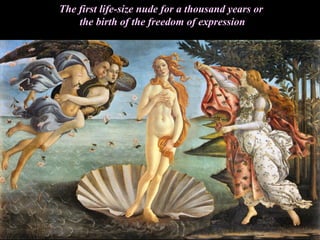
The first life-size nude for a thousand years or
the birth of the freedom of expression
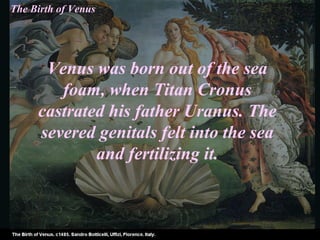
Venus was born out of the sea
foam, when Titan Cronus
castrated his father Uranus. The
severed genitals felt into the sea
and fertilizing it.
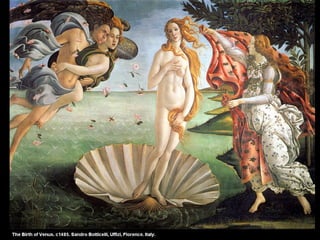
The Birth of Venus
Venus
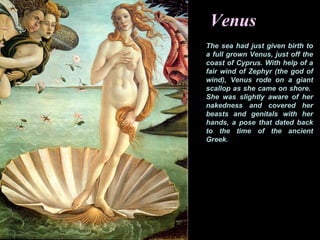
The sea had just given birth to
a full grown Venus, just off the
coast of Cyprus. With help of a
fair wind of Zephyr (the god of
wind), Venus rode on a giant
scallop as she came on shore.
She was slightly aware of her
nakedness and covered her
beasts and genitals with her
hands, a pose that dated back
to the time of the ancient
Greek.
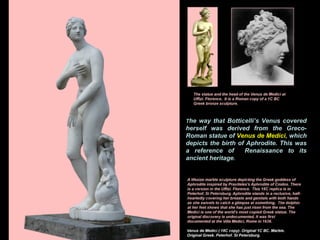
The way that Botticelli’s Venus covered
herself was derived from the Greco-
Roman statue of Venus de Medici, which
depicts the birth of Aphrodite. This was
a reference of Renaissance to its
ancient heritage.
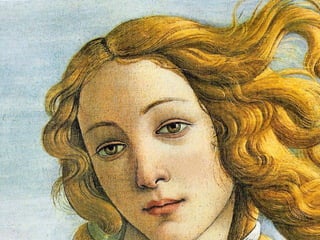
The expression on her
face is one of serenity
and peacefulness whilst
bearing the unpolluted
beauty of her sexuality.
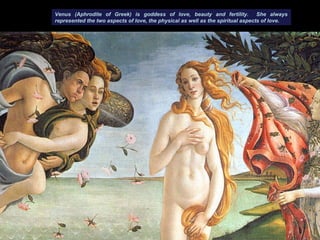
Venus (Aphrodite of Greek) is goddess of love, beauty and fertility. She always
represented the two aspects of love, the physical as well as the spiritual aspects of love.
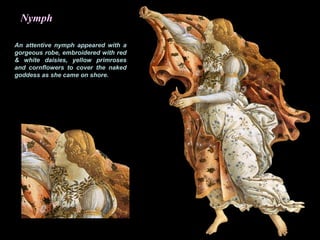
Nymph
An attentive nymph appeared with a
gorgeous robe, embroidered with red
& white daisies, yellow primroses
and cornflowers to cover the naked
goddess as she came on shore.
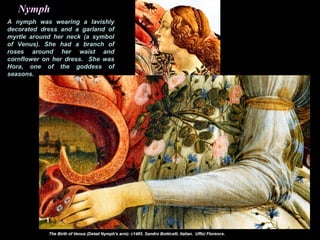
A nymph was wearing a lavishly
decorated dress and a garland of
myrtle around her neck (a symbol
of Venus). She had a branch of
roses around her waist and
cornflower on her dress. She was
Hora, one of the goddess of
seasons.
Nymph
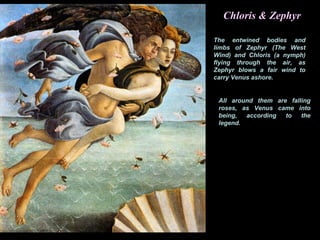
Chloris & Zephyr
The entwined bodies and
limbs of Zephyr (The West
Wind) and Chloris (a nymph)
flying through the air, as
Zephyr blows a fair wind to
carry Venus ashore.
All around them are falling
roses, as Venus came into
being, according to the
legend.
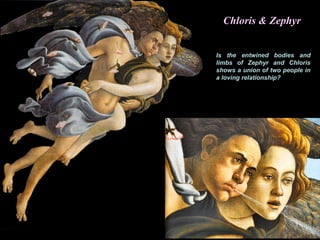
Chloris & Zephyr
Is the entwined bodies and
limbs of Zephyr and Chloris
shows a union of two people in
a loving relationship?
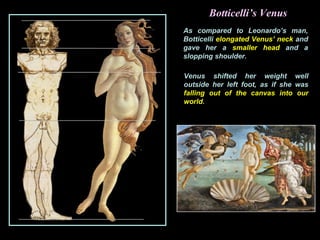
Botticelli’s Venus
As compared to Leonardo’s man,
Botticelli elongated Venus’ neck and
gave her a smaller head and a
slopping shoulder.
Venus shifted her weight well
outside her left foot, as if she was
falling out of the canvas into our
world.
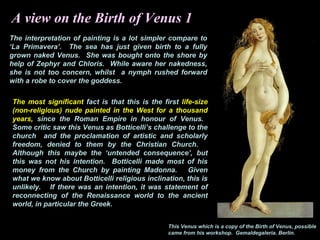
A view on the Birth of Venus 1
The interpretation of painting is a lot simpler compare to
‘La Primavera’. The sea has just given birth to a fully
grown naked Venus. She was bought onto the shore by
help of Zephyr and Chloris. While aware her nakedness,
she is not too concern, whilst a nymph rushed forward
with a robe to cover the goddess.
The most significant fact is that this is the first life-size
(non-religious) nude painted in the West for a thousand
years, since the Roman Empire in honour of Venus.
Some critic saw this Venus as Botticelli’s challenge to the
church and the proclamation of artistic and scholarly
freedom, denied to them by the Christian Church.
Although this maybe the ‘untended consequence’, but
this was not his intention. Botticelli made most of his
money from the Church by painting Madonna. Given
what we know about Botticelli religious inclination, this is
unlikely. If there was an intention, it was statement of
reconnecting of the Renaissance world to the ancient
world, in particular the Greek.
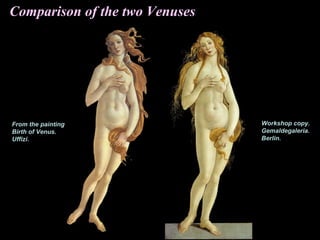
This Venus which is a copy of the Birth of Venus, possible
came from his workshop. Gemaldegaleria. Berlin.
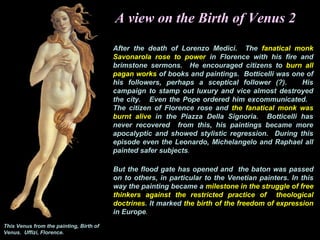
A view on the Birth of Venus 2
After the death of Lorenzo Medici. The fanatical monk
Savonarola rose to power in Florence with his fire and
brimstone sermons. He encouraged citizens to burn all
pagan works of books and paintings. Botticelli was one of
his followers, perhaps a sceptical follower (?). His
campaign to stamp out luxury and vice almost destroyed
the city. Even the Pope ordered him excommunicated.
The citizen of Florence rose and the fanatical monk was
burnt alive in the Piazza Della Signoria. Botticelli has
never recovered from this, his paintings became more
apocalyptic and showed stylistic regression. During this
episode even the Leonardo, Michelangelo and Raphael all
painted safer subjects.
But the flood gate has opened and the baton was passed
on to others, in particular to the Venetian painters. In this
way the painting became a milestone in the struggle of free
thinkers against the restricted practice of theological
doctrines. It marked the birth of the freedom of expression
in Europe.
This Venus from the painting, Birth of
Venus. Uffizi, Florence.
Comparison of the two Venuses
Workshop copy.
Gemaldegaleria.
Berlin.
From the painting
Birth of Venus.
Uffizi.
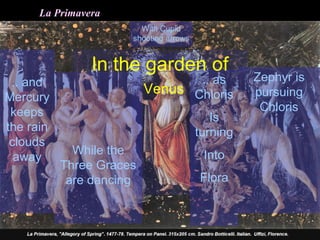
La Primavera
With Cupid
shooting arrows
Venus
While the
Three Graces
are dancing
Zephyr is
pursuing
Chloris
.. as
Chloris
Is
turning
Into
Flora
In the garden of
.. and
Mercury
keeps
the rain
clouds
away
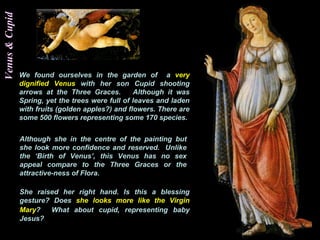
Venus&Cupid
We found ourselves in the garden of a very
dignified Venus with her son Cupid shooting
arrows at the Three Graces. Although it was
Spring, yet the trees were full of leaves and laden
with fruits (golden apples?) and flowers. There are
some 500 flowers representing some 170 species.
Although she in the centre of the painting but
she look more confidence and reserved. Unlike
the ‘Birth of Venus’, this Venus has no sex
appeal compare to the Three Graces or the
attractive-ness of Flora.
She raised her right hand. Is this a blessing
gesture? Does she looks more like the Virgin
Mary? What about cupid, representing baby
Jesus?
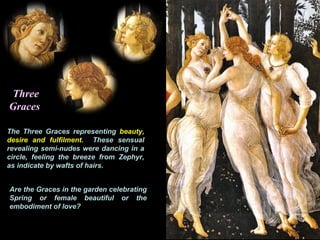
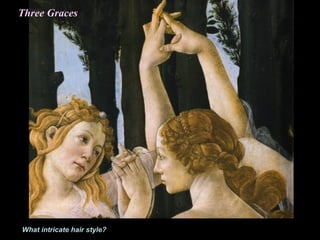
Three
Graces
The Three Graces representing beauty,
desire and fulfilment. These sensual
revealing semi-nudes were dancing in a
circle, feeling the breeze from Zephyr,
as indicate by wafts of hairs.
Are the Graces in the garden celebrating
Spring or female beautiful or the
embodiment of love?
Three Graces
What intricate hair style?
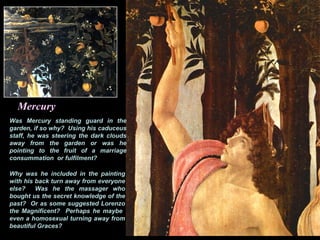
Mercury
Was Mercury standing guard in the
garden, if so why? Using his caduceus
staff, he was steering the dark clouds
away from the garden or was he
pointing to the fruit of a marriage
consummation or fulfilment?
Why was he included in the painting
with his back turn away from everyone
else? Was he the massager who
bought us the secret knowledge of the
past? Or as some suggested Lorenzo
the Magnificent? Perhaps he maybe
even a homosexual turning away from
beautiful Graces?
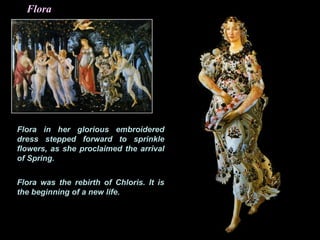
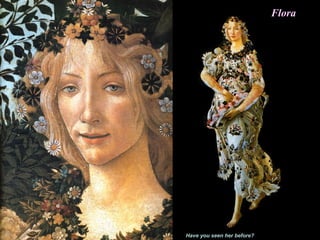
Flora
Flora in her glorious embroidered
dress stepped forward to sprinkle
flowers, as she proclaimed the arrival
of Spring.
Flora was the rebirth of Chloris. It is
the beginning of a new life.
Flora
Have you seen her before?
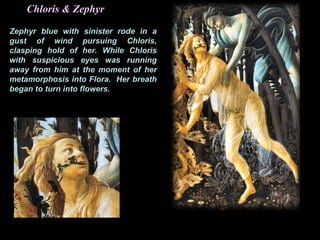
Chloris & Zephyr
Zephyr blue with sinister rode in a
gust of wind pursuing Chloris,
clasping hold of her. While Chloris
with suspicious eyes was running
away from him at the moment of her
metamorphosis into Flora. Her breath
began to turn into flowers.
BirthofVenus
LaPrimavera
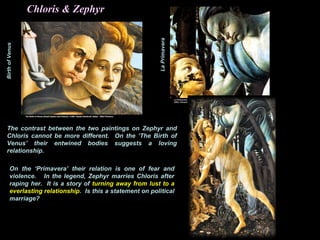
Chloris & Zephyr
The contrast between the two paintings on Zephyr and
Chloris cannot be more different. On the ‘The Birth of
Venus’ their entwined bodies suggests a loving
relationship.
On the ‘Primavera’ their relation is one of fear and
violence. In the legend, Zephyr marries Chloris after
raping her. It is a story of turning away from lust to a
everlasting relationship. Is this a statement on political
marriage?
A view on La Primavera 1
La Primavera (Spring) is one of the most written about and most
controversial paintings in Western arts. The difficulty in
interpretation the paintings is not so much about ‘who were
there’ but ‘why they were there’. The different groups of
characters seem to have no connection with each others. This
painting was commission in c1482. It was the first time a pagan
story had provided the subject of a major work in the
Renaissance, celebrating female beauty and grace
An interpretation of the painting is that it is a message (hence
Mercury) of love (by the presence of Venus). Love on one level
is the desire of beauty and fulfilment, (personified by the Three
Graces). While Zephyr personifies lust and sexual attraction of
love. The spiritual and physical nature of love combined, has
transformed Chloris into the happy Flora, who sprinkling of
flowers bought on the arrival of Spring, a season of renewal, as
a new generation lives appears.
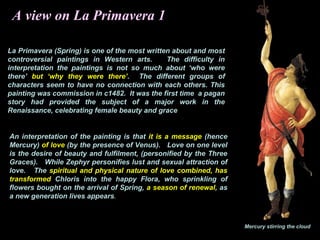
Mercury stirring the cloud
A view on La Primavera 2
Recently, a 1498 document was discovered in the
archive suggesting that Primavera was commissioned
by no other than Lorenzo the Magnificent for a
loveless political marriage of his nephew
Pierfrancesco Medici in 1482. Thus a painting started
with a sexual violence ending in happiness on the
arrival of Spring, became a comforting message to the
teenage newlyweds. This painting is not the only
example of a sexual violence commissioned for the
consumption of a marriage. Botticelli painted a weird
series of four paintings, ‘Nastagio degli Onesti’ on a
similar themes of sexual violence leading eventually to
happiness.
If this interpretation is true then Venus is the goddess of love
as well as Madonna giving a blessing to the newlywed.
Mercury could well be Lorenzo the Magnificent pointing with
his staff to the fruit of the marriage.
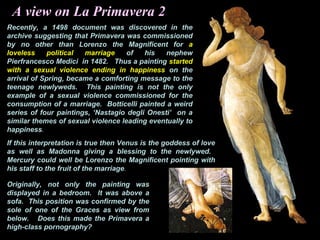
Originally, not only the painting was
displayed in a bedroom. It was above a
sofa. This position was confirmed by the
sole of one of the Graces as view from
below. Does this made the Primavera a
high-class pornography?
Venus and Mars
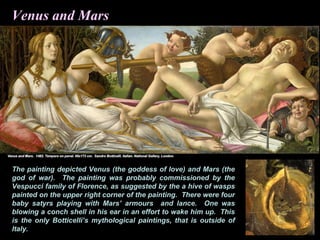
The painting depicted Venus (the goddess of love) and Mars (the
god of war). The painting was probably commissioned by the
Vespucci family of Florence, as suggested by the a hive of wasps
painted on the upper right corner of the painting. There were four
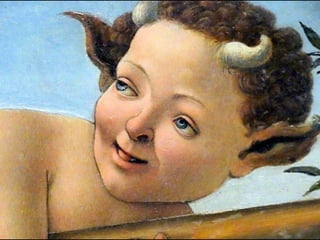
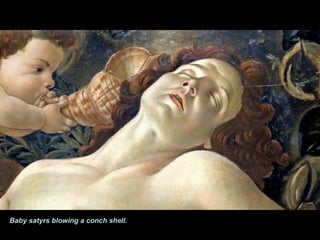
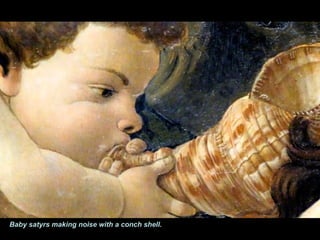
baby satyrs playing with Mars’ armours and lance. One was
blowing a conch shell in his ear in an effort to wake him up. This
is the only Botticelli’s mythological paintings, that is outside of
Italy.
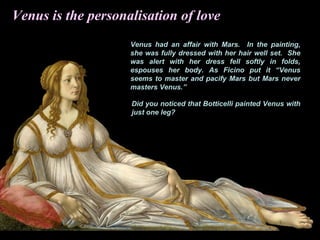
Venus had an affair with Mars. In the painting,
she was fully dressed with her hair well set. She
was alert with her dress fell softly in folds,
espouses her body. As Ficino put it “Venus
seems to master and pacify Mars but Mars never
masters Venus.”
Did you noticed that Botticelli painted Venus with
just one leg?
Venus is the personalisation of love
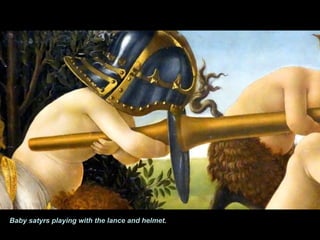
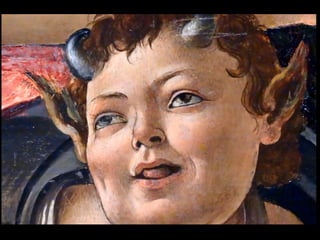
Baby satyrs playing with the lance and helmet.
Baby satyrs blowing a conch shell.
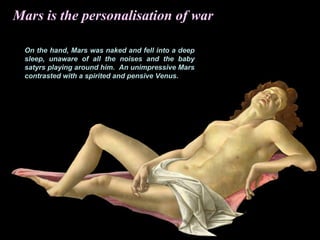
On the hand, Mars was naked and fell into a deep
sleep, unaware of all the noises and the baby
satyrs playing around him. An unimpressive Mars
contrasted with a spirited and pensive Venus.
Mars is the personalisation of war
Baby satyrs making noise with a conch shell.
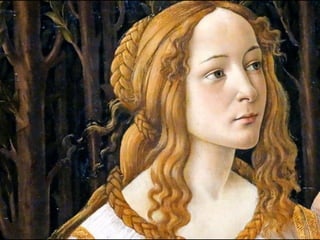
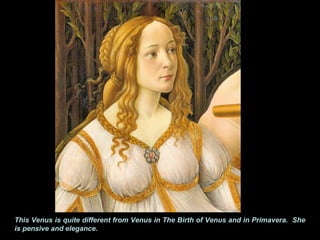
This Venus is quite different from Venus in The Birth of Venus and in Primavera. She
is pensive and elegance.
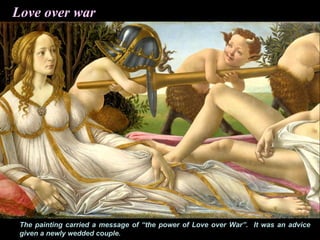
The painting carried a message of “the power of Love over War”. It was an advice
given a newly wedded couple.
Love over war
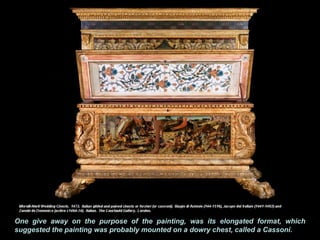
One give away on the purpose of the painting, was its elongated format, which
suggested the painting was probably mounted on a dowry chest, called a Cassoni.
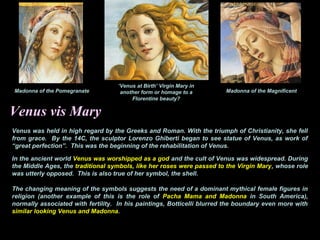
Madonna of the MagnificentMadonna of the Pomegranate
‘Venus at Birth’ Virgin Mary in
another form or homage to a
Florentine beauty?
Venus vis Mary
Venus was held in high regard by the Greeks and Roman. With the triumph of Christianity, she fell
from grace. By the 14C, the sculptor Lorenzo Ghiberti began to see statue of Venus, as work of
“great perfection”. This was the beginning of the rehabilitation of Venus.
In the ancient world Venus was worshipped as a god and the cult of Venus was widespread. During
the Middle Ages, the traditional symbols, like her roses were passed to the Virgin Mary, whose role
was utterly opposed. This is also true of her symbol, the shell.
The changing meaning of the symbols suggests the need of a dominant mythical female figures in
religion (another example of this is the role of Pacha Mama and Madonna in South America),
normally associated with fertility. In his paintings, Botticelli blurred the boundary even more with
similar looking Venus and Madonna.
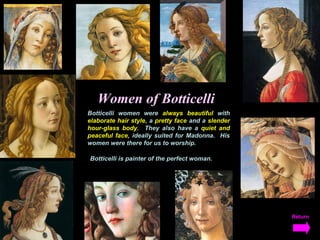
Women of Botticelli
Botticelli women were always beautiful with
elaborate hair style, a pretty face and a slender
hour-glass body. They also have a quiet and
peaceful face, ideally suited for Madonna. His
women were there for us to worship.
Botticelli is painter of the perfect woman.
Return
Music ‘Love Theme from Romeo and Juliet’, composed by Nino Rota from the film ‘Romeo
and Juliet’ directed by Federico Fellini.
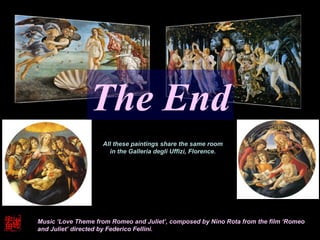
All these paintings share the same room
in the Galleria degli Uffizi, Florence.
The End
Italian Painters
Sandro Botticelli version 2.0

Sandro Botticelli version 2.0

  • 1.
    Version 2 Botticelli Most successfulpainter in late 15C, who painted Venus and Madonna equally beautiful. Sandro Botticelli c1445 - 1510 All rights reserved. Rights belong to their respective owners. Available free for non-commercial and personal use. First created Jul 2010. Version 2.0 - 24 Oct 2016. Jerry Tse. London. La Primavera
  • 2.
    Painting by FraFilippo Lippi, teacher of Botticelli Botticelli’s Biography 1 Sandro Botticelli (1445-1510) “The Little Barrel”, was a native of Florence. His real name is Alessandro di Maiano Filipepi. He was the most influential painter in Florence, in the late 15C. He probably a student to Fra Filippo Lippi. Botticelli established his own workshop in 1470. In 1481, he was summoned by the pope to Rome to do a painting for the Sistine chapel. By the time he painted the Birth of Venus and La Primavera, Botticelli was at the height of his influence.
  • 3.
    Botticelli’s Biography 2 Botticellinever married and expressed a strong aversion to the idea of marriage, a prospect he claimed gave him nightmares. It is a popular belief that he was in love with Simonetta Vespucci (1453- 1476), who became known as the most beautiful woman in Florence. When asked Botticelli said that he would like to be buried at her feet, when he died. His wish was fulfil some 34 years later. In later life, he was a followers of Savonarola, who ruled Florence in 1494 until he was overthrown in 1498. He was known for his burning of books and paintings, against the moral corruption of the Renaissance Humanists. After that Botticelli’s fortunes and his arts never fully recovered. He finally died in obscurity and poverty.Simonetta Vespucci painted by Botticelli 1480-85.
  • 4.
  • 5.
    Botticelli’s style 1 Hestyle was deliberately archaic, rarely showed much interest in perspective as his contemporaries. His painting was more decorative, poetic and gracious than real. His figures rarely casted a shadows. He used clear lines & contours, minimizing strong contrasts.
  • 6.
    Botticelli’s style 2 Hisstyle was directly opposite to that of Leonardo’s ‘sfumato’ style, which used shading to give his figure ‘solidity’ and reality. Botticelli’s paintings (Life of Moses) in the Sistine chapel also demonstrated his clear visual exposition of narrative skill and theological subtleties. It was mainly due to his style, Botticelli went out of fashion later in his life. He was rediscovered in in the 19C and gained popularity, supported by the like of the Pre- Raphaelite movement. His paintings ‘The Birth of Venus’ and ‘La Primavera’ are amongst some of the best well-known images of Renaissance paintings today. Trial of Moses (Detail Shepard Girl)
  • 7.
    The first life-sizenude for a thousand years or the birth of the freedom of expression
  • 8.
    Venus was bornout of the sea foam, when Titan Cronus castrated his father Uranus. The severed genitals felt into the sea and fertilizing it. The Birth of Venus
  • 9.
    Venus The sea hadjust given birth to a full grown Venus, just off the coast of Cyprus. With help of a fair wind of Zephyr (the god of wind), Venus rode on a giant scallop as she came on shore. She was slightly aware of her nakedness and covered her beasts and genitals with her hands, a pose that dated back to the time of the ancient Greek.
  • 10.
    The way thatBotticelli’s Venus covered herself was derived from the Greco- Roman statue of Venus de Medici, which depicts the birth of Aphrodite. This was a reference of Renaissance to its ancient heritage.
  • 11.
    The expression onher face is one of serenity and peacefulness whilst bearing the unpolluted beauty of her sexuality.
  • 12.
    Venus (Aphrodite ofGreek) is goddess of love, beauty and fertility. She always represented the two aspects of love, the physical as well as the spiritual aspects of love.
  • 13.
    Nymph An attentive nymphappeared with a gorgeous robe, embroidered with red & white daisies, yellow primroses and cornflowers to cover the naked goddess as she came on shore.
  • 14.
    A nymph waswearing a lavishly decorated dress and a garland of myrtle around her neck (a symbol of Venus). She had a branch of roses around her waist and cornflower on her dress. She was Hora, one of the goddess of seasons. Nymph
  • 15.
    Chloris & Zephyr Theentwined bodies and limbs of Zephyr (The West Wind) and Chloris (a nymph) flying through the air, as Zephyr blows a fair wind to carry Venus ashore. All around them are falling roses, as Venus came into being, according to the legend.
  • 16.
    Chloris & Zephyr Isthe entwined bodies and limbs of Zephyr and Chloris shows a union of two people in a loving relationship?
  • 17.
    Botticelli’s Venus As comparedto Leonardo’s man, Botticelli elongated Venus’ neck and gave her a smaller head and a slopping shoulder. Venus shifted her weight well outside her left foot, as if she was falling out of the canvas into our world.
  • 18.
    A view onthe Birth of Venus 1 The interpretation of painting is a lot simpler compare to ‘La Primavera’. The sea has just given birth to a fully grown naked Venus. She was bought onto the shore by help of Zephyr and Chloris. While aware her nakedness, she is not too concern, whilst a nymph rushed forward with a robe to cover the goddess. The most significant fact is that this is the first life-size (non-religious) nude painted in the West for a thousand years, since the Roman Empire in honour of Venus. Some critic saw this Venus as Botticelli’s challenge to the church and the proclamation of artistic and scholarly freedom, denied to them by the Christian Church. Although this maybe the ‘untended consequence’, but this was not his intention. Botticelli made most of his money from the Church by painting Madonna. Given what we know about Botticelli religious inclination, this is unlikely. If there was an intention, it was statement of reconnecting of the Renaissance world to the ancient world, in particular the Greek. This Venus which is a copy of the Birth of Venus, possible came from his workshop. Gemaldegaleria. Berlin.
  • 19.
    A view onthe Birth of Venus 2 After the death of Lorenzo Medici. The fanatical monk Savonarola rose to power in Florence with his fire and brimstone sermons. He encouraged citizens to burn all pagan works of books and paintings. Botticelli was one of his followers, perhaps a sceptical follower (?). His campaign to stamp out luxury and vice almost destroyed the city. Even the Pope ordered him excommunicated. The citizen of Florence rose and the fanatical monk was burnt alive in the Piazza Della Signoria. Botticelli has never recovered from this, his paintings became more apocalyptic and showed stylistic regression. During this episode even the Leonardo, Michelangelo and Raphael all painted safer subjects. But the flood gate has opened and the baton was passed on to others, in particular to the Venetian painters. In this way the painting became a milestone in the struggle of free thinkers against the restricted practice of theological doctrines. It marked the birth of the freedom of expression in Europe. This Venus from the painting, Birth of Venus. Uffizi, Florence.
  • 20.
    Comparison of thetwo Venuses Workshop copy. Gemaldegaleria. Berlin. From the painting Birth of Venus. Uffizi.
  • 22.
    La Primavera With Cupid shootingarrows Venus While the Three Graces are dancing Zephyr is pursuing Chloris .. as Chloris Is turning Into Flora In the garden of .. and Mercury keeps the rain clouds away
  • 23.
    Venus&Cupid We found ourselvesin the garden of a very dignified Venus with her son Cupid shooting arrows at the Three Graces. Although it was Spring, yet the trees were full of leaves and laden with fruits (golden apples?) and flowers. There are some 500 flowers representing some 170 species. Although she in the centre of the painting but she look more confidence and reserved. Unlike the ‘Birth of Venus’, this Venus has no sex appeal compare to the Three Graces or the attractive-ness of Flora. She raised her right hand. Is this a blessing gesture? Does she looks more like the Virgin Mary? What about cupid, representing baby Jesus?
  • 24.
    Three Graces The Three Gracesrepresenting beauty, desire and fulfilment. These sensual revealing semi-nudes were dancing in a circle, feeling the breeze from Zephyr, as indicate by wafts of hairs. Are the Graces in the garden celebrating Spring or female beautiful or the embodiment of love?
  • 25.
  • 26.
    Mercury Was Mercury standingguard in the garden, if so why? Using his caduceus staff, he was steering the dark clouds away from the garden or was he pointing to the fruit of a marriage consummation or fulfilment? Why was he included in the painting with his back turn away from everyone else? Was he the massager who bought us the secret knowledge of the past? Or as some suggested Lorenzo the Magnificent? Perhaps he maybe even a homosexual turning away from beautiful Graces?
  • 27.
    Flora Flora in herglorious embroidered dress stepped forward to sprinkle flowers, as she proclaimed the arrival of Spring. Flora was the rebirth of Chloris. It is the beginning of a new life.
  • 28.
  • 29.
    Chloris & Zephyr Zephyrblue with sinister rode in a gust of wind pursuing Chloris, clasping hold of her. While Chloris with suspicious eyes was running away from him at the moment of her metamorphosis into Flora. Her breath began to turn into flowers.
  • 30.
    BirthofVenus LaPrimavera Chloris & Zephyr Thecontrast between the two paintings on Zephyr and Chloris cannot be more different. On the ‘The Birth of Venus’ their entwined bodies suggests a loving relationship. On the ‘Primavera’ their relation is one of fear and violence. In the legend, Zephyr marries Chloris after raping her. It is a story of turning away from lust to a everlasting relationship. Is this a statement on political marriage?
  • 31.
    A view onLa Primavera 1 La Primavera (Spring) is one of the most written about and most controversial paintings in Western arts. The difficulty in interpretation the paintings is not so much about ‘who were there’ but ‘why they were there’. The different groups of characters seem to have no connection with each others. This painting was commission in c1482. It was the first time a pagan story had provided the subject of a major work in the Renaissance, celebrating female beauty and grace An interpretation of the painting is that it is a message (hence Mercury) of love (by the presence of Venus). Love on one level is the desire of beauty and fulfilment, (personified by the Three Graces). While Zephyr personifies lust and sexual attraction of love. The spiritual and physical nature of love combined, has transformed Chloris into the happy Flora, who sprinkling of flowers bought on the arrival of Spring, a season of renewal, as a new generation lives appears. Mercury stirring the cloud
  • 32.
    A view onLa Primavera 2 Recently, a 1498 document was discovered in the archive suggesting that Primavera was commissioned by no other than Lorenzo the Magnificent for a loveless political marriage of his nephew Pierfrancesco Medici in 1482. Thus a painting started with a sexual violence ending in happiness on the arrival of Spring, became a comforting message to the teenage newlyweds. This painting is not the only example of a sexual violence commissioned for the consumption of a marriage. Botticelli painted a weird series of four paintings, ‘Nastagio degli Onesti’ on a similar themes of sexual violence leading eventually to happiness. If this interpretation is true then Venus is the goddess of love as well as Madonna giving a blessing to the newlywed. Mercury could well be Lorenzo the Magnificent pointing with his staff to the fruit of the marriage. Originally, not only the painting was displayed in a bedroom. It was above a sofa. This position was confirmed by the sole of one of the Graces as view from below. Does this made the Primavera a high-class pornography?
  • 33.
    Venus and Mars Thepainting depicted Venus (the goddess of love) and Mars (the god of war). The painting was probably commissioned by the Vespucci family of Florence, as suggested by the a hive of wasps painted on the upper right corner of the painting. There were four baby satyrs playing with Mars’ armours and lance. One was blowing a conch shell in his ear in an effort to wake him up. This is the only Botticelli’s mythological paintings, that is outside of Italy.
  • 35.
    Venus had anaffair with Mars. In the painting, she was fully dressed with her hair well set. She was alert with her dress fell softly in folds, espouses her body. As Ficino put it “Venus seems to master and pacify Mars but Mars never masters Venus.” Did you noticed that Botticelli painted Venus with just one leg? Venus is the personalisation of love
  • 36.
    Baby satyrs playingwith the lance and helmet.
  • 38.
    Baby satyrs blowinga conch shell.
  • 39.
    On the hand,Mars was naked and fell into a deep sleep, unaware of all the noises and the baby satyrs playing around him. An unimpressive Mars contrasted with a spirited and pensive Venus. Mars is the personalisation of war
  • 40.
    Baby satyrs makingnoise with a conch shell.
  • 42.
    This Venus isquite different from Venus in The Birth of Venus and in Primavera. She is pensive and elegance.
  • 43.
    The painting carrieda message of “the power of Love over War”. It was an advice given a newly wedded couple. Love over war
  • 44.
    One give awayon the purpose of the painting, was its elongated format, which suggested the painting was probably mounted on a dowry chest, called a Cassoni.
  • 45.
    Madonna of theMagnificentMadonna of the Pomegranate ‘Venus at Birth’ Virgin Mary in another form or homage to a Florentine beauty? Venus vis Mary Venus was held in high regard by the Greeks and Roman. With the triumph of Christianity, she fell from grace. By the 14C, the sculptor Lorenzo Ghiberti began to see statue of Venus, as work of “great perfection”. This was the beginning of the rehabilitation of Venus. In the ancient world Venus was worshipped as a god and the cult of Venus was widespread. During the Middle Ages, the traditional symbols, like her roses were passed to the Virgin Mary, whose role was utterly opposed. This is also true of her symbol, the shell. The changing meaning of the symbols suggests the need of a dominant mythical female figures in religion (another example of this is the role of Pacha Mama and Madonna in South America), normally associated with fertility. In his paintings, Botticelli blurred the boundary even more with similar looking Venus and Madonna.
  • 46.
    Women of Botticelli Botticelliwomen were always beautiful with elaborate hair style, a pretty face and a slender hour-glass body. They also have a quiet and peaceful face, ideally suited for Madonna. His women were there for us to worship. Botticelli is painter of the perfect woman. Return
  • 47.
    Music ‘Love Themefrom Romeo and Juliet’, composed by Nino Rota from the film ‘Romeo and Juliet’ directed by Federico Fellini. All these paintings share the same room in the Galleria degli Uffizi, Florence. The End
  • 48.

Editor's Notes

  • #2 Botticelli, Sandro (c1445-1510) was the most individual, if not the most influential, painter in Florence at the end of the 15th century Renaissance. He spent almost all his life in his native Florence. At the peak of his career, Botticelli was the most sought-after painter in the city and head of a thriving workshop His only important journey outside Florence was made when he was on the of the artists chosen to decorate the Sistine Chapel in Rome – The most prestigious commission of the day. This presentation included three of his most popular and important paintings today – The Birth of Venus, La Primavera and Venus and Mars. The presentation explores the meanings behind these the great iconic paintings of the Renaissance. Jerry 24.10.16
  • #3 Botticelli (1445-1510) most influential painter in Florence in late 15C. Probabe teacher Fra Filippo Lippi. In his later year, he was much troubled by the religious crisis, with ambiguous in his attitude to Savonarole, the zealot monk against pagan paintings. In his later life he moved away from the Humanism of Renaissance and increasingly indulge in religious dogma. Savonarola ruled Florence as a theocracy, until he was burned alive in 1498. Fall out of favour until Pre-Ralphaelites of 1850.
  • #4 Botticelli (1445-1510) most influential painter in Florence in late 15C. Probabe teacher Fra Filippo Lippi. In his later year, he was much troubled by the religious crisis, with ambiguous in his attitude to Savonarole, the zealot monk against pagan paintings. In his later life he moved away from the Humanism of Renaissance and increasingly indulge in religious dogma. Savonarola ruled Florence as a theocracy, until he was burned alive in 1498. Fall out of favour until Pre-Ralphaelites of 1850.
  • #5 In 1481 summoned to Rome to paint the Sistine chapel.
  • #6 His style deliberately archaic, never showed interest in perspective, more decorative and dependence on outline. Clear contours and minimizing strong contrast. His style is opposed by Leonardo and Michelangelo, as his decline set in. His sistine chapel paintings demonstrate clear visual exposition of narrative and theological subtleties.
  • #7 His style deliberately archaic, never showed interest in perspective, more decorative and dependence on outline. Clear contours and minimizing strong contrast. His style is opposed by Leonardo and Michelangelo, as his decline set in. His sistine chapel paintings demonstrate clear visual exposition of narrative and theological subtleties.
  • #11 Iconic model for Venus.
  • #13 Venus may have been modelled by Simonetta Cataneo Vespucci. Zephyrs, god of the East Wind, symbols of spiritual passions. Nymph, maybe Horae, goddesses of the seasons in her flower flock. Such naked could have been burnt by the church of the day. Drooping shoulder and elongated neck.
  • #19 Both paintings were on displayed by 1499 in Medici’s Castello.
  • #20 Both paintings were on displayed by 1499 in Medici’s Castello.
  • #21 Both paintings were on displayed by 1499 in Medici’s Castello.