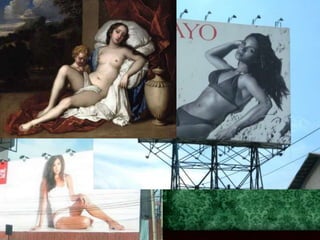
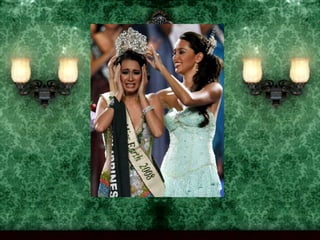
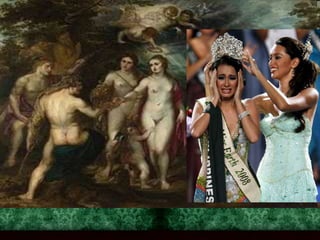
Nude VS NakedJohn Berger
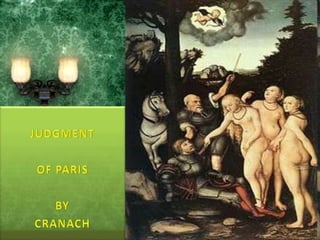
JUDGMENTOF PARISBYCRANACH
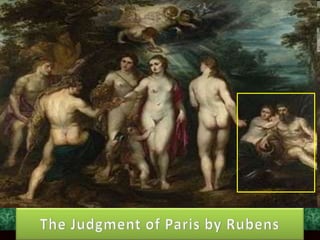
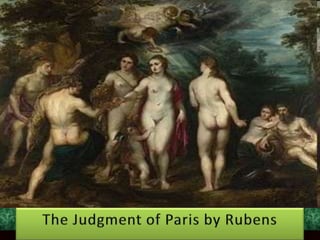
The Judgment of Paris by Rubens
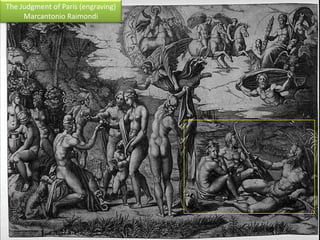
The Judgment of Paris (engraving)Marcantonio Raimondi
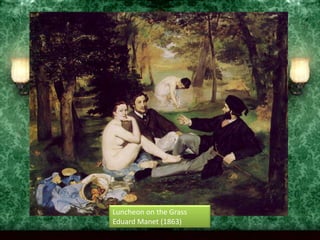
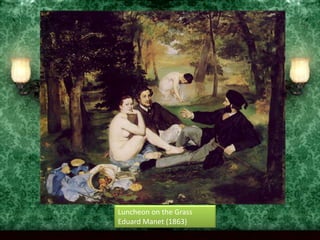
Luncheon on the GrassEduard Manet (1863)
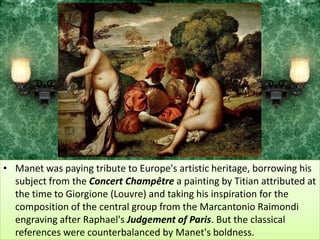
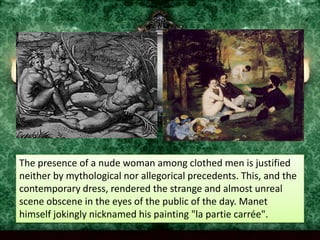
Manet was paying tribute to Europe's artistic heritage, borrowing his subject from the Concert Champêtrea painting by Titian attributed at the time to Giorgione (Louvre) and taking his inspiration for the composition of the central group from the Marcantonio Raimondi engraving after Raphael's Judgement of Paris. But the classical references were counterbalanced by Manet's boldness.
The presence of a nude woman among clothed men is justified neither by mythological nor allegorical precedents. This, and the contemporary dress, rendered the strange and almost unreal scene obscene in the eyes of the public of the day. Manet himself jokingly nicknamed his painting "la partiecarrée".
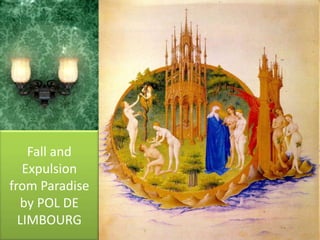
Fall and Expulsion from Paradiseby POL DE LIMBOURG
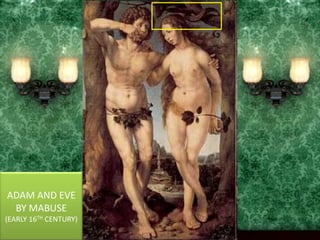
ADAM AND EVEBY MABUSE (EARLY 16TH CENTURY)
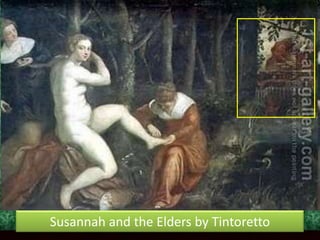
Susannah and the Elders by Tintoretto
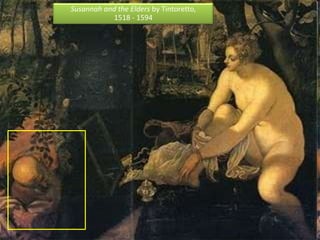
Susannah and the Elders by Tintoretto,1518 - 1594
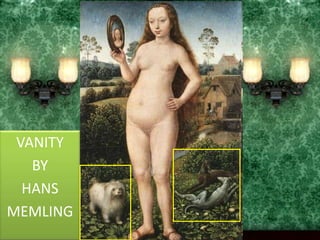
VANITY BYHANS MEMLING
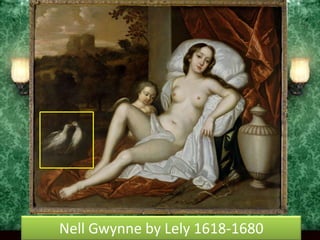
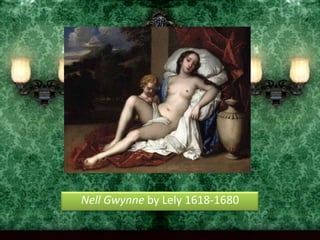
Nell Gwynne by Lely 1618-1680
Eastern and Native art
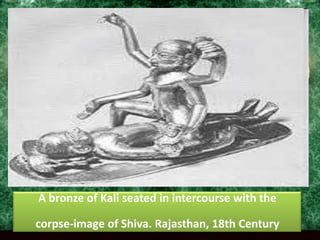
A bronze of Kali seated in intercourse with the  corpse-image of Shiva. Rajasthan, 18th Century
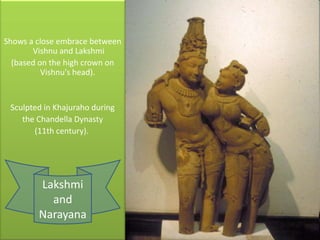
Shows a close embrace between Vishnu and Lakshmi(based on the high crown on Vishnu's head). Sculpted in Khajuraho during the ChandellaDynasty (11th century). Lakshmi and Narayana
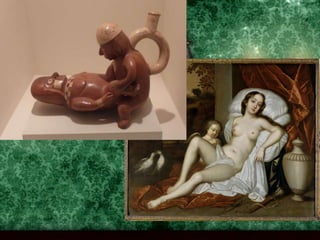
MOCHICA POTTERY
The Mochicans had no taboos when it came to privacy and were therefore free to portray the male and female genitalia within a cultural context.
European Paintings
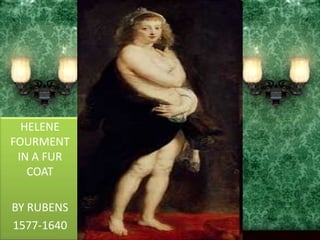
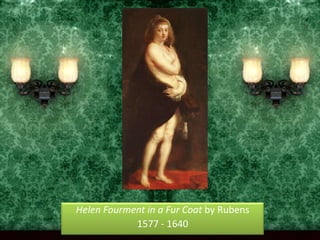
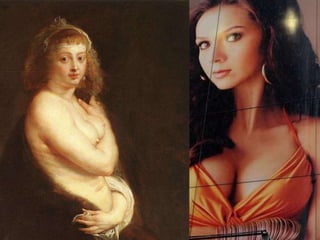
HELENE FOURMENT  IN A FUR COATBY RUBENS1577-1640
Sir Peter Paul Rubens(28 June 1577 – 30 May 1640) A prolific seventeenth-century Flemish Baroque painter, and a proponent of an extravagant Baroque style that emphasized movement, color, and sensuality. Well-known for his Counter-Reformation altarpieces, portraits, landscapes, and history paintings of mythological and allegorical subjects.
In addition to running a large studio in Antwerp that produced paintings popular with nobility and art collectors throughout Europe, Rubens was a classically educated humanist scholar, art collector, and diplomat who was knighted by both Philip IV, King of Spain, and Charles I, King of England.
Myth-inspired Artworks
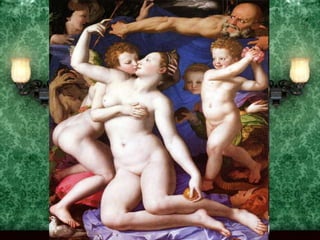
VENUS, CUPID TIME AND LOVEBY BRONZINO
BACCHUS, CERES AND CUPID BY VON AACHEN
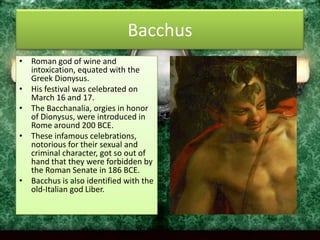
BacchusRoman god of wine and intoxication, equated with the Greek Dionysus.
His festival was celebrated on March 16 and 17.
The Bacchanalia, orgies in honor of Dionysus, were introduced in Rome around 200 BCE.
These infamous celebrations, notorious for their sexual and criminal character, got so out of hand that they were forbidden by the Roman Senate in 186 BCE.
Bacchus is also identified with the old-Italian god Liber. Ceresthe goddess of growing plants (particularly cereals) and of motherly love.worshipped in Ancient Roman religion, usually equated with the Greek goddess Demeterthe daughter of Saturn and Ops, wife-sister of Jupiter, mother of Proserpina by Jupiter and sister of Juno, Vesta, Neptune and Pluto.depicted conventionally with a scepter, a basket of flowers and fruit, and a garland made of corn ears. made up a trinity with Liber and Libera, who were two other agricultural gods.
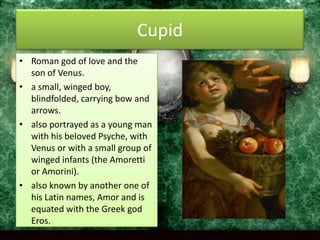
CupidRoman god of love and the son of Venus.a small, winged boy, blindfolded, carrying bow and arrows.also portrayed as a young man with his beloved Psyche, with Venus or with a small group of winged infants (the Amoretti or Amorini).also known by another one of his Latin names, Amor and is equated with the Greek god Eros.
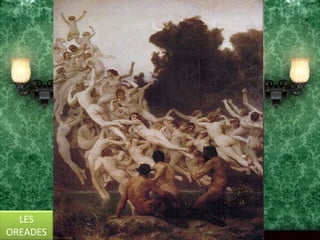
LES OREADES
William-AdolpheBouguereau(November 30, 1825 – August 19, 1905) French academic painter. Bouguereau was a traditionalist whose realistic genre paintings and mythological themes were modern interpretations of Classical subjects with a heavy emphasis on the female human body.Although he created an idealized world, his almost photo-realistic style was popular with rich art patrons. Was very famous in his time but today his subject matter and technique receive relatively little attention compared to the popularity of the Impressionists.
Reclining Women
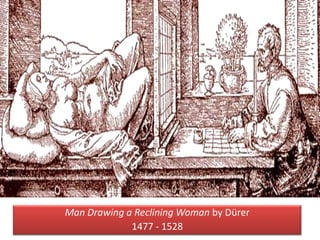
Man Drawing a Reclining Woman by Dürer1477 - 1528
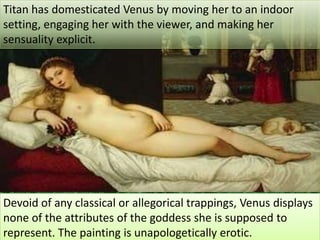
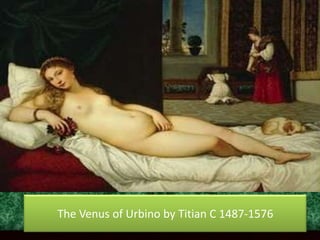
The Venus of Urbino by Titian C 1487-1576
The Venus of Urbino is a 1538 oil painting by the Italian master Titian. It depicts a nude young woman, identified with the goddess Venus, reclining on a couch or bed in the sumptuous surroundings of a Renaissance palace. It hangs in the Galleria degli Uffizi in Florence.
Titan has domesticated Venus by moving her to an indoor setting, engaging her with the viewer, and making her sensuality explicit. Devoid of any classical or allegorical trappings, Venus displays none of the attributes of the goddess she is supposed to represent. The painting is unapologetically erotic.
In the near background is a dog, often a symbol of either fidelity or sexual profligacy; that the animal is asleep hints that the woman portrayed is unfaithful.
The painting was commissioned by the Duke of Urbino, possibly to celebrate his 1534 marriage. The maids in the background are shown rummaging through a similar chest, apparently in search of Venus's clothes. Curiously, given its overtly erotic content, the painting was intended as an instructive "model" for Giulia Varano, the Duke's extremely young bride.
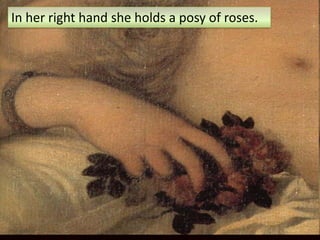
In her right hand she holds a posy of roses.
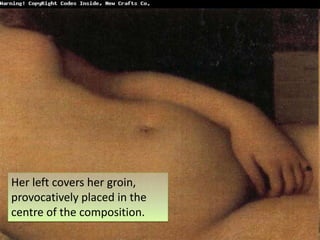
Her left covers her groin, provocatively placed in the centre of the composition.
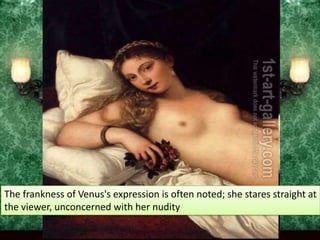
The frankness of Venus's expression is often noted; she stares straight at the viewer, unconcerned with her nudity
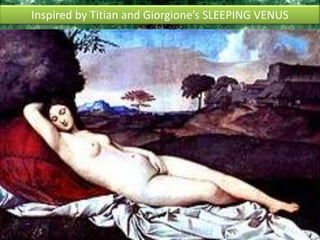
Inspired by Titian and Giorgione’s SLEEPING VENUS
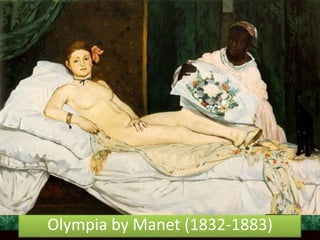
Olympia by Manet (1832-1883)
The painting was inspired by Titian's Venus of Urbino, which in turn refers to Giorgione's Sleeping Venus.Comparison is also made to Ingres' La grande Odalisque (1814). Unlike other artists, Manet did not depict a goddess or an odalisque but a high-class prostitute waiting for a client.
LA MAJA DESNUDA BY GOYAThe classic work that most closely resembles Manet's in character is Francisco Goya’s La majadesnuda (c. 1800).
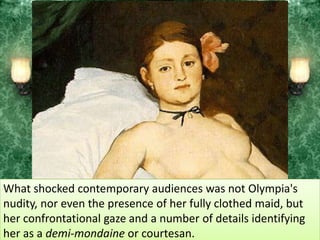
What shocked contemporary audiences was not Olympia's nudity, nor even the presence of her fully clothed maid, but her confrontational gaze and a number of details identifying her as a demi-mondaine or courtesan.
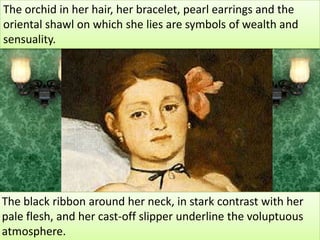
The orchid in her hair, her bracelet, pearl earrings and the oriental shawl on which she lies are symbols of wealth and sensuality. The black ribbon around her neck, in stark contrast with her pale flesh, and her cast-off slipper underline the voluptuous atmosphere.
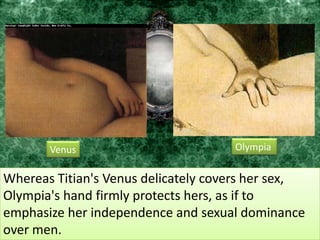
OlympiaVenusWhereas Titian's Venus delicately covers her sex, Olympia's hand firmly protects hers, as if to emphasize her independence and sexual dominance over men.
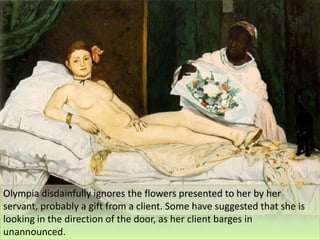
Manet replaced the little dog (symbol of fidelity) in Titian's painting with a black cat, which symbolized prostitution.
Olympia disdainfully ignores the flowers presented to her by her servant, probably a gift from a client. Some have suggested that she is looking in the direction of the door, as her client barges in unannounced.
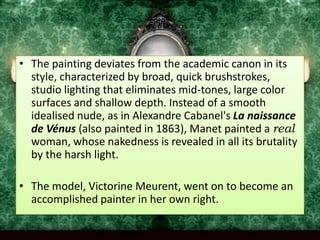
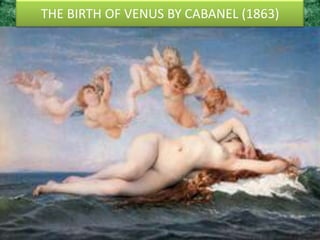
The painting deviates from the academic canon in its style, characterized by broad, quick brushstrokes, studio lighting that eliminates mid-tones, large color surfaces and shallow depth. Instead of a smooth idealised nude, as in AlexandreCabanel'sLa naissance de Vénus(also painted in 1863), Manet painted a realwoman, whose nakedness is revealed in all its brutality by the harsh light.The model, VictorineMeurent, went on to become an accomplished painter in her own right.
THE BIRTH OF VENUS BY CABANEL (1863)
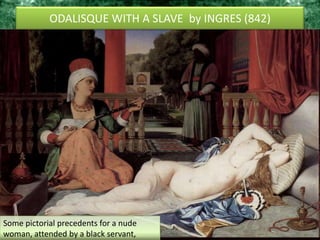
ODALISQUE WITH A SLAVE  by INGRES (842)Some pictorial precedents for a nude woman, attended by a black servant,
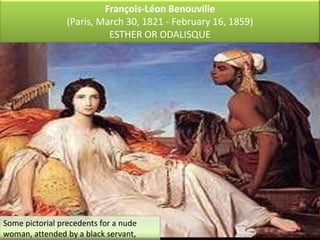
François-Léon Benouville(Paris, March 30, 1821 - February 16, 1859) ESTHER OR ODALISQUESome pictorial precedents for a nude woman, attended by a black servant,
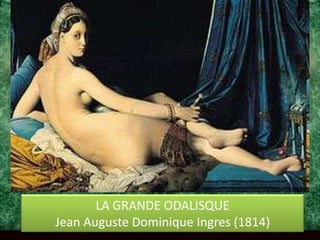
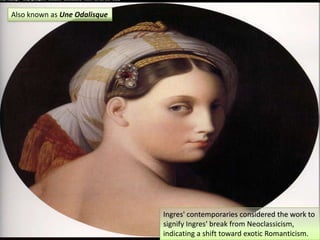
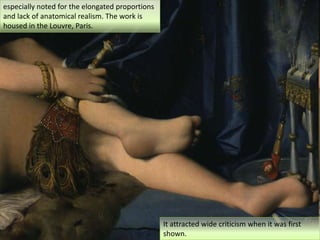
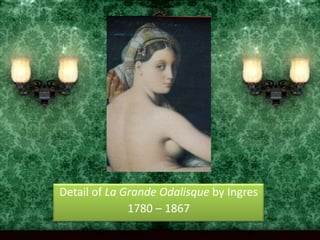
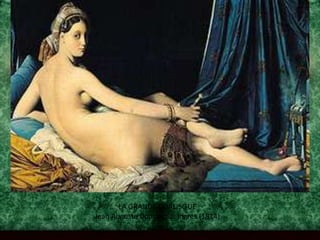
LA GRANDE ODALISQUEJean Auguste Dominique Ingres (1814)
Also known as Une OdalisqueIngres' contemporaries considered the work to signify Ingres' break from Neoclassicism, indicating a shift toward exotic Romanticism.
especially noted for the elongated proportions and lack of anatomical realism. The work is housed in the Louvre, Paris.It attracted wide criticism when it was first shown.
Odalisque(Turkish: Odalık) A female slave in an Ottoman seraglio.An assistant or apprentice to the concubines and wives, and she might rise in status to become one of them. Most odalisques were part of the Imperial Harem, that is, the household of the sultan.
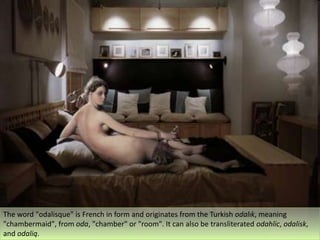
The word "odalisque" is French in form and originates from the Turkish odalık, meaning "chambermaid", from oda, "chamber" or "room". It can also be transliterated odahlic, odalisk, and odaliq.
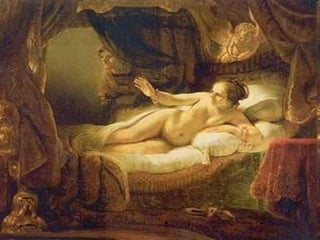
Danae By Rembrandt
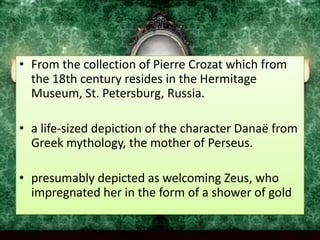
Fromthe collection of Pierre Crozat which from the 18th century resides in the Hermitage Museum, St. Petersburg, Russia.
a life-sized depiction of the character Danaëfrom Greek mythology, the mother of Perseus.
presumably depicted as welcoming Zeus, who impregnated her in the form of a shower of gold Given that this is one of Rembrandt's most magnificent paintings, it is not out of the question that he cherished it, but it also may have been difficult to sell because of its eight-by-ten-foot size.Although the artist's wife Saskia was the original model for Danaë, Rembrandt later changed the figure's face to that of his mistress GeertjeDircx.
Recurring Images
Helen Fourment in a Fur Coat by Rubens1577 - 1640
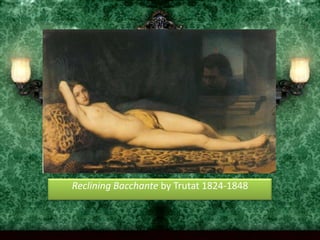
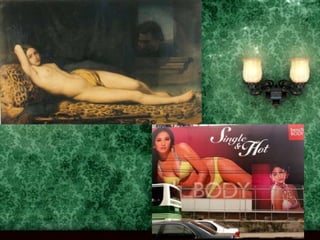
Reclining Bacchante by Trutat1824-1848
Nell Gwynne by Lely 1618-1680
The Judgment of Paris by Rubens
Luncheon on the GrassEduard Manet (1863)
Detail of La Grande Odalisque by Ingres1780 – 1867
Bacchus, Ceres and Cupid by Von Aachen1552 - 1615

Nude versus naked one

  • 1.
  • 3.
  • 4.
    The Judgment ofParis by Rubens
  • 5.
    The Judgment ofParis (engraving)Marcantonio Raimondi
  • 6.
    Luncheon on theGrassEduard Manet (1863)
  • 7.
    Manet was payingtribute to Europe's artistic heritage, borrowing his subject from the Concert Champêtrea painting by Titian attributed at the time to Giorgione (Louvre) and taking his inspiration for the composition of the central group from the Marcantonio Raimondi engraving after Raphael's Judgement of Paris. But the classical references were counterbalanced by Manet's boldness.
  • 8.
    The presence ofa nude woman among clothed men is justified neither by mythological nor allegorical precedents. This, and the contemporary dress, rendered the strange and almost unreal scene obscene in the eyes of the public of the day. Manet himself jokingly nicknamed his painting "la partiecarrée".
  • 9.
    Fall and Expulsionfrom Paradiseby POL DE LIMBOURG
  • 10.
    ADAM AND EVEBYMABUSE (EARLY 16TH CENTURY)
  • 11.
    Susannah and theElders by Tintoretto
  • 12.
    Susannah and theElders by Tintoretto,1518 - 1594
  • 13.
  • 14.
    Nell Gwynne byLely 1618-1680
  • 16.
  • 17.
    A bronze ofKali seated in intercourse with the corpse-image of Shiva. Rajasthan, 18th Century
  • 18.
    Shows a closeembrace between Vishnu and Lakshmi(based on the high crown on Vishnu's head). Sculpted in Khajuraho during the ChandellaDynasty (11th century). Lakshmi and Narayana
  • 19.
  • 20.
    The Mochicans hadno taboos when it came to privacy and were therefore free to portray the male and female genitalia within a cultural context.
  • 21.
  • 22.
    HELENE FOURMENT IN A FUR COATBY RUBENS1577-1640
  • 23.
    Sir Peter PaulRubens(28 June 1577 – 30 May 1640) A prolific seventeenth-century Flemish Baroque painter, and a proponent of an extravagant Baroque style that emphasized movement, color, and sensuality. Well-known for his Counter-Reformation altarpieces, portraits, landscapes, and history paintings of mythological and allegorical subjects.
  • 24.
    In addition torunning a large studio in Antwerp that produced paintings popular with nobility and art collectors throughout Europe, Rubens was a classically educated humanist scholar, art collector, and diplomat who was knighted by both Philip IV, King of Spain, and Charles I, King of England.
  • 25.
  • 26.
    VENUS, CUPID TIMEAND LOVEBY BRONZINO
  • 30.
    BACCHUS, CERES ANDCUPID BY VON AACHEN
  • 31.
    BacchusRoman god ofwine and intoxication, equated with the Greek Dionysus.
  • 32.
    His festival wascelebrated on March 16 and 17.
  • 33.
    The Bacchanalia, orgiesin honor of Dionysus, were introduced in Rome around 200 BCE.
  • 34.
    These infamous celebrations,notorious for their sexual and criminal character, got so out of hand that they were forbidden by the Roman Senate in 186 BCE.
  • 35.
    Bacchus is alsoidentified with the old-Italian god Liber. Ceresthe goddess of growing plants (particularly cereals) and of motherly love.worshipped in Ancient Roman religion, usually equated with the Greek goddess Demeterthe daughter of Saturn and Ops, wife-sister of Jupiter, mother of Proserpina by Jupiter and sister of Juno, Vesta, Neptune and Pluto.depicted conventionally with a scepter, a basket of flowers and fruit, and a garland made of corn ears. made up a trinity with Liber and Libera, who were two other agricultural gods.
  • 36.
    CupidRoman god oflove and the son of Venus.a small, winged boy, blindfolded, carrying bow and arrows.also portrayed as a young man with his beloved Psyche, with Venus or with a small group of winged infants (the Amoretti or Amorini).also known by another one of his Latin names, Amor and is equated with the Greek god Eros.
  • 37.
  • 38.
    William-AdolpheBouguereau(November 30, 1825– August 19, 1905) French academic painter. Bouguereau was a traditionalist whose realistic genre paintings and mythological themes were modern interpretations of Classical subjects with a heavy emphasis on the female human body.Although he created an idealized world, his almost photo-realistic style was popular with rich art patrons. Was very famous in his time but today his subject matter and technique receive relatively little attention compared to the popularity of the Impressionists.
  • 39.
  • 40.
    Man Drawing aReclining Woman by Dürer1477 - 1528
  • 41.
    The Venus ofUrbino by Titian C 1487-1576
  • 42.
    The Venus ofUrbino is a 1538 oil painting by the Italian master Titian. It depicts a nude young woman, identified with the goddess Venus, reclining on a couch or bed in the sumptuous surroundings of a Renaissance palace. It hangs in the Galleria degli Uffizi in Florence.
  • 43.
    Titan has domesticatedVenus by moving her to an indoor setting, engaging her with the viewer, and making her sensuality explicit. Devoid of any classical or allegorical trappings, Venus displays none of the attributes of the goddess she is supposed to represent. The painting is unapologetically erotic.
  • 44.
    In the nearbackground is a dog, often a symbol of either fidelity or sexual profligacy; that the animal is asleep hints that the woman portrayed is unfaithful.
  • 45.
    The painting wascommissioned by the Duke of Urbino, possibly to celebrate his 1534 marriage. The maids in the background are shown rummaging through a similar chest, apparently in search of Venus's clothes. Curiously, given its overtly erotic content, the painting was intended as an instructive "model" for Giulia Varano, the Duke's extremely young bride.
  • 46.
    In her righthand she holds a posy of roses.
  • 47.
    Her left coversher groin, provocatively placed in the centre of the composition.
  • 48.
    The frankness ofVenus's expression is often noted; she stares straight at the viewer, unconcerned with her nudity
  • 49.
    Inspired by Titianand Giorgione’s SLEEPING VENUS
  • 50.
    Olympia by Manet(1832-1883)
  • 51.
    The painting wasinspired by Titian's Venus of Urbino, which in turn refers to Giorgione's Sleeping Venus.Comparison is also made to Ingres' La grande Odalisque (1814). Unlike other artists, Manet did not depict a goddess or an odalisque but a high-class prostitute waiting for a client.
  • 52.
    LA MAJA DESNUDABY GOYAThe classic work that most closely resembles Manet's in character is Francisco Goya’s La majadesnuda (c. 1800).
  • 53.
    What shocked contemporaryaudiences was not Olympia's nudity, nor even the presence of her fully clothed maid, but her confrontational gaze and a number of details identifying her as a demi-mondaine or courtesan.
  • 54.
    The orchid inher hair, her bracelet, pearl earrings and the oriental shawl on which she lies are symbols of wealth and sensuality. The black ribbon around her neck, in stark contrast with her pale flesh, and her cast-off slipper underline the voluptuous atmosphere.
  • 55.
    OlympiaVenusWhereas Titian's Venusdelicately covers her sex, Olympia's hand firmly protects hers, as if to emphasize her independence and sexual dominance over men.
  • 56.
    Manet replaced thelittle dog (symbol of fidelity) in Titian's painting with a black cat, which symbolized prostitution.
  • 57.
    Olympia disdainfully ignoresthe flowers presented to her by her servant, probably a gift from a client. Some have suggested that she is looking in the direction of the door, as her client barges in unannounced.
  • 58.
    The painting deviatesfrom the academic canon in its style, characterized by broad, quick brushstrokes, studio lighting that eliminates mid-tones, large color surfaces and shallow depth. Instead of a smooth idealised nude, as in AlexandreCabanel'sLa naissance de Vénus(also painted in 1863), Manet painted a realwoman, whose nakedness is revealed in all its brutality by the harsh light.The model, VictorineMeurent, went on to become an accomplished painter in her own right.
  • 59.
    THE BIRTH OFVENUS BY CABANEL (1863)
  • 60.
    ODALISQUE WITH ASLAVE by INGRES (842)Some pictorial precedents for a nude woman, attended by a black servant,
  • 61.
    François-Léon Benouville(Paris, March30, 1821 - February 16, 1859) ESTHER OR ODALISQUESome pictorial precedents for a nude woman, attended by a black servant,
  • 62.
    LA GRANDE ODALISQUEJeanAuguste Dominique Ingres (1814)
  • 63.
    Also known asUne OdalisqueIngres' contemporaries considered the work to signify Ingres' break from Neoclassicism, indicating a shift toward exotic Romanticism.
  • 64.
    especially noted forthe elongated proportions and lack of anatomical realism. The work is housed in the Louvre, Paris.It attracted wide criticism when it was first shown.
  • 65.
    Odalisque(Turkish: Odalık) Afemale slave in an Ottoman seraglio.An assistant or apprentice to the concubines and wives, and she might rise in status to become one of them. Most odalisques were part of the Imperial Harem, that is, the household of the sultan.
  • 66.
    The word "odalisque"is French in form and originates from the Turkish odalık, meaning "chambermaid", from oda, "chamber" or "room". It can also be transliterated odahlic, odalisk, and odaliq.
  • 67.
  • 69.
    Fromthe collection ofPierre Crozat which from the 18th century resides in the Hermitage Museum, St. Petersburg, Russia.
  • 70.
    a life-sized depictionof the character Danaëfrom Greek mythology, the mother of Perseus.
  • 71.
    presumably depicted aswelcoming Zeus, who impregnated her in the form of a shower of gold Given that this is one of Rembrandt's most magnificent paintings, it is not out of the question that he cherished it, but it also may have been difficult to sell because of its eight-by-ten-foot size.Although the artist's wife Saskia was the original model for Danaë, Rembrandt later changed the figure's face to that of his mistress GeertjeDircx.
  • 72.
  • 73.
    Helen Fourment ina Fur Coat by Rubens1577 - 1640
  • 76.
    Reclining Bacchante byTrutat1824-1848
  • 79.
    Nell Gwynne byLely 1618-1680
  • 83.
    The Judgment ofParis by Rubens
  • 86.
    Luncheon on theGrassEduard Manet (1863)
  • 87.
    Detail of LaGrande Odalisque by Ingres1780 – 1867
  • 90.
    Bacchus, Ceres andCupid by Von Aachen1552 - 1615

Editor's Notes

  • #19 Although these divine couples may sometimes spar with each other, in the end they are seen not only as loving, but as inseparable (one well-known saying is "Where Lakshmi is, there also is Narayana.“

  • #20 The great Mochica culture existed on the Northern coast of Peru between I-VI centuries. They are especially famous for their knowledge of hydraulic engineering and their amazing mastery of the art of ceramics.
  • #21 In their culture, sexuality applies to nature and is not bound to humans. For that reason, they believed that reproduction was an extension of the divine. And neither humans nor animals could be outside of it. Through the use of disproportion, the Mochicans magnified human genitals to accentuate the representation of sexuality.
  • #39 The figure's pose is based on Giorgione's Sleeping Venus (c. 1510), which Titian completed.
  • #71 Show
  • #74 Show