Roman/Greek Mythical Painting

        By Andrew Jeong
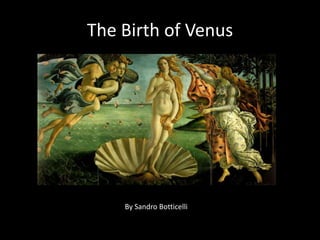
The Birth of Venus


    By Sandro Botticelli
• Oil on Canvas during Italian Renaissance
• A Roman myth relating to Venus, the goddess of
  love, which is equivalent to Aphrodite of Greek myth
• The artist wanted to portray divine love through the
  painting. By making Venus the central point of image, it
  conveys the idea of importance. Unlike the that of High
  Renaissance, this painting of the Italian Renaissance
  adopted the concept of Humanism and Botticelli
  implemented human like figure of Venus into this
  painting. All together, it tells a story of Venus born from
  divine shell all while she creates serenity, unity, and
  perfection in her surrounding.
Bibliography
• "Birth of Venus." Artble: The Home of
      Passionate Art Lovers. N.p., n.d. Web. 18
      Oct. 2012. <http://www.artble.com/
      artists/sandro_botticelli/paintings/
      birth_of_venus>.
• "Botticelli, Sandro." WebMuseum:. N.p., n.d.
      Web. 18 Oct. 2012. <http://
      www.ibiblio.org/wm/paint/auth/botticelli/
      >.
Art Hunt
 John Han
 Period B3
Title and Artist


• Title: Orpheus and Eurydice


• Artist: TizianoVecellio
The Painting
The Myth


• The Greek tragic story of Orpheus and
  Eurydice
How it’s retold


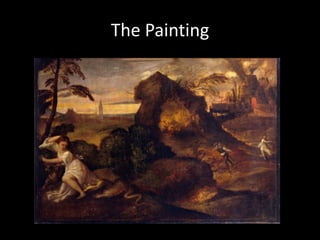
• The painting depicts two scenes from the
  myth. On the left, a serpent, shown as a
  dragon, bites Eurydice. On the right, the
  scene where Orpheus makes a mistake of
  looking back at Eurydice as they exit the
  inferno of Hades is illustrated.
Citation


Vecellio, Tiziano. Orpheus and Eurydice. 1508.
Oil on wood. The Metropolitan Museum of
Art, New York, New York.
Helen of Troy
Evelyn de Morgan
1898
The Illiad

Instead of weapons and battles, De Morgan
decides to paint Helena wearing a beautiful
pink robe and paint her beautiful face using
the artistic elements. This painting
illustrates her overwhelming beauty, which
relates to how she was very attractive to
men.

Morgan, Evelyn De. Helen of Troy. Digital
image. Web. <http://en.wikipedia.org/
         wiki/File:Helen_Of_Troy.jpg>
Medusa
Caravaggio
1597
The Illiad

In Greek mythology, Medusa is
depicted as a monster who has a ugly
face of a female attached with living
venomous snakes. Thus, this painting
lucidly illustrates the portrayal of
Medusa.

Caravaggio. Medusa. Digital
image. Web.
<http://en.wikipedia.org/wiki/File:Me
dusa.jpg>
Oedipus and the Sphinx

        Jessica Cho
      Ms. Hogshead
       World Lit A3
     October 18, 2012
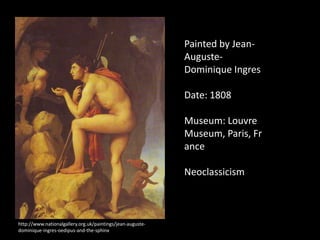
Painted by Jean-
                                                            Auguste-
                                                            Dominique Ingres

                                                            Date: 1808

                                                            Museum: Louvre
                                                            Museum, Paris, Fr
                                                            ance

                                                            Neoclassicism


http://www.nationalgallery.org.uk/paintings/jean-auguste-
dominique-ingres-oedipus-and-the-sphinx
The Myth
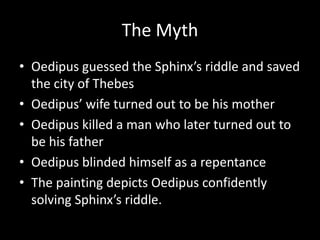
• Oedipus guessed the Sphinx’s riddle and saved
  the city of Thebes
• Oedipus’ wife turned out to be his mother
• Oedipus killed a man who later turned out to
  be his father
• Oedipus blinded himself as a repentance
• The painting depicts Oedipus confidently
  solving Sphinx’s riddle.
Pygmalion and Galatea

    Jean-Léon Gérôme

       Rachel Han
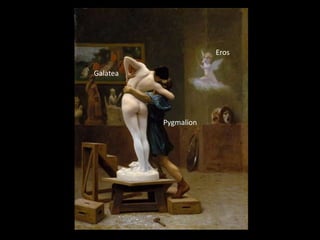
Eros

Galatea


          Pygmalion
Greek Mythology:
               Pygmalion and Galatea
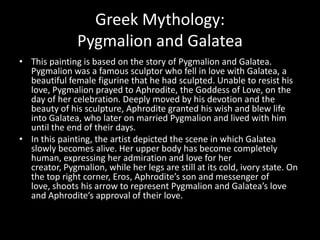
• This painting is based on the story of Pygmalion and Galatea.
  Pygmalion was a famous sculptor who fell in love with Galatea, a
  beautiful female figurine that he had sculpted. Unable to resist his
  love, Pygmalion prayed to Aphrodite, the Goddess of Love, on the
  day of her celebration. Deeply moved by his devotion and the
  beauty of his sculpture, Aphrodite granted his wish and blew life
  into Galatea, who later on married Pygmalion and lived with him
  until the end of their days.
• In this painting, the artist depicted the scene in which Galatea
  slowly becomes alive. Her upper body has become completely
  human, expressing her admiration and love for her
  creator, Pygmalion, while her legs are still at its cold, ivory state. On
  the top right corner, Eros, Aphrodite’s son and messenger of
  love, shoots his arrow to represent Pygmalion and Galatea’s love
  and Aphrodite’s approval of their love.
Works Cited:
• "Greece Myths: Pygmalion and Galatea."
  Greece Myths: Pygmalion and Galatea.
  N.p., n.d. Web. 18 Oct. 2012.
  <http://www.greeka.com/greece-
  myths/pygmalion-galatea.htm>.
• "HarvestHeart – Jean Gerome, Pygmalion and
  Galatea, Oil On..." HarvestHeart. N.p., n.d.
  Web. 18 Oct. 2012.
  <http://harvestheart.tumblr.com/post/321034
  3930>.
The
Triumph of
Galatea,RapBy Jeein Jeon
    hael
The Painting
The myth
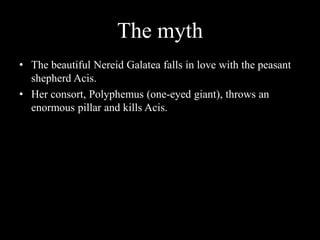
• The beautiful Nereid Galatea falls in love with the peasant
  shepherd Acis.
• Her consort, Polyphemus (one-eyed giant), throws an
  enormous pillar and kills Acis.
How is the myth retold through the
             painting?
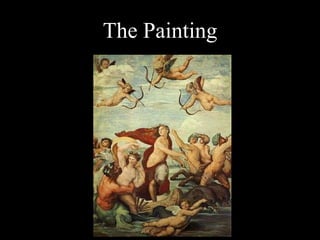
• No main events of the story
• The scene of the nymph's apotheosis
• Galatea appears surrounded by other sea creatures whose
  forms are inspired by Michelangelo
• The bright colors and decoration are inspired by ancient
  Roman paintings.
• At the left, a sturdy Triton (partly man and fish) abducts a
  sea nymph and another Triton uses a shell as a trumpet
• Galatea rides a shell-coach drawn by two dolphins
• Galatea not only resembles one human but also represents the
  ideal beauty
Works Cited
Krén, Emil, and Daniel Marx. "Web Gallery of Art, Image
Collection, Virtual Museum, Searchable Database of
European Fine Arts (1000-1850)." Web Gallery of Art,
Image Collection, Virtual Museum, Searchable
Database of European Fine Arts (1000-1850). N.p.,
n.d. Web. 18 Oct. 2012. <http://www.wga.hu/frames-
e.html?/html/r/raphael/5roma/1/05farne.html>.
Art Hunt

Nadya Kim and Lina Chang
      World Lit A1
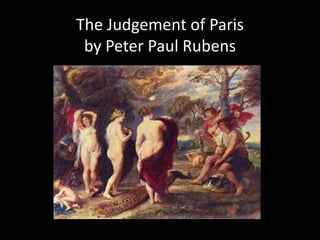
The Judgement of Paris
 by Peter Paul Rubens
The Myth
• Rubens tells the story of Paris’ judgment of
  which of the three goddesses (Venus, Juno or
  Minerva) was the most beautiful.
• Paris chose Venus and awarded her the golden
  apple
• The jealousy and fury of the goddesses were
  one of the reasons that led to the Trojan War.
How it’s retold through the painting
• Alterations show that Rubens first painted an
  earlier moment when Mercury told the
  goddesses to undress; the final stage shows Paris
  awarding the apple to Venus, who stands
  between Minerva and Juno; Mercury stands
  behind Paris and above is the Fury, Alecto.
• Paris was rescued by shepherds when he was
  young because he was prophesized that he would
  ruin the city so he was abandoned (his shepherd’s
  staff is clearly seen in the painting).
Works Cited
• Rubens, Peter Paul. Judgement of Paris. 1632-5. The National
  Gallery, Trafalgar Square, London WC2N 5DN. The National Gallery. The
  National Gallery. Web. 18 Oct. 2012.
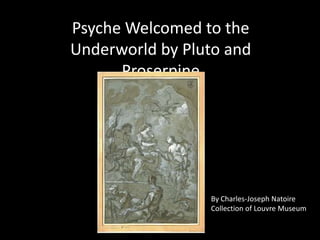
Psyche Welcomed to the
Underworld by Pluto and Proserpine
           Jane Jun-P3(B)
Psyche Welcomed to the
Underworld by Pluto and
      Proserpine


                 By Charles-Joseph Natoire
                 Collection of Louvre Museum
The myth of Eros and psyche

– -alludes to the Greek Myth of Eros and Psyche
– -This scene shows how Psyche receiving the bottle
  with a drop of Proserpine's beauty.

– -After Psyche falls in love with Eros but does not
  follow what he says, she is offered by Aphrodite to
  do certain things in order to meet Eros again. As
  one of the impossible tasks, Aphrodite demanded
  Psyche to go to the underworld to get
  Propserpine’sbeatuy.
Works Cited

• Natoire, Charles-Joseph. Psyche Welcomed to
  the Underworld by Pluto and Proserpine.
     1734-35. The Louvre, Paris.
Birth of Venus
   Hyojin kim
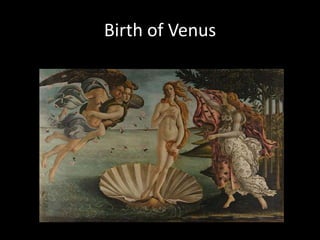
Birth of Venus
Birth of Venus
 - Title: “Birth of Venus”
- Artist: SandroBetticelli
- Myth: In myth, Venus-Aphrodite was born of sea-foam.
   Roman theology presents Venus as the yielding, watery
   female principle, essential to the generation and
   balance of life. Her male counterparts in the Roman
   pantheon, Vulcan and Mars, are active and fiery. Venus
   absorbs and tempers the male essence, uniting the
   opposite of male and female in mutual affection. She is
   essentially assimilative and benign, and embraces
   several otherwise quite disparate functions.
Birth of venus
• In Botticelli’s “Birth of Venus”, the goddess
  Venus emerges from the sea upon a shell in
  accordance with the myth that explains her
  birth. Her shell is pushed to the shore from
  the winds produced by the Zephyr wind-gods
  amid a shower of roses. As the goddess is
  about to step on the shore, one of the
  Nymphs reaches out to cover her with a
  purple cloak.
Work cited
The Birth of Venus by Sandro Botticelli

The painting depicts the scene in which Venus, the goddess of beauty and love, is born as she
arises from the foam of the sea water. After Saturn castrated his father Caelus, he threw Caelus’s
genital into the sea water. The mixture of Caelus’s blood and sea water created Venus and
prompted this miraculous birth.

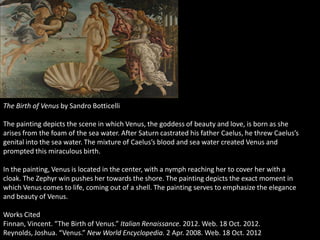
In the painting, Venus is located in the center, with a nymph reaching her to cover her with a
cloak. The Zephyr win pushes her towards the shore. The painting depicts the exact moment in
which Venus comes to life, coming out of a shell. The painting serves to emphasize the elegance
and beauty of Venus.

Works Cited
Finnan, Vincent. “The Birth of Venus.” Italian Renaissance. 2012. Web. 18 Oct. 2012.
Reynolds, Joshua. “Venus.” New World Encyclopedia. 2 Apr. 2008. Web. 18 Oct. 2012
JAMIE PARK and
  Andrew Oh’s
   Classwork
    YEAHHHHHHH
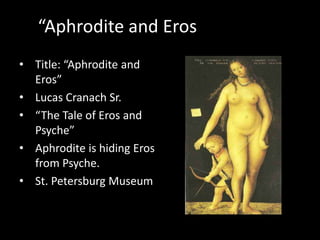
“Aphrodite and Eros
• Title: “Aphrodite and
  Eros”
• Lucas Cranach Sr.
• “The Tale of Eros and
  Psyche”
• Aphrodite is hiding Eros
  from Psyche.
• St. Petersburg Museum
Works cited
• “Greek Mythology Paintings.” iGreekmythology.

•     2009. Web. 18 October 2012.
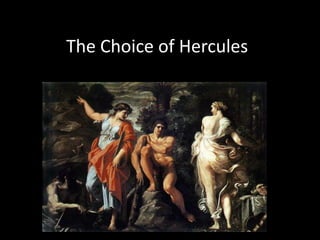
The Choice of Hercules
Art Hunt
•   Title: The Choice of Hercules
•   Artist: Annibale Carracci
•   The painting: Oil on Canvas
•   The Myth it relates to: Relates to the myth of
    the great hero, Hercules.
• How this myth is retold through the paining:
  The moment when Hercules had to choose his
  destiny. Hard journey to success or easy
  journey to no success. Left woman represents
  hard destiny and other represents easier
  destiny.
• Work cited:
  http://en.wikipedia.org/wiki/The_Choice_of_
  Hercules

Art hunt

  • 1.
  • 2.
    The Birth ofVenus By Sandro Botticelli
  • 3.
    • Oil onCanvas during Italian Renaissance • A Roman myth relating to Venus, the goddess of love, which is equivalent to Aphrodite of Greek myth • The artist wanted to portray divine love through the painting. By making Venus the central point of image, it conveys the idea of importance. Unlike the that of High Renaissance, this painting of the Italian Renaissance adopted the concept of Humanism and Botticelli implemented human like figure of Venus into this painting. All together, it tells a story of Venus born from divine shell all while she creates serenity, unity, and perfection in her surrounding.
  • 4.
    Bibliography • "Birth ofVenus." Artble: The Home of Passionate Art Lovers. N.p., n.d. Web. 18 Oct. 2012. <http://www.artble.com/ artists/sandro_botticelli/paintings/ birth_of_venus>. • "Botticelli, Sandro." WebMuseum:. N.p., n.d. Web. 18 Oct. 2012. <http:// www.ibiblio.org/wm/paint/auth/botticelli/ >.
  • 5.
    Art Hunt JohnHan Period B3
  • 6.
    Title and Artist •Title: Orpheus and Eurydice • Artist: TizianoVecellio
  • 7.
  • 8.
    The Myth • TheGreek tragic story of Orpheus and Eurydice
  • 9.
    How it’s retold •The painting depicts two scenes from the myth. On the left, a serpent, shown as a dragon, bites Eurydice. On the right, the scene where Orpheus makes a mistake of looking back at Eurydice as they exit the inferno of Hades is illustrated.
  • 10.
    Citation Vecellio, Tiziano. Orpheusand Eurydice. 1508. Oil on wood. The Metropolitan Museum of Art, New York, New York.
  • 11.
    Helen of Troy Evelynde Morgan 1898 The Illiad Instead of weapons and battles, De Morgan decides to paint Helena wearing a beautiful pink robe and paint her beautiful face using the artistic elements. This painting illustrates her overwhelming beauty, which relates to how she was very attractive to men. Morgan, Evelyn De. Helen of Troy. Digital image. Web. <http://en.wikipedia.org/ wiki/File:Helen_Of_Troy.jpg>
  • 12.
    Medusa Caravaggio 1597 The Illiad In Greekmythology, Medusa is depicted as a monster who has a ugly face of a female attached with living venomous snakes. Thus, this painting lucidly illustrates the portrayal of Medusa. Caravaggio. Medusa. Digital image. Web. <http://en.wikipedia.org/wiki/File:Me dusa.jpg>
  • 13.
    Oedipus and theSphinx Jessica Cho Ms. Hogshead World Lit A3 October 18, 2012
  • 14.
    Painted by Jean- Auguste- Dominique Ingres Date: 1808 Museum: Louvre Museum, Paris, Fr ance Neoclassicism http://www.nationalgallery.org.uk/paintings/jean-auguste- dominique-ingres-oedipus-and-the-sphinx
  • 15.
    The Myth • Oedipusguessed the Sphinx’s riddle and saved the city of Thebes • Oedipus’ wife turned out to be his mother • Oedipus killed a man who later turned out to be his father • Oedipus blinded himself as a repentance • The painting depicts Oedipus confidently solving Sphinx’s riddle.
  • 16.
    Pygmalion and Galatea Jean-Léon Gérôme Rachel Han
  • 17.
    Eros Galatea Pygmalion
  • 18.
    Greek Mythology: Pygmalion and Galatea • This painting is based on the story of Pygmalion and Galatea. Pygmalion was a famous sculptor who fell in love with Galatea, a beautiful female figurine that he had sculpted. Unable to resist his love, Pygmalion prayed to Aphrodite, the Goddess of Love, on the day of her celebration. Deeply moved by his devotion and the beauty of his sculpture, Aphrodite granted his wish and blew life into Galatea, who later on married Pygmalion and lived with him until the end of their days. • In this painting, the artist depicted the scene in which Galatea slowly becomes alive. Her upper body has become completely human, expressing her admiration and love for her creator, Pygmalion, while her legs are still at its cold, ivory state. On the top right corner, Eros, Aphrodite’s son and messenger of love, shoots his arrow to represent Pygmalion and Galatea’s love and Aphrodite’s approval of their love.
  • 19.
    Works Cited: • "GreeceMyths: Pygmalion and Galatea." Greece Myths: Pygmalion and Galatea. N.p., n.d. Web. 18 Oct. 2012. <http://www.greeka.com/greece- myths/pygmalion-galatea.htm>. • "HarvestHeart – Jean Gerome, Pygmalion and Galatea, Oil On..." HarvestHeart. N.p., n.d. Web. 18 Oct. 2012. <http://harvestheart.tumblr.com/post/321034 3930>.
  • 20.
  • 21.
  • 22.
    The myth • Thebeautiful Nereid Galatea falls in love with the peasant shepherd Acis. • Her consort, Polyphemus (one-eyed giant), throws an enormous pillar and kills Acis.
  • 23.
    How is themyth retold through the painting? • No main events of the story • The scene of the nymph's apotheosis • Galatea appears surrounded by other sea creatures whose forms are inspired by Michelangelo • The bright colors and decoration are inspired by ancient Roman paintings. • At the left, a sturdy Triton (partly man and fish) abducts a sea nymph and another Triton uses a shell as a trumpet • Galatea rides a shell-coach drawn by two dolphins • Galatea not only resembles one human but also represents the ideal beauty
  • 24.
    Works Cited Krén, Emil,and Daniel Marx. "Web Gallery of Art, Image Collection, Virtual Museum, Searchable Database of European Fine Arts (1000-1850)." Web Gallery of Art, Image Collection, Virtual Museum, Searchable Database of European Fine Arts (1000-1850). N.p., n.d. Web. 18 Oct. 2012. <http://www.wga.hu/frames- e.html?/html/r/raphael/5roma/1/05farne.html>.
  • 25.
    Art Hunt Nadya Kimand Lina Chang World Lit A1
  • 26.
    The Judgement ofParis by Peter Paul Rubens
  • 27.
    The Myth • Rubenstells the story of Paris’ judgment of which of the three goddesses (Venus, Juno or Minerva) was the most beautiful. • Paris chose Venus and awarded her the golden apple • The jealousy and fury of the goddesses were one of the reasons that led to the Trojan War.
  • 28.
    How it’s retoldthrough the painting • Alterations show that Rubens first painted an earlier moment when Mercury told the goddesses to undress; the final stage shows Paris awarding the apple to Venus, who stands between Minerva and Juno; Mercury stands behind Paris and above is the Fury, Alecto. • Paris was rescued by shepherds when he was young because he was prophesized that he would ruin the city so he was abandoned (his shepherd’s staff is clearly seen in the painting).
  • 29.
    Works Cited • Rubens,Peter Paul. Judgement of Paris. 1632-5. The National Gallery, Trafalgar Square, London WC2N 5DN. The National Gallery. The National Gallery. Web. 18 Oct. 2012.
  • 30.
    Psyche Welcomed tothe Underworld by Pluto and Proserpine Jane Jun-P3(B)
  • 31.
    Psyche Welcomed tothe Underworld by Pluto and Proserpine By Charles-Joseph Natoire Collection of Louvre Museum
  • 32.
    The myth ofEros and psyche – -alludes to the Greek Myth of Eros and Psyche – -This scene shows how Psyche receiving the bottle with a drop of Proserpine's beauty. – -After Psyche falls in love with Eros but does not follow what he says, she is offered by Aphrodite to do certain things in order to meet Eros again. As one of the impossible tasks, Aphrodite demanded Psyche to go to the underworld to get Propserpine’sbeatuy.
  • 33.
    Works Cited • Natoire,Charles-Joseph. Psyche Welcomed to the Underworld by Pluto and Proserpine. 1734-35. The Louvre, Paris.
  • 34.
    Birth of Venus Hyojin kim
  • 35.
  • 36.
    Birth of Venus - Title: “Birth of Venus” - Artist: SandroBetticelli - Myth: In myth, Venus-Aphrodite was born of sea-foam. Roman theology presents Venus as the yielding, watery female principle, essential to the generation and balance of life. Her male counterparts in the Roman pantheon, Vulcan and Mars, are active and fiery. Venus absorbs and tempers the male essence, uniting the opposite of male and female in mutual affection. She is essentially assimilative and benign, and embraces several otherwise quite disparate functions.
  • 37.
    Birth of venus •In Botticelli’s “Birth of Venus”, the goddess Venus emerges from the sea upon a shell in accordance with the myth that explains her birth. Her shell is pushed to the shore from the winds produced by the Zephyr wind-gods amid a shower of roses. As the goddess is about to step on the shore, one of the Nymphs reaches out to cover her with a purple cloak.
  • 38.
  • 39.
    The Birth ofVenus by Sandro Botticelli The painting depicts the scene in which Venus, the goddess of beauty and love, is born as she arises from the foam of the sea water. After Saturn castrated his father Caelus, he threw Caelus’s genital into the sea water. The mixture of Caelus’s blood and sea water created Venus and prompted this miraculous birth. In the painting, Venus is located in the center, with a nymph reaching her to cover her with a cloak. The Zephyr win pushes her towards the shore. The painting depicts the exact moment in which Venus comes to life, coming out of a shell. The painting serves to emphasize the elegance and beauty of Venus. Works Cited Finnan, Vincent. “The Birth of Venus.” Italian Renaissance. 2012. Web. 18 Oct. 2012. Reynolds, Joshua. “Venus.” New World Encyclopedia. 2 Apr. 2008. Web. 18 Oct. 2012
  • 40.
    JAMIE PARK and Andrew Oh’s Classwork YEAHHHHHHH
  • 41.
    “Aphrodite and Eros •Title: “Aphrodite and Eros” • Lucas Cranach Sr. • “The Tale of Eros and Psyche” • Aphrodite is hiding Eros from Psyche. • St. Petersburg Museum
  • 42.
    Works cited • “GreekMythology Paintings.” iGreekmythology. • 2009. Web. 18 October 2012.
  • 43.
    The Choice ofHercules
  • 44.
    Art Hunt • Title: The Choice of Hercules • Artist: Annibale Carracci • The painting: Oil on Canvas • The Myth it relates to: Relates to the myth of the great hero, Hercules.
  • 45.
    • How thismyth is retold through the paining: The moment when Hercules had to choose his destiny. Hard journey to success or easy journey to no success. Left woman represents hard destiny and other represents easier destiny. • Work cited: http://en.wikipedia.org/wiki/The_Choice_of_ Hercules