CONSOLIDATION BY SAND DRAINS
Guided By DR. Ramendu Bikas Sahu
Civil Engineering Department
Jadavpur University Kolkata
Presented By – Manish Kumar
BCE-IV B2
001910401142
Contents
• Introduction
• Consolidation Of Soil.
• Popular Theory
• Recent Researches.
• Numerical Approach
• Objective
• Observation
• Conclusion
• References
Introduction
• Soils are deposited or formed under differentenvironmental conditions.
• Man does not have any control on the process of soilformation.
• So, we need to accept them as they are and any construction has to be adapted to suit
the subsoil consideration
• The existing soil at a given site may not be suitable for supporting structures like
buildings, bridges, dams etc. because of safe bearing capacity of soil may not be
adequate to support the provided load.
• Although pile foundations may be adapted in some situations, which often became
too high for low to medium rise buildings.
Consolidation of Soil
Consolidation is a process by which soils decrease involume .
According to "Karl von Terzaghi" consolidation is any process which involves a decrease in water content of saturated
soil without replacement of water by air.
• In general it is the process in which reduction in volume takes place by expulsion of water under long term static loads.
• It occurs when stress is applied to a soil that causes thesoil particles to pack together more tightly, therefore reducing its bulk volume
• When this occurs in a soil that is saturated with water, water will be squeezed out of the soil.
• When stress is removed from a consolidated soil, the soil will rebound, regaining some of the volume it hadlost in the consolidation process.
• If the stress is reapplied, the soil will consolidate again along a recompression curve, defined by therecompression index.
Sand Drains
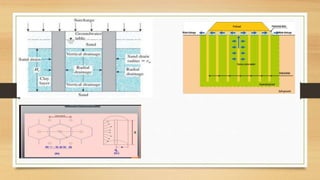
• In Order To Accelerate The Process Of Consolidation Settlement For The Construction Of Some Structure,
The Useful Technique Of Building Sand Drains Can Be Used. Sand Drains Are Constructed By Driving
Down Casings Or Hollow Mandrels Into The Soil.
• The Holes Are Then Filled With Sand, After Which the Casings Are Parallel Out
• When A Surcharge Is Applied At Ground Surface, The Pore Water Pressure In The Clay Will Increase, And
There Will Be Drainage In The Vertical And Horizontal Directions.
• The Horizontal Drainage Is Induced By The SandDrains.
• Hence, The Process Of Dissipation Of Excess Pore Water Pressure Created By The Loading (And Hence
The Settlement) Is Accelerated
Recent Researches
Nogami & Li (2003)
"Consolidation Of Clay With A System Of VerticalAnd Horizontal Drains.“
• Consolidation behaviour with the drain system isformulated using the transfer matrix method
• Care is given to formulation of thin pervious layersfor efficient computation
• Can handle the inhomogeneous profile in clay andmultiple horizontal drains made of either thin sand layers or geotextile sheets
• Developed formulation is verified using availablenumerical and field information
Indraratna et. al. (2008)
“Analytical And Numerical Modelling Of Consolidation By Vertical Drain Beneath a Circular Embankment”
• Consolidation by vertical drains below a circular loaded area where the system of vertical drains in the field was transformed
by a series of equivalentconcentric cylindrical drain walls.
• An equivalent value for the coefficient of permeability of the soil is obtained by matching the degree of consolidation of a unit
cell model.
Hsu et. al. (2013)
“ Consolidation For Radial Drainage UnderTime-dependent Loading”
• Radial drainage under linear time-dependent loading with varying loading dependent coefficients of radial
consolidation by using a visco-elastic approach
• Findings indicate that the predicted consolidation settlements accounting for the loadingrate-dependent Cr
values more closely match the experimental results than the predictions using an assumed constant Cr.
Lekha et. al. (1998)
“Consolidation Of Clay By Sand Drain UnderTime dependent Loading”
• Non Linear theory of sand drain consolidation
• Took account of effective stress/void ratio/permeability variations
• Closed form solutions are provided for the variationof pore water pressure with a time factor and load
increment ratio
• Verified with standard results for instantaneous loading, constant permeability, and constant compressibility
Numerical Approach towards study of Sand Drains
Objective:
1. Comparative analysis of consolidation times with or without sand drains
2. Finding variation of ultimate consolidation settlement with applied stress
3. Find variation of consolidation time with sand drain diameter at constant applied load
Observation
applied load
Results &Discussion
• From above table it is clear that sand drain effectively reduces the time taken for consolidation of saturated clay
for both stiff and soft clays.
• It is noticeable that as the applied stress increases the final settlement and the time taken (t1 and t2) increases
with it.
• Sand drains become less and less effective as the time of consolidation increases.
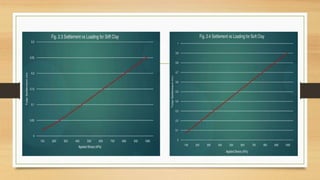
• For both stiff and soft clays , settlement steadily increase with applied load. This is in accordance wwith the
theory and intuition
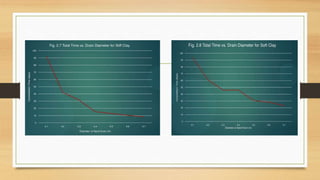
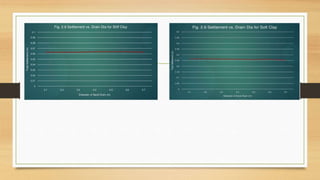
• The final settlement did not vary with the diameter of sand drains. And the time of consolidation steadily
decreases with increase in the diameter of drains. This is also in accordance with the theory
Conclusion
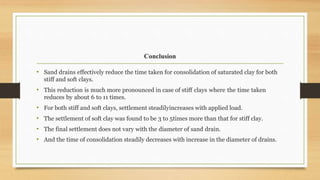
• Sand drains effectively reduce the time taken for consolidation of saturated clay for both
stiff and soft clays.
• This reduction is much more pronounced in case of stiff clays where the time taken
reduces by about 6 to 11 times.
• For both stiff and soft clays, settlement steadilyincreases with applied load.
• The settlement of soft clay was found to be 3 to 5times more than that for stiff clay.
• The final settlement does not vary with the diameter of sand drain.
• And the time of consolidation steadily decreases with increase in the diameter of drains.
References
• Hsu, T. and Liu, H. (2013). "Consolidation for Radial Drainage under Time Dependent Loading." J. Geotech. Geoenviron. Eng., 139(12),
2096–2103.
• Indraratna, B., Aljorany, A., and Rujikiatkamjorn,C. (2008). "Analytical and Numerical Modeling of Consolidation by Vertical Drain beneath
a CircularEmbankment." Int. J. Geomech., 8(3), 199–206.
• Nogami, T. and Li, M. (2003). "Consolidation of Clay with a System of Vertical and Horizontal Drains." J. Geotech. Geoenviron. Eng., 129(9), 838–848.
• Lekha, K., Krishnaswamy, N., and Basak, P. (1998). "Consolidation of Clay by Sand Drain under Time-Dependent Loading." J. Geotech. Geoenviron. Eng.,
124(1), 91-94.
• Das, B. M. (2008). "Advanced Soil Mechanics", 5thEd., Taylor and Francis, London and New York.
• Tan, S. (1993). "Ultimate Settlement by HyperbolicPlot for Clays with Vertical Drains." J. Geotech. Engrg., 119(5), 950-956
• Leo, C. (2004). "Equal Strain Consolidation by Vertical Drains." J. Geotech. Geoenviron. Eng., 130(3), 316–327.
THANK YOU !!

MAJOR_PROJECT_PPT_BY_MANISH KUMAR 001910401142.pptx

  • 1.
    CONSOLIDATION BY SANDDRAINS Guided By DR. Ramendu Bikas Sahu Civil Engineering Department Jadavpur University Kolkata Presented By – Manish Kumar BCE-IV B2 001910401142
  • 2.
    Contents • Introduction • ConsolidationOf Soil. • Popular Theory • Recent Researches. • Numerical Approach • Objective • Observation • Conclusion • References
  • 3.
    Introduction • Soils aredeposited or formed under differentenvironmental conditions. • Man does not have any control on the process of soilformation. • So, we need to accept them as they are and any construction has to be adapted to suit the subsoil consideration • The existing soil at a given site may not be suitable for supporting structures like buildings, bridges, dams etc. because of safe bearing capacity of soil may not be adequate to support the provided load. • Although pile foundations may be adapted in some situations, which often became too high for low to medium rise buildings.
  • 4.
    Consolidation of Soil Consolidationis a process by which soils decrease involume . According to "Karl von Terzaghi" consolidation is any process which involves a decrease in water content of saturated soil without replacement of water by air. • In general it is the process in which reduction in volume takes place by expulsion of water under long term static loads. • It occurs when stress is applied to a soil that causes thesoil particles to pack together more tightly, therefore reducing its bulk volume • When this occurs in a soil that is saturated with water, water will be squeezed out of the soil. • When stress is removed from a consolidated soil, the soil will rebound, regaining some of the volume it hadlost in the consolidation process. • If the stress is reapplied, the soil will consolidate again along a recompression curve, defined by therecompression index.
  • 5.
    Sand Drains • InOrder To Accelerate The Process Of Consolidation Settlement For The Construction Of Some Structure, The Useful Technique Of Building Sand Drains Can Be Used. Sand Drains Are Constructed By Driving Down Casings Or Hollow Mandrels Into The Soil. • The Holes Are Then Filled With Sand, After Which the Casings Are Parallel Out • When A Surcharge Is Applied At Ground Surface, The Pore Water Pressure In The Clay Will Increase, And There Will Be Drainage In The Vertical And Horizontal Directions. • The Horizontal Drainage Is Induced By The SandDrains. • Hence, The Process Of Dissipation Of Excess Pore Water Pressure Created By The Loading (And Hence The Settlement) Is Accelerated
  • 7.
    Recent Researches Nogami &Li (2003) "Consolidation Of Clay With A System Of VerticalAnd Horizontal Drains.“ • Consolidation behaviour with the drain system isformulated using the transfer matrix method • Care is given to formulation of thin pervious layersfor efficient computation • Can handle the inhomogeneous profile in clay andmultiple horizontal drains made of either thin sand layers or geotextile sheets • Developed formulation is verified using availablenumerical and field information Indraratna et. al. (2008) “Analytical And Numerical Modelling Of Consolidation By Vertical Drain Beneath a Circular Embankment” • Consolidation by vertical drains below a circular loaded area where the system of vertical drains in the field was transformed by a series of equivalentconcentric cylindrical drain walls. • An equivalent value for the coefficient of permeability of the soil is obtained by matching the degree of consolidation of a unit cell model.
  • 8.
    Hsu et. al.(2013) “ Consolidation For Radial Drainage UnderTime-dependent Loading” • Radial drainage under linear time-dependent loading with varying loading dependent coefficients of radial consolidation by using a visco-elastic approach • Findings indicate that the predicted consolidation settlements accounting for the loadingrate-dependent Cr values more closely match the experimental results than the predictions using an assumed constant Cr. Lekha et. al. (1998) “Consolidation Of Clay By Sand Drain UnderTime dependent Loading” • Non Linear theory of sand drain consolidation • Took account of effective stress/void ratio/permeability variations • Closed form solutions are provided for the variationof pore water pressure with a time factor and load increment ratio • Verified with standard results for instantaneous loading, constant permeability, and constant compressibility
  • 9.
    Numerical Approach towardsstudy of Sand Drains Objective: 1. Comparative analysis of consolidation times with or without sand drains 2. Finding variation of ultimate consolidation settlement with applied stress 3. Find variation of consolidation time with sand drain diameter at constant applied load
  • 10.
  • 11.
    Results &Discussion • Fromabove table it is clear that sand drain effectively reduces the time taken for consolidation of saturated clay for both stiff and soft clays. • It is noticeable that as the applied stress increases the final settlement and the time taken (t1 and t2) increases with it. • Sand drains become less and less effective as the time of consolidation increases. • For both stiff and soft clays , settlement steadily increase with applied load. This is in accordance wwith the theory and intuition • The final settlement did not vary with the diameter of sand drains. And the time of consolidation steadily decreases with increase in the diameter of drains. This is also in accordance with the theory

  • 15.
    Conclusion • Sand drainseffectively reduce the time taken for consolidation of saturated clay for both stiff and soft clays. • This reduction is much more pronounced in case of stiff clays where the time taken reduces by about 6 to 11 times. • For both stiff and soft clays, settlement steadilyincreases with applied load. • The settlement of soft clay was found to be 3 to 5times more than that for stiff clay. • The final settlement does not vary with the diameter of sand drain. • And the time of consolidation steadily decreases with increase in the diameter of drains.

  • 16.
    References • Hsu, T.and Liu, H. (2013). "Consolidation for Radial Drainage under Time Dependent Loading." J. Geotech. Geoenviron. Eng., 139(12), 2096–2103. • Indraratna, B., Aljorany, A., and Rujikiatkamjorn,C. (2008). "Analytical and Numerical Modeling of Consolidation by Vertical Drain beneath a CircularEmbankment." Int. J. Geomech., 8(3), 199–206. • Nogami, T. and Li, M. (2003). "Consolidation of Clay with a System of Vertical and Horizontal Drains." J. Geotech. Geoenviron. Eng., 129(9), 838–848. • Lekha, K., Krishnaswamy, N., and Basak, P. (1998). "Consolidation of Clay by Sand Drain under Time-Dependent Loading." J. Geotech. Geoenviron. Eng., 124(1), 91-94. • Das, B. M. (2008). "Advanced Soil Mechanics", 5thEd., Taylor and Francis, London and New York. • Tan, S. (1993). "Ultimate Settlement by HyperbolicPlot for Clays with Vertical Drains." J. Geotech. Engrg., 119(5), 950-956 • Leo, C. (2004). "Equal Strain Consolidation by Vertical Drains." J. Geotech. Geoenviron. Eng., 130(3), 316–327.
  • 17.