International Marketing Strategy Positions
Samsung as a Global Leader in Electronics
F. Ming
Marketing 6000
Dr. Thomas Kohler
F o r o v e r s e v e n t y y e a r s , S a m s u n g h a s b e e n d e d i c a t e d
t o m a k i n g a b e t t e r w o r l d t h r o u g h d i v e r s e b u s i n e s s e s
t h a t t o d a y s p a n a d v a n c e d t e c h n o l o g y ,
s e m i c o n d u c t o r s , s k y s c r a p e r a n d p l a n t c o n s t r u c t i o n ,
p e t r o c h e m i c a l s , f a s h i o n , m e d i c i n e , f i n a n c e , h o t e l s ,
a n d m o r e . T h e i r f l a g s h i p c o m p a n y , S a m s u n g
E l e c t r o n i c s , l e a d s t h e g l o b a l m a r k e t i n h i g h - t e c h
e l e c t r o n i c s m a n u f a c t u r i n g a n d d i g i t a l m e d i a .
T h r o u g h i n n o v a t i v e , r e l i a b l e p r o d u c t s a n d s e r v i c e s ,
t a l e n t e d p e o p l e ; a r e s p o n s i b l e a p p r o a c h t o b u s i n e s s
a n d g l o b a l c i t i z e n s h i p ; a n d c o l l a b o r a t i o n w i t h o u t
p a r t n e r s a n d c u s t o m e r s , S a m s u n g i s t a k i n g t h e w o r l d
i n i m a g i n a t i v e n e w d i r e c t i o n s .
s a m s u n g . c o m
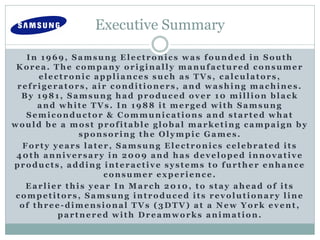
Executive Summary
In 1969, Samsung Electronics was founded in South
Korea. The company originally manufactured consumer
electronic appliances such as TVs, calculators,
refrigerators, air conditioners, and washing machines.
By 1981, Samsung had produced over 10 million black
and white TVs. In 1988 it merged with Samsung
Semiconductor & Communications and started what
would be a most profitable global marketing campaign by
sponsoring the Olympic Games.
Forty years later, Samsung Electronics celebrated its
40th anniversary in 2009 and has developed innovative
products, adding interactive systems to further enhance
consumer experience.
Earlier this year In March 2010, to stay ahead of its
competitors, Samsung introduced its revolutionary line
of three-dimensional TVs (3DTV) at a New York event,
partnered with Dreamworks animation.
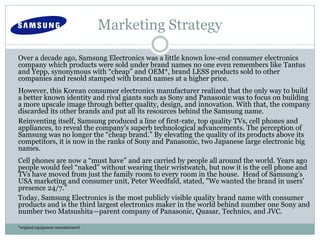
Marketing Strategy
Over a decade ago, Samsung Electronics was a little known low-end consumer electronics
company which products were sold under brand names no one even remembers like Tantus
and Yepp, synonymous with ―cheap‖ and OEM*, brand LESS products sold to other
companies and resold stamped with brand names at a higher price.
However, this Korean consumer electronics manufacturer realized that the only way to build
a better known identity and rival giants such as Sony and Panasonic was to focus on building
a more upscale image through better quality, design, and innovation. With that, the company
discarded its other brands and put all its resources behind the Samsung name.
Reinventing itself, Samsung produced a line of first-rate, top quality TVs, cell phones and
appliances, to reveal the company's superb technological advancements. The perception of
Samsung was no longer the ―cheap brand.‖ By elevating the quality of its products above its
competitors, it is now in the ranks of Sony and Panasonic, two Japanese large electronic big
names.
Cell phones are now a ―must have‖ and are carried by people all around the world. Years ago
people would feel ―naked‖ without wearing their wristwatch, but now it is the cell phone and
TVs have moved from just the family room to every room in the house. Head of Samsung’s
USA marketing and consumer unit, Peter Weedfald, stated, "We wanted the brand in users'
presence 24/7.‖
Today, Samsung Electronics is the most publicly visible quality brand name with consumer
products and is the third largest electronics maker in the world behind number one Sony and
number two Matsushita—parent company of Panasonic, Quasar, Technics, and JVC.
*original equipment manufactured
Marketing Strategy
Make Your Presence Known 24/7
In order to be a powerhouse electronic company, Samsung needed to change
its brand image. When Seoul, Korea was host for the 1988 Summer Olympic
Games the time was ripe for Samsung to showcase its products by associating
its company with this international sporting event.
Samsung became the official sponsor of wireless technology for the Olympic
Games, just as Omega was and has been the official timekeeper. With over a
thousand athletes from 200 or more countries competing, plus tens of
thousands of workers, and hundreds of millions of attendees and viewers, this
certainly amplified the company’s image.
In 1999, American-Korean, Erick Kim, ―marketing miracle man,‖ started
working with Samsung and eventually became the head of Samsung’s global
marketing department. Within a few years, Samsung’s cell phones and flat-
panel TVs were consumer favorites because Kim focused on partnering with
Best Buy, a top U.S. retailer of electronic goods.
business.goldsea.com
Mass Marketing
Marketers report a number of reasons to sponsor events:
 Identify with a particular target market or lifestyle
 Increase awareness of company or product name
 Create or reinforce perceptions of key brand image
 Enhance corporate image
 Create experiences and evoke feelings
 Express commitment to the community or on social issues
 Entertain key clients or reward key employees
 Permit merchandising or promotional opportunities
Kotler & Keller
Omega has had a long and close
relationship with the Olympic
Games as official timekeeper.
Since 1932 the brand has defined
sports timekeeping through its
accurate timing of 24 Olympic
Games and its sponsorship
continues until the year 2020.
omegawatches.com
Marketing Sponsorship
Samsung’s involvement with the Olympic Games
began in 1988, when it became a local sponsor for
the Seoul 1988 Olympic Summer Games. In 1997,
the company then became a member of The Olympic
Partner (TOP), Worldwide Olympic Partner in the
wireless communications equipment category,
continuing its contribution to the Olympic
Movement for five consecutive Olympic Games.
Through its advanced wireless telecommunication
technology and products, Samsung is recognized for
providing the Games with crucial, real-time
information service in support of the world's largest
sporting event. Samsung is proud to carry on its
Olympic partnership through the 2016 Olympic
Games.
vancouver2010.com
Olympic Sponsors
Social media measurement programs are custom and unique for each company
depending on their business objectives. Monitoring brands is a measurement project
that is reported to the client. In the above graph, Cymfony, a research company that
provides expert marketing analysis tracks the shares of Olympic sponsorship.
cymfony.com
google.com
Samsung Creating Experiences
Luxury C0-Branding
Samsung’s Armani Smartphone
In the fall of 2009, Samsung Electronics and
Giorgio Armani released their premium
smartphone. It was designed by the world
renowned Italian fashion designer to the rich
and famous, Giorgio Armani and Samsung
Features: Samsung Giorgio Armani B7620
Unlocked Windows Mobile Smartphone
Quad-Band GSM with Full QWERTY
keyboard, Touchscreen, 5MP camera, GPS
navigation and Wi-Fi - International Version
with No Warranty (Bronze).
List price: $999.99
Amazon Price: $849.99
A luxury smartphone that looks like a piece of
jewelry is very eye catching. One can only
imagine Samsung’s next partner—Mercedes
Benz of DaimlerAG or maybe even Rolls
Royce!
image: google.comsmartphone info: amazon.com
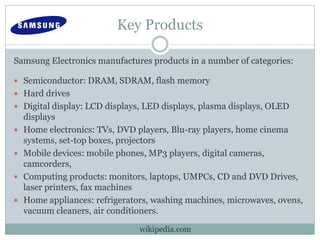
Key Products
Samsung Electronics manufactures products in a number of categories:
 Semiconductor: DRAM, SDRAM, flash memory
 Hard drives
 Digital display: LCD displays, LED displays, plasma displays, OLED
displays
 Home electronics: TVs, DVD players, Blu-ray players, home cinema
systems, set-top boxes, projectors
 Mobile devices: mobile phones, MP3 players, digital cameras,
camcorders,
 Computing products: monitors, laptops, UMPCs, CD and DVD Drives,
laser printers, fax machines
 Home appliances: refrigerators, washing machines, microwaves, ovens,
vacuum cleaners, air conditioners.
wikipedia.com
Evolution of the TV
circa 1970s – black and white TV
circa 1980s – color TV
circa 1990s – color projection TV
google.com
Samsung’s 3DTV
Cinema-quality 3D experience 3-Dimensional TVs add new depth and dimension to create
larger-than-life experiences. 3D Active Glasses sync up with the 3D TV to produce 3D
images that virtually leap off the screen. Favorite shows can even be transformed to 3D in
real time for the ultimate "reality" TV.
samsung.com
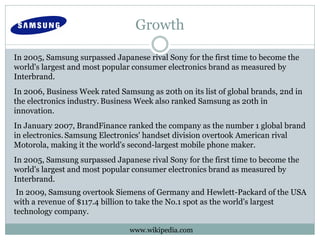
Growth
In 2005, Samsung surpassed Japanese rival Sony for the first time to become the
world's largest and most popular consumer electronics brand as measured by
Interbrand.
In 2006, Business Week rated Samsung as 20th on its list of global brands, 2nd in
the electronics industry. Business Week also ranked Samsung as 20th in
innovation.
In January 2007, BrandFinance ranked the company as the number 1 global brand
in electronics. Samsung Electronics' handset division overtook American rival
Motorola, making it the world's second-largest mobile phone maker.
In 2005, Samsung surpassed Japanese rival Sony for the first time to become the
world's largest and most popular consumer electronics brand as measured by
Interbrand.
In 2009, Samsung overtook Siemens of Germany and Hewlett-Packard of the USA
with a revenue of $117.4 billion to take the No.1 spot as the world's largest
technology company.
www.wikipedia.com
Samsung held on to the top spot in the
broader category of flat-panel TVs,
thanks in part to its strength in plasma
as well as LCD-based TVs. Samsung's
U.S. flat-panel television shipments
rose to 6.6 million units in 2009, up
22.6 percent from 5.4 million units in
2008, giving the Korean giant a 18.4
percent market share down from 18.5
percent in 2008.
eetimes.com
Vision 2020
samsung.com
Strategy Analysis
 Positioning – is the act of designing the company’s
offering and image to occupy a distinctive place in
the minds of the target market.
 Samsung changed its image, creating an elliptical logo
symbolizing the world moving through space and writing
―Samsung‖ in English to expand its global presence.
 Targeted certain type of sports-minded consumers on an
international level by sponsoring the Olympic Games and
other sporting events in various countries.
 Targeted consumers attracted to prestige, quality and wealth
by partnering with Giorgio Armani.
Strategy Analysis
 Competitive advantage is a company’s ability to
perform in one or more ways that competitors
cannot or will not match.
 Samsung manufactures everything from air conditioners to cell
phones to hard disk drives to vacuum cleaners. They produce
the whole gamut of products related to electronics.
 Samsung refrigerators are top of the line and comparable to
companies whose main products are kitchen applicances like
KitchenAid, Maytag, and Jenn-Air.
 Samsung’s newest product is the 3DTV that one revolutionary
step above the plasma, LED, and LCD television screens.
Strategy Analysis
 Product Life-Cycle – a company’s positioning and
differentiation strategy must change as the product,
market, and competitors change.
 Samsung comes out with a new cell phone every few months
that is the latest rave. Samsung’s Galaxy S which is the first
smartphone to qualify for point-to-point Wi-Fi
communications.
 For fashion-minded consumers, the Giorgio Armani –
Samsung Slide is the most gorgeous smartphone produced. Its
bronze color will match any outfit in any occasion.
 Though critics are saying that the 3DTV is just a novelty or fad,
to experience viewing it is an unforgettable feeling. Consumers
are ready for the 3-D effect after having seen many hit movies
in 3-D.
Strategy Analysis
 Competition – a good way to start to deal with it is
through creatively designed and well-executed
marketing programs.
 Samsung knew who their competitors were: Sony and
Panasonic, the two Japanese electronic kings. With emerging
competitors, they had to stay one-step ahead of the game.
 By analyzing their competitors in the electronics market,
Samsung put more into research and development to produce
high quality and eye-catching television sets and major home
appliances, appealing to the consumer’s senses through
functionality and looks.
Strategy Analysis
 Market-Challenger Strategy – Challengers set high
aspirations.
 Samsung may not be the industry leader for all their products,
with the exception of the cell phone and the TV, but they
continue to try and edge out its competitors with innovative
products.
 Samsung seems to attack the market leader head on, matching,
if not surpassing its opponent’s product, advertising, price, and
distribution. More people buy Samsung TVs than Sony because
of the price difference. Samsung’s 3DTV is ―a technological
leader that's packed with almost every imaginable cutting-edge
advancement.‖ (consumersearch.com)
Analysis
More than a decade ago my uncle bought the cheapest VHS recorder/player on the
market—it was a Samsung. At that time it was considered the ―poor man’s Sony.‖
He told me that it lasted longer than any other brand he bought . My uncle was
retired and TV was his hobby, his passion, his life. It’s unfortunate he didn’t live
long enough to experience Samsung’s LED TV and now its innovative 3DTV.
Samsung has positioned itself as one of the world’s most recognized leaders not only
in cell phones, but in TVs and appliances. The digital age is here and Samsung is
taking every opportunity to advance in this technology to be a competitive force.
Their unwavering commitment to being the world's best and pledge to be ―better
than Sony‖ has given them the No.1 global market share for more than a dozen of
their innovative products. It’s marketing strategy proved successful by sponsoring
the Olympic Games and other sporting events, as well as partnering with electronics
giant, Best Buy and haute couture designer, Giorgio Armani.
As we end the first decade of the 21st century, Samsung has created a revolutionary
mode of entertainment that consumers will be able to experience in their own
homes—3D television. Samsung Electronics has proven that its name synonymous
with quality and progress.
Samsung Timeline
A Decade at a Glance
samsung.com
Bibliography
 ―Best Global Brands, The‖, BusinessWeek/Interbrand rank the companies that best built their images -- and made them
stick, Bloomberg Business Week.
http://www.businessweek.com/magazine/content/05_31/b3945098.htm
 Guaraldi, Vince, Charlie Brown Theme, Peanuts, 1964
 Kotler, Philip and Keller, Kevin Lane, Marketing Management, Managing Mass Communications, p521
 Osawa, Juro, Japan Realtime.
http://blogs.wsj.com/japanrealtime/2010/11/02/japan-no-longer-home-for-panasonic/?KEYWORDS=samsung
 ―Supply Glut Can't Derail Samsung‖, WSJ Online.
http://online.wsj.com/article/SB10001424052702303390704575575870793175254.html
 Samsung Values & Philosophies.
http://www.samsung.com/my/aboutsamsung/corporateprofile/valuesphilosophy.html
 Samsung Digital Timeline.
http://www.samsung.com/us/aboutsamsung/corporateprofile/history.html
 "Sony Vows Comeback Against Samsung, LG". The Korea Times.
http://koreatimes.co.kr/www/news/nation/2009/09/123_51434.html.
 ―Supply Glut Can't Derail Samsung‖, WSJ Online.
http://online.wsj.com/article/SB10001424052702303390704575575870793175254.html?KEYWORDS=samsung
 "Top 100 Global Brands Scoreboard". Business Week.
http://bwnt.businessweek.com/intera tive_reports/top_brands/index.asp.
 ―VISA 42% Share of Olympic Sponsor Discussion? NOT!‖, Cymfony.
http://blog.cymfony.com/2008/08/visa-42-share-o.html
 ―Vizio takes lead in U.S. LCD-TV Sales‖, EE Times News and Analysis.
http://www.eetimes.com/electronics-news/4087889/Vizio-takes-lead-in-U-S-LCD-TV-sales
 Worldwide Olympic Partners, Vancouver 2010.
http://www.vancouver2010.com/more-2010-information/about-vanoc/sponsors-and-
partners/vancouver-2010-sponsors/worldwide-olympic-partners/

Samsung - International Marketing Strategy

  • 1.
    International Marketing StrategyPositions Samsung as a Global Leader in Electronics F. Ming Marketing 6000 Dr. Thomas Kohler
  • 2.
    F o ro v e r s e v e n t y y e a r s , S a m s u n g h a s b e e n d e d i c a t e d t o m a k i n g a b e t t e r w o r l d t h r o u g h d i v e r s e b u s i n e s s e s t h a t t o d a y s p a n a d v a n c e d t e c h n o l o g y , s e m i c o n d u c t o r s , s k y s c r a p e r a n d p l a n t c o n s t r u c t i o n , p e t r o c h e m i c a l s , f a s h i o n , m e d i c i n e , f i n a n c e , h o t e l s , a n d m o r e . T h e i r f l a g s h i p c o m p a n y , S a m s u n g E l e c t r o n i c s , l e a d s t h e g l o b a l m a r k e t i n h i g h - t e c h e l e c t r o n i c s m a n u f a c t u r i n g a n d d i g i t a l m e d i a . T h r o u g h i n n o v a t i v e , r e l i a b l e p r o d u c t s a n d s e r v i c e s , t a l e n t e d p e o p l e ; a r e s p o n s i b l e a p p r o a c h t o b u s i n e s s a n d g l o b a l c i t i z e n s h i p ; a n d c o l l a b o r a t i o n w i t h o u t p a r t n e r s a n d c u s t o m e r s , S a m s u n g i s t a k i n g t h e w o r l d i n i m a g i n a t i v e n e w d i r e c t i o n s . s a m s u n g . c o m
  • 3.
    Executive Summary In 1969,Samsung Electronics was founded in South Korea. The company originally manufactured consumer electronic appliances such as TVs, calculators, refrigerators, air conditioners, and washing machines. By 1981, Samsung had produced over 10 million black and white TVs. In 1988 it merged with Samsung Semiconductor & Communications and started what would be a most profitable global marketing campaign by sponsoring the Olympic Games. Forty years later, Samsung Electronics celebrated its 40th anniversary in 2009 and has developed innovative products, adding interactive systems to further enhance consumer experience. Earlier this year In March 2010, to stay ahead of its competitors, Samsung introduced its revolutionary line of three-dimensional TVs (3DTV) at a New York event, partnered with Dreamworks animation.
  • 4.
    Marketing Strategy Over adecade ago, Samsung Electronics was a little known low-end consumer electronics company which products were sold under brand names no one even remembers like Tantus and Yepp, synonymous with ―cheap‖ and OEM*, brand LESS products sold to other companies and resold stamped with brand names at a higher price. However, this Korean consumer electronics manufacturer realized that the only way to build a better known identity and rival giants such as Sony and Panasonic was to focus on building a more upscale image through better quality, design, and innovation. With that, the company discarded its other brands and put all its resources behind the Samsung name. Reinventing itself, Samsung produced a line of first-rate, top quality TVs, cell phones and appliances, to reveal the company's superb technological advancements. The perception of Samsung was no longer the ―cheap brand.‖ By elevating the quality of its products above its competitors, it is now in the ranks of Sony and Panasonic, two Japanese large electronic big names. Cell phones are now a ―must have‖ and are carried by people all around the world. Years ago people would feel ―naked‖ without wearing their wristwatch, but now it is the cell phone and TVs have moved from just the family room to every room in the house. Head of Samsung’s USA marketing and consumer unit, Peter Weedfald, stated, "We wanted the brand in users' presence 24/7.‖ Today, Samsung Electronics is the most publicly visible quality brand name with consumer products and is the third largest electronics maker in the world behind number one Sony and number two Matsushita—parent company of Panasonic, Quasar, Technics, and JVC. *original equipment manufactured
  • 5.
    Marketing Strategy Make YourPresence Known 24/7 In order to be a powerhouse electronic company, Samsung needed to change its brand image. When Seoul, Korea was host for the 1988 Summer Olympic Games the time was ripe for Samsung to showcase its products by associating its company with this international sporting event. Samsung became the official sponsor of wireless technology for the Olympic Games, just as Omega was and has been the official timekeeper. With over a thousand athletes from 200 or more countries competing, plus tens of thousands of workers, and hundreds of millions of attendees and viewers, this certainly amplified the company’s image. In 1999, American-Korean, Erick Kim, ―marketing miracle man,‖ started working with Samsung and eventually became the head of Samsung’s global marketing department. Within a few years, Samsung’s cell phones and flat- panel TVs were consumer favorites because Kim focused on partnering with Best Buy, a top U.S. retailer of electronic goods. business.goldsea.com
  • 6.
    Mass Marketing Marketers reporta number of reasons to sponsor events:  Identify with a particular target market or lifestyle  Increase awareness of company or product name  Create or reinforce perceptions of key brand image  Enhance corporate image  Create experiences and evoke feelings  Express commitment to the community or on social issues  Entertain key clients or reward key employees  Permit merchandising or promotional opportunities Kotler & Keller
  • 7.
    Omega has hada long and close relationship with the Olympic Games as official timekeeper. Since 1932 the brand has defined sports timekeeping through its accurate timing of 24 Olympic Games and its sponsorship continues until the year 2020. omegawatches.com
  • 8.
    Marketing Sponsorship Samsung’s involvementwith the Olympic Games began in 1988, when it became a local sponsor for the Seoul 1988 Olympic Summer Games. In 1997, the company then became a member of The Olympic Partner (TOP), Worldwide Olympic Partner in the wireless communications equipment category, continuing its contribution to the Olympic Movement for five consecutive Olympic Games. Through its advanced wireless telecommunication technology and products, Samsung is recognized for providing the Games with crucial, real-time information service in support of the world's largest sporting event. Samsung is proud to carry on its Olympic partnership through the 2016 Olympic Games. vancouver2010.com
  • 9.
    Olympic Sponsors Social mediameasurement programs are custom and unique for each company depending on their business objectives. Monitoring brands is a measurement project that is reported to the client. In the above graph, Cymfony, a research company that provides expert marketing analysis tracks the shares of Olympic sponsorship. cymfony.com
  • 10.
  • 11.
    Luxury C0-Branding Samsung’s ArmaniSmartphone In the fall of 2009, Samsung Electronics and Giorgio Armani released their premium smartphone. It was designed by the world renowned Italian fashion designer to the rich and famous, Giorgio Armani and Samsung Features: Samsung Giorgio Armani B7620 Unlocked Windows Mobile Smartphone Quad-Band GSM with Full QWERTY keyboard, Touchscreen, 5MP camera, GPS navigation and Wi-Fi - International Version with No Warranty (Bronze). List price: $999.99 Amazon Price: $849.99 A luxury smartphone that looks like a piece of jewelry is very eye catching. One can only imagine Samsung’s next partner—Mercedes Benz of DaimlerAG or maybe even Rolls Royce! image: google.comsmartphone info: amazon.com
  • 12.
    Key Products Samsung Electronicsmanufactures products in a number of categories:  Semiconductor: DRAM, SDRAM, flash memory  Hard drives  Digital display: LCD displays, LED displays, plasma displays, OLED displays  Home electronics: TVs, DVD players, Blu-ray players, home cinema systems, set-top boxes, projectors  Mobile devices: mobile phones, MP3 players, digital cameras, camcorders,  Computing products: monitors, laptops, UMPCs, CD and DVD Drives, laser printers, fax machines  Home appliances: refrigerators, washing machines, microwaves, ovens, vacuum cleaners, air conditioners. wikipedia.com
  • 13.
    Evolution of theTV circa 1970s – black and white TV circa 1980s – color TV circa 1990s – color projection TV google.com
  • 14.
    Samsung’s 3DTV Cinema-quality 3Dexperience 3-Dimensional TVs add new depth and dimension to create larger-than-life experiences. 3D Active Glasses sync up with the 3D TV to produce 3D images that virtually leap off the screen. Favorite shows can even be transformed to 3D in real time for the ultimate "reality" TV. samsung.com
  • 15.
    Growth In 2005, Samsungsurpassed Japanese rival Sony for the first time to become the world's largest and most popular consumer electronics brand as measured by Interbrand. In 2006, Business Week rated Samsung as 20th on its list of global brands, 2nd in the electronics industry. Business Week also ranked Samsung as 20th in innovation. In January 2007, BrandFinance ranked the company as the number 1 global brand in electronics. Samsung Electronics' handset division overtook American rival Motorola, making it the world's second-largest mobile phone maker. In 2005, Samsung surpassed Japanese rival Sony for the first time to become the world's largest and most popular consumer electronics brand as measured by Interbrand. In 2009, Samsung overtook Siemens of Germany and Hewlett-Packard of the USA with a revenue of $117.4 billion to take the No.1 spot as the world's largest technology company. www.wikipedia.com
  • 16.
    Samsung held onto the top spot in the broader category of flat-panel TVs, thanks in part to its strength in plasma as well as LCD-based TVs. Samsung's U.S. flat-panel television shipments rose to 6.6 million units in 2009, up 22.6 percent from 5.4 million units in 2008, giving the Korean giant a 18.4 percent market share down from 18.5 percent in 2008. eetimes.com
  • 17.
  • 18.
    Strategy Analysis  Positioning– is the act of designing the company’s offering and image to occupy a distinctive place in the minds of the target market.  Samsung changed its image, creating an elliptical logo symbolizing the world moving through space and writing ―Samsung‖ in English to expand its global presence.  Targeted certain type of sports-minded consumers on an international level by sponsoring the Olympic Games and other sporting events in various countries.  Targeted consumers attracted to prestige, quality and wealth by partnering with Giorgio Armani.
  • 19.
    Strategy Analysis  Competitiveadvantage is a company’s ability to perform in one or more ways that competitors cannot or will not match.  Samsung manufactures everything from air conditioners to cell phones to hard disk drives to vacuum cleaners. They produce the whole gamut of products related to electronics.  Samsung refrigerators are top of the line and comparable to companies whose main products are kitchen applicances like KitchenAid, Maytag, and Jenn-Air.  Samsung’s newest product is the 3DTV that one revolutionary step above the plasma, LED, and LCD television screens.
  • 20.
    Strategy Analysis  ProductLife-Cycle – a company’s positioning and differentiation strategy must change as the product, market, and competitors change.  Samsung comes out with a new cell phone every few months that is the latest rave. Samsung’s Galaxy S which is the first smartphone to qualify for point-to-point Wi-Fi communications.  For fashion-minded consumers, the Giorgio Armani – Samsung Slide is the most gorgeous smartphone produced. Its bronze color will match any outfit in any occasion.  Though critics are saying that the 3DTV is just a novelty or fad, to experience viewing it is an unforgettable feeling. Consumers are ready for the 3-D effect after having seen many hit movies in 3-D.
  • 21.
    Strategy Analysis  Competition– a good way to start to deal with it is through creatively designed and well-executed marketing programs.  Samsung knew who their competitors were: Sony and Panasonic, the two Japanese electronic kings. With emerging competitors, they had to stay one-step ahead of the game.  By analyzing their competitors in the electronics market, Samsung put more into research and development to produce high quality and eye-catching television sets and major home appliances, appealing to the consumer’s senses through functionality and looks.
  • 22.
    Strategy Analysis  Market-ChallengerStrategy – Challengers set high aspirations.  Samsung may not be the industry leader for all their products, with the exception of the cell phone and the TV, but they continue to try and edge out its competitors with innovative products.  Samsung seems to attack the market leader head on, matching, if not surpassing its opponent’s product, advertising, price, and distribution. More people buy Samsung TVs than Sony because of the price difference. Samsung’s 3DTV is ―a technological leader that's packed with almost every imaginable cutting-edge advancement.‖ (consumersearch.com)
  • 23.
    Analysis More than adecade ago my uncle bought the cheapest VHS recorder/player on the market—it was a Samsung. At that time it was considered the ―poor man’s Sony.‖ He told me that it lasted longer than any other brand he bought . My uncle was retired and TV was his hobby, his passion, his life. It’s unfortunate he didn’t live long enough to experience Samsung’s LED TV and now its innovative 3DTV. Samsung has positioned itself as one of the world’s most recognized leaders not only in cell phones, but in TVs and appliances. The digital age is here and Samsung is taking every opportunity to advance in this technology to be a competitive force. Their unwavering commitment to being the world's best and pledge to be ―better than Sony‖ has given them the No.1 global market share for more than a dozen of their innovative products. It’s marketing strategy proved successful by sponsoring the Olympic Games and other sporting events, as well as partnering with electronics giant, Best Buy and haute couture designer, Giorgio Armani. As we end the first decade of the 21st century, Samsung has created a revolutionary mode of entertainment that consumers will be able to experience in their own homes—3D television. Samsung Electronics has proven that its name synonymous with quality and progress.
  • 24.
    Samsung Timeline A Decadeat a Glance samsung.com
  • 25.
    Bibliography  ―Best GlobalBrands, The‖, BusinessWeek/Interbrand rank the companies that best built their images -- and made them stick, Bloomberg Business Week. http://www.businessweek.com/magazine/content/05_31/b3945098.htm  Guaraldi, Vince, Charlie Brown Theme, Peanuts, 1964  Kotler, Philip and Keller, Kevin Lane, Marketing Management, Managing Mass Communications, p521  Osawa, Juro, Japan Realtime. http://blogs.wsj.com/japanrealtime/2010/11/02/japan-no-longer-home-for-panasonic/?KEYWORDS=samsung  ―Supply Glut Can't Derail Samsung‖, WSJ Online. http://online.wsj.com/article/SB10001424052702303390704575575870793175254.html  Samsung Values & Philosophies. http://www.samsung.com/my/aboutsamsung/corporateprofile/valuesphilosophy.html  Samsung Digital Timeline. http://www.samsung.com/us/aboutsamsung/corporateprofile/history.html  "Sony Vows Comeback Against Samsung, LG". The Korea Times. http://koreatimes.co.kr/www/news/nation/2009/09/123_51434.html.  ―Supply Glut Can't Derail Samsung‖, WSJ Online. http://online.wsj.com/article/SB10001424052702303390704575575870793175254.html?KEYWORDS=samsung  "Top 100 Global Brands Scoreboard". Business Week. http://bwnt.businessweek.com/intera tive_reports/top_brands/index.asp.  ―VISA 42% Share of Olympic Sponsor Discussion? NOT!‖, Cymfony. http://blog.cymfony.com/2008/08/visa-42-share-o.html  ―Vizio takes lead in U.S. LCD-TV Sales‖, EE Times News and Analysis. http://www.eetimes.com/electronics-news/4087889/Vizio-takes-lead-in-U-S-LCD-TV-sales  Worldwide Olympic Partners, Vancouver 2010. http://www.vancouver2010.com/more-2010-information/about-vanoc/sponsors-and- partners/vancouver-2010-sponsors/worldwide-olympic-partners/