SHARANBASAVA UNIVERSITY
SUBJECT : MANAGERIAL ECONOMICS.
TOPIC : SAMSUNG COMPANY.
PRESENTED BY
SUMAN.
SACHIN.
VEERBADRA.
SUHARSH.
AVINASH PATIL.
SHASHANK.
INTRODUCTION
 SAMSUNG was founded by Lee Byung-chul in 1938 as a
trading company.
 HQ is at South Korea.
 SAMSUNG has two meaning in Korean language I.e “SAM”
means THREE & “SUNG” means STAR.
 It served world wide area.
 It is public sector company.
 It is a largest technology company in the world.
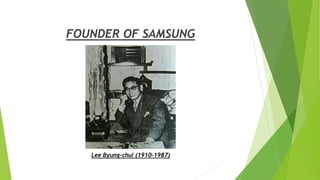
FOUNDER OF SAMSUNG
Lee Byung-chul (1910–1987)
HISTORY
 In 1938, Lee Byung-chul (1910–1987) of a large landowning
family in Japan and founded Samsung Sanghoe.
 Samsung started out as a small trading company with forty
employees located in Su-dong.
 Samsung moved into lines of business such as insurance,
securities and retail.
 In the late 1960s, Samsung Group entered the electronics
industry. It formed several electronics-related divisions,
such as Samsung Electronics Devices, Samsung Electro-
Mechanics.
 Its first product was a black-and-white television set.
1938-70
1970-90
 After Lee, the founder's death in 1987, Samsung Group
was separated into four business groups—Samsung Group,
Shinsegae Group, CJ Group and the Hansol Group.
 In 1980s, Samsung Electronics began to invest heavily in
research and development.
 In 1982, it built a television assembly plant in Portugal
 As of 2012, Samsung has invested more than
US$13,000,000,000 in the Austin facility, which operates
under the name Samsung Austin Semiconductor.
1990–2000
 Samsung started to rise as an international corporation in the
1990s.
 Samsung became the world's largest producer of memory chips
in 1992 and is the world's second-largest chipmaker after Intel.
 In 1995, it created its first liquid-crystal display screen.
 Ten years later, Samsung grew to be the world's largest
manufacturer of liquid-crystal display panels.
 Additionally, Samsung manufactured a range of aircraft from
the 1980s to 1990s. The company was founded in 1999 as Korea
Aerospace Industries (KAI).
2000–present
 In 2000, Samsung opened a development center in Poland.
 Its work began with set-top-box technology before moving
into digital TV and smartphones.
 In 2015, Samsung has been granted more U.S. patents
than any other company - including IBM, Google, Sony,
Microsoft and Apple.
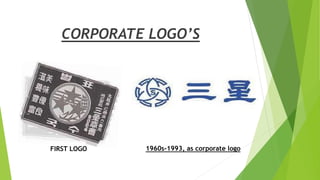
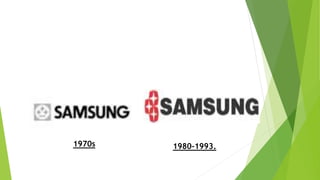
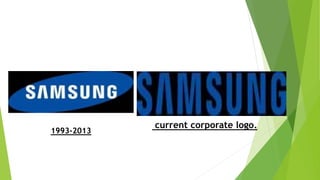
CORPORATE LOGO’S
FIRST LOGO 1960s-1993, as corporate logo
1970s 1980-1993.
1993-2013
current corporate logo.
SLOGAN FOR SAMSUNG.
 Samsung For Today and Tomorrow (1993–1999)
 Everyone's Invited (1999–2005)
 Samsung, Imagine (2005–2007)
 Samsung, Next Is What? (2007–2010)
 Samsung, Turn on Tomorrow (2010–2013)
 The Next Big Thing is Here (2013–2017)
 Do What You Can't (2017 – present)
SAMSUNG IN INDIA
 Samsung Electronics established its operations in Dec
1995.
 Two R&D centers are located in Delhi & Banglore.
 In 2K10 achieved a sales-turnover of $ 3.5 Billions.
 It is one of the largest sell cellphone brand.
 The first Tab ( tablet) was launched on 10th November
2K10.
 In 2003 it launched its first Ultra HD (32inches) TV
Samsung’s Mission Statement
“We will devote our human resources and technology to
create superior products and services, thereby contributing
to a better global society.”
Samsung’s Vision Statement
“Inspire the world with our innovative technologies,
products and design that enrich people’s lives and contribute
to social prosperity by creating a new future.”
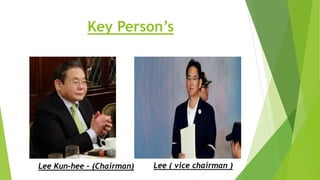
Key Person’s
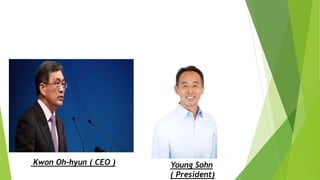
Lee Kun-hee – (Chairman) Lee ( vice chairman )
Kwon Oh-hyun ( CEO ) Young Sohn
( President)
OBJECTIVE OF SAMSUNG.
 One of Samsung’s leading objectives is the attainment of a
leadership position in the electronics industry.
 It ensures that it provides its customers with products that
more than meet their demands.
 The other objective that Samsung Electronics Company
pursues is the manufacture of high-quality products, and
to ensure that such products are availed in the latest
technology all over the world.
 It not only just the expectations of the customers but also
the attainment of the firm’s main goal: higher profits
 Delivering high quality of goods, utilizing the latest
technology, and taking a leadership position in the
technology industry
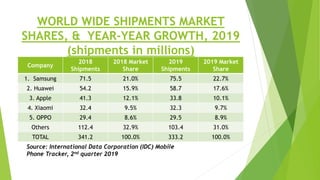
WORLD WIDE SHIPMENTS MARKET
SHARES, & YEAR-YEAR GROWTH, 2019
(shipments in millions)
Company
2018
Shipments
2018 Market
Share
2019
Shipments
2019 Market
Share
1. Samsung 71.5 21.0% 75.5 22.7%
2. Huawei 54.2 15.9% 58.7 17.6%
3. Apple 41.3 12.1% 33.8 10.1%
4. Xiaomi 32.4 9.5% 32.3 9.7%
5. OPPO 29.4 8.6% 29.5 8.9%
Others 112.4 32.9% 103.4 31.0%
TOTAL 341.2 100.0% 333.2 100.0%
Source: International Data Corporation (IDC) Mobile
Phone Tracker, 2nd quarter 2019
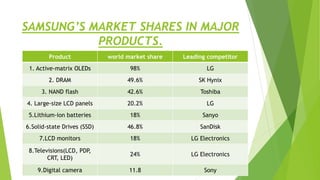
SAMSUNG’S MARKET SHARES IN MAJOR
PRODUCTS.
Product world market share Leading competitor
1. Active-matrix OLEDs 98% LG
2. DRAM 49.6% SK Hynix
3. NAND flash 42.6% Toshiba
4. Large-size LCD panels 20.2% LG
5.Lithium-ion batteries 18% Sanyo
6.Solid-state Drives (SSD) 46.8% SanDisk
7.LCD monitors 18% LG Electronics
8.Televisions(LCD, PDP,
CRT, LED)
24% LG Electronics
9.Digital camera 11.8 Sony
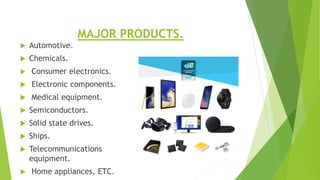
MAJOR PRODUCTS.
 Automotive.
 Chemicals.
 Consumer electronics.
 Electronic components.
 Medical equipment.
 Semiconductors.
 Solid state drives.
 Ships.
 Telecommunications
equipment.
 Home appliances, ETC.
MARKETING STRATEGIES.
 Consist of huge variety of products.
 Sells products directly to its Retailers & Services dealers.
 Uses Skimming price techniques.
 Believe as “Advertising “ is key In engaging potential
customers.
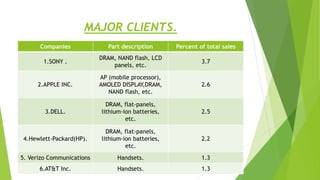
MAJOR CLIENTS.
Companies Part description Percent of total sales
1.SONY .
DRAM, NAND flash, LCD
panels, etc.
3.7
2.APPLE INC.
AP (mobile processor),
AMOLED DISPLAY,DRAM,
NAND flash, etc.
2.6
3.DELL.
DRAM, flat-panels,
lithium-ion batteries,
etc.
2.5
4.Hewlett-Packard(HP).
DRAM, flat-panels,
lithium-ion batteries,
etc.
2.2
5. Verizo Communications Handsets. 1.3
6.AT&T Inc. Handsets. 1.3
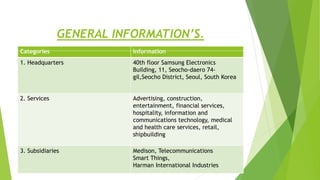
Categories Information
1. Headquarters 40th floor Samsung Electronics
Building, 11, Seocho-daero 74-
gil,Seocho District, Seoul, South Korea
2. Services Advertising, construction,
entertainment, financial services,
hospitality, information and
communications technology, medical
and health care services, retail,
shipbuilding
3. Subsidiaries Medison, Telecommunications
Smart Things,
Harman International Industries
GENERAL INFORMATION’S.
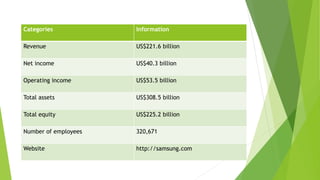
Categories Information
Revenue US$221.6 billion
Net income US$40.3 billion
Operating income US$53.5 billion
Total assets US$308.5 billion
Total equity US$225.2 billion
Number of employees 320,671
Website http://samsung.com
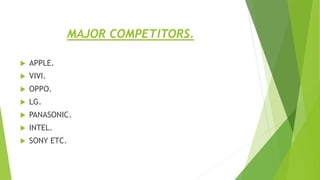
MAJOR COMPETITORS.
 APPLE.
 VIVI.
 OPPO.
 LG.
 PANASONIC.
 INTEL.
 SONY ETC.
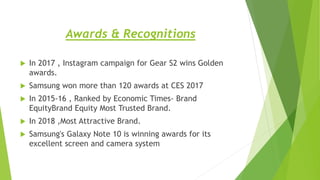
Awards & Recognitions
 In 2017 , Instagram campaign for Gear S2 wins Golden
awards.
 Samsung won more than 120 awards at CES 2017
 In 2015-16 , Ranked by Economic Times- Brand
EquityBrand Equity Most Trusted Brand.
 In 2018 ,Most Attractive Brand.
 Samsung's Galaxy Note 10 is winning awards for its
excellent screen and camera system
CONCLUSION
 Sumsung brand is famous allover the world because of its
service, excellent employees, Innovative reliable product.
 A responsible approach to business and global citizenship
and globlelisation with partners and customers.
 Samsung is taking the world in progressive direction for
new generations.
 So It is trying to be the best brand in the field of
electronices materials in the world by improving its size ,
price quality, capasity or power of the devices.

Presentation.samsung.ppt

Presentation.samsung.ppt

  • 1.
    SHARANBASAVA UNIVERSITY SUBJECT :MANAGERIAL ECONOMICS. TOPIC : SAMSUNG COMPANY. PRESENTED BY SUMAN. SACHIN. VEERBADRA. SUHARSH. AVINASH PATIL. SHASHANK.
  • 2.
    INTRODUCTION  SAMSUNG wasfounded by Lee Byung-chul in 1938 as a trading company.  HQ is at South Korea.  SAMSUNG has two meaning in Korean language I.e “SAM” means THREE & “SUNG” means STAR.  It served world wide area.  It is public sector company.  It is a largest technology company in the world.
  • 3.
    FOUNDER OF SAMSUNG LeeByung-chul (1910–1987)
  • 4.
    HISTORY  In 1938,Lee Byung-chul (1910–1987) of a large landowning family in Japan and founded Samsung Sanghoe.  Samsung started out as a small trading company with forty employees located in Su-dong.  Samsung moved into lines of business such as insurance, securities and retail.  In the late 1960s, Samsung Group entered the electronics industry. It formed several electronics-related divisions, such as Samsung Electronics Devices, Samsung Electro- Mechanics.  Its first product was a black-and-white television set. 1938-70
  • 5.
    1970-90  After Lee,the founder's death in 1987, Samsung Group was separated into four business groups—Samsung Group, Shinsegae Group, CJ Group and the Hansol Group.  In 1980s, Samsung Electronics began to invest heavily in research and development.  In 1982, it built a television assembly plant in Portugal  As of 2012, Samsung has invested more than US$13,000,000,000 in the Austin facility, which operates under the name Samsung Austin Semiconductor.
  • 6.
    1990–2000  Samsung startedto rise as an international corporation in the 1990s.  Samsung became the world's largest producer of memory chips in 1992 and is the world's second-largest chipmaker after Intel.  In 1995, it created its first liquid-crystal display screen.  Ten years later, Samsung grew to be the world's largest manufacturer of liquid-crystal display panels.  Additionally, Samsung manufactured a range of aircraft from the 1980s to 1990s. The company was founded in 1999 as Korea Aerospace Industries (KAI).
  • 7.
    2000–present  In 2000,Samsung opened a development center in Poland.  Its work began with set-top-box technology before moving into digital TV and smartphones.  In 2015, Samsung has been granted more U.S. patents than any other company - including IBM, Google, Sony, Microsoft and Apple.

  • 8.
    CORPORATE LOGO’S FIRST LOGO1960s-1993, as corporate logo
  • 9.
  • 10.
  • 11.
    SLOGAN FOR SAMSUNG. Samsung For Today and Tomorrow (1993–1999)  Everyone's Invited (1999–2005)  Samsung, Imagine (2005–2007)  Samsung, Next Is What? (2007–2010)  Samsung, Turn on Tomorrow (2010–2013)  The Next Big Thing is Here (2013–2017)  Do What You Can't (2017 – present)
  • 12.
    SAMSUNG IN INDIA Samsung Electronics established its operations in Dec 1995.  Two R&D centers are located in Delhi & Banglore.  In 2K10 achieved a sales-turnover of $ 3.5 Billions.  It is one of the largest sell cellphone brand.  The first Tab ( tablet) was launched on 10th November 2K10.  In 2003 it launched its first Ultra HD (32inches) TV


  • 13.
    Samsung’s Mission Statement “Wewill devote our human resources and technology to create superior products and services, thereby contributing to a better global society.”
  • 14.
    Samsung’s Vision Statement “Inspirethe world with our innovative technologies, products and design that enrich people’s lives and contribute to social prosperity by creating a new future.”
  • 15.
    Key Person’s Lee Kun-hee– (Chairman) Lee ( vice chairman )
  • 16.
    Kwon Oh-hyun (CEO ) Young Sohn ( President)
  • 17.
    OBJECTIVE OF SAMSUNG. One of Samsung’s leading objectives is the attainment of a leadership position in the electronics industry.  It ensures that it provides its customers with products that more than meet their demands.  The other objective that Samsung Electronics Company pursues is the manufacture of high-quality products, and to ensure that such products are availed in the latest technology all over the world.  It not only just the expectations of the customers but also the attainment of the firm’s main goal: higher profits  Delivering high quality of goods, utilizing the latest technology, and taking a leadership position in the technology industry
  • 18.
    WORLD WIDE SHIPMENTSMARKET SHARES, & YEAR-YEAR GROWTH, 2019 (shipments in millions) Company 2018 Shipments 2018 Market Share 2019 Shipments 2019 Market Share 1. Samsung 71.5 21.0% 75.5 22.7% 2. Huawei 54.2 15.9% 58.7 17.6% 3. Apple 41.3 12.1% 33.8 10.1% 4. Xiaomi 32.4 9.5% 32.3 9.7% 5. OPPO 29.4 8.6% 29.5 8.9% Others 112.4 32.9% 103.4 31.0% TOTAL 341.2 100.0% 333.2 100.0% Source: International Data Corporation (IDC) Mobile Phone Tracker, 2nd quarter 2019
  • 19.
    SAMSUNG’S MARKET SHARESIN MAJOR PRODUCTS. Product world market share Leading competitor 1. Active-matrix OLEDs 98% LG 2. DRAM 49.6% SK Hynix 3. NAND flash 42.6% Toshiba 4. Large-size LCD panels 20.2% LG 5.Lithium-ion batteries 18% Sanyo 6.Solid-state Drives (SSD) 46.8% SanDisk 7.LCD monitors 18% LG Electronics 8.Televisions(LCD, PDP, CRT, LED) 24% LG Electronics 9.Digital camera 11.8 Sony
  • 20.
    MAJOR PRODUCTS.  Automotive. Chemicals.  Consumer electronics.  Electronic components.  Medical equipment.  Semiconductors.  Solid state drives.  Ships.  Telecommunications equipment.  Home appliances, ETC.
  • 21.
    MARKETING STRATEGIES.  Consistof huge variety of products.  Sells products directly to its Retailers & Services dealers.  Uses Skimming price techniques.  Believe as “Advertising “ is key In engaging potential customers.
  • 22.
    MAJOR CLIENTS. Companies Partdescription Percent of total sales 1.SONY . DRAM, NAND flash, LCD panels, etc. 3.7 2.APPLE INC. AP (mobile processor), AMOLED DISPLAY,DRAM, NAND flash, etc. 2.6 3.DELL. DRAM, flat-panels, lithium-ion batteries, etc. 2.5 4.Hewlett-Packard(HP). DRAM, flat-panels, lithium-ion batteries, etc. 2.2 5. Verizo Communications Handsets. 1.3 6.AT&T Inc. Handsets. 1.3
  • 23.
    Categories Information 1. Headquarters40th floor Samsung Electronics Building, 11, Seocho-daero 74- gil,Seocho District, Seoul, South Korea 2. Services Advertising, construction, entertainment, financial services, hospitality, information and communications technology, medical and health care services, retail, shipbuilding 3. Subsidiaries Medison, Telecommunications Smart Things, Harman International Industries GENERAL INFORMATION’S.
  • 24.
    Categories Information Revenue US$221.6billion Net income US$40.3 billion Operating income US$53.5 billion Total assets US$308.5 billion Total equity US$225.2 billion Number of employees 320,671 Website http://samsung.com
  • 25.
    MAJOR COMPETITORS.  APPLE. VIVI.  OPPO.  LG.  PANASONIC.  INTEL.  SONY ETC.
  • 27.
    Awards & Recognitions In 2017 , Instagram campaign for Gear S2 wins Golden awards.  Samsung won more than 120 awards at CES 2017  In 2015-16 , Ranked by Economic Times- Brand EquityBrand Equity Most Trusted Brand.  In 2018 ,Most Attractive Brand.  Samsung's Galaxy Note 10 is winning awards for its excellent screen and camera system
  • 28.
    CONCLUSION  Sumsung brandis famous allover the world because of its service, excellent employees, Innovative reliable product.  A responsible approach to business and global citizenship and globlelisation with partners and customers.  Samsung is taking the world in progressive direction for new generations.  So It is trying to be the best brand in the field of electronices materials in the world by improving its size , price quality, capasity or power of the devices.