Sampling-based
             versus
          Mixer-based
           front-end


This slide set introduces the two common measurement techniques for
large-signal network analysis technology and discusses in details the pros
and cons of each technique.


                                                                        1
Outline

      LSNA based on Sampler-based Front-end
           •   Front-end
           •   Harmonic Sampling – Theory of Operation
                  Continuous Wave


                  Narrowband Modulation


                  Broadband Modulation


      LSNA based on Mixer-based Front-end
           •   Front-end
           •   Theory of Operation

      Conclusions


10/22/08                                                 2


                                                             2
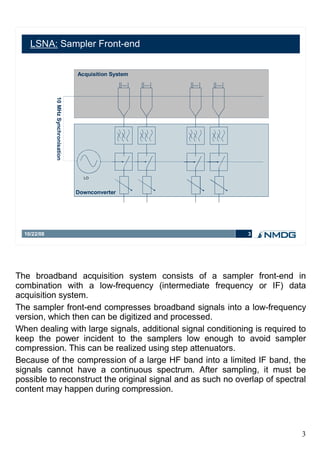
LSNA: Sampler Front-end


                                      Acquisition System
             10 MHz Synchronisation


                                        LO


                                      Downconverter


  10/22/08                                                    3


The broadband acquisition system consists of a sampler front-end in
combination with a low-frequency (intermediate frequency or IF) data
acquisition system.
The sampler front-end compresses broadband signals into a low-frequency
version, which then can be digitized and processed.
When dealing with large signals, additional signal conditioning is required to
keep the power incident to the samplers low enough to avoid sampler
compression. This can be realized using step attenuators.
Because of the compression of a large HF band into a limited IF band, the
signals cannot have a continuous spectrum. After sampling, it must be
possible to reconstruct the original signal and as such no overlap of spectral
content may happen during compression.


                                                                            3
Harmonic Sampling - Signal Class: Continuous Wave


                      fLO=24.975 MHz = (1GHz-1MHz)/40
                                   1 MHz
     RF
                                                            2 MHz
                      40 fLO                   80 fLO               120 fLO           3 MHz


                                                                                      Freq. (GHz)
                               1                        2                         3


                                                                              IF Bandwidth
                 IF


                               1    2      3                           10 Freq. (MHz)

  10/22/08                                                                        4


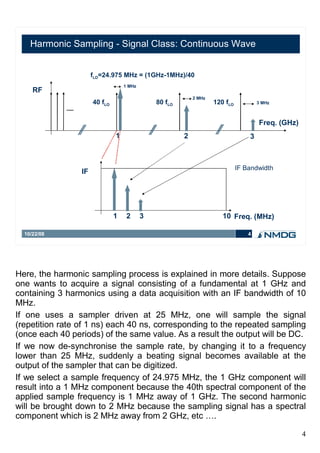
Here, the harmonic sampling process is explained in more details. Suppose
one wants to acquire a signal consisting of a fundamental at 1 GHz and
containing 3 harmonics using a data acquisition with an IF bandwidth of 10
MHz.
If one uses a sampler driven at 25 MHz, one will sample the signal
(repetition rate of 1 ns) each 40 ns, corresponding to the repeated sampling
(once each 40 periods) of the same value. As a result the output will be DC.
If we now de-synchronise the sample rate, by changing it to a frequency
lower than 25 MHz, suddenly a beating signal becomes available at the
output of the sampler that can be digitized.
If we select a sample frequency of 24.975 MHz, the 1 GHz component will
result into a 1 MHz component because the 40th spectral component of the
applied sample frequency is 1 MHz away of 1 GHz. The second harmonic
will be brought down to 2 MHz because the sampling signal has a spectral
component which is 2 MHz away from 2 GHz, etc ….

                                                                                                    4
Harmonic Sampling - Signal Class: Narrowband Modulation


                  fLO=24.975 MHz = (1GHz-1MHz)/40
                              1 MHz
   RF
                                                   2 MHz
                 40 fLO               80 fLO               120 fLO       3 MHz


                                                                            Freq. (GHz)
                          1                        2                 3


                IF


                                 1             2       3
                                                                         Freq. (MHz)

  10/22/08                                                           5


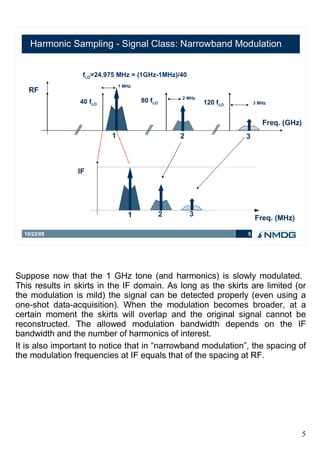
Suppose now that the 1 GHz tone (and harmonics) is slowly modulated.
This results in skirts in the IF domain. As long as the skirts are limited (or
the modulation is mild) the signal can be detected properly (even using a
one-shot data-acquisition). When the modulation becomes broader, at a
certain moment the skirts will overlap and the original signal cannot be
reconstructed. The allowed modulation bandwidth depends on the IF
bandwidth and the number of harmonics of interest.
It is also important to notice that in “narrowband modulation”, the spacing of
the modulation frequencies at IF equals that of the spacing at RF.


                                                                                          5
Harmonic Sampling - Signal Class: Broadband Modulation

                                   2BW

                                         BW        Adapted sampling process
   RF
                          40 fLO              80 fLO              120 fLO


                                    1                   2                      3 Freq. (GHz)


                     IF


                                                                   Freq. (MHz)

             BW of Periodic Broadband Modulation = 2* BW IF data acquisition

  10/22/08                                                                     6


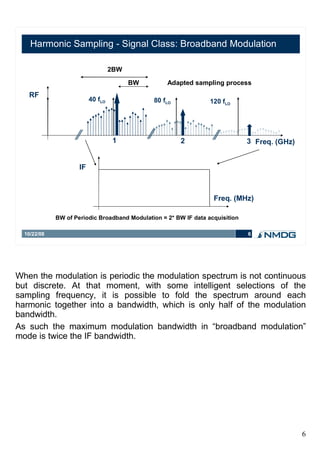
When the modulation is periodic the modulation spectrum is not continuous
but discrete. At that moment, with some intelligent selections of the
sampling frequency, it is possible to fold the spectrum around each
harmonic together into a bandwidth, which is only half of the modulation
bandwidth.
As such the maximum modulation bandwidth in “broadband modulation”
mode is twice the IF bandwidth.


                                                                                               6
LSNA: Mixer Front-End

       Network Analyser
                                                       1 + df GHz
 Mixer Front-end


                                                            ...
                                     df GHz            5 + df GHz                 df GHz
                                                            ...
                   1 GHz                                                                                                      1 GHz
                                                       20 + df GHz


                                                            LO
 Test Set


                           Input 1            Port 1                   Port 2              Input 2           Ref Channel

                                                          DUT                                                  Synchroniser
                                                                        5 GHz                        5 GHz
                                                                                                             “Fixed Phase Relationship”
                                                                     1 … 20 GHz                1 … 20 GHz


        10/22/08                                                                                                 7


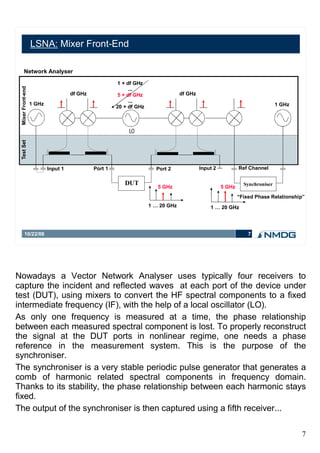
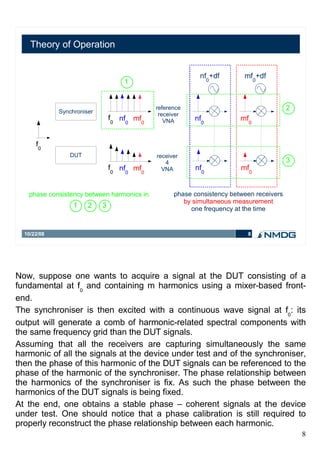
Nowadays a Vector Network Analyser uses typically four receivers to
capture the incident and reflected waves at each port of the device under
test (DUT), using mixers to convert the HF spectral components to a fixed
intermediate frequency (IF), with the help of a local oscillator (LO).
As only one frequency is measured at a time, the phase relationship
between each measured spectral component is lost. To properly reconstruct
the signal at the DUT ports in nonlinear regime, one needs a phase
reference in the measurement system. This is the purpose of the
synchroniser.
The synchroniser is a very stable periodic pulse generator that generates a
comb of harmonic related spectral components in frequency domain.
Thanks to its stability, the phase relationship between each harmonic stays
fixed.
The output of the synchroniser is then captured using a fifth receiver...

                                                                                                                                      7
Theory of Operation


                                                                nf0+df        mf0+df
                                         1


             Synchroniser
                                                  reference                                   2
                                                   receiver
                                f       nf0 mf0      VNA      nf0            mf0
                                    0


      f0
                DUT                               receiver
                                                     4                                        3
                                f       nf0 mf0     VNA       nf0            mf0
                                    0


   phase consistency between harmonics in               phase consistency between receivers
                                                           by simultaneous measurement
                  1    2    3                                one frequency at the time


  10/22/08                                                                     8


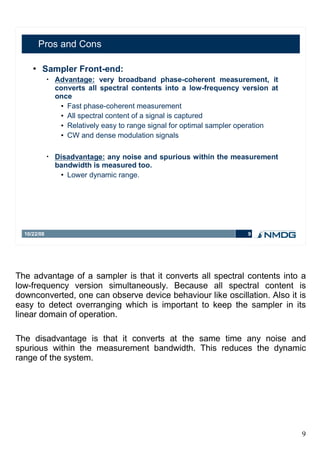
Now, suppose one wants to acquire a signal at the DUT consisting of a
fundamental at f0 and containing m harmonics using a mixer-based front-
end.
The synchroniser is then excited with a continuous wave signal at f0: its
output will generate a comb of harmonic-related spectral components with
the same frequency grid than the DUT signals.
Assuming that all the receivers are capturing simultaneously the same
harmonic of all the signals at the device under test and of the synchroniser,
then the phase of this harmonic of the DUT signals can be referenced to the
phase of the harmonic of the synchroniser. The phase relationship between
the harmonics of the synchroniser is fix. As such the phase between the
harmonics of the DUT signals is being fixed.
At the end, one obtains a stable phase – coherent signals at the device
under test. One should notice that a phase calibration is still required to
properly reconstruct the phase relationship between each harmonic.
                                                                                                  8
Pros and Cons

        Sampler Front-end:
             •   Advantage: very broadband phase-coherent measurement, it
                 converts all spectral contents into a low-frequency version at
                 once
                   Fast phase-coherent measurement


                   All spectral content of a signal is captured


                   Relatively easy to range signal for optimal sampler operation


                   CW and dense modulation signals


             •   Disadvantage: any noise and spurious within the measurement
                 bandwidth is measured too.
                   Lower dynamic range.


  10/22/08                                                              9


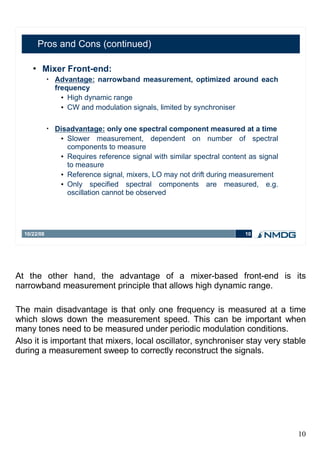
The advantage of a sampler is that it converts all spectral contents into a
low-frequency version simultaneously. Because all spectral content is
downconverted, one can observe device behaviour like oscillation. Also it is
easy to detect overranging which is important to keep the sampler in its
linear domain of operation.

The disadvantage is that it converts at the same time any noise and
spurious within the measurement bandwidth. This reduces the dynamic
range of the system.


                                                                                    9
Pros and Cons (continued)

         Mixer Front-end:
             •   Advantage: narrowband measurement, optimized around each
                 frequency
                    High dynamic range


                    CW and modulation signals, limited by synchroniser


             •   Disadvantage: only one spectral component measured at a time
                   Slower    measurement, dependent on number of spectral
                    components to measure
                   Requires reference signal with similar spectral content as signal

                    to measure
                   Reference signal, mixers, LO may not drift during measurement


                   Only    specified spectral components are measured, e.g.
                    oscillation cannot be observed


  10/22/08                                                                10


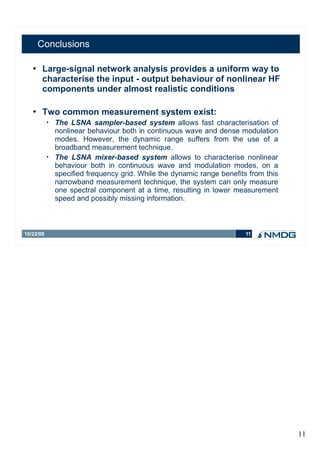
At the other hand, the advantage of a mixer-based front-end is its
narrowband measurement principle that allows high dynamic range.

The main disadvantage is that only one frequency is measured at a time
which slows down the measurement speed. This can be important when
many tones need to be measured under periodic modulation conditions.
Also it is important that mixers, local oscillator, synchroniser stay very stable
during a measurement sweep to correctly reconstruct the signals.


                                                                                        10
Conclusions

       Large-signal network analysis provides a uniform way to
        characterise the input - output behaviour of nonlinear HF
        components under almost realistic conditions

       Two common measurement system exist:
           •   The LSNA sampler-based system allows fast characterisation of
               nonlinear behaviour both in continuous wave and dense modulation
               modes. However, the dynamic range suffers from the use of a
               broadband measurement technique.
           •   The LSNA mixer-based system allows to characterise nonlinear
               behaviour both in continuous wave and modulation modes, on a
               specified frequency grid. While the dynamic range benefits from this
               narrowband measurement technique, the system can only measure
               one spectral component at a time, resulting in lower measurement
               speed and possibly missing information.


10/22/08                                                                 11


                                                                                      11

Sampling based versus mixer-based front-end

  • 1.
    Sampling-based versus Mixer-based front-end This slide set introduces the two common measurement techniques for large-signal network analysis technology and discusses in details the pros and cons of each technique. 1
  • 2.
    Outline  LSNA based on Sampler-based Front-end • Front-end • Harmonic Sampling – Theory of Operation  Continuous Wave  Narrowband Modulation  Broadband Modulation  LSNA based on Mixer-based Front-end • Front-end • Theory of Operation  Conclusions 10/22/08 2 2
  • 3.
    LSNA: Sampler Front-end Acquisition System 10 MHz Synchronisation LO Downconverter 10/22/08 3 The broadband acquisition system consists of a sampler front-end in combination with a low-frequency (intermediate frequency or IF) data acquisition system. The sampler front-end compresses broadband signals into a low-frequency version, which then can be digitized and processed. When dealing with large signals, additional signal conditioning is required to keep the power incident to the samplers low enough to avoid sampler compression. This can be realized using step attenuators. Because of the compression of a large HF band into a limited IF band, the signals cannot have a continuous spectrum. After sampling, it must be possible to reconstruct the original signal and as such no overlap of spectral content may happen during compression. 3
  • 4.
    Harmonic Sampling -Signal Class: Continuous Wave fLO=24.975 MHz = (1GHz-1MHz)/40 1 MHz RF 2 MHz 40 fLO 80 fLO 120 fLO 3 MHz Freq. (GHz) 1 2 3 IF Bandwidth IF 1 2 3 10 Freq. (MHz) 10/22/08 4 Here, the harmonic sampling process is explained in more details. Suppose one wants to acquire a signal consisting of a fundamental at 1 GHz and containing 3 harmonics using a data acquisition with an IF bandwidth of 10 MHz. If one uses a sampler driven at 25 MHz, one will sample the signal (repetition rate of 1 ns) each 40 ns, corresponding to the repeated sampling (once each 40 periods) of the same value. As a result the output will be DC. If we now de-synchronise the sample rate, by changing it to a frequency lower than 25 MHz, suddenly a beating signal becomes available at the output of the sampler that can be digitized. If we select a sample frequency of 24.975 MHz, the 1 GHz component will result into a 1 MHz component because the 40th spectral component of the applied sample frequency is 1 MHz away of 1 GHz. The second harmonic will be brought down to 2 MHz because the sampling signal has a spectral component which is 2 MHz away from 2 GHz, etc …. 4
  • 5.
    Harmonic Sampling -Signal Class: Narrowband Modulation fLO=24.975 MHz = (1GHz-1MHz)/40 1 MHz RF 2 MHz 40 fLO 80 fLO 120 fLO 3 MHz Freq. (GHz) 1 2 3 IF 1 2 3 Freq. (MHz) 10/22/08 5 Suppose now that the 1 GHz tone (and harmonics) is slowly modulated. This results in skirts in the IF domain. As long as the skirts are limited (or the modulation is mild) the signal can be detected properly (even using a one-shot data-acquisition). When the modulation becomes broader, at a certain moment the skirts will overlap and the original signal cannot be reconstructed. The allowed modulation bandwidth depends on the IF bandwidth and the number of harmonics of interest. It is also important to notice that in “narrowband modulation”, the spacing of the modulation frequencies at IF equals that of the spacing at RF. 5
  • 6.
    Harmonic Sampling -Signal Class: Broadband Modulation 2BW BW Adapted sampling process RF 40 fLO 80 fLO 120 fLO 1 2 3 Freq. (GHz) IF Freq. (MHz) BW of Periodic Broadband Modulation = 2* BW IF data acquisition 10/22/08 6 When the modulation is periodic the modulation spectrum is not continuous but discrete. At that moment, with some intelligent selections of the sampling frequency, it is possible to fold the spectrum around each harmonic together into a bandwidth, which is only half of the modulation bandwidth. As such the maximum modulation bandwidth in “broadband modulation” mode is twice the IF bandwidth. 6
  • 7.
    LSNA: Mixer Front-End Network Analyser 1 + df GHz Mixer Front-end ... df GHz 5 + df GHz df GHz ... 1 GHz 1 GHz 20 + df GHz LO Test Set Input 1 Port 1 Port 2 Input 2 Ref Channel DUT Synchroniser 5 GHz 5 GHz “Fixed Phase Relationship” 1 … 20 GHz 1 … 20 GHz 10/22/08 7 Nowadays a Vector Network Analyser uses typically four receivers to capture the incident and reflected waves at each port of the device under test (DUT), using mixers to convert the HF spectral components to a fixed intermediate frequency (IF), with the help of a local oscillator (LO). As only one frequency is measured at a time, the phase relationship between each measured spectral component is lost. To properly reconstruct the signal at the DUT ports in nonlinear regime, one needs a phase reference in the measurement system. This is the purpose of the synchroniser. The synchroniser is a very stable periodic pulse generator that generates a comb of harmonic related spectral components in frequency domain. Thanks to its stability, the phase relationship between each harmonic stays fixed. The output of the synchroniser is then captured using a fifth receiver... 7
  • 8.
    Theory of Operation nf0+df mf0+df 1 Synchroniser reference 2 receiver f nf0 mf0 VNA nf0 mf0 0 f0 DUT receiver 4 3 f nf0 mf0 VNA nf0 mf0 0 phase consistency between harmonics in phase consistency between receivers by simultaneous measurement 1 2 3 one frequency at the time 10/22/08 8 Now, suppose one wants to acquire a signal at the DUT consisting of a fundamental at f0 and containing m harmonics using a mixer-based front- end. The synchroniser is then excited with a continuous wave signal at f0: its output will generate a comb of harmonic-related spectral components with the same frequency grid than the DUT signals. Assuming that all the receivers are capturing simultaneously the same harmonic of all the signals at the device under test and of the synchroniser, then the phase of this harmonic of the DUT signals can be referenced to the phase of the harmonic of the synchroniser. The phase relationship between the harmonics of the synchroniser is fix. As such the phase between the harmonics of the DUT signals is being fixed. At the end, one obtains a stable phase – coherent signals at the device under test. One should notice that a phase calibration is still required to properly reconstruct the phase relationship between each harmonic. 8
  • 9.
    Pros and Cons  Sampler Front-end: • Advantage: very broadband phase-coherent measurement, it converts all spectral contents into a low-frequency version at once  Fast phase-coherent measurement  All spectral content of a signal is captured  Relatively easy to range signal for optimal sampler operation  CW and dense modulation signals • Disadvantage: any noise and spurious within the measurement bandwidth is measured too.  Lower dynamic range. 10/22/08 9 The advantage of a sampler is that it converts all spectral contents into a low-frequency version simultaneously. Because all spectral content is downconverted, one can observe device behaviour like oscillation. Also it is easy to detect overranging which is important to keep the sampler in its linear domain of operation. The disadvantage is that it converts at the same time any noise and spurious within the measurement bandwidth. This reduces the dynamic range of the system. 9
  • 10.
    Pros and Cons(continued)  Mixer Front-end: • Advantage: narrowband measurement, optimized around each frequency  High dynamic range  CW and modulation signals, limited by synchroniser • Disadvantage: only one spectral component measured at a time  Slower measurement, dependent on number of spectral components to measure  Requires reference signal with similar spectral content as signal to measure  Reference signal, mixers, LO may not drift during measurement  Only specified spectral components are measured, e.g. oscillation cannot be observed 10/22/08 10 At the other hand, the advantage of a mixer-based front-end is its narrowband measurement principle that allows high dynamic range. The main disadvantage is that only one frequency is measured at a time which slows down the measurement speed. This can be important when many tones need to be measured under periodic modulation conditions. Also it is important that mixers, local oscillator, synchroniser stay very stable during a measurement sweep to correctly reconstruct the signals. 10
  • 11.
    Conclusions  Large-signal network analysis provides a uniform way to characterise the input - output behaviour of nonlinear HF components under almost realistic conditions  Two common measurement system exist: • The LSNA sampler-based system allows fast characterisation of nonlinear behaviour both in continuous wave and dense modulation modes. However, the dynamic range suffers from the use of a broadband measurement technique. • The LSNA mixer-based system allows to characterise nonlinear behaviour both in continuous wave and modulation modes, on a specified frequency grid. While the dynamic range benefits from this narrowband measurement technique, the system can only measure one spectral component at a time, resulting in lower measurement speed and possibly missing information. 10/22/08 11 11