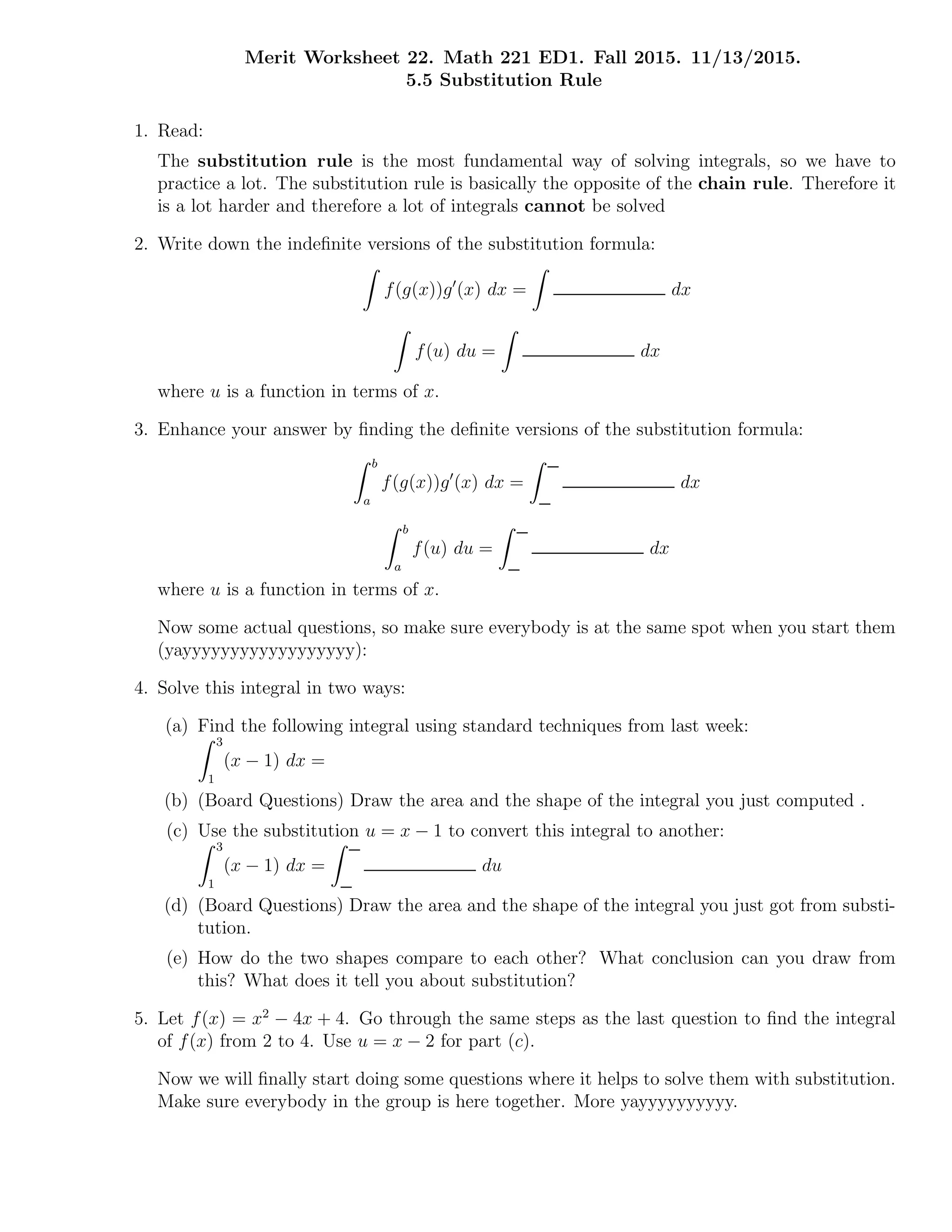
Merit Worksheet 22. Math 221 ED1. Fall 2015. 11/13/2015.
5.5 Substitution Rule
1. Read:
The substitution rule is the most fundamental way of solving integrals, so we have to
practice a lot. The substitution rule is basically the opposite of the chain rule. Therefore it
is a lot harder and therefore a lot of integrals cannot be solved
2. Write down the indefinite versions of the substitution formula:
f(g(x))g (x) dx = dx
f(u) du = dx
where u is a function in terms of x.
3. Enhance your answer by finding the definite versions of the substitution formula:
b
a
f(g(x))g (x) dx = dx
b
a
f(u) du = dx
where u is a function in terms of x.
Now some actual questions, so make sure everybody is at the same spot when you start them
(yayyyyyyyyyyyyyyyyyy):
4. Solve this integral in two ways:
(a) Find the following integral using standard techniques from last week:
3
1
(x − 1) dx =
(b) (Board Questions) Draw the area and the shape of the integral you just computed .
(c) Use the substitution u = x − 1 to convert this integral to another:
3
1
(x − 1) dx = du
(d) (Board Questions) Draw the area and the shape of the integral you just got from substi-
tution.
(e) How do the two shapes compare to each other? What conclusion can you draw from
this? What does it tell you about substitution?
5. Let f(x) = x2
− 4x + 4. Go through the same steps as the last question to find the integral
of f(x) from 2 to 4. Use u = x − 2 for part (c).
Now we will finally start doing some questions where it helps to solve them with substitution.
Make sure everybody in the group is here together. More yayyyyyyyyyy.
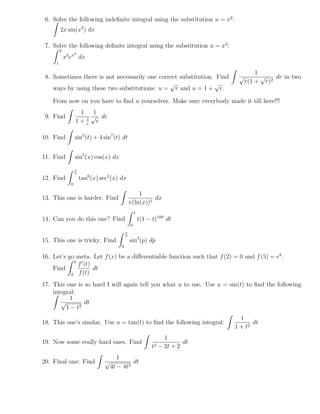
6. Solve the following indefinite integral using the substitution u = x2
:
2x sin(x2
) dx
7. Solve the following definite integral using the substitution u = x3
:
2
1
x2
ex3
dx
8. Sometimes there is not necessarily one correct substitution. Find
1
√
r(1 +
√
r)2
dr in two
ways by using these two substitutions: u =
√
r and u = 1 +
√
r.
From now on you have to find u yourselves. Make sure everybody made it till here!!!
9. Find
1
1 + 1
e
1
√
e
de
10. Find sin3
(t) + 4 sin7
(t) dt
11. Find sin5
(x) cos(x) dx
12. Find
π
4
0
tan6
(x) sec2
(x) dx
13. This one is harder. Find
1
x(ln(x))5
dx
14. Can you do this one? Find
1
0
t(1 − t)100
dt
15. This one is tricky. Find
π
2
0
sin3
(p) dp
16. Let’s go meta. Let f(x) be a differentiable function such that f(2) = 0 and f(5) = e8
.
Find
5
2
f (t)
f(t)
dt
17. This one is so hard I will again tell you what u to use. Use u = sin(t) to find the following
integral:
1
√
1 − t2
dt
18. This one’s similar. Use u = tan(t) to find the following integral:
1
1 + t2
dt
19. Now some really hard ones. Find
1
t2 − 2t + 2
dt
20. Final one: Find
1
√
4t − 4t2
dt

Sample2

  • 1.
    Merit Worksheet 22.Math 221 ED1. Fall 2015. 11/13/2015. 5.5 Substitution Rule 1. Read: The substitution rule is the most fundamental way of solving integrals, so we have to practice a lot. The substitution rule is basically the opposite of the chain rule. Therefore it is a lot harder and therefore a lot of integrals cannot be solved 2. Write down the indefinite versions of the substitution formula: f(g(x))g (x) dx = dx f(u) du = dx where u is a function in terms of x. 3. Enhance your answer by finding the definite versions of the substitution formula: b a f(g(x))g (x) dx = dx b a f(u) du = dx where u is a function in terms of x. Now some actual questions, so make sure everybody is at the same spot when you start them (yayyyyyyyyyyyyyyyyyy): 4. Solve this integral in two ways: (a) Find the following integral using standard techniques from last week: 3 1 (x − 1) dx = (b) (Board Questions) Draw the area and the shape of the integral you just computed . (c) Use the substitution u = x − 1 to convert this integral to another: 3 1 (x − 1) dx = du (d) (Board Questions) Draw the area and the shape of the integral you just got from substi- tution. (e) How do the two shapes compare to each other? What conclusion can you draw from this? What does it tell you about substitution? 5. Let f(x) = x2 − 4x + 4. Go through the same steps as the last question to find the integral of f(x) from 2 to 4. Use u = x − 2 for part (c). Now we will finally start doing some questions where it helps to solve them with substitution. Make sure everybody in the group is here together. More yayyyyyyyyyy.
  • 2.
    6. Solve thefollowing indefinite integral using the substitution u = x2 : 2x sin(x2 ) dx 7. Solve the following definite integral using the substitution u = x3 : 2 1 x2 ex3 dx 8. Sometimes there is not necessarily one correct substitution. Find 1 √ r(1 + √ r)2 dr in two ways by using these two substitutions: u = √ r and u = 1 + √ r. From now on you have to find u yourselves. Make sure everybody made it till here!!! 9. Find 1 1 + 1 e 1 √ e de 10. Find sin3 (t) + 4 sin7 (t) dt 11. Find sin5 (x) cos(x) dx 12. Find π 4 0 tan6 (x) sec2 (x) dx 13. This one is harder. Find 1 x(ln(x))5 dx 14. Can you do this one? Find 1 0 t(1 − t)100 dt 15. This one is tricky. Find π 2 0 sin3 (p) dp 16. Let’s go meta. Let f(x) be a differentiable function such that f(2) = 0 and f(5) = e8 . Find 5 2 f (t) f(t) dt 17. This one is so hard I will again tell you what u to use. Use u = sin(t) to find the following integral: 1 √ 1 − t2 dt 18. This one’s similar. Use u = tan(t) to find the following integral: 1 1 + t2 dt 19. Now some really hard ones. Find 1 t2 − 2t + 2 dt 20. Final one: Find 1 √ 4t − 4t2 dt