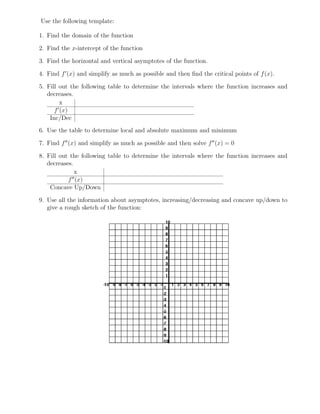
This document contains a math worksheet with 7 problems involving graphing and analyzing functions. The problems include sketching graphs of functions with given properties, finding examples of functions with vertical tangents or local maxima, graphing polynomial functions, determining intervals where functions are positive or negative, and using templates to analyze additional functions by finding domains, intercepts, asymptotes, critical points, and concavity.
![Math 220 Worksheet 12
7/7/2016
Name: Group:
1. Sketch the graph of a function f that is continuous on [1, 5] and has the given properties:
f has an absolute minimum at 1, an absolute maximum at 5, a local maximum at 2, and a
local minimum at 4.
2. Give an example of a function which has both a vertical tangent line and a local maximum
at the origin. You do not need to justify your answer.
3. Find the graph of the following:
f(x) = 2x3
+ 3x2
− 12x − 13
Use the given template.
4. Find a, b, c, and d so that the function f(x) = ax3
+ bx2
+ cx + d has a local minimum at
the origin and a local maximum at (2, 2).
5. Graph the following function:
f(x) =
3x − 1
5x + 2
6. For each of the following, sketch a graph of a function that satisfies the properties:
(a) f (x) > 0 and f (x) < 0 for all x;
(b) f (x) < 0 and f (x) > 0 for all x;
7. Here are some extra functions you can draw:
(a) f(x) =
x + 1
x2 + 1
(b) f(x) =
x2
− 2x + 2
x − 1
(c) f(x) = 5x2/3
− x5/3
(d) f(x) = etan−1(x)
(Note that e
π
2 = 4.8 and e−π
2 = 0.2)](https://image.slidesharecdn.com/af14c735-73a0-4927-9195-9b95af3fff55-160816000532/85/Sample2-1-320.jpg)
![Math 220 Worksheet 12
7/7/2016
Name: Group:
1. Sketch the graph of a function f that is continuous on [1, 5] and has the given properties:
f has an absolute minimum at 1, an absolute maximum at 5, a local maximum at 2, and a
local minimum at 4.
2. Give an example of a function which has both a vertical tangent line and a local maximum
at the origin. You do not need to justify your answer.
3. Find the graph of the following:
f(x) = 2x3
+ 3x2
− 12x − 13
Use the given template.
4. Find a, b, c, and d so that the function f(x) = ax3
+ bx2
+ cx + d has a local minimum at
the origin and a local maximum at (2, 2).
5. Graph the following function:
f(x) =
3x − 1
5x + 2
6. For each of the following, sketch a graph of a function that satisfies the properties:
(a) f (x) > 0 and f (x) < 0 for all x;
(b) f (x) < 0 and f (x) > 0 for all x;
7. Here are some extra functions you can draw:
(a) f(x) =
x + 1
x2 + 1
(b) f(x) =
x2
− 2x + 2
x − 1
(c) f(x) = 5x2/3
− x5/3
(d) f(x) = etan−1(x)
(Note that e
π
2 = 4.8 and e−π
2 = 0.2)](https://image.slidesharecdn.com/af14c735-73a0-4927-9195-9b95af3fff55-160816000532/75/Sample2-1-2048.jpg)