Math 220 Summary 4
6/16/2016
First we did some review.
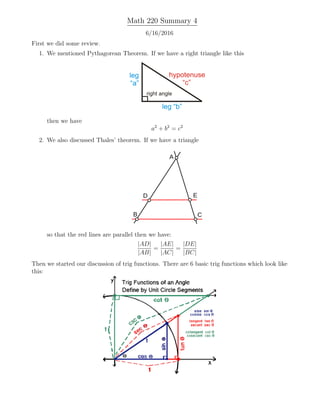
1. We mentioned Pythagorean Theorem. If we have a right triangle like this
then we have
a2
+ b2
= c2
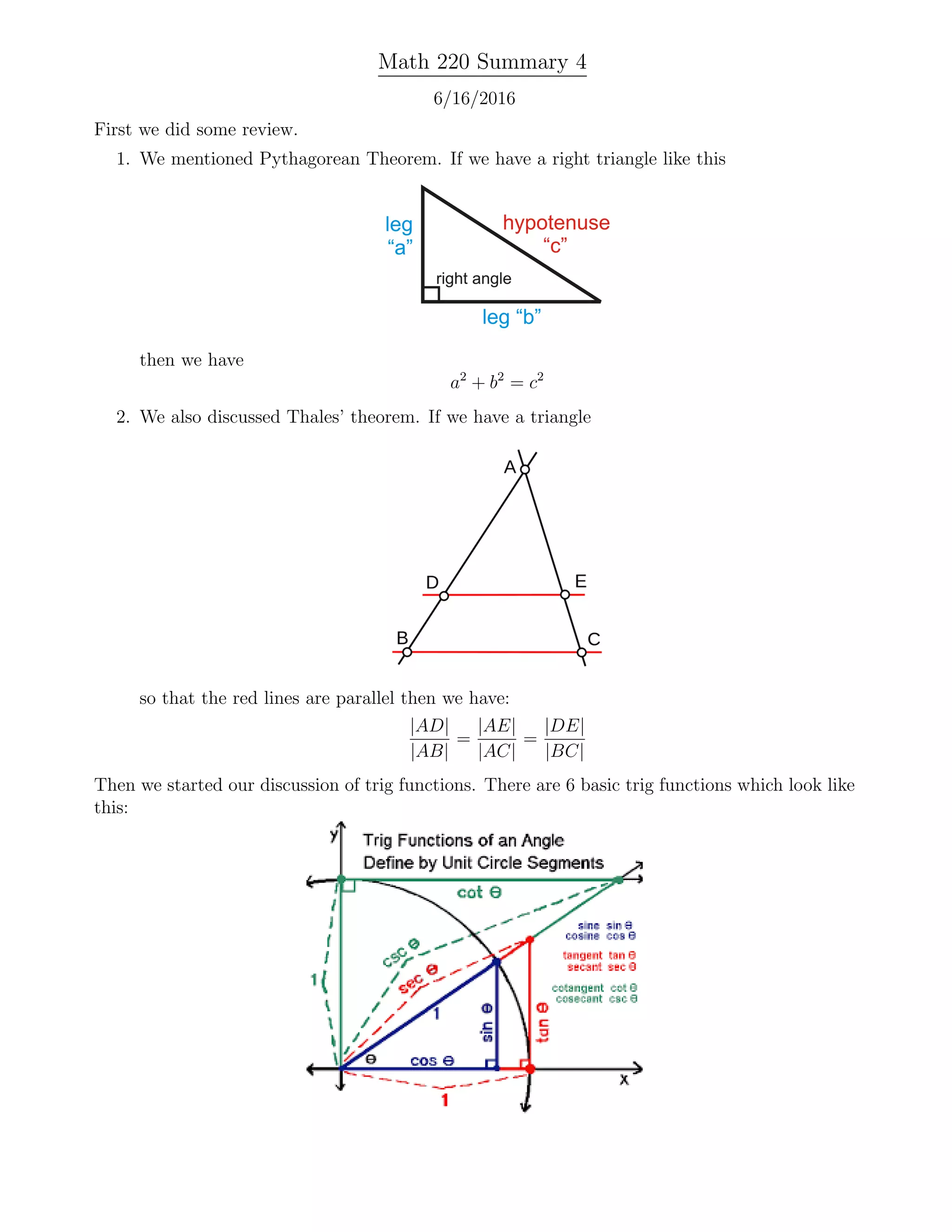
2. We also discussed Thales’ theorem. If we have a triangle
so that the red lines are parallel then we have:
|AD|
|AB|
=
|AE|
|AC|
=
|DE|
|BC|
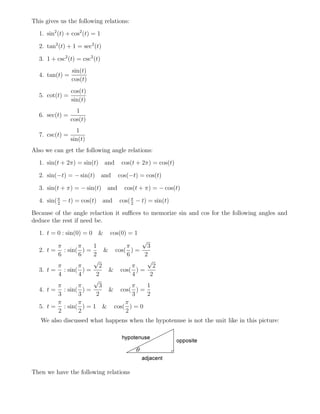
Then we started our discussion of trig functions. There are 6 basic trig functions which look like
this:
This gives us the following relations:
1. sin2
(t) + cos2
(t) = 1
2. tan2
(t) + 1 = sec2
(t)
3. 1 + csc2
(t) = csc2
(t)
4. tan(t) =
sin(t)
cos(t)
5. cot(t) =
cos(t)
sin(t)
6. sec(t) =
1
cos(t)
7. csc(t) =
1
sin(t)
Also we can get the following angle relations:
1. sin(t + 2π) = sin(t) and cos(t + 2π) = cos(t)
2. sin(−t) = − sin(t) and cos(−t) = cos(t)
3. sin(t + π) = − sin(t) and cos(t + π) = − cos(t)
4. sin(π
2
− t) = cos(t) and cos(π
2
− t) = sin(t)
Because of the angle relaction it suffices to memorize sin and cos for the following angles and
deduce the rest if need be.
1. t = 0 : sin(0) = 0 & cos(0) = 1
2. t =
π
6
: sin(
π
6
) =
1
2
& cos(
π
6
) =
√
3
2
3. t =
π
4
: sin(
π
4
) =
√
2
2
& cos(
π
4
) =
√
2
2
4. t =
π
3
: sin(
π
3
) =
√
3
2
& cos(
π
3
) =
1
2
5. t =
π
2
: sin(
π
2
) = 1 & cos(
π
2
) = 0
We also discussed what happens when the hypotenuse is not the unit like in this picture:
Then we have the following relations
sin(t) =
opp
hyp
cos(t) =
adj
hyp
tan(t) =
opp
adj
cot(t) =
adj
opp
sec(t) =
hyp
adj
csc(t) =
hyp
opp
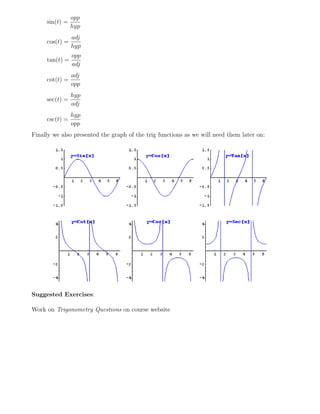
Finally we also presented the graph of the trig functions as we will need them later on:
Suggested Exercises:
Work on Trigonometry Questions on course website

Sample1

  • 1.
    Math 220 Summary4 6/16/2016 First we did some review. 1. We mentioned Pythagorean Theorem. If we have a right triangle like this then we have a2 + b2 = c2 2. We also discussed Thales’ theorem. If we have a triangle so that the red lines are parallel then we have: |AD| |AB| = |AE| |AC| = |DE| |BC| Then we started our discussion of trig functions. There are 6 basic trig functions which look like this:
  • 2.
    This gives usthe following relations: 1. sin2 (t) + cos2 (t) = 1 2. tan2 (t) + 1 = sec2 (t) 3. 1 + csc2 (t) = csc2 (t) 4. tan(t) = sin(t) cos(t) 5. cot(t) = cos(t) sin(t) 6. sec(t) = 1 cos(t) 7. csc(t) = 1 sin(t) Also we can get the following angle relations: 1. sin(t + 2π) = sin(t) and cos(t + 2π) = cos(t) 2. sin(−t) = − sin(t) and cos(−t) = cos(t) 3. sin(t + π) = − sin(t) and cos(t + π) = − cos(t) 4. sin(π 2 − t) = cos(t) and cos(π 2 − t) = sin(t) Because of the angle relaction it suffices to memorize sin and cos for the following angles and deduce the rest if need be. 1. t = 0 : sin(0) = 0 & cos(0) = 1 2. t = π 6 : sin( π 6 ) = 1 2 & cos( π 6 ) = √ 3 2 3. t = π 4 : sin( π 4 ) = √ 2 2 & cos( π 4 ) = √ 2 2 4. t = π 3 : sin( π 3 ) = √ 3 2 & cos( π 3 ) = 1 2 5. t = π 2 : sin( π 2 ) = 1 & cos( π 2 ) = 0 We also discussed what happens when the hypotenuse is not the unit like in this picture: Then we have the following relations
  • 3.
    sin(t) = opp hyp cos(t) = adj hyp tan(t)= opp adj cot(t) = adj opp sec(t) = hyp adj csc(t) = hyp opp Finally we also presented the graph of the trig functions as we will need them later on: Suggested Exercises: Work on Trigonometry Questions on course website