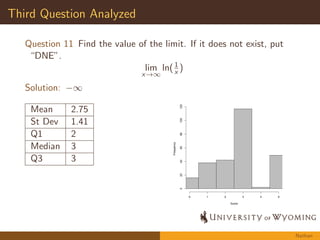
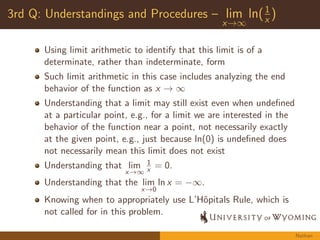
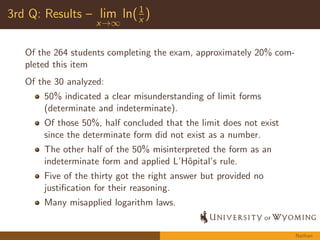
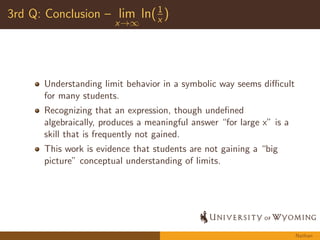
What do students at UW get out of Calculus I? 
Work for the Assessment Committee 
Dr. Michelle Chamberlin, Dr. Nathan Clements 
November, 13th, 2014
Agenda 
1 Methods and context for the study 
2 Students overall performance on the
nal exam 
3 Results for four exam questions 
4 Conclusions and next steps 
5 Questions and discussion 
Michelle
Motivation for the study 
Each year we are required to assess the learning of our 
undergraduate students in mathematics 
Needed assessment activities for the 2013-2014 academic year 
Decided to draw upon student work that Nathan had 
collected in Calculus I 
Michelle
What is assessment of student learning? 
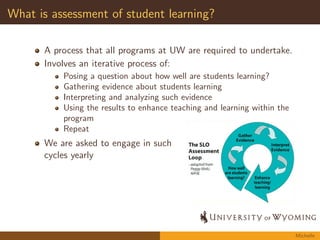
A process that all programs at UW are required to undertake. 
Involves an iterative process of: 
Posing a question about how well are students learning? 
Gathering evidence about students learning 
Interpreting and analyzing such evidence 
Using the results to enhance teaching and learning within the 
program 
Repeat 
We are asked to engage in such 
cycles yearly 
Michelle
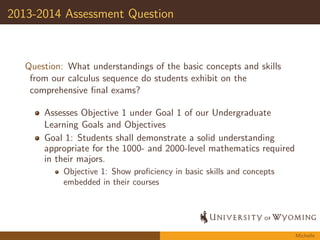
2013-2014 Assessment Question 
Question: What understandings of the basic concepts and skills 
from our calculus sequence do students exhibit on the 
comprehensive
nal exams? 
Assesses Objective 1 under Goal 1 of our Undergraduate 
Learning Goals and Objectives 
Goal 1: Students shall demonstrate a solid understanding 
appropriate for the 1000- and 2000-level mathematics required 
in their majors. 
Objective 1: Show pro
ciency in basic skills and concepts 
embedded in their courses 
Michelle
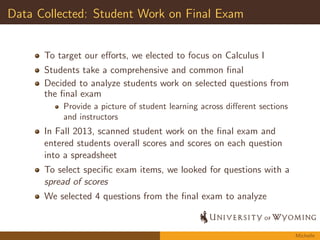
Data Collected: Student Work on Final Exam 
To target our eorts, we elected to focus on Calculus I 
Students take a comprehensive and common
nal 
Decided to analyze students work on selected questions from 
the
nal exam 
Provide a picture of student learning across dierent sections 
and instructors 
In Fall 2013, scanned student work on the
nal exam and 
entered students overall scores and scores on each question 
into a spreadsheet 
To select speci
c exam items, we looked for questions with a 
spread of scores 
We selected 4 questions from the
nal exam to analyze 
Michelle
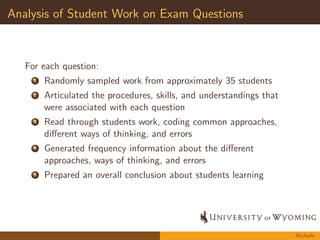
Analysis of Student Work on Exam Questions 
For each question: 
1 Randomly sampled work from approximately 35 students 
2 Articulated the procedures, skills, and understandings that 
were associated with each question 
3 Read through students work, coding common approaches, 
dierent ways of thinking, and errors 
4 Generated frequency information about the dierent 
approaches, ways of thinking, and errors 
5 Prepared an overall conclusion about students learning 
Michelle
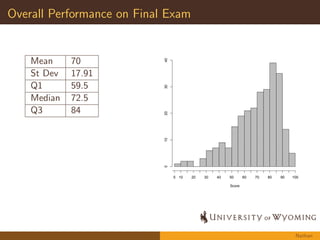
Overall Performance on Final Exam 
Mean 70 
St Dev 17.91 
Q1 59.5 
Median 72.5 
Q3 84 
Q1 59.5 3 8 1 6 4 0 2 Median 72.5 5 9 3 8 8 4 5 Q3 84 6 9 4 8 8 5 5 Max 98 7 9 7 8 8 5 5 All Scores (all sections) 
Score 
Frequency 
0 10 20 30 40 
5 10 20 30 40 50 60 70 80 90 100 
Problem: 2 (all sections) 
150 200 
50 60 
Nathan
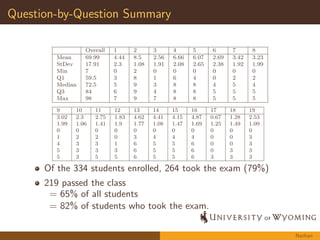
Question-by-Question Summary 
Math 2200 Exam 4 – All Sections 
Fall 2013 
Overall 1 2 3 4 5 6 7 8 9 10 11 Mean 69.99 4.44 8.5 2.56 6.66 6.07 2.69 3.42 3.23 3.02 2.3 2.75 StDev 17.91 2.3 1.08 1.91 2.08 2.65 2.38 1.92 1.99 1.99 1.06 1.41 Min 7 0 2 0 0 0 0 0 0 0 0 0 Q1 59.5 3 8 1 6 4 0 2 2 1 2 2 Median 72.5 5 9 3 8 8 4 5 4 4 3 3 Q3 84 6 9 4 8 8 5 5 5 5 3 3 Max 98 7 9 7 8 8 5 5 5 5 3 5 All Scores (all sections) 
Math 2200 Exam 4 – All Sections 
Of the 334 students enrolled, 264 took the exam (79%) 
219 passed the class 
= 65% of all students 
= 82% of students who took the exam. 
Frequency 
10 20 30 40 
Fall 2013 
6 7 8 9 10 11 12 13 14 15 16 17 18 19 
2.69 3.42 3.23 3.02 2.3 2.75 1.83 4.62 4.41 4.15 4.87 0.67 1.28 2.53 
2.38 1.92 1.99 1.99 1.06 1.41 1.9 1.77 1.08 1.47 1.69 1.25 1.49 1.09 
0 0 0 0 0 0 0 0 0 0 0 0 0 0 
0 2 2 1 2 2 0 3 4 4 4 0 0 3 
4 5 4 4 3 3 1 6 5 5 6 0 0 3 
5 5 5 5 3 3 3 6 5 5 6 0 3 3 
5 5 5 5 3 5 5 6 5 5 6 3 3 3 
Problem: 1 (all sections) 
60 
Nathan
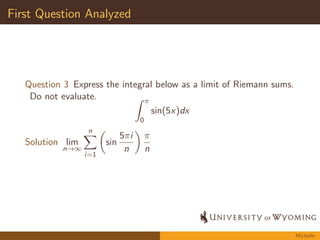
First Question Analyzed 
Question 3 Express the integral below as a limit of Riemann sums. 
Do not evaluate. Z  
0 
sin(5x)dx 
Solution lim 
n!1 
Xn 
i=1 
 
sin 
5i 
n 
 
 
n 
Michelle
1st Q: Understandings and Procedures { 
R  
0 sin(5x)dx 
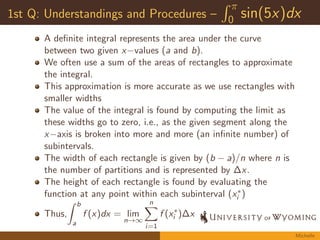
A de
nite integral represents the area under the curve 
between two given xvalues (a and b). 
We often use a sum of the areas of rectangles to approximate 
the integral. 
This approximation is more accurate as we use rectangles with 
smaller widths 
The value of the integral is found by computing the limit as 
these widths go to zero, i.e., as the given segment along the 
xaxis is broken into more and more (an in
nite number) of 
subintervals. 
The width of each rectangle is given by (b  a)=n where n is 
the number of partitions and is represented by x. 
The height of each rectangle is found by evaluating the 
function at any point within each subinterval (x 
i ) 
Z b 
Thus, 
a 
f (x)dx = lim 
n!1 
Xn 
i=1 
f (x 
i )x 
Michelle
1st Q: Understandings and Procedures (cont.) { 
R  
0 sin(5x)dx 
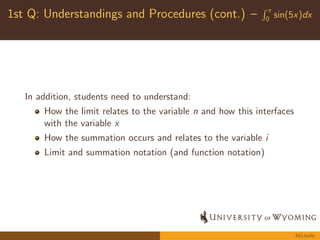
In addition, students need to understand: 
How the limit relates to the variable n and how this interfaces 
with the variable x 
How the summation occurs and relates to the variable i 
Limit and summation notation (and function notation) 
Michelle
1st Q: Results { 
R  
0 sin(5x)dx 
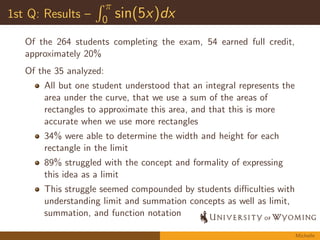
Of the 264 students completing the exam, 54 earned full credit, 
approximately 20% 
Of the 35 analyzed: 
All but one student understood that an integral represents the 
area under the curve, that we use a sum of the areas of 
rectangles to approximate this area, and that this is more 
accurate when we use more rectangles 
34% were able to determine the width and height for each 
rectangle in the limit 
89% struggled with the concept and formality of expressing 
this idea as a limit 
This struggle seemed compounded by students diculties with 
understanding limit and summation concepts as well as limit, 
summation, and function notation 
Michelle
1st Q: Common Errors { 
R  
0 sin(5x)dx 
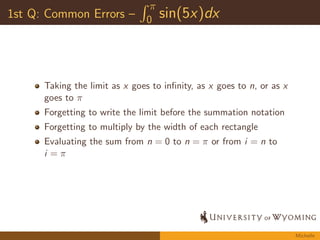
Taking the limit as x goes to in
nity, as x goes to n, or as x 
goes to  
Forgetting to write the limit before the summation notation 
Forgetting to multiply by the width of each rectangle 
Evaluating the sum from n = 0 to n =  or from i = n to 
i =  
Michelle
1st Question: Conclusion { 
R  
0 sin(5x)dx 
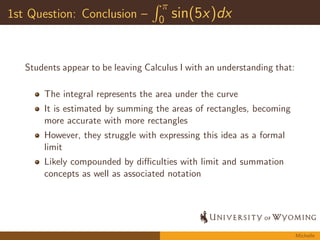
Students appear to be leaving Calculus I with an understanding that: 
The integral represents the area under the curve 
It is estimated by summing the areas of rectangles, becoming 
more accurate with more rectangles 
However, they struggle with expressing this idea as a formal 
limit 
Likely compounded by diculties with limit and summation 
concepts as well as associated notation 
Michelle
Second Question Analyzed 
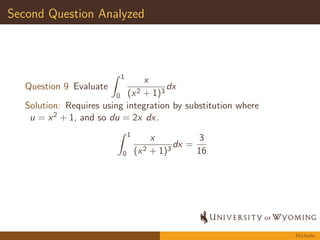
Question 9 Evaluate 
Z 1 
0 
x 
(x2 + 1)3 dx 
Solution: Requires using integration by substitution where 
u = x2 + 1, and so du = 2x dx. 
Z 1 
0 
x 
(x2 + 1)3 dx = 
3 
16 
Michelle
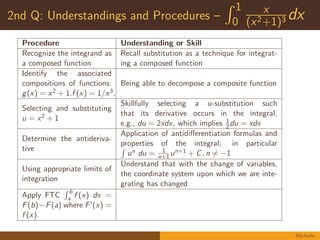
2nd Q: Understandings and Procedures { 
R 1 
0 
x 
(x2+1)3dx 
Procedure Understanding or Skill 
Recognize the integrand as 
a composed function 
Recall substitution as a technique for integrat- 
ing a composed function 
Identify the associated 
compositions of functions: 
g(x) = x2 + 1,f (x) = 1=x3, 
Being able to decompose a composite function 
Selecting and substituting 
u = x2 + 1 
12 
Skillfully selecting a u-substitution such 
that its derivative occurs in the integral, 
e.g., du = 2xdx, which implies du = xdx 
Determine the antideriva- 
tive 
Application of antidierentiation formulas and 
Rproperties of the integral; in particular 
un du = 1 
n+1un+1 + C; n6= 1 
Using appropriate limits of 
integration 
Understand that with the change of variables, 
the coordinate system upon which we are inte- 
grating has changed 
Apply FTC 
R b 
a f (x) dx = 
F(b)F(a) where F0(x) = 
f (x). 
Michelle
2nd Q: Results { 
R 1 
0 
x 
(x2+1)3dx 
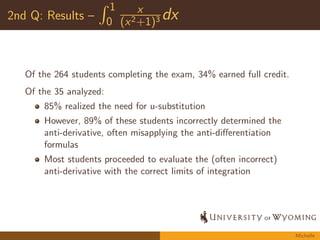
Of the 264 students completing the exam, 34% earned full credit. 
Of the 35 analyzed: 
85% realized the need for u-substitution 
However, 89% of these students incorrectly determined the 
anti-derivative, often misapplying the anti-dierentiation 
formulas 
Most students proceeded to evaluate the (often incorrect) 
anti-derivative with the correct limits of integration 
Michelle
2nd Q: Common Errors { 
R 1 
0 
x 
(x2+1)3dx 
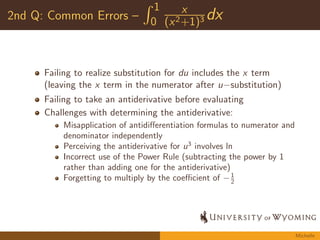
Failing to realize substitution for du includes the x term 
(leaving the x term in the numerator after usubstitution) 
Failing to take an antiderivative before evaluating 
Challenges with determining the antiderivative: 
Misapplication of antidierentiation formulas to numerator and 
denominator independently 
Perceiving the antiderivative for u3 involves ln 
Incorrect use of the Power Rule (subtracting the power by 1 
rather than adding one for the antiderivative) 
Forgetting to multiply by the coecient of 1 
2 
Michelle

2014 11-13

  • 1.
    What do studentsat UW get out of Calculus I? Work for the Assessment Committee Dr. Michelle Chamberlin, Dr. Nathan Clements November, 13th, 2014
  • 2.
    Agenda 1 Methodsand context for the study 2 Students overall performance on the
  • 3.
    nal exam 3Results for four exam questions 4 Conclusions and next steps 5 Questions and discussion Michelle
  • 4.
    Motivation for thestudy Each year we are required to assess the learning of our undergraduate students in mathematics Needed assessment activities for the 2013-2014 academic year Decided to draw upon student work that Nathan had collected in Calculus I Michelle
  • 5.
    What is assessmentof student learning? A process that all programs at UW are required to undertake. Involves an iterative process of: Posing a question about how well are students learning? Gathering evidence about students learning Interpreting and analyzing such evidence Using the results to enhance teaching and learning within the program Repeat We are asked to engage in such cycles yearly Michelle
  • 6.
    2013-2014 Assessment Question Question: What understandings of the basic concepts and skills from our calculus sequence do students exhibit on the comprehensive
  • 7.
    nal exams? AssessesObjective 1 under Goal 1 of our Undergraduate Learning Goals and Objectives Goal 1: Students shall demonstrate a solid understanding appropriate for the 1000- and 2000-level mathematics required in their majors. Objective 1: Show pro
  • 8.
    ciency in basicskills and concepts embedded in their courses Michelle
  • 9.
    Data Collected: StudentWork on Final Exam To target our eorts, we elected to focus on Calculus I Students take a comprehensive and common
  • 10.
    nal Decided toanalyze students work on selected questions from the
  • 11.
    nal exam Providea picture of student learning across dierent sections and instructors In Fall 2013, scanned student work on the
  • 12.
    nal exam and entered students overall scores and scores on each question into a spreadsheet To select speci
  • 13.
    c exam items,we looked for questions with a spread of scores We selected 4 questions from the
  • 14.
    nal exam toanalyze Michelle
  • 15.
    Analysis of StudentWork on Exam Questions For each question: 1 Randomly sampled work from approximately 35 students 2 Articulated the procedures, skills, and understandings that were associated with each question 3 Read through students work, coding common approaches, dierent ways of thinking, and errors 4 Generated frequency information about the dierent approaches, ways of thinking, and errors 5 Prepared an overall conclusion about students learning Michelle
  • 16.
    Overall Performance onFinal Exam Mean 70 St Dev 17.91 Q1 59.5 Median 72.5 Q3 84 Q1 59.5 3 8 1 6 4 0 2 Median 72.5 5 9 3 8 8 4 5 Q3 84 6 9 4 8 8 5 5 Max 98 7 9 7 8 8 5 5 All Scores (all sections) Score Frequency 0 10 20 30 40 5 10 20 30 40 50 60 70 80 90 100 Problem: 2 (all sections) 150 200 50 60 Nathan
  • 17.
    Question-by-Question Summary Math2200 Exam 4 – All Sections Fall 2013 Overall 1 2 3 4 5 6 7 8 9 10 11 Mean 69.99 4.44 8.5 2.56 6.66 6.07 2.69 3.42 3.23 3.02 2.3 2.75 StDev 17.91 2.3 1.08 1.91 2.08 2.65 2.38 1.92 1.99 1.99 1.06 1.41 Min 7 0 2 0 0 0 0 0 0 0 0 0 Q1 59.5 3 8 1 6 4 0 2 2 1 2 2 Median 72.5 5 9 3 8 8 4 5 4 4 3 3 Q3 84 6 9 4 8 8 5 5 5 5 3 3 Max 98 7 9 7 8 8 5 5 5 5 3 5 All Scores (all sections) Math 2200 Exam 4 – All Sections Of the 334 students enrolled, 264 took the exam (79%) 219 passed the class = 65% of all students = 82% of students who took the exam. Frequency 10 20 30 40 Fall 2013 6 7 8 9 10 11 12 13 14 15 16 17 18 19 2.69 3.42 3.23 3.02 2.3 2.75 1.83 4.62 4.41 4.15 4.87 0.67 1.28 2.53 2.38 1.92 1.99 1.99 1.06 1.41 1.9 1.77 1.08 1.47 1.69 1.25 1.49 1.09 0 0 0 0 0 0 0 0 0 0 0 0 0 0 0 2 2 1 2 2 0 3 4 4 4 0 0 3 4 5 4 4 3 3 1 6 5 5 6 0 0 3 5 5 5 5 3 3 3 6 5 5 6 0 3 3 5 5 5 5 3 5 5 6 5 5 6 3 3 3 Problem: 1 (all sections) 60 Nathan
  • 18.
    First Question Analyzed Question 3 Express the integral below as a limit of Riemann sums. Do not evaluate. Z 0 sin(5x)dx Solution lim n!1 Xn i=1 sin 5i n n Michelle
  • 19.
    1st Q: Understandingsand Procedures { R 0 sin(5x)dx A de
  • 20.
    nite integral representsthe area under the curve between two given xvalues (a and b). We often use a sum of the areas of rectangles to approximate the integral. This approximation is more accurate as we use rectangles with smaller widths The value of the integral is found by computing the limit as these widths go to zero, i.e., as the given segment along the xaxis is broken into more and more (an in
  • 21.
    nite number) of subintervals. The width of each rectangle is given by (b a)=n where n is the number of partitions and is represented by x. The height of each rectangle is found by evaluating the function at any point within each subinterval (x i ) Z b Thus, a f (x)dx = lim n!1 Xn i=1 f (x i )x Michelle
  • 22.
    1st Q: Understandingsand Procedures (cont.) { R 0 sin(5x)dx In addition, students need to understand: How the limit relates to the variable n and how this interfaces with the variable x How the summation occurs and relates to the variable i Limit and summation notation (and function notation) Michelle
  • 23.
    1st Q: Results{ R 0 sin(5x)dx Of the 264 students completing the exam, 54 earned full credit, approximately 20% Of the 35 analyzed: All but one student understood that an integral represents the area under the curve, that we use a sum of the areas of rectangles to approximate this area, and that this is more accurate when we use more rectangles 34% were able to determine the width and height for each rectangle in the limit 89% struggled with the concept and formality of expressing this idea as a limit This struggle seemed compounded by students diculties with understanding limit and summation concepts as well as limit, summation, and function notation Michelle
  • 24.
    1st Q: CommonErrors { R 0 sin(5x)dx Taking the limit as x goes to in
  • 25.
    nity, as xgoes to n, or as x goes to Forgetting to write the limit before the summation notation Forgetting to multiply by the width of each rectangle Evaluating the sum from n = 0 to n = or from i = n to i = Michelle
  • 26.
    1st Question: Conclusion{ R 0 sin(5x)dx Students appear to be leaving Calculus I with an understanding that: The integral represents the area under the curve It is estimated by summing the areas of rectangles, becoming more accurate with more rectangles However, they struggle with expressing this idea as a formal limit Likely compounded by diculties with limit and summation concepts as well as associated notation Michelle
  • 27.
    Second Question Analyzed Question 9 Evaluate Z 1 0 x (x2 + 1)3 dx Solution: Requires using integration by substitution where u = x2 + 1, and so du = 2x dx. Z 1 0 x (x2 + 1)3 dx = 3 16 Michelle
  • 28.
    2nd Q: Understandingsand Procedures { R 1 0 x (x2+1)3dx Procedure Understanding or Skill Recognize the integrand as a composed function Recall substitution as a technique for integrat- ing a composed function Identify the associated compositions of functions: g(x) = x2 + 1,f (x) = 1=x3, Being able to decompose a composite function Selecting and substituting u = x2 + 1 12 Skillfully selecting a u-substitution such that its derivative occurs in the integral, e.g., du = 2xdx, which implies du = xdx Determine the antideriva- tive Application of antidierentiation formulas and Rproperties of the integral; in particular un du = 1 n+1un+1 + C; n6= 1 Using appropriate limits of integration Understand that with the change of variables, the coordinate system upon which we are inte- grating has changed Apply FTC R b a f (x) dx = F(b)F(a) where F0(x) = f (x). Michelle
  • 29.
    2nd Q: Results{ R 1 0 x (x2+1)3dx Of the 264 students completing the exam, 34% earned full credit. Of the 35 analyzed: 85% realized the need for u-substitution However, 89% of these students incorrectly determined the anti-derivative, often misapplying the anti-dierentiation formulas Most students proceeded to evaluate the (often incorrect) anti-derivative with the correct limits of integration Michelle
  • 30.
    2nd Q: CommonErrors { R 1 0 x (x2+1)3dx Failing to realize substitution for du includes the x term (leaving the x term in the numerator after usubstitution) Failing to take an antiderivative before evaluating Challenges with determining the antiderivative: Misapplication of antidierentiation formulas to numerator and denominator independently Perceiving the antiderivative for u3 involves ln Incorrect use of the Power Rule (subtracting the power by 1 rather than adding one for the antiderivative) Forgetting to multiply by the coecient of 1 2 Michelle