Student: Doe, Jane                         Student ID: 1234567890                                  Hour: 1st
Grades: The chart below highlights the standards-based grading system used and how it translates to the 14-Point scale
               Numerical Rating                            Rating Description                             Letter Grade
                     13              Student meets standard with excellence                                     A
                     10              Student meets standard with proficiency                                    B
                      7              Student is approaching proficiency with standard                           C
                      4              Student is well below proficiency with standard                            D
                      1              Student does not meet standard                                             E
                      0              Insufficient evidence to rate student's performance on standard            Z

 Standard      Rating    Circular Motion Standards Description:
                         I can represent the path in which an object in circular motion is traveling using a diagram, even if the object
   CM.1          10
                         only travels around a portion of the path
                         I know that in order for an object to move circular motion, there has to be an unbalanced force (Funb) toward
   CM.2          7
                         the center of the circular path, called the centripetal force
                         I know that objects in circular motion are accelerating (centripetal acceleration,) and the objects: can have a
   CM.3          7
                         constant speed, are changing direction, and have a changing velocity due to the change in direction
   CM.4           7      I know that object can accelerate in any of three ways: speeding up, slowing down, changing direction
   CM.5          10      I know that the velocity of an object in circular motion is tangent to the circular path
                         I can represent the motion of an object in circular motion by drawing motion map arrows of its velocity
   CM.6          10
                         (tangent to circular path) and acceleration (toward center)
                         I can predict the path of an object that “escapes” circular motion due to a lack of centripetal force and
   CM.7          7
                         represent it using a diagram of some kind
                         I have a conceptual sense of the centripetal force quantity, Fc, and its relationship to mass, velocity, and
   CM.8          4
                         radius
                         I can recognize and come up with real life examples of circular motion, centripetal force and centripetal
   CM.9          10
                         acceleration, including analysis of freeway exit ramps
                         I can calculate the amount of centripetal acceleration or force associated with certain conditions of an object
  CM.10          7
                         traveling in circular motion
 Standard      Rating    Universal Gravitation Standards Description:
                         I can explain the orbit of the moon around the earth and the earth around the sun in terms of the centripetal
       G.1       7       motion model, and know that the gravitational force is responsible for the centripetal force. I can explain the
                         motion of any orbiting object around another in terms of centripetal motion.
       G.2       13      I can identify and represent all of the forces acting on an orbiting body
       G.3       10      I can draw a motion map for a body in orbit
                         I know and can explain how an orbiting body is really just free-falling toward the object it orbits, but it never
       G.4       10
                         gets there because it is in centripetal motion.
       G.5       7       I understand that the path of orbit is not circular but elliptical.
                         I can state Newton's Law of Universal Gravitation and explain the relationship between mass, distance and
       G.6       7
                         force of objects and predict the effect of changing one of these variables on the other
       G.7       7       I can explain how the gravitational force functions between two bodies and relate it to Newton's Third Law
       G.8       4       I can calculate the amount of gravitational force attracting two objects together
       G.9       7       I can describe the velocity and gravitational force of an orbiting body
                         I know that all objects that have mass exert an attractive force on all other objects with mass according to
   G.10          7
                         Newton's Law of Universal Gravitation.
 Standard      Rating    Momentum Unit Standards Description:
                         I know that momentum is a measurement of "mass in motion" and is the product of an object's mass times its
    M.1          7       velocity; I can calculate, using a formula (p=mv), the amount of momentum an object has given specific
                         conditions
                         I can compare the momentum of an object to that of another; I know the effect of increasing/decreasing either
    M.2          7
                         the velocity or mass of an object on its momentum
                         I know that an impulse is a measurement of "force exerted for some time" and is responsible for a change in
    M.3          7
                         momentum; I can use a formula (I = Ft = change in momentum)
                         I know the effect of changing the contact time between two objects during a collision can effect the force and
    M.4          7
                         thus the impulse; I know that increasing the time of a collision is the way to reduce the impact of the force
                         I know that momentum is conserved in an elastic collision and can predict the final or starting velocities
    M.5          7
                         based on given conditions of mass and velocity
                         I can explain collisions in situations such as Newton's Cradle toy, recoil of a shot, throwing an egg at a wall
    M.6          4
                         vs. a sheet, pool ball collision, or catching a ball.
  rd
 3 Quarter Overall:                                                              8 / C+

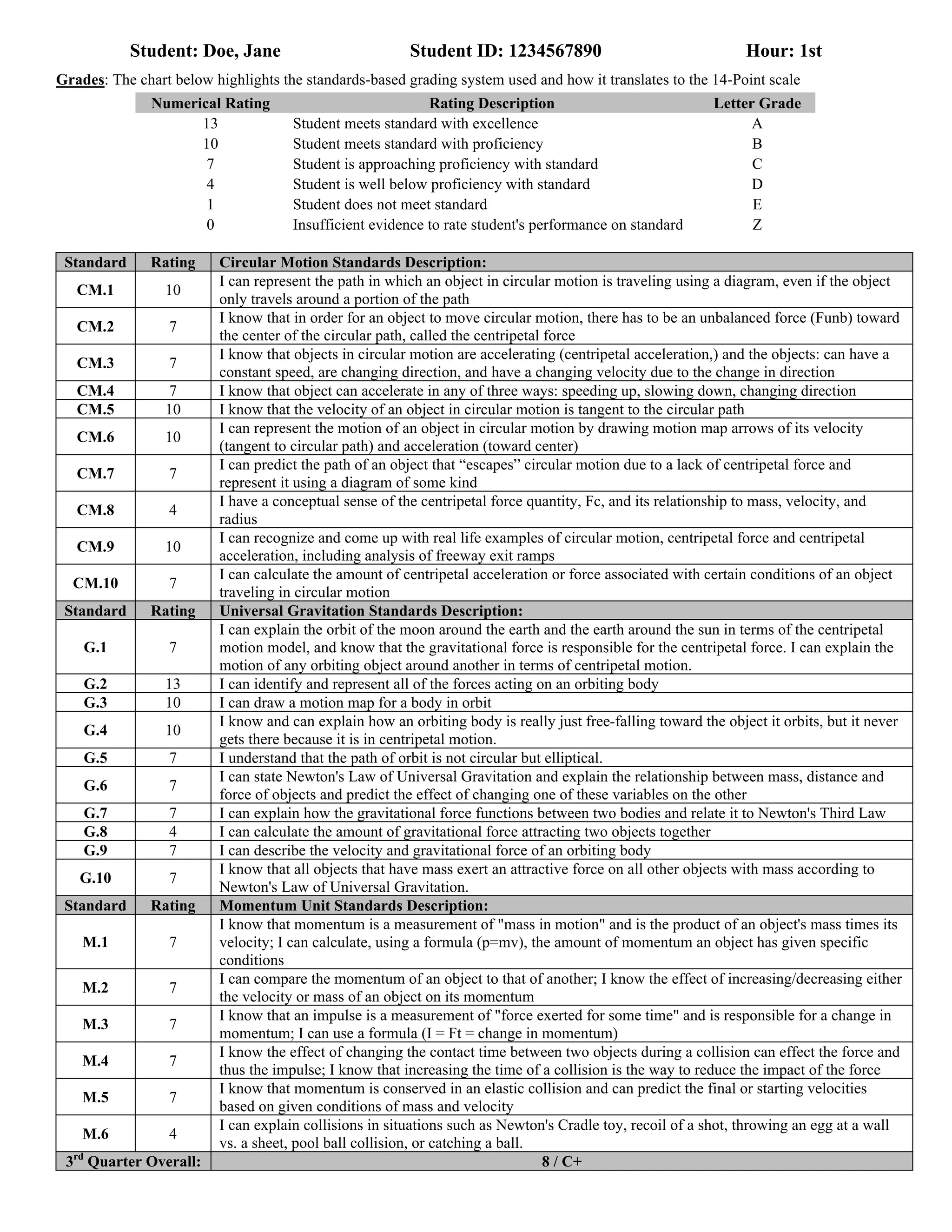
Sample standards based report card for physics

  • 1.
    Student: Doe, Jane Student ID: 1234567890 Hour: 1st Grades: The chart below highlights the standards-based grading system used and how it translates to the 14-Point scale Numerical Rating Rating Description Letter Grade 13 Student meets standard with excellence A 10 Student meets standard with proficiency B 7 Student is approaching proficiency with standard C 4 Student is well below proficiency with standard D 1 Student does not meet standard E 0 Insufficient evidence to rate student's performance on standard Z Standard Rating Circular Motion Standards Description: I can represent the path in which an object in circular motion is traveling using a diagram, even if the object CM.1 10 only travels around a portion of the path I know that in order for an object to move circular motion, there has to be an unbalanced force (Funb) toward CM.2 7 the center of the circular path, called the centripetal force I know that objects in circular motion are accelerating (centripetal acceleration,) and the objects: can have a CM.3 7 constant speed, are changing direction, and have a changing velocity due to the change in direction CM.4 7 I know that object can accelerate in any of three ways: speeding up, slowing down, changing direction CM.5 10 I know that the velocity of an object in circular motion is tangent to the circular path I can represent the motion of an object in circular motion by drawing motion map arrows of its velocity CM.6 10 (tangent to circular path) and acceleration (toward center) I can predict the path of an object that “escapes” circular motion due to a lack of centripetal force and CM.7 7 represent it using a diagram of some kind I have a conceptual sense of the centripetal force quantity, Fc, and its relationship to mass, velocity, and CM.8 4 radius I can recognize and come up with real life examples of circular motion, centripetal force and centripetal CM.9 10 acceleration, including analysis of freeway exit ramps I can calculate the amount of centripetal acceleration or force associated with certain conditions of an object CM.10 7 traveling in circular motion Standard Rating Universal Gravitation Standards Description: I can explain the orbit of the moon around the earth and the earth around the sun in terms of the centripetal G.1 7 motion model, and know that the gravitational force is responsible for the centripetal force. I can explain the motion of any orbiting object around another in terms of centripetal motion. G.2 13 I can identify and represent all of the forces acting on an orbiting body G.3 10 I can draw a motion map for a body in orbit I know and can explain how an orbiting body is really just free-falling toward the object it orbits, but it never G.4 10 gets there because it is in centripetal motion. G.5 7 I understand that the path of orbit is not circular but elliptical. I can state Newton's Law of Universal Gravitation and explain the relationship between mass, distance and G.6 7 force of objects and predict the effect of changing one of these variables on the other G.7 7 I can explain how the gravitational force functions between two bodies and relate it to Newton's Third Law G.8 4 I can calculate the amount of gravitational force attracting two objects together G.9 7 I can describe the velocity and gravitational force of an orbiting body I know that all objects that have mass exert an attractive force on all other objects with mass according to G.10 7 Newton's Law of Universal Gravitation. Standard Rating Momentum Unit Standards Description: I know that momentum is a measurement of "mass in motion" and is the product of an object's mass times its M.1 7 velocity; I can calculate, using a formula (p=mv), the amount of momentum an object has given specific conditions I can compare the momentum of an object to that of another; I know the effect of increasing/decreasing either M.2 7 the velocity or mass of an object on its momentum I know that an impulse is a measurement of "force exerted for some time" and is responsible for a change in M.3 7 momentum; I can use a formula (I = Ft = change in momentum) I know the effect of changing the contact time between two objects during a collision can effect the force and M.4 7 thus the impulse; I know that increasing the time of a collision is the way to reduce the impact of the force I know that momentum is conserved in an elastic collision and can predict the final or starting velocities M.5 7 based on given conditions of mass and velocity I can explain collisions in situations such as Newton's Cradle toy, recoil of a shot, throwing an egg at a wall M.6 4 vs. a sheet, pool ball collision, or catching a ball. rd 3 Quarter Overall: 8 / C+