Solution Manual for Physical Science 11th
Edition Tillery Slater 9780077862626 download
http://testbankpack.com/download/solution-manual-for-physical-
science-11th-edition-tillery-slater-9780077862626/
Explore and download more test bank or solution manual
at testbankpack.com
Here are some suggested products you might be interested in.
Click the link to download
Test bank for Physical Science 11th Edition Tillery Slater
9780077862626
https://testbankpack.com/download/test-bank-for-physical-science-11th-
edition-tillery-slater-9780077862626/
Solution Manual for Physical Science 10th Edition Tillery
007351389X 9780073513898
https://testbankpack.com/download/solution-manual-for-physical-
science-10th-edition-tillery-007351389x-9780073513898/
Test bank for Physical Science 10th Edition Tillery
007351389X 9780073513898
https://testbankpack.com/download/test-bank-for-physical-science-10th-
edition-tillery-007351389x-9780073513898/
Solution Manual for Physical Geography 11th Edition
Petersen Sack Gabler 1305652649 9781305652644
https://testbankpack.com/download/solution-manual-for-physical-
geography-11th-edition-petersen-sack-gabler-1305652649-9781305652644/
Solution Manual for Introduction to Physical Science 14th
Edition Shipman Wilson Higgins Torres 1305079132
9781305079137
https://testbankpack.com/download/solution-manual-for-introduction-to-
physical-science-14th-edition-shipman-wilson-higgins-
torres-1305079132-9781305079137/
Test Bank for Physical Geography 11th Edition Petersen
Sack Gabler 1305652649 9781305652644
https://testbankpack.com/download/test-bank-for-physical-
geography-11th-edition-petersen-sack-gabler-1305652649-9781305652644/
Test Bank for Introduction to Physical Science 14th
Edition Shipman Wilson Higgins Torres 1305079132
9781305079137
https://testbankpack.com/download/test-bank-for-introduction-to-
physical-science-14th-edition-shipman-wilson-higgins-
torres-1305079132-9781305079137/
Solutions Manual for Introduction to Management Science
11th Edition Taylor 0132751917 9780132751919
https://testbankpack.com/download/solutions-manual-for-introduction-
to-management-science-11th-edition-taylor-0132751917-9780132751919/
Solution Manual for Investigating Astronomy 2nd Edition
Slater Freedman 1464140855 9781464140853
https://testbankpack.com/download/solution-manual-for-investigating-
astronomy-2nd-edition-slater-freedman-1464140855-9781464140853/
Solution Manual for Physical Science 11th Edition Tillery Slater
9780077862626
Link full download:
Solution Manual:
https://testbankpack.com/p/solution-manual-for-physical-science-11th-
edition-tillery-slater-9780077862626/
Test bank:
https://testbankpack.com/p/test-bank-for-physical-science-11th-edition-
tillery-slater-9780077862626/
2 Motion
Contents
2.1 Describing Motion
2.2 Measuring Motion
Speed
Velocity
Acceleration
Science and Society: Transportation and the
Environment Forces
2.3 Horizontal Motion on Land
2.4 Falling Objects
A Closer Look: A Bicycle Racer’s Edge
2.5 Compound Motion
Vertical Projectiles
Horizontal Projectiles
A Closer Look: Free Fall
2.6 Three Laws of Motion
Newton’s First Law of Motion
Newton’s Second Law of Motion
Weight and Mass
Newton’s Third Law of Motion
2.7 Momentum
Conservation of Momentum
Impulse
2.8 Forces and Circular Motion
2.9 Newton’s Law of Gravitation
Earth Satellites
A Closer Look: Gravity Problems
Weightlessness
People Behind the Science: Isaac Newton
Overview
This chapter primarily contains the patterns of motion developed by Isaac Newton (A.D.
1642–1727). Newton made many contributions to science, but his three laws of motion and his
law of gravitation are the most famous. The three laws of motion are concerned with (1) what
happens to the motion of a single object when no unbalanced forces are involved, (2) the
relationship between the force, the mass of an object, and the resulting change of motion when
an unbalanced force is involved, and (3) the relationship between the force experienced by two
objects when they interact. The laws of motion are universal, that is, they apply
13
© 2017 by McGraw-Hill Education. This is proprietary material solely for authorized instructor use. Not authorized for sale or
distribution in any manner. This document may not be copied, scanned, duplicated, forwarded, distributed, or posted on a
website, in whole or part.
14
© 2017 by McGraw-Hill Education. This is proprietary material solely for authorized instructor use. Not authorized for sale or
distribution in any manner. This document may not be copied, scanned, duplicated, forwarded, distributed, or posted on a
website, in whole or part.
14
© 2017 by McGraw-Hill Education. This is proprietary material solely for authorized instructor use. Not authorized for sale or
distribution in any manner. This document may not be copied, scanned, duplicated, forwarded, distributed, or posted on a
website, in whole or part.
throughout the known universe and describe all motion. Throughout the universe mass is a
measure of inertia, and inertia exists everywhere. A change of motion, acceleration, always
results from an unbalanced force everywhere in the known universe. Finally, forces of the
universe always come in pairs. Of the two forces one force is always equal in magnitude but
opposite in direction to the other. The law of gravitation is also applicable throughout the
known universe. All objects in the Solar System — the sun and the planets, the earth and its
moon, and all orbiting satellites — obey the law of gravitation. Relativistic considerations
should not be mentioned at this time. Concentrate on Newton's laws of motion, not Einstein's
modifications of them.
The key to understanding patterns of motion is to understand simultaneously the
ideas represented in the three laws of motion. These areas follow:
1. Inertia is the resistance to a change in the state of motion of an object in the
absence of an unbalanced force. An object at rest remains at rest and an object moving in a
straight line retains its straight-line motion in the absence of an unbalanced force. The
analysis of why a ball moving across a smooth floor comes to a stop, as presented in the
previous chapter, is an important part of the development of this concept. Newton's first law
of motion is also known as the law of inertia.
2. Mass is defined as a measure of inertia, that is, a resistance to a change in the state of
motion of an object. Thus the greater the mass the greater the resistance to a change in the state
of motion of an object. Acceleration is a change in the state of motion of an object.
According to the definition developed in the previous chapter, an object that speeds up,
slows down, or changes its direction of travel is undergoing an acceleration. Students who
have difficulty accepting the meanings of mass and acceleration often have less difficulty if
they are told these are definitions of the quantities. A force is a push or a pull that is capable
of causing a change in the state of motion of an object, that is, capable of producing an
acceleration. The resulting acceleration is always in the same direction as the direction of the
applied force. Newton's second law of motion is a relationship between mass, acceleration,
and an unbalanced force that becomes clear when the conceptual meaning of these terms is
understood. The relationship is that the greater the mass (inertia), the greater the force
required to bring about a change in the state of motion (acceleration). In symbol form, the
relationship is a  F/m, or the more familiar F  ma. Since a newton of force is defined in
terms of a certain mass (1 kg) and a certain acceleration (1 m/s
2
), the units are the same on
both sides and the relationship becomes an equation, or F = ma. This is an example of an
equation that defines a concept (see chapter 1).
3. A single force never occurs alone; a force is always produced by the interaction
of two or more objects. There is always a matched and opposite force that occurs at the
same time, and Newton's second law of motion is a statement of this relationship.
15
© 2017 by McGraw-Hill Education. This is proprietary material solely for authorized instructor use. Not authorized for sale or
distribution in any manner. This document may not be copied, scanned, duplicated, forwarded, distributed, or posted on a
website, in whole or part.
15
© 2017 by McGraw-Hill Education. This is proprietary material solely for authorized instructor use. Not authorized for sale or
distribution in any manner. This document may not be copied, scanned, duplicated, forwarded, distributed, or posted on a
website, in whole or part.
Suggestions
1. The need for precision and exact understanding should be emphasized as the various
terms such as speed, velocity, rate, distance, acceleration, and others are presented.
Stress the reasoning behind each equation, for example, that velocity is a ratio that
describes a property of objects in motion. Likewise, acceleration is a time rate of change
of velocity, so vf - vi/t not only makes sense but can be reasoned out rather than
memorized. Also stress the need to show how units are handled in solving problems.
The complete manipulation of units mathematically is stressed throughout this book.
Typically students must be shown how unit work serves as a check on problem-solving
steps. Students are sometimes confused by the use of the symbol “v” for both speed and
velocity. Explain that speed is the same quantity as velocity but without direction, so the
same symbol is used to simplify things. On the point of simplifying things, avoid the
temptation to use calculus in any explanation or discussion.
2. Students are generally interested in “relative to what” questions concerning motion. For
example, what is the speed of an insect flying at 5 mph from the front to the back of a
bus moving at 50 mph? What do you observe happening to an object dropped inside an
airplane moving at 600 mph? What would an observer outside the airplane observe
happening to the object?
3. The discussion of what happens to a ball rolling across the floor is an important one, and
many students who think from an “Aristotelian framework” are surprised by the
analysis. When discussing the role of friction and objects moving on the earth’s surface,
it is often interesting to ask why planets do not stop moving around the sun. Spur on the
discussion by answering with another question, why should they stop? It might be
helpful to review the meaning of vector arrows that represent forces.
4. Another way to consider acceleration is to ask, How fast does “how fast” change? If
students have learned the concept of a ratio they will understand the concept of
uniform straight-line motion. The acceleration concepts, however, require the use of a
ratio within another ratio, that is, a change of velocity (a ratio within) per unit of time
(the acceleration ratio). This understanding is necessary (along with some basic math
skills) to understand the meaning of such units as m/s
2
.
5. Demonstrations that illustrate the characteristics of projectile motion are illustrated in
several devices found in scientific catalogs. Among the most impressive is the “monkey
and hunter” demonstration. Students enjoy this demonstration along with the humor that
the instructor can induce while performing it.
6. There are many demonstrations and devices available from scientific suppliers that
readily illustrate the laws of motion. However, none seems better than the personal
experiences of students who have stood in the aisle of a bus as it starts moving, turns
a corner, or comes to a stop. Use the three laws of motion to analyze the inertia,
forces, and resulting changes of motion of a student standing in such an aisle of a bus.
16
© 2017 by McGraw-Hill Education. This is proprietary material solely for authorized instructor use. Not authorized for sale or
distribution in any manner. This document may not be copied, scanned, duplicated, forwarded, distributed, or posted on a
website, in whole or part.
16
© 2017 by McGraw-Hill Education. This is proprietary material solely for authorized instructor use. Not authorized for sale or
distribution in any manner. This document may not be copied, scanned, duplicated, forwarded, distributed, or posted on a
website, in whole or part.
7. Stress that weight and mass are two entirely different concepts. You will probably have
to emphasize more than once that weight is another name for the gravitational force
acting on an object, and that weight varies from place to place while mass does not. Use
the second law of motion to show how weight can be used to calculate mass. A large
demonstration spring scale calibrated in newtons can be used to show that a 1-kg mass
weighs 9.8 N. Other masses can be weighed to show that weight and mass are
proportional in a given location.
8. In solving problems involving the third law of motion, it is helpful for students to realize
that a change in the state of motion always occurs in the same direction as the direction
of an applied force. If you apply an unbalanced force on a ball toward the North, you
would expect the ball to move toward the North. Thus if one starts walking toward the
North a force must have been applied in the same direction. The foot pushed on the
ground in the opposite direction, so it must be that the equal and opposite force of the
ground pushing on the foot is what caused the motion toward the North. It seems almost
anthropomorphic to state that the ground pushed on a foot, but no other answer is
possible with this analysis. The next step, so to speak, is to realize that since the force of
the foot on the ground equals the force of the ground on the foot (third law). Then the
mass of the earth times the acceleration of the earth (second law) must equal the mass of
the person times the acceleration of the person (ma = ma). This means at least two
things: (1) that the earth must move when you walk across the surface (earth's
acceleration must be greater than zero) and (2) that the earth would move with the same
acceleration as the person if both had the same mass. Students are making progress
when they can understand or make this kind of analysis.
9. A strong cord attached to a large coffee can half filled with water makes an
interesting demonstration of centripetal force and inertia when whirled overhead.
Practice this, however, before trying before a class.
10. Additional demonstrations:
(a) Show the stroboscopic effect as a means of measuring motion. Use a strobe light or
hand stroboscopes, for example, to “stop” the motion of a spinning wheel of an upside-
down bicycle.
(b) Roll a steel ball down a long ramp and mark the distance at the end of each second.
Plot distance vs. time and distance vs. time squared to verify the acceleration equation.
(c) Crumple a sheet of paper tightly into a small ball. Drop the crumpled ball and a sheet
of uncrumpled paper from the same height. Discuss which is accelerated at 9.8 m/s
2
and
the roll of air resistance.
(d) Use the commercial apparatus that shoots or moves one ball horizontally and
drops another ball vertically at the same time. A single “click” means that both balls
hit the floor at the same time. This illustrates the independence of velocities.
17
© 2017 by McGraw-Hill Education. This is proprietary material solely for authorized instructor use. Not authorized for sale or
distribution in any manner. This document may not be copied, scanned, duplicated, forwarded, distributed, or posted on a
website, in whole or part.
17
© 2017 by McGraw-Hill Education. This is proprietary material solely for authorized instructor use. Not authorized for sale or
distribution in any manner. This document may not be copied, scanned, duplicated, forwarded, distributed, or posted on a
website, in whole or part.
(e) Drop a small steel ball from the highest place practical into a tub of water. Make sure
this is done on a day without wind and with no person near the tub. Time the fall with a
stopwatch. Measure the vertical distance accurately, then find g from d = 1/2gt
2
.
(f) Use a spring scale to show that a 1.0-kg mass weighs 9.8 N. Use other masses to
show that the weight of an object is always proportional to the mass in a given location.
(g) Use an air track to illustrate Newton’s first and second law of motion. If an air track
is not available, consider a slab of ice or dry ice on a smooth demonstration tabletop.
Wood blocks can be set on the ice to add mass.
(h) Will a jet plane backed up to a brick wall take off faster than one out in the open?
Compare the jet plane to a balloon filled with air, that is, a jet of escaping air propels the
balloon. Thus, the movement is a consequence of Newton’s third law and the brick wall
will make no difference–a jet plane backed up to a brick will take off the same as
an identical jet plane out in the open.
(i) Seat yourself on a small cart with a CO2 fire extinguisher or a bottle of compressed
air from the shop. Hold the device between your feet and legs with the escape valve
pointed away from your body. With the way clear behind you, carefully discharge a
short burst of gas as you accelerate. This attention-grabber affords an opportunity to
review all three of Newton’s Laws of motion.
(j) Demonstrate that the acceleration of a freely falling object is independent of weight.
Use a commercial “free-fall tube” if one is available. If not, try a large-diameter 1-meter
glass or plastic tube with a solid stopper in one end and a one-hole stopper in the other.
Place a coil and a feather in the tube, then connect the one-hole stopper to a vacuum
pump. Invert the tube to show how the coin and feather fall in air. Pump air from the
tube then again invert to show the coin and feather in free fall.
For Class Discussions
1. Neglecting air resistance, a ball in freefall will have
a. constant speed and constant acceleration.
b. increasing speed and increasing acceleration.
c. increasing speed and decreasing acceleration.
d. increasing speed and constant acceleration.
e. decreasing speed and increasing acceleration.
18
© 2017 by McGraw-Hill Education. This is proprietary material solely for authorized instructor use. Not authorized for sale or
distribution in any manner. This document may not be copied, scanned, duplicated, forwarded, distributed, or posted on a
website, in whole or part.
18
© 2017 by McGraw-Hill Education. This is proprietary material solely for authorized instructor use. Not authorized for sale or
distribution in any manner. This document may not be copied, scanned, duplicated, forwarded, distributed, or posted on a
website, in whole or part.
2. Neglecting air resistance, a ball rolling down the slope of a steep hill will have
a. constant speed and constant acceleration.
b. increasing speed and increasing acceleration.
c. increasing speed and decreasing acceleration.
d. increasing speed and constant acceleration.
e. decreasing speed and increasing acceleration.
3. Again neglecting air resistance, a ball thrown straight up will come to a momentary stop
at the top of the path. What is the acceleration of the ball during this stop?
a. 9.8 m/s2
.
b. zero.
c. less than 9.8 m/s2
.
d. more than 9.8 m/s
2
.
4. Again neglecting air resistance, the ball thrown straight up comes to a momentary stop
at the top of the path, then falls for 1.0 s. What is speed of the ball after falling 1.0 s?
a. 1 m/s
b. 4.9 m/s
c. 9.8 m/s
d. 19.6 m/s
5. Yet again neglecting air resistance, the ball thrown straight up comes to a momentary stop at
the top of the path, then falls for 2.0 s. What distance did the ball fall during the 2.0 s?
a. 1 m
b. 4.9 m
c. 9.8 m
d. 19.6 m
6. A ball is thrown straight up at the same time a ball is thrown straight down from a
bridge, with the same initial speed. Neglecting air resistance, which ball would have a
greater speed when it hits the ground?
a. The one thrown straight up.
b. The one thrown straight down.
c. Both balls would have the same speed.
19
© 2017 by McGraw-Hill Education. This is proprietary material solely for authorized instructor use. Not authorized for sale or
distribution in any manner. This document may not be copied, scanned, duplicated, forwarded, distributed, or posted on a
website, in whole or part.
19
© 2017 by McGraw-Hill Education. This is proprietary material solely for authorized instructor use. Not authorized for sale or
distribution in any manner. This document may not be copied, scanned, duplicated, forwarded, distributed, or posted on a
website, in whole or part.
7. After being released, a ball thrown straight down from a bridge would have
an acceleration of
a. 9.8 m/s2
.
b. zero.
c. less than 9.8 m/s2
.
d. more than 9.8 m/s2
.
8. A gun is aimed at an apple hanging from a tree. The instant the gun is fired the apple falls
to the ground, and the bullet
a. hits the apple.
b. arrives late, missing the apple.
c. may or may not hit the apple, depending on how fast it is moving.
9. You are at rest with a grocery cart at the supermarket, when you see an “opening” in a
checkout line. You apply a certain force to the cart for a short time and acquire a certain
speed. Neglecting friction, how long would you have to push with half the force to acquire
the same final speed?
a. one-fourth as long.
b. one-half as long.
c. for twice as long.
d. for four times as long.
10. Once again you are at rest with a grocery cart at the supermarket, when you apply a
certain force to the cart for a short time and acquire a certain speed. Suppose you had bought
more groceries, enough to double the mass of the groceries and cart. Neglecting friction,
doubling the mass would have what effect on the resulting final speed if you used the same
force for the same length of time? The new final speed would be
a. one-fourth.
b. one-half.
c. doubled.
d. quadrupled.
11. You are moving a grocery cart at a constant speed in a straight line down the aisle of
a store. The forces on the cart are
a. unbalanced, in the direction of the movement.
b. balanced, with a net force of zero.
c. equal to the force of gravity acting on the cart.
d. greater than the frictional forces opposing the motion of the cart.
20
© 2017 by McGraw-Hill Education. This is proprietary material solely for authorized instructor use. Not authorized for sale or
distribution in any manner. This document may not be copied, scanned, duplicated, forwarded, distributed, or posted on a
website, in whole or part.
20
© 2017 by McGraw-Hill Education. This is proprietary material solely for authorized instructor use. Not authorized for sale or
distribution in any manner. This document may not be copied, scanned, duplicated, forwarded, distributed, or posted on a
website, in whole or part.
12. Considering the gravitational attraction between the Earth and Moon, the
a. more massive Earth pulls harder on the less massive Moon.
b. less massive Moon pulls harder on the more massive Earth.
c. attraction between the Earth and Moon and the Moon and Earth are equal.
d. attraction varies with the Moon phase, being greatest at a full moon.
13. You are outside a store, moving a loaded grocery cart down the street on a very steep
hill. It is difficult, but you are able to pull back on the handle and keep the cart moving down
the street in a straight line and at a constant speed. The forces on the cart are
a. unbalanced, in the direction of the movement.
b. balanced, with a net force of zero.
c. equal to the force of gravity acting on the cart.
d. greater than the frictional forces opposing the motion of the cart.
14. Which of the following must be true about a horse pulling a buggy?
a. According to the third law of motion, the horse pulls on the buggy and the buggy
pulls on the horse with an equal and opposite force. Therefore the net force is zero
and the buggy cannot move.
b. Since they move forward, this means the horse is pulling harder on the
buggy than the buggy is pulling on the horse.
c. The action force from the horse is quicker than the reaction force from the
buggy, so the buggy moves forward.
d. The action-reaction force between the horse and buggy are equal, but the
resisting frictional force on the buggy is smaller since it is on wheels.
15. Suppose you have a choice of driving your speeding car head on into a massive
concrete wall or hitting an identical car head on. Which would produce the greatest change
in the momentum of your car?
a. The identical car.
b. The concrete wall.
c. Both would be equal.
16. A small, compact car and a large sports utility vehicle collide head on and stick
together. Which vehicle had the larger momentum change?
a. The small, compact car.
b. The large sports utility vehicle.
c. Both would be equal.
21
© 2017 by McGraw-Hill Education. This is proprietary material solely for authorized instructor use. Not authorized for sale or
distribution in any manner. This document may not be copied, scanned, duplicated, forwarded, distributed, or posted on a
website, in whole or part.
21
© 2017 by McGraw-Hill Education. This is proprietary material solely for authorized instructor use. Not authorized for sale or
distribution in any manner. This document may not be copied, scanned, duplicated, forwarded, distributed, or posted on a
website, in whole or part.
17. Again consider the small, compact car and large sports utility vehicle that collided head
on and stuck together. Which experienced the larger deceleration during the collision?
a. The small, compact car.
b. The large sports utility vehicle.
c. Both would be equal.
18. Certain professional football players can throw a football so fast that it
moves horizontally in a flat trajectory.
a. True
b. False
Answers: 1d, 2c (a = g straight down, but decreases to zero on a level surface), 3a (acceleration is a rate of change of
velocity and gravity is acting, F = ma, so a must be occurring), 4b (initial speed was zero, average speed is one-half of
final speed), 5d, 6c, 7a (after release only gravity acts on ball), 8a (the apple and bullet accelerate downward together, no
matter how fast the bullet is moving), 9c, 10b, 11b, 12c, 13b, 14d, 15c, 16c, 17a, 18b.
Answers to Questions for Thought
1. The speed of the insect relative to the ground is the 50.0 mi/h of the bus plus the 5.0
mi/h of the insect for a total of 55 mi/h. Relative to the bus alone the speed of the insect
is 5.0 mi/h.
2. After it leaves the rifle barrel, the force of gravity acting straight down is the only
force acting on the bullet.
3. Gravity does not depend upon some medium so it can operate in a vacuum.
4. Yes, the small car would have to be moving with a much higher velocity, but it can
have the same momentum since momentum is mass times velocity.
5. A net force of zero is required to maintain a constant velocity. The force from the engine
balances the force of friction as a car drives with a constant velocity.
6. The action and reaction forces are between two objects that are interacting. An
unbalanced force occurs on a single object as the result of one or more interactions
with other objects.
7. Bending your knees as you hit the ground extends the stopping time. This is important
since the change of momentum is equal to the impulse, which is force times the time.
A greater time therefore means less force when coming to a stop.
8. Your weight can change from place to place because weight is a downward force
from gravitational attraction on your mass and the force of gravity can vary from
place to place.
9. Nothing! There is no force parallel to the motion to increase or decrease Earth's speed,
so the speed remains constant.
22
© 2017 by McGraw-Hill Education. This is proprietary material solely for authorized instructor use. Not authorized for sale or
distribution in any manner. This document may not be copied, scanned, duplicated, forwarded, distributed, or posted on a
website, in whole or part.
22
© 2017 by McGraw-Hill Education. This is proprietary material solely for authorized instructor use. Not authorized for sale or
distribution in any manner. This document may not be copied, scanned, duplicated, forwarded, distributed, or posted on a
website, in whole or part.
10. If you have something to throw, such as car keys or a snowball, you can easily get off
the frictionless ice. Since the force you apply to the thrown object results in an equal
and opposite force (the third law of motion), you will move in the opposite direction as
the object is thrown (the second law of motion). The same result can be achieved by
blowing a puff of air in a direction opposite to the way you wish to move.
11. Considering everything else to be equal, the two rockets will have the same acceleration. In
both cases, the acceleration results as burning rocket fuel escapes the rocket, exerting an
unbalanced force on the rocket (third law) and the rocket accelerates during the
applied force (second law). The acceleration has nothing to do with the escaping gases
having something to “push against.”
12. The astronaut is traveling with the same speed as the spaceship as he or she leaves. If no
net force is applied parallel to the direction of motion of either the astronaut or the
spaceship, they will both maintain a constant velocity and will stay together.
For Further Analysis
1. Similar – both speed and velocity describe a magnitude of motion, that is, how fast
something is moving. Differences – velocity must specify a direction; speed does not.
2. Similar – both velocity and acceleration describe motion. Differences –
velocity specifies how fast something is moving in a particular direction;
acceleration specified a change of velocity (speed, direction, or both).
3. This requires a comparison of beliefs and an analysis and comparison with new
contexts. Answers will vary, but should show understanding of Newton’s three
laws of motion.
4. This question requires both clarifying beliefs and comparing perspectives.
Answers will vary.
5. Requires refining of understanding. Mass is a measure of inertia, meaning a resistance
to a change of motion. Weight is gravitational acceleration acting on a mass. Since
gravity can vary from place to place, the weight as a result of gravity will also vary
from place to place.
6. Requires clarifying and analyzing several conceptual understandings. Newton’s first
law of motion tells us that motion is unchanged in a straight line without an
unbalanced force. An object moving on the end of a string in a circular path is pulled
out of a straight line by a centripetal force on the string. The object will move off in a
straight line if the string breaks. It would move off in some other direction if other
forces were involved.
23
© 2017 by McGraw-Hill Education. This is proprietary material solely for authorized instructor use. Not authorized for sale or
distribution in any manner. This document may not be copied, scanned, duplicated, forwarded, distributed, or posted on a
website, in whole or part.
23
© 2017 by McGraw-Hill Education. This is proprietary material solely for authorized instructor use. Not authorized for sale or
distribution in any manner. This document may not be copied, scanned, duplicated, forwarded, distributed, or posted on a
website, in whole or part.
Group B Solutions
1. The distance and time are known and the problem asked for the average velocity.
Listing these quantities with heir symbols, we have
d = 400.0 km
t = 4.5 h
v = ?
These are the quantities involved in the average speed equation, which is already solved
for the unknown average speed:
d
v =
t
= 400.0 km
4.5 h
km
= 89
h
2. Listing the quantities given in this problem, we have
d = 16.0 km
t = 45 min
v = ?
The problem specifies that the answer should be in km/h. We see that 45 minutes is 45/60,
or 3/4, or 0.75 of an hour, and the appropriate units are:
d = 16.0 km
t = 0.75 h
v = ?
Substituting the known quantities, we have
v =
d
t
= 16.0 km
0.75 h
km
= 21.3333
h
km
= 21
h
24
© 2017 by McGraw-Hill Education. This is proprietary material solely for authorized instructor use. Not authorized for sale or
distribution in any manner. This document may not be copied, scanned, duplicated, forwarded, distributed, or posted on a
website, in whole or part.
24
© 2017 by McGraw-Hill Education. This is proprietary material solely for authorized instructor use. Not authorized for sale or
distribution in any manner. This document may not be copied, scanned, duplicated, forwarded, distributed, or posted on a
website, in whole or part.

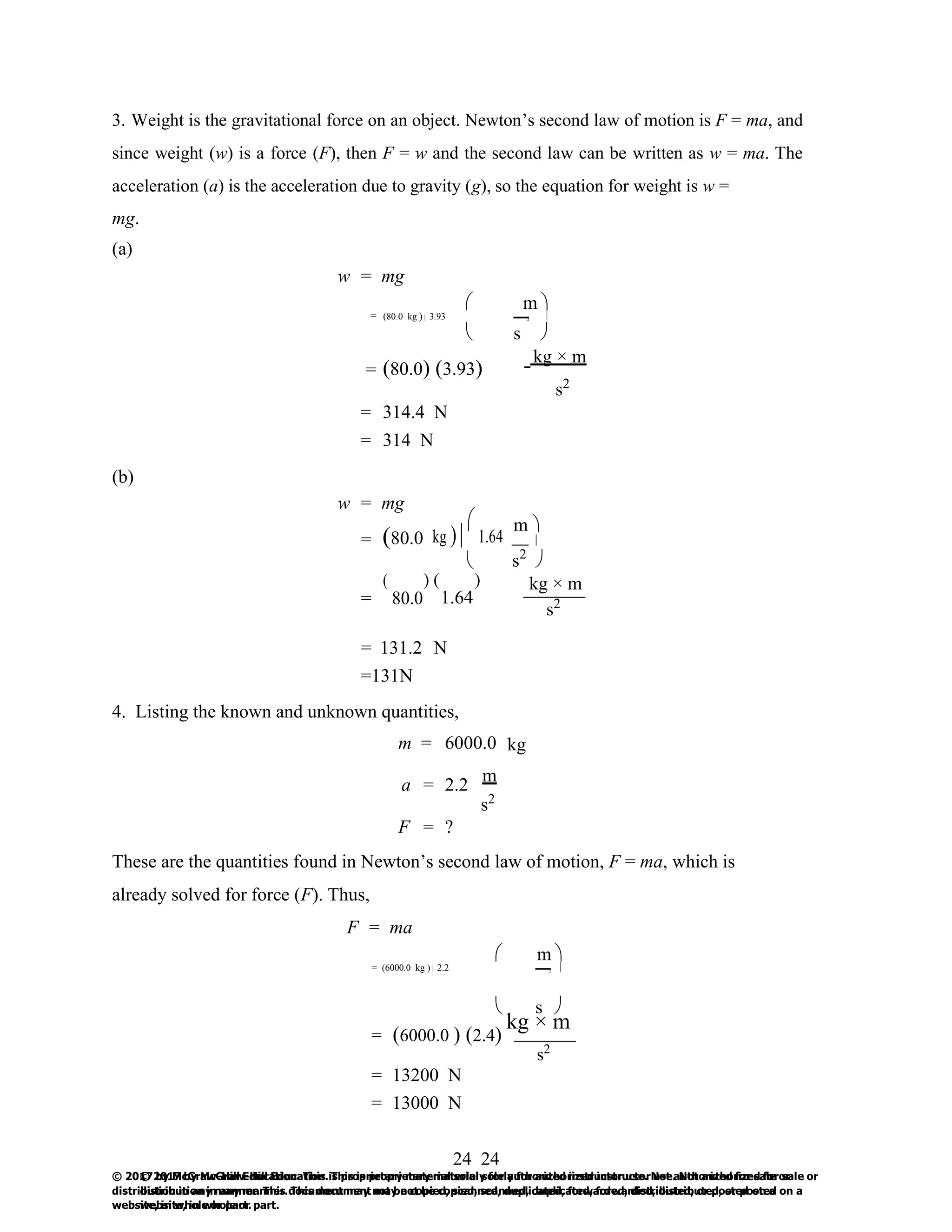
3. Weight is the gravitational force on an object. Newton’s second law of motion is F = ma, and
since weight (w) is a force (F), then F = w and the second law can be written as w = ma. The
acceleration (a) is the acceleration due to gravity (g), so the equation for weight is w =
mg.
(a)
w = mg
 m 
= (80.0 kg )  3.93 2 
 s 
= (80.0) (3.93)
kg × m
s2
(b)
= 314.4 N
= 314 N
w = mg
= (80.0 kg ) 

1.64
m 
(
= 80.0

) ( )
1.64
s2

kg × m
s2
= 131.2 N
=131N
4. Listing the known and unknown quantities,
m = 6000.0 kg
a = 2.2
m
s2
F = ?
These are the quantities found in Newton’s second law of motion, F = ma, which is
already solved for force (F). Thus,
F = ma
= (6000.0 kg )  2.2
 m 
2 
 s 
= (6000.0 ) (2.4)
kg × m
s2
= 13200 N
= 13000 N
25
© 2017 by McGraw-Hill Education. This is proprietary material solely for authorized instructor use. Not authorized for sale or
distribution in any manner. This document may not be copied, scanned, duplicated, forwarded, distributed, or posted on a
website, in whole or part.
25
© 2017 by McGraw-Hill Education. This is proprietary material solely for authorized instructor use. Not authorized for sale or
distribution in any manner. This document may not be copied, scanned, duplicated, forwarded, distributed, or posted on a
website, in whole or part.
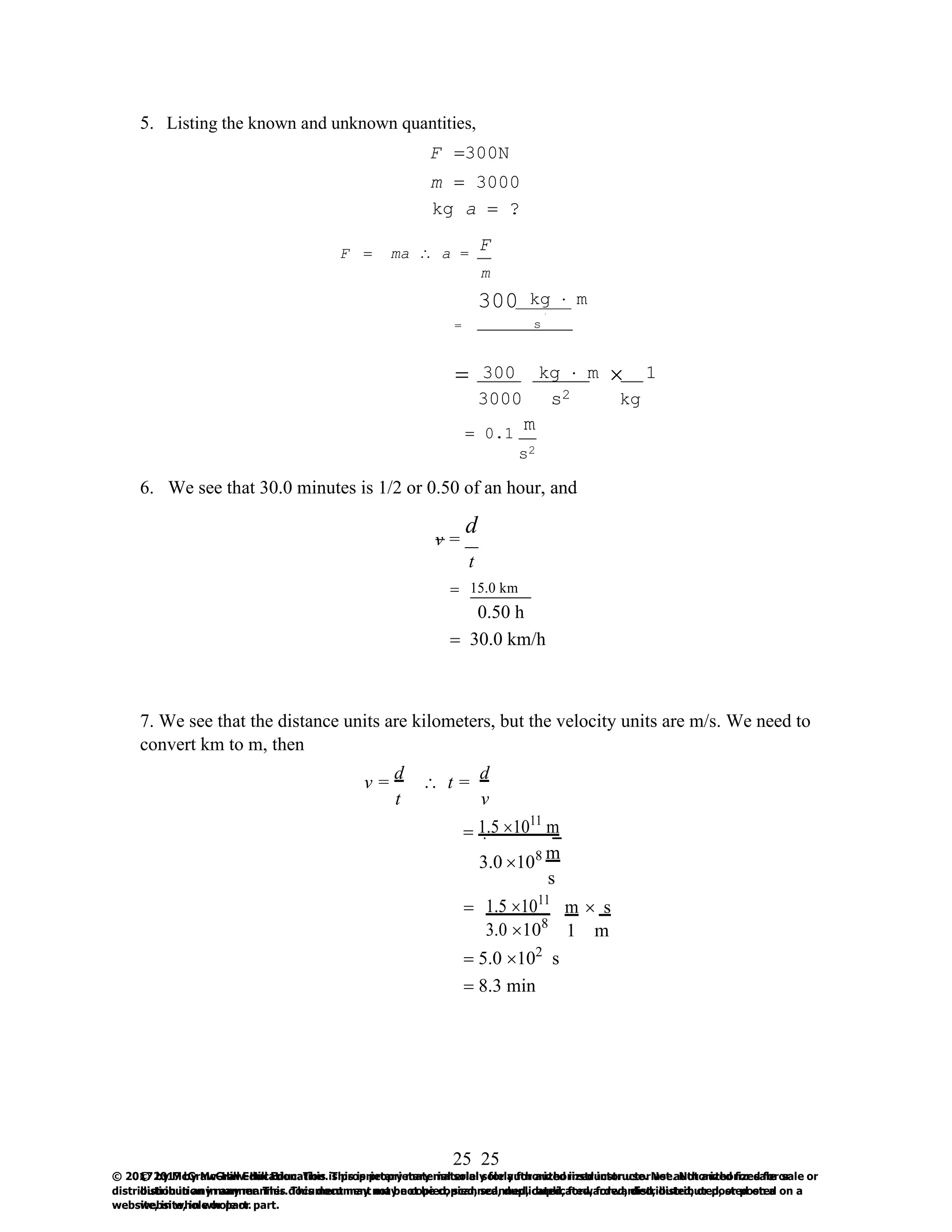
5. Listing the known and unknown quantities,
F =300N
m = 3000
kg a = ?
F = ma  a =
F
m
300 kg  m
2
= s
= 300 kg  m  1
3000 s2 kg
= 0.1
m
s2
6. We see that 30.0 minutes is 1/2 or 0.50 of an hour, and
d
v =
t
= 15.0 km
0.50 h
= 30.0 km/h
7. We see that the distance units are kilometers, but the velocity units are m/s. We need to
convert km to m, then
v =
d
 t =
d
t v
= 1.5 1011
m
3.0 108 m
s
= 1.5 1011
m  s
3.0 108
1 m
= 5.0 102
s
= 8.3 min
Random documents with unrelated
content Scribd suggests to you:
INCLUDING BUT NOT LIMITED TO WARRANTIES OF
MERCHANTABILITY OR FITNESS FOR ANY PURPOSE.
1.F.5. Some states do not allow disclaimers of certain implied
warranties or the exclusion or limitation of certain types of damages.
If any disclaimer or limitation set forth in this agreement violates the
law of the state applicable to this agreement, the agreement shall be
interpreted to make the maximum disclaimer or limitation permitted
by the applicable state law. The invalidity or unenforceability of any
provision of this agreement shall not void the remaining provisions.
1.F.6. INDEMNITY - You agree to indemnify and hold the Foundation,
the trademark owner, any agent or employee of the Foundation,
anyone providing copies of Project Gutenberg™ electronic works in
accordance with this agreement, and any volunteers associated with
the production, promotion and distribution of Project Gutenberg™
electronic works, harmless from all liability, costs and expenses,
including legal fees, that arise directly or indirectly from any of the
following which you do or cause to occur: (a) distribution of this or
any Project Gutenberg™ work, (b) alteration, modification, or
additions or deletions to any Project Gutenberg™ work, and (c) any
Defect you cause.
Section 2. Information about the Mission
of Project Gutenberg™
Project Gutenberg™ is synonymous with the free distribution of
electronic works in formats readable by the widest variety of
computers including obsolete, old, middle-aged and new computers.
It exists because of the efforts of hundreds of volunteers and
donations from people in all walks of life.
Volunteers and financial support to provide volunteers with the
assistance they need are critical to reaching Project Gutenberg™’s
goals and ensuring that the Project Gutenberg™ collection will
remain freely available for generations to come. In 2001, the Project
Gutenberg Literary Archive Foundation was created to provide a
secure and permanent future for Project Gutenberg™ and future
generations. To learn more about the Project Gutenberg Literary
Archive Foundation and how your efforts and donations can help,
see Sections 3 and 4 and the Foundation information page at
www.gutenberg.org.
Section 3. Information about the Project
Gutenberg Literary Archive Foundation
The Project Gutenberg Literary Archive Foundation is a non-profit
501(c)(3) educational corporation organized under the laws of the
state of Mississippi and granted tax exempt status by the Internal
Revenue Service. The Foundation’s EIN or federal tax identification
number is 64-6221541. Contributions to the Project Gutenberg
Literary Archive Foundation are tax deductible to the full extent
permitted by U.S. federal laws and your state’s laws.
The Foundation’s business office is located at 809 North 1500 West,
Salt Lake City, UT 84116, (801) 596-1887. Email contact links and up
to date contact information can be found at the Foundation’s website
and official page at www.gutenberg.org/contact
Section 4. Information about Donations to
the Project Gutenberg Literary Archive
Foundation
Project Gutenberg™ depends upon and cannot survive without
widespread public support and donations to carry out its mission of
increasing the number of public domain and licensed works that can
be freely distributed in machine-readable form accessible by the
widest array of equipment including outdated equipment. Many
small donations ($1 to $5,000) are particularly important to
maintaining tax exempt status with the IRS.
The Foundation is committed to complying with the laws regulating
charities and charitable donations in all 50 states of the United
States. Compliance requirements are not uniform and it takes a
considerable effort, much paperwork and many fees to meet and
keep up with these requirements. We do not solicit donations in
locations where we have not received written confirmation of
compliance. To SEND DONATIONS or determine the status of
compliance for any particular state visit www.gutenberg.org/donate.
While we cannot and do not solicit contributions from states where
we have not met the solicitation requirements, we know of no
prohibition against accepting unsolicited donations from donors in
such states who approach us with offers to donate.
International donations are gratefully accepted, but we cannot make
any statements concerning tax treatment of donations received from
outside the United States. U.S. laws alone swamp our small staff.
Please check the Project Gutenberg web pages for current donation
methods and addresses. Donations are accepted in a number of
other ways including checks, online payments and credit card
donations. To donate, please visit: www.gutenberg.org/donate.
Section 5. General Information About
Project Gutenberg™ electronic works
Professor Michael S. Hart was the originator of the Project
Gutenberg™ concept of a library of electronic works that could be
freely shared with anyone. For forty years, he produced and
distributed Project Gutenberg™ eBooks with only a loose network of
volunteer support.
Project Gutenberg™ eBooks are often created from several printed
editions, all of which are confirmed as not protected by copyright in
the U.S. unless a copyright notice is included. Thus, we do not
necessarily keep eBooks in compliance with any particular paper
edition.
Most people start at our website which has the main PG search
facility: www.gutenberg.org.
This website includes information about Project Gutenberg™,
including how to make donations to the Project Gutenberg Literary
Archive Foundation, how to help produce our new eBooks, and how
to subscribe to our email newsletter to hear about new eBooks.
Welcome to our website – the ideal destination for book lovers and
knowledge seekers. With a mission to inspire endlessly, we offer a
vast collection of books, ranging from classic literary works to
specialized publications, self-development books, and children's
literature. Each book is a new journey of discovery, expanding
knowledge and enriching the soul of the reade
Our website is not just a platform for buying books, but a bridge
connecting readers to the timeless values of culture and wisdom. With
an elegant, user-friendly interface and an intelligent search system,
we are committed to providing a quick and convenient shopping
experience. Additionally, our special promotions and home delivery
services ensure that you save time and fully enjoy the joy of reading.
Let us accompany you on the journey of exploring knowledge and
personal growth!
testbankpack.com

Solution Manual for Physical Science 11th Edition Tillery Slater 9780077862626

  • 1.
    Solution Manual forPhysical Science 11th Edition Tillery Slater 9780077862626 download http://testbankpack.com/download/solution-manual-for-physical- science-11th-edition-tillery-slater-9780077862626/ Explore and download more test bank or solution manual at testbankpack.com

  • 2.
    Here are somesuggested products you might be interested in. Click the link to download Test bank for Physical Science 11th Edition Tillery Slater 9780077862626 https://testbankpack.com/download/test-bank-for-physical-science-11th- edition-tillery-slater-9780077862626/ Solution Manual for Physical Science 10th Edition Tillery 007351389X 9780073513898 https://testbankpack.com/download/solution-manual-for-physical- science-10th-edition-tillery-007351389x-9780073513898/ Test bank for Physical Science 10th Edition Tillery 007351389X 9780073513898 https://testbankpack.com/download/test-bank-for-physical-science-10th- edition-tillery-007351389x-9780073513898/ Solution Manual for Physical Geography 11th Edition Petersen Sack Gabler 1305652649 9781305652644 https://testbankpack.com/download/solution-manual-for-physical- geography-11th-edition-petersen-sack-gabler-1305652649-9781305652644/
  • 3.
    Solution Manual forIntroduction to Physical Science 14th Edition Shipman Wilson Higgins Torres 1305079132 9781305079137 https://testbankpack.com/download/solution-manual-for-introduction-to- physical-science-14th-edition-shipman-wilson-higgins- torres-1305079132-9781305079137/ Test Bank for Physical Geography 11th Edition Petersen Sack Gabler 1305652649 9781305652644 https://testbankpack.com/download/test-bank-for-physical- geography-11th-edition-petersen-sack-gabler-1305652649-9781305652644/ Test Bank for Introduction to Physical Science 14th Edition Shipman Wilson Higgins Torres 1305079132 9781305079137 https://testbankpack.com/download/test-bank-for-introduction-to- physical-science-14th-edition-shipman-wilson-higgins- torres-1305079132-9781305079137/ Solutions Manual for Introduction to Management Science 11th Edition Taylor 0132751917 9780132751919 https://testbankpack.com/download/solutions-manual-for-introduction- to-management-science-11th-edition-taylor-0132751917-9780132751919/ Solution Manual for Investigating Astronomy 2nd Edition Slater Freedman 1464140855 9781464140853 https://testbankpack.com/download/solution-manual-for-investigating- astronomy-2nd-edition-slater-freedman-1464140855-9781464140853/
  • 5.
    Solution Manual forPhysical Science 11th Edition Tillery Slater 9780077862626 Link full download: Solution Manual: https://testbankpack.com/p/solution-manual-for-physical-science-11th- edition-tillery-slater-9780077862626/ Test bank: https://testbankpack.com/p/test-bank-for-physical-science-11th-edition- tillery-slater-9780077862626/ 2 Motion Contents 2.1 Describing Motion 2.2 Measuring Motion Speed Velocity Acceleration Science and Society: Transportation and the Environment Forces 2.3 Horizontal Motion on Land 2.4 Falling Objects A Closer Look: A Bicycle Racer’s Edge 2.5 Compound Motion Vertical Projectiles Horizontal Projectiles A Closer Look: Free Fall 2.6 Three Laws of Motion Newton’s First Law of Motion Newton’s Second Law of Motion Weight and Mass Newton’s Third Law of Motion 2.7 Momentum Conservation of Momentum Impulse 2.8 Forces and Circular Motion 2.9 Newton’s Law of Gravitation Earth Satellites A Closer Look: Gravity Problems Weightlessness People Behind the Science: Isaac Newton
  • 6.
  • 7.
    This chapter primarilycontains the patterns of motion developed by Isaac Newton (A.D. 1642–1727). Newton made many contributions to science, but his three laws of motion and his law of gravitation are the most famous. The three laws of motion are concerned with (1) what happens to the motion of a single object when no unbalanced forces are involved, (2) the relationship between the force, the mass of an object, and the resulting change of motion when an unbalanced force is involved, and (3) the relationship between the force experienced by two objects when they interact. The laws of motion are universal, that is, they apply 13 © 2017 by McGraw-Hill Education. This is proprietary material solely for authorized instructor use. Not authorized for sale or distribution in any manner. This document may not be copied, scanned, duplicated, forwarded, distributed, or posted on a website, in whole or part.
  • 8.
    14 © 2017 byMcGraw-Hill Education. This is proprietary material solely for authorized instructor use. Not authorized for sale or distribution in any manner. This document may not be copied, scanned, duplicated, forwarded, distributed, or posted on a website, in whole or part. 14 © 2017 by McGraw-Hill Education. This is proprietary material solely for authorized instructor use. Not authorized for sale or distribution in any manner. This document may not be copied, scanned, duplicated, forwarded, distributed, or posted on a website, in whole or part. throughout the known universe and describe all motion. Throughout the universe mass is a measure of inertia, and inertia exists everywhere. A change of motion, acceleration, always results from an unbalanced force everywhere in the known universe. Finally, forces of the universe always come in pairs. Of the two forces one force is always equal in magnitude but opposite in direction to the other. The law of gravitation is also applicable throughout the known universe. All objects in the Solar System — the sun and the planets, the earth and its moon, and all orbiting satellites — obey the law of gravitation. Relativistic considerations should not be mentioned at this time. Concentrate on Newton's laws of motion, not Einstein's modifications of them. The key to understanding patterns of motion is to understand simultaneously the ideas represented in the three laws of motion. These areas follow: 1. Inertia is the resistance to a change in the state of motion of an object in the absence of an unbalanced force. An object at rest remains at rest and an object moving in a straight line retains its straight-line motion in the absence of an unbalanced force. The analysis of why a ball moving across a smooth floor comes to a stop, as presented in the previous chapter, is an important part of the development of this concept. Newton's first law of motion is also known as the law of inertia. 2. Mass is defined as a measure of inertia, that is, a resistance to a change in the state of motion of an object. Thus the greater the mass the greater the resistance to a change in the state of motion of an object. Acceleration is a change in the state of motion of an object. According to the definition developed in the previous chapter, an object that speeds up, slows down, or changes its direction of travel is undergoing an acceleration. Students who have difficulty accepting the meanings of mass and acceleration often have less difficulty if they are told these are definitions of the quantities. A force is a push or a pull that is capable of causing a change in the state of motion of an object, that is, capable of producing an acceleration. The resulting acceleration is always in the same direction as the direction of the applied force. Newton's second law of motion is a relationship between mass, acceleration, and an unbalanced force that becomes clear when the conceptual meaning of these terms is understood. The relationship is that the greater the mass (inertia), the greater the force required to bring about a change in the state of motion (acceleration). In symbol form, the relationship is a  F/m, or the more familiar F  ma. Since a newton of force is defined in terms of a certain mass (1 kg) and a certain acceleration (1 m/s 2 ), the units are the same on both sides and the relationship becomes an equation, or F = ma. This is an example of an equation that defines a concept (see chapter 1). 3. A single force never occurs alone; a force is always produced by the interaction of two or more objects. There is always a matched and opposite force that occurs at the same time, and Newton's second law of motion is a statement of this relationship.
  • 9.
    15 © 2017 byMcGraw-Hill Education. This is proprietary material solely for authorized instructor use. Not authorized for sale or distribution in any manner. This document may not be copied, scanned, duplicated, forwarded, distributed, or posted on a website, in whole or part. 15 © 2017 by McGraw-Hill Education. This is proprietary material solely for authorized instructor use. Not authorized for sale or distribution in any manner. This document may not be copied, scanned, duplicated, forwarded, distributed, or posted on a website, in whole or part. Suggestions 1. The need for precision and exact understanding should be emphasized as the various terms such as speed, velocity, rate, distance, acceleration, and others are presented. Stress the reasoning behind each equation, for example, that velocity is a ratio that describes a property of objects in motion. Likewise, acceleration is a time rate of change of velocity, so vf - vi/t not only makes sense but can be reasoned out rather than memorized. Also stress the need to show how units are handled in solving problems. The complete manipulation of units mathematically is stressed throughout this book. Typically students must be shown how unit work serves as a check on problem-solving steps. Students are sometimes confused by the use of the symbol “v” for both speed and velocity. Explain that speed is the same quantity as velocity but without direction, so the same symbol is used to simplify things. On the point of simplifying things, avoid the temptation to use calculus in any explanation or discussion. 2. Students are generally interested in “relative to what” questions concerning motion. For example, what is the speed of an insect flying at 5 mph from the front to the back of a bus moving at 50 mph? What do you observe happening to an object dropped inside an airplane moving at 600 mph? What would an observer outside the airplane observe happening to the object? 3. The discussion of what happens to a ball rolling across the floor is an important one, and many students who think from an “Aristotelian framework” are surprised by the analysis. When discussing the role of friction and objects moving on the earth’s surface, it is often interesting to ask why planets do not stop moving around the sun. Spur on the discussion by answering with another question, why should they stop? It might be helpful to review the meaning of vector arrows that represent forces. 4. Another way to consider acceleration is to ask, How fast does “how fast” change? If students have learned the concept of a ratio they will understand the concept of uniform straight-line motion. The acceleration concepts, however, require the use of a ratio within another ratio, that is, a change of velocity (a ratio within) per unit of time (the acceleration ratio). This understanding is necessary (along with some basic math skills) to understand the meaning of such units as m/s 2 . 5. Demonstrations that illustrate the characteristics of projectile motion are illustrated in several devices found in scientific catalogs. Among the most impressive is the “monkey and hunter” demonstration. Students enjoy this demonstration along with the humor that the instructor can induce while performing it. 6. There are many demonstrations and devices available from scientific suppliers that readily illustrate the laws of motion. However, none seems better than the personal experiences of students who have stood in the aisle of a bus as it starts moving, turns a corner, or comes to a stop. Use the three laws of motion to analyze the inertia, forces, and resulting changes of motion of a student standing in such an aisle of a bus.
  • 10.
    16 © 2017 byMcGraw-Hill Education. This is proprietary material solely for authorized instructor use. Not authorized for sale or distribution in any manner. This document may not be copied, scanned, duplicated, forwarded, distributed, or posted on a website, in whole or part. 16 © 2017 by McGraw-Hill Education. This is proprietary material solely for authorized instructor use. Not authorized for sale or distribution in any manner. This document may not be copied, scanned, duplicated, forwarded, distributed, or posted on a website, in whole or part. 7. Stress that weight and mass are two entirely different concepts. You will probably have to emphasize more than once that weight is another name for the gravitational force acting on an object, and that weight varies from place to place while mass does not. Use the second law of motion to show how weight can be used to calculate mass. A large demonstration spring scale calibrated in newtons can be used to show that a 1-kg mass weighs 9.8 N. Other masses can be weighed to show that weight and mass are proportional in a given location. 8. In solving problems involving the third law of motion, it is helpful for students to realize that a change in the state of motion always occurs in the same direction as the direction of an applied force. If you apply an unbalanced force on a ball toward the North, you would expect the ball to move toward the North. Thus if one starts walking toward the North a force must have been applied in the same direction. The foot pushed on the ground in the opposite direction, so it must be that the equal and opposite force of the ground pushing on the foot is what caused the motion toward the North. It seems almost anthropomorphic to state that the ground pushed on a foot, but no other answer is possible with this analysis. The next step, so to speak, is to realize that since the force of the foot on the ground equals the force of the ground on the foot (third law). Then the mass of the earth times the acceleration of the earth (second law) must equal the mass of the person times the acceleration of the person (ma = ma). This means at least two things: (1) that the earth must move when you walk across the surface (earth's acceleration must be greater than zero) and (2) that the earth would move with the same acceleration as the person if both had the same mass. Students are making progress when they can understand or make this kind of analysis. 9. A strong cord attached to a large coffee can half filled with water makes an interesting demonstration of centripetal force and inertia when whirled overhead. Practice this, however, before trying before a class. 10. Additional demonstrations: (a) Show the stroboscopic effect as a means of measuring motion. Use a strobe light or hand stroboscopes, for example, to “stop” the motion of a spinning wheel of an upside- down bicycle. (b) Roll a steel ball down a long ramp and mark the distance at the end of each second. Plot distance vs. time and distance vs. time squared to verify the acceleration equation. (c) Crumple a sheet of paper tightly into a small ball. Drop the crumpled ball and a sheet of uncrumpled paper from the same height. Discuss which is accelerated at 9.8 m/s 2 and the roll of air resistance. (d) Use the commercial apparatus that shoots or moves one ball horizontally and drops another ball vertically at the same time. A single “click” means that both balls hit the floor at the same time. This illustrates the independence of velocities.
  • 11.
    17 © 2017 byMcGraw-Hill Education. This is proprietary material solely for authorized instructor use. Not authorized for sale or distribution in any manner. This document may not be copied, scanned, duplicated, forwarded, distributed, or posted on a website, in whole or part. 17 © 2017 by McGraw-Hill Education. This is proprietary material solely for authorized instructor use. Not authorized for sale or distribution in any manner. This document may not be copied, scanned, duplicated, forwarded, distributed, or posted on a website, in whole or part. (e) Drop a small steel ball from the highest place practical into a tub of water. Make sure this is done on a day without wind and with no person near the tub. Time the fall with a stopwatch. Measure the vertical distance accurately, then find g from d = 1/2gt 2 . (f) Use a spring scale to show that a 1.0-kg mass weighs 9.8 N. Use other masses to show that the weight of an object is always proportional to the mass in a given location. (g) Use an air track to illustrate Newton’s first and second law of motion. If an air track is not available, consider a slab of ice or dry ice on a smooth demonstration tabletop. Wood blocks can be set on the ice to add mass. (h) Will a jet plane backed up to a brick wall take off faster than one out in the open? Compare the jet plane to a balloon filled with air, that is, a jet of escaping air propels the balloon. Thus, the movement is a consequence of Newton’s third law and the brick wall will make no difference–a jet plane backed up to a brick will take off the same as an identical jet plane out in the open. (i) Seat yourself on a small cart with a CO2 fire extinguisher or a bottle of compressed air from the shop. Hold the device between your feet and legs with the escape valve pointed away from your body. With the way clear behind you, carefully discharge a short burst of gas as you accelerate. This attention-grabber affords an opportunity to review all three of Newton’s Laws of motion. (j) Demonstrate that the acceleration of a freely falling object is independent of weight. Use a commercial “free-fall tube” if one is available. If not, try a large-diameter 1-meter glass or plastic tube with a solid stopper in one end and a one-hole stopper in the other. Place a coil and a feather in the tube, then connect the one-hole stopper to a vacuum pump. Invert the tube to show how the coin and feather fall in air. Pump air from the tube then again invert to show the coin and feather in free fall. For Class Discussions 1. Neglecting air resistance, a ball in freefall will have a. constant speed and constant acceleration. b. increasing speed and increasing acceleration. c. increasing speed and decreasing acceleration. d. increasing speed and constant acceleration. e. decreasing speed and increasing acceleration.
  • 12.
    18 © 2017 byMcGraw-Hill Education. This is proprietary material solely for authorized instructor use. Not authorized for sale or distribution in any manner. This document may not be copied, scanned, duplicated, forwarded, distributed, or posted on a website, in whole or part. 18 © 2017 by McGraw-Hill Education. This is proprietary material solely for authorized instructor use. Not authorized for sale or distribution in any manner. This document may not be copied, scanned, duplicated, forwarded, distributed, or posted on a website, in whole or part. 2. Neglecting air resistance, a ball rolling down the slope of a steep hill will have a. constant speed and constant acceleration. b. increasing speed and increasing acceleration. c. increasing speed and decreasing acceleration. d. increasing speed and constant acceleration. e. decreasing speed and increasing acceleration. 3. Again neglecting air resistance, a ball thrown straight up will come to a momentary stop at the top of the path. What is the acceleration of the ball during this stop? a. 9.8 m/s2 . b. zero. c. less than 9.8 m/s2 . d. more than 9.8 m/s 2 . 4. Again neglecting air resistance, the ball thrown straight up comes to a momentary stop at the top of the path, then falls for 1.0 s. What is speed of the ball after falling 1.0 s? a. 1 m/s b. 4.9 m/s c. 9.8 m/s d. 19.6 m/s 5. Yet again neglecting air resistance, the ball thrown straight up comes to a momentary stop at the top of the path, then falls for 2.0 s. What distance did the ball fall during the 2.0 s? a. 1 m b. 4.9 m c. 9.8 m d. 19.6 m 6. A ball is thrown straight up at the same time a ball is thrown straight down from a bridge, with the same initial speed. Neglecting air resistance, which ball would have a greater speed when it hits the ground? a. The one thrown straight up. b. The one thrown straight down. c. Both balls would have the same speed.
  • 13.
    19 © 2017 byMcGraw-Hill Education. This is proprietary material solely for authorized instructor use. Not authorized for sale or distribution in any manner. This document may not be copied, scanned, duplicated, forwarded, distributed, or posted on a website, in whole or part. 19 © 2017 by McGraw-Hill Education. This is proprietary material solely for authorized instructor use. Not authorized for sale or distribution in any manner. This document may not be copied, scanned, duplicated, forwarded, distributed, or posted on a website, in whole or part. 7. After being released, a ball thrown straight down from a bridge would have an acceleration of a. 9.8 m/s2 . b. zero. c. less than 9.8 m/s2 . d. more than 9.8 m/s2 . 8. A gun is aimed at an apple hanging from a tree. The instant the gun is fired the apple falls to the ground, and the bullet a. hits the apple. b. arrives late, missing the apple. c. may or may not hit the apple, depending on how fast it is moving. 9. You are at rest with a grocery cart at the supermarket, when you see an “opening” in a checkout line. You apply a certain force to the cart for a short time and acquire a certain speed. Neglecting friction, how long would you have to push with half the force to acquire the same final speed? a. one-fourth as long. b. one-half as long. c. for twice as long. d. for four times as long. 10. Once again you are at rest with a grocery cart at the supermarket, when you apply a certain force to the cart for a short time and acquire a certain speed. Suppose you had bought more groceries, enough to double the mass of the groceries and cart. Neglecting friction, doubling the mass would have what effect on the resulting final speed if you used the same force for the same length of time? The new final speed would be a. one-fourth. b. one-half. c. doubled. d. quadrupled. 11. You are moving a grocery cart at a constant speed in a straight line down the aisle of a store. The forces on the cart are a. unbalanced, in the direction of the movement. b. balanced, with a net force of zero. c. equal to the force of gravity acting on the cart. d. greater than the frictional forces opposing the motion of the cart.
  • 14.
    20 © 2017 byMcGraw-Hill Education. This is proprietary material solely for authorized instructor use. Not authorized for sale or distribution in any manner. This document may not be copied, scanned, duplicated, forwarded, distributed, or posted on a website, in whole or part. 20 © 2017 by McGraw-Hill Education. This is proprietary material solely for authorized instructor use. Not authorized for sale or distribution in any manner. This document may not be copied, scanned, duplicated, forwarded, distributed, or posted on a website, in whole or part. 12. Considering the gravitational attraction between the Earth and Moon, the a. more massive Earth pulls harder on the less massive Moon. b. less massive Moon pulls harder on the more massive Earth. c. attraction between the Earth and Moon and the Moon and Earth are equal. d. attraction varies with the Moon phase, being greatest at a full moon. 13. You are outside a store, moving a loaded grocery cart down the street on a very steep hill. It is difficult, but you are able to pull back on the handle and keep the cart moving down the street in a straight line and at a constant speed. The forces on the cart are a. unbalanced, in the direction of the movement. b. balanced, with a net force of zero. c. equal to the force of gravity acting on the cart. d. greater than the frictional forces opposing the motion of the cart. 14. Which of the following must be true about a horse pulling a buggy? a. According to the third law of motion, the horse pulls on the buggy and the buggy pulls on the horse with an equal and opposite force. Therefore the net force is zero and the buggy cannot move. b. Since they move forward, this means the horse is pulling harder on the buggy than the buggy is pulling on the horse. c. The action force from the horse is quicker than the reaction force from the buggy, so the buggy moves forward. d. The action-reaction force between the horse and buggy are equal, but the resisting frictional force on the buggy is smaller since it is on wheels. 15. Suppose you have a choice of driving your speeding car head on into a massive concrete wall or hitting an identical car head on. Which would produce the greatest change in the momentum of your car? a. The identical car. b. The concrete wall. c. Both would be equal. 16. A small, compact car and a large sports utility vehicle collide head on and stick together. Which vehicle had the larger momentum change? a. The small, compact car. b. The large sports utility vehicle. c. Both would be equal.
  • 15.
    21 © 2017 byMcGraw-Hill Education. This is proprietary material solely for authorized instructor use. Not authorized for sale or distribution in any manner. This document may not be copied, scanned, duplicated, forwarded, distributed, or posted on a website, in whole or part. 21 © 2017 by McGraw-Hill Education. This is proprietary material solely for authorized instructor use. Not authorized for sale or distribution in any manner. This document may not be copied, scanned, duplicated, forwarded, distributed, or posted on a website, in whole or part. 17. Again consider the small, compact car and large sports utility vehicle that collided head on and stuck together. Which experienced the larger deceleration during the collision? a. The small, compact car. b. The large sports utility vehicle. c. Both would be equal. 18. Certain professional football players can throw a football so fast that it moves horizontally in a flat trajectory. a. True b. False Answers: 1d, 2c (a = g straight down, but decreases to zero on a level surface), 3a (acceleration is a rate of change of velocity and gravity is acting, F = ma, so a must be occurring), 4b (initial speed was zero, average speed is one-half of final speed), 5d, 6c, 7a (after release only gravity acts on ball), 8a (the apple and bullet accelerate downward together, no matter how fast the bullet is moving), 9c, 10b, 11b, 12c, 13b, 14d, 15c, 16c, 17a, 18b. Answers to Questions for Thought 1. The speed of the insect relative to the ground is the 50.0 mi/h of the bus plus the 5.0 mi/h of the insect for a total of 55 mi/h. Relative to the bus alone the speed of the insect is 5.0 mi/h. 2. After it leaves the rifle barrel, the force of gravity acting straight down is the only force acting on the bullet. 3. Gravity does not depend upon some medium so it can operate in a vacuum. 4. Yes, the small car would have to be moving with a much higher velocity, but it can have the same momentum since momentum is mass times velocity. 5. A net force of zero is required to maintain a constant velocity. The force from the engine balances the force of friction as a car drives with a constant velocity. 6. The action and reaction forces are between two objects that are interacting. An unbalanced force occurs on a single object as the result of one or more interactions with other objects. 7. Bending your knees as you hit the ground extends the stopping time. This is important since the change of momentum is equal to the impulse, which is force times the time. A greater time therefore means less force when coming to a stop. 8. Your weight can change from place to place because weight is a downward force from gravitational attraction on your mass and the force of gravity can vary from place to place. 9. Nothing! There is no force parallel to the motion to increase or decrease Earth's speed, so the speed remains constant.
  • 16.
    22 © 2017 byMcGraw-Hill Education. This is proprietary material solely for authorized instructor use. Not authorized for sale or distribution in any manner. This document may not be copied, scanned, duplicated, forwarded, distributed, or posted on a website, in whole or part. 22 © 2017 by McGraw-Hill Education. This is proprietary material solely for authorized instructor use. Not authorized for sale or distribution in any manner. This document may not be copied, scanned, duplicated, forwarded, distributed, or posted on a website, in whole or part. 10. If you have something to throw, such as car keys or a snowball, you can easily get off the frictionless ice. Since the force you apply to the thrown object results in an equal and opposite force (the third law of motion), you will move in the opposite direction as the object is thrown (the second law of motion). The same result can be achieved by blowing a puff of air in a direction opposite to the way you wish to move. 11. Considering everything else to be equal, the two rockets will have the same acceleration. In both cases, the acceleration results as burning rocket fuel escapes the rocket, exerting an unbalanced force on the rocket (third law) and the rocket accelerates during the applied force (second law). The acceleration has nothing to do with the escaping gases having something to “push against.” 12. The astronaut is traveling with the same speed as the spaceship as he or she leaves. If no net force is applied parallel to the direction of motion of either the astronaut or the spaceship, they will both maintain a constant velocity and will stay together. For Further Analysis 1. Similar – both speed and velocity describe a magnitude of motion, that is, how fast something is moving. Differences – velocity must specify a direction; speed does not. 2. Similar – both velocity and acceleration describe motion. Differences – velocity specifies how fast something is moving in a particular direction; acceleration specified a change of velocity (speed, direction, or both). 3. This requires a comparison of beliefs and an analysis and comparison with new contexts. Answers will vary, but should show understanding of Newton’s three laws of motion. 4. This question requires both clarifying beliefs and comparing perspectives. Answers will vary. 5. Requires refining of understanding. Mass is a measure of inertia, meaning a resistance to a change of motion. Weight is gravitational acceleration acting on a mass. Since gravity can vary from place to place, the weight as a result of gravity will also vary from place to place. 6. Requires clarifying and analyzing several conceptual understandings. Newton’s first law of motion tells us that motion is unchanged in a straight line without an unbalanced force. An object moving on the end of a string in a circular path is pulled out of a straight line by a centripetal force on the string. The object will move off in a straight line if the string breaks. It would move off in some other direction if other forces were involved.
  • 17.
    23 © 2017 byMcGraw-Hill Education. This is proprietary material solely for authorized instructor use. Not authorized for sale or distribution in any manner. This document may not be copied, scanned, duplicated, forwarded, distributed, or posted on a website, in whole or part. 23 © 2017 by McGraw-Hill Education. This is proprietary material solely for authorized instructor use. Not authorized for sale or distribution in any manner. This document may not be copied, scanned, duplicated, forwarded, distributed, or posted on a website, in whole or part. Group B Solutions 1. The distance and time are known and the problem asked for the average velocity. Listing these quantities with heir symbols, we have d = 400.0 km t = 4.5 h v = ? These are the quantities involved in the average speed equation, which is already solved for the unknown average speed: d v = t = 400.0 km 4.5 h km = 89 h 2. Listing the quantities given in this problem, we have d = 16.0 km t = 45 min v = ? The problem specifies that the answer should be in km/h. We see that 45 minutes is 45/60, or 3/4, or 0.75 of an hour, and the appropriate units are: d = 16.0 km t = 0.75 h v = ? Substituting the known quantities, we have v = d t = 16.0 km 0.75 h km = 21.3333 h km = 21 h
  • 18.
    24 © 2017 byMcGraw-Hill Education. This is proprietary material solely for authorized instructor use. Not authorized for sale or distribution in any manner. This document may not be copied, scanned, duplicated, forwarded, distributed, or posted on a website, in whole or part. 24 © 2017 by McGraw-Hill Education. This is proprietary material solely for authorized instructor use. Not authorized for sale or distribution in any manner. This document may not be copied, scanned, duplicated, forwarded, distributed, or posted on a website, in whole or part.  3. Weight is the gravitational force on an object. Newton’s second law of motion is F = ma, and since weight (w) is a force (F), then F = w and the second law can be written as w = ma. The acceleration (a) is the acceleration due to gravity (g), so the equation for weight is w = mg. (a) w = mg  m  = (80.0 kg )  3.93 2   s  = (80.0) (3.93) kg × m s2 (b) = 314.4 N = 314 N w = mg = (80.0 kg )   1.64 m  ( = 80.0  ) ( ) 1.64 s2  kg × m s2 = 131.2 N =131N 4. Listing the known and unknown quantities, m = 6000.0 kg a = 2.2 m s2 F = ? These are the quantities found in Newton’s second law of motion, F = ma, which is already solved for force (F). Thus, F = ma = (6000.0 kg )  2.2  m  2   s  = (6000.0 ) (2.4) kg × m s2 = 13200 N = 13000 N
  • 19.
    25 © 2017 byMcGraw-Hill Education. This is proprietary material solely for authorized instructor use. Not authorized for sale or distribution in any manner. This document may not be copied, scanned, duplicated, forwarded, distributed, or posted on a website, in whole or part. 25 © 2017 by McGraw-Hill Education. This is proprietary material solely for authorized instructor use. Not authorized for sale or distribution in any manner. This document may not be copied, scanned, duplicated, forwarded, distributed, or posted on a website, in whole or part. 5. Listing the known and unknown quantities, F =300N m = 3000 kg a = ? F = ma  a = F m 300 kg  m 2 = s = 300 kg  m  1 3000 s2 kg = 0.1 m s2 6. We see that 30.0 minutes is 1/2 or 0.50 of an hour, and d v = t = 15.0 km 0.50 h = 30.0 km/h 7. We see that the distance units are kilometers, but the velocity units are m/s. We need to convert km to m, then v = d  t = d t v = 1.5 1011 m 3.0 108 m s = 1.5 1011 m  s 3.0 108 1 m = 5.0 102 s = 8.3 min
  • 20.
    Random documents withunrelated content Scribd suggests to you:
  • 21.
    INCLUDING BUT NOTLIMITED TO WARRANTIES OF MERCHANTABILITY OR FITNESS FOR ANY PURPOSE. 1.F.5. Some states do not allow disclaimers of certain implied warranties or the exclusion or limitation of certain types of damages. If any disclaimer or limitation set forth in this agreement violates the law of the state applicable to this agreement, the agreement shall be interpreted to make the maximum disclaimer or limitation permitted by the applicable state law. The invalidity or unenforceability of any provision of this agreement shall not void the remaining provisions. 1.F.6. INDEMNITY - You agree to indemnify and hold the Foundation, the trademark owner, any agent or employee of the Foundation, anyone providing copies of Project Gutenberg™ electronic works in accordance with this agreement, and any volunteers associated with the production, promotion and distribution of Project Gutenberg™ electronic works, harmless from all liability, costs and expenses, including legal fees, that arise directly or indirectly from any of the following which you do or cause to occur: (a) distribution of this or any Project Gutenberg™ work, (b) alteration, modification, or additions or deletions to any Project Gutenberg™ work, and (c) any Defect you cause. Section 2. Information about the Mission of Project Gutenberg™ Project Gutenberg™ is synonymous with the free distribution of electronic works in formats readable by the widest variety of computers including obsolete, old, middle-aged and new computers. It exists because of the efforts of hundreds of volunteers and donations from people in all walks of life. Volunteers and financial support to provide volunteers with the assistance they need are critical to reaching Project Gutenberg™’s goals and ensuring that the Project Gutenberg™ collection will
  • 22.
    remain freely availablefor generations to come. In 2001, the Project Gutenberg Literary Archive Foundation was created to provide a secure and permanent future for Project Gutenberg™ and future generations. To learn more about the Project Gutenberg Literary Archive Foundation and how your efforts and donations can help, see Sections 3 and 4 and the Foundation information page at www.gutenberg.org. Section 3. Information about the Project Gutenberg Literary Archive Foundation The Project Gutenberg Literary Archive Foundation is a non-profit 501(c)(3) educational corporation organized under the laws of the state of Mississippi and granted tax exempt status by the Internal Revenue Service. The Foundation’s EIN or federal tax identification number is 64-6221541. Contributions to the Project Gutenberg Literary Archive Foundation are tax deductible to the full extent permitted by U.S. federal laws and your state’s laws. The Foundation’s business office is located at 809 North 1500 West, Salt Lake City, UT 84116, (801) 596-1887. Email contact links and up to date contact information can be found at the Foundation’s website and official page at www.gutenberg.org/contact Section 4. Information about Donations to the Project Gutenberg Literary Archive Foundation Project Gutenberg™ depends upon and cannot survive without widespread public support and donations to carry out its mission of increasing the number of public domain and licensed works that can be freely distributed in machine-readable form accessible by the widest array of equipment including outdated equipment. Many
  • 23.
    small donations ($1to $5,000) are particularly important to maintaining tax exempt status with the IRS. The Foundation is committed to complying with the laws regulating charities and charitable donations in all 50 states of the United States. Compliance requirements are not uniform and it takes a considerable effort, much paperwork and many fees to meet and keep up with these requirements. We do not solicit donations in locations where we have not received written confirmation of compliance. To SEND DONATIONS or determine the status of compliance for any particular state visit www.gutenberg.org/donate. While we cannot and do not solicit contributions from states where we have not met the solicitation requirements, we know of no prohibition against accepting unsolicited donations from donors in such states who approach us with offers to donate. International donations are gratefully accepted, but we cannot make any statements concerning tax treatment of donations received from outside the United States. U.S. laws alone swamp our small staff. Please check the Project Gutenberg web pages for current donation methods and addresses. Donations are accepted in a number of other ways including checks, online payments and credit card donations. To donate, please visit: www.gutenberg.org/donate. Section 5. General Information About Project Gutenberg™ electronic works Professor Michael S. Hart was the originator of the Project Gutenberg™ concept of a library of electronic works that could be freely shared with anyone. For forty years, he produced and distributed Project Gutenberg™ eBooks with only a loose network of volunteer support.
  • 24.
    Project Gutenberg™ eBooksare often created from several printed editions, all of which are confirmed as not protected by copyright in the U.S. unless a copyright notice is included. Thus, we do not necessarily keep eBooks in compliance with any particular paper edition. Most people start at our website which has the main PG search facility: www.gutenberg.org. This website includes information about Project Gutenberg™, including how to make donations to the Project Gutenberg Literary Archive Foundation, how to help produce our new eBooks, and how to subscribe to our email newsletter to hear about new eBooks.
  • 25.
    Welcome to ourwebsite – the ideal destination for book lovers and knowledge seekers. With a mission to inspire endlessly, we offer a vast collection of books, ranging from classic literary works to specialized publications, self-development books, and children's literature. Each book is a new journey of discovery, expanding knowledge and enriching the soul of the reade Our website is not just a platform for buying books, but a bridge connecting readers to the timeless values of culture and wisdom. With an elegant, user-friendly interface and an intelligent search system, we are committed to providing a quick and convenient shopping experience. Additionally, our special promotions and home delivery services ensure that you save time and fully enjoy the joy of reading. Let us accompany you on the journey of exploring knowledge and personal growth! testbankpack.com