7 
Rotational Motion and 
the Law of Gravity 
CLICKER QUESTIONS 
Question A3.03a 
Description: Developing intuition about circular motion and gravitation. 
Question 
Estimate the speed of the Earth relative to the Sun in m s. 
1. Less than 0.003 
2. Between 0.003 and 0.03 
3. Between 0.03 and 0.3 
4. Between 0.3 and 3 
5. Between 3 and 30 
6. Between 30 and 300 
7. Between 300 and 3 000 
8. Between 3 000 and 30 000 
9. More than 30 000 
10. Impossible to determine 
Commentary 
Purpose: To develop your intuition about circular motion and gravitation. 
Discussion: Relative to the Sun, the Earth travels in a circular orbit whose radius is about 93 million miles 
(150 million km) and whose period is about 365 days. Therefore, the Earth travels at a constant speed of 
about 2π (150 × 106 km) (365 days), which is just under 30 000 m s, or about 60 000 mph. 
Key Points: 
• For an object moving with constant speed, the speed is equal to the distance traveled in some time 
period divided by the duration of that time period. 
• For uniform circular motion, speed can be found from circumference divided by period of rotation. 
For Instructors Only 
This is the fi rst of two questions asking students to work out numerical values for the speed and accelera-tion 
of the Earth relative to the Sun. The context is to fi nd the strength of the gravitational fi eld of the Sun 
at the Earth. 
307
308 Chapter 7 
If desired, only the second of these questions is needed. 
If students don’t know the relevant astronomical measurements, they should be encouraged to estimate 
them. 
One possible point to discuss (after answers are collected and displayed) is the signifi cance of the phrase 
“relative to the Sun” in the question. 
(Technically, the period of the orbit of the Earth about the Sun is closer to 365.25 days. We are ignoring this 
effect.) 
Question A3.03b 
Description: Developing intuition about circular motion and gravitation. 
Question 
Estimate the acceleration of the Earth relative to the Sun in m s2. 
1. Less than 0.003 
2. Between 0.003 and 0.03 
3. Between 0.03 and 0.3 
4. Between 0.3 and 3 
5. Between 3 and 30 
6. Between 30 and 300 
7. Between 300 and 3 000 
8. Between 3 000 and 30 000 
9. More than 30 000 
10. Impossible to determine 
Commentary 
Purpose: To develop your intuition about circular motion and gravitation. 
Discussion: The Earth is traveling at a speed of about 30 000 m s (60 000 mph) relative to the Sun, as 
discussed in the previous question. 
The Earth is also moving in a circle, so its velocity vector is constantly changing direction. Thus, it is expe-riencing 
an acceleration. For an object traveling in a circle at constant speed (“uniform circular motion”), 
the acceleration vector points towards the center of the circle and has a magnitude of v2 R. Since the radius 
of the Earth’s orbit is 150 000 000 km, its acceleration is toward the Sun has a magnitude of 0.006 m s2. 
This is a very, very small acceleration (11 600 of the acceleration of an object dropped at the Earth’s 
surface, relative to the Earth). 
Because the gravitational force exerted by the Sun is the only force on the Earth, this value is also the 
gravitational fi eld strength g of the Sun, i.e., 0.006 Nkg. (The Moon exerts a negligible force on the Earth.) 
Key points: 
• The acceleration of the Earth relative to the Sun is quite small. 
• The acceleration of the Earth relative to the Sun is also the gravitational fi eld strength of the Sun at the 
Earth, only about 0.006 Nkg.
Rotational Motion and the Law of Gravity 309 
For Instructors Only 
This is the second of two questions asking students to use astronomical data to compute a motion quantity. 
This particular quantity, by Newton’s second law, is also the strength of the “local” gravitational fi eld of the 
Sun at the Earth. 
Students choosing one of the larger answers may be guessing, based on the magnitude of the previous 
question’s answer (the speed of the Earth). 
Another likely source of error is units confusion: answering in kmh or kms or mph, for example. 
This question pair also presents another opportunity to discuss the fact that we “feel” accelerations, not 
velocities. The fact that we cannot sense the Earth’s motion implies that the Earth’s acceleration, but not 
necessarily its velocity, must be small. 
Question A3.04a 
Description: Working with circular motion, and developing intuition about kinematic quantities in an 
astronomical context. 
Question 
An object is at rest on the equator. Estimate its speed relative to the center of the Earth in ms. 
1. Less than 0.001 
2. Between 0.001 and 0.01 
3. Between 0.01 and 0.1 
4. Between 0.1 and 1 
5. Between 1 and 10 
6. Between 10 and 100 
7. Between 100 and 1 000 
8. Between 1 000 and 10 000 
9. More than 10 000 
10. Impossible to determine 
Commentary 
Purpose: To explore your current perceptions of circular motion, and set up the subsequent question. 
Discussion: A point on the equator is about 4 000 miles, or about 6 400 km, from the center of the Earth. 
Due to the rotation of the Earth once every 24 hours, this point is moving and thus has a nonzero speed. The 
point travels one circumference of the Earth in 24 hours, so the speed is constant and equal to the distance 
traveled divided by the time taken: 2p (6 400 km)(24 h) = 465 ms, or about 1 000 mph; answer (7). 
Note that as we move toward the poles, the speed becomes smaller, because the circumference of the circle 
traveled every day is smaller. At the poles, this speed is zero. 
Answering this question requires you to estimate the radius of the earth. This is a valuable “benchmark” 
number to know. However, even if you don’t know it, you should be able to estimate it with suffi cient 
accuracy to answer the question correctly: any estimate between 1 375 and 13 750 km will produce the 
correct answer. By comparing to known geographical distances—for example, that the width of the lower 
48 U.S. states is about 3 000 miles or 4 800 km—you can fi gure that it should be somewhere between 
5 000 and 10 000 km.
310 Chapter 7 
Key Points: 
• The speed of a point on the equator of the Earth is quite large, about 1 000 mph. 
• The speed of a point on the surface of the Earth becomes smaller away from the equator, because the 
circle traveled in one day becomes smaller. 
• The Earth’s radius is approximately 4 000 miles or 6 400 km. 
• If you don’t know a number such as the Earth’s radius, you can often estimate it by comparing it to 
similar distances you do know. 
• Your body cannot feel that you are moving at a high speed; you can only feel accelerations, not speeds. 
For Instructors Only 
This is the fi rst of two questions using this situation. The goals of this set are to help students distinguish 
velocity and acceleration better, if they have not done so yet, and to help students see that many experi-ments 
and demonstrations are still valid in spite of the acceleration of the classroom relative to the center of 
the Earth. 
Students might be surprised to learn just how fast a point on the equator is moving due to the Earth’s 
rotation, since they don’t feel any motion. 
One possible source of confusion is that students must realize a point on the Earth returns to almost the 
same position every 24 hours; this can be diffi cult for some to visualize. (Note that this is not absolutely 
true, since we are orbiting the Sun. There is a 1365 correction: because we are orbiting the Sun, we rotate 
366 times every 365 days. This is irrelevant for an estimate, but instructors should be aware of the fact 
nonetheless.) 
An interesting and, for this problem, useful fact to know is that the meter is defi ned such that a (particular) 
quarter circle on the Earth has a length of 10 000 km. Thus, the circumference of the Earth at the equator is 
about 40 000 km. 
Question A3.04b 
Description: Working with circular motion, and developing intuition about kinematic quantities in an 
astronomical context. 
Question 
An object is at rest on the equator. Estimate its acceleration relative to the center of the Earth in ms2. 
1. Less than 0.001 
2. Between 0.001 and 0.01 
3. Between 0.01 and 0.1 
4. Between 0.1 and 1 
5. Between 1 and 10 
6. Between 10 and 100 
7. Between 100 and 1 000 
8. Between 1 000 and 10 000 
9. More than 10 000 
10. Impossible to determine
Rotational Motion and the Law of Gravity 311 
Commentary 
Purpose: To consider the validity of Newton’s laws in a reference frame fi xed to the Earth’s surface. 
Discussion: An object “at rest” on the equator is moving at about 465 ms (about 1 000 mph) relative to 
the center of the Earth, as discussed in the previous question. 
The object is also moving at constant speed in a circle having a radius of 6 400 km, so its acceleration is 
toward the center of the Earth and has a magnitude of v2 R = 0.033 m s2. This is a very small acceleration. 
(An object starting from rest and accelerating with this value would take about 3 minutes to reach a normal 
walking speed of 3 mph.) 
Even though objects “at rest” on the surface of the Earth are moving very quickly, we do not perceive any 
motion at all, because the acceleration is so small. This means that many experiments and demonstrations 
performed on the surface of the Earth are valid and do not violate Newton’s laws. In other words, the sur-face 
of the Earth may be considered an inertial (Newtonian) frame of reference for all but the most sensitive 
experiments. This is good, since Newton’s laws were discovered in this frame! 
Note that as we move toward the poles, the acceleration becomes smaller, and the direction is no longer 
toward the center of the Earth, but toward the axis about which the Earth rotates. (Think about the circle 
being traveled and where its center is located.) 
Key Points: 
• The acceleration of an object moving in a circle with constant speed is equal to v2 R. 
• We get no “sense of motion” from high speed, only from high acceleration. 
• Although a point on the Earth’s surface is not a Newtonian (nonaccelerating) reference frame, it is 
close enough to one that many experiments and demonstrations used to confi rm Newton’s laws are still 
valid. 
• A frame with large velocity does not invalidate Newton’s laws; a frame with large acceleration does. 
For Instructors Only 
This is the second of two questions using this situation. 
The main point of this question is not about the mechanics of circular motion (e.g., computing speeds and 
acceleration), but about valid Newtonian frames of reference. 
Students in introductory physics should be warned against imagining themselves as part of a system under-going 
accelerated motion. For instance, when discussing a car going around a curve in the road, many stu-dents 
will imagine being the driver or a passenger. This raises many issues that students are not prepared to 
deal with properly, such as fi ctitious forces like the centrifugal force. Thus, it is often best to simply remind 
students that Newton’s laws are valid only in “inertial” frames, i.e., frames that are not accelerating, so they 
should always “view” the process from a proper frame. 
Some students will naturally be curious about why we can validate Newton’s laws within the classroom, 
since it is accelerating. Some of these students will still not have a fi rm grasp on the difference between 
velocity and acceleration, and when they discover just how quickly we are moving (either relative to the 
center of the Earth or relative to the Sun), they might have trouble accepting the whole Newtonian model. 
Thus, they might need to be reminded that Newton’s laws are perfectly valid in a moving but inertial 
reference frame (e.g., a train) and that constant-velocity motion cannot be detected. It is acceleration that 
invalidates a moving frame, and the accelerations involved in a “laboratory” frame are very small.
312 Chapter 7 
Students might not appreciate the importance or value of the phrase “relative to the center of the Earth.” 
The question is ambiguous without defi ning the frame of reference; the acceleration of the object is zero 
from a “laboratory” frame fi xed to the Earth’s surface. 
If students do not know that the acceleration is v2 R or that the radius of the Earth is about 6 400 km, they 
should be encouraged to guess. They can still benefi t from the question and subsequent discussion. 
Students who choose a large value may be confusing velocity and acceleration, or assuming that a large 
velocity is likely to indicate a large acceleration. 
Students who select the smallest answer may do so because they believe the acceleration is zero; this 
should be drawn out during discussion. 
Question A3.05a 
Description: Working with circular motion, and developing intuition about kinematic quantities in an 
astronomical context. 
Question 
Estimate the speed of the Moon relative to the center of the Earth in ms. 
1. Less than 0.003 
2. Between 0.003 and 0.03 
3. Between 0.03 and 0.3 
4. Between 0.3 and 3 
5. Between 3 and 30 
6. Between 30 and 300 
7. Between 300 and 3 000 
8. Between 3 000 and 30 000 
9. More than 30 000 
10. Impossible to determine 
Commentary 
Purpose: To challenge your perceptions about circular motion, speed, velocity, and acceleration. 
Discussion: Relative to the Earth, the Moon travels in a circular orbit whose radius is about 250 000 mi 
(400 000 km) and whose period is about 28 days. Therefore, the Moon travels at a constant speed of about 
2π(400 000 km)(28 days), which is about 1 000 ms or about 2 000 mph: answer (7). 
If you don’t know the radius of the Moon’s orbit, you can estimate it. The Moon’s radius is roughly one 
quarter of the Earth’s, or about 1 600 km (actually, it’s 1 738 km). If the Moon were only ten Earth radii 
from the Earth, it would look very large indeed when overhead! Something closer to 100 Earth radii is more 
reasonable. (The actual value is about 60.) If it were much farther than that, it would appear much smaller 
to the eye than it does; you can sketch a diagram and do some simple geometry to see that. 
Key Points: 
• The Moon’s orbital distance from the Earth is approximately 60 times the radius of the Earth. 
• The Moon travels at high speed in its orbit around the Earth.
Rotational Motion and the Law of Gravity 313 
For Instructors Only 
This is the fi rst of two questions asking students to work out numerical values for the speed and accelera-tion 
of the Moon relative to the Earth. 
Students might just guess, perhaps because they are not sure how to estimate the speed, or because they do 
not know the relevant values for the radius or period of the Moon’s orbit around the Earth. This is not bad; 
it helps students to adjust their physical intuition and sense of numbers, and opens up a discussion about 
ways to estimate physical quantities and place bounds on guesses. 
Students might use 30 days as the period of the Moon’s orbit, since that is the typical time between full 
moons. This is okay, since we are interested only in an estimate, but it should be noted that 30 days is not 
strictly correct. Since the Earth does not remain is the same place relative to the Sun, the Moon must travel 
a little farther than one complete period to reach a position where it is full as seen from the Earth. 
Students who choose answer (4) may have computed the correct value in kms and failed to convert 
to ms. 
A valuable follow-up question is to ask how the answer would change if the question asked about the 
Moon’s speed relative to the Sun. (It would be very much larger.) 
Question A3.05b 
Description: Working with circular motion, and developing intuition about kinematic quantities in an 
astronomical context. 
Question 
Estimate the acceleration of the Moon relative to the center of the Earth in m s2. 
1. Less than 0.003 
2. Between 0.003 and 0.03 
3. Between 0.03 and 0.3 
4. Between 0.3 and 3 
5. Between 3 and 30 
6. Between 30 and 300 
7. Between 300 and 3 000 
8. Between 3 000 and 30 000 
9. More than 30 000 
10. Impossible to determine 
Commentary 
Purpose: To challenge your perceptions about circular motion, speed, velocity, and acceleration. 
Discussion: The Moon is traveling at a speed of about 1 000 ms (2 000 mph) relative to the Earth, as 
discussed in the previous question. 
The Moon is also moving at constant speed in a circle having a radius of 400 000 km, so its acceleration is 
toward the Earth and has a magnitude of v2 R = 0.002 7 m s2. This is a very, very small acceleration.
314 Chapter 7 
Key points: 
• For an object moving in a circle with uniform speed, its acceleration is v2R towards the center of the 
circle. 
• The Moon is an example of something that has a speed much larger than we are accustomed to 
(2 000 mph) but an acceleration that is much smaller than we are accustomed to (about 0.003 m/s2). 
• Large speeds do not always indicate large accelerations. If the radius of the circular path is very large, 
the acceleration can be small even for large speed. 
For Instructors Only 
This is the second of two questions exploring students perceptions of speed and acceleration of objects 
in circular motion. Students often think that a large speed is associated with a large acceleration; this is a 
familiar situation challenging that intuition. 
Students might guess, and that is okay, since the question aims to develop students’ physical intuition and 
sense of physical quantities. Many will guess a large value because they think that the acceleration is large 
when the speed is large. They do not always have an accurate sense of the effect of large circles. 
Determining the answer in incorrect units, such as kmh, kms, or mph, is a common error. 
Technically, the radius of the circular orbit is very slightly smaller than the Earth–Moon distance, because 
the center of mass of the system is not at the center of the Earth. It is about 5 000 km from the Earth’s 
center (or about 1 500 km below the surface of the Earth). We are ignoring this effect. Further, students are 
asked to fi nd the acceleration “relative to the center of the Earth,” which means this effect is not relevant. 
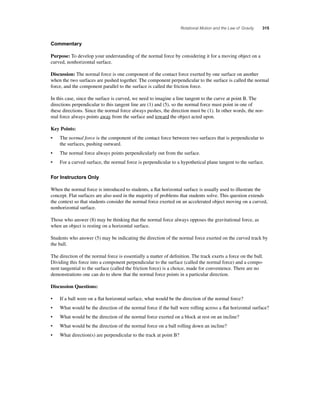
Question B1.07a 
Description: Develop understanding of “normal force” in an extended context. 
Question 
A small ball is released from rest at position A and rolls down a vertical circular track under the infl uence of 
gravity. 
1 
When the ball reaches position B, which of the indicated directions most nearly corresponds to the direction 
of the normal force on the ball? 
Enter (9) if the direction cannot be determined. 
8 
7 
6 2 
5 3 
4 
A 
B 
C
Rotational Motion and the Law of Gravity 315 
Commentary 
Purpose: To develop your understanding of the normal force by considering it for a moving object on a 
curved, nonhorizontal surface. 
Discussion: The normal force is one component of the contact force exerted by one surface on another 
when the two surfaces are pushed together. The component perpendicular to the surface is called the normal 
force, and the component parallel to the surface is called the friction force. 
In this case, since the surface is curved, we need to imagine a line tangent to the curve at point B. The 
directions perpendicular to this tangent line are (1) and (5), so the normal force must point in one of 
these directions. Since the normal force always pushes, the direction must be (1). In other words, the nor-mal 
force always points away from the surface and toward the object acted upon. 
Key Points: 
• The normal force is the component of the contact force between two surfaces that is perpendicular to 
the surfaces, pushing outward. 
• The normal force always points perpendicularly out from the surface. 
• For a curved surface, the normal force is perpendicular to a hypothetical plane tangent to the surface. 
For Instructors Only 
When the normal force is introduced to students, a fl at horizontal surface is usually used to illustrate the 
concept. Flat surfaces are also used in the majority of problems that students solve. This question extends 
the context so that students consider the normal force exerted on an accelerated object moving on a curved, 
nonhorizontal surface. 
Those who answer (8) may be thinking that the normal force always opposes the gravitational force, as 
when an object is resting on a horizontal surface. 
Students who answer (5) may be indicating the direction of the normal force exerted on the curved track by 
the ball. 
The direction of the normal force is essentially a matter of defi nition. The track exerts a force on the ball. 
Dividing this force into a component perpendicular to the surface (called the normal force) and a compo-nent 
tangential to the surface (called the friction force) is a choice, made for convenience. There are no 
demonstrations one can do to show that the normal force points in a particular direction. 
Discussion Questions: 
• If a ball were on a fl at horizontal surface, what would be the direction of the normal force? 
• What would be the direction of the normal force if the ball were rolling across a fl at horizontal surface? 
• What would be the direction of the normal force exerted on a block at rest on an incline? 
• What would be the direction of the normal force on a ball rolling down an incline? 
• What direction(s) are perpendicular to the track at point B?
316 Chapter 7 
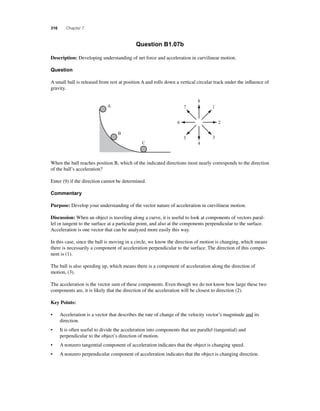
Question B1.07b 
Description: Developing understanding of net force and acceleration in curvilinear motion. 
Question 
A small ball is released from rest at position A and rolls down a vertical circular track under the infl uence of 
gravity. 
8 
7 
1 
6 2 
5 3 
4 
A 
B 
C 
When the ball reaches position B, which of the indicated directions most nearly corresponds to the direction 
of the ball’s acceleration? 
Enter (9) if the direction cannot be determined. 
Commentary 
Purpose: Develop your understanding of the vector nature of acceleration in curvilinear motion. 
Discussion: When an object is traveling along a curve, it is useful to look at components of vectors paral-lel 
or tangent to the surface at a particular point, and also at the components perpendicular to the surface. 
Acceleration is one vector that can be analyzed more easily this way. 
In this case, since the ball is moving in a circle, we know the direction of motion is changing, which means 
there is necessarily a component of acceleration perpendicular to the surface. The direction of this compo-nent 
is (1). 
The ball is also speeding up, which means there is a component of acceleration along the direction of 
motion, (3). 
The acceleration is the vector sum of these components. Even though we do not know how large these two 
components are, it is likely that the direction of the acceleration will be closest to direction (2). 
Key Points: 
• Acceleration is a vector that describes the rate of change of the velocity vector’s magnitude and its 
direction. 
• It is often useful to divide the acceleration into components that are parallel (tangential) and 
perpendicular to the object’s direction of motion. 
• A nonzero tangential component of acceleration indicates that the object is changing speed. 
• A nonzero perpendicular component of acceleration indicates that the object is changing direction.
Rotational Motion and the Law of Gravity 317 
For Instructors Only 
It is common for students to neglect one component or the other. Those who focus excessively on the ball’s 
speeding up will choose direction (3), while those who focus excessively on the “radial” acceleration will 
choose direction (1). 
Choosing (9), impossible to determine, is valid in this context, since we are assuming that students do 
not have suffi cient experience to derive the relationships needed to be specifi c. These students should be 
pressed to fi nd out the range of answers. They should recognize that if the “perpendicular” component is 
much larger than the “parallel” component, then the best answer is direction (1). For a wide range of com-ponents, 
the best answer is direction (2). If the “parallel” component is much larger, then the best answer is 
direction (3). 
Students might not realize just how large the ratio of components must be for direction (1) or (3) to be the 
best answer. The ratio must be more than 2.4. 
Worked out carefully, the perpendicular component of acceleration is twice as large as its parallel compo-nent, 
so the direction of the acceleration is 18.43 degrees above direction (2). 
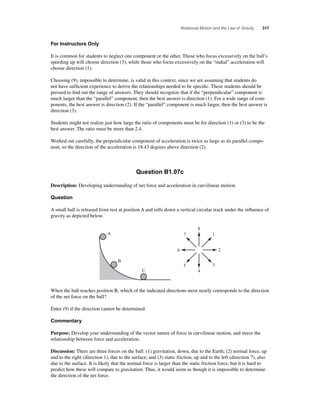
Question B1.07c 
Description: Developing understanding of net force and acceleration in curvilinear motion. 
Question 
A small ball is released from rest at position A and rolls down a vertical circular track under the infl uence of 
gravity as depicted below. 
8 
7 
1 
6 2 
5 3 
4 
A 
B 
C 
When the ball reaches position B, which of the indicated directions most nearly corresponds to the direction 
of the net force on the ball? 
Enter (9) if the direction cannot be determined. 
Commentary 
Purpose: Develop your understanding of the vector nature of force in curvilinear motion, and stress the 
relationship between force and acceleration. 
Discussion: There are three forces on the ball: (1) gravitation, down, due to the Earth; (2) normal force, up 
and to the right (direction 1), due to the surface; and (3) static friction, up and to the left (direction 7), also 
due to the surface. It is likely that the normal force is larger than the static friction force, but it is hard to 
predict how these will compare to gravitation. Thus, it would seem as though it is impossible to determine 
the direction of the net force.
318 Chapter 7 
However, there is another way to look at this situation. According to Newton’s second law, the direction 
of the net force must be the same as the direction of the acceleration. In the previous question, we found 
that the ball’s acceleration vector points approximately in direction (2). Thus, the net force must also point 
that way. 
Key Points: 
• The net force on an object and the object's acceleration vector always have the same direction. 
For Instructors Only 
You may think this question is highly redundant with the previous one, but many students still get it wrong. 
They focus on the individual forces and try to fi gure out what the sum will be, and ignore Newton’s 
second law. 
Students will choose (1) if they are focusing excessively on the normal force. 
They will choose (3) if they are focusing on the component of gravitation parallel to the incline, and ignor-ing 
the normal force. 
They will choose (4) if they think the net force is the gravitational force. 
They will choose (5) if they think the net force is the centrifugal force. 
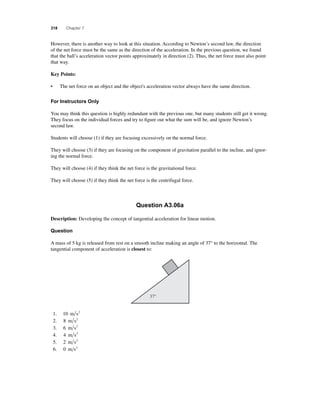
Question A3.06a 
Description: Developing the concept of tangential acceleration for linear motion. 
Question 
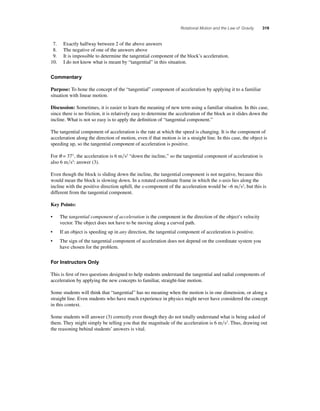
A mass of 5 kg is released from rest on a smooth incline making an angle of 37° to the horizontal. The 
tangential component of acceleration is closest to: 
1. 10 m s2 
2. 8 m s2 
3. 6 m s2 
4. 4 m s2 
5. 2 m s2 
6. 0 m s2 
37°
Rotational Motion and the Law of Gravity 319 
7. Exactly halfway between 2 of the above answers 
8. The negative of one of the answers above 
9. It is impossible to determine the tangential component of the block’s acceleration. 
10. I do not know what is meant by “tangential” in this situation. 
Commentary 
Purpose: To hone the concept of the “tangential” component of acceleration by applying it to a familiar 
situation with linear motion. 
Discussion: Sometimes, it is easier to learn the meaning of new term using a familiar situation. In this case, 
since there is no friction, it is relatively easy to determine the acceleration of the block as it slides down the 
incline. What is not so easy is to apply the defi nition of “tangential component.” 
The tangential component of acceleration is the rate at which the speed is changing. It is the component of 
acceleration along the direction of motion, even if that motion is in a straight line. In this case, the object is 
speeding up, so the tangential component of acceleration is positive. 
For θ = 37°, the acceleration is 6 ms2 “down the incline,” so the tangential component of acceleration is 
also 6 ms2: answer (3). 
Even though the block is sliding down the incline, the tangential component is not negative, because this 
would mean the block is slowing down. In a rotated coordinate frame in which the x-axis lies along the 
incline with the positive direction uphill, the x-component of the acceleration would be –6 ms2, but this is 
different from the tangential component. 
Key Points: 
• The tangential component of acceleration is the component in the direction of the object’s velocity 
vector. The object does not have to be moving along a curved path. 
• If an object is speeding up in any direction, the tangential component of acceleration is positive. 
• The sign of the tangential component of acceleration does not depend on the coordinate system you 
have chosen for the problem. 
For Instructors Only 
This is fi rst of two questions designed to help students understand the tangential and radial components of 
acceleration by applying the new concepts to familiar, straight-line motion. 
Some students will think that “tangential” has no meaning when the motion is in one dimension, or along a 
straight line. Even students who have much experience in physics might never have considered the concept 
in this context. 
Some students will answer (3) correctly even though they do not totally understand what is being asked of 
them. They might simply be telling you that the magnitude of the acceleration is 6 ms2. Thus, drawing out 
the reasoning behind students’ answers is vital.
320 Chapter 7 
Question A3.06b 
Description: Developing the concept of radial acceleration for linear motion. 
Question 
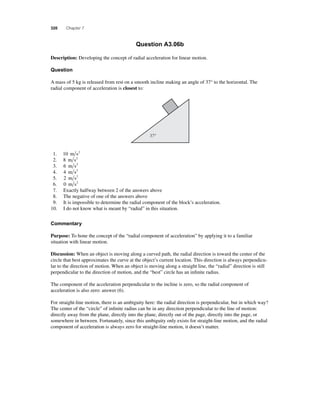
A mass of 5 kg is released from rest on a smooth incline making an angle of 37° to the horizontal. The 
radial component of acceleration is closest to: 
37° 
1. 10 m s2 
2. 8 m s2 
3. 6 m s2 
4. 4 m s2 
5. 2 m s2 
6. 0 m s2 
7. Exactly halfway between 2 of the answers above 
8. The negative of one of the answers above 
9. It is impossible to determine the radial component of the block’s acceleration. 
10. I do not know what is meant by “radial” in this situation. 
Commentary 
Purpose: To hone the concept of the “radial component of acceleration” by applying it to a familiar 
situation with linear motion. 
Discussion: When an object is moving along a curved path, the radial direction is toward the center of the 
circle that best approximates the curve at the object’s current location. This direction is always perpendicu-lar 
to the direction of motion. When an object is moving along a straight line, the “radial” direction is still 
perpendicular to the direction of motion, and the “best” circle has an infi nite radius. 
The component of the acceleration perpendicular to the incline is zero, so the radial component of 
acceleration is also zero: answer (6). 
For straight-line motion, there is an ambiguity here: the radial direction is perpendicular, but in which way? 
The center of the “circle” of infi nite radius can be in any direction perpendicular to the line of motion: 
directly away from the plane, directly into the plane, directly out of the page, directly into the page, or 
somewhere in between. Fortunately, since this ambiguity only exists for straight-line motion, and the radial 
component of acceleration is always zero for straight-line motion, it doesn’t matter.
Rotational Motion and the Law of Gravity 321 
Key Points: 
• The radial component of acceleration is the component of an object’s acceleration vector along a 
direction perpendicular to the direction of the object’s motion, pointing towards the center of the 
imaginary circle that best fi ts the curved trajectory of the object at its current location. 
• For straight-line motion, the radial component of the acceleration is always zero. 
For Instructors Only 
This is the second of two questions designed to introduce the concepts of “radial” and “tangential” compo-nents 
of acceleration, by applying the new terms to a familiar one-dimensional situation students should 
already know how to treat. 
Most students will probably not know how to apply the term “radial” to this situation, since there does not 
appear to be any circle or curved path. Others might not know if the “best circle” should be above or below 
the incline (or parallel to it, perpendicular to the page). 
Some students will likely answer 6 m s2, since that is the magnitude of the block’s acceleration. Other 
students might think that the component is –6 m s2, perhaps because the block is accelerating down the 
incline. 
It is useful to point out to students that even in straight line motion, “tangential” and “radial” form a per-pendicular 
pair of components, which means it is relatively easy to fi nd the (total) acceleration vector. 
Question A3.07 
Description: Honing the concept of tangential acceleration. 
Question 
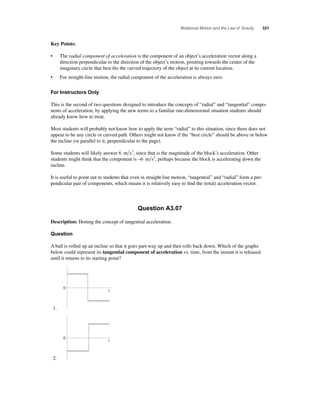
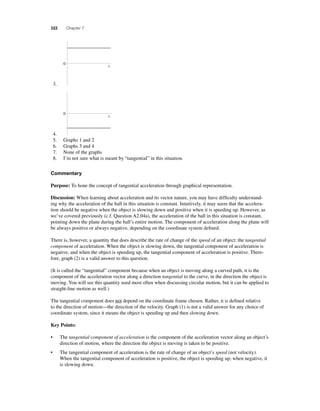
A ball is rolled up an incline so that it goes part-way up and then rolls back down. Which of the graphs 
below could represent its tangential component of acceleration vs. time, from the instant it is released 
until it returns to its starting point? 
1. 
0 
t 
2. 
0 
t
322 Chapter 7 
3. 
0 
t 
4. 
0 
t 
5. Graphs 1 and 2 
6. Graphs 3 and 4 
7. None of the graphs 
8. I’m not sure what is meant by “tangential” in this situation. 
Commentary 
Purpose: To hone the concept of tangential acceleration through graphical representation. 
Discussion: When learning about acceleration and its vector nature, you may have diffi culty understand-ing 
why the acceleration of the ball in this situation is constant. Intuitively, it may seem that the accelera-tion 
should be negative when the object is slowing down and positive when it is speeding up. However, as 
we’ve covered previously (c.f. Question A2.04a), the acceleration of the ball in this situation is constant, 
pointing down the plane during the ball’s entire motion. The component of acceleration along the plane will 
be always positive or always negative, depending on the coordinate system defi ned. 
There is, however, a quantity that does describe the rate of change of the speed of an object: the tangential 
component of acceleration. When the object is slowing down, the tangential component of acceleration is 
negative, and when the object is speeding up, the tangential component of acceleration is positive. There-fore, 
graph (2) is a valid answer to this question. 
(It is called the “tangential” component because when an object is moving along a curved path, it is the 
component of the acceleration vector along a direction tangential to the curve, in the direction the object is 
moving. You will see this quantity used most often when discussing circular motion, but it can be applied to 
straight-line motion as well.) 
The tangential component does not depend on the coordinate frame chosen. Rather, it is defi ned relative 
to the direction of motion—the direction of the velocity. Graph (1) is not a valid answer for any choice of 
coordinate system, since it means the object is speeding up and then slowing down. 
Key Points: 
• The tangential component of acceleration is the component of the acceleration vector along an object’s 
direction of motion, where the direction the object is moving is taken to be positive. 
• The tangential component of acceleration is the rate of change of an object’s speed (not velocity). 
When the tangential component of acceleration is positive, the object is speeding up; when negative, it 
is slowing down.
Rotational Motion and the Law of Gravity 323 
• The value of an object’s tangential component of acceleration does not depend on the coordinate 
system chosen for the problem. 
For Instructors Only 
This question is a follow-up to Questions 23a and 23b, which asked about the velocity and acceleration 
graphs for this same situation. It gives a name to the concept of “rate of change of speed” that many 
students intuitively attach to the word “acceleration.” 
Some students will not know how to interpret “tangential” when the motion is along a straight line. They 
might think “tangential” and “radial” only have meaning when an object is moving along a curved path. 
Although the tangential component of acceleration is mostly used in circular or at least curvilinear motion 
settings, applying it to linear motion as in this problem extends the context in which students encounter 
the concept. This helps them relate it to kinematics in general, rather than “pigeonholing” it with circular 
motion ideas only. 
Students who select answers (3), (4), or (5) might be choosing a graph for the acceleration, not its tangen-tial 
component. 
Students may not see why (1) cannot be valid if (2) is. They do not realize that we cannot choose the direc-tion 
that is positive for tangential acceleration, but that it is always the direction of motion. And this would 
not be surprising—we’ve tried hard to convince them that components can be positive or negative depend-ing 
on coordinate system, and now we introduce a strange kind of component where it’s not! 
It may or may not be helpful to describe this component in terms of a coordinate system that is attached to 
the object and travels and turns along with it. (Formally, such a system is called the Frenet-Serret frame, 
and consists of a tangential unit vector in the direction of the derivative of the particle’s position, a 
normal unit vector orthogonal to that and in the direction of the second derivative of the position, and a 
binormal unit vector orthogonal to the other two and forming a right-handed coordinate system.) Making 
this connection can be enriching, but it opens up a large can of worms, and should probably not be 
attempted unless you are willing to spend a good deal of time discussing inertial vs. noninertial reference 
frames and similar issues. 
Question F1.01 
Description: Reasoning with universal gravitation and linking it to experience. 
Question 
An iceberg weighing 1 000 tons is fl oating in the North Atlantic. Consider the gravitational forces on 
the iceberg due to the Earth, the Moon, and the Sun. Put these gravitational forces in order of increasing 
magnitude. 
You do not need to do any calculations. Use reasoning, or simply guess. 
1. Earth  Moon  Sun 
2. Earth  Sun  Moon 
3. Moon  Sun  Earth 
4. Moon  Earth  Sun 
5. Sun  Moon  Earth 
6. Sun  Earth  Moon
324 Chapter 7 
Commentary 
Purpose: To develop your ability to reason with universal gravitation. 
Discussion: The gravitational force on an object due to some source is equal to the mass of that object 
times the gravitational fi eld strength due to the source. The gravitational fi eld strength of a source depends 
on the mass of the source and how far away it is, as describe by Newton’s law of universal gravitation. 
However, you can solve this problem purely through deduction, without any calculation at all. 
In this situation, the weight and circumstances of the iceberg are irrelevant; the ordering of the gravitational 
forces depends only on the value of the gravitational fi eld strength due to each of the three celestial objects. 
If the water were removed, the iceberg would fall towards the Earth, not towards the Moon or Sun. Thus, 
the Earth must be exerting the strongest gravitational force. In fact, almost every time we solve a physics 
problem that takes place on the surface of the Earth, we consider the force of gravity due to the Earth but 
neglect the gravitational forces of the Moon and Sun because they are negligibly small. 
Which of the other objects—the Moon or the Sun—exerts the next largest force? The Earth orbits the Sun, 
not the Moon. If the Moon were removed, the Earth’s behavior would not change signifi cantly; it would 
still orbit the Sun once a year. However, if the Sun were removed, the Earth’s behavior would change 
dramatically; it would respond slightly as the Moon orbited it, but would no longer travel in its large circle 
about the Sun. Thus, the effect of the Sun’s gravitational fi eld on the Earth (and objects on it) is clearly 
larger than the effect of the Moon’s gravitational fi eld. 
It might be tempting to think that the Moon exerts a larger force than the Sun because it is so much closer, 
but remember that it also has far less mass. You might also argue that the Moon has a larger infl uence than 
the Sun because the Moon’s gravity causes signifi cant tides on the Earth, while the Sun’s causes only a 
small perturbation to those tides. However, tides are caused by the gradient of a gravitational fi eld, not by 
the strength of that fi eld. The Moon’s gravitational fi eld is weaker, but it is changing more rapidly with 
distance. 
Key Points: 
• To fi gure out which force on a system is stronger, determine which has the larger effect (unless another 
force balances it and “cancels out” its effect). 
• The strength of the gravitational force on an object depends on both the mass of the source and the 
distance to that source. 
For Instructors Only 
Students who select answers (1) or (2) may think that the Earth exerts no gravitational force at all on the 
object, perhaps because the object is “fl oating.” This indicates a fundamental misconception about weight. 
Note that “impossible to determine” is not an available option. Students should be encouraged to select one 
of the answers, even if they are not sure if it is correct. 
Students will likely want to compute the three forces using F GMm d g 
2, and may be frustrated if they are 
not given suffi cient time to do this. They should be reminded that the question asks them only to compare 
the forces, not to compute them. They should be encouraged to fi nd qualitative arguments. 
We can confi rm our qualitative argument via calculations, though this is not necessary and students should 
be discouraged from doing so. We include the following for the instructors’ benefi t.
Rotational Motion and the Law of Gravity 325 
The gravitational fi eld strength at some location is g = GM d2, where G is the Universal gravitational 
constant, M is the mass of the agent exerting the gravitational force, and d is the separation of the agent and 
the object. (That is, the force is F mg GMmd g= = 2.) Since G is the same for all 3 forces, we can compare 
M d2 
to fi nd out which is largest and which is smallest. 
For the Earth M = 6 × 1024 kg and d = 6 400 km is the radius of the Earth. For the Moon, 
M = 7.4 × 10²² kg and d = 400 000 km is the orbital radius of the Moon about the Earth. For the Sun, 
M = 2 × 1030 kg and d = 150 000 000 km is the orbital radius of the Earth about the Sun. 
The results are tabulated below. 
Agent 
Mass, M 
(1021 kg) 
Separation, d 
(103 km) 
Ratio, M d2 
(1012 kg km2) 
Earth 6 000 6.4 150 000 
Moon 74 400 0.5 
Sun 2 × 10⁹ 150 000 90 
Thus, as reasoned above, the Earth exerts the strongest force, the Sun is next, and the Moon is smallest. 
Further, the Sun exerts a force almost 200 times as strong as that of the Moon. 
We can also compute g due to each celestial body. Due to the Earth, it is about 10 Nkg. Due to the Sun, it 
is equal to the acceleration of the Earth relative to the Sun, or about 6 mNkg (i.e., 0.006 Nkg). Due to the 
Moon, it is equal to about 30 μNkg (3 × 10⁻⁵ N kg), which can be deduced from its acceleration relative 
to the Earth multiplied by the ratio of the two masses (1:81). Of course, we can also use g = GM d2 , but it 
is noteworthy to discover than we do not need G to determine these values of g. 
Question F1.02a 
Description: Applying energy ideas to universal gravitation. 
Question 
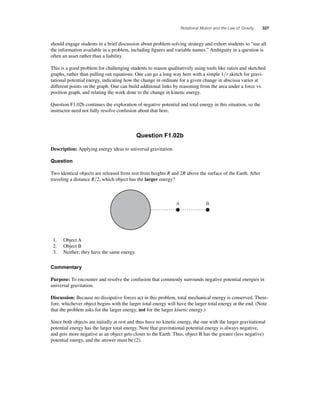
Two identical objects are released from rest from heights R and 2R above the surface of the Earth. After 
traveling a distance R2, which object has the larger speed? 
1. Object A 
2. Object B 
3. Neither; they have the same speed. 
A B
326 Chapter 7 
Commentary 
Purpose: To extend work and energy ideas to a situation requiring universal gravitation, and to sensitize 
you to the danger of applying remembered results to new situations without resorting to general principles. 
Discussion: In a uniform gravitational fi eld (“local gravity approximation”), two objects that fall the same 
distance from rest will have the same fi nal speed, regardless of any difference in their starting heights. In 
this problem, however, the distances are comparable to the size of the Earth, so the gravitational fi eld is far 
from uniform. (The question’s wording does not explicitly state this, but the diagram implies it.) 
You can try to argue for an answer based on Newton’s law of universal gravitation (noting that the gravita-tional 
force is weaker for objects farther away), Newton’s second law, and kinematics, but this tends to be 
confusing. Object B is farther away, so it experiences a weaker force; however, it falls for a longer time to 
cover the same distance, so it has more time to accelerate due to that force. Determining anything defi nitive 
about the fi nal speed requires careful calculation. 
As usual when talking about distances and speeds but not times, energy ideas are easiest to use. In this 
case, you must recognize that total mechanical energy is conserved since all acting forces are conservative; 
therefore, whichever object loses the most gravitational potential energy as it falls a distance of R2 will 
gain the most kinetic energy and thus have the greatest fi nal speed. 
The trick is that for universal gravitation, an object’s gravitational potential energy is zero at infi nity and 
increasingly negative as the object gets closer to the Earth. Furthermore, the potential energy goes as one 
over the distance (from the center of the Earth), so that a given change in distance causes a greater change 
in potential energy closer to the source compared to far away. (This is clearer if you sketch a plot of 1r.) 
Given this, object a will lose more potential energy falling a distance R2 than will object B; both have a 
potential energy that starts negative and gets more negative, but a has the larger change. Thus, a will gain 
more kinetic energy and have the larger fi nal speed, so (a) is the best answer. 
Key Points: 
• Know what assumptions (like “local gravity”) are involved in any physics principles, laws, rules, 
derived results, etc., that you learn, and be on the lookout for situations that violate those assumptions. 
• Be careful about using derived results like “objects that fall the same distance from rest end up with the 
same speed, regardless of how high they start” as if they were general truths. Trust general principles 
like the work–energy theorem, not specifi c rules that may depend on the details of a situation. 
• Energy ideas are usually more useful than forces and kinematics when reasoning about forces, 
distances, and speeds (but not times). 
• It is traditional to choose r = 0 as the reference point at which the gravitational potential is zero. With 
this convention, potential energy is always negative for universal gravitation. 
For Instructors Only 
This is a classic “extend the context” problem: it asks a familiar question in an unfamiliar context, requiring 
students to extend their understanding of conservation of energy outside the realm of local gravitation. 
The problem may be considered ambiguous because its wording does not state that R is signifi cant com-pared 
to the size of the Earth, and therefore that the local gravity approximation is inappropriate. However, 
the diagram shows a spherical Earth and clearly implies it. In addition, one might suspect that the choice 
of “R” as the distance variable is meant to signify the radius of the spherical Earth. This “ambiguity” is 
not a weakness of the question, but rather a strength: it provides the opportunity to sensitize students to 
the assumptions they may make. If some students fail to recognize the fi gure’s implication, the instructor
Rotational Motion and the Law of Gravity 327 
should engage students in a brief discussion about problem-solving strategy and exhort students to “use all 
the information available in a problem, including fi gures and variable names.” Ambiguity in a question is 
often an asset rather than a liability. 
This is a good problem for challenging students to reason qualitatively using tools like ratios and sketched 
graphs, rather than pulling out equations. One can go a long way here with a simple 1r sketch for gravi-tational 
potential energy, indicating how the change in ordinate for a given change in abscissa varies at 
different points on the graph. One can build additional links by reasoning from the area under a force vs. 
position graph, and relating the work done to the change in kinetic energy. 
Question F1.02b continues the exploration of negative potential and total energy in this situation, so the 
instructor need not fully resolve confusion about that here. 
Question F1.02b 
Description: Applying energy ideas to universal gravitation. 
Question 
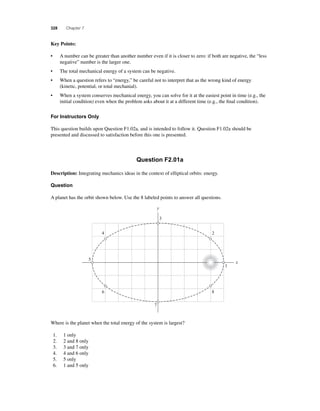
Two identical objects are released from rest from heights R and 2R above the surface of the Earth. After 
traveling a distance R2, which object has the larger energy? 
1. Object A 
2. Object B 
3. Neither; they have the same energy. 
Commentary 
A B 
Purpose: To encounter and resolve the confusion that commonly surrounds negative potential energies in 
universal gravitation. 
Discussion: Because no dissipative forces act in this problem, total mechanical energy is conserved. There-fore, 
whichever object begins with the larger total energy will have the larger total energy at the end. (Note 
that the problem asks for the larger energy, not for the larger kinetic energy.) 
Since both objects are initially at rest and thus have no kinetic energy, the one with the larger gravitational 
potential energy has the larger total energy. Note that gravitational potential energy is always negative, 
and gets more negative as an object gets closer to the Earth. Thus, object B has the greater (less negative) 
potential energy, and the answer must be (2).
328 Chapter 7 
Key Points: 
• A number can be greater than another number even if it is closer to zero: if both are negative, the “less 
negative” number is the larger one. 
• The total mechanical energy of a system can be negative. 
• When a question refers to “energy,” be careful not to interpret that as the wrong kind of energy 
(kinetic, potential, or total mechanial). 
• When a system conserves mechanical energy, you can solve for it at the easiest point in time (e.g., the 
initial condition) even when the problem asks about it at a different time (e.g., the fi nal condition). 
For Instructors Only 
This question builds upon Question F1.02a, and is intended to follow it. Question F1.02a should be 
presented and discussed to satisfaction before this one is presented. 
Question F2.01a 
Description: Integrating mechanics ideas in the context of elliptical orbits: energy. 
Question 
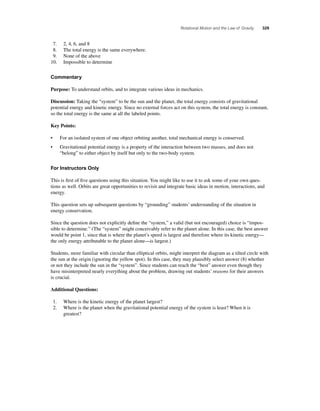
A planet has the orbit shown below. Use the 8 labeled points to answer all questions. 
Where is the planet when the total energy of the system is largest? 
1. 1 only 
2. 2 and 8 only 
3. 3 and 7 only 
4. 4 and 6 only 
5. 5 only 
6. 1 and 5 only 
3 
2 
1 
x 
y 
8 
7 
6 
5 
4
Rotational Motion and the Law of Gravity 329 
7. 2, 4, 6, and 8 
8. The total energy is the same everywhere. 
9. None of the above 
10. Impossible to determine 
Commentary 
Purpose: To understand orbits, and to integrate various ideas in mechanics. 
Discussion: Taking the “system” to be the sun and the planet, the total energy consists of gravitational 
potential energy and kinetic energy. Since no external forces act on this system, the total energy is constant, 
so the total energy is the same at all the labeled points. 
Key Points: 
• For an isolated system of one object orbiting another, total mechanical energy is conserved. 
• Gravitational potential energy is a property of the interaction between two masses, and does not 
“belong” to either object by itself but only to the two-body system. 
For Instructors Only 
This is fi rst of fi ve questions using this situation. You might like to use it to ask some of your own ques-tions 
as well. Orbits are great opportunities to revisit and integrate basic ideas in motion, interactions, and 
energy. 
This question sets up subsequent questions by “grounding” students’ understanding of the situation in 
energy conservation. 
Since the question does not explicitly defi ne the “system,” a valid (but not encouraged) choice is “impos-sible 
to determine.” (The “system” might conceivably refer to the planet alone. In this case, the best answer 
would be point 1, since that is where the planet’s speed is largest and therefore where its kinetic energy— 
the only energy attributable to the planet alone—is largest.) 
Students, more familiar with circular than elliptical orbits, might interpret the diagram as a tilted circle with 
the sun at the origin (ignoring the yellow spot). In this case, they may plausibly select answer (8) whether 
or not they include the sun in the “system”. Since students can reach the “best” answer even though they 
have misinterpreted nearly everything about the problem, drawing out students’ reasons for their answers 
is crucial. 
Additional Questions: 
1. Where is the kinetic energy of the planet largest? 
2. Where is the planet when the gravitational potential energy of the system is least? When it is 
greatest?
330 Chapter 7 
Question F2.01b 
Description: Integrating mechanics ideas in the context of elliptical orbits: energy. 
Question 
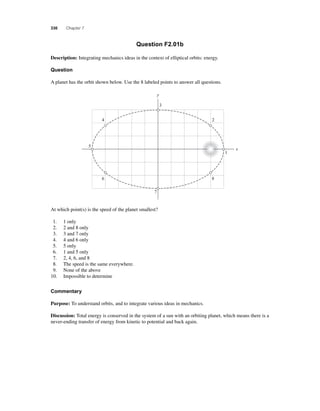
A planet has the orbit shown below. Use the 8 labeled points to answer all questions. 
y 
7 
4 
6 
5 
At which point(s) is the speed of the planet smallest? 
1. 1 only 
2. 2 and 8 only 
3. 3 and 7 only 
4. 4 and 6 only 
5. 5 only 
6. 1 and 5 only 
7. 2, 4, 6, and 8 
8. The speed is the same everywhere. 
9. None of the above 
10. Impossible to determine 
Commentary 
3 
Purpose: To understand orbits, and to integrate various ideas in mechanics. 
2 
1 
x 
8 
Discussion: Total energy is conserved in the system of a sun with an orbiting planet, which means there is a 
never-ending transfer of energy from kinetic to potential and back again.
Rotational Motion and the Law of Gravity 331 
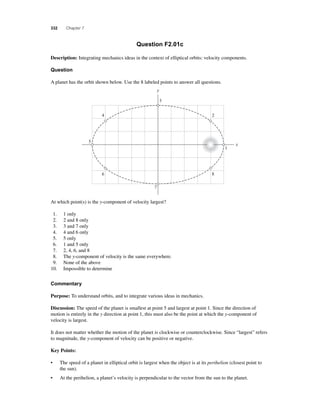
For an elliptical orbit as shown, the distance between the planet and the sun is constantly changing. To pre-dict 
where the speed is smallest, we need to fi nd where the kinetic energy is smallest. This occurs when the 
gravitational potential energy is greatest, which occurs when the planet is farthest from the sun, at point 5. 
Do not be distracted by the fact that the gravitational potential energy is negative. A small negative value is 
“greater” than a large negative value. Just imagine an object far from the sun. The potential energy of the 
system is zero. As the object “falls” toward the sun, the potential energy decreases and the kinetic energy 
increases. The only way to decrease from zero is to become negative. Thus, the gravitational potential 
energy is “greatest” when it is “least negative.” 
Key Points: 
• The total mechanical energy of a system comprised of one object orbiting another is constant. 
• Gravitational potential energy is negative, and decreases (becomes more negative) as the object gets 
closer to the source of attraction. 
• Energy ideas are often useful for reasoning about speed. 
For Instructors Only 
This is second of fi ve questions using this situation. You might like to use it to ask some of your own ques-tions 
as well. Orbits are great opportunities to revisit and integrate basic ideas in motion, interactions, and 
energy. 
This question is intended primarily to make sure that students understand the diagram, with the orbit ellipti-cal 
and the sun at the right focus. 
Students choosing answer (8), “the same everywhere,” may be misinterpreting the fi gure as a perspective 
drawing of a circular orbit with the sun at the center (ignoring the yellow spot). 
Students choosing answer (6) may be recognizing that the orbit is elliptical but assuming the sun is at the 
origin of the graph (overlooking the yellow spot), and reasoning that the sun is farthest and equidistant at 
points 1 and 5. 
Students choosing answers (1) or (3) may be confused about the minus sign in the gravitational potential 
energy, and looking for where the potential energy is “largest” rather than “greatest.” 
Additional Questions: 
1. Where is the speed of the planet largest?
332 Chapter 7 
Question F2.01c 
Description: Integrating mechanics ideas in the context of elliptical orbits: velocity components. 
Question 
A planet has the orbit shown below. Use the 8 labeled points to answer all questions. 
3 
y 
7 
4 
6 
5 
At which point(s) is the y-component of velocity largest? 
1. 1 only 
2. 2 and 8 only 
3. 3 and 7 only 
4. 4 and 6 only 
5. 5 only 
6. 1 and 5 only 
7. 2, 4, 6, and 8 
8. The y-component of velocity is the same everywhere. 
9. None of the above 
10. Impossible to determine 
Commentary 
Purpose: To understand orbits, and to integrate various ideas in mechanics. 
2 
1 
x 
8 
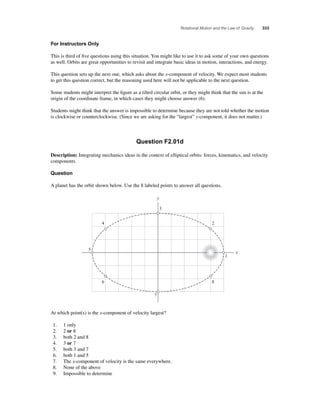
Discussion: The speed of the planet is smallest at point 5 and largest at point 1. Since the direction of 
motion is entirely in the y direction at point 1, this must also be the point at which the y-component of 
velocity is largest. 
It does not matter whether the motion of the planet is clockwise or counterclockwise. Since “largest” refers 
to magnitude, the y-component of velocity can be positive or negative. 
Key Points: 
• The speed of a planet in elliptical orbit is largest when the object is at its perihelion (closest point to 
the sun). 
• At the perihelion, a planet’s velocity is perpendicular to the vector from the sun to the planet.
Rotational Motion and the Law of Gravity 333 
For Instructors Only 
This is third of fi ve questions using this situation. You might like to use it to ask some of your own questions 
as well. Orbits are great opportunities to revisit and integrate basic ideas in motion, interactions, and energy. 
This question sets up the next one, which asks about the x-component of velocity. We expect most students 
to get this question correct, but the reasoning used here will not be applicable to the next question. 
Some students might interpret the fi gure as a tilted circular orbit, or they might think that the sun is at the 
origin of the coordinate frame, in which cases they might choose answer (6). 
Students might think that the answer is impossible to determine because they are not told whether the motion 
is clockwise or counterclockwise. (Since we are asking for the “largest” y-component, it does not matter.) 
Question F2.01d 
Description: Integrating mechanics ideas in the context of elliptical orbits: forces, kinematics, and velocity 
components. 
Question 
A planet has the orbit shown below. Use the 8 labeled points to answer all questions. 
3 
At which point(s) is the x-component of velocity largest? 
1. 1 only 
2. 2 or 8 
3. both 2 and 8 
4. 3 or 7 
5. both 3 and 7 
6. both 1 and 5 
7. The x-component of velocity is the same everywhere. 
8. None of the above 
9. Impossible to determine 
2 
1 
x 
y 
8 
7 
6 
5 
4
334 Chapter 7 
Commentary 
Purpose: To understand orbits, and to integrate various ideas in mechanics. 
Discussion: It is tempting to think that the x-component of velocity must be largest where the y-component 
is zero and choose points 3 andor 7, but this is not correct. 
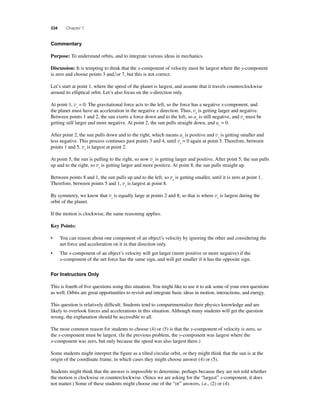
Let’s start at point 1, where the speed of the planet is largest, and assume that it travels counterclockwise 
around its elliptical orbit. Let’s also focus on the x-direction only. 
At point 1, vx = 0. The gravitational force acts to the left, so the force has a negative x-component, and 
the planet must have an acceleration in the negative x direction. Thus, vx is getting larger and negative. 
Between points 1 and 2, the sun exerts a force down and to the left, so ax is still negative, and vx must be 
getting still larger and more negative. At point 2, the sun pulls straight down, and ax = 0. 
After point 2, the sun pulls down and to the right, which means ax is positive and vx is getting smaller and 
less negative. This process continues past points 3 and 4, until vx = 0 again at point 5. Therefore, between 
points 1 and 5, vx is largest at point 2. 
At point 5, the sun is pulling to the right, so now vx is getting larger and positive. After point 5, the sun pulls 
up and to the right, so vx is getting larger and more positive. At point 8, the sun pulls straight up. 
Between points 8 and 1, the sun pulls up and to the left, so vx is getting smaller, until it is zero at point 1. 
Therefore, between points 5 and 1, vx is largest at point 8. 
By symmetry, we know that vx is equally large at points 2 and 8, so that is where vx is largest during the 
orbit of the planet. 
If the motion is clockwise, the same reasoning applies. 
Key Points: 
• You can reason about one component of an object’s velocity by ignoring the other and considering the 
net force and acceleration on it in that direction only. 
• The x-component of an object’s velocity will get larger (more positive or more negative) if the 
x-component of the net force has the same sign, and will get smaller if it has the opposite sign. 
For Instructors Only 
This is fourth of fi ve questions using this situation. You might like to use it to ask some of your own questions 
as well. Orbits are great opportunities to revisit and integrate basic ideas in motion, interactions, and energy. 
This question is relatively diffi cult. Students tend to compartmentalize their physics knowledge and are 
likely to overlook forces and accelerations in this situation. Although many students will get the question 
wrong, the explanation should be accessible to all. 
The most common reason for students to choose (4) or (5) is that the y-component of velocity is zero, so 
the x-component must be largest. (In the previous problem, the y-component was largest where the 
x-component was zero, but only because the speed was also largest there.) 
Some students might interpret the fi gure as a tilted circular orbit, or they might think that the sun is at the 
origin of the coordinate frame, in which cases they might choose answer (4) or (5). 
Students might think that the answer is impossible to determine, perhaps because they are not told whether 
the motion is clockwise or counterclockwise. (Since we are asking for the “largest” x-component, it does 
not matter.) Some of these students might choose one of the “or” answers, i.e., (2) or (4).
Rotational Motion and the Law of Gravity 335 
Additional Questions: 
1. Where is the force on the planet largest? smallest? 
2. Where is the force on the sun largest? smallest? 
3. Where is the x-component of acceleration largest? smallest? 
4. Where is the y-component of acceleration largest? smallest? 
QUICK QUIZZES 
1. (c). For a rotation of more than 180°, the angular displacement must be larger than π = 3.14 rad. The 
angular displacements in the three choices are (a) 6 rad − 3 rad = 3 rad, (b) 1 rad − (−1) rad = 2 rad, 
(c) 5 rad − 1 rad = 4 rad. 
2. (b). Because all angular displacements occurred in the same time interval, the displacement with the 
lowest value will be associated with the lowest average angular speed. 
3. (b). From 
α 
ω ω 
θ 
ω 
2 2 2 
θ 
ω 
θ 
= 
− 
= − = 
2 
0 
2 
0 
Δ 2 Δ 2 Δ 
it is seen that the case with the smallest angular displacement involves the highest angular acceleration. 
4. (b). All points in a rotating rigid body have the same angular speed. 
5. (a). Andrea and Chuck have the same angular speed, but Andrea moves in a circle with twice the 
radius of the circle followed by Chuck. Thus, from vt = rω, it is seen that Andrea’s tangential speed is 
twice Chuck’s. 
6. 1. (e). Since the tangential speed is constant, the tangential acceleration is zero. 
2. (a). The centripetal acceleration, a r c t = v2 , is inversely proportional to the radius when the 
tangential speed is constant. 
3. (b). The angular speed, ω = vt r, is inversely proportional to the radius when the tangential speed 
is constant. 
7. (c). Both the velocity and acceleration are changing in direction, so neither of these vector quantities 
is constant. 
8. (b) and (c). According to Newton’s law of universal gravitation, the force between the ball and the 
Earth depends on the product of their masses, so both forces, that of the ball on the Earth, and that of 
the Earth on the ball, are equal in magnitude. This follows also, of course, from Newton’s third law. 
The ball has large motion compared to the Earth because according to Newton’s second law, the force 
gives a much greater acceleration to the small mass of the ball. 
9. (e). From F = G Mm r2, the gravitational force is inversely proportional to the square of the radius of 
the orbit. 
10. (d). The semi-major axis of the asteroid’s orbit is 4 times the size of Earth’s orbit. Thus, Kepler’s third 
law (T 2 r3 = constant) indicates that its orbital period is 8 times that of Earth.
336 Chapter 7 
ANSWERS TO MULTIPLE CHOICE QUESTIONS 
1. Earth moves 2π radians around the Sun in 1 year. The average angular speed is then 
ω π 
av 
2 = × − 
rad 
1 y 
1 y 
= r 
× 
3.156 s 
⎛⎝ 
⎞⎠ 
10 
. 7 ad s 
1 99 10 7 
which is choice (e). 
2. The angular displacement will be 
ω ω 
Δθ = ω ⋅ Δ = 
Δ 
⎛ + 
⎝ ⎜ 
⎞ 
⎠ ⎟ 
= + 
av 
⎜ 
⎛⎝ rad s ra 
4 00 32 0 t t f i 
2 
12.00 4.00 d s 
s rad 
2 
⎞⎠ ⎟ 
( . ) = . 
which matches choice (d). 
3. The wheel has a radius of 0.500 m and made 320 revolutions. The distance traveled is 
θ π = 
s r = = ( )( )⎛⎝ 
⎞⎠ 
0 500 320 
2 
rad 
. m rev 1.00 
1 rev 
× 103 m = 1.00 km 
so choice (c) is the correct answer. 
4. At the top of the circular path, both the tension in the string and the gravitational force act 
downward, toward the center of the circle, and together supply the needed centripetal force. Thus, 
F T mg mr c= + = ω 2 or 
T = m(rω 2 − g) = ( ) ( )( )2 − 0 400 0 500 8 00 . . . kg m rad s 9 80 8 88 . . m s N 2 ⎡⎣ 
⎤⎦ 
= 
making (a) the correct choice for this question. 
5. The required centripetal force is F ma m r mr c c = = v2 = ω 2. When m and ω are both constant, 
the centripetal force is directly proportional to the radius of the circular path. Thus, as the rider 
moves toward the center of the merry-go-round, the centripetal force decreases and the correct 
choice is (c). 
6. Any object moving in a circular path undergoes a constant change in the direction of its velocity. 
This change in the direction of velocity is an acceleration, always directed toward the center of 
the path, called the centripetal acceleration, a r r c= v2 = ω 2. The tangential speed of the object 
is vt = rω, where ω is the angular velocity. If ω is not constant, the object will have both an 
angular acceleration, α ω av = Δ Δt, and a tangential acceleration, a r t = α . The only untrue state-ment 
among the listed choices is (b). Even when ω is constant, the object still has centripetal 
acceleration. 
7. According to Newton’s law of universal gravitation, the gravitational force one body exerts on 
the other decreases as the distance separating the two bodies increases. When on Earth’s surface, 
the astronaut’s distance from the center of the Earth is Earth’s radius r R0 E = . If h is the altitude 
at which the station orbits above the surface, her distance from Earth’s center when on the station 
is r′ = R + h  r E 0 . Thus, she experiences a smaller force while on the space station and (c) is the 
correct choice.
Rotational Motion and the Law of Gravity 337 
8. The mass of a spherical body of radius R and density ρ is M = ρV = ρ (4π R3 3). The escape 
velocity from the surface of this body may then be written in either of the following equivalent 
forms: 
vesc = 2GM 
R 
and vesc = 
⎛ 
πρR πρGR 
G 3 2 
R 
= 2 4 
⎝ ⎜ 
⎞ 
⎠ ⎟ 
3 
8 
3 
We see that the escape velocity depends on the three properties (mass, density, and radius) of the 
planet. Also, the weight of an object on the surface of the planet is F mg GMmR g= = 2 , giving 
g GM R 
G 
R 
ρ π R 
πρ 
⎛ 
2 = 
= = GR 
⎝ ⎜ 
⎞ 
⎠ ⎟ 
⎡ 
⎣ ⎢ 
⎤ 
⎦ ⎥ 
2 
4 3 
3 
4 
3 
The acceleration of gravity at the planet surface then depends on the same properties as does 
the escape velocity. Changing the value of g would necessarily change the escape velocity. Of the 
listed quantities, the only one that does not affect the escape velocity is choice (e), the mass of 
the object on the planet’s surface. 
9. The satellite experiences a gravitational force, always directed toward the center of its orbit, 
and supplying the centripetal force required to hold it in its orbit. This force gives the satellite a 
centripetal acceleration, even if it is moving with constant angular speed. At each point on the 
circular orbit, the gravitational force is directed along a radius line of the path, and is perpendicu-lar 
to the motion of the satellite, so this force does no work on the satellite. Therefore, the only 
true statement among the listed choices is (d). 
10. In a circular orbit, the gravity force is always directed along a radius line of the circle, and hence, 
perpendicular to the object’s velocity which is tangential to the circle. In an elliptical orbit, the 
gravity force is always directed toward the center of the Earth, located at one of the foci of the 
orbit. This means that it is perpendicular to the velocity, which is always tangential to the orbit, 
only at the two points where the object crosses the major axis of the ellipse. These are the points 
where the object is nearest to and farthest from Earth. Since the gravity force is a conservative 
force, the total energy (kinetic plus gravitational potential energy) of the object is constant as 
it moves around the orbit. This means that it has maximum kinetic energy (and hence, greatest 
speed) when its potential energy is lowest (i.e., when it is closest to Earth. The only true state-ments 
among the listed choices are (a) and (b). 
11. The weight of an object of mass m at the surface of a spherical body of mass M and radius R is 
F mg GMmR g= = 2 . Thus, the acceleration of gravity at the surface is g = GM R2. 
For Earth, 
g 
GM 
R E 
E 
= 2 
E 
and for the planet, 
g 
E = = ( ) 
GM 
R 
G M 
= = 2 2 2 
R 
GM 
R 
p 
g p 
p 
E 
E 
E 
E 
( ) = 
⎛ 
⎝ ⎜ 
⎞ 
⎠ ⎟ 
2 
2 
1 
2 
1 
2 
0 5 . gE 
meaning that choice (b) is the correct response. 
12. The total gravitational potential energy of this set of 4 particles is the sum of the gravitational 
energies of each distinct pair of particles in the set of four. There are six distinct pairs in a set of 
four particles, which are: 1  2, 1  3, 1  4, 2  3, 2  4, and 3  4. Therefore, the correct 
answer to this question is (b).
338 Chapter 7 
13. We assume that the elliptical orbit is so elongated that Sun, at one foci, is almost at one end of the 
major axis. If the period, T, is expressed in years and the semi-major axis, a, in astronomical units 
(AU), Kepler’s third law states that T 2 = a3 . Thus, for Halley’s comet, with a period of T = 76 y, 
the semi-major axis of its orbit is 
a = (76) = 18 3 2 AU 
The length of the major axis, and the approximate maximum distance from the Sun, is 2a = 36 AU, 
making the correct answer for this question choice (e). 
ANSWERS TO EVEN-NUMBERED CONCEPTUAL QUESTIONS 
2. If we assume they are separated by about 10 m and their masses are estimated to be 70 kg and 40 kg, 
then, using the law of universal gravitation, we estimate a gravitational force on the order of 10−9 N. 
4. To a good fi rst approximation, your bathroom scale reading is unaffected because you, Earth, and 
the scale are all in free fall in the Sun’s gravitational fi eld, in orbit around the Sun. To a precise 
second approximation, you weight slightly less at noon and at midnight than you do at sunrise 
or sunset. The Sun’s gravitational fi eld is a little weaker at the center of the Earth than at the 
surface sub-solar point, and a little weaker still on the far side of the planet. When the Sun is high 
in your sky, its gravity pulls up on you a little more strongly than on the Earth as a whole. At 
midnight the Sun pulls down on you a little less strongly than it does on the Earth below you. So 
you can have another doughnut with lunch, and your bedsprings will still last a little longer. 
6. Consider one end of a string connected to a spring scale and the other end connected to an object, 
caac 
of true weight w. The tension T in the string will be measured by the scale and construed as the 
apparent weight. We have w − T = m. This gives, T = w − m. Thus, the apparent weight 
is less than the actual weight by the term mac . At the poles the centripetal acceleration is zero. 
Thus, T = w. However, at the equator the term containing the centripetal acceleration is nonzero, 
and the apparent weight is less than the true weight. 
8. If the acceleration is constant in magnitude and perpendicular to the velocity, the object is mov-ing 
in a circular path at constant speed. If the acceleration is parallel to the velocity, the object is 
either speeding up, v and a in same direction, or slowing down, v and a in opposite directions. 
10. Kepler’s second law says that equal areas are swept out in equal times by a line drawn from the 
Sun to the planet. For this to be so, the planet must move fastest when it is closest to the Sun. 
This, surprisingly, occurs during the winter. 
12. Yes. A weak, but nonzero, nonconservative force due to air resistance, opposes the motion of the 
satellite and causes its speed to decrease with time. 
PROBLEM SOLUTIONS 
7.1 (a) Earth rotates 2π radians (360°) on its axis in 1 day. Thus, 
Δ = 
Δt 
ω = θ = π 
× 
⎛ 
⎝ ⎜ 
⎞ 
⎠ ⎟ 
2 
10 
7 2 4 
rad 
1 day 
1 day 
8.64 s 
. 7 × 10⁻⁵ rad s 
(b) Because of its rotation about its axis, Earth bulges at the equator.
Rotational Motion and the Law of Gravity 339 
7.2 The distance traveled is s = rθ , where θ is in radians. 
For 30°, 
θ π = 
s = r = ( ) ° 
° 
⎛⎝ 
⎞⎠ 
⎡ 
⎣ ⎢ 
⎤ 
⎦ ⎥ 
4.1 m 30 
rad 
180 
2.1 m 
For 30 radians, 
s = rθ = (4.1 m)(30 rad) = 1.2 × 10² m 
For 30 revolutions, 
θ π = 
s r = = ( ) ⎛⎝ 
⎞⎠ 
⎡ 
4.1 m 30 rev 7.7 
⎣ ⎢ 
⎤ 
⎦ ⎥ 
2 rad 
1 rev 
× 102 m 
= × s 
r 
7.3 (a) θ= = ⎛⎝ 
⎞⎠ 
60 000 5280 
3 2 108 mi 
1.0 ft 
ft 
1 mi 
. rad 
(b) θ 
rev 
2 rad 
3 2 10 = × 
π 
= × 
⎛ 
⎝ ⎜ 
⎞ 
⎠ ⎟ 
1 
. 8 rad 5.0 107 
rev 
⎛ 
Δ − 
Δt 
7.4 (a) α = ω = − = × 
3 33 10 2 . 
⎝ ⎜ 
1 00 0 
30 . 
0 
. 
rev s 
s 
rev 
s2 
⎞ 
⎠ ⎟ 
⎛ 
⎝ ⎜ 
⎞ 
= 2 
⎠ ⎟ 
0 209 
π rad 
1 rev 
. rad s2 
(b) Yes. When an object starts from rest, its angular speed is related to the angular accelera-tion 
and time by the equation ω =α (Δt ). Thus, the angular speed is directly proportional 
to both the angular acceleration and the time interval. It the time interval is held constant, 
doubling the angular acceleration will double the angular speed attained during the interval. 
× − ( )⎛⎝ 
2 1 . 4 
7.5 (a) α = π 
⎞⎠ 
2 51 10 0 
3 20 
. 
rev min 
s 
rad 
1 rev 
min 
60.0 s 
21 rad s2 ⎛⎝ 
⎞⎠ 
= 8 
1 
2 
2 821 3 20 2 4 rad 
(b) θ ω α = + = + ⎛⎝ 
⎞⎠ 
t t 
0 
( ) = i1 
2 
s 
s .21 2 . × 103 rad 
7.6 ω π 
rev 2 1 
min 
i = ⎛⎝ 
⎞⎠ 
⎛⎝ 
rad 
3 600 ⎞ 
1 rev 
min 
60.0 s⎠ = 377 rad s 
Δθ π = ⎛⎝ 
⎞⎠ 
2 rad 
1 rev 
50.0 rev = 314 
rad 
Thus, 
2 2 
α = ω − ω 
= 
θ 
− ( ) 
( ) = − 
2 
i 
2 
0 377 
2 314 
226 
Δ 
rad s 
rad 
rad s2 
= 2 + 2 (Δ ) , the angular displacement is 
7.7 (a) From ω 2 ω α θ 
0 
Δθ 
= 2 ( ) − ( ) 
2 2 2 
ω ω 
α 
= 
− 
0 
2 
2 . 2 0 . 
06 
rad s rad s 
rad ( 2 ) = 3 5 . 
2 0 . 
70 
rad s 
(b) From the equation given above for Δθ , observe that when the angular acceleration is con-stant, 
the displacement is proportional to the difference in the squares of the fi nal and initial 
angular speeds. Thus, the angular displacement would increase by a factor of 4 
if both of 
these speeds were doubled.
340 Chapter 7 
7.8 (a) The maximum height h depends on the drop’s vertical speed at the instant it leaves the 
tire and becomes a projectile. The vertical speed at this instant is the same as the tangen-tial 
speed, vt = rω, of points on the tire. Since the second drop rose to a lesser height, 
the tangential speed decreased 
during the intervening rotation of the tire. 
= 2 + 2a ( y) y Δ , with v v 0= =− t y, a g, and v = 0 when Δy = h, the relation 
(b) From v2 v 
0 
between the tangential speed of the tire and the maximum height h is found to be 
0 = v2 + 2(− ) t g h or vt = 2gh 
Thus, the angular speed of the tire when the fi rst drop left was 
ω1 
= ( ) = 
1 1 2 
vt 
r 
gh 
r 
and when the second drop left, the angular speed was 
ω2 
= ( ) = 
2 2 2 
vt 
r 
gh 
r 
= 2 + 2 (Δ ) , with Δθ = 2π rad , the angular acceleration is found to be 
From ω 2 ω α θ 
0 
α = ω − 
ω 
( ) = − 
2 2 
gh r gh r g 
( ) = ( ) 
2 
θ θ θ 
2 
2 
1 
2 
2 
1 
2 
2 2 2 
Δ 2 Δ r 
Δ 
(h − h ) 1 
or 
α 
= ( ) 
( ) ( ) − 
0 510 0 540 2 
π 
. 
9 80 
. 
0 381 2 
. . 
m s 
m rad 
m 
2 
( m) = −0.322 rad s2 
7.9 Main Rotor: 
rω π 
v= =( )⎛⎝ ⎜ 
⎞⎠ ⎟ 
⎛⎝ ⎜ 
3 80 450 
2 
. m 
rev 
min 
rad 
1 rev 
⎞⎠ ⎟ 
⎛⎝ ⎜ 
⎞⎠ ⎟ 
= 1 
179 
min 
60 s 
m s 
v 
⎜ 
⎛⎝ v 
0 522 m 
s ms = 
sound 
= v 
so 179 
343 
⎞⎠ ⎟ 
⎛ 
⎝ ⎜ 
⎞ 
⎠ ⎟ 
. und 
Tail Rotor: 
⎛ rω π 
v= =( )⎛⎝ ⎜ 
⎞⎠ ⎟ 
0 4 
2 
.510 m 138 
rev 
min 
rad 
1 rev ⎝ ⎜ 
⎞⎠ ⎟ 
⎛⎝ ⎜ 
⎞⎠ ⎟ 
= 1 
221 
min 
60 s 
m s 
v 
⎜ 
⎛⎝ v 
0 644 m 
s ms = 
sound 
= 21 v 
so 2 
343 
⎞⎠ ⎟ 
⎛ 
⎝ ⎜ 
⎞ 
⎠ ⎟ 
. und 
7.10 We will break the motion into two stages: (1) an acceleration period and (2) a deceleration period. 
The angular displacement during the acceleration period is 
= ( ) t t f i 
θ ω 
ω ω π 
1 av 
rev s rad 1 rev 
= = 
⎛ + 
⎝ ⎜ 
⎞ 
⎠ ⎟ 
2 
⎡ 5.0 (2 ) + 
⎣ ⎢ 
⎤ 
⎦ ⎥ 
( ) = 
0 
2 
8.0 s 126 rad 
and while decelerating, 
θ 
+ ( )( ) f i t 
2 
ω ω π 
2 
rev s rad 1 rev 
= 
⎛ + 
⎝ ⎜ 
⎞ 
⎠ ⎟ 
= 
0 50 2 
2 
⎡ . 
⎣ ⎢ 
⎤ 
⎦ ⎥ 
(12 s) = 188 rad 
The total displacement is θ θ θ 
= 1 2 rad 
π 
= + = + ( ) ⎡⎣ 
⎤⎦ 
⎛ 
⎝ ⎜ 
⎞ 
⎠ ⎟ 
1 rev 
2 rad 
126 188 50 rev .
Rotational Motion and the Law of Gravity 341 
= 2 + 2 (Δ ) as 
7.11 (a) The linear distance the car travels in coming to rest is given by v v f2 a x 
0 
Δx 
a 
f = 
− 
2 2 
= 
− ( ) 
(− ) = 
v2 v 
0 
2 
0 290 
2 175 
240 
. 
. 
m s 
m s 
m 2 
Since the car does not skid, the linear displacement of the car and the angular displacement 
of the tires are related by Δx = r (Δθ ). Thus, the angular displacement of the tires is 
Δθ Δ 
π 
= = =( )⎛⎝ ⎜ 
x 
r 
240 
728 
1 
2 
m 
0.330 m 
rad 
rev 
rad 
⎞⎠ ⎟ 
= 116 rev 
(b) When the car has traveled 120 m (one half of the total distance), the linear speed of the car is 
v = v + ( ) = ( ) + (− )( ) 0 
2 2 2a Δx 29.0 m s 2 1.75 m s2 120 m = 20.5 m s 
and the angular speed of the tires is 
ω= = = v 
r 
20 5 
62 1 
. 
. 
m s 
0.330 m 
rad s 
7.12 (a) The angular speed is ω =ω +α = + ( )( ) = 0 t 0 2.50 rad s2 2.30 s 5.75 rad s . 
(b) Since the disk has a diameter of 45.0 cm, its radius is r = (00.450 m) 2 = 0.225 m. 
Thus, 
vt = rω = (0.225 m)(5.75 rad s) = 1.29 m s 
and 
a r t= α = (0.225 m)(2.50 rad s2 ) = 0.563 m s2 
(c) The angular displacement of the disk is 
Δθ θ θ 
ω ω 
α 
= − = 
− 
= ( ) − 
f 
f 
0 
2 
2 2 
0 
2 
rad s 
rad s2 rad 
( ) rad = ( ) ° ⎛⎝ 
5 . 
75 0 
2 2 . 
50 
⎞⎠ 
360 
2 
6 . 61 = 379 
° 
π 
and the fi nal angular position of the radius line through point P is 
θ θ θ f= + = °+ °= ° 0 Δ 57.3 379 436 
or it is at 76° counterclockwise from the +x-axis after turning 19° beyond one full 
revolution. 
7.13 From Δθ ω ω ω = = + ⎛⎝ 
⎞⎠avt i t 
2 
, we fi nd the initial angular speed to be 
= − = ( 
ω θ ω 
π 
i t 
)⎛⎝ 
⎞⎠ 
2 37 0 
2 
rev 
− 2 
3 00 
Δ . 
. 
rad 
1 rev 
s 
98.0 rad s = 57.0 rad s 
The angular acceleration is then 
α = ω −ωi = − = 
t 
98 0 57 0 
3 00 
13 7 
. . 
. 
. 
rad s rad s 
s 
rad s2
342 Chapter 7 
7.14 (a) The initial angular speed is 
ω π 
0 
= × ⎛ 
1 00 102 
2 1 ⎝ ⎜ 
⎞ 
⎠ ⎟ 
. 
rev 
min 
rad 
1 rev 
min 
60.0 s 
rad s 
⎛ 
⎝ ⎜ 
⎞ 
⎠ ⎟ 
= 10 5 . 
The time to stop (i.e., reach a speed of ω = 0) with α = −2.00 rad s2 is 
t = 
− 
= − 
− 
= 
ω ω 
α 
0 0 105 
5 25 
. 
. 
rad s 
2.00 rad s 
s 2 
(b) Δθ ω 
ω ω 
= = 
+ ⎛⎝ 
⎞⎠ 
= + ⎛⎝ 
⎞⎠ 
rad s 
t 0 t ( s 
) av 
2 
0 105 
2 
5 25 
. 
. = 27 6. rad 
7.15 The centripetal acceleration is a r r c t = v2 = ω 2 where r radius of the circular path followed by the 
object in question. The angular speed of the rotating Earth is 
7 27 10 5 rad 
day 
ω = π 
day 
× 
⎛⎝ 
⎞⎠ 
1 
2 = × − 
8.64 s 
10 
ra 4 . d s 
(a) For a person on the equator, r RE = = 6.38 × 10⁶ m, so 
a r c= ω 2 = ( × 6 )( × −5 )2 = × 6.38 10 m 7.27 10 rad s 3.37 10−2 m s2 
(b) For a person at the North Pole, r ac = 0 ⇒ = 0 . 
(c) The centripetal acceleration of an object is directed toward the center of the circular path 
the object is following. Thus, the forces involved in producing this acceleration are all 
forces acting on the object which have a component along the radius line of the circular 
path. These forces are the gravitational force and the normal force . 
7.16 The radius of the cylinder is r = ⎛⎝ 
⎞⎠ 
1609 m 
1 mi 
2.5 mi = 4.0 × 
103 m. Thus, from a r c = ω 2 , the 
required angular velocity is 
c 9 80 
a = × − 
r 
ω= = 
× 
4 0 10 
4 9 3 
. 
. 
. 
m s 
m 
10 rad s 
2 
2 
7.17 The fi nal angular velocity is 
ω π 
f = ⎛⎝ 
1 2 
⎞⎠ 
⎛⎝ 
⎞⎠ 
78 = 
8 
rev 
min 
min 
60 s 
rad 
1 rev 
.17 rad s 
and the radius of the disk is 
r = ⎛⎝ ⎜ 
⎞⎠ ⎟ 
2 . 
54 
cm 
5 . 0 in = 12 . 
7 
= 
1 in 
cm 0.127 m 
(a) The tangential acceleration of the bug as the disk speeds up is 
t t= = 
a r r 
⎛ 
⎝ ⎜ 
⎞ 
⎠ ⎟ 
= ( )⎛⎝ 
α Δω 
Δ 
0.127 m 
rad s 
s 
8 . 
17 
⎜ . 
3 0 
⎞⎠ ⎟ 
= 0.35 m s2 
(b) The fi nal tangential speed of the bug is 
vt f = rω = (0.127 m)(8.17 rad s) = 1.0 m s 
continued on next page
Rotational Motion and the Law of Gravity 343 
8 17 
(c) At t = 1.0 s, ω ω α = + = + ⎛⎝ 
⎞⎠ 
( ) = i t 0 
1 0 2 7 
. 
. . 
rad s 
3.0 s 
s rads 
Thus, a r t= α = 0.35 m s2 as above, while the radial acceleration is 
a r c= ω 2 = ( )( )2 = 0.127 m 2.7 rad s 0.94 m s2 
The total acceleration is a a a c t = 2 + 2 = 1.0 m s2 , and the angle this acceleration makes 
with the direction of a 
c is 
θ = 
⎛ 
1 1 0 35 
⎝ ⎜ 
⎞ 
⎠ ⎟ 
= ⎛⎝ 
⎞⎠ 
. 
. 
= ° tan− tan− 
0 94 
20 
a 
a 
t 
c 
7.18 The normal force exerted by the wall behind 
the person’s back will supply the necessary 
centripetal acceleration, or 
n ma mr c = = ω 2 
where r = 29 ft is the radius of the circular 
path followed by the person. 
If it is desired to have n = 20 × weight = 20mg, then it is necessary that mrω 2 = 20 mg, or 
ω= = ( ) 
2 rad 
20 20 9 8 
( )( ) = 29 1 
4 7 
g 
r 
. 
. 
m s 
ft m 3.281 ft 
s 
rev 
2 rad 
s 
1 min 
re 
1 60 
45 
π 
⎛ 
⎝ ⎜ 
⎞ 
⎠ ⎟ 
⎛ 
⎝ ⎜ 
⎞ 
⎠ ⎟ 
= v min 
7.19 The total force, directed toward the center of 
the circular path, acting on the rider at the top 
of the loop is the sum of the normal force and 
the gravitation force. If the magnitude of the 
normal force (exerted on the rider by the seat) 
is to have a magnitude equal to the rider’s 
weight, the total centripetal force is then 
F n F mg mg mg c g = + = + =2 
Also, F m r c = vtop 
2 so we solve for the needed 
speed at the top of the loop as 
m 
r 
2 
= 2 2 = 2 
mg rg 
v 
v top 
top or 
vi  0 →n 
m 
Ignoring any friction and using conservation of energy from when the coaster starts from rest 
vi ( = 0) at height h until it reaches the top of the loop gives 
1 
2 
1 
2 
m 2 mgh m 2 mg 2r iv + = v + ( ) top or 0 
1 
2 
+ gh = (2rg) + g(2r) 
and reduces to h = 3r = 3(4.00 m) = 12.0 m . 
Figure P7.18 
29 ft 
2r  8.00 m 
→F 
g  m→g 
h 
→V 
top
344 Chapter 7 
7.20 (a) The natural tendency of the coin is to move in a straight line (tangent to the circular path 
of radius 15.0 cm), and hence, go farther from the center of the turntable. To prevent this, 
the force of static friction must act toward the center of the turntable and supply the needed 
centripetal force. When the necessary centripetal force exceeds the maximum value of the 
static friction force, ( fs )max = μsn = μsmg, the coin begins to slip. 
(b) When the turntable has angular speed ω, the required centripetal force is F mr c = ω 2 . Thus, 
if the coin is not to slip, it is necessary that mr mg s ω 2 ≤ μ , or 
( )( ) s = g 
r 
ω ≤ μ = 
0 350 9 80 
0 150 
4 78 
. . 
. 
. 
m s 
m 
rad s 
2 
With a constant angular acceleration of α = 0.730 rad s2, the time required to reach the 
critical angular speed is 
t = 
ω − 
ω 
α 
= − = 
0 4 78 0 
0 730 
6 55 
. 
. 
. 
rad s 
rad s 
s 2 
7.21 (a) From ΣF ma r c = , we have 
= ( )( ) = v2 2 55 0 4 00 
= t 
T m 
r 
⎛ 
⎝ ⎜ 
⎞ 
⎠ ⎟ 
0 800 
1 
. . 
. 
. 
kg m s 
m 
10 × 103 N = 1.10 kN 
(b) The tension is larger than her weight by a factor of 
T 
mg 
= 1 10 × 
10 
( )( ) = 9 80 
2 04 
. 3 
. 
. 
N 
55.0 kg m s 
time 2 s 
7.22 (a) The centripetal acceleration is a r c t = v2 . Thus, when a a c t = = 0.500 m s2 , we have 
vt c = r a = (400 m)(0.500 m s2 ) = 200 m s = 14.1 m s 
(b) At this time, 
t 
= v − v 200 m s 
− t i 
= = a 
t 
m s 
0 
s 2 
0 500 
28 3 
. 
. 
and the linear displacement is 
t i = ( ) = + ⎛⎝ ⎜ 
⎞⎠ ⎟ 
s t t t 
= + ⎛ 
⎝ ⎜ 
⎞ 
⎠ ⎟ 
v 
v v 
av 
200 m s 
2 
0 
2 
(28.3 s) = 200 m 
(c) The time is t = 28 3. s as found in part (b) above. 
7.23 Friction between the tires and the roadway is capable of giving the truck a maximum centripetal 
acceleration of 
a 
v2 ( ) 2 
= t 
= = 
m s ,max 
,max m s 
r c 
32 . 
0 
6 . 
83 
2 150 
m 
If the radius of the curve changes to 75.0 m, the maximum safe speed will be 
vt c r a ,max ,max = = (75 0 m)(6 83 m s ) = 22 6 m s 2 . . .
Rotational Motion and the Law of Gravity 345 
= t = v2 
ω 2, the needed angular velocity is 
7.24 Since F m 
mr c 
r 
ω × 
− 
4 . 
0 10 
c − = = 
11 
( × ) 
N 
. kg ( . m 
) 
F 
mr 
16 
3 0 10 0 150 
( × 2 ) = re ⎛ 
= 9.4 10 rad s 
1 rev 
2 rad 
⎝ ⎜ 
⎞ 
⎠ ⎟ 
× 
π 
1.5 102 v s 
7.25 (a) a r c= ω 2 = ( )( )2 = 2.00 m 3.00 rad s 18.0 m s2 
(b) F ma c c = = (50.0 kg)(18.0 m s2 ) = 900 N 
(c) We know the centripetal acceleration is produced by the force of friction. Therefore, the 
needed static friction force is fs = 900 N. Also, the normal force is n = mg = 490 N. Thus, 
the minimum coeffi cient of friction required is 
μs 
= ( ) max = N 
s f 
n 
490 N 
= 1.84 
900 
So large a coeffi cient of friction is unreasonable, and she will not be able to stay on the 
merry-go-round. 
7.26 (a) The only force acting on the astronaut 
is the normal force exerted on him by 
the “fl oor” of the cabin. 
(b) F 
= t = v2 
m 
r 
n c 
= 1 
2 
(c) If n mgE 
, then 
n = ( )( ) = 1 
2 
60.0 kg 9.80 m s2 294 N 
(d) From the equation in Part (b), 
vt 
= = ( )( ) = 
nr 
m 
294 10 0 
60 0 
7 00 
N m 
kg 
m s 
. 
. 
. 
(e) Since vt = rω, we have 
ω= = = vt 
r 
7 00 
10 0 
0 700 
. 
. 
. 
m s 
m 
rad s 
(f) The period of rotation is 
T= = = 2 2 
0 700 
8 98 
π 
ω 
π 
. 
. 
rad s 
s 
(g) Upon standing, the astronaut’s head is moving slower than his feet because his head is 
closer to the axis of rotation. When standing, the radius of the circular path followed by the 
head is rhead = 10.0 m − 1.80 m = 8.20 m, and the tangential speed of the head is 
vt ( ) = r = ( )( ) = head head ω 8.20 m 0.700 rad s 5.74 m s 
 
10.0 m 
Figure P7.26
346 Chapter 7 
7.27 (a) Since the 1.0-kg mass is in equilibrium, the tension in the string is 
T = m g = (1.0 kg)(9.8 m s2 ) = 9.8 N 
(b) The tension in the string must produce the centripetal acceleration of the puck. Hence, 
F T c= = 9.8 N . 
⎛ 
= t 
(c) From F m 
⎝ ⎜ 
r c 
⎞ 
⎠ ⎟ 
puck 
v2 
, we fi nd vt 
= =( )( ) = 
c r F 
m 
puck 
m N 
0.25 kg 
m s 
1 0 9 8 
6 3 
. . 
. . 
7.28 (a) Since the mass m2 hangs in equilibrium on the end of the string, 
ΣF T mg y= − = 2 0 
or T = m g 2 
(b) The puck moves in a circular path of radius R and must have an acceleration directed 
toward the center equal to a R c t = v2 . The only force acting on the puck and directed 
toward the center is the tension in the string. Newton’s second law requires 
ΣF mac 
toward 
center 
= 1 giving T m 
v2 
= t 1 
R 
(c) Combing the results from (a) and (b) gives 
m 
v t = m g 
or vt 
R 
1 
2 
2 
m gR 
m 
= 2 
1 
(d) Substitution of the numeric data from problem 7.27 into the results for (a) and (c) shown 
above will yield the answers given for that problem. 
7.29 (a) The force of static friction acting toward the road’s center of curvature must supply 
the briefcase’s required centripetal acceleration. The condition that it be able to meet 
this need is that F m r f mg c t s s = v2 ≤ ( ) = 
max μ , or μs t ≥ v2 rg. When the tangential 
speed becomes large enough that μs t = v2 rg , the briefcase will begin to slide. 
(b) As discussed above, the briefcase starts to slide when μs t = v2 rg. If this occurs at the 
speed, vt = 15 0 . m s, the coeffi cient of static friction must be 
( 15 0 
) 
μ= s ( )( ) = 
62 0 9 80 
0 370 
2 . 
. . 
. 
m s 
m ms2 
7.30 (a) The external forces acting on the water are the gravitational force and 
the contact force exerted on the water by the pail . 
(b) The contact force exerted by the pail is the most important in causing the water to move 
in a circle. If the gravitational force acted alone, the water would follow the parabolic path 
of a projectile. 
(c) When the pail is inverted at the top of the circular path, it cannot hold the water up to pre-vent 
it from falling out. If the water is not to spill, the pail must be moving fast enough that 
the required centripetal force is at least as large as the gravitational force. That is, we must 
have 
m 
v2 
≥ or v ≥ rg = (1.00 m)(9.80 m s2 ) = 3.13 m s 
r 
mg 
continued on next page
Rotational Motion and the Law of Gravity 347 
(d) If the pail were to suddenly disappear when is it at the top of the circle and moving at 
3.13 m s , the water would follow the parabolic arc of a projectile launched with initial 
velocity components of v v 0 0 3 13 0 x y = . m s , = . 
7.31 (a) The centripetal acceleration is 
ω π 2 9 400 
a r c= =( ) ⎛⎝ 
. ⎞⎠ 
⎞⎠ 
⎛⎝ 
2 
.00 m 
rev 
min 
rad 
1 rev 
⎛⎝ 
= 1 
⎞⎠ 
⎡ 
⎣ ⎢ 
⎤ 
⎦ ⎥ 
1 58 
2 min 
60 s 
. m s2 
(b) At the bottom of the circular path, the normal force exerted by the seat must support the 
weight and also produce the centripetal acceleration. Thus, 
= + ( ) = ( ) + ( ) ⎡⎣ 
n m g ac 
⎤⎦ 
40.0 kg 9.80 1.58 m s2 = 455 N upward 
(c) At the top of the path, the weight must offset the normal force of the seat plus supply the 
needed centripetal acceleration. Therefore, mg n mac = + , or 
= − ( ) = ( ) − ( ) ⎡⎣ 
n m g ac 
⎤⎦ 
40.0 kg 9.80 1.58 m s2 = 329 N upward 
(d) At a point halfway up, the seat exerts an upward vertical component equal to the 
child’s weight (392 N) and a component toward the center having magnitude 
F ma c c = = (40.0 kg)(1.58 m s2 ) = 63.2 N. The total force exerted by the seat is 
FR = (392 ) + (63 2 ) = 2 2 N . N 397 N directed inward and at 
θ = ⎛⎝ 
1 . 392 
63 2 
⎞⎠ 
tan− = ° 
. 
80 8 
N 
N 
above the horizontal 
7.32 (a) At A, the track supports the weight and supplies the centripetal acceleration. Thus, 
= + t = ( ) + v2 ⎡ ( )2 
n mg mr 
5 980 
20 0 
10 
00 kg m s 
m s 
m 
. 2 
. 
⎣ ⎢⎢ 
⎤ 
⎦ ⎥⎥ 
= 25 kN 
(b) At B, the weight must offset the normal force exerted by the track and produce the needed 
centripetal acceleration, or mg n m r t = + v2 . If the car is on the verge of leaving the track, 
then n = 0 and mg m r t = v2 . Hence, 
vt = r g = (15 m)(9.80 m s2 ) = 12 m s 
7.33 At the half-way point the spaceship is 1.92 × 10⁸ m from both bodies. The force exerted on the 
ship by the Earth is directed toward the Earth and has magnitude 
Gm m 
r E 
F 
= E s 
= 
2 
( × − ⋅ ) × 
6.67 10 11 N m2 kg2 (5.98 1024 kg)( 3 00 × 10 
) 
( × ) = 
325 
4 
2 
. kg 
1.92 10 m 
N 
8 
The force exerted on the ship by the Moon is directed toward the Moon and has a magnitude of 
F 
Gm m 
= M s 
r M 
= 
2 
( × − ⋅ ) × 
6.67 10 11 N m2 kg2 (7.36 1022 kg)( 3 00 × 10 
) 
( × ) = 
4 00 
4 
2 
. 
. 
kg 
1.92 10 m 
N 
8 
The resultant force is (325 N − 4.00 N) = 321 N directed toward Earth .
348 Chapter 7 
7.34 The radius of the satellite’s orbit is 
r = RE + h = 6.38 × 10⁶ m + 2.00 × 10⁶ m = 8.38 × 10⁶ m 
(a) PE 
GM m 
= − E 
r g 
( × ) 6 67 10− 
5 98 100 . 11 
N m . 
kg 
= − ⎛ × ⋅ 
⎝ ⎜ 
2 ⎞ 
10 kg 
2 
⎠ ⎟ 
24 kg 
m 
J 
( ) 
× 
= − × 
8 38 10 
4 76 10 6 
9 
. 
. 
(b) F 
N ( )( ) 
( × ) = 
× − 
= GM m 
⎛ = × ⋅ 
E r 
⎝ ⎜ 
⎞ 
⎠ ⎟ 
2 
11 
24 
6 67 10 
5 98 10 
. 
N m 2 
. 
kg 
2 
kg kg 
100 
m 
8 38 10 
568 
6 2 . 
7.35 The forces exerted on the 2.0-kg mass by the other bodies 
are F F x y and as shown in the diagram at the right. 
The magnitudes of these forces are 
Fx = 
(6 . 67 × 10− 11 N ⋅ m kg )(2 .0 kg )(4 .0 kg 
) 
4 
2 2 
m 
.0 
N 
( ) 
= × − 
2 
3.3 10 11 
and 
Fy = 
(6 . 67 × 10− 11 N ⋅ m kg )(2 .0 kg )(3 .0 kg 
) 
− 
( ) = × N 2 
2 2 
m 
.0 
2 
1.0 10 10 
→F 
y 
→ 
F 
The resultant force exerted on the 2.0-kg mass is F F F x y = 2 + 2 = 1.1 × 10⁻¹⁰ N 
directed at θ = tan−1(F F ) = tan−1 (3.0) = 72 +x − y x ° above the axis . 
7.36 (a) The density of the white dwarf would be 
ρ 
= = = = M 
V 
π π 
M 
V 
M 
R 
M 
R E E 
sun 
Earth 
sun sun 
4 3 
3 
3 4 3 
and using data from Table 7.3, 
ρ 
π 
= 
( × ) 
( × )= × 
9 . 
. 
3 1 991 10 
4 6 38 10 
1 83 10 
30 
6 3 
. 
kg 
m 
kg m3 
(b) F mg GMmr g= = 2, so the acceleration of gravity on the surface of the white dwarf would be 
g 
GM 
RE 
= = 
( × − ⋅ ) × 
sun 
m s2 ( ) 
N m2 kg2 k 
2 
6.67 10 11 1.991 1030 g 
( ) = × 
6 38 × 10 
m 
3 26 10 
6 2 
6 
. 
. 
(c) The general expression for the gravitational potential energy of an object of mass m at 
distance r from the center of a spherical mass M is PE = −GMm r. Thus, the potential 
energy of a 1.00-kg mass on the surface of the white dwarf would be 
PE 
GM 
( . 
) 
= − RE 
= − 
sun 
( × − ⋅ 2 2 
) 
kg 
N m kg 
1 00 
( × )( ) 
× 
6 67 10 11 1 
. . . 
. 
. 
991 10 1 00 
6 38 10 
2 08 10 
30 
6 
= − × 
kg kg 
m 
13 J 
4.0 m 
4.0 kg 
3.0 kg 
2.0 m 
2.0 kg 
→F 
x
Rotational Motion and the Law of Gravity 349 
7.37 (a) At the midpoint between the two masses, the forces exerted by the 200-kg and 500-kg 
masses are oppositely directed, so from F 
GMm 
r 
= 2 
and r r r 1 2 = = , we have 
ΣF 
GMm 
r 
GMm 
r 
GM 
r 
= 1 − = (m − m ) 
2 
1 
2 
2 2 1 2 
2 
or 
ΣF = 
(6.67 × 10⁻¹¹ N⋅m2 kg2 )(50.0 kg) 500 kg − 200 kg 
m 
N toward the 500- 
( ) 
( ) 
= × − 
0 200 
2 50 10 
2 
5 
. 
. kg mass 
(b) At a point between the two masses and distance d from the 500-kg mass, the net force will 
be zero when 
G 
( 50 0 )( 200 ) G 
( kg 
) 0 
( = 0 400 
− d 
) ( kg) 
d 
50 0 50 
2 
. 
. 
kg kg . 
m 
2 
or d = 0.245 m 
Note that the above equation yields a second solution d = 1.09 m. At that point, the two gravita-tional 
forces do have equal magnitudes, but are in the same direction and cannot add to zero. 
7.38 The equilibrium position lies between the Earth and the Sun on the line connecting their centers. 
At this point, the gravitational forces exerted on the object by the Earth and Sun have equal mag-nitudes 
and opposite directions. Let this point be located distance r from the center of the Earth. 
Then, its distance from the Sun is (1.496 × 10¹¹ m − r), and we may determine the value of r by 
requiring that 
Gm m 
r 
Gm m 
E S 
2 2 = 
(1.496 × 10¹¹ m − r 
) 
where m m E S and are the masses of the Earth and Sun respectively. This reduces to 
(1.496 × 10¹¹ m − r 
)= = 
r 
m 
m 
S 
E 
577 
or 1.496 × 10¹¹ m = 578 r , which yields r = 2.59 × 10⁸ m from center of the Earth . 
7.39 (a) When the rocket engine shuts off at an altitude of 250 km, we may consider the rocket 
to be beyond Earth’s atmosphere. Then, its mechanical energy will remain constant 
from that instant until it comes to rest momentarily at the maximum altitude. That is, 
KE PE KE PE f f i i + = + , or 
0 
1 
2 
− = 2 − GM m 
r 
m 
GM m 
v or 
r 
E 
i 
E 
max i 
1 
= − + v 
2 
2 1 
i 
r GM r 
max E i 
With r = R + 250 km = 6.38 × 10⁶ m + 250 × 103 m = 6.63 × 10⁶ m and 
i E v= 6.00 km s = 6.00 × 10³ m s, this gives 
i6 00 10 
3 2 
1 r 11 max 
. 
m s 
2 6 67 10 5 
. 
= − 
( × ) 
( × − ⋅ ) 
1 06 10 24 6 
N m2 kg2 . . 
. 
98 10 
1 
6 63 10 
7 
( × ) + 
× 
= × − − 
kg m 
m 1 
or rmax = 9.46 × 10⁶ m. The maximum altitude above Earth’s surface is then 
h r RE 
max max = − = 9.46 × 10⁶ m − 6.38 × 10⁶ m = 3.08 × 10⁶ m = 3.08 × 10³ km 
continued on next page
350 Chapter 7 
(b) If the rocket were fi red from a launch site on the equator, it would have a signifi cant 
eastward component of velocity because of the Earth’s rotation about its axis. Hence, 
compared to being fi red from the South Pole, the rocket’s initial speed would be greater, 
and the rocket would travel farther from Earth . 
7.40 We know that m1 + m2 = 5.00 kg, or m m 2 1 = 5.00 kg − 
F 
⋅ 
= Gm m 
⇒ × = × r 
⎛ 
⎝ 
1 2 − − 
2 
1.00 10 8 N 6.67 10 11 
N m 
kg 
2 
⎜ 2 
⎞ 
⎠ ⎟ 
( − ) 
( ) 
m m 1 1 
2 
5 . 
00 
0 . 
200 
kg 
m 
( N m 5 00 
) − = 
1 00 10 0 200 
2 
1 1 
6 67 8 2 
. 
. . 
. 
kg 
( × − )( ) 
m m 
= 10− 
. 2 
6 00 11 N m kg 
× ⋅ 
kg 2 2 
2 
1 − (5.00 kg) + 6.00 kg2 = 0, 
Thus, m m 1 
or m m 1 1 ( − 3.00 kg)( − 2.00 kg) = 0 
giving 
m m 1 2 = 3.00 kg, so = 2.00 kg . 
The answer m1 = 2.00 kg and m2 = 3.00 kg is physically equivalent. 
7.41 (a) The gravitational force must supply the required centripetal acceleration, so 
Gm m 
r 
2 
E m 
t 
2 
r 
= 
⎛ 
⎝ ⎜ 
⎞ 
⎠ ⎟ 
v 
This reduces to 
r 
GmE 
t 
= 
v2 
which gives 
( × ) 6 67 10− 
r = ⎛ × ⋅ 
⎝ ⎜ 
2 ⎞ 
kg 
2 0 
⎠ ⎟ 
5 98 10 
5 00 
11 
24 
. 
. 
N m 
kg 
( ) = 1 . 595 × 
10 7 
m m s 
2 
The altitude above the surface of the Earth is then 
= − = 1.595 × 10⁷ m − 6.38 × 10⁶ m = 9.57 × 10⁶ m 
h r RE 
(b) The time required to complete one orbit is 
T= = circumference of orbit 
orbital speed 
4 ( × )= × = 
2π 1.595 10 
5 000 
2 00 10 5 57 
7 
m 
m s 
. s . h
Rotational Motion and the Law of Gravity 351 
7.42 For an object in orbit about Earth, Kepler’s third law gives the relation between the orbital period 
T and the average radius of the orbit (“semi-major axis”) as 
T 
GM 
r 
E 
2 
2 
⎛ 
4 3 = 
⎝ ⎜ 
⎞ 
⎠ ⎟ 
π 
Thus, if the average radius is 
r 
+ 
min max = + = . × 
r r = 
2 
6 670 385 000 
1 96 105 km km 
2 
km = 1.96 × 10⁸ m 
the period (time for a round trip from Earth to the Moon) would be 
T 
3 8 3 
r 
GME 
= = 
( 1 96 × 10 
) 
11 π π 
2 2 
6 67 × 10 
− ⋅ . 
. 
m 
( N m2 kg2 )( × )= × 
5 98 10 
8 63 10 24 
5 
. 
. 
kg 
s 
The time for a one way trip from Earth to the Moon is then 
Δt = T = × 
× 
⎛⎝ ⎜ 
⎞⎠ ⎟ 
1 
8 63 10 
1 
= 2 
2 
10 
4 9 
5 
4 
. 
. 
s day 
8.64 s 
9 d 
7.43 The gravitational force exerted on Io by Jupiter provides the centripetal acceleration, so 
m 
r 
GM m 
r 
t v2 
2 
⎛ 
⎝ ⎜ 
⎞ 
⎠ ⎟ 
= , or M 
= t v2 
r 
G 
The orbital speed of Io is 
vt 
8 π π . 
2 2 4 22 10 
r 
T 
= = 
( × ) 
( . 
) 
1 77 86 400 
m 
days ( s day)= 1.73 × 10⁴ m s 
Thus, 
M = 
( × )( × ) 
8 4 2 
4 . 22 10 1 . 
73 10 
× − ⋅ 
6 67 10 
11 
. 
m ms 
N m2 kg 
kg 2 = 1.90 × 1027 
7.44 (a) The satellite moves in an orbit of radius r RE = 2 and the gravitational force supplies the 
required centripetal acceleration. Hence, m R Gmm R t E E E v2 2 ( 2 ) = (2 ) , or 
vt 
m s ( ) 
( × )= × 
× − 
⎛ 
= = × ⋅ E 
Gm 
R 
E 
⎝ ⎜ 
⎞ 
⎠ ⎟ 
2 
6 67 10 
5 98 10 11 
24 
. 
. 
N m 
kg 
2 
2 
kg 
m 
2 6 38 10 
5 59 10 6 
3 
. 
. 
(b) The period of the satellite’s motion is 
T 
2 r 
2 2638 10 
= = = 
t 
× ( ) ⎡⎣⎤⎦ 
× 
1 43 
π π 
. 
6 v 
. 
m 
5.59 103 m s ×104 s = 3.98 h 
(c) The gravitational force acting on the satellite is F Gm m r E = 2, or 
( × ) 6 67 10− 
5 98 10 600 11 
F = ⎛ × ⋅ 
⎝ ⎜ 
⎞ 
⎠ ⎟ 
24 
. 
N m . 
kg 
2 kg 
2 
kg 
m 
N 
( ) 
× ( ) ⎡⎣ 
⎤⎦ 
= × 
2 6 38 10 
1 47 10 
6 2 
3 
. 
.
352 Chapter 7 
7.45 The radius of the satellite’s orbit is 
r = RE + h = 6.38 × 10⁶ m + 200 × 103 m = 6.58 × 10⁶ m 
(a) Since the gravitational force provides the centripetal acceleration, 
m 
t E v2 
r 
Gm m 
r 
2 
⎛ 
⎝ ⎜ 
⎞ 
⎠ ⎟ 
= 
or 
vt 
m s ( ) 
( × )= × 
× 6 67 10− 
5 98 10 11 
= = × ⋅ ⎛ 
E Gm 
r 
⎝ ⎜ 
2 ⎞ 
k 
2 
⎠ ⎟ 
24 
. 
. 
N m 
kg 
g 
m 
6 58 10 
7 79 10 6 
3 
. 
. 
Hence, the period of the orbital motion is 
T 
π r 
π 
3 v 
= = 
t 
( × ) 
× 
= × 2 2 6 58 10 
7 79 10 
5 31 10 
6 
3 
. 
. 
. 
m 
m s 
s = 1.48 h 
(b) The orbital speed is vt= 7.79 × 10³ m s as computed above. 
(c) Assuming the satellite is launched from a point on the equator of the Earth, its initial speed 
is the rotational speed of the launch point, or 
vi 
( × ) = 2 
1 
E R = = 
2 6 38 10 
86 400 
464 
6 π π 
day 
m 
s 
m s 
. 
The work–kinetic energy theorem gives the energy input required to place the satellite in 
orbit as W = ( KE + PE ) − ( KE + PE ) , or 
nc g f g i 
⎛ 
GM m 
R nc t 
W m 
GM m 
r 
m 
E 
i 
E 
E 
= − ⎛⎝ ⎜ 
⎞⎠ ⎟ 
− − 
⎝ ⎜ 
⎞ 
⎠ ⎟= 1 
2 
1 
2 
− + 1 − 1 
v2 v2 m GM 
R r 
t i 
E 
E 
v2 v2 
2 
⎛ 
⎝ ⎜ 
⎞ 
⎠ ⎟ 
⎡ 
⎣ ⎢ 
⎤ 
⎦ ⎥ 
Substitution of appropriate numeric values into this result gives the minimum energy input 
as Wnc= 6.43 × 10⁹ J . 
7.46 A synchronous satellite will have an orbital period equal to Jupiter’s rotation period, so the satel-lite 
can have the red spot in sight at all times. Thus, the desired orbital period is 
T = ⎛⎝ 
⎞⎠ 
3 600 
s 
9 84 = × 
. h 3.54 104 
1 h 
s 
Kepler’s third law gives the period of a satellite in orbit around Jupiter as 
T 
4 3 = π 
2 r 
GM 
2 
Jupiter 
The required radius of the circular orbit is therefore 
r 
GM T 
= 
⎛ 
⎝ ⎜ 
⎞ 
⎠ ⎟ 
= 
× − ⋅ 
Jupiter 
2 N m2 kg2 
2 
1 3 11 
4 
6 67 10 
π 
⎡( . )( × )( × ) 
⎣ 
⎢⎢ 
⎤ 
⎦ 
⎥⎥ 
27 4 2 
1 90 10 3 54 10 
4 
2 
1 3 
. kg . s 
π 
= 1.59 × 10⁸m 
and the altitude of the satellite above Jupiter’s surface should be 
h = r − R = × − × = × Jupiter 1.59 108 m 6.99 107 m 8.91 107 m
Rotational Motion and the Law of Gravity 353 
7.47 The gravitational force on mass m located at distance r from the center of the Earth is 
F mg GM mr g E = = 2. Thus, the acceleration of gravity at this location is g GM r E = 2. If 
g = 9.00 m s2 at the location of the satellite, the radius of its orbit must be 
r 
GM 
g 
= E = 
(6 . 67 × 10− 11 N ⋅ m2 kg2 )(5 . 98 × 10 24 
kg 
) 
9 
. 
00 
6 66 106 
m s 
m 2 = . × 
2 = 4π 2 3 , the period is found to be 
From Kepler’s third law for Earth satellites, T rGME 
T 
3 6 3 
r 
GME 
= = 
( 6 66 × 10 
) 
11 π π 
2 2 
6 67 × 10 
− ⋅ . 
. 
m 
( N m2 kg2 )( × )= × 
5 98 10 
5 41 10 24 
3 
. 
. 
kg 
s 
or 
T = ( × )⎛ 
h 
5 41 10 = = 
⎝ ⎜ 
⎞ 
⎠ ⎟ 
1 
. 3 s 1.50 90.0 
3 600 s 
h min 
7.48 The gravitational force on a small parcel of material at the star’s equator supplies the centripetal 
acceleration, or 
GM m 
R 
2 
v = ( ) ω 
= 2 
s m 
t 
m R 
s 
2 s 
R 
s 
⎛ 
⎝ ⎜ 
⎞ 
⎠ ⎟ 
Hence, ω = GM R s s 
3 
= 
× ⋅ ( ) × ( ) ⎡⎣ 
⎤⎦ 
6 67 10− 2 1 99 10 
. 11 . 30 
N m2 kg2 kg 
( 0 × ) = × 
10 
. 
10 
1 63 10 
3 3 
4 
m 
. rad s 
7.49 (a) ω= = 
( )⎛ 
⎝ ⎜ 
⎞ 
⎠ ⎟ 
98 0 
0 447 
1 
. 
. 
mi h 
m s 
mi h 
= vt 
r 
0.742 m 
59 0 
⎛⎝ ⎜ ⎞⎠ ⎟ 
1 
rev 
2 rad 
rad 
s 
. 9.40 
rev s 
π 
= 
= − = ( ) − 
2 2 2 
2 
(b) α ω ω 
θ 
9 40 0 
( ) = 
i 44 2 
2 1 
Δ 
. 
. 
rev s 
rev 
rev s2 
a 
= t = 
r c 
( )⎛ 
⎝ ⎜ 
⎞ 
⎠ ⎟ 
⎡ 
⎣ ⎢ 
⎤ 
⎦ ⎥ 
v2 
98 0 
0 447 
. 
. 
mi h 
m s 
1 mi h 
2 
2 59 103 
0.742 m 
= . × m s2 
a r t= =( ) ⎛⎝ ⎜ 
⎞⎠ ⎟ 
α ⎡ π 
0 742 44 2 
2 
1 
. m . 
rev 
s 
rad 
2 rev ⎣ ⎢ 
⎤ 
⎦ ⎥ 
= 206 m s2 
(c) In the radial direction at the release point, the hand supports the weight of the ball and also 
supplies the centripetal acceleration. Thus, F mg ma m g a r r r = + = ( + ), or 
Fr = (0.198 kg)(9.80 m s2 + 2.59 × 10³ m s2 ) = 514 N 
In the tangential direction, the hand supplies only the tangential acceleration, so 
F ma t t = = (0 198 )(206 ) = 40 8 2 . kg m s . N
354 Chapter 7 
7.50 (a) ωi 
= t 
= 
i r 
× 
= − 
v 1 30 
56 5 
rad s 2 
. 
. 
m s 
2.30 10 m 
(b) ω f 
= t 
= 
f r 
× 
= − 
v 1 30 
22 4 
. 
. 
m s 
rad s 2 
5.80 10 m 
(c) The duration of the recording is 
Δt = (74 min)(60 s min) + 33 s = 4 473 s 
Thus, 
α 
( − ) = − × f i 
Δt 
ω ω 
av 
rad s 
s 
= 
− 
= 
22 4 56 5 
4 473 
7 62 10 
. . 
. −3 rad s2 
(d) Δθ 
2 2 2 2 
2 
ω ω 
α 
= 
− 
( rad s ) − ( 6.5 rad s 
) 
= − 
f i 
22 4 5 
2 7 6 
2 10 
. 
. 
1 77 10 3 
5 
( × ) = × − rad s 
rad 2 . 
(e) The track moves past the lens at a constant speed of vt = 1.30 m s for 4 473 seconds. 
Therefore, the length of the spiral track is 
Δs Δt t = v ( ) = (1.30 m s)(4 473 s) = 5.81×10³ m = 5.81 km 
7.51 The angular velocity of the ball is ω = 0.500 rev s = π rad s. 
(a) vt = rω = (0.800 m)(π rad s) = 2.51 m s 
(b) a 
= t = = ( )( ) = v2 
r c 
r 
2 2 ω 0.800 m π rad s 7.90 m s2 
(c) We imagine that the weight of the ball is supported by a frictionless platform. Then, the 
rope tension need only produce the centripetal acceleration. The force required to produce 
the needed centripetal acceleration is F m r t = (v2 ). Thus, if the maximum force the rope 
can exert is 100 N, the maximum tangential speed of the ball is 
( ) r F 
=( 0 800 m )( 100 
N 
) v= max = t 
max 
m kg 
5 00 
4 00 
. 
. 
. m s
Rotational Motion and the Law of Gravity 355 
7.52 (a) When the car is about to slip down the incline, 
the friction force, 
f 
, is directed up the incline as 
shown and has the magnitude f = μn. Thus, 
ΣF n n mg y= cosθ + μ sinθ − = 0 
or 
n 
mg = 
cosθ + μ sinθ 
[1] 
Also, ΣF n n m R x= sin − cos = ( ), min θ μ θ v2 or 
vmin = (sin − cos ) n R 
m 
f 
θ μ θ [2] 
Substituting equation [1] into [2] gives 
vmin 
tan = − 
θ μ θ 
θ μ θ 
sin cos 
cos sin 
+ 
⎛ 
⎝ ⎜ 
⎞ 
⎠ ⎟ 
= − 
Rg Rg 
θ μ 
1+ 
⎛ 
⎝ ⎜ 
⎞ 
⎠ ⎟ 
μ tanθ 
If the car is about to slip up the incline, f = μn is directed down the slope (opposite to 
what is shown in the sketch). Then, ΣF n n mg y= cosθ − μ sinθ − = 0, or 
n 
mg = 
cosθ − μ sinθ 
[3] 
Also, ΣF n n m R x= sin + cos = ( ) max θ μ θ v2 
or 
vmax = (sin + cos ) n R 
m 
θ μ θ [4] 
Combining equations [3] and [4] gives 
vmax 
tan = + 
θ μ θ 
θ μ θ 
sin cos 
cos sin 
− 
⎛ 
⎝ ⎜ 
⎞ 
⎠ ⎟ 
= + 
Rg Rg 
θ μ 
1− 
⎛ 
⎞ 
⎟ 
⎠ ⎜⎝ μ tanθ 
(b) If R = 100 m, θ = 10°, and μ = 0.10, the lower and upper limits of safe speeds are 
= ( )( ) ° − 
vmin . 
tan . 
. tan 
+ 
100 9 8 
10 0 10 
1 0 10 10 
m m s2 
° 
⎛⎝ ⎜ 
⎞⎠ ⎟ 
= 8 6 . m s 
and 
= ( )( ) ° + 
vmax . 
tan . 
. tan 
− 
100 9 8 
10 0 10 
1 0 10 10 
m ms2 
° 
⎛⎝ ⎜ 
⎞⎠ ⎟ 
= 17 m s 
 n 
 
R 
y 
x 
mg
356 Chapter 7 
7.53 The radius of the satellite’s orbit is 
r = RE + h = 6.38 × 10⁶ m + (1.50 × 10² mi)(1 609 m 1 mi) = 6.62 × 10⁶ m 
(a) The required centripetal acceleration is produced by the gravitational force, so 
m 
t E v2 
r 
GM m 
r 
2 
⎛ 
⎝ ⎜ 
⎞ 
⎠ ⎟ 
= , 
which gives 
vt 
E GM 
r 
= 
( 5 98 × 10 ) 6 67 10− 
11 
vt= × ⋅ ⎛ 
⎝ ⎜ 
⎞ 
⎠ ⎟ 
24 
. 
. 
N m 
kg 
kg 
6. 
2 
m s × 6 
2 62 10 m 
= 7.76 × 10³ 
(b) The time for one complete revolution is 
T 
π r 
π 
3 v 
= = 
t 
( × ) 
× 
= × 2 2 6 62 10 
7 76 10 
5 36 10 
6 
3 
. 
. 
. 
m 
m s 
s = 89.3 min 
7.54 (a) At the lowest point on the path, the net upward force (i.e., the force directed toward the 
center of the path and supplying the centripetal acceleration) is ΣF T mg m r up t = − = (v2 ), 
so the tension in the cable is 
m s 2 ⎛ ) 
= ( ) + v2 ( 
= + t 
T m g 
r 
⎛ 
⎝ ⎜ 
⎞ 
⎠ ⎟ 
0 400 9 80 
3 00 
. . 
. 
kg m s 
⎝ ⎜ 
⎞ 
⎠ ⎟ 
= 
2 
0 800 
8 42 
. 
. 
m 
N 
( + ) = ( + ) , as the bob goes 
(b) Using conservation of mechanical energy, KE PE KE PE g f g i 
from the lowest to the highest point on the path gives 
0 1 
1 
2 
0 2 + − ( ) ⎡⎣ 
⎤⎦ 
mg L = m + i cosθmax v , or cosθmax = 1− 
2 
v2i 
g L 
θmax 
⎛ 
( ) cos− . m s 
1 
= cos− 
− = − 
⎝ ⎜ 
⎞ 
vi 
g L 9 80 0 800 
⎠ ⎟ 
2 
1 
2 
1 
2 
1 
3 00 
2 
64 8 
. . 
. 
( m s2 )( m) 
⎛ 
⎝ ⎜ 
⎞ 
⎠ ⎟ 
= ° 
(c) At the highest point on the path, the bob is at rest and the net radial force is 
ΣF T mg m 
⎛ 
= − = t 
cosθ = max 
⎝ ⎜ 
r r 
⎞ 
⎠ ⎟ 
v2 
0 
Therefore, 
T = mg cosθ = ( . )( . )cos ( . ) = max 
0 400 kg 9 80 m s2 64 8° 1.67 N 
7.55 (a) When the car is at the top of the arc, the normal force is upward and the weight downward. 
The net force directed downward, toward the center of the circular path and hence 
supplying the centripetal acceleration, is ΣF mg n m r down t = − = (v2 ). 
Thus, the normal force is n m g r t = ( − v2 ) . 
(b) If r = 30.0 m and n→ 0, then g 
− t → v2 
r 
0 or the speed of the car must be 
vt = r g = (30.0 m)(9.80 m s2 ) = 17.1 m s
Rotational Motion and the Law of Gravity 357 
7.56 The escape speed from the surface of a planet of radius R and mass M is given by 
ve 
GM 
R 
= 2 
If the planet has uniform density, ρ, the mass is given by 
M = ρ (volume) = ρ (4π R3 3) = 4π ρ R3 3 
The expression for the escape speed then becomes 
ve 
π ρ 3 π ρ 
2 4 = ( ) 
G 
R 
R G 
⎛ 
= R constant R 
⎝ ⎜ 
⎞ 
⎠ ⎟ 
= 
⎛ 
⎝ ⎜ 
⎞ 
⎠ ⎟ 
3 
8 
3 
or the escape speed is directly proportional to the radius of the planet. 
7.57 The speed the person has due to the rotation of the Earth is vt = rω where r is the distance from 
the rotation axis and ω is the angular velocity of rotation. 
The person’s apparent weight, (F ) g apparent, equals the magnitude of the upward normal force exerted 
on him by the scales. The true weight, (F ) mg g true = , is directed downward. The net downward force 
produces the needed centripetal acceleration, or 
2 ⎛ 
=− +( ) = −( ) + ( ) = vt 
ΣF n F F F m down g true g apparent g true 
r 
mr 
2 
⎝ ⎜ 
⎞ 
⎠ ⎟ 
= ω 
(a) At the equator, r RE = , so F F mR F g g E g ( ) = ( ) + ( ) true apparent apparent 
ω 2 . 
(b) At the equator, it is given that rω 2 = 0.0340 m s2, so the apparent weight is 
F F mr g g ( ) = ( ) − =( ) − 
apparent true 
kg ω 2 75 0 9 80 0 . . .0340 732 ( ) ⎡⎣ 
⎤⎦ 
m s2 = N 
At either pole, r = 0 (the person is on the rotation axis) and 
F F mg g g ( ) = ( ) = =( )( apparent true 
75.0 kg 9.80 m s2 ) = 735 N 
7.58 Choosing y PEg = 0 and = 0 at the level of point B, applying the work–energy theorem to the 
block’s motion gives W m mgy m mg R nc= + − − 12 
v v2 (2 ), or 
2 12 
0 
= + + 2 (2 − ) W 
v2 v 
2 2 
0 
m 
nc g R y [1] 
continued on next page
358 Chapter 7 
(a) At point A, y = R and Wnc = 0 (no nonconservative force has done work on the block yet). 
= 2 + 2 . The normal force exerted on the block by the track must supply the 
Thus, v v A 2 gR 
0 
centripetal acceleration at point A, so 
n m 
⎛ 
⎛ 
2 
g A 
R 
m 
R 
= A 
⎝ ⎜ 
⎞ 
⎠ ⎟ 
= + 
⎝ ⎜ 
⎞ 
⎠ ⎟ 
v2 v 
0 
2 
= ( ) ( ) + ( ) ⎛ 
m s 
m 
0 50 = 
⎝ ⎜ 
⎞ 
⎠ ⎟ 
4 0 
1 5 
2 98 1 
2 
. 
. 
. 
kg . 
m s2 5 N 
At point B, y Wnc = 0 and is still zero. Thus, v v B 2 gR 
= 2 + 4 . Here, the normal force must 
0 
supply the centripetal acceleration and support the weight of the block. Therefore, 
n m 
⎛ 
⎛ 
2 
g B 
R 
mg m 
R 
= B 
⎝ ⎜ 
⎞ 
⎠ ⎟ 
+ = + 
⎝ ⎜ 
⎞ 
⎠ ⎟ 
v2 v 
0 
5 
= ( ) ( ) + ( ) ⎛ 
m s 
m 
0 50 = 
⎝ ⎜ 
⎞ 
⎠ ⎟ 
4 0 
1 5 
5 9 8 3 
2 
. 
. 
. 
kg . 
m s2 0 N 
(b) When the block reaches point C, y = 2R and W f L mg L nc k k = − = −μ ( ) . At this point, the 
normal force is to be zero, so the weight alone must supply the centripetal acceleration. 
Thus, m (v2 R ) = mg , or the required speed at point C is v2 = R g. Substituting this into 
c c equation [1] yields Rg = v 2 − 2μ gL + 0, or 
0 
k μk 
v ( ) − ( )( ) 0 
2 2 
2 
= − = 
Rg 
gL 
m s m m s2 
( m s2 )( m) = 
4 . 0 1 . 5 9 . 
8 
2 98 
. 
0 40 
0 17 
. 
. 
7.59 Defi ne the following symbols: Mm = mass of moon, Me = mass of the Earth, Rm = radius of 
moon, Re = radius of the Earth, and r = radius of the Moon’s orbit around the Earth. 
We interpret “lunar escape speed” to be the escape speed from the surface of a stationary moon 
alone in the universe. Then, 
v v launch escape = 2 = 2 
2GM 
R 
m 
m 
, or 
2 8 = GM 
vlaunch 
R 
m 
m 
Applying conservation of mechanical energy from launch to impact gives 
1 
2 
v v impact launch + ( ) = +( ), or 
1 
2 
m 2 PE m 2 PE g f g i 
v v impact launch = + ( ) − ( ) ⎡⎣⎢ 
⎤⎦⎥ 
2 2 
m 
PE PE g i g f 
The needed potential energies are 
( ) = − G M m 
PE 
− e and PE 
R 
GM m 
m 
r g i 
m 
( ) = − G M m 
− m 
R 
GM m 
e 
r g f 
e 
2 from above, the equation for the 
Using these potential energies and the expression for vlaunch 
impact speed reduces to 
⎛ ( − ) 
vimpact= + − 
⎝ ⎜ 
⎞ 
⎠ ⎟ 
2 
3 
G 
M 
R 
M 
R 
M M 
r 
m 
m 
e 
e 
e m 
With numeric values of G = 6.67 × 10⁻¹¹ N⋅m2 kg2, Mm= 7.36 × 10²² kg, Rm= 1.74 × 10⁶ m, 
Re= 6.38 × 10⁶ m, and r = 3.84 × 10⁸ m, we fi nd 
vimpact = 1.18 × 10⁴ m s = 11.8 km s
Rotational Motion and the Law of Gravity 359 
7.60 (a) When the passenger is at the top, the radial forces producing the centripetal 
acceleration are the upward force of the seat and the downward force of 
gravity. The downward force must exceed the upward force to yield a net 
force toward the center of the circular path. 
(b) At the lowest point on the path, the radial forces contributing to the centripetal 
acceleration are again the upward force of the seat and the downward force of 
gravity. However, the upward force must now exceed the downward force to 
yield a net force directed toward the center of the circular path. 
(c) The seat must exert the greatest force on the passenger at the lowest point on 
the circular path. 
F n r g = = − v2 
(d) At the top of the loop, ΣF m 
r 
or 
⎛ 
N ⎛ ( ) 
= ( ) − v2 v2 
r g = − = − 
n F mr 
m g 
⎝ ⎜ 
⎞ 
⎠ ⎟ 
kg m s2 00 
70 0 9 80 
4 
. . 
. 
8 00 
546 
2 m s 
m 
⎝ ⎜ 
⎞ 
⎠ ⎟ 
= 
. 
At the bottom of the loop, ΣF m r n F r g = (v2 ) = − 
or 
⎛ 
N ⎛ ( ) 
= ( ) + v2 v2 
r g = + = + 
n F mr 
m g 
⎝ ⎜ 
⎞ 
⎠ ⎟ 
kg m s2 00 
70 0 9 80 
4 
. . 
. 
8 00 
826 
2 m s 
m 
⎝ ⎜ 
⎞ 
⎠ ⎟ 
= 
. 
7.61 (a) In order to launch yourself into orbit by running, your running speed must be such that the 
gravitational force acting on you exactly equals the force needed to produce the centripetal 
acceleration. That is, GMm r 2 = m v2 r , where M is the mass of the asteroid and r is its 
t 
radius. Since M = density × volume = ρ [(4 3)π r3 ], this requirement becomes 
2 ⎛⎝ ⎜ 
⎞⎠ ⎟= v 
ρ π t 4 
G r 
m 
r 
m 
r 
3 
3 
2 
or r 
v2 
π ρ 
= t 3 
G 
4 
. 
The radius of the asteroid would then be 
3 ( 8 50 
) 
r = 2 
. 
m s 
m ( 3 )= . × 
( × − ⋅ ) × 
π 11 
N m2 kg2 3 
4 6 . 673 10 1 . 
10 10 
1 53 104 
kg m 
or r = 15.3 km . 
(b) The mass of the asteroid is given by 
ρ π = ( × ) π ( × ) 4 
M r = ⎛⎝ 
⎞⎠ 
3 
1 10 10 
4 
3 
3 . 3 kg m3 1.53 104 m 3 = 1.66 × 10¹⁶ kg 
(c) Your period will be 
T 
2 ( × )= × 2 2 1 53 10 
π r 
π 
v 
= = = 
t 
. 
. 
8 50 
1 13 10 
4 
π 
. 
4 ω 
m 
m s 
s 
→n 
→F 
g 
→n 
→F 
g
360 Chapter 7 
7.62 (a) 
Legend: Position vector 
Velocity vector 
Acceleration vector 
B A 
(b) The velocity vector at A is shorter than that at B. The gravitational force acting on the 
spacecraft is a conservative force, so the total mechanical energy of the craft is constant. 
The gravitational potential energy at A is larger than at B. Hence, the kinetic energy (and 
therefore the velocity) at A must be less than at B. 
(c) The acceleration vector at A is shorter than that at B. From Newton’s second law, the 
acceleration of the spacecraft is directly proportional to the force acting on it. Since 
the gravitational force at A is weaker than that at B, the acceleration at A must be less 
than the acceleration at B. 
7.63 Choosing PEg = 0 at the top of the hill, the speed of the 
skier after dropping distance h is found using conservation 
of mechanical energy as 
1 
2 
m 2 m g h 0 0 t v− = +, or vt 2 = 2 g h 
The net force directed toward the center of the circular 
path, and providing the centripetal acceleration, is 
ΣF mg n m 
⎛ 
= − = t 
⎝ ⎜ 
R r 
⎞ 
⎠ ⎟ 
cosθ v2 
vi  0 
Solving for the normal force, after making the substitutions vt 2 = 2 g h and cosθ = − = − R h 
R 
h 
R 
1 , 
gives n mg 
h 
R 
m 
gh 
R 
mg 
h 
R 
= − ⎛⎝ 
⎞⎠ 
− ⎛⎝ 
⎞⎠ 
= − ⎛⎝ 
⎞⎠ 
1 
2 
1 
3 
The skier leaves the hill when n→ 0 . This occurs when 
1 
3 
− = 0 h 
R 
or h 
R = 
3 
7.64 The centripetal acceleration of a particle at distance r from the axis is a r r c t = v2 = ω 2. If we are 
to have a g c = 100 , then it is necessary that 
100 = or = 
r g 
g 
r 
ω 2 100 ω 
The required rotation rate increases as r decreases. In order to maintain the required acceleration 
for all particles in the casting, we use the minimum value of r and fi nd 
ω= = ( ) 
× 
rad 2 
= − 
100 100 9 80 
2 10 10 
216 2 
g 
rmin 
. 
. 
m s 
m 
s 
1 rev 
60 . 
0 
s 
= 2 06 × 103 
r 
2 
rad 
1 min 
π 
⎛⎝ 
⎞⎠ 
⎛⎝ 
⎞⎠ 
. 
ev 
min 
→n 
h 
R  h 
m→g 
  R
Rotational Motion and the Law of Gravity 361 
7.65 The sketch at the right shows the car as it passes the highest point 
on the bump. Taking upward as positive, we have 
ΣF ma n mg m 
⎛ 
r y y = ⇒ − = − 
⎝ ⎜ 
⎞ 
⎠ ⎟ 
v2 
or 
⎛ 
n m g 
r 
= − 
⎝ ⎜ 
⎞ 
⎠ ⎟ 
v2 
(a) If v = 8.94 m s, the normal force exerted by the road is 
⎡ ( . 
) 
n = ( ) − 1 800 9 80 = 
⎣ ⎢ 
⎤ 
⎦ ⎥ 
8 94 
20 4 
2 
kg 
m 
s 
m s 
. 
2 . 
m 1.06 × 10⁴ N = 10.6 kN 
(b) When the car is on the verge of losing contact with the road, n = 0. This gives g = v2 r 
and the speed must be 
v = rg = (20.4 m)(9.80 m s2 ) = 14.1 m s 
7.66 When the rope makes angle θ with the vertical, the net 
force directed toward the center of the circular path is 
ΣF T mg r= − cosθ as shown in the sketch. This force 
supplies the needed centripetal acceleration, so 
− = t 
T mg m 
r 
⎛ 
⎝ ⎜ 
⎞ 
⎠ ⎟ 
cosθ v2 
= + t 
, or T m g 
r 
⎛ 
⎝ ⎜ 
⎞ 
⎠ ⎟ 
cosθ v2 
Using conservation of mechanical energy, with KE = 0 at 
θ = 90° and PEg = 0 at the bottom of the arc, the speed when 
the rope is at angle θ from the vertical is given by 12 
m 2 mg r r 0 mg r t v + ( − cosθ ) = + , or 
vt 2 = 2 g r cosθ . The expression for the tension in the rope at angle θ then reduces to T = 3m g cosθ . 
(a) At the beginning of the motion, θ = 90° and T = 0 . 
θ = = = . 2 5 2 5 
(b) At 1.5 m from the bottom of the arc, cos 
. . 
0 63 
m m 
r 4.0 m 
and the tension is 
T = 3(70 kg)(9.8 m s2 )(0.63) = 1.3 × 10³ N = 1.3 kN 
(c) At the bottom of the arc, θ = 0° and cosθ = 1.0 , so the tension is 
T = 3(70 kg)(9.8 m s2 )(1.0) = 2.1 × 10³ N = 2.1 kN 
→n 
→F 
gm→g 
r 
r 
1.5 m 2.5 m 
→T  
 
→w 
m→g
362 Chapter 7 
7.67 (a) The desired path is an elliptical trajectory 
with the Sun at one of the foci, the departure 
planet at the perihelion, and the target planet 
at the aphelion. The perihelion distance rD is 
the radius of the departure planet’s orbit, 
while the aphelion distance rT is the radius 
of the target planet’s orbit. The semi-major 
axis of the desired trajectory is then 
a = (rD + rT ) 2. 
If Earth is the departure planet, rD= 1.496 × 10¹¹ m = 1.00 AU. 
With Mars as the target planet, 
rT= × 
AU 
11 1 52 
11 . m . 
× 
⎛⎝ 
⎞⎠ 
1 
2 28 10 = 
1.496 10 
m 
Departure 
planet 
AU 
Thus, the semi-major axis of the minimum energy trajectory is 
a 
r r = D + T = + = 
2 
1 00 1 52 
1 26 
. . 
. 
AU AU 
2 
AU 
Kepler’s third law, T 2 = a3, then gives the time for a full trip around this path as 
T = a = ( ) = 3 3 1.26 AU 1.41 yr 
so the time for a one-way trip from Earth to Mars is 
Δt = T = = 1 
2 
1 41 
0 71 
. 
. 
yr 
2 
yr 
(b) This trip cannot be taken at just any time. The departure must be timed so that the space-craft 
arrives at the aphelion when the target planet is located there. 
7.68 (a) Consider the sketch at the right. At the bottom of the 
loop, the net force toward the center (i.e., the centripetal 
force) is 
n F c g = = − v2 
F 
m 
R 
so the pilot’s apparent weight (normal force) is 
g = + = +( ) = + 
n F 
m 
R 
F 
F g 
R 
F 
g 
⎛ 
⎝ ⎜ 
gR g g 
⎞ 
⎠ ⎟ 
v2 v2 v2 
1 
or 
n = ( ) + 
( × ) 
2 2 
m s 
. 
3 N 
( ) × 
712 1 
2 00 10 
m s2 
. . m s 
9 80 3 20 10 
N 
( 2 ) 
⎛ 
⎝ ⎜⎜ 
⎞ 
⎠ ⎟⎟ 
= 1.62 × 10³ 
(b) At the top of the loop, the centripetal force is F m R n F c g = v2 = + , so the apparent weight is 
n 
) − = − 
g g = − = ( 
m 
R 
F 
F g 
R 
F F 
g 
⎛ 
⎝ ⎜ 
gR g 
⎞ 
⎠ ⎟ 
= ( 
v2 v2 v2 
1 
712 N) ( × ) 
⎛ 2 00 10 
9 80 3 20 10 
( )( × ) − 
1 
2 2 
3 
. 
. . 
m s 
m s2 m s2 
⎝ ⎜⎜ 
⎞ 
⎠ ⎟⎟ 
= 196 N 
Target 
planet 
Sun 
2a 
rD rT 
→v 
R 
→n 
→n 
→F 
g 
→F 
g 
→v 
continued on next page
Rotational Motion and the Law of Gravity 363 
(c) With the right speed, the needed centripetal force at the top of the loop can be made 
exactly equal to the gravitational force. At this speed, the normal force exerted on the 
pilot by the seat (his apparent weight) will be zero, and the pilot will have the sensation of 
weightlessness. 
(d) When n = 0 at the top of the loop, Fc = mv2 R = mg = Fg, and the speed will be 
v = = = ( × )( ) = mg 
m R 
Rg 3.20 103 m 9.80 m s2 177 m s 
7.69 (a) At the instant the mud leaves the tire and becomes a projectile, its velocity components are 
v v v 0 0 0 x y t = , = = Rω. From Δy t a t y y = v + 0 
2 2 with a g y = − , the time required for the 
mud to return to its starting point (with Δy = 0) is given by 
0 
gt ω 
2 
= − ⎛⎝ 
⎞⎠ 
t R 
for which the nonzero solution is 
t 
= 2 ω 
R 
g 
(b) The angular displacement of the wheel (turning at constant angular speed ω ) in time t is 
Δθ =ωt. If the displacement is Δθ = 1 rev = 2π rad at t = 2Rω g, then 
2 π ω ω 
2 
rad = 
⎛ 
⎝ ⎜ 
⎞ 
⎠ ⎟ 
R 
g 
or ω π 2 = g 
R 
and ω = π g 
R 
7.70 (a) At each point on the vertical circular path, two forces are acting on the ball: 
(1) The downward gravitational force with constant magnitude F mg g = 
(2) The tension force in the string, always directed toward the center of the path 
(b) The sketch at the right shows the forces acting on the ball 
when it is at the bottom of the circular path and when it is 
at the highest point on the path. Note that the gravitational 
force has the same magnitude and direction at each point 
on the circular path. The tension force varies in magnitude 
at different points and is always directed toward the center 
of the path. 
(c) At the top of the circle, F m r T F c g = v2 = + , or 
T 
v2 v2 v2 
m 
r 
= − F 
= − = − 
g g m 
r 
mg m 
r 
⎛ 
⎝ ⎜ 
⎞ 
⎠ ⎟ 
= ( 0 275 
) 
( 5 
) − 
m s2 N . 
. 
kg 
20 
0 850 
9 80 6 05 
2 m s 
m 
⎡ 
⎣ ⎢⎢ 
⎤ 
⎦ ⎥⎥ 
= 
. 
. . 
Fg 
(d) At the bottom of the circle, F m r T F T mg c g = v2 = − = − , and solving for the speed gives 
v2 = − ( ) = − ⎛⎝ ⎜ 
⎞⎠ ⎟ 
r 
m 
T mg r 
T 
m 
g and v = − ⎛⎝ ⎜ 
⎞⎠ ⎟ 
r 
T 
m 
g 
If the string is at the breaking point at the bottom of the circle, then T = 22 5. N, and the 
speed of the object at this point must be 
⎛ 
. 
. 
N 
kg 
v = ( ) − 
0 850 = 
⎝ ⎜ 
⎞ 
m s2 82 m s 
⎠ ⎟ 
22 5 
0 275 
. 9 80 7 
m . . 
T 
T 
Fg
364 Chapter 7 
7.71 From Figure (a) at the right, observe that the 
angle the strings make with the vertical is 
1 . 1 50 
θ = ⎛⎝ 
⎞⎠ 
. 
cos− = 41 4 
° 
m 
2.00 m 
Also, the radius of the circular path is 
r = (2 00 ) − (1 50 ) = 1 32 2 2 . m . m . m 
(a) (b) 
Figure (b) gives a free-body diagram of the object with the +y-axis vertical and the +x-axis 
directed toward the center of the circular path. 
(a) Since the object has zero vertical acceleration, Newton’s second law gives 
ΣF T T mg y= − − = 1 2 cosθ cosθ 0 
or T T 
mg 
1 2 − = 
cosθ 
[1] 
In the horizontal direction, the object has the centripetal acceleration a r c = v2 directed in 
the +x-direction (toward the center of the circular path). Thus, 
ΣF T T 
m 
r x= + = 1 2 
2 
sinθ sinθ v 
m 
r 1 2 
or T T 
2 
+ = v 
sinθ 
[2] 
Adding equations [1] and [2] gives 
2 1 
2 
T m 
g 
r 
⎛ 
= + 
⎝ ⎜ 
⎞ 
⎠ ⎟ 
v 
cosθ sinθ 
so the tension in the upper string is 
T1 
2 
+ . . ( ) 
4 00 
2 
kg 9 80 
m s2 m s2 
41 4 
6 00 
1 
= ( ) 
° 
cos . 
. 
. 
( 109 
N 32 m 
) 41 4 
° 
⎡ 
⎣ 
⎢⎢ 
⎤ 
⎦ 
⎥⎥ 
= 
sin . 
(b) To compute the tension T2 in the lower string, subtract equation [1] above from equation [2] 
to obtain 
2 2 
2 
v 
sinθ cosθ 
g = − 
T m 
r 
⎛ 
⎝ ⎜ 
⎞ 
⎠ ⎟ 
Thus, 
T2 
( 4 00 
) ( ) 
2 
= 9 2 
2 80 
6 00 
1 32 41 4 
kg m s . 
( ) ° 
− 
. . 
m 
. sin . 
41 4 
56 4 
m s 
N 
2 
cos . 
. 
° 
⎡ 
⎣ 
⎢⎢ 
⎤ 
⎦ 
⎥⎥ 
= 
3.00 m 
2.00 m 
q 2.00 m 
T1 
T2 
x 
y 
Fg  mg 
q 
q
Rotational Motion and the Law of Gravity 365 
7.72 The maximum lift force is (FL )max = Cv2, where C = 0.018 N⋅ s2 m2 and v is the fl ying 
speed. For the bat to stay aloft, the vertical component of the lift force must equal the weight, or 
F mg L cosθ = where θ is the banking angle. The horizontal component of this force supplies the 
centripetal acceleration needed to make a turn, or F m r L sinθ = (v2 ) where r is the radius of the 
turn. 
(a) To stay aloft while fl ying at minimum speed, the bat must have θ = 0 (to give 
cos cos max θ = ( θ ) = 1) and also use the maximum lift force possible at that speed. That is, 
we need 
( F ) ( cosθ ) = mg , or Cv 2 (1) = 
mg L max max min 
Thus, we see that minimum fl ying speed is 
vmin 
( )( ) 
. . 
. 
0 031 9 8 
0 018 
= mg 
C 
= = . 
⋅ 
4 
kg m s 
N s m 
2 
2 2 1 m s 
(b) To maintain horizontal fl ight while banking at the maximum possible angle, we must have 
F mg L ( ) = max max cosθ , or Cv2 cos mg max θ = . For v = 10 m s, this yields 
cos 
. . 
max θ = = 
( )( ) 
⋅ 
mg 
Cv2 
0 031 kg 9 8 m s 
0.018 N s 
2 
( 2 m2 )( m s) = 
10 
0 17 2 . or θmax= 80° 
(c) The horizontal component of the lift force supplies the centripetal acceleration in a turn, 
F m r L sinθ = v2 . Thus, the minimum radius turn possible is given by 
r 
2 2 
θ 2 θ n max θ 
= m 
v ( ) ( ) = m 
v 
= F 
C 
m 
C L 
min 
sin sin si 
max max v 
max where we have recognized that sinθ has its maximum value at the largest allowable value 
of θ . For a fl ying speed of v = 10 m s, the maximum allowable bank angle is θmax= 80° 
as found in part (b). The minimum radius turn possible at this fl ying speed is then 
rmin 
. 
= 0 031 
= . 
( ⋅ ) ° 
m 2 2 
. sin . 
0 018 80 0 
1 7 
kg 
N s m 
(d) No . Flying slower actually increases the minimum radius of the achievable turns. 
As found in part (c), r mC min max = sinθ . To see how this depends on the fl ying speed, recall 
that the vertical component of the lift force must equal the weight or F mg L cosθ = . 
At the maximum allowable bank angle, cosθ will be a minimum. This occurs when 
F F C L L = ( ) = max v2. Thus, cos max θ = mg Cv2 and 
2 mg 
Cv 
sin cos max max θ θ = − = −⎛⎝ ⎜ 
⎞⎠ ⎟ 
1 2 1 
2 
This gives the minimum radius turn possible at fl ying speed v as 
r 
m 
C 
mg 
C 
min = 
−⎛⎝ ⎜ 
⎞⎠ ⎟ 
1 2 
2 
v 
Decreasing the fl ying speed v will decrease the denominator of this expression, yielding a 
larger value for the minimum radius of achievable turns.
366 Chapter 7 
7.73 The angular speed of the luggage is ω = 2π T where 
T is the time for one complete rotation of the carousel. 
The resultant force acting on the luggage must be 
directed toward the center of the horizontal circular 
path (that is, in the +x direction). The magnitude of 
this resultant force must be 
= v2 
= t 
ma m 
mr c 
r 
⎛ 
⎝ ⎜ 
⎞ 
⎠ ⎟ 
ω 2 
Thus, 
ΣF ma f n ma x x s c = ⇒ cosθ − sinθ = [1] 
and 
ΣF ma f n mg y y s = ⇒ sinθ + cosθ − = 0 
or 
n 
mg f= − s sin 
cos 
θ 
θ 
[2] 
Substituting equation [2] into equation [1] gives 
θ θ θ 
sin 
cos 
f mg f ma s s c cos tan 
θ 
− + 
⎛ 
⎝ ⎜ 
⎞ 
⎠ ⎟ 
= 
2 
or 
f 
ma mg 
s 
= c + 
θ 2θ θ [3] 
+ 
tan 
θ 
cos sin cos 
(a) With T = 38.0 s and r = 7.46 m, we fi nd that 
ω = 0.165 rad s and ma mr c= ω 2 = ( )( )( )2 = 30.0 kg 7.46 m 0.165 rad s 6.09 N 
Equation [3] then gives the friction force as 
fs = 
6 . 09 N + (30 . 0 kg )(9 . 80 m s2 
) tan 20 . 
0° 
cos 20 
. 
0 
20 0 
20 0 
113 
1 06 
107 2 
° + ° 
° 
= = 
sin . 
cos . 
. 
N 
N 
(b) If T = 34.0 s and r = 7.94 m, then ω = 0.185 rad s and 
ma mr c= ω 2 = (30.0 kg)(7.94 m s2 )(0.185 rad s)2 = 8.15 N 
From equation [1], 
fs = 
8 . 15 N + (30 . 0 kg )(9 . 80 m s2 
) tan 20 . 
0° 
cos 20 
. 
0 
20 0 
20 0 
115 
1 06 
108 2 
° + ° 
° 
= = 
sin . 
cos . 
. 
N 
N 
while equation [2] yields 
n = 
(30 . 0 kg )(9 . 80 m s2 )− (108 N 
) sin 20 . 
0° 
cos 20 
. 
0 
273 
° 
= N 
Since the luggage is on the verge of slipping, f = ( f ) = μ n and the coeffi cient of 
s s max s static friction must be 
μ= = 108 
= s 
s f 
n 
0 396 
N 
273 N 
. 
x 
y 
q 
q 
→f 
s 
→n 
mg →
Rotational Motion and the Law of Gravity 367 
7.74 The horizontal component of the tension in the cord is the only 
force directed toward the center of the circular path, so it must 
supply the centripetal acceleration. Thus, 
sin t t 
T m 
r 
m 
L 
sin 
θ 
θ 
= 
⎛ 
⎝ ⎜ 
⎞ 
⎠ ⎟ 
= 
⎛ 
⎝ ⎜ 
⎞ 
⎠ ⎟ 
v2 v2 
or 
T 
θ = v 
m 
L 
2 
sin2 t 
[1] 
Also, the vertical component of the tension must support the weight of the ball, or 
T cosθ = m g [2] 
(a) Dividing equation [1] by [2] gives 
2θ 2 
θ 
sin 
cos 
= vt 
L g 
or 
vt 
L g = sin 
cos 
θ 
θ 
[3] 
With L = 1.5 m s and θ = 30°, 
1 5 9 8 
sin = 
vt= ° 
( )( ) 
30 . 
° 
. . 
cos 
30 
2 1 
m ms 
m s 
2 
(b) From equation [3], with sin2θ = 1− cos2θ , we fi nd 
1− 2 = 2 cos 
cos 
θ 
θ 
vt 
L g 
2 
⎛ 
− = vt 
L g 
θ + θ 1 0 
or cos2 cos 
⎝ ⎜ 
⎞ 
⎠ ⎟ 
Solving this quadratic equation for cosθ gives 
cosθ = − 
⎛ 
⎝ ⎜ 
2 ⎞ 
2 2 
2 2 
⎠ ⎟ 
± 
⎛ 
⎝ ⎜ 
⎞ 
⎠ ⎟+ v v t t 
L g L g 
1 
If L t = 1.5 m and v = 4.0 m s, this yields solutions: cosθ = −1.7 (which is impossible), 
and cosθ = +0.59 (which is possible). 
Thus, θ = cos−1 (0.59) = 54° . 
(c) From equation [2], when T = 9 8. N and the cord is about to break, the angle is 
⎛ ( 0 50 )( 9 8 
2 
) cos− 1 cos− 
1 θ = ⎛⎝ 
⎞⎠ 
= 
. . 
9 8 
. 
mg 
T 
kg m s 
N 
⎝ ⎜ 
⎞ 
⎠ ⎟ 
= 60° 
Then equation [3] gives 
vt 
L g = = ° 
( m )( ms2 
) 
sin = 
° 
cos 
sin 
. . 
cos 
θ 
θ 
60 
1 5 9 8 
60 
4 7 . m s 
L 
r 
q 
q T → 
mg →
368 Chapter 7 
7.75 The normal force exerted on the person by the cylindrical wall must provide the centripetal 
acceleration, so 
n = m(rω 2 ). 
If the minimum acceptable coeffi cient of friction is present, the person is on the verge of slipping 
and the maximum static friction force equals the person’s weight, or f n mg s s ( ) = ( ) = max min μ . 
Thus, 
( μ 
=( 
) = mg 
= g 
n 
r 9 . 
80 
. . ) = 2 0.131 
min )( 
ω s 
m s2 
2 
3 00 m 5 00 
rads 7.76 If the block will just make it through the top of the loop, the force required to produce the 
centripetal acceleration at point C must equal the block’s weight, or m R mg c (v2 ) = . 
This gives vc = R g, as the required speed of the block at point C. 
We apply the work–energy theorem in the form 
= ( + + ) − ( + + ) 
W KE PE PE KE PE PE nc g s f g s i 
from when the block is fi rst released until it reaches point C to obtain 
f AB m mg R kd k c ( )cos180° = + ( ) + − − − 
1 
2 
2 0 0 0 1 
v2 2 
2 
The friction force is f u mg k k = ( ), and for minimum initial compression of the spring, vc 2 = Rg 
as found above. Thus, the work–energy equation reduces to 
d 
min = ( )+ + ( ) 
2μ mg AB mRg 2 mg 2 R 
(2μ + 5 ) 
k 
mg AB R 
k 
k k 
= 
dmin 
kg m s2 m 
= 
(0.50 )(9.8 ) 2(0.30)(2.5 ) + 5 1.5 m 
N m 
m 
[ ( )] = 
78 4 
0 75 
. 
.

Solucionario Fundamentos de Física 9na edición Capitulo 11

  • 1.
    7 Rotational Motionand the Law of Gravity CLICKER QUESTIONS Question A3.03a Description: Developing intuition about circular motion and gravitation. Question Estimate the speed of the Earth relative to the Sun in m s. 1. Less than 0.003 2. Between 0.003 and 0.03 3. Between 0.03 and 0.3 4. Between 0.3 and 3 5. Between 3 and 30 6. Between 30 and 300 7. Between 300 and 3 000 8. Between 3 000 and 30 000 9. More than 30 000 10. Impossible to determine Commentary Purpose: To develop your intuition about circular motion and gravitation. Discussion: Relative to the Sun, the Earth travels in a circular orbit whose radius is about 93 million miles (150 million km) and whose period is about 365 days. Therefore, the Earth travels at a constant speed of about 2π (150 × 106 km) (365 days), which is just under 30 000 m s, or about 60 000 mph. Key Points: • For an object moving with constant speed, the speed is equal to the distance traveled in some time period divided by the duration of that time period. • For uniform circular motion, speed can be found from circumference divided by period of rotation. For Instructors Only This is the fi rst of two questions asking students to work out numerical values for the speed and accelera-tion of the Earth relative to the Sun. The context is to fi nd the strength of the gravitational fi eld of the Sun at the Earth. 307
  • 2.
    308 Chapter 7 If desired, only the second of these questions is needed. If students don’t know the relevant astronomical measurements, they should be encouraged to estimate them. One possible point to discuss (after answers are collected and displayed) is the signifi cance of the phrase “relative to the Sun” in the question. (Technically, the period of the orbit of the Earth about the Sun is closer to 365.25 days. We are ignoring this effect.) Question A3.03b Description: Developing intuition about circular motion and gravitation. Question Estimate the acceleration of the Earth relative to the Sun in m s2. 1. Less than 0.003 2. Between 0.003 and 0.03 3. Between 0.03 and 0.3 4. Between 0.3 and 3 5. Between 3 and 30 6. Between 30 and 300 7. Between 300 and 3 000 8. Between 3 000 and 30 000 9. More than 30 000 10. Impossible to determine Commentary Purpose: To develop your intuition about circular motion and gravitation. Discussion: The Earth is traveling at a speed of about 30 000 m s (60 000 mph) relative to the Sun, as discussed in the previous question. The Earth is also moving in a circle, so its velocity vector is constantly changing direction. Thus, it is expe-riencing an acceleration. For an object traveling in a circle at constant speed (“uniform circular motion”), the acceleration vector points towards the center of the circle and has a magnitude of v2 R. Since the radius of the Earth’s orbit is 150 000 000 km, its acceleration is toward the Sun has a magnitude of 0.006 m s2. This is a very, very small acceleration (11 600 of the acceleration of an object dropped at the Earth’s surface, relative to the Earth). Because the gravitational force exerted by the Sun is the only force on the Earth, this value is also the gravitational fi eld strength g of the Sun, i.e., 0.006 Nkg. (The Moon exerts a negligible force on the Earth.) Key points: • The acceleration of the Earth relative to the Sun is quite small. • The acceleration of the Earth relative to the Sun is also the gravitational fi eld strength of the Sun at the Earth, only about 0.006 Nkg.
  • 3.
    Rotational Motion andthe Law of Gravity 309 For Instructors Only This is the second of two questions asking students to use astronomical data to compute a motion quantity. This particular quantity, by Newton’s second law, is also the strength of the “local” gravitational fi eld of the Sun at the Earth. Students choosing one of the larger answers may be guessing, based on the magnitude of the previous question’s answer (the speed of the Earth). Another likely source of error is units confusion: answering in kmh or kms or mph, for example. This question pair also presents another opportunity to discuss the fact that we “feel” accelerations, not velocities. The fact that we cannot sense the Earth’s motion implies that the Earth’s acceleration, but not necessarily its velocity, must be small. Question A3.04a Description: Working with circular motion, and developing intuition about kinematic quantities in an astronomical context. Question An object is at rest on the equator. Estimate its speed relative to the center of the Earth in ms. 1. Less than 0.001 2. Between 0.001 and 0.01 3. Between 0.01 and 0.1 4. Between 0.1 and 1 5. Between 1 and 10 6. Between 10 and 100 7. Between 100 and 1 000 8. Between 1 000 and 10 000 9. More than 10 000 10. Impossible to determine Commentary Purpose: To explore your current perceptions of circular motion, and set up the subsequent question. Discussion: A point on the equator is about 4 000 miles, or about 6 400 km, from the center of the Earth. Due to the rotation of the Earth once every 24 hours, this point is moving and thus has a nonzero speed. The point travels one circumference of the Earth in 24 hours, so the speed is constant and equal to the distance traveled divided by the time taken: 2p (6 400 km)(24 h) = 465 ms, or about 1 000 mph; answer (7). Note that as we move toward the poles, the speed becomes smaller, because the circumference of the circle traveled every day is smaller. At the poles, this speed is zero. Answering this question requires you to estimate the radius of the earth. This is a valuable “benchmark” number to know. However, even if you don’t know it, you should be able to estimate it with suffi cient accuracy to answer the question correctly: any estimate between 1 375 and 13 750 km will produce the correct answer. By comparing to known geographical distances—for example, that the width of the lower 48 U.S. states is about 3 000 miles or 4 800 km—you can fi gure that it should be somewhere between 5 000 and 10 000 km.
  • 4.
    310 Chapter 7 Key Points: • The speed of a point on the equator of the Earth is quite large, about 1 000 mph. • The speed of a point on the surface of the Earth becomes smaller away from the equator, because the circle traveled in one day becomes smaller. • The Earth’s radius is approximately 4 000 miles or 6 400 km. • If you don’t know a number such as the Earth’s radius, you can often estimate it by comparing it to similar distances you do know. • Your body cannot feel that you are moving at a high speed; you can only feel accelerations, not speeds. For Instructors Only This is the fi rst of two questions using this situation. The goals of this set are to help students distinguish velocity and acceleration better, if they have not done so yet, and to help students see that many experi-ments and demonstrations are still valid in spite of the acceleration of the classroom relative to the center of the Earth. Students might be surprised to learn just how fast a point on the equator is moving due to the Earth’s rotation, since they don’t feel any motion. One possible source of confusion is that students must realize a point on the Earth returns to almost the same position every 24 hours; this can be diffi cult for some to visualize. (Note that this is not absolutely true, since we are orbiting the Sun. There is a 1365 correction: because we are orbiting the Sun, we rotate 366 times every 365 days. This is irrelevant for an estimate, but instructors should be aware of the fact nonetheless.) An interesting and, for this problem, useful fact to know is that the meter is defi ned such that a (particular) quarter circle on the Earth has a length of 10 000 km. Thus, the circumference of the Earth at the equator is about 40 000 km. Question A3.04b Description: Working with circular motion, and developing intuition about kinematic quantities in an astronomical context. Question An object is at rest on the equator. Estimate its acceleration relative to the center of the Earth in ms2. 1. Less than 0.001 2. Between 0.001 and 0.01 3. Between 0.01 and 0.1 4. Between 0.1 and 1 5. Between 1 and 10 6. Between 10 and 100 7. Between 100 and 1 000 8. Between 1 000 and 10 000 9. More than 10 000 10. Impossible to determine
  • 5.
    Rotational Motion andthe Law of Gravity 311 Commentary Purpose: To consider the validity of Newton’s laws in a reference frame fi xed to the Earth’s surface. Discussion: An object “at rest” on the equator is moving at about 465 ms (about 1 000 mph) relative to the center of the Earth, as discussed in the previous question. The object is also moving at constant speed in a circle having a radius of 6 400 km, so its acceleration is toward the center of the Earth and has a magnitude of v2 R = 0.033 m s2. This is a very small acceleration. (An object starting from rest and accelerating with this value would take about 3 minutes to reach a normal walking speed of 3 mph.) Even though objects “at rest” on the surface of the Earth are moving very quickly, we do not perceive any motion at all, because the acceleration is so small. This means that many experiments and demonstrations performed on the surface of the Earth are valid and do not violate Newton’s laws. In other words, the sur-face of the Earth may be considered an inertial (Newtonian) frame of reference for all but the most sensitive experiments. This is good, since Newton’s laws were discovered in this frame! Note that as we move toward the poles, the acceleration becomes smaller, and the direction is no longer toward the center of the Earth, but toward the axis about which the Earth rotates. (Think about the circle being traveled and where its center is located.) Key Points: • The acceleration of an object moving in a circle with constant speed is equal to v2 R. • We get no “sense of motion” from high speed, only from high acceleration. • Although a point on the Earth’s surface is not a Newtonian (nonaccelerating) reference frame, it is close enough to one that many experiments and demonstrations used to confi rm Newton’s laws are still valid. • A frame with large velocity does not invalidate Newton’s laws; a frame with large acceleration does. For Instructors Only This is the second of two questions using this situation. The main point of this question is not about the mechanics of circular motion (e.g., computing speeds and acceleration), but about valid Newtonian frames of reference. Students in introductory physics should be warned against imagining themselves as part of a system under-going accelerated motion. For instance, when discussing a car going around a curve in the road, many stu-dents will imagine being the driver or a passenger. This raises many issues that students are not prepared to deal with properly, such as fi ctitious forces like the centrifugal force. Thus, it is often best to simply remind students that Newton’s laws are valid only in “inertial” frames, i.e., frames that are not accelerating, so they should always “view” the process from a proper frame. Some students will naturally be curious about why we can validate Newton’s laws within the classroom, since it is accelerating. Some of these students will still not have a fi rm grasp on the difference between velocity and acceleration, and when they discover just how quickly we are moving (either relative to the center of the Earth or relative to the Sun), they might have trouble accepting the whole Newtonian model. Thus, they might need to be reminded that Newton’s laws are perfectly valid in a moving but inertial reference frame (e.g., a train) and that constant-velocity motion cannot be detected. It is acceleration that invalidates a moving frame, and the accelerations involved in a “laboratory” frame are very small.
  • 6.
    312 Chapter 7 Students might not appreciate the importance or value of the phrase “relative to the center of the Earth.” The question is ambiguous without defi ning the frame of reference; the acceleration of the object is zero from a “laboratory” frame fi xed to the Earth’s surface. If students do not know that the acceleration is v2 R or that the radius of the Earth is about 6 400 km, they should be encouraged to guess. They can still benefi t from the question and subsequent discussion. Students who choose a large value may be confusing velocity and acceleration, or assuming that a large velocity is likely to indicate a large acceleration. Students who select the smallest answer may do so because they believe the acceleration is zero; this should be drawn out during discussion. Question A3.05a Description: Working with circular motion, and developing intuition about kinematic quantities in an astronomical context. Question Estimate the speed of the Moon relative to the center of the Earth in ms. 1. Less than 0.003 2. Between 0.003 and 0.03 3. Between 0.03 and 0.3 4. Between 0.3 and 3 5. Between 3 and 30 6. Between 30 and 300 7. Between 300 and 3 000 8. Between 3 000 and 30 000 9. More than 30 000 10. Impossible to determine Commentary Purpose: To challenge your perceptions about circular motion, speed, velocity, and acceleration. Discussion: Relative to the Earth, the Moon travels in a circular orbit whose radius is about 250 000 mi (400 000 km) and whose period is about 28 days. Therefore, the Moon travels at a constant speed of about 2π(400 000 km)(28 days), which is about 1 000 ms or about 2 000 mph: answer (7). If you don’t know the radius of the Moon’s orbit, you can estimate it. The Moon’s radius is roughly one quarter of the Earth’s, or about 1 600 km (actually, it’s 1 738 km). If the Moon were only ten Earth radii from the Earth, it would look very large indeed when overhead! Something closer to 100 Earth radii is more reasonable. (The actual value is about 60.) If it were much farther than that, it would appear much smaller to the eye than it does; you can sketch a diagram and do some simple geometry to see that. Key Points: • The Moon’s orbital distance from the Earth is approximately 60 times the radius of the Earth. • The Moon travels at high speed in its orbit around the Earth.
  • 7.
    Rotational Motion andthe Law of Gravity 313 For Instructors Only This is the fi rst of two questions asking students to work out numerical values for the speed and accelera-tion of the Moon relative to the Earth. Students might just guess, perhaps because they are not sure how to estimate the speed, or because they do not know the relevant values for the radius or period of the Moon’s orbit around the Earth. This is not bad; it helps students to adjust their physical intuition and sense of numbers, and opens up a discussion about ways to estimate physical quantities and place bounds on guesses. Students might use 30 days as the period of the Moon’s orbit, since that is the typical time between full moons. This is okay, since we are interested only in an estimate, but it should be noted that 30 days is not strictly correct. Since the Earth does not remain is the same place relative to the Sun, the Moon must travel a little farther than one complete period to reach a position where it is full as seen from the Earth. Students who choose answer (4) may have computed the correct value in kms and failed to convert to ms. A valuable follow-up question is to ask how the answer would change if the question asked about the Moon’s speed relative to the Sun. (It would be very much larger.) Question A3.05b Description: Working with circular motion, and developing intuition about kinematic quantities in an astronomical context. Question Estimate the acceleration of the Moon relative to the center of the Earth in m s2. 1. Less than 0.003 2. Between 0.003 and 0.03 3. Between 0.03 and 0.3 4. Between 0.3 and 3 5. Between 3 and 30 6. Between 30 and 300 7. Between 300 and 3 000 8. Between 3 000 and 30 000 9. More than 30 000 10. Impossible to determine Commentary Purpose: To challenge your perceptions about circular motion, speed, velocity, and acceleration. Discussion: The Moon is traveling at a speed of about 1 000 ms (2 000 mph) relative to the Earth, as discussed in the previous question. The Moon is also moving at constant speed in a circle having a radius of 400 000 km, so its acceleration is toward the Earth and has a magnitude of v2 R = 0.002 7 m s2. This is a very, very small acceleration.
  • 8.
    314 Chapter 7 Key points: • For an object moving in a circle with uniform speed, its acceleration is v2R towards the center of the circle. • The Moon is an example of something that has a speed much larger than we are accustomed to (2 000 mph) but an acceleration that is much smaller than we are accustomed to (about 0.003 m/s2). • Large speeds do not always indicate large accelerations. If the radius of the circular path is very large, the acceleration can be small even for large speed. For Instructors Only This is the second of two questions exploring students perceptions of speed and acceleration of objects in circular motion. Students often think that a large speed is associated with a large acceleration; this is a familiar situation challenging that intuition. Students might guess, and that is okay, since the question aims to develop students’ physical intuition and sense of physical quantities. Many will guess a large value because they think that the acceleration is large when the speed is large. They do not always have an accurate sense of the effect of large circles. Determining the answer in incorrect units, such as kmh, kms, or mph, is a common error. Technically, the radius of the circular orbit is very slightly smaller than the Earth–Moon distance, because the center of mass of the system is not at the center of the Earth. It is about 5 000 km from the Earth’s center (or about 1 500 km below the surface of the Earth). We are ignoring this effect. Further, students are asked to fi nd the acceleration “relative to the center of the Earth,” which means this effect is not relevant. Question B1.07a Description: Develop understanding of “normal force” in an extended context. Question A small ball is released from rest at position A and rolls down a vertical circular track under the infl uence of gravity. 1 When the ball reaches position B, which of the indicated directions most nearly corresponds to the direction of the normal force on the ball? Enter (9) if the direction cannot be determined. 8 7 6 2 5 3 4 A B C
  • 9.
    Rotational Motion andthe Law of Gravity 315 Commentary Purpose: To develop your understanding of the normal force by considering it for a moving object on a curved, nonhorizontal surface. Discussion: The normal force is one component of the contact force exerted by one surface on another when the two surfaces are pushed together. The component perpendicular to the surface is called the normal force, and the component parallel to the surface is called the friction force. In this case, since the surface is curved, we need to imagine a line tangent to the curve at point B. The directions perpendicular to this tangent line are (1) and (5), so the normal force must point in one of these directions. Since the normal force always pushes, the direction must be (1). In other words, the nor-mal force always points away from the surface and toward the object acted upon. Key Points: • The normal force is the component of the contact force between two surfaces that is perpendicular to the surfaces, pushing outward. • The normal force always points perpendicularly out from the surface. • For a curved surface, the normal force is perpendicular to a hypothetical plane tangent to the surface. For Instructors Only When the normal force is introduced to students, a fl at horizontal surface is usually used to illustrate the concept. Flat surfaces are also used in the majority of problems that students solve. This question extends the context so that students consider the normal force exerted on an accelerated object moving on a curved, nonhorizontal surface. Those who answer (8) may be thinking that the normal force always opposes the gravitational force, as when an object is resting on a horizontal surface. Students who answer (5) may be indicating the direction of the normal force exerted on the curved track by the ball. The direction of the normal force is essentially a matter of defi nition. The track exerts a force on the ball. Dividing this force into a component perpendicular to the surface (called the normal force) and a compo-nent tangential to the surface (called the friction force) is a choice, made for convenience. There are no demonstrations one can do to show that the normal force points in a particular direction. Discussion Questions: • If a ball were on a fl at horizontal surface, what would be the direction of the normal force? • What would be the direction of the normal force if the ball were rolling across a fl at horizontal surface? • What would be the direction of the normal force exerted on a block at rest on an incline? • What would be the direction of the normal force on a ball rolling down an incline? • What direction(s) are perpendicular to the track at point B?
  • 10.
    316 Chapter 7 Question B1.07b Description: Developing understanding of net force and acceleration in curvilinear motion. Question A small ball is released from rest at position A and rolls down a vertical circular track under the infl uence of gravity. 8 7 1 6 2 5 3 4 A B C When the ball reaches position B, which of the indicated directions most nearly corresponds to the direction of the ball’s acceleration? Enter (9) if the direction cannot be determined. Commentary Purpose: Develop your understanding of the vector nature of acceleration in curvilinear motion. Discussion: When an object is traveling along a curve, it is useful to look at components of vectors paral-lel or tangent to the surface at a particular point, and also at the components perpendicular to the surface. Acceleration is one vector that can be analyzed more easily this way. In this case, since the ball is moving in a circle, we know the direction of motion is changing, which means there is necessarily a component of acceleration perpendicular to the surface. The direction of this compo-nent is (1). The ball is also speeding up, which means there is a component of acceleration along the direction of motion, (3). The acceleration is the vector sum of these components. Even though we do not know how large these two components are, it is likely that the direction of the acceleration will be closest to direction (2). Key Points: • Acceleration is a vector that describes the rate of change of the velocity vector’s magnitude and its direction. • It is often useful to divide the acceleration into components that are parallel (tangential) and perpendicular to the object’s direction of motion. • A nonzero tangential component of acceleration indicates that the object is changing speed. • A nonzero perpendicular component of acceleration indicates that the object is changing direction.
  • 11.
    Rotational Motion andthe Law of Gravity 317 For Instructors Only It is common for students to neglect one component or the other. Those who focus excessively on the ball’s speeding up will choose direction (3), while those who focus excessively on the “radial” acceleration will choose direction (1). Choosing (9), impossible to determine, is valid in this context, since we are assuming that students do not have suffi cient experience to derive the relationships needed to be specifi c. These students should be pressed to fi nd out the range of answers. They should recognize that if the “perpendicular” component is much larger than the “parallel” component, then the best answer is direction (1). For a wide range of com-ponents, the best answer is direction (2). If the “parallel” component is much larger, then the best answer is direction (3). Students might not realize just how large the ratio of components must be for direction (1) or (3) to be the best answer. The ratio must be more than 2.4. Worked out carefully, the perpendicular component of acceleration is twice as large as its parallel compo-nent, so the direction of the acceleration is 18.43 degrees above direction (2). Question B1.07c Description: Developing understanding of net force and acceleration in curvilinear motion. Question A small ball is released from rest at position A and rolls down a vertical circular track under the infl uence of gravity as depicted below. 8 7 1 6 2 5 3 4 A B C When the ball reaches position B, which of the indicated directions most nearly corresponds to the direction of the net force on the ball? Enter (9) if the direction cannot be determined. Commentary Purpose: Develop your understanding of the vector nature of force in curvilinear motion, and stress the relationship between force and acceleration. Discussion: There are three forces on the ball: (1) gravitation, down, due to the Earth; (2) normal force, up and to the right (direction 1), due to the surface; and (3) static friction, up and to the left (direction 7), also due to the surface. It is likely that the normal force is larger than the static friction force, but it is hard to predict how these will compare to gravitation. Thus, it would seem as though it is impossible to determine the direction of the net force.
  • 12.
    318 Chapter 7 However, there is another way to look at this situation. According to Newton’s second law, the direction of the net force must be the same as the direction of the acceleration. In the previous question, we found that the ball’s acceleration vector points approximately in direction (2). Thus, the net force must also point that way. Key Points: • The net force on an object and the object's acceleration vector always have the same direction. For Instructors Only You may think this question is highly redundant with the previous one, but many students still get it wrong. They focus on the individual forces and try to fi gure out what the sum will be, and ignore Newton’s second law. Students will choose (1) if they are focusing excessively on the normal force. They will choose (3) if they are focusing on the component of gravitation parallel to the incline, and ignor-ing the normal force. They will choose (4) if they think the net force is the gravitational force. They will choose (5) if they think the net force is the centrifugal force. Question A3.06a Description: Developing the concept of tangential acceleration for linear motion. Question A mass of 5 kg is released from rest on a smooth incline making an angle of 37° to the horizontal. The tangential component of acceleration is closest to: 1. 10 m s2 2. 8 m s2 3. 6 m s2 4. 4 m s2 5. 2 m s2 6. 0 m s2 37°
  • 13.
    Rotational Motion andthe Law of Gravity 319 7. Exactly halfway between 2 of the above answers 8. The negative of one of the answers above 9. It is impossible to determine the tangential component of the block’s acceleration. 10. I do not know what is meant by “tangential” in this situation. Commentary Purpose: To hone the concept of the “tangential” component of acceleration by applying it to a familiar situation with linear motion. Discussion: Sometimes, it is easier to learn the meaning of new term using a familiar situation. In this case, since there is no friction, it is relatively easy to determine the acceleration of the block as it slides down the incline. What is not so easy is to apply the defi nition of “tangential component.” The tangential component of acceleration is the rate at which the speed is changing. It is the component of acceleration along the direction of motion, even if that motion is in a straight line. In this case, the object is speeding up, so the tangential component of acceleration is positive. For θ = 37°, the acceleration is 6 ms2 “down the incline,” so the tangential component of acceleration is also 6 ms2: answer (3). Even though the block is sliding down the incline, the tangential component is not negative, because this would mean the block is slowing down. In a rotated coordinate frame in which the x-axis lies along the incline with the positive direction uphill, the x-component of the acceleration would be –6 ms2, but this is different from the tangential component. Key Points: • The tangential component of acceleration is the component in the direction of the object’s velocity vector. The object does not have to be moving along a curved path. • If an object is speeding up in any direction, the tangential component of acceleration is positive. • The sign of the tangential component of acceleration does not depend on the coordinate system you have chosen for the problem. For Instructors Only This is fi rst of two questions designed to help students understand the tangential and radial components of acceleration by applying the new concepts to familiar, straight-line motion. Some students will think that “tangential” has no meaning when the motion is in one dimension, or along a straight line. Even students who have much experience in physics might never have considered the concept in this context. Some students will answer (3) correctly even though they do not totally understand what is being asked of them. They might simply be telling you that the magnitude of the acceleration is 6 ms2. Thus, drawing out the reasoning behind students’ answers is vital.
  • 14.
    320 Chapter 7 Question A3.06b Description: Developing the concept of radial acceleration for linear motion. Question A mass of 5 kg is released from rest on a smooth incline making an angle of 37° to the horizontal. The radial component of acceleration is closest to: 37° 1. 10 m s2 2. 8 m s2 3. 6 m s2 4. 4 m s2 5. 2 m s2 6. 0 m s2 7. Exactly halfway between 2 of the answers above 8. The negative of one of the answers above 9. It is impossible to determine the radial component of the block’s acceleration. 10. I do not know what is meant by “radial” in this situation. Commentary Purpose: To hone the concept of the “radial component of acceleration” by applying it to a familiar situation with linear motion. Discussion: When an object is moving along a curved path, the radial direction is toward the center of the circle that best approximates the curve at the object’s current location. This direction is always perpendicu-lar to the direction of motion. When an object is moving along a straight line, the “radial” direction is still perpendicular to the direction of motion, and the “best” circle has an infi nite radius. The component of the acceleration perpendicular to the incline is zero, so the radial component of acceleration is also zero: answer (6). For straight-line motion, there is an ambiguity here: the radial direction is perpendicular, but in which way? The center of the “circle” of infi nite radius can be in any direction perpendicular to the line of motion: directly away from the plane, directly into the plane, directly out of the page, directly into the page, or somewhere in between. Fortunately, since this ambiguity only exists for straight-line motion, and the radial component of acceleration is always zero for straight-line motion, it doesn’t matter.
  • 15.
    Rotational Motion andthe Law of Gravity 321 Key Points: • The radial component of acceleration is the component of an object’s acceleration vector along a direction perpendicular to the direction of the object’s motion, pointing towards the center of the imaginary circle that best fi ts the curved trajectory of the object at its current location. • For straight-line motion, the radial component of the acceleration is always zero. For Instructors Only This is the second of two questions designed to introduce the concepts of “radial” and “tangential” compo-nents of acceleration, by applying the new terms to a familiar one-dimensional situation students should already know how to treat. Most students will probably not know how to apply the term “radial” to this situation, since there does not appear to be any circle or curved path. Others might not know if the “best circle” should be above or below the incline (or parallel to it, perpendicular to the page). Some students will likely answer 6 m s2, since that is the magnitude of the block’s acceleration. Other students might think that the component is –6 m s2, perhaps because the block is accelerating down the incline. It is useful to point out to students that even in straight line motion, “tangential” and “radial” form a per-pendicular pair of components, which means it is relatively easy to fi nd the (total) acceleration vector. Question A3.07 Description: Honing the concept of tangential acceleration. Question A ball is rolled up an incline so that it goes part-way up and then rolls back down. Which of the graphs below could represent its tangential component of acceleration vs. time, from the instant it is released until it returns to its starting point? 1. 0 t 2. 0 t
  • 16.
    322 Chapter 7 3. 0 t 4. 0 t 5. Graphs 1 and 2 6. Graphs 3 and 4 7. None of the graphs 8. I’m not sure what is meant by “tangential” in this situation. Commentary Purpose: To hone the concept of tangential acceleration through graphical representation. Discussion: When learning about acceleration and its vector nature, you may have diffi culty understand-ing why the acceleration of the ball in this situation is constant. Intuitively, it may seem that the accelera-tion should be negative when the object is slowing down and positive when it is speeding up. However, as we’ve covered previously (c.f. Question A2.04a), the acceleration of the ball in this situation is constant, pointing down the plane during the ball’s entire motion. The component of acceleration along the plane will be always positive or always negative, depending on the coordinate system defi ned. There is, however, a quantity that does describe the rate of change of the speed of an object: the tangential component of acceleration. When the object is slowing down, the tangential component of acceleration is negative, and when the object is speeding up, the tangential component of acceleration is positive. There-fore, graph (2) is a valid answer to this question. (It is called the “tangential” component because when an object is moving along a curved path, it is the component of the acceleration vector along a direction tangential to the curve, in the direction the object is moving. You will see this quantity used most often when discussing circular motion, but it can be applied to straight-line motion as well.) The tangential component does not depend on the coordinate frame chosen. Rather, it is defi ned relative to the direction of motion—the direction of the velocity. Graph (1) is not a valid answer for any choice of coordinate system, since it means the object is speeding up and then slowing down. Key Points: • The tangential component of acceleration is the component of the acceleration vector along an object’s direction of motion, where the direction the object is moving is taken to be positive. • The tangential component of acceleration is the rate of change of an object’s speed (not velocity). When the tangential component of acceleration is positive, the object is speeding up; when negative, it is slowing down.
  • 17.
    Rotational Motion andthe Law of Gravity 323 • The value of an object’s tangential component of acceleration does not depend on the coordinate system chosen for the problem. For Instructors Only This question is a follow-up to Questions 23a and 23b, which asked about the velocity and acceleration graphs for this same situation. It gives a name to the concept of “rate of change of speed” that many students intuitively attach to the word “acceleration.” Some students will not know how to interpret “tangential” when the motion is along a straight line. They might think “tangential” and “radial” only have meaning when an object is moving along a curved path. Although the tangential component of acceleration is mostly used in circular or at least curvilinear motion settings, applying it to linear motion as in this problem extends the context in which students encounter the concept. This helps them relate it to kinematics in general, rather than “pigeonholing” it with circular motion ideas only. Students who select answers (3), (4), or (5) might be choosing a graph for the acceleration, not its tangen-tial component. Students may not see why (1) cannot be valid if (2) is. They do not realize that we cannot choose the direc-tion that is positive for tangential acceleration, but that it is always the direction of motion. And this would not be surprising—we’ve tried hard to convince them that components can be positive or negative depend-ing on coordinate system, and now we introduce a strange kind of component where it’s not! It may or may not be helpful to describe this component in terms of a coordinate system that is attached to the object and travels and turns along with it. (Formally, such a system is called the Frenet-Serret frame, and consists of a tangential unit vector in the direction of the derivative of the particle’s position, a normal unit vector orthogonal to that and in the direction of the second derivative of the position, and a binormal unit vector orthogonal to the other two and forming a right-handed coordinate system.) Making this connection can be enriching, but it opens up a large can of worms, and should probably not be attempted unless you are willing to spend a good deal of time discussing inertial vs. noninertial reference frames and similar issues. Question F1.01 Description: Reasoning with universal gravitation and linking it to experience. Question An iceberg weighing 1 000 tons is fl oating in the North Atlantic. Consider the gravitational forces on the iceberg due to the Earth, the Moon, and the Sun. Put these gravitational forces in order of increasing magnitude. You do not need to do any calculations. Use reasoning, or simply guess. 1. Earth Moon Sun 2. Earth Sun Moon 3. Moon Sun Earth 4. Moon Earth Sun 5. Sun Moon Earth 6. Sun Earth Moon
  • 18.
    324 Chapter 7 Commentary Purpose: To develop your ability to reason with universal gravitation. Discussion: The gravitational force on an object due to some source is equal to the mass of that object times the gravitational fi eld strength due to the source. The gravitational fi eld strength of a source depends on the mass of the source and how far away it is, as describe by Newton’s law of universal gravitation. However, you can solve this problem purely through deduction, without any calculation at all. In this situation, the weight and circumstances of the iceberg are irrelevant; the ordering of the gravitational forces depends only on the value of the gravitational fi eld strength due to each of the three celestial objects. If the water were removed, the iceberg would fall towards the Earth, not towards the Moon or Sun. Thus, the Earth must be exerting the strongest gravitational force. In fact, almost every time we solve a physics problem that takes place on the surface of the Earth, we consider the force of gravity due to the Earth but neglect the gravitational forces of the Moon and Sun because they are negligibly small. Which of the other objects—the Moon or the Sun—exerts the next largest force? The Earth orbits the Sun, not the Moon. If the Moon were removed, the Earth’s behavior would not change signifi cantly; it would still orbit the Sun once a year. However, if the Sun were removed, the Earth’s behavior would change dramatically; it would respond slightly as the Moon orbited it, but would no longer travel in its large circle about the Sun. Thus, the effect of the Sun’s gravitational fi eld on the Earth (and objects on it) is clearly larger than the effect of the Moon’s gravitational fi eld. It might be tempting to think that the Moon exerts a larger force than the Sun because it is so much closer, but remember that it also has far less mass. You might also argue that the Moon has a larger infl uence than the Sun because the Moon’s gravity causes signifi cant tides on the Earth, while the Sun’s causes only a small perturbation to those tides. However, tides are caused by the gradient of a gravitational fi eld, not by the strength of that fi eld. The Moon’s gravitational fi eld is weaker, but it is changing more rapidly with distance. Key Points: • To fi gure out which force on a system is stronger, determine which has the larger effect (unless another force balances it and “cancels out” its effect). • The strength of the gravitational force on an object depends on both the mass of the source and the distance to that source. For Instructors Only Students who select answers (1) or (2) may think that the Earth exerts no gravitational force at all on the object, perhaps because the object is “fl oating.” This indicates a fundamental misconception about weight. Note that “impossible to determine” is not an available option. Students should be encouraged to select one of the answers, even if they are not sure if it is correct. Students will likely want to compute the three forces using F GMm d g 2, and may be frustrated if they are not given suffi cient time to do this. They should be reminded that the question asks them only to compare the forces, not to compute them. They should be encouraged to fi nd qualitative arguments. We can confi rm our qualitative argument via calculations, though this is not necessary and students should be discouraged from doing so. We include the following for the instructors’ benefi t.
  • 19.
    Rotational Motion andthe Law of Gravity 325 The gravitational fi eld strength at some location is g = GM d2, where G is the Universal gravitational constant, M is the mass of the agent exerting the gravitational force, and d is the separation of the agent and the object. (That is, the force is F mg GMmd g= = 2.) Since G is the same for all 3 forces, we can compare M d2 to fi nd out which is largest and which is smallest. For the Earth M = 6 × 1024 kg and d = 6 400 km is the radius of the Earth. For the Moon, M = 7.4 × 10²² kg and d = 400 000 km is the orbital radius of the Moon about the Earth. For the Sun, M = 2 × 1030 kg and d = 150 000 000 km is the orbital radius of the Earth about the Sun. The results are tabulated below. Agent Mass, M (1021 kg) Separation, d (103 km) Ratio, M d2 (1012 kg km2) Earth 6 000 6.4 150 000 Moon 74 400 0.5 Sun 2 × 10⁹ 150 000 90 Thus, as reasoned above, the Earth exerts the strongest force, the Sun is next, and the Moon is smallest. Further, the Sun exerts a force almost 200 times as strong as that of the Moon. We can also compute g due to each celestial body. Due to the Earth, it is about 10 Nkg. Due to the Sun, it is equal to the acceleration of the Earth relative to the Sun, or about 6 mNkg (i.e., 0.006 Nkg). Due to the Moon, it is equal to about 30 μNkg (3 × 10⁻⁵ N kg), which can be deduced from its acceleration relative to the Earth multiplied by the ratio of the two masses (1:81). Of course, we can also use g = GM d2 , but it is noteworthy to discover than we do not need G to determine these values of g. Question F1.02a Description: Applying energy ideas to universal gravitation. Question Two identical objects are released from rest from heights R and 2R above the surface of the Earth. After traveling a distance R2, which object has the larger speed? 1. Object A 2. Object B 3. Neither; they have the same speed. A B
  • 20.
    326 Chapter 7 Commentary Purpose: To extend work and energy ideas to a situation requiring universal gravitation, and to sensitize you to the danger of applying remembered results to new situations without resorting to general principles. Discussion: In a uniform gravitational fi eld (“local gravity approximation”), two objects that fall the same distance from rest will have the same fi nal speed, regardless of any difference in their starting heights. In this problem, however, the distances are comparable to the size of the Earth, so the gravitational fi eld is far from uniform. (The question’s wording does not explicitly state this, but the diagram implies it.) You can try to argue for an answer based on Newton’s law of universal gravitation (noting that the gravita-tional force is weaker for objects farther away), Newton’s second law, and kinematics, but this tends to be confusing. Object B is farther away, so it experiences a weaker force; however, it falls for a longer time to cover the same distance, so it has more time to accelerate due to that force. Determining anything defi nitive about the fi nal speed requires careful calculation. As usual when talking about distances and speeds but not times, energy ideas are easiest to use. In this case, you must recognize that total mechanical energy is conserved since all acting forces are conservative; therefore, whichever object loses the most gravitational potential energy as it falls a distance of R2 will gain the most kinetic energy and thus have the greatest fi nal speed. The trick is that for universal gravitation, an object’s gravitational potential energy is zero at infi nity and increasingly negative as the object gets closer to the Earth. Furthermore, the potential energy goes as one over the distance (from the center of the Earth), so that a given change in distance causes a greater change in potential energy closer to the source compared to far away. (This is clearer if you sketch a plot of 1r.) Given this, object a will lose more potential energy falling a distance R2 than will object B; both have a potential energy that starts negative and gets more negative, but a has the larger change. Thus, a will gain more kinetic energy and have the larger fi nal speed, so (a) is the best answer. Key Points: • Know what assumptions (like “local gravity”) are involved in any physics principles, laws, rules, derived results, etc., that you learn, and be on the lookout for situations that violate those assumptions. • Be careful about using derived results like “objects that fall the same distance from rest end up with the same speed, regardless of how high they start” as if they were general truths. Trust general principles like the work–energy theorem, not specifi c rules that may depend on the details of a situation. • Energy ideas are usually more useful than forces and kinematics when reasoning about forces, distances, and speeds (but not times). • It is traditional to choose r = 0 as the reference point at which the gravitational potential is zero. With this convention, potential energy is always negative for universal gravitation. For Instructors Only This is a classic “extend the context” problem: it asks a familiar question in an unfamiliar context, requiring students to extend their understanding of conservation of energy outside the realm of local gravitation. The problem may be considered ambiguous because its wording does not state that R is signifi cant com-pared to the size of the Earth, and therefore that the local gravity approximation is inappropriate. However, the diagram shows a spherical Earth and clearly implies it. In addition, one might suspect that the choice of “R” as the distance variable is meant to signify the radius of the spherical Earth. This “ambiguity” is not a weakness of the question, but rather a strength: it provides the opportunity to sensitize students to the assumptions they may make. If some students fail to recognize the fi gure’s implication, the instructor
  • 21.
    Rotational Motion andthe Law of Gravity 327 should engage students in a brief discussion about problem-solving strategy and exhort students to “use all the information available in a problem, including fi gures and variable names.” Ambiguity in a question is often an asset rather than a liability. This is a good problem for challenging students to reason qualitatively using tools like ratios and sketched graphs, rather than pulling out equations. One can go a long way here with a simple 1r sketch for gravi-tational potential energy, indicating how the change in ordinate for a given change in abscissa varies at different points on the graph. One can build additional links by reasoning from the area under a force vs. position graph, and relating the work done to the change in kinetic energy. Question F1.02b continues the exploration of negative potential and total energy in this situation, so the instructor need not fully resolve confusion about that here. Question F1.02b Description: Applying energy ideas to universal gravitation. Question Two identical objects are released from rest from heights R and 2R above the surface of the Earth. After traveling a distance R2, which object has the larger energy? 1. Object A 2. Object B 3. Neither; they have the same energy. Commentary A B Purpose: To encounter and resolve the confusion that commonly surrounds negative potential energies in universal gravitation. Discussion: Because no dissipative forces act in this problem, total mechanical energy is conserved. There-fore, whichever object begins with the larger total energy will have the larger total energy at the end. (Note that the problem asks for the larger energy, not for the larger kinetic energy.) Since both objects are initially at rest and thus have no kinetic energy, the one with the larger gravitational potential energy has the larger total energy. Note that gravitational potential energy is always negative, and gets more negative as an object gets closer to the Earth. Thus, object B has the greater (less negative) potential energy, and the answer must be (2).
  • 22.
    328 Chapter 7 Key Points: • A number can be greater than another number even if it is closer to zero: if both are negative, the “less negative” number is the larger one. • The total mechanical energy of a system can be negative. • When a question refers to “energy,” be careful not to interpret that as the wrong kind of energy (kinetic, potential, or total mechanial). • When a system conserves mechanical energy, you can solve for it at the easiest point in time (e.g., the initial condition) even when the problem asks about it at a different time (e.g., the fi nal condition). For Instructors Only This question builds upon Question F1.02a, and is intended to follow it. Question F1.02a should be presented and discussed to satisfaction before this one is presented. Question F2.01a Description: Integrating mechanics ideas in the context of elliptical orbits: energy. Question A planet has the orbit shown below. Use the 8 labeled points to answer all questions. Where is the planet when the total energy of the system is largest? 1. 1 only 2. 2 and 8 only 3. 3 and 7 only 4. 4 and 6 only 5. 5 only 6. 1 and 5 only 3 2 1 x y 8 7 6 5 4
  • 23.
    Rotational Motion andthe Law of Gravity 329 7. 2, 4, 6, and 8 8. The total energy is the same everywhere. 9. None of the above 10. Impossible to determine Commentary Purpose: To understand orbits, and to integrate various ideas in mechanics. Discussion: Taking the “system” to be the sun and the planet, the total energy consists of gravitational potential energy and kinetic energy. Since no external forces act on this system, the total energy is constant, so the total energy is the same at all the labeled points. Key Points: • For an isolated system of one object orbiting another, total mechanical energy is conserved. • Gravitational potential energy is a property of the interaction between two masses, and does not “belong” to either object by itself but only to the two-body system. For Instructors Only This is fi rst of fi ve questions using this situation. You might like to use it to ask some of your own ques-tions as well. Orbits are great opportunities to revisit and integrate basic ideas in motion, interactions, and energy. This question sets up subsequent questions by “grounding” students’ understanding of the situation in energy conservation. Since the question does not explicitly defi ne the “system,” a valid (but not encouraged) choice is “impos-sible to determine.” (The “system” might conceivably refer to the planet alone. In this case, the best answer would be point 1, since that is where the planet’s speed is largest and therefore where its kinetic energy— the only energy attributable to the planet alone—is largest.) Students, more familiar with circular than elliptical orbits, might interpret the diagram as a tilted circle with the sun at the origin (ignoring the yellow spot). In this case, they may plausibly select answer (8) whether or not they include the sun in the “system”. Since students can reach the “best” answer even though they have misinterpreted nearly everything about the problem, drawing out students’ reasons for their answers is crucial. Additional Questions: 1. Where is the kinetic energy of the planet largest? 2. Where is the planet when the gravitational potential energy of the system is least? When it is greatest?
  • 24.
    330 Chapter 7 Question F2.01b Description: Integrating mechanics ideas in the context of elliptical orbits: energy. Question A planet has the orbit shown below. Use the 8 labeled points to answer all questions. y 7 4 6 5 At which point(s) is the speed of the planet smallest? 1. 1 only 2. 2 and 8 only 3. 3 and 7 only 4. 4 and 6 only 5. 5 only 6. 1 and 5 only 7. 2, 4, 6, and 8 8. The speed is the same everywhere. 9. None of the above 10. Impossible to determine Commentary 3 Purpose: To understand orbits, and to integrate various ideas in mechanics. 2 1 x 8 Discussion: Total energy is conserved in the system of a sun with an orbiting planet, which means there is a never-ending transfer of energy from kinetic to potential and back again.
  • 25.
    Rotational Motion andthe Law of Gravity 331 For an elliptical orbit as shown, the distance between the planet and the sun is constantly changing. To pre-dict where the speed is smallest, we need to fi nd where the kinetic energy is smallest. This occurs when the gravitational potential energy is greatest, which occurs when the planet is farthest from the sun, at point 5. Do not be distracted by the fact that the gravitational potential energy is negative. A small negative value is “greater” than a large negative value. Just imagine an object far from the sun. The potential energy of the system is zero. As the object “falls” toward the sun, the potential energy decreases and the kinetic energy increases. The only way to decrease from zero is to become negative. Thus, the gravitational potential energy is “greatest” when it is “least negative.” Key Points: • The total mechanical energy of a system comprised of one object orbiting another is constant. • Gravitational potential energy is negative, and decreases (becomes more negative) as the object gets closer to the source of attraction. • Energy ideas are often useful for reasoning about speed. For Instructors Only This is second of fi ve questions using this situation. You might like to use it to ask some of your own ques-tions as well. Orbits are great opportunities to revisit and integrate basic ideas in motion, interactions, and energy. This question is intended primarily to make sure that students understand the diagram, with the orbit ellipti-cal and the sun at the right focus. Students choosing answer (8), “the same everywhere,” may be misinterpreting the fi gure as a perspective drawing of a circular orbit with the sun at the center (ignoring the yellow spot). Students choosing answer (6) may be recognizing that the orbit is elliptical but assuming the sun is at the origin of the graph (overlooking the yellow spot), and reasoning that the sun is farthest and equidistant at points 1 and 5. Students choosing answers (1) or (3) may be confused about the minus sign in the gravitational potential energy, and looking for where the potential energy is “largest” rather than “greatest.” Additional Questions: 1. Where is the speed of the planet largest?
  • 26.
    332 Chapter 7 Question F2.01c Description: Integrating mechanics ideas in the context of elliptical orbits: velocity components. Question A planet has the orbit shown below. Use the 8 labeled points to answer all questions. 3 y 7 4 6 5 At which point(s) is the y-component of velocity largest? 1. 1 only 2. 2 and 8 only 3. 3 and 7 only 4. 4 and 6 only 5. 5 only 6. 1 and 5 only 7. 2, 4, 6, and 8 8. The y-component of velocity is the same everywhere. 9. None of the above 10. Impossible to determine Commentary Purpose: To understand orbits, and to integrate various ideas in mechanics. 2 1 x 8 Discussion: The speed of the planet is smallest at point 5 and largest at point 1. Since the direction of motion is entirely in the y direction at point 1, this must also be the point at which the y-component of velocity is largest. It does not matter whether the motion of the planet is clockwise or counterclockwise. Since “largest” refers to magnitude, the y-component of velocity can be positive or negative. Key Points: • The speed of a planet in elliptical orbit is largest when the object is at its perihelion (closest point to the sun). • At the perihelion, a planet’s velocity is perpendicular to the vector from the sun to the planet.
  • 27.
    Rotational Motion andthe Law of Gravity 333 For Instructors Only This is third of fi ve questions using this situation. You might like to use it to ask some of your own questions as well. Orbits are great opportunities to revisit and integrate basic ideas in motion, interactions, and energy. This question sets up the next one, which asks about the x-component of velocity. We expect most students to get this question correct, but the reasoning used here will not be applicable to the next question. Some students might interpret the fi gure as a tilted circular orbit, or they might think that the sun is at the origin of the coordinate frame, in which cases they might choose answer (6). Students might think that the answer is impossible to determine because they are not told whether the motion is clockwise or counterclockwise. (Since we are asking for the “largest” y-component, it does not matter.) Question F2.01d Description: Integrating mechanics ideas in the context of elliptical orbits: forces, kinematics, and velocity components. Question A planet has the orbit shown below. Use the 8 labeled points to answer all questions. 3 At which point(s) is the x-component of velocity largest? 1. 1 only 2. 2 or 8 3. both 2 and 8 4. 3 or 7 5. both 3 and 7 6. both 1 and 5 7. The x-component of velocity is the same everywhere. 8. None of the above 9. Impossible to determine 2 1 x y 8 7 6 5 4
  • 28.
    334 Chapter 7 Commentary Purpose: To understand orbits, and to integrate various ideas in mechanics. Discussion: It is tempting to think that the x-component of velocity must be largest where the y-component is zero and choose points 3 andor 7, but this is not correct. Let’s start at point 1, where the speed of the planet is largest, and assume that it travels counterclockwise around its elliptical orbit. Let’s also focus on the x-direction only. At point 1, vx = 0. The gravitational force acts to the left, so the force has a negative x-component, and the planet must have an acceleration in the negative x direction. Thus, vx is getting larger and negative. Between points 1 and 2, the sun exerts a force down and to the left, so ax is still negative, and vx must be getting still larger and more negative. At point 2, the sun pulls straight down, and ax = 0. After point 2, the sun pulls down and to the right, which means ax is positive and vx is getting smaller and less negative. This process continues past points 3 and 4, until vx = 0 again at point 5. Therefore, between points 1 and 5, vx is largest at point 2. At point 5, the sun is pulling to the right, so now vx is getting larger and positive. After point 5, the sun pulls up and to the right, so vx is getting larger and more positive. At point 8, the sun pulls straight up. Between points 8 and 1, the sun pulls up and to the left, so vx is getting smaller, until it is zero at point 1. Therefore, between points 5 and 1, vx is largest at point 8. By symmetry, we know that vx is equally large at points 2 and 8, so that is where vx is largest during the orbit of the planet. If the motion is clockwise, the same reasoning applies. Key Points: • You can reason about one component of an object’s velocity by ignoring the other and considering the net force and acceleration on it in that direction only. • The x-component of an object’s velocity will get larger (more positive or more negative) if the x-component of the net force has the same sign, and will get smaller if it has the opposite sign. For Instructors Only This is fourth of fi ve questions using this situation. You might like to use it to ask some of your own questions as well. Orbits are great opportunities to revisit and integrate basic ideas in motion, interactions, and energy. This question is relatively diffi cult. Students tend to compartmentalize their physics knowledge and are likely to overlook forces and accelerations in this situation. Although many students will get the question wrong, the explanation should be accessible to all. The most common reason for students to choose (4) or (5) is that the y-component of velocity is zero, so the x-component must be largest. (In the previous problem, the y-component was largest where the x-component was zero, but only because the speed was also largest there.) Some students might interpret the fi gure as a tilted circular orbit, or they might think that the sun is at the origin of the coordinate frame, in which cases they might choose answer (4) or (5). Students might think that the answer is impossible to determine, perhaps because they are not told whether the motion is clockwise or counterclockwise. (Since we are asking for the “largest” x-component, it does not matter.) Some of these students might choose one of the “or” answers, i.e., (2) or (4).
  • 29.
    Rotational Motion andthe Law of Gravity 335 Additional Questions: 1. Where is the force on the planet largest? smallest? 2. Where is the force on the sun largest? smallest? 3. Where is the x-component of acceleration largest? smallest? 4. Where is the y-component of acceleration largest? smallest? QUICK QUIZZES 1. (c). For a rotation of more than 180°, the angular displacement must be larger than π = 3.14 rad. The angular displacements in the three choices are (a) 6 rad − 3 rad = 3 rad, (b) 1 rad − (−1) rad = 2 rad, (c) 5 rad − 1 rad = 4 rad. 2. (b). Because all angular displacements occurred in the same time interval, the displacement with the lowest value will be associated with the lowest average angular speed. 3. (b). From α ω ω θ ω 2 2 2 θ ω θ = − = − = 2 0 2 0 Δ 2 Δ 2 Δ it is seen that the case with the smallest angular displacement involves the highest angular acceleration. 4. (b). All points in a rotating rigid body have the same angular speed. 5. (a). Andrea and Chuck have the same angular speed, but Andrea moves in a circle with twice the radius of the circle followed by Chuck. Thus, from vt = rω, it is seen that Andrea’s tangential speed is twice Chuck’s. 6. 1. (e). Since the tangential speed is constant, the tangential acceleration is zero. 2. (a). The centripetal acceleration, a r c t = v2 , is inversely proportional to the radius when the tangential speed is constant. 3. (b). The angular speed, ω = vt r, is inversely proportional to the radius when the tangential speed is constant. 7. (c). Both the velocity and acceleration are changing in direction, so neither of these vector quantities is constant. 8. (b) and (c). According to Newton’s law of universal gravitation, the force between the ball and the Earth depends on the product of their masses, so both forces, that of the ball on the Earth, and that of the Earth on the ball, are equal in magnitude. This follows also, of course, from Newton’s third law. The ball has large motion compared to the Earth because according to Newton’s second law, the force gives a much greater acceleration to the small mass of the ball. 9. (e). From F = G Mm r2, the gravitational force is inversely proportional to the square of the radius of the orbit. 10. (d). The semi-major axis of the asteroid’s orbit is 4 times the size of Earth’s orbit. Thus, Kepler’s third law (T 2 r3 = constant) indicates that its orbital period is 8 times that of Earth.
  • 30.
    336 Chapter 7 ANSWERS TO MULTIPLE CHOICE QUESTIONS 1. Earth moves 2π radians around the Sun in 1 year. The average angular speed is then ω π av 2 = × − rad 1 y 1 y = r × 3.156 s ⎛⎝ ⎞⎠ 10 . 7 ad s 1 99 10 7 which is choice (e). 2. The angular displacement will be ω ω Δθ = ω ⋅ Δ = Δ ⎛ + ⎝ ⎜ ⎞ ⎠ ⎟ = + av ⎜ ⎛⎝ rad s ra 4 00 32 0 t t f i 2 12.00 4.00 d s s rad 2 ⎞⎠ ⎟ ( . ) = . which matches choice (d). 3. The wheel has a radius of 0.500 m and made 320 revolutions. The distance traveled is θ π = s r = = ( )( )⎛⎝ ⎞⎠ 0 500 320 2 rad . m rev 1.00 1 rev × 103 m = 1.00 km so choice (c) is the correct answer. 4. At the top of the circular path, both the tension in the string and the gravitational force act downward, toward the center of the circle, and together supply the needed centripetal force. Thus, F T mg mr c= + = ω 2 or T = m(rω 2 − g) = ( ) ( )( )2 − 0 400 0 500 8 00 . . . kg m rad s 9 80 8 88 . . m s N 2 ⎡⎣ ⎤⎦ = making (a) the correct choice for this question. 5. The required centripetal force is F ma m r mr c c = = v2 = ω 2. When m and ω are both constant, the centripetal force is directly proportional to the radius of the circular path. Thus, as the rider moves toward the center of the merry-go-round, the centripetal force decreases and the correct choice is (c). 6. Any object moving in a circular path undergoes a constant change in the direction of its velocity. This change in the direction of velocity is an acceleration, always directed toward the center of the path, called the centripetal acceleration, a r r c= v2 = ω 2. The tangential speed of the object is vt = rω, where ω is the angular velocity. If ω is not constant, the object will have both an angular acceleration, α ω av = Δ Δt, and a tangential acceleration, a r t = α . The only untrue state-ment among the listed choices is (b). Even when ω is constant, the object still has centripetal acceleration. 7. According to Newton’s law of universal gravitation, the gravitational force one body exerts on the other decreases as the distance separating the two bodies increases. When on Earth’s surface, the astronaut’s distance from the center of the Earth is Earth’s radius r R0 E = . If h is the altitude at which the station orbits above the surface, her distance from Earth’s center when on the station is r′ = R + h r E 0 . Thus, she experiences a smaller force while on the space station and (c) is the correct choice.
  • 31.
    Rotational Motion andthe Law of Gravity 337 8. The mass of a spherical body of radius R and density ρ is M = ρV = ρ (4π R3 3). The escape velocity from the surface of this body may then be written in either of the following equivalent forms: vesc = 2GM R and vesc = ⎛ πρR πρGR G 3 2 R = 2 4 ⎝ ⎜ ⎞ ⎠ ⎟ 3 8 3 We see that the escape velocity depends on the three properties (mass, density, and radius) of the planet. Also, the weight of an object on the surface of the planet is F mg GMmR g= = 2 , giving g GM R G R ρ π R πρ ⎛ 2 = = = GR ⎝ ⎜ ⎞ ⎠ ⎟ ⎡ ⎣ ⎢ ⎤ ⎦ ⎥ 2 4 3 3 4 3 The acceleration of gravity at the planet surface then depends on the same properties as does the escape velocity. Changing the value of g would necessarily change the escape velocity. Of the listed quantities, the only one that does not affect the escape velocity is choice (e), the mass of the object on the planet’s surface. 9. The satellite experiences a gravitational force, always directed toward the center of its orbit, and supplying the centripetal force required to hold it in its orbit. This force gives the satellite a centripetal acceleration, even if it is moving with constant angular speed. At each point on the circular orbit, the gravitational force is directed along a radius line of the path, and is perpendicu-lar to the motion of the satellite, so this force does no work on the satellite. Therefore, the only true statement among the listed choices is (d). 10. In a circular orbit, the gravity force is always directed along a radius line of the circle, and hence, perpendicular to the object’s velocity which is tangential to the circle. In an elliptical orbit, the gravity force is always directed toward the center of the Earth, located at one of the foci of the orbit. This means that it is perpendicular to the velocity, which is always tangential to the orbit, only at the two points where the object crosses the major axis of the ellipse. These are the points where the object is nearest to and farthest from Earth. Since the gravity force is a conservative force, the total energy (kinetic plus gravitational potential energy) of the object is constant as it moves around the orbit. This means that it has maximum kinetic energy (and hence, greatest speed) when its potential energy is lowest (i.e., when it is closest to Earth. The only true state-ments among the listed choices are (a) and (b). 11. The weight of an object of mass m at the surface of a spherical body of mass M and radius R is F mg GMmR g= = 2 . Thus, the acceleration of gravity at the surface is g = GM R2. For Earth, g GM R E E = 2 E and for the planet, g E = = ( ) GM R G M = = 2 2 2 R GM R p g p p E E E E ( ) = ⎛ ⎝ ⎜ ⎞ ⎠ ⎟ 2 2 1 2 1 2 0 5 . gE meaning that choice (b) is the correct response. 12. The total gravitational potential energy of this set of 4 particles is the sum of the gravitational energies of each distinct pair of particles in the set of four. There are six distinct pairs in a set of four particles, which are: 1 2, 1 3, 1 4, 2 3, 2 4, and 3 4. Therefore, the correct answer to this question is (b).
  • 32.
    338 Chapter 7 13. We assume that the elliptical orbit is so elongated that Sun, at one foci, is almost at one end of the major axis. If the period, T, is expressed in years and the semi-major axis, a, in astronomical units (AU), Kepler’s third law states that T 2 = a3 . Thus, for Halley’s comet, with a period of T = 76 y, the semi-major axis of its orbit is a = (76) = 18 3 2 AU The length of the major axis, and the approximate maximum distance from the Sun, is 2a = 36 AU, making the correct answer for this question choice (e). ANSWERS TO EVEN-NUMBERED CONCEPTUAL QUESTIONS 2. If we assume they are separated by about 10 m and their masses are estimated to be 70 kg and 40 kg, then, using the law of universal gravitation, we estimate a gravitational force on the order of 10−9 N. 4. To a good fi rst approximation, your bathroom scale reading is unaffected because you, Earth, and the scale are all in free fall in the Sun’s gravitational fi eld, in orbit around the Sun. To a precise second approximation, you weight slightly less at noon and at midnight than you do at sunrise or sunset. The Sun’s gravitational fi eld is a little weaker at the center of the Earth than at the surface sub-solar point, and a little weaker still on the far side of the planet. When the Sun is high in your sky, its gravity pulls up on you a little more strongly than on the Earth as a whole. At midnight the Sun pulls down on you a little less strongly than it does on the Earth below you. So you can have another doughnut with lunch, and your bedsprings will still last a little longer. 6. Consider one end of a string connected to a spring scale and the other end connected to an object, caac of true weight w. The tension T in the string will be measured by the scale and construed as the apparent weight. We have w − T = m. This gives, T = w − m. Thus, the apparent weight is less than the actual weight by the term mac . At the poles the centripetal acceleration is zero. Thus, T = w. However, at the equator the term containing the centripetal acceleration is nonzero, and the apparent weight is less than the true weight. 8. If the acceleration is constant in magnitude and perpendicular to the velocity, the object is mov-ing in a circular path at constant speed. If the acceleration is parallel to the velocity, the object is either speeding up, v and a in same direction, or slowing down, v and a in opposite directions. 10. Kepler’s second law says that equal areas are swept out in equal times by a line drawn from the Sun to the planet. For this to be so, the planet must move fastest when it is closest to the Sun. This, surprisingly, occurs during the winter. 12. Yes. A weak, but nonzero, nonconservative force due to air resistance, opposes the motion of the satellite and causes its speed to decrease with time. PROBLEM SOLUTIONS 7.1 (a) Earth rotates 2π radians (360°) on its axis in 1 day. Thus, Δ = Δt ω = θ = π × ⎛ ⎝ ⎜ ⎞ ⎠ ⎟ 2 10 7 2 4 rad 1 day 1 day 8.64 s . 7 × 10⁻⁵ rad s (b) Because of its rotation about its axis, Earth bulges at the equator.
  • 33.
    Rotational Motion andthe Law of Gravity 339 7.2 The distance traveled is s = rθ , where θ is in radians. For 30°, θ π = s = r = ( ) ° ° ⎛⎝ ⎞⎠ ⎡ ⎣ ⎢ ⎤ ⎦ ⎥ 4.1 m 30 rad 180 2.1 m For 30 radians, s = rθ = (4.1 m)(30 rad) = 1.2 × 10² m For 30 revolutions, θ π = s r = = ( ) ⎛⎝ ⎞⎠ ⎡ 4.1 m 30 rev 7.7 ⎣ ⎢ ⎤ ⎦ ⎥ 2 rad 1 rev × 102 m = × s r 7.3 (a) θ= = ⎛⎝ ⎞⎠ 60 000 5280 3 2 108 mi 1.0 ft ft 1 mi . rad (b) θ rev 2 rad 3 2 10 = × π = × ⎛ ⎝ ⎜ ⎞ ⎠ ⎟ 1 . 8 rad 5.0 107 rev ⎛ Δ − Δt 7.4 (a) α = ω = − = × 3 33 10 2 . ⎝ ⎜ 1 00 0 30 . 0 . rev s s rev s2 ⎞ ⎠ ⎟ ⎛ ⎝ ⎜ ⎞ = 2 ⎠ ⎟ 0 209 π rad 1 rev . rad s2 (b) Yes. When an object starts from rest, its angular speed is related to the angular accelera-tion and time by the equation ω =α (Δt ). Thus, the angular speed is directly proportional to both the angular acceleration and the time interval. It the time interval is held constant, doubling the angular acceleration will double the angular speed attained during the interval. × − ( )⎛⎝ 2 1 . 4 7.5 (a) α = π ⎞⎠ 2 51 10 0 3 20 . rev min s rad 1 rev min 60.0 s 21 rad s2 ⎛⎝ ⎞⎠ = 8 1 2 2 821 3 20 2 4 rad (b) θ ω α = + = + ⎛⎝ ⎞⎠ t t 0 ( ) = i1 2 s s .21 2 . × 103 rad 7.6 ω π rev 2 1 min i = ⎛⎝ ⎞⎠ ⎛⎝ rad 3 600 ⎞ 1 rev min 60.0 s⎠ = 377 rad s Δθ π = ⎛⎝ ⎞⎠ 2 rad 1 rev 50.0 rev = 314 rad Thus, 2 2 α = ω − ω = θ − ( ) ( ) = − 2 i 2 0 377 2 314 226 Δ rad s rad rad s2 = 2 + 2 (Δ ) , the angular displacement is 7.7 (a) From ω 2 ω α θ 0 Δθ = 2 ( ) − ( ) 2 2 2 ω ω α = − 0 2 2 . 2 0 . 06 rad s rad s rad ( 2 ) = 3 5 . 2 0 . 70 rad s (b) From the equation given above for Δθ , observe that when the angular acceleration is con-stant, the displacement is proportional to the difference in the squares of the fi nal and initial angular speeds. Thus, the angular displacement would increase by a factor of 4 if both of these speeds were doubled.
  • 34.
    340 Chapter 7 7.8 (a) The maximum height h depends on the drop’s vertical speed at the instant it leaves the tire and becomes a projectile. The vertical speed at this instant is the same as the tangen-tial speed, vt = rω, of points on the tire. Since the second drop rose to a lesser height, the tangential speed decreased during the intervening rotation of the tire. = 2 + 2a ( y) y Δ , with v v 0= =− t y, a g, and v = 0 when Δy = h, the relation (b) From v2 v 0 between the tangential speed of the tire and the maximum height h is found to be 0 = v2 + 2(− ) t g h or vt = 2gh Thus, the angular speed of the tire when the fi rst drop left was ω1 = ( ) = 1 1 2 vt r gh r and when the second drop left, the angular speed was ω2 = ( ) = 2 2 2 vt r gh r = 2 + 2 (Δ ) , with Δθ = 2π rad , the angular acceleration is found to be From ω 2 ω α θ 0 α = ω − ω ( ) = − 2 2 gh r gh r g ( ) = ( ) 2 θ θ θ 2 2 1 2 2 1 2 2 2 2 Δ 2 Δ r Δ (h − h ) 1 or α = ( ) ( ) ( ) − 0 510 0 540 2 π . 9 80 . 0 381 2 . . m s m rad m 2 ( m) = −0.322 rad s2 7.9 Main Rotor: rω π v= =( )⎛⎝ ⎜ ⎞⎠ ⎟ ⎛⎝ ⎜ 3 80 450 2 . m rev min rad 1 rev ⎞⎠ ⎟ ⎛⎝ ⎜ ⎞⎠ ⎟ = 1 179 min 60 s m s v ⎜ ⎛⎝ v 0 522 m s ms = sound = v so 179 343 ⎞⎠ ⎟ ⎛ ⎝ ⎜ ⎞ ⎠ ⎟ . und Tail Rotor: ⎛ rω π v= =( )⎛⎝ ⎜ ⎞⎠ ⎟ 0 4 2 .510 m 138 rev min rad 1 rev ⎝ ⎜ ⎞⎠ ⎟ ⎛⎝ ⎜ ⎞⎠ ⎟ = 1 221 min 60 s m s v ⎜ ⎛⎝ v 0 644 m s ms = sound = 21 v so 2 343 ⎞⎠ ⎟ ⎛ ⎝ ⎜ ⎞ ⎠ ⎟ . und 7.10 We will break the motion into two stages: (1) an acceleration period and (2) a deceleration period. The angular displacement during the acceleration period is = ( ) t t f i θ ω ω ω π 1 av rev s rad 1 rev = = ⎛ + ⎝ ⎜ ⎞ ⎠ ⎟ 2 ⎡ 5.0 (2 ) + ⎣ ⎢ ⎤ ⎦ ⎥ ( ) = 0 2 8.0 s 126 rad and while decelerating, θ + ( )( ) f i t 2 ω ω π 2 rev s rad 1 rev = ⎛ + ⎝ ⎜ ⎞ ⎠ ⎟ = 0 50 2 2 ⎡ . ⎣ ⎢ ⎤ ⎦ ⎥ (12 s) = 188 rad The total displacement is θ θ θ = 1 2 rad π = + = + ( ) ⎡⎣ ⎤⎦ ⎛ ⎝ ⎜ ⎞ ⎠ ⎟ 1 rev 2 rad 126 188 50 rev .
  • 35.
    Rotational Motion andthe Law of Gravity 341 = 2 + 2 (Δ ) as 7.11 (a) The linear distance the car travels in coming to rest is given by v v f2 a x 0 Δx a f = − 2 2 = − ( ) (− ) = v2 v 0 2 0 290 2 175 240 . . m s m s m 2 Since the car does not skid, the linear displacement of the car and the angular displacement of the tires are related by Δx = r (Δθ ). Thus, the angular displacement of the tires is Δθ Δ π = = =( )⎛⎝ ⎜ x r 240 728 1 2 m 0.330 m rad rev rad ⎞⎠ ⎟ = 116 rev (b) When the car has traveled 120 m (one half of the total distance), the linear speed of the car is v = v + ( ) = ( ) + (− )( ) 0 2 2 2a Δx 29.0 m s 2 1.75 m s2 120 m = 20.5 m s and the angular speed of the tires is ω= = = v r 20 5 62 1 . . m s 0.330 m rad s 7.12 (a) The angular speed is ω =ω +α = + ( )( ) = 0 t 0 2.50 rad s2 2.30 s 5.75 rad s . (b) Since the disk has a diameter of 45.0 cm, its radius is r = (00.450 m) 2 = 0.225 m. Thus, vt = rω = (0.225 m)(5.75 rad s) = 1.29 m s and a r t= α = (0.225 m)(2.50 rad s2 ) = 0.563 m s2 (c) The angular displacement of the disk is Δθ θ θ ω ω α = − = − = ( ) − f f 0 2 2 2 0 2 rad s rad s2 rad ( ) rad = ( ) ° ⎛⎝ 5 . 75 0 2 2 . 50 ⎞⎠ 360 2 6 . 61 = 379 ° π and the fi nal angular position of the radius line through point P is θ θ θ f= + = °+ °= ° 0 Δ 57.3 379 436 or it is at 76° counterclockwise from the +x-axis after turning 19° beyond one full revolution. 7.13 From Δθ ω ω ω = = + ⎛⎝ ⎞⎠avt i t 2 , we fi nd the initial angular speed to be = − = ( ω θ ω π i t )⎛⎝ ⎞⎠ 2 37 0 2 rev − 2 3 00 Δ . . rad 1 rev s 98.0 rad s = 57.0 rad s The angular acceleration is then α = ω −ωi = − = t 98 0 57 0 3 00 13 7 . . . . rad s rad s s rad s2
  • 36.
    342 Chapter 7 7.14 (a) The initial angular speed is ω π 0 = × ⎛ 1 00 102 2 1 ⎝ ⎜ ⎞ ⎠ ⎟ . rev min rad 1 rev min 60.0 s rad s ⎛ ⎝ ⎜ ⎞ ⎠ ⎟ = 10 5 . The time to stop (i.e., reach a speed of ω = 0) with α = −2.00 rad s2 is t = − = − − = ω ω α 0 0 105 5 25 . . rad s 2.00 rad s s 2 (b) Δθ ω ω ω = = + ⎛⎝ ⎞⎠ = + ⎛⎝ ⎞⎠ rad s t 0 t ( s ) av 2 0 105 2 5 25 . . = 27 6. rad 7.15 The centripetal acceleration is a r r c t = v2 = ω 2 where r radius of the circular path followed by the object in question. The angular speed of the rotating Earth is 7 27 10 5 rad day ω = π day × ⎛⎝ ⎞⎠ 1 2 = × − 8.64 s 10 ra 4 . d s (a) For a person on the equator, r RE = = 6.38 × 10⁶ m, so a r c= ω 2 = ( × 6 )( × −5 )2 = × 6.38 10 m 7.27 10 rad s 3.37 10−2 m s2 (b) For a person at the North Pole, r ac = 0 ⇒ = 0 . (c) The centripetal acceleration of an object is directed toward the center of the circular path the object is following. Thus, the forces involved in producing this acceleration are all forces acting on the object which have a component along the radius line of the circular path. These forces are the gravitational force and the normal force . 7.16 The radius of the cylinder is r = ⎛⎝ ⎞⎠ 1609 m 1 mi 2.5 mi = 4.0 × 10³ m. Thus, from a r c = ω 2 , the required angular velocity is c 9 80 a = × − r ω= = × 4 0 10 4 9 3 . . . m s m 10 rad s 2 2 7.17 The fi nal angular velocity is ω π f = ⎛⎝ 1 2 ⎞⎠ ⎛⎝ ⎞⎠ 78 = 8 rev min min 60 s rad 1 rev .17 rad s and the radius of the disk is r = ⎛⎝ ⎜ ⎞⎠ ⎟ 2 . 54 cm 5 . 0 in = 12 . 7 = 1 in cm 0.127 m (a) The tangential acceleration of the bug as the disk speeds up is t t= = a r r ⎛ ⎝ ⎜ ⎞ ⎠ ⎟ = ( )⎛⎝ α Δω Δ 0.127 m rad s s 8 . 17 ⎜ . 3 0 ⎞⎠ ⎟ = 0.35 m s2 (b) The fi nal tangential speed of the bug is vt f = rω = (0.127 m)(8.17 rad s) = 1.0 m s continued on next page
  • 37.
    Rotational Motion andthe Law of Gravity 343 8 17 (c) At t = 1.0 s, ω ω α = + = + ⎛⎝ ⎞⎠ ( ) = i t 0 1 0 2 7 . . . rad s 3.0 s s rads Thus, a r t= α = 0.35 m s2 as above, while the radial acceleration is a r c= ω 2 = ( )( )2 = 0.127 m 2.7 rad s 0.94 m s2 The total acceleration is a a a c t = 2 + 2 = 1.0 m s2 , and the angle this acceleration makes with the direction of a c is θ = ⎛ 1 1 0 35 ⎝ ⎜ ⎞ ⎠ ⎟ = ⎛⎝ ⎞⎠ . . = ° tan− tan− 0 94 20 a a t c 7.18 The normal force exerted by the wall behind the person’s back will supply the necessary centripetal acceleration, or n ma mr c = = ω 2 where r = 29 ft is the radius of the circular path followed by the person. If it is desired to have n = 20 × weight = 20mg, then it is necessary that mrω 2 = 20 mg, or ω= = ( ) 2 rad 20 20 9 8 ( )( ) = 29 1 4 7 g r . . m s ft m 3.281 ft s rev 2 rad s 1 min re 1 60 45 π ⎛ ⎝ ⎜ ⎞ ⎠ ⎟ ⎛ ⎝ ⎜ ⎞ ⎠ ⎟ = v min 7.19 The total force, directed toward the center of the circular path, acting on the rider at the top of the loop is the sum of the normal force and the gravitation force. If the magnitude of the normal force (exerted on the rider by the seat) is to have a magnitude equal to the rider’s weight, the total centripetal force is then F n F mg mg mg c g = + = + =2 Also, F m r c = vtop 2 so we solve for the needed speed at the top of the loop as m r 2 = 2 2 = 2 mg rg v v top top or vi 0 →n m Ignoring any friction and using conservation of energy from when the coaster starts from rest vi ( = 0) at height h until it reaches the top of the loop gives 1 2 1 2 m 2 mgh m 2 mg 2r iv + = v + ( ) top or 0 1 2 + gh = (2rg) + g(2r) and reduces to h = 3r = 3(4.00 m) = 12.0 m . Figure P7.18 29 ft 2r 8.00 m →F g m→g h →V top
  • 38.
    344 Chapter 7 7.20 (a) The natural tendency of the coin is to move in a straight line (tangent to the circular path of radius 15.0 cm), and hence, go farther from the center of the turntable. To prevent this, the force of static friction must act toward the center of the turntable and supply the needed centripetal force. When the necessary centripetal force exceeds the maximum value of the static friction force, ( fs )max = μsn = μsmg, the coin begins to slip. (b) When the turntable has angular speed ω, the required centripetal force is F mr c = ω 2 . Thus, if the coin is not to slip, it is necessary that mr mg s ω 2 ≤ μ , or ( )( ) s = g r ω ≤ μ = 0 350 9 80 0 150 4 78 . . . . m s m rad s 2 With a constant angular acceleration of α = 0.730 rad s2, the time required to reach the critical angular speed is t = ω − ω α = − = 0 4 78 0 0 730 6 55 . . . rad s rad s s 2 7.21 (a) From ΣF ma r c = , we have = ( )( ) = v2 2 55 0 4 00 = t T m r ⎛ ⎝ ⎜ ⎞ ⎠ ⎟ 0 800 1 . . . . kg m s m 10 × 103 N = 1.10 kN (b) The tension is larger than her weight by a factor of T mg = 1 10 × 10 ( )( ) = 9 80 2 04 . 3 . . N 55.0 kg m s time 2 s 7.22 (a) The centripetal acceleration is a r c t = v2 . Thus, when a a c t = = 0.500 m s2 , we have vt c = r a = (400 m)(0.500 m s2 ) = 200 m s = 14.1 m s (b) At this time, t = v − v 200 m s − t i = = a t m s 0 s 2 0 500 28 3 . . and the linear displacement is t i = ( ) = + ⎛⎝ ⎜ ⎞⎠ ⎟ s t t t = + ⎛ ⎝ ⎜ ⎞ ⎠ ⎟ v v v av 200 m s 2 0 2 (28.3 s) = 200 m (c) The time is t = 28 3. s as found in part (b) above. 7.23 Friction between the tires and the roadway is capable of giving the truck a maximum centripetal acceleration of a v2 ( ) 2 = t = = m s ,max ,max m s r c 32 . 0 6 . 83 2 150 m If the radius of the curve changes to 75.0 m, the maximum safe speed will be vt c r a ,max ,max = = (75 0 m)(6 83 m s ) = 22 6 m s 2 . . .
  • 39.
    Rotational Motion andthe Law of Gravity 345 = t = v2 ω 2, the needed angular velocity is 7.24 Since F m mr c r ω × − 4 . 0 10 c − = = 11 ( × ) N . kg ( . m ) F mr 16 3 0 10 0 150 ( × 2 ) = re ⎛ = 9.4 10 rad s 1 rev 2 rad ⎝ ⎜ ⎞ ⎠ ⎟ × π 1.5 102 v s 7.25 (a) a r c= ω 2 = ( )( )2 = 2.00 m 3.00 rad s 18.0 m s2 (b) F ma c c = = (50.0 kg)(18.0 m s2 ) = 900 N (c) We know the centripetal acceleration is produced by the force of friction. Therefore, the needed static friction force is fs = 900 N. Also, the normal force is n = mg = 490 N. Thus, the minimum coeffi cient of friction required is μs = ( ) max = N s f n 490 N = 1.84 900 So large a coeffi cient of friction is unreasonable, and she will not be able to stay on the merry-go-round. 7.26 (a) The only force acting on the astronaut is the normal force exerted on him by the “fl oor” of the cabin. (b) F = t = v2 m r n c = 1 2 (c) If n mgE , then n = ( )( ) = 1 2 60.0 kg 9.80 m s2 294 N (d) From the equation in Part (b), vt = = ( )( ) = nr m 294 10 0 60 0 7 00 N m kg m s . . . (e) Since vt = rω, we have ω= = = vt r 7 00 10 0 0 700 . . . m s m rad s (f) The period of rotation is T= = = 2 2 0 700 8 98 π ω π . . rad s s (g) Upon standing, the astronaut’s head is moving slower than his feet because his head is closer to the axis of rotation. When standing, the radius of the circular path followed by the head is rhead = 10.0 m − 1.80 m = 8.20 m, and the tangential speed of the head is vt ( ) = r = ( )( ) = head head ω 8.20 m 0.700 rad s 5.74 m s 10.0 m Figure P7.26
  • 40.
    346 Chapter 7 7.27 (a) Since the 1.0-kg mass is in equilibrium, the tension in the string is T = m g = (1.0 kg)(9.8 m s2 ) = 9.8 N (b) The tension in the string must produce the centripetal acceleration of the puck. Hence, F T c= = 9.8 N . ⎛ = t (c) From F m ⎝ ⎜ r c ⎞ ⎠ ⎟ puck v2 , we fi nd vt = =( )( ) = c r F m puck m N 0.25 kg m s 1 0 9 8 6 3 . . . . 7.28 (a) Since the mass m2 hangs in equilibrium on the end of the string, ΣF T mg y= − = 2 0 or T = m g 2 (b) The puck moves in a circular path of radius R and must have an acceleration directed toward the center equal to a R c t = v2 . The only force acting on the puck and directed toward the center is the tension in the string. Newton’s second law requires ΣF mac toward center = 1 giving T m v2 = t 1 R (c) Combing the results from (a) and (b) gives m v t = m g or vt R 1 2 2 m gR m = 2 1 (d) Substitution of the numeric data from problem 7.27 into the results for (a) and (c) shown above will yield the answers given for that problem. 7.29 (a) The force of static friction acting toward the road’s center of curvature must supply the briefcase’s required centripetal acceleration. The condition that it be able to meet this need is that F m r f mg c t s s = v2 ≤ ( ) = max μ , or μs t ≥ v2 rg. When the tangential speed becomes large enough that μs t = v2 rg , the briefcase will begin to slide. (b) As discussed above, the briefcase starts to slide when μs t = v2 rg. If this occurs at the speed, vt = 15 0 . m s, the coeffi cient of static friction must be ( 15 0 ) μ= s ( )( ) = 62 0 9 80 0 370 2 . . . . m s m ms2 7.30 (a) The external forces acting on the water are the gravitational force and the contact force exerted on the water by the pail . (b) The contact force exerted by the pail is the most important in causing the water to move in a circle. If the gravitational force acted alone, the water would follow the parabolic path of a projectile. (c) When the pail is inverted at the top of the circular path, it cannot hold the water up to pre-vent it from falling out. If the water is not to spill, the pail must be moving fast enough that the required centripetal force is at least as large as the gravitational force. That is, we must have m v2 ≥ or v ≥ rg = (1.00 m)(9.80 m s2 ) = 3.13 m s r mg continued on next page
  • 41.
    Rotational Motion andthe Law of Gravity 347 (d) If the pail were to suddenly disappear when is it at the top of the circle and moving at 3.13 m s , the water would follow the parabolic arc of a projectile launched with initial velocity components of v v 0 0 3 13 0 x y = . m s , = . 7.31 (a) The centripetal acceleration is ω π 2 9 400 a r c= =( ) ⎛⎝ . ⎞⎠ ⎞⎠ ⎛⎝ 2 .00 m rev min rad 1 rev ⎛⎝ = 1 ⎞⎠ ⎡ ⎣ ⎢ ⎤ ⎦ ⎥ 1 58 2 min 60 s . m s2 (b) At the bottom of the circular path, the normal force exerted by the seat must support the weight and also produce the centripetal acceleration. Thus, = + ( ) = ( ) + ( ) ⎡⎣ n m g ac ⎤⎦ 40.0 kg 9.80 1.58 m s2 = 455 N upward (c) At the top of the path, the weight must offset the normal force of the seat plus supply the needed centripetal acceleration. Therefore, mg n mac = + , or = − ( ) = ( ) − ( ) ⎡⎣ n m g ac ⎤⎦ 40.0 kg 9.80 1.58 m s2 = 329 N upward (d) At a point halfway up, the seat exerts an upward vertical component equal to the child’s weight (392 N) and a component toward the center having magnitude F ma c c = = (40.0 kg)(1.58 m s2 ) = 63.2 N. The total force exerted by the seat is FR = (392 ) + (63 2 ) = 2 2 N . N 397 N directed inward and at θ = ⎛⎝ 1 . 392 63 2 ⎞⎠ tan− = ° . 80 8 N N above the horizontal 7.32 (a) At A, the track supports the weight and supplies the centripetal acceleration. Thus, = + t = ( ) + v2 ⎡ ( )2 n mg mr 5 980 20 0 10 00 kg m s m s m . 2 . ⎣ ⎢⎢ ⎤ ⎦ ⎥⎥ = 25 kN (b) At B, the weight must offset the normal force exerted by the track and produce the needed centripetal acceleration, or mg n m r t = + v2 . If the car is on the verge of leaving the track, then n = 0 and mg m r t = v2 . Hence, vt = r g = (15 m)(9.80 m s2 ) = 12 m s 7.33 At the half-way point the spaceship is 1.92 × 10⁸ m from both bodies. The force exerted on the ship by the Earth is directed toward the Earth and has magnitude Gm m r E F = E s = 2 ( × − ⋅ ) × 6.67 10 11 N m2 kg2 (5.98 1024 kg)( 3 00 × 10 ) ( × ) = 325 4 2 . kg 1.92 10 m N 8 The force exerted on the ship by the Moon is directed toward the Moon and has a magnitude of F Gm m = M s r M = 2 ( × − ⋅ ) × 6.67 10 11 N m2 kg2 (7.36 1022 kg)( 3 00 × 10 ) ( × ) = 4 00 4 2 . . kg 1.92 10 m N 8 The resultant force is (325 N − 4.00 N) = 321 N directed toward Earth .
  • 42.
    348 Chapter 7 7.34 The radius of the satellite’s orbit is r = RE + h = 6.38 × 10⁶ m + 2.00 × 10⁶ m = 8.38 × 10⁶ m (a) PE GM m = − E r g ( × ) 6 67 10− 5 98 100 . 11 N m . kg = − ⎛ × ⋅ ⎝ ⎜ 2 ⎞ 10 kg 2 ⎠ ⎟ 24 kg m J ( ) × = − × 8 38 10 4 76 10 6 9 . . (b) F N ( )( ) ( × ) = × − = GM m ⎛ = × ⋅ E r ⎝ ⎜ ⎞ ⎠ ⎟ 2 11 24 6 67 10 5 98 10 . N m 2 . kg 2 kg kg 100 m 8 38 10 568 6 2 . 7.35 The forces exerted on the 2.0-kg mass by the other bodies are F F x y and as shown in the diagram at the right. The magnitudes of these forces are Fx = (6 . 67 × 10− 11 N ⋅ m kg )(2 .0 kg )(4 .0 kg ) 4 2 2 m .0 N ( ) = × − 2 3.3 10 11 and Fy = (6 . 67 × 10− 11 N ⋅ m kg )(2 .0 kg )(3 .0 kg ) − ( ) = × N 2 2 2 m .0 2 1.0 10 10 →F y → F The resultant force exerted on the 2.0-kg mass is F F F x y = 2 + 2 = 1.1 × 10⁻¹⁰ N directed at θ = tan−1(F F ) = tan−1 (3.0) = 72 +x − y x ° above the axis . 7.36 (a) The density of the white dwarf would be ρ = = = = M V π π M V M R M R E E sun Earth sun sun 4 3 3 3 4 3 and using data from Table 7.3, ρ π = ( × ) ( × )= × 9 . . 3 1 991 10 4 6 38 10 1 83 10 30 6 3 . kg m kg m3 (b) F mg GMmr g= = 2, so the acceleration of gravity on the surface of the white dwarf would be g GM RE = = ( × − ⋅ ) × sun m s2 ( ) N m2 kg2 k 2 6.67 10 11 1.991 1030 g ( ) = × 6 38 × 10 m 3 26 10 6 2 6 . . (c) The general expression for the gravitational potential energy of an object of mass m at distance r from the center of a spherical mass M is PE = −GMm r. Thus, the potential energy of a 1.00-kg mass on the surface of the white dwarf would be PE GM ( . ) = − RE = − sun ( × − ⋅ 2 2 ) kg N m kg 1 00 ( × )( ) × 6 67 10 11 1 . . . . . 991 10 1 00 6 38 10 2 08 10 30 6 = − × kg kg m 13 J 4.0 m 4.0 kg 3.0 kg 2.0 m 2.0 kg →F x
  • 43.
    Rotational Motion andthe Law of Gravity 349 7.37 (a) At the midpoint between the two masses, the forces exerted by the 200-kg and 500-kg masses are oppositely directed, so from F GMm r = 2 and r r r 1 2 = = , we have ΣF GMm r GMm r GM r = 1 − = (m − m ) 2 1 2 2 2 1 2 2 or ΣF = (6.67 × 10⁻¹¹ N⋅m2 kg2 )(50.0 kg) 500 kg − 200 kg m N toward the 500- ( ) ( ) = × − 0 200 2 50 10 2 5 . . kg mass (b) At a point between the two masses and distance d from the 500-kg mass, the net force will be zero when G ( 50 0 )( 200 ) G ( kg ) 0 ( = 0 400 − d ) ( kg) d 50 0 50 2 . . kg kg . m 2 or d = 0.245 m Note that the above equation yields a second solution d = 1.09 m. At that point, the two gravita-tional forces do have equal magnitudes, but are in the same direction and cannot add to zero. 7.38 The equilibrium position lies between the Earth and the Sun on the line connecting their centers. At this point, the gravitational forces exerted on the object by the Earth and Sun have equal mag-nitudes and opposite directions. Let this point be located distance r from the center of the Earth. Then, its distance from the Sun is (1.496 × 10¹¹ m − r), and we may determine the value of r by requiring that Gm m r Gm m E S 2 2 = (1.496 × 10¹¹ m − r ) where m m E S and are the masses of the Earth and Sun respectively. This reduces to (1.496 × 10¹¹ m − r )= = r m m S E 577 or 1.496 × 10¹¹ m = 578 r , which yields r = 2.59 × 10⁸ m from center of the Earth . 7.39 (a) When the rocket engine shuts off at an altitude of 250 km, we may consider the rocket to be beyond Earth’s atmosphere. Then, its mechanical energy will remain constant from that instant until it comes to rest momentarily at the maximum altitude. That is, KE PE KE PE f f i i + = + , or 0 1 2 − = 2 − GM m r m GM m v or r E i E max i 1 = − + v 2 2 1 i r GM r max E i With r = R + 250 km = 6.38 × 10⁶ m + 250 × 103 m = 6.63 × 10⁶ m and i E v= 6.00 km s = 6.00 × 10³ m s, this gives i6 00 10 3 2 1 r 11 max . m s 2 6 67 10 5 . = − ( × ) ( × − ⋅ ) 1 06 10 24 6 N m2 kg2 . . . 98 10 1 6 63 10 7 ( × ) + × = × − − kg m m 1 or rmax = 9.46 × 10⁶ m. The maximum altitude above Earth’s surface is then h r RE max max = − = 9.46 × 10⁶ m − 6.38 × 10⁶ m = 3.08 × 10⁶ m = 3.08 × 10³ km continued on next page
  • 44.
    350 Chapter 7 (b) If the rocket were fi red from a launch site on the equator, it would have a signifi cant eastward component of velocity because of the Earth’s rotation about its axis. Hence, compared to being fi red from the South Pole, the rocket’s initial speed would be greater, and the rocket would travel farther from Earth . 7.40 We know that m1 + m2 = 5.00 kg, or m m 2 1 = 5.00 kg − F ⋅ = Gm m ⇒ × = × r ⎛ ⎝ 1 2 − − 2 1.00 10 8 N 6.67 10 11 N m kg 2 ⎜ 2 ⎞ ⎠ ⎟ ( − ) ( ) m m 1 1 2 5 . 00 0 . 200 kg m ( N m 5 00 ) − = 1 00 10 0 200 2 1 1 6 67 8 2 . . . . kg ( × − )( ) m m = 10− . 2 6 00 11 N m kg × ⋅ kg 2 2 2 1 − (5.00 kg) + 6.00 kg2 = 0, Thus, m m 1 or m m 1 1 ( − 3.00 kg)( − 2.00 kg) = 0 giving m m 1 2 = 3.00 kg, so = 2.00 kg . The answer m1 = 2.00 kg and m2 = 3.00 kg is physically equivalent. 7.41 (a) The gravitational force must supply the required centripetal acceleration, so Gm m r 2 E m t 2 r = ⎛ ⎝ ⎜ ⎞ ⎠ ⎟ v This reduces to r GmE t = v2 which gives ( × ) 6 67 10− r = ⎛ × ⋅ ⎝ ⎜ 2 ⎞ kg 2 0 ⎠ ⎟ 5 98 10 5 00 11 24 . . N m kg ( ) = 1 . 595 × 10 7 m m s 2 The altitude above the surface of the Earth is then = − = 1.595 × 10⁷ m − 6.38 × 10⁶ m = 9.57 × 10⁶ m h r RE (b) The time required to complete one orbit is T= = circumference of orbit orbital speed 4 ( × )= × = 2π 1.595 10 5 000 2 00 10 5 57 7 m m s . s . h
  • 45.
    Rotational Motion andthe Law of Gravity 351 7.42 For an object in orbit about Earth, Kepler’s third law gives the relation between the orbital period T and the average radius of the orbit (“semi-major axis”) as T GM r E 2 2 ⎛ 4 3 = ⎝ ⎜ ⎞ ⎠ ⎟ π Thus, if the average radius is r + min max = + = . × r r = 2 6 670 385 000 1 96 105 km km 2 km = 1.96 × 10⁸ m the period (time for a round trip from Earth to the Moon) would be T 3 8 3 r GME = = ( 1 96 × 10 ) 11 π π 2 2 6 67 × 10 − ⋅ . . m ( N m2 kg2 )( × )= × 5 98 10 8 63 10 24 5 . . kg s The time for a one way trip from Earth to the Moon is then Δt = T = × × ⎛⎝ ⎜ ⎞⎠ ⎟ 1 8 63 10 1 = 2 2 10 4 9 5 4 . . s day 8.64 s 9 d 7.43 The gravitational force exerted on Io by Jupiter provides the centripetal acceleration, so m r GM m r t v2 2 ⎛ ⎝ ⎜ ⎞ ⎠ ⎟ = , or M = t v2 r G The orbital speed of Io is vt 8 π π . 2 2 4 22 10 r T = = ( × ) ( . ) 1 77 86 400 m days ( s day)= 1.73 × 10⁴ m s Thus, M = ( × )( × ) 8 4 2 4 . 22 10 1 . 73 10 × − ⋅ 6 67 10 11 . m ms N m2 kg kg 2 = 1.90 × 1027 7.44 (a) The satellite moves in an orbit of radius r RE = 2 and the gravitational force supplies the required centripetal acceleration. Hence, m R Gmm R t E E E v2 2 ( 2 ) = (2 ) , or vt m s ( ) ( × )= × × − ⎛ = = × ⋅ E Gm R E ⎝ ⎜ ⎞ ⎠ ⎟ 2 6 67 10 5 98 10 11 24 . . N m kg 2 2 kg m 2 6 38 10 5 59 10 6 3 . . (b) The period of the satellite’s motion is T 2 r 2 2638 10 = = = t × ( ) ⎡⎣⎤⎦ × 1 43 π π . 6 v . m 5.59 103 m s ×104 s = 3.98 h (c) The gravitational force acting on the satellite is F Gm m r E = 2, or ( × ) 6 67 10− 5 98 10 600 11 F = ⎛ × ⋅ ⎝ ⎜ ⎞ ⎠ ⎟ 24 . N m . kg 2 kg 2 kg m N ( ) × ( ) ⎡⎣ ⎤⎦ = × 2 6 38 10 1 47 10 6 2 3 . .
  • 46.
    352 Chapter 7 7.45 The radius of the satellite’s orbit is r = RE + h = 6.38 × 10⁶ m + 200 × 103 m = 6.58 × 10⁶ m (a) Since the gravitational force provides the centripetal acceleration, m t E v2 r Gm m r 2 ⎛ ⎝ ⎜ ⎞ ⎠ ⎟ = or vt m s ( ) ( × )= × × 6 67 10− 5 98 10 11 = = × ⋅ ⎛ E Gm r ⎝ ⎜ 2 ⎞ k 2 ⎠ ⎟ 24 . . N m kg g m 6 58 10 7 79 10 6 3 . . Hence, the period of the orbital motion is T π r π 3 v = = t ( × ) × = × 2 2 6 58 10 7 79 10 5 31 10 6 3 . . . m m s s = 1.48 h (b) The orbital speed is vt= 7.79 × 10³ m s as computed above. (c) Assuming the satellite is launched from a point on the equator of the Earth, its initial speed is the rotational speed of the launch point, or vi ( × ) = 2 1 E R = = 2 6 38 10 86 400 464 6 π π day m s m s . The work–kinetic energy theorem gives the energy input required to place the satellite in orbit as W = ( KE + PE ) − ( KE + PE ) , or nc g f g i ⎛ GM m R nc t W m GM m r m E i E E = − ⎛⎝ ⎜ ⎞⎠ ⎟ − − ⎝ ⎜ ⎞ ⎠ ⎟= 1 2 1 2 − + 1 − 1 v2 v2 m GM R r t i E E v2 v2 2 ⎛ ⎝ ⎜ ⎞ ⎠ ⎟ ⎡ ⎣ ⎢ ⎤ ⎦ ⎥ Substitution of appropriate numeric values into this result gives the minimum energy input as Wnc= 6.43 × 10⁹ J . 7.46 A synchronous satellite will have an orbital period equal to Jupiter’s rotation period, so the satel-lite can have the red spot in sight at all times. Thus, the desired orbital period is T = ⎛⎝ ⎞⎠ 3 600 s 9 84 = × . h 3.54 104 1 h s Kepler’s third law gives the period of a satellite in orbit around Jupiter as T 4 3 = π 2 r GM 2 Jupiter The required radius of the circular orbit is therefore r GM T = ⎛ ⎝ ⎜ ⎞ ⎠ ⎟ = × − ⋅ Jupiter 2 N m2 kg2 2 1 3 11 4 6 67 10 π ⎡( . )( × )( × ) ⎣ ⎢⎢ ⎤ ⎦ ⎥⎥ 27 4 2 1 90 10 3 54 10 4 2 1 3 . kg . s π = 1.59 × 10⁸m and the altitude of the satellite above Jupiter’s surface should be h = r − R = × − × = × Jupiter 1.59 108 m 6.99 107 m 8.91 107 m
  • 47.
    Rotational Motion andthe Law of Gravity 353 7.47 The gravitational force on mass m located at distance r from the center of the Earth is F mg GM mr g E = = 2. Thus, the acceleration of gravity at this location is g GM r E = 2. If g = 9.00 m s2 at the location of the satellite, the radius of its orbit must be r GM g = E = (6 . 67 × 10− 11 N ⋅ m2 kg2 )(5 . 98 × 10 24 kg ) 9 . 00 6 66 106 m s m 2 = . × 2 = 4π 2 3 , the period is found to be From Kepler’s third law for Earth satellites, T rGME T 3 6 3 r GME = = ( 6 66 × 10 ) 11 π π 2 2 6 67 × 10 − ⋅ . . m ( N m2 kg2 )( × )= × 5 98 10 5 41 10 24 3 . . kg s or T = ( × )⎛ h 5 41 10 = = ⎝ ⎜ ⎞ ⎠ ⎟ 1 . 3 s 1.50 90.0 3 600 s h min 7.48 The gravitational force on a small parcel of material at the star’s equator supplies the centripetal acceleration, or GM m R 2 v = ( ) ω = 2 s m t m R s 2 s R s ⎛ ⎝ ⎜ ⎞ ⎠ ⎟ Hence, ω = GM R s s 3 = × ⋅ ( ) × ( ) ⎡⎣ ⎤⎦ 6 67 10− 2 1 99 10 . 11 . 30 N m2 kg2 kg ( 0 × ) = × 10 . 10 1 63 10 3 3 4 m . rad s 7.49 (a) ω= = ( )⎛ ⎝ ⎜ ⎞ ⎠ ⎟ 98 0 0 447 1 . . mi h m s mi h = vt r 0.742 m 59 0 ⎛⎝ ⎜ ⎞⎠ ⎟ 1 rev 2 rad rad s . 9.40 rev s π = = − = ( ) − 2 2 2 2 (b) α ω ω θ 9 40 0 ( ) = i 44 2 2 1 Δ . . rev s rev rev s2 a = t = r c ( )⎛ ⎝ ⎜ ⎞ ⎠ ⎟ ⎡ ⎣ ⎢ ⎤ ⎦ ⎥ v2 98 0 0 447 . . mi h m s 1 mi h 2 2 59 103 0.742 m = . × m s2 a r t= =( ) ⎛⎝ ⎜ ⎞⎠ ⎟ α ⎡ π 0 742 44 2 2 1 . m . rev s rad 2 rev ⎣ ⎢ ⎤ ⎦ ⎥ = 206 m s2 (c) In the radial direction at the release point, the hand supports the weight of the ball and also supplies the centripetal acceleration. Thus, F mg ma m g a r r r = + = ( + ), or Fr = (0.198 kg)(9.80 m s2 + 2.59 × 10³ m s2 ) = 514 N In the tangential direction, the hand supplies only the tangential acceleration, so F ma t t = = (0 198 )(206 ) = 40 8 2 . kg m s . N
  • 48.
    354 Chapter 7 7.50 (a) ωi = t = i r × = − v 1 30 56 5 rad s 2 . . m s 2.30 10 m (b) ω f = t = f r × = − v 1 30 22 4 . . m s rad s 2 5.80 10 m (c) The duration of the recording is Δt = (74 min)(60 s min) + 33 s = 4 473 s Thus, α ( − ) = − × f i Δt ω ω av rad s s = − = 22 4 56 5 4 473 7 62 10 . . . −3 rad s2 (d) Δθ 2 2 2 2 2 ω ω α = − ( rad s ) − ( 6.5 rad s ) = − f i 22 4 5 2 7 6 2 10 . . 1 77 10 3 5 ( × ) = × − rad s rad 2 . (e) The track moves past the lens at a constant speed of vt = 1.30 m s for 4 473 seconds. Therefore, the length of the spiral track is Δs Δt t = v ( ) = (1.30 m s)(4 473 s) = 5.81×10³ m = 5.81 km 7.51 The angular velocity of the ball is ω = 0.500 rev s = π rad s. (a) vt = rω = (0.800 m)(π rad s) = 2.51 m s (b) a = t = = ( )( ) = v2 r c r 2 2 ω 0.800 m π rad s 7.90 m s2 (c) We imagine that the weight of the ball is supported by a frictionless platform. Then, the rope tension need only produce the centripetal acceleration. The force required to produce the needed centripetal acceleration is F m r t = (v2 ). Thus, if the maximum force the rope can exert is 100 N, the maximum tangential speed of the ball is ( ) r F =( 0 800 m )( 100 N ) v= max = t max m kg 5 00 4 00 . . . m s
  • 49.
    Rotational Motion andthe Law of Gravity 355 7.52 (a) When the car is about to slip down the incline, the friction force, f , is directed up the incline as shown and has the magnitude f = μn. Thus, ΣF n n mg y= cosθ + μ sinθ − = 0 or n mg = cosθ + μ sinθ [1] Also, ΣF n n m R x= sin − cos = ( ), min θ μ θ v2 or vmin = (sin − cos ) n R m f θ μ θ [2] Substituting equation [1] into [2] gives vmin tan = − θ μ θ θ μ θ sin cos cos sin + ⎛ ⎝ ⎜ ⎞ ⎠ ⎟ = − Rg Rg θ μ 1+ ⎛ ⎝ ⎜ ⎞ ⎠ ⎟ μ tanθ If the car is about to slip up the incline, f = μn is directed down the slope (opposite to what is shown in the sketch). Then, ΣF n n mg y= cosθ − μ sinθ − = 0, or n mg = cosθ − μ sinθ [3] Also, ΣF n n m R x= sin + cos = ( ) max θ μ θ v2 or vmax = (sin + cos ) n R m θ μ θ [4] Combining equations [3] and [4] gives vmax tan = + θ μ θ θ μ θ sin cos cos sin − ⎛ ⎝ ⎜ ⎞ ⎠ ⎟ = + Rg Rg θ μ 1− ⎛ ⎞ ⎟ ⎠ ⎜⎝ μ tanθ (b) If R = 100 m, θ = 10°, and μ = 0.10, the lower and upper limits of safe speeds are = ( )( ) ° − vmin . tan . . tan + 100 9 8 10 0 10 1 0 10 10 m m s2 ° ⎛⎝ ⎜ ⎞⎠ ⎟ = 8 6 . m s and = ( )( ) ° + vmax . tan . . tan − 100 9 8 10 0 10 1 0 10 10 m ms2 ° ⎛⎝ ⎜ ⎞⎠ ⎟ = 17 m s n R y x mg
  • 50.
    356 Chapter 7 7.53 The radius of the satellite’s orbit is r = RE + h = 6.38 × 10⁶ m + (1.50 × 10² mi)(1 609 m 1 mi) = 6.62 × 10⁶ m (a) The required centripetal acceleration is produced by the gravitational force, so m t E v2 r GM m r 2 ⎛ ⎝ ⎜ ⎞ ⎠ ⎟ = , which gives vt E GM r = ( 5 98 × 10 ) 6 67 10− 11 vt= × ⋅ ⎛ ⎝ ⎜ ⎞ ⎠ ⎟ 24 . . N m kg kg 6. 2 m s × 6 2 62 10 m = 7.76 × 10³ (b) The time for one complete revolution is T π r π 3 v = = t ( × ) × = × 2 2 6 62 10 7 76 10 5 36 10 6 3 . . . m m s s = 89.3 min 7.54 (a) At the lowest point on the path, the net upward force (i.e., the force directed toward the center of the path and supplying the centripetal acceleration) is ΣF T mg m r up t = − = (v2 ), so the tension in the cable is m s 2 ⎛ ) = ( ) + v2 ( = + t T m g r ⎛ ⎝ ⎜ ⎞ ⎠ ⎟ 0 400 9 80 3 00 . . . kg m s ⎝ ⎜ ⎞ ⎠ ⎟ = 2 0 800 8 42 . . m N ( + ) = ( + ) , as the bob goes (b) Using conservation of mechanical energy, KE PE KE PE g f g i from the lowest to the highest point on the path gives 0 1 1 2 0 2 + − ( ) ⎡⎣ ⎤⎦ mg L = m + i cosθmax v , or cosθmax = 1− 2 v2i g L θmax ⎛ ( ) cos− . m s 1 = cos− − = − ⎝ ⎜ ⎞ vi g L 9 80 0 800 ⎠ ⎟ 2 1 2 1 2 1 3 00 2 64 8 . . . ( m s2 )( m) ⎛ ⎝ ⎜ ⎞ ⎠ ⎟ = ° (c) At the highest point on the path, the bob is at rest and the net radial force is ΣF T mg m ⎛ = − = t cosθ = max ⎝ ⎜ r r ⎞ ⎠ ⎟ v2 0 Therefore, T = mg cosθ = ( . )( . )cos ( . ) = max 0 400 kg 9 80 m s2 64 8° 1.67 N 7.55 (a) When the car is at the top of the arc, the normal force is upward and the weight downward. The net force directed downward, toward the center of the circular path and hence supplying the centripetal acceleration, is ΣF mg n m r down t = − = (v2 ). Thus, the normal force is n m g r t = ( − v2 ) . (b) If r = 30.0 m and n→ 0, then g − t → v2 r 0 or the speed of the car must be vt = r g = (30.0 m)(9.80 m s2 ) = 17.1 m s
  • 51.
    Rotational Motion andthe Law of Gravity 357 7.56 The escape speed from the surface of a planet of radius R and mass M is given by ve GM R = 2 If the planet has uniform density, ρ, the mass is given by M = ρ (volume) = ρ (4π R3 3) = 4π ρ R3 3 The expression for the escape speed then becomes ve π ρ 3 π ρ 2 4 = ( ) G R R G ⎛ = R constant R ⎝ ⎜ ⎞ ⎠ ⎟ = ⎛ ⎝ ⎜ ⎞ ⎠ ⎟ 3 8 3 or the escape speed is directly proportional to the radius of the planet. 7.57 The speed the person has due to the rotation of the Earth is vt = rω where r is the distance from the rotation axis and ω is the angular velocity of rotation. The person’s apparent weight, (F ) g apparent, equals the magnitude of the upward normal force exerted on him by the scales. The true weight, (F ) mg g true = , is directed downward. The net downward force produces the needed centripetal acceleration, or 2 ⎛ =− +( ) = −( ) + ( ) = vt ΣF n F F F m down g true g apparent g true r mr 2 ⎝ ⎜ ⎞ ⎠ ⎟ = ω (a) At the equator, r RE = , so F F mR F g g E g ( ) = ( ) + ( ) true apparent apparent ω 2 . (b) At the equator, it is given that rω 2 = 0.0340 m s2, so the apparent weight is F F mr g g ( ) = ( ) − =( ) − apparent true kg ω 2 75 0 9 80 0 . . .0340 732 ( ) ⎡⎣ ⎤⎦ m s2 = N At either pole, r = 0 (the person is on the rotation axis) and F F mg g g ( ) = ( ) = =( )( apparent true 75.0 kg 9.80 m s2 ) = 735 N 7.58 Choosing y PEg = 0 and = 0 at the level of point B, applying the work–energy theorem to the block’s motion gives W m mgy m mg R nc= + − − 12 v v2 (2 ), or 2 12 0 = + + 2 (2 − ) W v2 v 2 2 0 m nc g R y [1] continued on next page
  • 52.
    358 Chapter 7 (a) At point A, y = R and Wnc = 0 (no nonconservative force has done work on the block yet). = 2 + 2 . The normal force exerted on the block by the track must supply the Thus, v v A 2 gR 0 centripetal acceleration at point A, so n m ⎛ ⎛ 2 g A R m R = A ⎝ ⎜ ⎞ ⎠ ⎟ = + ⎝ ⎜ ⎞ ⎠ ⎟ v2 v 0 2 = ( ) ( ) + ( ) ⎛ m s m 0 50 = ⎝ ⎜ ⎞ ⎠ ⎟ 4 0 1 5 2 98 1 2 . . . kg . m s2 5 N At point B, y Wnc = 0 and is still zero. Thus, v v B 2 gR = 2 + 4 . Here, the normal force must 0 supply the centripetal acceleration and support the weight of the block. Therefore, n m ⎛ ⎛ 2 g B R mg m R = B ⎝ ⎜ ⎞ ⎠ ⎟ + = + ⎝ ⎜ ⎞ ⎠ ⎟ v2 v 0 5 = ( ) ( ) + ( ) ⎛ m s m 0 50 = ⎝ ⎜ ⎞ ⎠ ⎟ 4 0 1 5 5 9 8 3 2 . . . kg . m s2 0 N (b) When the block reaches point C, y = 2R and W f L mg L nc k k = − = −μ ( ) . At this point, the normal force is to be zero, so the weight alone must supply the centripetal acceleration. Thus, m (v2 R ) = mg , or the required speed at point C is v2 = R g. Substituting this into c c equation [1] yields Rg = v 2 − 2μ gL + 0, or 0 k μk v ( ) − ( )( ) 0 2 2 2 = − = Rg gL m s m m s2 ( m s2 )( m) = 4 . 0 1 . 5 9 . 8 2 98 . 0 40 0 17 . . 7.59 Defi ne the following symbols: Mm = mass of moon, Me = mass of the Earth, Rm = radius of moon, Re = radius of the Earth, and r = radius of the Moon’s orbit around the Earth. We interpret “lunar escape speed” to be the escape speed from the surface of a stationary moon alone in the universe. Then, v v launch escape = 2 = 2 2GM R m m , or 2 8 = GM vlaunch R m m Applying conservation of mechanical energy from launch to impact gives 1 2 v v impact launch + ( ) = +( ), or 1 2 m 2 PE m 2 PE g f g i v v impact launch = + ( ) − ( ) ⎡⎣⎢ ⎤⎦⎥ 2 2 m PE PE g i g f The needed potential energies are ( ) = − G M m PE − e and PE R GM m m r g i m ( ) = − G M m − m R GM m e r g f e 2 from above, the equation for the Using these potential energies and the expression for vlaunch impact speed reduces to ⎛ ( − ) vimpact= + − ⎝ ⎜ ⎞ ⎠ ⎟ 2 3 G M R M R M M r m m e e e m With numeric values of G = 6.67 × 10⁻¹¹ N⋅m2 kg2, Mm= 7.36 × 10²² kg, Rm= 1.74 × 10⁶ m, Re= 6.38 × 10⁶ m, and r = 3.84 × 10⁸ m, we fi nd vimpact = 1.18 × 10⁴ m s = 11.8 km s
  • 53.
    Rotational Motion andthe Law of Gravity 359 7.60 (a) When the passenger is at the top, the radial forces producing the centripetal acceleration are the upward force of the seat and the downward force of gravity. The downward force must exceed the upward force to yield a net force toward the center of the circular path. (b) At the lowest point on the path, the radial forces contributing to the centripetal acceleration are again the upward force of the seat and the downward force of gravity. However, the upward force must now exceed the downward force to yield a net force directed toward the center of the circular path. (c) The seat must exert the greatest force on the passenger at the lowest point on the circular path. F n r g = = − v2 (d) At the top of the loop, ΣF m r or ⎛ N ⎛ ( ) = ( ) − v2 v2 r g = − = − n F mr m g ⎝ ⎜ ⎞ ⎠ ⎟ kg m s2 00 70 0 9 80 4 . . . 8 00 546 2 m s m ⎝ ⎜ ⎞ ⎠ ⎟ = . At the bottom of the loop, ΣF m r n F r g = (v2 ) = − or ⎛ N ⎛ ( ) = ( ) + v2 v2 r g = + = + n F mr m g ⎝ ⎜ ⎞ ⎠ ⎟ kg m s2 00 70 0 9 80 4 . . . 8 00 826 2 m s m ⎝ ⎜ ⎞ ⎠ ⎟ = . 7.61 (a) In order to launch yourself into orbit by running, your running speed must be such that the gravitational force acting on you exactly equals the force needed to produce the centripetal acceleration. That is, GMm r 2 = m v2 r , where M is the mass of the asteroid and r is its t radius. Since M = density × volume = ρ [(4 3)π r3 ], this requirement becomes 2 ⎛⎝ ⎜ ⎞⎠ ⎟= v ρ π t 4 G r m r m r 3 3 2 or r v2 π ρ = t 3 G 4 . The radius of the asteroid would then be 3 ( 8 50 ) r = 2 . m s m ( 3 )= . × ( × − ⋅ ) × π 11 N m2 kg2 3 4 6 . 673 10 1 . 10 10 1 53 104 kg m or r = 15.3 km . (b) The mass of the asteroid is given by ρ π = ( × ) π ( × ) 4 M r = ⎛⎝ ⎞⎠ 3 1 10 10 4 3 3 . 3 kg m3 1.53 104 m 3 = 1.66 × 10¹⁶ kg (c) Your period will be T 2 ( × )= × 2 2 1 53 10 π r π v = = = t . . 8 50 1 13 10 4 π . 4 ω m m s s →n →F g →n →F g
  • 54.
    360 Chapter 7 7.62 (a) Legend: Position vector Velocity vector Acceleration vector B A (b) The velocity vector at A is shorter than that at B. The gravitational force acting on the spacecraft is a conservative force, so the total mechanical energy of the craft is constant. The gravitational potential energy at A is larger than at B. Hence, the kinetic energy (and therefore the velocity) at A must be less than at B. (c) The acceleration vector at A is shorter than that at B. From Newton’s second law, the acceleration of the spacecraft is directly proportional to the force acting on it. Since the gravitational force at A is weaker than that at B, the acceleration at A must be less than the acceleration at B. 7.63 Choosing PEg = 0 at the top of the hill, the speed of the skier after dropping distance h is found using conservation of mechanical energy as 1 2 m 2 m g h 0 0 t v− = +, or vt 2 = 2 g h The net force directed toward the center of the circular path, and providing the centripetal acceleration, is ΣF mg n m ⎛ = − = t ⎝ ⎜ R r ⎞ ⎠ ⎟ cosθ v2 vi 0 Solving for the normal force, after making the substitutions vt 2 = 2 g h and cosθ = − = − R h R h R 1 , gives n mg h R m gh R mg h R = − ⎛⎝ ⎞⎠ − ⎛⎝ ⎞⎠ = − ⎛⎝ ⎞⎠ 1 2 1 3 The skier leaves the hill when n→ 0 . This occurs when 1 3 − = 0 h R or h R = 3 7.64 The centripetal acceleration of a particle at distance r from the axis is a r r c t = v2 = ω 2. If we are to have a g c = 100 , then it is necessary that 100 = or = r g g r ω 2 100 ω The required rotation rate increases as r decreases. In order to maintain the required acceleration for all particles in the casting, we use the minimum value of r and fi nd ω= = ( ) × rad 2 = − 100 100 9 80 2 10 10 216 2 g rmin . . m s m s 1 rev 60 . 0 s = 2 06 × 103 r 2 rad 1 min π ⎛⎝ ⎞⎠ ⎛⎝ ⎞⎠ . ev min →n h R h m→g R
  • 55.
    Rotational Motion andthe Law of Gravity 361 7.65 The sketch at the right shows the car as it passes the highest point on the bump. Taking upward as positive, we have ΣF ma n mg m ⎛ r y y = ⇒ − = − ⎝ ⎜ ⎞ ⎠ ⎟ v2 or ⎛ n m g r = − ⎝ ⎜ ⎞ ⎠ ⎟ v2 (a) If v = 8.94 m s, the normal force exerted by the road is ⎡ ( . ) n = ( ) − 1 800 9 80 = ⎣ ⎢ ⎤ ⎦ ⎥ 8 94 20 4 2 kg m s m s . 2 . m 1.06 × 10⁴ N = 10.6 kN (b) When the car is on the verge of losing contact with the road, n = 0. This gives g = v2 r and the speed must be v = rg = (20.4 m)(9.80 m s2 ) = 14.1 m s 7.66 When the rope makes angle θ with the vertical, the net force directed toward the center of the circular path is ΣF T mg r= − cosθ as shown in the sketch. This force supplies the needed centripetal acceleration, so − = t T mg m r ⎛ ⎝ ⎜ ⎞ ⎠ ⎟ cosθ v2 = + t , or T m g r ⎛ ⎝ ⎜ ⎞ ⎠ ⎟ cosθ v2 Using conservation of mechanical energy, with KE = 0 at θ = 90° and PEg = 0 at the bottom of the arc, the speed when the rope is at angle θ from the vertical is given by 12 m 2 mg r r 0 mg r t v + ( − cosθ ) = + , or vt 2 = 2 g r cosθ . The expression for the tension in the rope at angle θ then reduces to T = 3m g cosθ . (a) At the beginning of the motion, θ = 90° and T = 0 . θ = = = . 2 5 2 5 (b) At 1.5 m from the bottom of the arc, cos . . 0 63 m m r 4.0 m and the tension is T = 3(70 kg)(9.8 m s2 )(0.63) = 1.3 × 10³ N = 1.3 kN (c) At the bottom of the arc, θ = 0° and cosθ = 1.0 , so the tension is T = 3(70 kg)(9.8 m s2 )(1.0) = 2.1 × 10³ N = 2.1 kN →n →F gm→g r r 1.5 m 2.5 m →T →w m→g
  • 56.
    362 Chapter 7 7.67 (a) The desired path is an elliptical trajectory with the Sun at one of the foci, the departure planet at the perihelion, and the target planet at the aphelion. The perihelion distance rD is the radius of the departure planet’s orbit, while the aphelion distance rT is the radius of the target planet’s orbit. The semi-major axis of the desired trajectory is then a = (rD + rT ) 2. If Earth is the departure planet, rD= 1.496 × 10¹¹ m = 1.00 AU. With Mars as the target planet, rT= × AU 11 1 52 11 . m . × ⎛⎝ ⎞⎠ 1 2 28 10 = 1.496 10 m Departure planet AU Thus, the semi-major axis of the minimum energy trajectory is a r r = D + T = + = 2 1 00 1 52 1 26 . . . AU AU 2 AU Kepler’s third law, T 2 = a3, then gives the time for a full trip around this path as T = a = ( ) = 3 3 1.26 AU 1.41 yr so the time for a one-way trip from Earth to Mars is Δt = T = = 1 2 1 41 0 71 . . yr 2 yr (b) This trip cannot be taken at just any time. The departure must be timed so that the space-craft arrives at the aphelion when the target planet is located there. 7.68 (a) Consider the sketch at the right. At the bottom of the loop, the net force toward the center (i.e., the centripetal force) is n F c g = = − v2 F m R so the pilot’s apparent weight (normal force) is g = + = +( ) = + n F m R F F g R F g ⎛ ⎝ ⎜ gR g g ⎞ ⎠ ⎟ v2 v2 v2 1 or n = ( ) + ( × ) 2 2 m s . 3 N ( ) × 712 1 2 00 10 m s2 . . m s 9 80 3 20 10 N ( 2 ) ⎛ ⎝ ⎜⎜ ⎞ ⎠ ⎟⎟ = 1.62 × 10³ (b) At the top of the loop, the centripetal force is F m R n F c g = v2 = + , so the apparent weight is n ) − = − g g = − = ( m R F F g R F F g ⎛ ⎝ ⎜ gR g ⎞ ⎠ ⎟ = ( v2 v2 v2 1 712 N) ( × ) ⎛ 2 00 10 9 80 3 20 10 ( )( × ) − 1 2 2 3 . . . m s m s2 m s2 ⎝ ⎜⎜ ⎞ ⎠ ⎟⎟ = 196 N Target planet Sun 2a rD rT →v R →n →n →F g →F g →v continued on next page
  • 57.
    Rotational Motion andthe Law of Gravity 363 (c) With the right speed, the needed centripetal force at the top of the loop can be made exactly equal to the gravitational force. At this speed, the normal force exerted on the pilot by the seat (his apparent weight) will be zero, and the pilot will have the sensation of weightlessness. (d) When n = 0 at the top of the loop, Fc = mv2 R = mg = Fg, and the speed will be v = = = ( × )( ) = mg m R Rg 3.20 103 m 9.80 m s2 177 m s 7.69 (a) At the instant the mud leaves the tire and becomes a projectile, its velocity components are v v v 0 0 0 x y t = , = = Rω. From Δy t a t y y = v + 0 2 2 with a g y = − , the time required for the mud to return to its starting point (with Δy = 0) is given by 0 gt ω 2 = − ⎛⎝ ⎞⎠ t R for which the nonzero solution is t = 2 ω R g (b) The angular displacement of the wheel (turning at constant angular speed ω ) in time t is Δθ =ωt. If the displacement is Δθ = 1 rev = 2π rad at t = 2Rω g, then 2 π ω ω 2 rad = ⎛ ⎝ ⎜ ⎞ ⎠ ⎟ R g or ω π 2 = g R and ω = π g R 7.70 (a) At each point on the vertical circular path, two forces are acting on the ball: (1) The downward gravitational force with constant magnitude F mg g = (2) The tension force in the string, always directed toward the center of the path (b) The sketch at the right shows the forces acting on the ball when it is at the bottom of the circular path and when it is at the highest point on the path. Note that the gravitational force has the same magnitude and direction at each point on the circular path. The tension force varies in magnitude at different points and is always directed toward the center of the path. (c) At the top of the circle, F m r T F c g = v2 = + , or T v2 v2 v2 m r = − F = − = − g g m r mg m r ⎛ ⎝ ⎜ ⎞ ⎠ ⎟ = ( 0 275 ) ( 5 ) − m s2 N . . kg 20 0 850 9 80 6 05 2 m s m ⎡ ⎣ ⎢⎢ ⎤ ⎦ ⎥⎥ = . . . Fg (d) At the bottom of the circle, F m r T F T mg c g = v2 = − = − , and solving for the speed gives v2 = − ( ) = − ⎛⎝ ⎜ ⎞⎠ ⎟ r m T mg r T m g and v = − ⎛⎝ ⎜ ⎞⎠ ⎟ r T m g If the string is at the breaking point at the bottom of the circle, then T = 22 5. N, and the speed of the object at this point must be ⎛ . . N kg v = ( ) − 0 850 = ⎝ ⎜ ⎞ m s2 82 m s ⎠ ⎟ 22 5 0 275 . 9 80 7 m . . T T Fg
  • 58.
    364 Chapter 7 7.71 From Figure (a) at the right, observe that the angle the strings make with the vertical is 1 . 1 50 θ = ⎛⎝ ⎞⎠ . cos− = 41 4 ° m 2.00 m Also, the radius of the circular path is r = (2 00 ) − (1 50 ) = 1 32 2 2 . m . m . m (a) (b) Figure (b) gives a free-body diagram of the object with the +y-axis vertical and the +x-axis directed toward the center of the circular path. (a) Since the object has zero vertical acceleration, Newton’s second law gives ΣF T T mg y= − − = 1 2 cosθ cosθ 0 or T T mg 1 2 − = cosθ [1] In the horizontal direction, the object has the centripetal acceleration a r c = v2 directed in the +x-direction (toward the center of the circular path). Thus, ΣF T T m r x= + = 1 2 2 sinθ sinθ v m r 1 2 or T T 2 + = v sinθ [2] Adding equations [1] and [2] gives 2 1 2 T m g r ⎛ = + ⎝ ⎜ ⎞ ⎠ ⎟ v cosθ sinθ so the tension in the upper string is T1 2 + . . ( ) 4 00 2 kg 9 80 m s2 m s2 41 4 6 00 1 = ( ) ° cos . . . ( 109 N 32 m ) 41 4 ° ⎡ ⎣ ⎢⎢ ⎤ ⎦ ⎥⎥ = sin . (b) To compute the tension T2 in the lower string, subtract equation [1] above from equation [2] to obtain 2 2 2 v sinθ cosθ g = − T m r ⎛ ⎝ ⎜ ⎞ ⎠ ⎟ Thus, T2 ( 4 00 ) ( ) 2 = 9 2 2 80 6 00 1 32 41 4 kg m s . ( ) ° − . . m . sin . 41 4 56 4 m s N 2 cos . . ° ⎡ ⎣ ⎢⎢ ⎤ ⎦ ⎥⎥ = 3.00 m 2.00 m q 2.00 m T1 T2 x y Fg mg q q
  • 59.
    Rotational Motion andthe Law of Gravity 365 7.72 The maximum lift force is (FL )max = Cv2, where C = 0.018 N⋅ s2 m2 and v is the fl ying speed. For the bat to stay aloft, the vertical component of the lift force must equal the weight, or F mg L cosθ = where θ is the banking angle. The horizontal component of this force supplies the centripetal acceleration needed to make a turn, or F m r L sinθ = (v2 ) where r is the radius of the turn. (a) To stay aloft while fl ying at minimum speed, the bat must have θ = 0 (to give cos cos max θ = ( θ ) = 1) and also use the maximum lift force possible at that speed. That is, we need ( F ) ( cosθ ) = mg , or Cv 2 (1) = mg L max max min Thus, we see that minimum fl ying speed is vmin ( )( ) . . . 0 031 9 8 0 018 = mg C = = . ⋅ 4 kg m s N s m 2 2 2 1 m s (b) To maintain horizontal fl ight while banking at the maximum possible angle, we must have F mg L ( ) = max max cosθ , or Cv2 cos mg max θ = . For v = 10 m s, this yields cos . . max θ = = ( )( ) ⋅ mg Cv2 0 031 kg 9 8 m s 0.018 N s 2 ( 2 m2 )( m s) = 10 0 17 2 . or θmax= 80° (c) The horizontal component of the lift force supplies the centripetal acceleration in a turn, F m r L sinθ = v2 . Thus, the minimum radius turn possible is given by r 2 2 θ 2 θ n max θ = m v ( ) ( ) = m v = F C m C L min sin sin si max max v max where we have recognized that sinθ has its maximum value at the largest allowable value of θ . For a fl ying speed of v = 10 m s, the maximum allowable bank angle is θmax= 80° as found in part (b). The minimum radius turn possible at this fl ying speed is then rmin . = 0 031 = . ( ⋅ ) ° m 2 2 . sin . 0 018 80 0 1 7 kg N s m (d) No . Flying slower actually increases the minimum radius of the achievable turns. As found in part (c), r mC min max = sinθ . To see how this depends on the fl ying speed, recall that the vertical component of the lift force must equal the weight or F mg L cosθ = . At the maximum allowable bank angle, cosθ will be a minimum. This occurs when F F C L L = ( ) = max v2. Thus, cos max θ = mg Cv2 and 2 mg Cv sin cos max max θ θ = − = −⎛⎝ ⎜ ⎞⎠ ⎟ 1 2 1 2 This gives the minimum radius turn possible at fl ying speed v as r m C mg C min = −⎛⎝ ⎜ ⎞⎠ ⎟ 1 2 2 v Decreasing the fl ying speed v will decrease the denominator of this expression, yielding a larger value for the minimum radius of achievable turns.
  • 60.
    366 Chapter 7 7.73 The angular speed of the luggage is ω = 2π T where T is the time for one complete rotation of the carousel. The resultant force acting on the luggage must be directed toward the center of the horizontal circular path (that is, in the +x direction). The magnitude of this resultant force must be = v2 = t ma m mr c r ⎛ ⎝ ⎜ ⎞ ⎠ ⎟ ω 2 Thus, ΣF ma f n ma x x s c = ⇒ cosθ − sinθ = [1] and ΣF ma f n mg y y s = ⇒ sinθ + cosθ − = 0 or n mg f= − s sin cos θ θ [2] Substituting equation [2] into equation [1] gives θ θ θ sin cos f mg f ma s s c cos tan θ − + ⎛ ⎝ ⎜ ⎞ ⎠ ⎟ = 2 or f ma mg s = c + θ 2θ θ [3] + tan θ cos sin cos (a) With T = 38.0 s and r = 7.46 m, we fi nd that ω = 0.165 rad s and ma mr c= ω 2 = ( )( )( )2 = 30.0 kg 7.46 m 0.165 rad s 6.09 N Equation [3] then gives the friction force as fs = 6 . 09 N + (30 . 0 kg )(9 . 80 m s2 ) tan 20 . 0° cos 20 . 0 20 0 20 0 113 1 06 107 2 ° + ° ° = = sin . cos . . N N (b) If T = 34.0 s and r = 7.94 m, then ω = 0.185 rad s and ma mr c= ω 2 = (30.0 kg)(7.94 m s2 )(0.185 rad s)2 = 8.15 N From equation [1], fs = 8 . 15 N + (30 . 0 kg )(9 . 80 m s2 ) tan 20 . 0° cos 20 . 0 20 0 20 0 115 1 06 108 2 ° + ° ° = = sin . cos . . N N while equation [2] yields n = (30 . 0 kg )(9 . 80 m s2 )− (108 N ) sin 20 . 0° cos 20 . 0 273 ° = N Since the luggage is on the verge of slipping, f = ( f ) = μ n and the coeffi cient of s s max s static friction must be μ= = 108 = s s f n 0 396 N 273 N . x y q q →f s →n mg →
  • 61.
    Rotational Motion andthe Law of Gravity 367 7.74 The horizontal component of the tension in the cord is the only force directed toward the center of the circular path, so it must supply the centripetal acceleration. Thus, sin t t T m r m L sin θ θ = ⎛ ⎝ ⎜ ⎞ ⎠ ⎟ = ⎛ ⎝ ⎜ ⎞ ⎠ ⎟ v2 v2 or T θ = v m L 2 sin2 t [1] Also, the vertical component of the tension must support the weight of the ball, or T cosθ = m g [2] (a) Dividing equation [1] by [2] gives 2θ 2 θ sin cos = vt L g or vt L g = sin cos θ θ [3] With L = 1.5 m s and θ = 30°, 1 5 9 8 sin = vt= ° ( )( ) 30 . ° . . cos 30 2 1 m ms m s 2 (b) From equation [3], with sin2θ = 1− cos2θ , we fi nd 1− 2 = 2 cos cos θ θ vt L g 2 ⎛ − = vt L g θ + θ 1 0 or cos2 cos ⎝ ⎜ ⎞ ⎠ ⎟ Solving this quadratic equation for cosθ gives cosθ = − ⎛ ⎝ ⎜ 2 ⎞ 2 2 2 2 ⎠ ⎟ ± ⎛ ⎝ ⎜ ⎞ ⎠ ⎟+ v v t t L g L g 1 If L t = 1.5 m and v = 4.0 m s, this yields solutions: cosθ = −1.7 (which is impossible), and cosθ = +0.59 (which is possible). Thus, θ = cos−1 (0.59) = 54° . (c) From equation [2], when T = 9 8. N and the cord is about to break, the angle is ⎛ ( 0 50 )( 9 8 2 ) cos− 1 cos− 1 θ = ⎛⎝ ⎞⎠ = . . 9 8 . mg T kg m s N ⎝ ⎜ ⎞ ⎠ ⎟ = 60° Then equation [3] gives vt L g = = ° ( m )( ms2 ) sin = ° cos sin . . cos θ θ 60 1 5 9 8 60 4 7 . m s L r q q T → mg →
  • 62.
    368 Chapter 7 7.75 The normal force exerted on the person by the cylindrical wall must provide the centripetal acceleration, so n = m(rω 2 ). If the minimum acceptable coeffi cient of friction is present, the person is on the verge of slipping and the maximum static friction force equals the person’s weight, or f n mg s s ( ) = ( ) = max min μ . Thus, ( μ =( ) = mg = g n r 9 . 80 . . ) = 2 0.131 min )( ω s m s2 2 3 00 m 5 00 rads 7.76 If the block will just make it through the top of the loop, the force required to produce the centripetal acceleration at point C must equal the block’s weight, or m R mg c (v2 ) = . This gives vc = R g, as the required speed of the block at point C. We apply the work–energy theorem in the form = ( + + ) − ( + + ) W KE PE PE KE PE PE nc g s f g s i from when the block is fi rst released until it reaches point C to obtain f AB m mg R kd k c ( )cos180° = + ( ) + − − − 1 2 2 0 0 0 1 v2 2 2 The friction force is f u mg k k = ( ), and for minimum initial compression of the spring, vc 2 = Rg as found above. Thus, the work–energy equation reduces to d min = ( )+ + ( ) 2μ mg AB mRg 2 mg 2 R (2μ + 5 ) k mg AB R k k k = dmin kg m s2 m = (0.50 )(9.8 ) 2(0.30)(2.5 ) + 5 1.5 m N m m [ ( )] = 78 4 0 75 . .