Assessing
Learning in
Classrooms
LEGAL BASIS
Wandering Down Memory Lane
 What are your earliest, or most vivid,
memories of assessment?
 In primary? In secondary? In tertiary?
 Why are these experiences memorable?
 What was pleasing or frustrating for you?
 How have these experiences affected the
way you assess your learners now?
NCBTS Domain 5:
Planning, Assessing and Reporting
• Develops and utilizes creative and
appropriate instructional plan
• Develops and uses a variety of appropriate
assessment strategies to monitor and
evaluate learning
• Monitors regularly and provides feedback on
learners' understanding of content
• Communicates promptly and clearly to
learners, parents and superiors about
progress of learners
ACTIVITY
• In pairs, brainstorm ideas that are
related to the word “assessment”.
• Then as a group, consolidate and
organize these ideas through a
concept map.
• Lastly, write down your own
definition for “assessment”.
K to 12 Classroom Assessment
 A joint process that involves both teachers & learners
 An integral part of teaching and learning
 Facilitates the development of learners’ higher-
order thinking and 21st-century skills
 The “ongoing process of identifying, gathering,
organizing, and interpreting quantitative and
qualitative information about what learners know
and can do” (DO #8, s. 2015, p. 1)
 the learners’ zone of proximal development (Vygotsky
1978)
Types of Classroom Assessment
DO #8, s.2015, p2
observable
invisible
Assessment Methods
• What are you assessing – knowledge, skills
or both?
• Which method would best allow your
learners to demonstrate what they have
learned?
• Which method would make it easy and
manageable for you to gather evidence of
your learners’ progress over time?
DepEd, 2016
ACTIVITY
 What is Feedback?
 Fill in this table.
Effective Feedback Ineffective Feedback
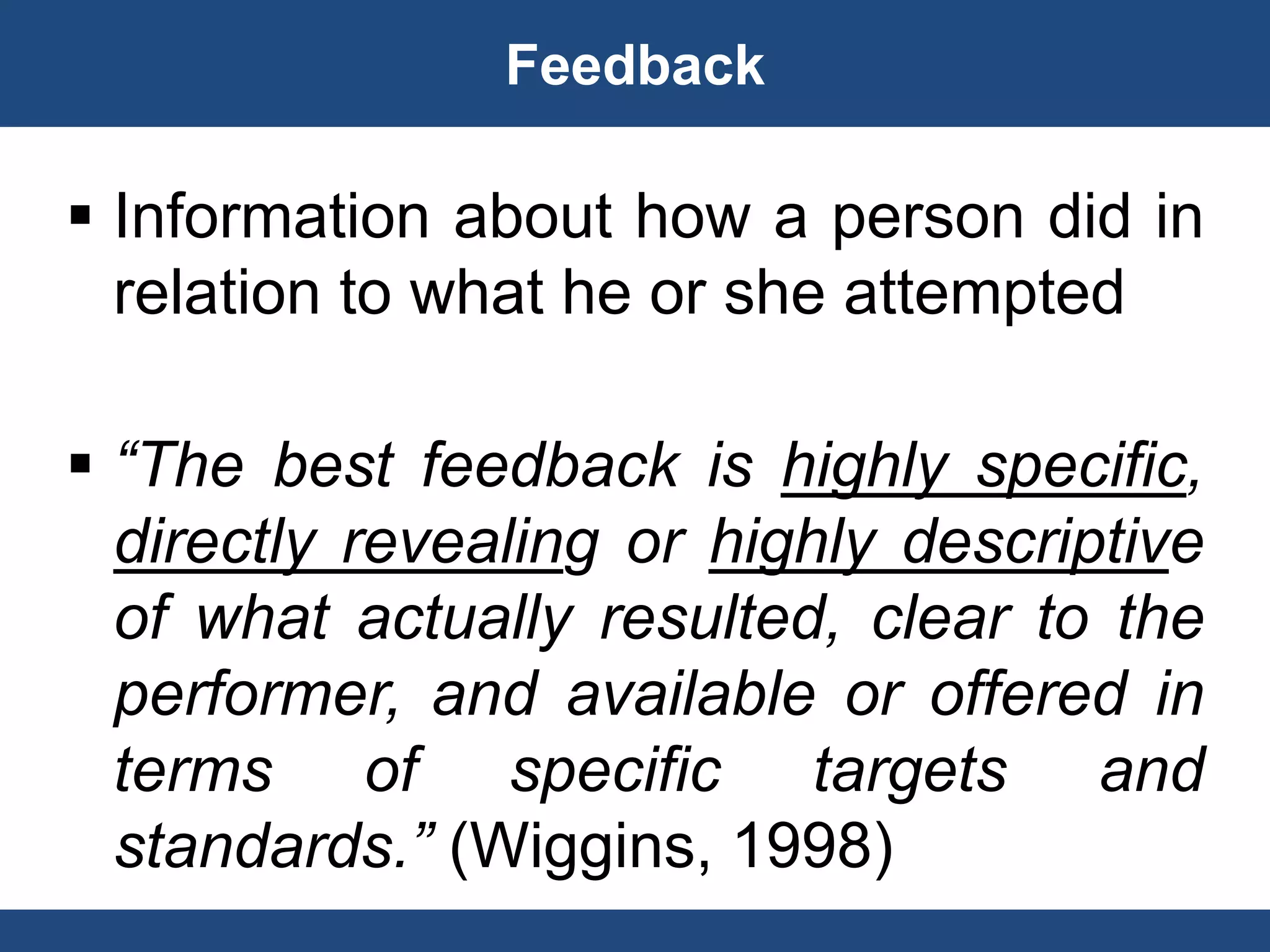
Feedback
 Information about how a person did in
relation to what he or she attempted
 “The best feedback is highly specific,
directly revealing or highly descriptive
of what actually resulted, clear to the
performer, and available or offered in
terms of specific targets and
standards.” (Wiggins, 1998)
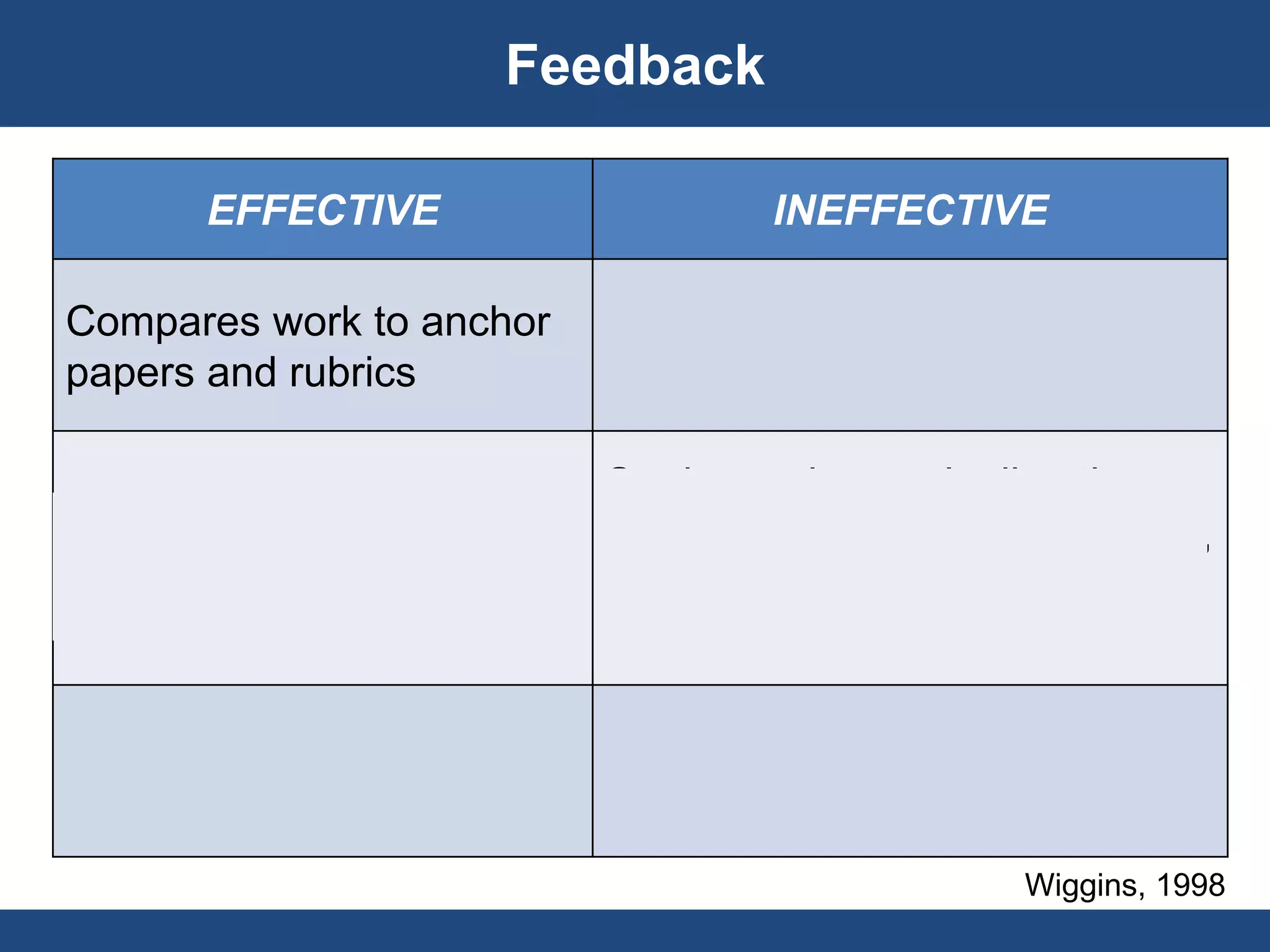
Feedback
EFFECTIVE INEFFECTIVE
Compares work to anchor
papers and rubrics
“Very good!”, “Try harder!”,
Mere score on a paper
Compares work against
exemplars and criteria
Students given only directions
on how to complete assignment,
not guidance on specific
standards of final products
Timely
Not timely (e.g. standardized
test)
Wiggins, 1998
Feedback
EFFECTIVE INEFFECTIVE
Frequent and ongoing Infrequent, given once
Use of descriptive language
focusing on qualities of
performance
Use of
evaluative/comparative
language, with no insight into
the characteristics that lead to
such value judgments
Grade or score confirms what
was apparent to the
performer about the quality of
the performance
The evaluation process is
mysterious or arbitrary to the
performer
Wiggins, 1998
Feedback
EFFECTIVE INEFFECTIVE
Given in terms of the goal
derived from exemplars
Derived from a simplistic goal
Enables performers to
improve through self-
assessment and self-
adjustment
Keeps the performers
constantly dependent on the
judge to know how they did
Wiggins, 1998
The Cognitive Process Dimensions
(DO #8, s. 2015, p. 4)http://www.schrockguide.net/bloomin-apps.html
What is the Grading System?
 Standard & competency-based grading system.
 All grades will be based on weighted raw score of
the learners’ summative assessments.
 The minimum grade is 60, which is transmuted to
75 in the report card.
 The lowest mark on the report card is 60.
 Learners from Grades 1 to 12 are graded on Written
Work, Performance Tasks, and Quarterly
Assessment every quarter.
DO #8, s.2015, p9
How is learner’s progress
recorded and computed?
DO #8, s.2015, p10
How is Attendance Reported?
 learners must be in school every day
 attendance shall be recorded by teacher
daily
 Learner who incurs absences of more than
20% of the prescribed number of class or
laboratory periods during the school year or
semester should be given a failing grade
and not earn credit for the learning area or
subject (DO #8, s.2015, p.23)
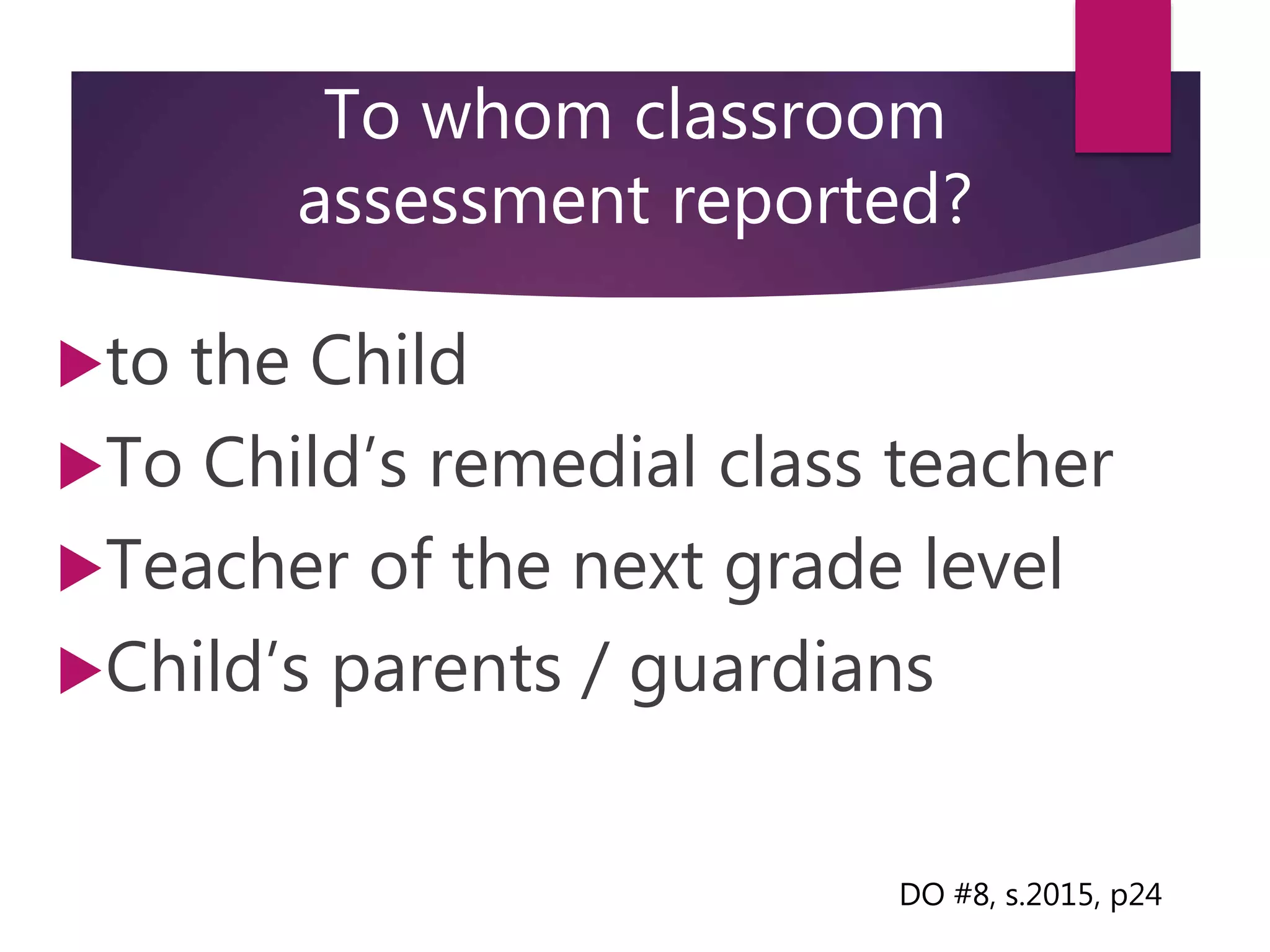
To whom classroom
assessment reported?
to the Child
To Child’s remedial class teacher
Teacher of the next grade level
Child’s parents / guardians
DO #8, s.2015, p24
THANK
YOU
&

Assessment DO no.8, s.2015

  • 1.
  • 2.
  • 3.
    Wandering Down MemoryLane  What are your earliest, or most vivid, memories of assessment?  In primary? In secondary? In tertiary?  Why are these experiences memorable?  What was pleasing or frustrating for you?  How have these experiences affected the way you assess your learners now?
  • 5.
    NCBTS Domain 5: Planning,Assessing and Reporting • Develops and utilizes creative and appropriate instructional plan • Develops and uses a variety of appropriate assessment strategies to monitor and evaluate learning • Monitors regularly and provides feedback on learners' understanding of content • Communicates promptly and clearly to learners, parents and superiors about progress of learners
  • 6.
    ACTIVITY • In pairs,brainstorm ideas that are related to the word “assessment”. • Then as a group, consolidate and organize these ideas through a concept map. • Lastly, write down your own definition for “assessment”.
  • 7.
    K to 12Classroom Assessment  A joint process that involves both teachers & learners  An integral part of teaching and learning  Facilitates the development of learners’ higher- order thinking and 21st-century skills  The “ongoing process of identifying, gathering, organizing, and interpreting quantitative and qualitative information about what learners know and can do” (DO #8, s. 2015, p. 1)  the learners’ zone of proximal development (Vygotsky 1978)
  • 9.
    Types of ClassroomAssessment DO #8, s.2015, p2
  • 10.
  • 11.
    Assessment Methods • Whatare you assessing – knowledge, skills or both? • Which method would best allow your learners to demonstrate what they have learned? • Which method would make it easy and manageable for you to gather evidence of your learners’ progress over time? DepEd, 2016
  • 12.
    ACTIVITY  What isFeedback?  Fill in this table. Effective Feedback Ineffective Feedback
  • 13.
    Feedback  Information abouthow a person did in relation to what he or she attempted  “The best feedback is highly specific, directly revealing or highly descriptive of what actually resulted, clear to the performer, and available or offered in terms of specific targets and standards.” (Wiggins, 1998)
  • 14.
    Feedback EFFECTIVE INEFFECTIVE Compares workto anchor papers and rubrics “Very good!”, “Try harder!”, Mere score on a paper Compares work against exemplars and criteria Students given only directions on how to complete assignment, not guidance on specific standards of final products Timely Not timely (e.g. standardized test) Wiggins, 1998
  • 15.
    Feedback EFFECTIVE INEFFECTIVE Frequent andongoing Infrequent, given once Use of descriptive language focusing on qualities of performance Use of evaluative/comparative language, with no insight into the characteristics that lead to such value judgments Grade or score confirms what was apparent to the performer about the quality of the performance The evaluation process is mysterious or arbitrary to the performer Wiggins, 1998
  • 16.
    Feedback EFFECTIVE INEFFECTIVE Given interms of the goal derived from exemplars Derived from a simplistic goal Enables performers to improve through self- assessment and self- adjustment Keeps the performers constantly dependent on the judge to know how they did Wiggins, 1998
  • 17.
    The Cognitive ProcessDimensions (DO #8, s. 2015, p. 4)http://www.schrockguide.net/bloomin-apps.html
  • 18.
    What is theGrading System?  Standard & competency-based grading system.  All grades will be based on weighted raw score of the learners’ summative assessments.  The minimum grade is 60, which is transmuted to 75 in the report card.  The lowest mark on the report card is 60.  Learners from Grades 1 to 12 are graded on Written Work, Performance Tasks, and Quarterly Assessment every quarter. DO #8, s.2015, p9
  • 19.
    How is learner’sprogress recorded and computed? DO #8, s.2015, p10
  • 20.
    How is AttendanceReported?  learners must be in school every day  attendance shall be recorded by teacher daily  Learner who incurs absences of more than 20% of the prescribed number of class or laboratory periods during the school year or semester should be given a failing grade and not earn credit for the learning area or subject (DO #8, s.2015, p.23)
  • 21.
    To whom classroom assessmentreported? to the Child To Child’s remedial class teacher Teacher of the next grade level Child’s parents / guardians DO #8, s.2015, p24
  • 22.

Editor's Notes

  • #6 40 Performance Indicators (from 183-222) The use of assessment data to plan and revise instructional plans Integration of assessment procedures in the plan and implementation of teaching-learning activities Reporting of the learners’ actual achievement and behavior
  • #8 Teachers provide appropriate assessment when they aim to holistically measure learners’ current & developing abilities while enabling them to take responsibility in the process. This view recognizes the diversity of learners inside the classroom, the need for multiple ways of measuring their varying abilities and learning potentials, and the role of learners as co-participants in the assessment process. ……moving from guided to independent display of knowledge, understanding, and skills between people (interpsychological) and then inside the child (intrapsychological) A second aspect of Vygotsky's theory is the idea that the potential for cognitive development depends upon the "zone of proximal development" (ZPD): a level of development attained when children engage in social behavior. Full development of the ZPD depends upon full social interaction. The range of skill that can be developed with adult guidance or peer collaboration exceeds what can be attained alone.
  • #20 Basic content & skills Higher level skills Desirable content & skills
  • #22 Basic content & skills Higher level skills Desirable content & skills
  • #30 Now that we are done with our assessment, what is the next step that we are going to do? What are we going to do with that assessment?
  • #33 School head may exempt a learner for reasons considered valid and acceptable to the school. However, report card should still reflect the number of absences.
  • #34 To understand the learners’ progress on curriculum standards