Extended Process Modeling,
 Languages and Notations
                 Nov 2010,
    Sylvain Astier, sastier@gmail.com
Extended Process Modeling, Languages and Notations


            1   The Need for Models

            2   The Need for Languages

            3   The Process Domain

            4   Business Interactions Modeling

            5   BPMN 2 Overview
Extended Process Modeling, Languages and Notations


            1   The Need for Models

            2   The Need for Languages

            3   The Process Domain

            4   Business Interactions Modeling

            5   BPMN 2 Overview
1 Why do we need models ?


       • A Model is a simple representation of the
        complex reality of a business.
1 Why do we need models ?


       • A Model is a simple representation of the
        complex reality of a business.

       • Models are created to simplify, abstract
        reality, and focus on a specific area of
        concern.
1 Why do we need models ?


       • A Model is a simple representation of the
        complex reality of a business.

       • Models are created to simplify, abstract
        reality, and focus on a specific area of
        concern.

             ➡ A Model is built for a purpose
1 Why do we need models ?


       • Models are work products of Architecture
1 One question though ..


                            Is this Architecture ?


             (Inspired from John Zachman)
1 This is not Architecture !


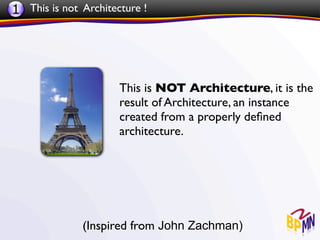
                      This is NOT Architecture, it is the
                      result of Architecture, an instance
                      created from a properly defined
                      architecture.


              (Inspired from John Zachman)
1Is ThisArchitecture ? !
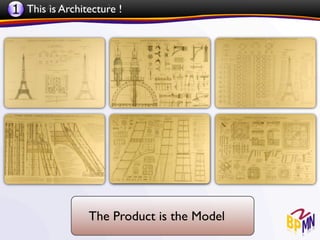
    this is Architecture


                The Product is the Model
1 Architecture Definition


       • Architecture expresses the characteristics,
         structures, behaviors, and relationships that
         are common across a family of things. 
1 Architecture Definition


       • Architecture expresses the characteristics,
         structures, behaviors, and relationships that
         are common across a family of things. 

       • Design expresses in detail how a specific
         member of a family will be built.

                                         - Oliver Sims
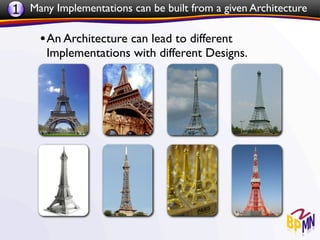
1 Many Implementations can be built from a given Architecture

     • An Architecture can lead to different
       Implementations with different Designs.
1 Many Implementations can be built from a given Architecture

     • An Architecture can lead to different
       Implementations with different Designs.
1 Enterprise Architecture Definition


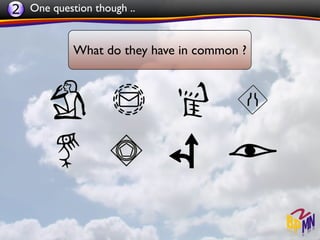
       “Enterprise Architecture is the total set of
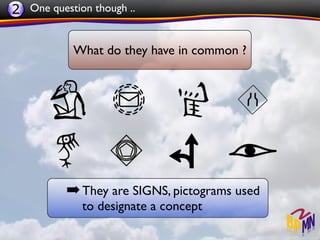
       descriptive representations (models) relevant for
       describing an Enterprise, that is, the descriptive
       representations required to create (a coherent,
       optimal) Enterprise and required to serve as a
       baseline for changing the Enterprise once it is
       created.”
                                  -- John Zachman
1 Enterprise Architecture reaps two major benefits :


                  Change Management
1 Enterprise Architecture reaps two major benefits :


                  Change Management

   • By maintaining the descriptive representations
     of the object of interest, you can run ‘what-if’
     analysis.
1 Enterprise Architecture reaps two major benefits :


                  Change Management

   • By maintaining the descriptive representations
     of the object of interest, you can run ‘what-if’
     analysis.
         ➡Change is manageable as soon as you can
           study its impacts on models, before
           modifying their instances.
1 Enterprise Architecture reaps two major benefits :


                  Change Management

   • By maintaining the descriptive representations
     of the object of interest, you can run ‘what-if’
     analysis.
         ➡Change is manageable as soon as you can
           study its impacts on models, before
           modifying their instances.

    • You need the map of your own territory.
1 Enterprise Architecture reaps two major benefits :


                Integration Management
1 Enterprise Architecture reaps two major benefits :


                Integration Management


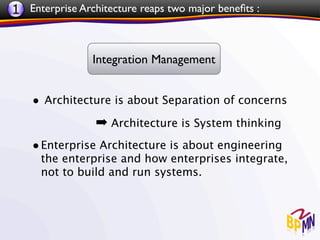
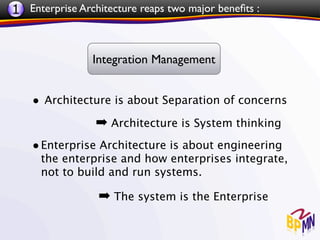
    • Architecture is about Separation of concerns
1 Enterprise Architecture reaps two major benefits :


                Integration Management


    • Architecture is about Separation of concerns
                 ➡ Architecture is System thinking
1 Enterprise Architecture reaps two major benefits :


                Integration Management


    • Architecture is about Separation of concerns
                 ➡ Architecture is System thinking
    • Enterprise Architecture is about engineering
      the enterprise and how enterprises integrate,
      not to build and run systems.
1 Enterprise Architecture reaps two major benefits :


                Integration Management


    • Architecture is about Separation of concerns
                 ➡ Architecture is System thinking
    • Enterprise Architecture is about engineering
      the enterprise and how enterprises integrate,
      not to build and run systems.

                 ➡ The system is the Enterprise
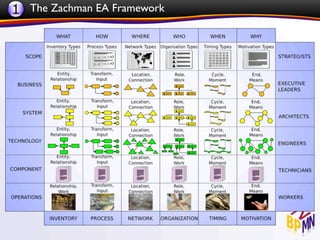
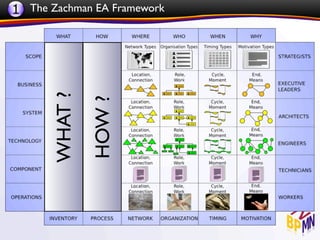
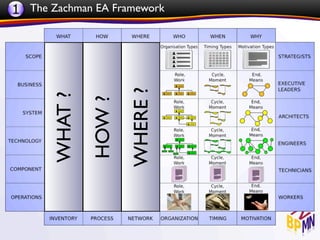
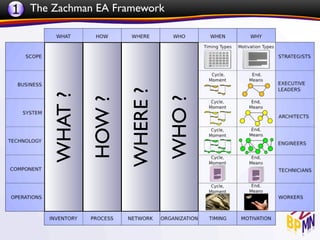
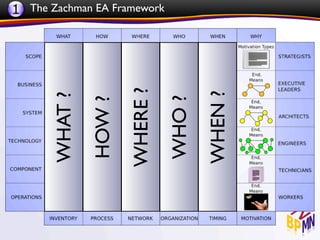
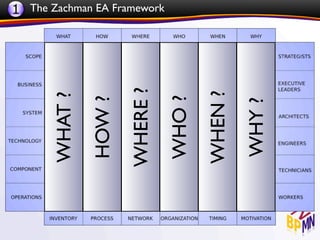
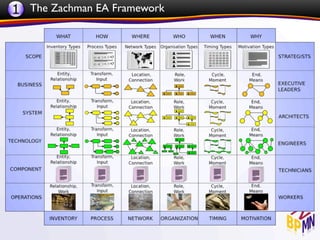
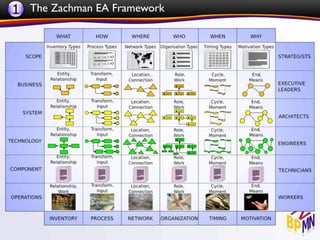
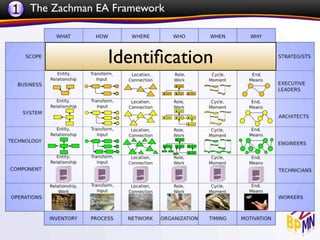
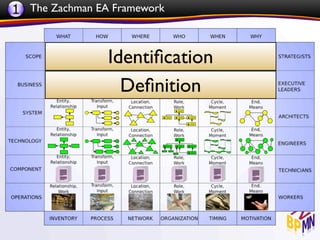
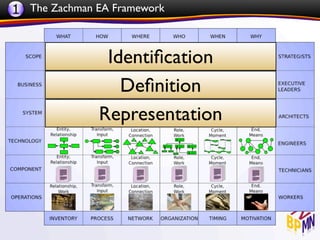
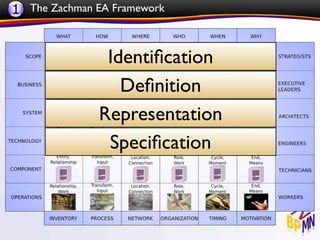
1 The Zachman EA Framework


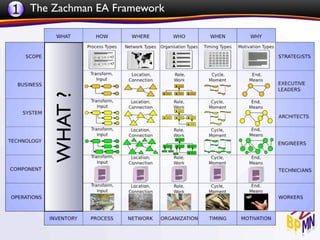
      WHAT ?
1 The Zachman EA Framework


      WHAT ?
               HOW ?
1 The Zachman EA Framework


                       WHERE ?
      WHAT ?
               HOW ?
1 The Zachman EA Framework


                       WHERE ?
      WHAT ?


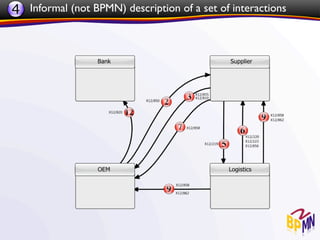
                                 WHO ?
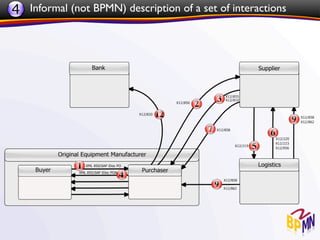
               HOW ?
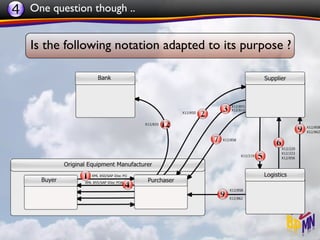
WHAT ?
HOW ?
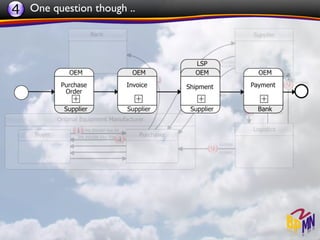
WHERE ?
          1 The Zachman EA Framework


WHO ?
WHEN ?
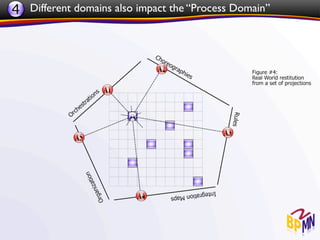
WHAT ?
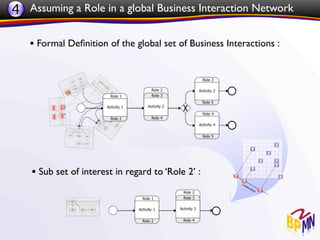
HOW ?
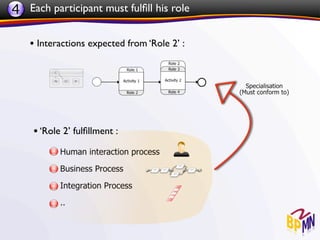
WHERE ?
          1 The Zachman EA Framework


WHO ?
WHEN ?
WHY ?
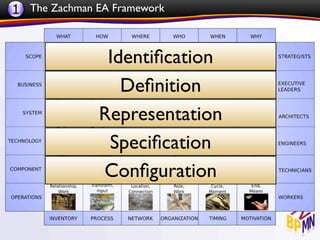
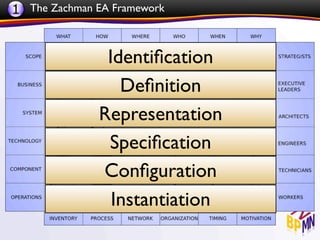
1 The Zachman EA Framework


                Identification
1 The Zachman EA Framework


                Identification
                  Definition
1 The Zachman EA Framework


               Identification
                 Definition
              Representation
1 The Zachman EA Framework


               Identification
                 Definition
              Representation
               Specification
1 The Zachman EA Framework


               Identification
                 Definition
              Representation
               Specification
              Configuration
1 The Zachman EA Framework


               Identification
                 Definition
              Representation
               Specification
              Configuration
                Instantiation
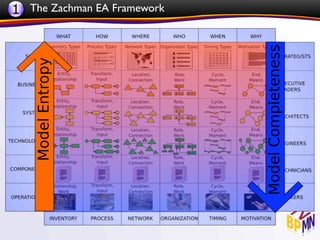
1 The Zachman EA Framework
1 One question though ..


           Should everything be formalized ?
1 One question though ..


           Should everything be formalized ?


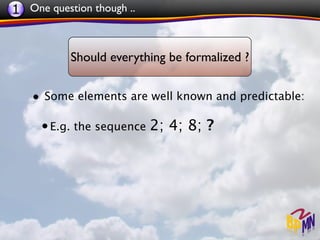
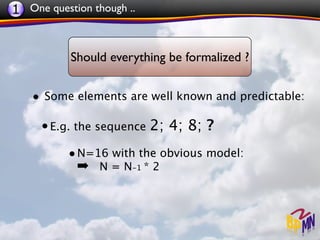
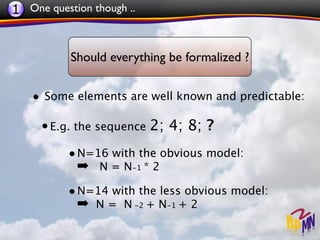
   • Some elements are well known and predictable:

     • E.g. the sequence 2; 4; 8; ?
1 One question though ..


           Should everything be formalized ?


   • Some elements are well known and predictable:

     • E.g. the sequence 2; 4; 8; ?
          • N=16 with the obvious model:
            ➡ N = N-1 * 2
1 One question though ..


           Should everything be formalized ?


   • Some elements are well known and predictable:

     • E.g. the sequence 2; 4; 8; ?
          • N=16 with the obvious model:
            ➡ N = N-1 * 2
          • N=14 with the less obvious model:
            ➡ N = N -2 + N-1 + 2
1 One question though ..


           Should everything be formalized ?
1 One question though ..


           Should everything be formalized ?


     No; assumptions can be made knowing that:
         •They can lead to defects
         •Until a phenomenon is KNOWN it is
              ➡Not Predictable
              ➡Not Repeatable
1 One question though ..


           Should everything be formalized ?


     No; assumptions can be made knowing that:
         •They can lead to defects
         •Until a phenomenon is KNOWN it is
              ➡Not Predictable
              ➡Not Repeatable

          ARCHITECTURE is KNOWLEDGE
Extended Process Modeling, Languages and Notations


            1   The Need for Models

            2   The Need for Languages

            3   The Process Domain

            4   Business Interactions Modeling

            5   BPMN 2 Overview
2 Why do we need modeling languages ?
 •Modeling allows efficiency in reading and
   understanding.
2 Why do we need modeling languages ?
 •Modeling allows efficiency in reading and
  understanding.
 •A standardized modeling language allows
  communication improvement, much the same
  way one becomes more literate through
  continuous practice of French or English
2 Why do we need modeling languages ?
 •Modeling allows efficiency in reading and
  understanding.
 •A standardized modeling language allows
  communication improvement, much the same
  way one becomes more literate through
  continuous practice of French or English
 • Skillful modeling drives the simplification of
   reality - and thereby abstraction.
2 Why do we need modeling languages ?
 •Modeling allows efficiency in reading and
  understanding.
 •A standardized modeling language allows
  communication improvement, much the same
  way one becomes more literate through
  continuous practice of French or English
 • Skillful modeling drives the simplification of
  reality - and thereby abstraction.
 •Improves efficiency, modeling allows one to
  learn from the Masters and reuse patterns.
2 Why do we need modeling languages ?
 •Modeling allows efficiency in reading and
  understanding.
 •A standardized modeling language allows
  communication improvement, much the same
  way one becomes more literate through
  continuous practice of French or English
 • Skillful modeling drives the simplification of
  reality - and thereby abstraction.
 •Improves efficiency, modeling allows one to
  learn from the Masters and reuse patterns.
 •Models constitute a body of knowledge from
   which one can elaborate on to create new
   architectures.
2 Why do we need modeling languages ?


    • The goal of a modeling language is to enable
      the description of some domain of interest.
2 Why do we need modeling languages ?


    • The goal of a modeling language is to enable
      the description of some domain of interest.

    • The semantics of a language describe the
      meaning of its concepts in the domain of
      interest.
2 Why do we need modeling languages ?


    • The goal of a modeling language is to enable
      the description of some domain of interest.

    • The semantics of a language describe the
      meaning of its concepts in the domain of
      interest.

           ‣ We need Modeling Languages to
            express our concepts and their
            interactions in a specific domain of
            interest
2 Why do we need modeling languages ?

    • The set of symbols that compose a language
      as well as the rules for forming valid
      combinations of these symbols constitute the
      language’s syntax.
2 Why do we need modeling languages ?

    • The set of symbols that compose a language
      as well as the rules for forming valid
      combinations of these symbols constitute the
      language’s syntax.

    • The syntax can be defined in terms of:
      • Linear sequences of characters
      • Pictorial signs
2 One question though ..


           What do they have in common ?
2 One question though ..


           What do they have in common ?


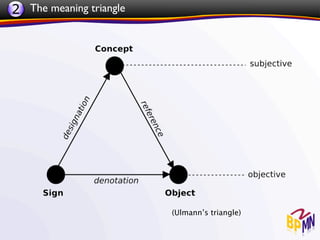
          ➡ They are SIGNS, pictograms used
             to designate a concept
2 Signs, Objects and Concepts

       • A Sign is an object that is used as a
         representation of something else.
2 Signs, Objects and Concepts

       • A Sign is an object that is used as a
         representation of something else.

       • An Object is an observable and identifiable
         individual thing.
2 Signs, Objects and Concepts

       • A Sign is an object that is used as a
         representation of something else.

       • An Object is an observable and identifiable
         individual thing.

        • A Concept is always a Concept of a Type.
2 Signs, Objects and Concepts

 • Relationship:
2 Signs, Objects and Concepts

 • Relationship:
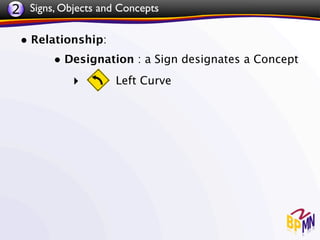
       • Designation : a Sign designates a Concept
2 Signs, Objects and Concepts

 • Relationship:
       • Designation : a Sign designates a Concept
            ‣       Left Curve
2 Signs, Objects and Concepts

 • Relationship:
       • Designation : a Sign designates a Concept
            ‣       Left Curve

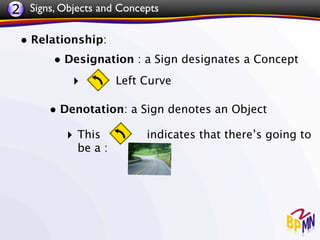
       • Denotation: a Sign denotes an Object
2 Signs, Objects and Concepts

 • Relationship:
       • Designation : a Sign designates a Concept
            ‣        Left Curve

       • Denotation: a Sign denotes an Object
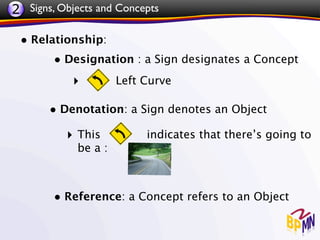
          ‣ This          indicates that there’s going to
            be a :
2 Signs, Objects and Concepts

 • Relationship:
       • Designation : a Sign designates a Concept
            ‣        Left Curve

       • Denotation: a Sign denotes an Object
          ‣ This          indicates that there’s going to
            be a :


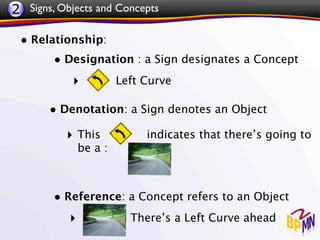
        • Reference: a Concept refers to an Object
2 Signs, Objects and Concepts

 • Relationship:
       • Designation : a Sign designates a Concept
            ‣           Left Curve

       • Denotation: a Sign denotes an Object
          ‣ This             indicates that there’s going to
               be a :


        • Reference: a Concept refers to an Object
           ‣              There’s a Left Curve ahead
2 The meaning triangle


                         (Ulmann’s triangle)
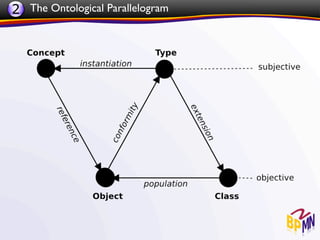
2 The Ontological Parallelogram
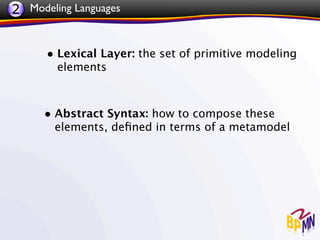
2 Modeling Languages


      • Lexical Layer: the set of primitive modeling
        elements
2 Modeling Languages


      • Lexical Layer: the set of primitive modeling
        elements


     • Abstract Syntax: how to compose these
       elements, defined in terms of a metamodel
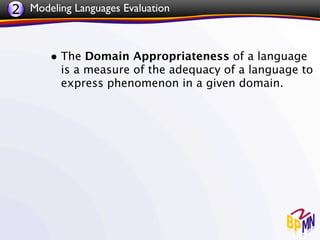
2 Modeling Languages Evaluation


       • The Domain Appropriateness of a language
         is a measure of the adequacy of a language to
         express phenomenon in a given domain.
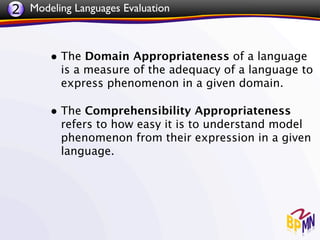
2 Modeling Languages Evaluation


       • The Domain Appropriateness of a language
         is a measure of the adequacy of a language to
         express phenomenon in a given domain.
       • The Comprehensibility Appropriateness
         refers to how easy it is to understand model
         phenomenon from their expression in a given
         language.
Extended Process Modeling, Languages and Notations


            1   The Need for Models

            2   The Need for Languages

            3   The Process Domain

            4   Business Interactions Modeling

            5   BPMN 2 Overview
3 Domain Specific Languages for Processes


      • The main evaluation criteria for a language
        are:
3 Domain Specific Languages for Processes


      • The main evaluation criteria for a language
        are:

            • Domain Appropriateness
3 Domain Specific Languages for Processes


      • The main evaluation criteria for a language
        are:

            • Domain Appropriateness
            • Comprehensibility Appropriateness
3 Domain Specific Languages for Processes


      • The main evaluation criteria for a language
        are:

            • Domain Appropriateness
            • Comprehensibility Appropriateness

       • A language appropriateness is determined by
         its suitability to a domain, while the
         comprehensibility is determined by its users
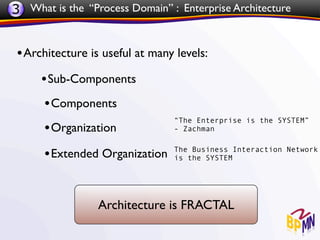
3 What is the “Process Domain” : Enterprise Architecture


 • Architecture is useful at many levels:
3 What is the “Process Domain” : Enterprise Architecture


 • Architecture is useful at many levels:
      • Sub-Components
3 What is the “Process Domain” : Enterprise Architecture


 • Architecture is useful at many levels:
      • Sub-Components
      • Components
3 What is the “Process Domain” : Enterprise Architecture


 • Architecture is useful at many levels:
      • Sub-Components
      • Components
      • Organization
3 What is the “Process Domain” : Enterprise Architecture


 • Architecture is useful at many levels:
      • Sub-Components
      • Components
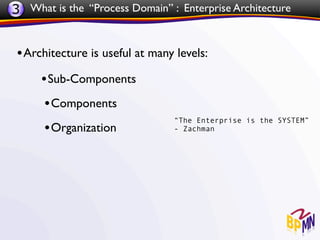
                                 “The Enterprise is the SYSTEM”
      • Organization             - Zachman
3 What is the “Process Domain” : Enterprise Architecture


 • Architecture is useful at many levels:
      • Sub-Components
      • Components
                                 “The Enterprise is the SYSTEM”
      • Organization             - Zachman


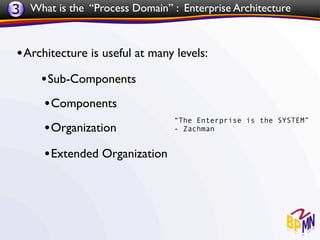
      • Extended Organization
3 What is the “Process Domain” : Enterprise Architecture


 • Architecture is useful at many levels:
      • Sub-Components
      • Components
                                 “The Enterprise is the SYSTEM”
      • Organization             - Zachman


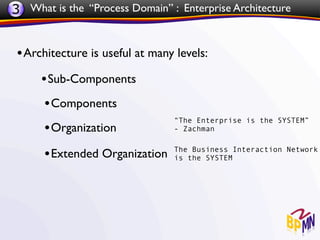
      • Extended Organization    The Business Interaction Network
                                 is the SYSTEM
3 What is the “Process Domain” : Enterprise Architecture


 • Architecture is useful at many levels:
      • Sub-Components
      • Components
                                 “The Enterprise is the SYSTEM”
      • Organization             - Zachman


      • Extended Organization    The Business Interaction Network
                                 is the SYSTEM


                  Architecture is FRACTAL
3 From Silos to Services 1/4


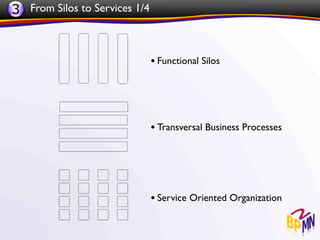
                               • Functional Silos


                               • Transversal Business Processes


                               • Service Oriented Organization
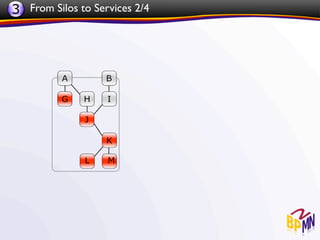
3 From Silos to Services 2/4


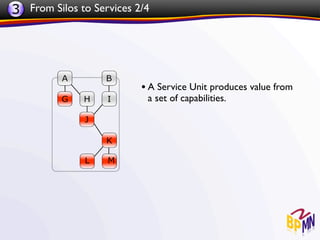
                          • A Service Unit produces value from
                           a set of capabilities.
3 From Silos to Services 2/4


                          • A Service Unit produces value from
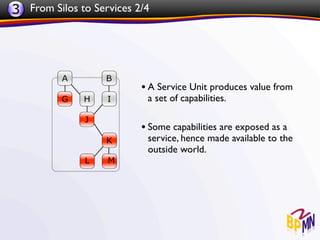
                           a set of capabilities.

                          • Some capabilities are exposed as a
                           service, hence made available to the
                           outside world.
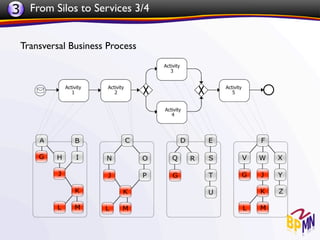
3 From Silos to Services 3/4

 Transversal Business Process
3 From Silos to Services 4/4


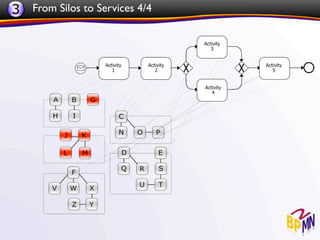
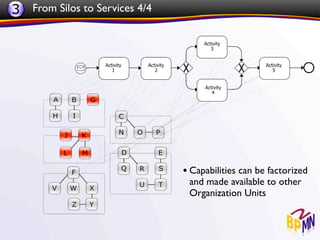
                               • Capabilities can be factorized
                                and made available to other
                                Organization Units
3   Different kinds of Processes
3     Different kinds of Processes


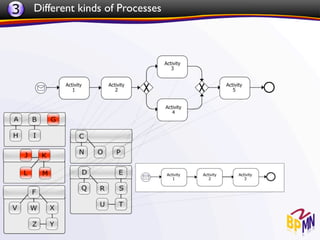
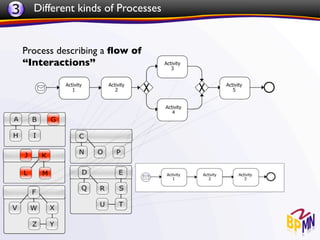
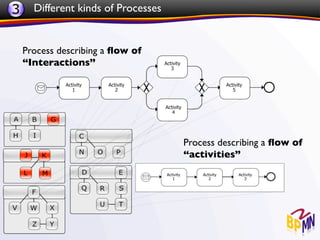
    Process describing a flow of
    “Interactions”
3     Different kinds of Processes


    Process describing a flow of
    “Interactions”


                                     Process describing a flow of
                                     “activities”
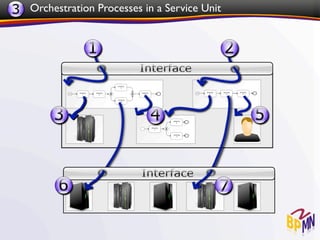
3 Orchestration Processes in a Service Unit
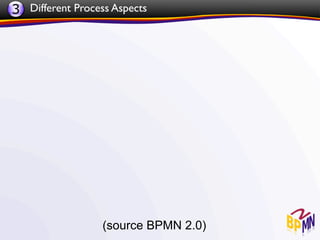
3 Different Process Aspects


                  (source BPMN 2.0)
3 Different Process Aspects

      • Orchestration: A sequence or flow of Activities in
         an organization with the objective of carrying out work.


                   (source BPMN 2.0)
3 Different Process Aspects

      • Orchestration: A sequence or flow of Activities in
         an organization with the objective of carrying out work.

      • Collaboration: Collaboration is the act of sending
         messages between any two Participants.


                   (source BPMN 2.0)
3 Different Process Aspects

      • Orchestration: A sequence or flow of Activities in
         an organization with the objective of carrying out work.

      • Collaboration: Collaboration is the act of sending
         messages between any two Participants.

                  • Conversation: It represents a set of
                    Message Flows grouped together based
                    on a concept and/or a CorrelationKey.


                   (source BPMN 2.0)
3 Different Process Aspects

      • Orchestration: A sequence or flow of Activities in
         an organization with the objective of carrying out work.

      • Collaboration: Collaboration is the act of sending
         messages between any two Participants.

                  • Conversation: It represents a set of
                    Message Flows grouped together based
                    on a concept and/or a CorrelationKey.

       • Choreography: An ordered sequence of B2B
         message exchanges between two or more Participants.

                   (source BPMN 2.0)
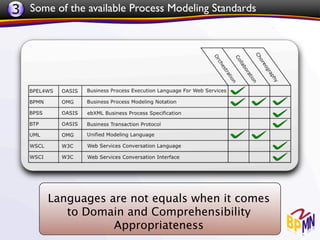
3 Some of the available Process Modeling Standards


       Languages are not equals when it comes
          to Domain and Comprehensibility
                  Appropriateness
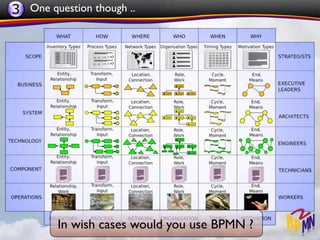
3 One question though ..


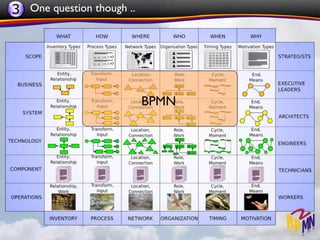
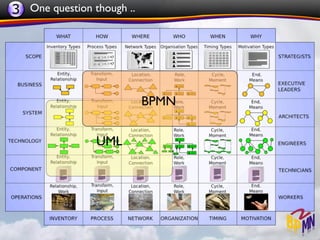
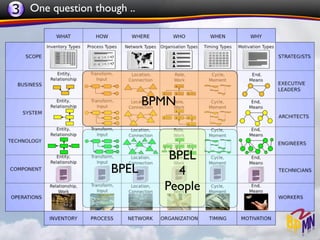
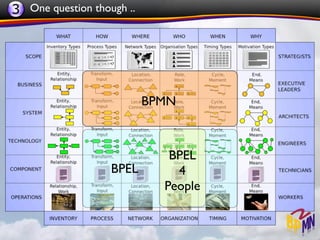
        In wish cases would you use BPMN ?
3 One question though ..


                           BPMN
3 One question though ..


                           BPMN


                UML
3 One question though ..


                           BPMN


                              BPEL
                   BPEL        4
                             People
3 One question though ..


                           BPMN


                              BPEL
                   BPEL        4
                             People
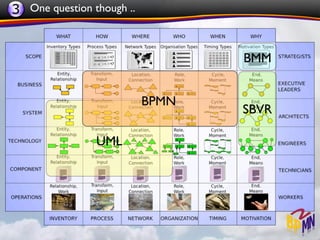
3 One question though ..


                                  BMM


                           BPMN
                                  SBVR

                UML
Extended Process Modeling, Languages and Notations


            1   The Need for Models

            2   The Need for Languages

            3   The Process Domain

            4   Business Interactions Modeling

            5   BPMN 2 Overview
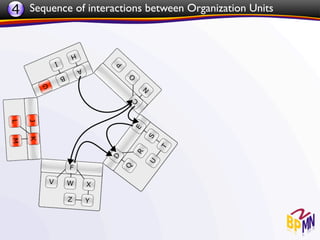
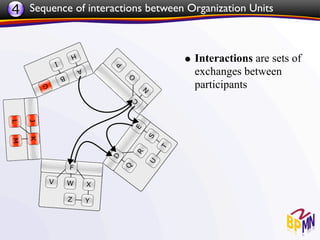
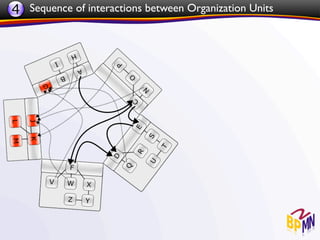
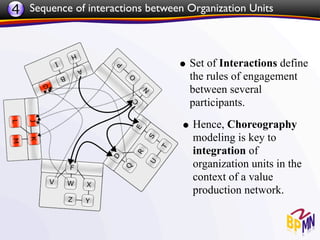
4 Sequence of interactions between Organization Units


                                  • Interactions are sets of
                                     exchanges between
                                     participants
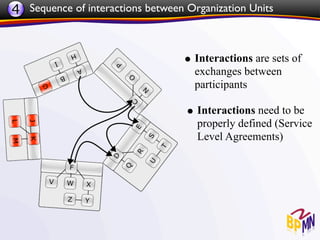
4 Sequence of interactions between Organization Units


                                  • Interactions are sets of
                                     exchanges between
                                     participants

                                   • Interactions need to be
                                     properly defined (Service
                                     Level Agreements)
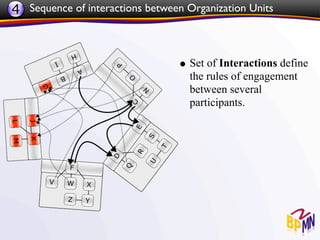
4 Sequence of interactions between Organization Units


                                 • Set of Interactions define
                                    the rules of engagement
                                    between several
                                    participants.
4 Sequence of interactions between Organization Units


                                 • Set of Interactions define
                                    the rules of engagement
                                    between several
                                    participants.

                                  • Hence, Choreography
                                    modeling is key to
                                    integration of
                                    organization units in the
                                    context of a value
                                    production network.
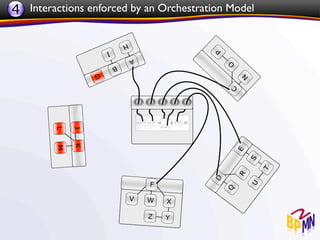
4 Interactions enforced by an Orchestration Model
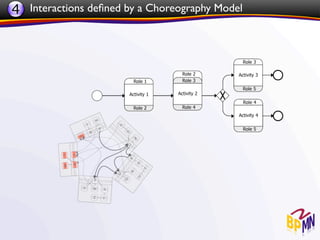
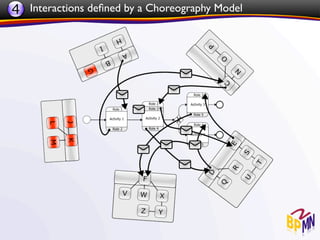
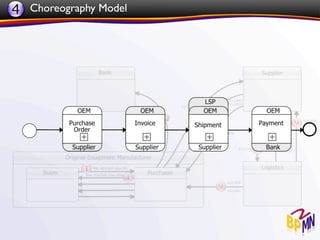
4 Interactions defined by a Choreography Model
4 Informal (not BPMN) description of a set of interactions
4 One question though ..

   Is the following notation adapted to its purpose ?
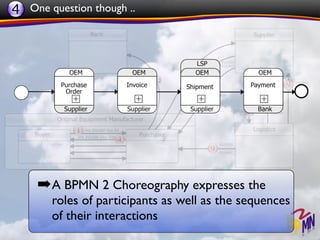
4 One question though ..


     ➡ A BPMN 2 Choreography expresses the
       roles of participants as well as the sequences
       of their interactions
4 Choreography Model
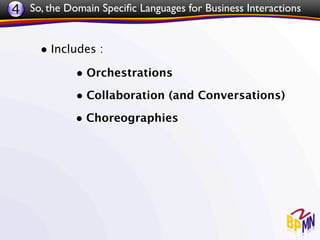
4 So, the Domain Specific Languages for Business Interactions


     • Includes :
             • Orchestrations
             • Collaboration (and Conversations)
             • Choreographies
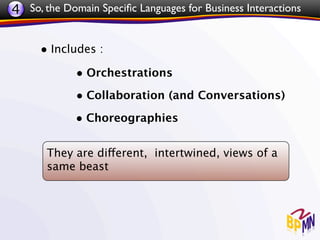
4 So, the Domain Specific Languages for Business Interactions


     • Includes :
             • Orchestrations
             • Collaboration (and Conversations)
             • Choreographies

       They are different, intertwined, views of a
       same beast
4 Different domains also impact the “Process Domain”
4 Assuming a Role in a global Business Interaction Network

   • Formal Definition of the global set of Business Interactions :


    • Sub set of interest in regard to ‘Role 2’ :
4 Each participant must fulfill his role

   • Interactions expected from ‘Role 2’ :


    • ‘Role 2’ fulfillment :
Extended Process Modeling, Languages and Notations


            1   The Need for Models

            2   The Need for Languages

            3   The Process Domain

            4   Business Interactions Modeling

            5   BPMN 2 Overview
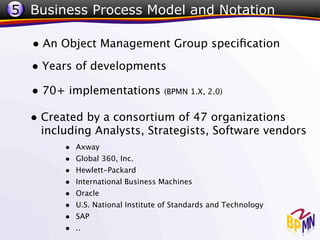
5 Business Process Model and Notation

  • An Object Management Group specification
  • Years of developments
  • 70+ implementations (BPMN 1.X, 2.0)
  • Created by a consortium of 47 organizations
    including Analysts, Strategists, Software vendors
        •   Axway
        •   Global 360, Inc.
        •   Hewlett-Packard
        •   International Business Machines
        •   Oracle
        •   U.S. National Institute of Standards and Technology
        •   SAP
        •   ..
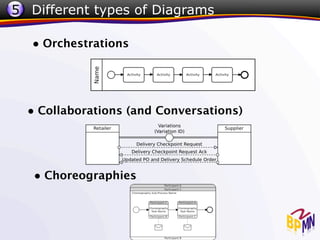
5 Different types of Diagrams

  • Orchestrations


  • Collaborations (and Conversations)


   • Choreographies
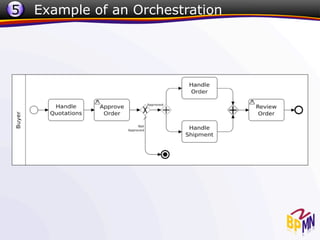
5   Example of an Orchestration
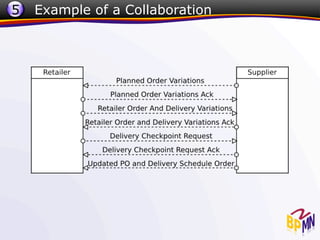
5   Example of a Collaboration
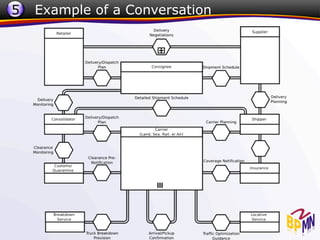
5   Example of a Conversation
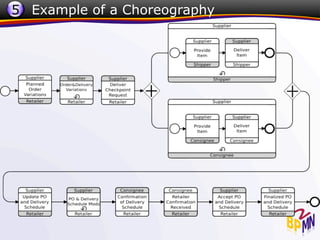
5 Example of a Choreography
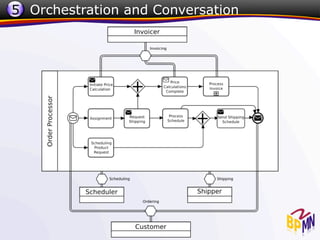
5 Orchestration and Conversation
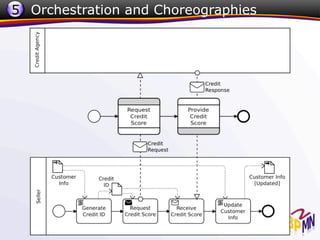
5 Orchestration and Choreographies
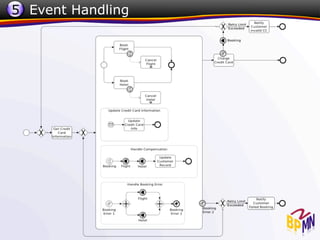
5 Event Handling
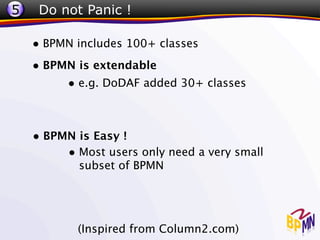
5    Do not Panic !

    • BPMN includes 100+ classes
    • BPMN is extendable
         • e.g. DoDAF added 30+ classes


    • BPMN is Easy !
         • Most users only need a very small
            subset of BPMN


           (Inspired from Column2.com)
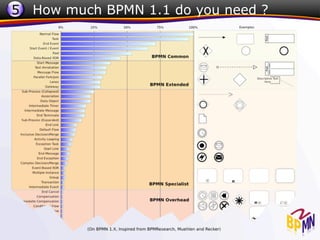
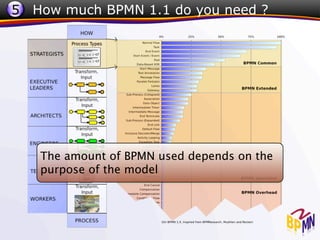
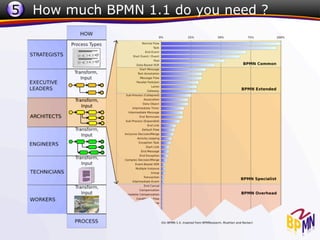
5 How much BPMN 1.1 do you need ?


   The amount of BPMN used depends on the
   purpose of the model
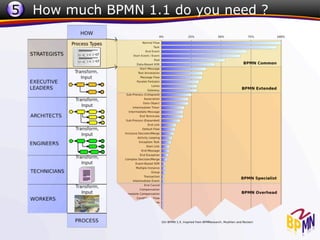
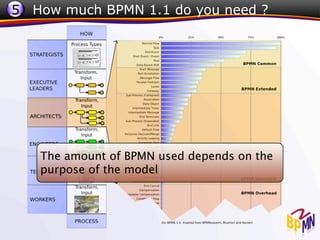
5 How much BPMN 1.1 do you need ?


   The amount of BPMN used depends on the
   purpose of the model
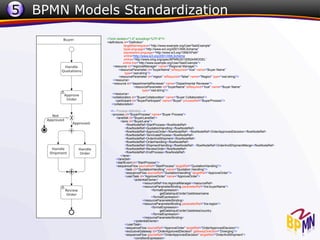
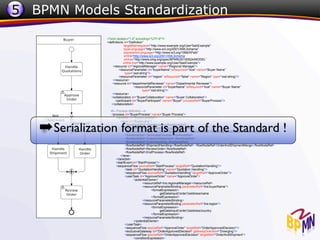
5 BPMN Models Standardization
            <?xml version="1.0" encoding="UTF-8"?>
            <definitions id="Definition"
                         targetNamespace="http://www.example.org/UserTaskExample"
                         typeLanguage="http://www.w3.org/2001/XMLSchema"
                         expressionLanguage="http://www.w3.org/1999/XPath"
                         xmlns=http://www.w3.org/2001/XMLSchema
                         xmlns=”http://www.omg.org/spec/BPMN/20100524/MODEL”
                        xmlns:tns="http://www.example.org/UserTaskExample">
                <resource id="regionalManager" name="Regional Manager">
                     <resourceParameter id="buyerName" isRequired="true" name="Buyer Name"
                          type="xsd:string"/>
                     <resourceParameter id="region" isRequired="false" name="Region" type="xsd:string"/>
                </resource>
               <resource id="departmentalReviewer" name="Departmental Reviewer">
                                <resourceParameter id="buyerName" isRequired="true" name="Buyer Name"
                                       type="xsd:string"/>
               </resource>
               <collaboration id="BuyerCollaboration" name="Buyer Collaboration">
                  <participant id="BuyerParticipant" name="Buyer" processRef="BuyerProcess"/>
               </collaboration>

              <!-- Process definition -->
              <process id="BuyerProcess" name="Buyer Process">
                   <laneSet id="BuyerLaneSet">
                       <lane id="BuyerLane">
                           <flowNodeRef>StartProcess</flowNodeRef>
                           <flowNodeRef>QuotationHandling</flowNodeRef>
                           <flowNodeRef>ApproveOrder</flowNodeRef> <flowNodeRef>OrderApprovedDecision</flowNodeRef>
                           <flowNodeRef>TerminateProcess</flowNodeRef>
                           <flowNodeRef>OrderAndShipment</flowNodeRef>
                           <flowNodeRef>OrderHandling</flowNodeRef>
                           <flowNodeRef>ShipmentHandling</flowNodeRef> <flowNodeRef>OrderAndShipmentMerge</flowNodeRef>
                           <flowNodeRef>ReviewOrder</flowNodeRef>
                           <flowNodeRef>EndProcess</flowNodeRef>
                       </lane>
                   </laneSet>
                   <startEvent id="StartProcess"/>
                   <sequenceFlow sourceRef="StartProcess" targetRef="QuotationHandling"/>
                           <task id="QuotationHandling" name="Quotation Handling"/>
                           <sequenceFlow sourceRef="QuotationHandling" targetRef="ApproveOrder"/>
                           <userTask id="ApproveOrder" name="ApproveOrder">
                                 <potentialOwner>
                                       <resourceRef>tns:regionalManager</resourceRef>
                                       <resourceParameterBinding parameterRef="tns:buyerName">
                                             <formalExpression>
                                                   getDataInput('order')/address/name
                                             </formalExpression>
                                       </resourceParameterBinding>
                                       <resourceParameterBinding parameterRef="tns:region">
                                             <formalExpression>
                                                   getDataInput('order')/address/country
                                             </formalExpression>
                                       </resourceParameterBinding>
                                 </potentialOwner>
                           </userTask>
                           <sequenceFlow sourceRef="ApproveOrder" targetRef="OrderApprovedDecision"/>
                           <exclusiveGateway id="OrderApprovedDecision" gatewayDirection="Diverging"/>
                           <sequenceFlow sourceRef="OrderApprovedDecision" targetRef="OrderAndShipment">
                                 <conditionExpression>
5 BPMN Models Standardization
                <?xml version="1.0" encoding="UTF-8"?>
                <definitions id="Definition"
                             targetNamespace="http://www.example.org/UserTaskExample"
                             typeLanguage="http://www.w3.org/2001/XMLSchema"
                             expressionLanguage="http://www.w3.org/1999/XPath"
                             xmlns=http://www.w3.org/2001/XMLSchema
                             xmlns=”http://www.omg.org/spec/BPMN/20100524/MODEL”
                            xmlns:tns="http://www.example.org/UserTaskExample">
                    <resource id="regionalManager" name="Regional Manager">
                         <resourceParameter id="buyerName" isRequired="true" name="Buyer Name"
                              type="xsd:string"/>
                         <resourceParameter id="region" isRequired="false" name="Region" type="xsd:string"/>
                    </resource>
                   <resource id="departmentalReviewer" name="Departmental Reviewer">
                                    <resourceParameter id="buyerName" isRequired="true" name="Buyer Name"
                                           type="xsd:string"/>
                   </resource>
                   <collaboration id="BuyerCollaboration" name="Buyer Collaboration">
                      <participant id="BuyerParticipant" name="Buyer" processRef="BuyerProcess"/>
                   </collaboration>

                  <!-- Process definition -->
                  <process id="BuyerProcess" name="Buyer Process">
                       <laneSet id="BuyerLaneSet">


   ➡ Serialization format is part of the Standard !
                           <lane id="BuyerLane">
                               <flowNodeRef>StartProcess</flowNodeRef>
                               <flowNodeRef>QuotationHandling</flowNodeRef>
                               <flowNodeRef>ApproveOrder</flowNodeRef> <flowNodeRef>OrderApprovedDecision</flowNodeRef>
                               <flowNodeRef>TerminateProcess</flowNodeRef>
                               <flowNodeRef>OrderAndShipment</flowNodeRef>
                               <flowNodeRef>OrderHandling</flowNodeRef>
                               <flowNodeRef>ShipmentHandling</flowNodeRef> <flowNodeRef>OrderAndShipmentMerge</flowNodeRef>
                               <flowNodeRef>ReviewOrder</flowNodeRef>
                               <flowNodeRef>EndProcess</flowNodeRef>
                           </lane>
                       </laneSet>
                       <startEvent id="StartProcess"/>
                       <sequenceFlow sourceRef="StartProcess" targetRef="QuotationHandling"/>
                               <task id="QuotationHandling" name="Quotation Handling"/>
                               <sequenceFlow sourceRef="QuotationHandling" targetRef="ApproveOrder"/>
                               <userTask id="ApproveOrder" name="ApproveOrder">
                                     <potentialOwner>
                                           <resourceRef>tns:regionalManager</resourceRef>
                                           <resourceParameterBinding parameterRef="tns:buyerName">
                                                 <formalExpression>
                                                       getDataInput('order')/address/name
                                                 </formalExpression>
                                           </resourceParameterBinding>
                                           <resourceParameterBinding parameterRef="tns:region">
                                                 <formalExpression>
                                                       getDataInput('order')/address/country
                                                 </formalExpression>
                                           </resourceParameterBinding>
                                     </potentialOwner>
                               </userTask>
                               <sequenceFlow sourceRef="ApproveOrder" targetRef="OrderApprovedDecision"/>
                               <exclusiveGateway id="OrderApprovedDecision" gatewayDirection="Diverging"/>
                               <sequenceFlow sourceRef="OrderApprovedDecision" targetRef="OrderAndShipment">
                                     <conditionExpression>
4 One question though ..


             Is it important that BPMN 2
            defines its serialization format?
Extended Process Modeling, Languages and Notations


                 Conclusion

Extended Process Modeling

  • 1.
    Extended Process Modeling, Languages and Notations Nov 2010, Sylvain Astier, sastier@gmail.com
  • 2.
    Extended Process Modeling,Languages and Notations 1 The Need for Models 2 The Need for Languages 3 The Process Domain 4 Business Interactions Modeling 5 BPMN 2 Overview
  • 3.
    Extended Process Modeling,Languages and Notations 1 The Need for Models 2 The Need for Languages 3 The Process Domain 4 Business Interactions Modeling 5 BPMN 2 Overview
  • 4.
    1 Why dowe need models ? • A Model is a simple representation of the complex reality of a business.
  • 5.
    1 Why dowe need models ? • A Model is a simple representation of the complex reality of a business. • Models are created to simplify, abstract reality, and focus on a specific area of concern.
  • 6.
    1 Why dowe need models ? • A Model is a simple representation of the complex reality of a business. • Models are created to simplify, abstract reality, and focus on a specific area of concern. ➡ A Model is built for a purpose
  • 7.
    1 Why dowe need models ?
  • 8.
    1 Why dowe need models ? • Models are work products of Architecture
  • 9.
    1 One questionthough .. Is this Architecture ? (Inspired from John Zachman)
  • 10.
    1 This isnot Architecture ! This is NOT Architecture, it is the result of Architecture, an instance created from a properly defined architecture. (Inspired from John Zachman)
  • 11.
    1Is ThisArchitecture ?! this is Architecture The Product is the Model
  • 12.
  • 13.
    1 Architecture Definition • Architecture expresses the characteristics, structures, behaviors, and relationships that are common across a family of things. 
  • 14.
    1 Architecture Definition • Architecture expresses the characteristics, structures, behaviors, and relationships that are common across a family of things.  • Design expresses in detail how a specific member of a family will be built. - Oliver Sims
  • 15.
    1 Many Implementationscan be built from a given Architecture • An Architecture can lead to different Implementations with different Designs.
  • 16.
    1 Many Implementationscan be built from a given Architecture • An Architecture can lead to different Implementations with different Designs.
  • 17.
    1 Enterprise ArchitectureDefinition “Enterprise Architecture is the total set of descriptive representations (models) relevant for describing an Enterprise, that is, the descriptive representations required to create (a coherent, optimal) Enterprise and required to serve as a baseline for changing the Enterprise once it is created.” -- John Zachman
  • 18.
    1 Enterprise Architecturereaps two major benefits : Change Management
  • 19.
    1 Enterprise Architecturereaps two major benefits : Change Management • By maintaining the descriptive representations of the object of interest, you can run ‘what-if’ analysis.
  • 20.
    1 Enterprise Architecturereaps two major benefits : Change Management • By maintaining the descriptive representations of the object of interest, you can run ‘what-if’ analysis. ➡Change is manageable as soon as you can study its impacts on models, before modifying their instances.
  • 21.
    1 Enterprise Architecturereaps two major benefits : Change Management • By maintaining the descriptive representations of the object of interest, you can run ‘what-if’ analysis. ➡Change is manageable as soon as you can study its impacts on models, before modifying their instances. • You need the map of your own territory.
  • 22.
    1 Enterprise Architecturereaps two major benefits : Integration Management
  • 23.
    1 Enterprise Architecturereaps two major benefits : Integration Management • Architecture is about Separation of concerns
  • 24.
    1 Enterprise Architecturereaps two major benefits : Integration Management • Architecture is about Separation of concerns ➡ Architecture is System thinking
  • 25.
    1 Enterprise Architecturereaps two major benefits : Integration Management • Architecture is about Separation of concerns ➡ Architecture is System thinking • Enterprise Architecture is about engineering the enterprise and how enterprises integrate, not to build and run systems.
  • 26.
    1 Enterprise Architecturereaps two major benefits : Integration Management • Architecture is about Separation of concerns ➡ Architecture is System thinking • Enterprise Architecture is about engineering the enterprise and how enterprises integrate, not to build and run systems. ➡ The system is the Enterprise
  • 27.
    1 The ZachmanEA Framework
  • 28.
    1 The ZachmanEA Framework WHAT ?
  • 29.
    1 The ZachmanEA Framework WHAT ? HOW ?
  • 30.
    1 The ZachmanEA Framework WHERE ? WHAT ? HOW ?
  • 31.
    1 The ZachmanEA Framework WHERE ? WHAT ? WHO ? HOW ?
  • 32.
    WHAT ? HOW ? WHERE? 1 The Zachman EA Framework WHO ? WHEN ?
  • 33.
    WHAT ? HOW ? WHERE? 1 The Zachman EA Framework WHO ? WHEN ? WHY ?
  • 34.
    1 The ZachmanEA Framework
  • 35.
    1 The ZachmanEA Framework Identification
  • 36.
    1 The ZachmanEA Framework Identification Definition
  • 37.
    1 The ZachmanEA Framework Identification Definition Representation
  • 38.
    1 The ZachmanEA Framework Identification Definition Representation Specification
  • 39.
    1 The ZachmanEA Framework Identification Definition Representation Specification Configuration
  • 40.
    1 The ZachmanEA Framework Identification Definition Representation Specification Configuration Instantiation
  • 41.
    1 The ZachmanEA Framework
  • 42.
    1 The ZachmanEA Framework
  • 43.
    1 One questionthough .. Should everything be formalized ?
  • 44.
    1 One questionthough .. Should everything be formalized ? • Some elements are well known and predictable: • E.g. the sequence 2; 4; 8; ?
  • 45.
    1 One questionthough .. Should everything be formalized ? • Some elements are well known and predictable: • E.g. the sequence 2; 4; 8; ? • N=16 with the obvious model: ➡ N = N-1 * 2
  • 46.
    1 One questionthough .. Should everything be formalized ? • Some elements are well known and predictable: • E.g. the sequence 2; 4; 8; ? • N=16 with the obvious model: ➡ N = N-1 * 2 • N=14 with the less obvious model: ➡ N = N -2 + N-1 + 2
  • 47.
    1 One questionthough .. Should everything be formalized ?
  • 48.
    1 One questionthough .. Should everything be formalized ? No; assumptions can be made knowing that: •They can lead to defects •Until a phenomenon is KNOWN it is ➡Not Predictable ➡Not Repeatable
  • 49.
    1 One questionthough .. Should everything be formalized ? No; assumptions can be made knowing that: •They can lead to defects •Until a phenomenon is KNOWN it is ➡Not Predictable ➡Not Repeatable ARCHITECTURE is KNOWLEDGE
  • 50.
    Extended Process Modeling,Languages and Notations 1 The Need for Models 2 The Need for Languages 3 The Process Domain 4 Business Interactions Modeling 5 BPMN 2 Overview
  • 51.
    2 Why dowe need modeling languages ?
  • 52.
    2 Why dowe need modeling languages ? •Modeling allows efficiency in reading and understanding.
  • 53.
    2 Why dowe need modeling languages ? •Modeling allows efficiency in reading and understanding. •A standardized modeling language allows communication improvement, much the same way one becomes more literate through continuous practice of French or English
  • 54.
    2 Why dowe need modeling languages ? •Modeling allows efficiency in reading and understanding. •A standardized modeling language allows communication improvement, much the same way one becomes more literate through continuous practice of French or English • Skillful modeling drives the simplification of reality - and thereby abstraction.
  • 55.
    2 Why dowe need modeling languages ? •Modeling allows efficiency in reading and understanding. •A standardized modeling language allows communication improvement, much the same way one becomes more literate through continuous practice of French or English • Skillful modeling drives the simplification of reality - and thereby abstraction. •Improves efficiency, modeling allows one to learn from the Masters and reuse patterns.
  • 56.
    2 Why dowe need modeling languages ? •Modeling allows efficiency in reading and understanding. •A standardized modeling language allows communication improvement, much the same way one becomes more literate through continuous practice of French or English • Skillful modeling drives the simplification of reality - and thereby abstraction. •Improves efficiency, modeling allows one to learn from the Masters and reuse patterns. •Models constitute a body of knowledge from which one can elaborate on to create new architectures.
  • 57.
    2 Why dowe need modeling languages ?
  • 58.
    2 Why dowe need modeling languages ? • The goal of a modeling language is to enable the description of some domain of interest.
  • 59.
    2 Why dowe need modeling languages ? • The goal of a modeling language is to enable the description of some domain of interest. • The semantics of a language describe the meaning of its concepts in the domain of interest.
  • 60.
    2 Why dowe need modeling languages ? • The goal of a modeling language is to enable the description of some domain of interest. • The semantics of a language describe the meaning of its concepts in the domain of interest. ‣ We need Modeling Languages to express our concepts and their interactions in a specific domain of interest
  • 61.
    2 Why dowe need modeling languages ?
  • 62.
    2 Why dowe need modeling languages ? • The set of symbols that compose a language as well as the rules for forming valid combinations of these symbols constitute the language’s syntax.
  • 63.
    2 Why dowe need modeling languages ? • The set of symbols that compose a language as well as the rules for forming valid combinations of these symbols constitute the language’s syntax. • The syntax can be defined in terms of: • Linear sequences of characters • Pictorial signs
  • 64.
    2 One questionthough .. What do they have in common ?
  • 65.
    2 One questionthough .. What do they have in common ? ➡ They are SIGNS, pictograms used to designate a concept
  • 66.
    2 Signs, Objectsand Concepts
  • 67.
    2 Signs, Objectsand Concepts • A Sign is an object that is used as a representation of something else.
  • 68.
    2 Signs, Objectsand Concepts • A Sign is an object that is used as a representation of something else. • An Object is an observable and identifiable individual thing.
  • 69.
    2 Signs, Objectsand Concepts • A Sign is an object that is used as a representation of something else. • An Object is an observable and identifiable individual thing. • A Concept is always a Concept of a Type.
  • 70.
    2 Signs, Objectsand Concepts • Relationship:
  • 71.
    2 Signs, Objectsand Concepts • Relationship: • Designation : a Sign designates a Concept
  • 72.
    2 Signs, Objectsand Concepts • Relationship: • Designation : a Sign designates a Concept ‣ Left Curve
  • 73.
    2 Signs, Objectsand Concepts • Relationship: • Designation : a Sign designates a Concept ‣ Left Curve • Denotation: a Sign denotes an Object
  • 74.
    2 Signs, Objectsand Concepts • Relationship: • Designation : a Sign designates a Concept ‣ Left Curve • Denotation: a Sign denotes an Object ‣ This indicates that there’s going to be a :
  • 75.
    2 Signs, Objectsand Concepts • Relationship: • Designation : a Sign designates a Concept ‣ Left Curve • Denotation: a Sign denotes an Object ‣ This indicates that there’s going to be a : • Reference: a Concept refers to an Object
  • 76.
    2 Signs, Objectsand Concepts • Relationship: • Designation : a Sign designates a Concept ‣ Left Curve • Denotation: a Sign denotes an Object ‣ This indicates that there’s going to be a : • Reference: a Concept refers to an Object ‣ There’s a Left Curve ahead
  • 77.
    2 The meaningtriangle (Ulmann’s triangle)
  • 78.
    2 The OntologicalParallelogram
  • 79.
  • 80.
    2 Modeling Languages • Lexical Layer: the set of primitive modeling elements
  • 81.
    2 Modeling Languages • Lexical Layer: the set of primitive modeling elements • Abstract Syntax: how to compose these elements, defined in terms of a metamodel
  • 82.
  • 83.
    2 Modeling LanguagesEvaluation • The Domain Appropriateness of a language is a measure of the adequacy of a language to express phenomenon in a given domain.
  • 84.
    2 Modeling LanguagesEvaluation • The Domain Appropriateness of a language is a measure of the adequacy of a language to express phenomenon in a given domain. • The Comprehensibility Appropriateness refers to how easy it is to understand model phenomenon from their expression in a given language.
  • 85.
    Extended Process Modeling,Languages and Notations 1 The Need for Models 2 The Need for Languages 3 The Process Domain 4 Business Interactions Modeling 5 BPMN 2 Overview
  • 86.
    3 Domain SpecificLanguages for Processes
  • 87.
    3 Domain SpecificLanguages for Processes • The main evaluation criteria for a language are:
  • 88.
    3 Domain SpecificLanguages for Processes • The main evaluation criteria for a language are: • Domain Appropriateness
  • 89.
    3 Domain SpecificLanguages for Processes • The main evaluation criteria for a language are: • Domain Appropriateness • Comprehensibility Appropriateness
  • 90.
    3 Domain SpecificLanguages for Processes • The main evaluation criteria for a language are: • Domain Appropriateness • Comprehensibility Appropriateness • A language appropriateness is determined by its suitability to a domain, while the comprehensibility is determined by its users
  • 91.
    3 What isthe “Process Domain” : Enterprise Architecture • Architecture is useful at many levels:
  • 92.
    3 What isthe “Process Domain” : Enterprise Architecture • Architecture is useful at many levels: • Sub-Components
  • 93.
    3 What isthe “Process Domain” : Enterprise Architecture • Architecture is useful at many levels: • Sub-Components • Components
  • 94.
    3 What isthe “Process Domain” : Enterprise Architecture • Architecture is useful at many levels: • Sub-Components • Components • Organization
  • 95.
    3 What isthe “Process Domain” : Enterprise Architecture • Architecture is useful at many levels: • Sub-Components • Components “The Enterprise is the SYSTEM” • Organization - Zachman
  • 96.
    3 What isthe “Process Domain” : Enterprise Architecture • Architecture is useful at many levels: • Sub-Components • Components “The Enterprise is the SYSTEM” • Organization - Zachman • Extended Organization
  • 97.
    3 What isthe “Process Domain” : Enterprise Architecture • Architecture is useful at many levels: • Sub-Components • Components “The Enterprise is the SYSTEM” • Organization - Zachman • Extended Organization The Business Interaction Network is the SYSTEM
  • 98.
    3 What isthe “Process Domain” : Enterprise Architecture • Architecture is useful at many levels: • Sub-Components • Components “The Enterprise is the SYSTEM” • Organization - Zachman • Extended Organization The Business Interaction Network is the SYSTEM Architecture is FRACTAL
  • 99.
    3 From Silosto Services 1/4 • Functional Silos • Transversal Business Processes • Service Oriented Organization
  • 100.
    3 From Silosto Services 2/4
  • 101.
    3 From Silosto Services 2/4 • A Service Unit produces value from a set of capabilities.
  • 102.
    3 From Silosto Services 2/4 • A Service Unit produces value from a set of capabilities. • Some capabilities are exposed as a service, hence made available to the outside world.
  • 103.
    3 From Silosto Services 3/4 Transversal Business Process
  • 104.
    3 From Silosto Services 4/4
  • 105.
    3 From Silosto Services 4/4 • Capabilities can be factorized and made available to other Organization Units
  • 106.
    3 Different kinds of Processes
  • 107.
    3 Different kinds of Processes Process describing a flow of “Interactions”
  • 108.
    3 Different kinds of Processes Process describing a flow of “Interactions” Process describing a flow of “activities”
  • 109.
    3 Orchestration Processesin a Service Unit
  • 110.
    3 Different ProcessAspects (source BPMN 2.0)
  • 111.
    3 Different ProcessAspects • Orchestration: A sequence or flow of Activities in an organization with the objective of carrying out work. (source BPMN 2.0)
  • 112.
    3 Different ProcessAspects • Orchestration: A sequence or flow of Activities in an organization with the objective of carrying out work. • Collaboration: Collaboration is the act of sending messages between any two Participants. (source BPMN 2.0)
  • 113.
    3 Different ProcessAspects • Orchestration: A sequence or flow of Activities in an organization with the objective of carrying out work. • Collaboration: Collaboration is the act of sending messages between any two Participants. • Conversation: It represents a set of Message Flows grouped together based on a concept and/or a CorrelationKey. (source BPMN 2.0)
  • 114.
    3 Different ProcessAspects • Orchestration: A sequence or flow of Activities in an organization with the objective of carrying out work. • Collaboration: Collaboration is the act of sending messages between any two Participants. • Conversation: It represents a set of Message Flows grouped together based on a concept and/or a CorrelationKey. • Choreography: An ordered sequence of B2B message exchanges between two or more Participants. (source BPMN 2.0)
  • 115.
    3 Some ofthe available Process Modeling Standards Languages are not equals when it comes to Domain and Comprehensibility Appropriateness
  • 116.
    3 One questionthough .. In wish cases would you use BPMN ?
  • 117.
    3 One questionthough .. BPMN
  • 118.
    3 One questionthough .. BPMN UML
  • 119.
    3 One questionthough .. BPMN BPEL BPEL 4 People
  • 120.
    3 One questionthough .. BPMN BPEL BPEL 4 People
  • 121.
    3 One questionthough .. BMM BPMN SBVR UML
  • 122.
    Extended Process Modeling,Languages and Notations 1 The Need for Models 2 The Need for Languages 3 The Process Domain 4 Business Interactions Modeling 5 BPMN 2 Overview
  • 123.
    4 Sequence ofinteractions between Organization Units
  • 124.
    4 Sequence ofinteractions between Organization Units • Interactions are sets of exchanges between participants
  • 125.
    4 Sequence ofinteractions between Organization Units • Interactions are sets of exchanges between participants • Interactions need to be properly defined (Service Level Agreements)
  • 126.
    4 Sequence ofinteractions between Organization Units
  • 127.
    4 Sequence ofinteractions between Organization Units • Set of Interactions define the rules of engagement between several participants.
  • 128.
    4 Sequence ofinteractions between Organization Units • Set of Interactions define the rules of engagement between several participants. • Hence, Choreography modeling is key to integration of organization units in the context of a value production network.
  • 129.
    4 Interactions enforcedby an Orchestration Model
  • 130.
    4 Interactions definedby a Choreography Model
  • 131.
    4 Interactions definedby a Choreography Model
  • 132.
    4 Informal (notBPMN) description of a set of interactions
  • 133.
    4 Informal (notBPMN) description of a set of interactions
  • 134.
    4 One questionthough .. Is the following notation adapted to its purpose ?
  • 135.
    4 One questionthough ..
  • 136.
    4 One questionthough .. ➡ A BPMN 2 Choreography expresses the roles of participants as well as the sequences of their interactions
  • 137.
  • 138.
    4 So, theDomain Specific Languages for Business Interactions • Includes : • Orchestrations • Collaboration (and Conversations) • Choreographies
  • 139.
    4 So, theDomain Specific Languages for Business Interactions • Includes : • Orchestrations • Collaboration (and Conversations) • Choreographies They are different, intertwined, views of a same beast
  • 140.
    4 Different domainsalso impact the “Process Domain”
  • 141.
    4 Assuming aRole in a global Business Interaction Network • Formal Definition of the global set of Business Interactions : • Sub set of interest in regard to ‘Role 2’ :
  • 142.
    4 Each participantmust fulfill his role • Interactions expected from ‘Role 2’ : • ‘Role 2’ fulfillment :
  • 143.
    Extended Process Modeling,Languages and Notations 1 The Need for Models 2 The Need for Languages 3 The Process Domain 4 Business Interactions Modeling 5 BPMN 2 Overview
  • 144.
    5 Business ProcessModel and Notation • An Object Management Group specification • Years of developments • 70+ implementations (BPMN 1.X, 2.0) • Created by a consortium of 47 organizations including Analysts, Strategists, Software vendors • Axway • Global 360, Inc. • Hewlett-Packard • International Business Machines • Oracle • U.S. National Institute of Standards and Technology • SAP • ..
  • 145.
    5 Different typesof Diagrams • Orchestrations • Collaborations (and Conversations) • Choreographies
  • 146.
    5 Example of an Orchestration
  • 147.
    5 Example of a Collaboration
  • 148.
    5 Example of a Conversation
  • 149.
    5 Example ofa Choreography
  • 150.
    5 Orchestration andConversation
  • 151.
    5 Orchestration andChoreographies
  • 152.
  • 153.
    5 Do not Panic ! • BPMN includes 100+ classes • BPMN is extendable • e.g. DoDAF added 30+ classes • BPMN is Easy ! • Most users only need a very small subset of BPMN (Inspired from Column2.com)
  • 154.
    5 How muchBPMN 1.1 do you need ?
  • 155.
    5 How muchBPMN 1.1 do you need ?
  • 156.
    5 How muchBPMN 1.1 do you need ? The amount of BPMN used depends on the purpose of the model
  • 157.
    5 How muchBPMN 1.1 do you need ?
  • 158.
    5 How muchBPMN 1.1 do you need ? The amount of BPMN used depends on the purpose of the model
  • 159.
    5 BPMN ModelsStandardization <?xml version="1.0" encoding="UTF-8"?> <definitions id="Definition" targetNamespace="http://www.example.org/UserTaskExample" typeLanguage="http://www.w3.org/2001/XMLSchema" expressionLanguage="http://www.w3.org/1999/XPath" xmlns=http://www.w3.org/2001/XMLSchema xmlns=”http://www.omg.org/spec/BPMN/20100524/MODEL” xmlns:tns="http://www.example.org/UserTaskExample"> <resource id="regionalManager" name="Regional Manager"> <resourceParameter id="buyerName" isRequired="true" name="Buyer Name" type="xsd:string"/> <resourceParameter id="region" isRequired="false" name="Region" type="xsd:string"/> </resource> <resource id="departmentalReviewer" name="Departmental Reviewer"> <resourceParameter id="buyerName" isRequired="true" name="Buyer Name" type="xsd:string"/> </resource> <collaboration id="BuyerCollaboration" name="Buyer Collaboration"> <participant id="BuyerParticipant" name="Buyer" processRef="BuyerProcess"/> </collaboration> <!-- Process definition --> <process id="BuyerProcess" name="Buyer Process"> <laneSet id="BuyerLaneSet"> <lane id="BuyerLane"> <flowNodeRef>StartProcess</flowNodeRef> <flowNodeRef>QuotationHandling</flowNodeRef> <flowNodeRef>ApproveOrder</flowNodeRef> <flowNodeRef>OrderApprovedDecision</flowNodeRef> <flowNodeRef>TerminateProcess</flowNodeRef> <flowNodeRef>OrderAndShipment</flowNodeRef> <flowNodeRef>OrderHandling</flowNodeRef> <flowNodeRef>ShipmentHandling</flowNodeRef> <flowNodeRef>OrderAndShipmentMerge</flowNodeRef> <flowNodeRef>ReviewOrder</flowNodeRef> <flowNodeRef>EndProcess</flowNodeRef> </lane> </laneSet> <startEvent id="StartProcess"/> <sequenceFlow sourceRef="StartProcess" targetRef="QuotationHandling"/> <task id="QuotationHandling" name="Quotation Handling"/> <sequenceFlow sourceRef="QuotationHandling" targetRef="ApproveOrder"/> <userTask id="ApproveOrder" name="ApproveOrder"> <potentialOwner> <resourceRef>tns:regionalManager</resourceRef> <resourceParameterBinding parameterRef="tns:buyerName"> <formalExpression> getDataInput('order')/address/name </formalExpression> </resourceParameterBinding> <resourceParameterBinding parameterRef="tns:region"> <formalExpression> getDataInput('order')/address/country </formalExpression> </resourceParameterBinding> </potentialOwner> </userTask> <sequenceFlow sourceRef="ApproveOrder" targetRef="OrderApprovedDecision"/> <exclusiveGateway id="OrderApprovedDecision" gatewayDirection="Diverging"/> <sequenceFlow sourceRef="OrderApprovedDecision" targetRef="OrderAndShipment"> <conditionExpression>
  • 160.
    5 BPMN ModelsStandardization <?xml version="1.0" encoding="UTF-8"?> <definitions id="Definition" targetNamespace="http://www.example.org/UserTaskExample" typeLanguage="http://www.w3.org/2001/XMLSchema" expressionLanguage="http://www.w3.org/1999/XPath" xmlns=http://www.w3.org/2001/XMLSchema xmlns=”http://www.omg.org/spec/BPMN/20100524/MODEL” xmlns:tns="http://www.example.org/UserTaskExample"> <resource id="regionalManager" name="Regional Manager"> <resourceParameter id="buyerName" isRequired="true" name="Buyer Name" type="xsd:string"/> <resourceParameter id="region" isRequired="false" name="Region" type="xsd:string"/> </resource> <resource id="departmentalReviewer" name="Departmental Reviewer"> <resourceParameter id="buyerName" isRequired="true" name="Buyer Name" type="xsd:string"/> </resource> <collaboration id="BuyerCollaboration" name="Buyer Collaboration"> <participant id="BuyerParticipant" name="Buyer" processRef="BuyerProcess"/> </collaboration> <!-- Process definition --> <process id="BuyerProcess" name="Buyer Process"> <laneSet id="BuyerLaneSet"> ➡ Serialization format is part of the Standard ! <lane id="BuyerLane"> <flowNodeRef>StartProcess</flowNodeRef> <flowNodeRef>QuotationHandling</flowNodeRef> <flowNodeRef>ApproveOrder</flowNodeRef> <flowNodeRef>OrderApprovedDecision</flowNodeRef> <flowNodeRef>TerminateProcess</flowNodeRef> <flowNodeRef>OrderAndShipment</flowNodeRef> <flowNodeRef>OrderHandling</flowNodeRef> <flowNodeRef>ShipmentHandling</flowNodeRef> <flowNodeRef>OrderAndShipmentMerge</flowNodeRef> <flowNodeRef>ReviewOrder</flowNodeRef> <flowNodeRef>EndProcess</flowNodeRef> </lane> </laneSet> <startEvent id="StartProcess"/> <sequenceFlow sourceRef="StartProcess" targetRef="QuotationHandling"/> <task id="QuotationHandling" name="Quotation Handling"/> <sequenceFlow sourceRef="QuotationHandling" targetRef="ApproveOrder"/> <userTask id="ApproveOrder" name="ApproveOrder"> <potentialOwner> <resourceRef>tns:regionalManager</resourceRef> <resourceParameterBinding parameterRef="tns:buyerName"> <formalExpression> getDataInput('order')/address/name </formalExpression> </resourceParameterBinding> <resourceParameterBinding parameterRef="tns:region"> <formalExpression> getDataInput('order')/address/country </formalExpression> </resourceParameterBinding> </potentialOwner> </userTask> <sequenceFlow sourceRef="ApproveOrder" targetRef="OrderApprovedDecision"/> <exclusiveGateway id="OrderApprovedDecision" gatewayDirection="Diverging"/> <sequenceFlow sourceRef="OrderApprovedDecision" targetRef="OrderAndShipment"> <conditionExpression>
  • 161.
    4 One questionthough .. Is it important that BPMN 2 defines its serialization format?
  • 162.
    Extended Process Modeling,Languages and Notations Conclusion