November 17 2008 Gladstone Hotel, Toronto Will the real information architect please stand up?
Who are you? Information Architects? Creative Directors  Designers?  Project Managers? Developers?  Writers?  Other? Why are you here? Meet other IAs? Find an IA?  Be an IA? Stop being an IA?  Other?
This is the part where I explain that the title of this presentation comes from an old American TV show called To Tell The Truth.  No one in the audience seemed to know what I was referring to (blank, but polite stares all around) so I attempted to act it out - mugging as 3 different people all claiming to be Information Architects.  Since I can’t do my improv for you online (consider yourself lucky!) you can  watch this. About the title
A lot of people claim to be information architects
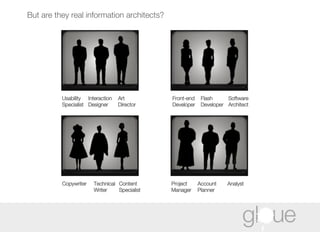
But are they real information architects? Usability  Specialist Interaction Designer Art Director Front-end Developer Flash Developer Software  Architect Copywriter Technical  Writer Content  Specialist Project  Manager Account Planner Analyst
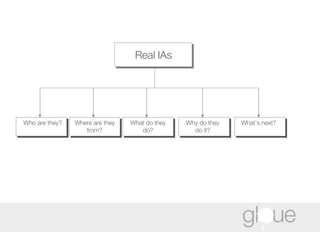
Real IAs Who are they? What do they do? Why do they do it? What’s next? Where are they from?
Did you think that that mock flowchart was a totally lame and gratuitously gimmicky way to organize the topics in this presentation?
You’re probably a Real IA
There has been a lot of discussion over the years about what exactly information architecture is. These “Defining The Damned Thing (DTDT)” conversations have been primarily around the What, rather than the Who.  But who are these people? Where do they come from? Why are they often crossing over from other disciplines, abandoning the comforts of an established professional identity, to become the synthesizers, connectors and interpreters - sometimes referred to as glue people - whose reward for doing a good job is often that their contribution seems so inevitable that becomes invisible?  And how long can they be satisfied with what is prematurely congealing into the role of "wireframer?" How can they leverage their previous experience, education and interests to offer more value to their projects and teams?  And, finally, what is the career path for an information architect?  What's next after IA?
There has been a lot of discussion over the years about what exactly information architecture is. These “Defining The Damned Thing (DTDT)” conversations have been primarily around the What, rather than the Who.  But who are these people? Where do they come from? Why are they often crossing over from other disciplines, abandoning the comforts of an established professional identity, to become the synthesizers, connectors and interpreters - sometimes referred to as glue people - whose reward for doing a good job is often that their contribution seems so inevitable that becomes invisible?  And how long can they be satisfied with what is prematurely congealing into the role of "wireframer?" How can they leverage their previous experience, education and interests to offer more value to their projects and teams?  And, finally, what is the career path for an information architect?  What's next after IA? “ Defining The Damned Thing (DTDT)”
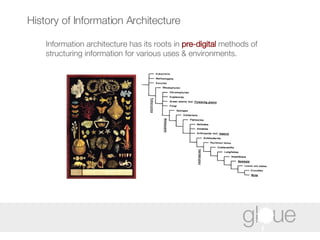
History of Information Architecture Information architecture has its roots in  pre-digital  methods of structuring information for various uses & environments.
First Came the Pre-digital Influences Library Science   Directories, classification systems, indices Architecture  Sketches, blueprints, floorplans, elevations Communication Design   Layouts, infographics, typesetting, copywriting Environmental Design   Wayfinding, signage, urban planning Industrial Design   Affordances, ergonomics, human factors  Education & Instructional Design   Outcome-based learning, behavioral psychology Engineering   Systems and network design Marketing   Focus groups, consumer research
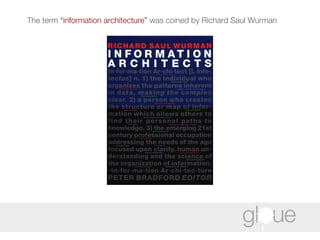
The term  “information architecture”  was coined by Richard Saul Wurman
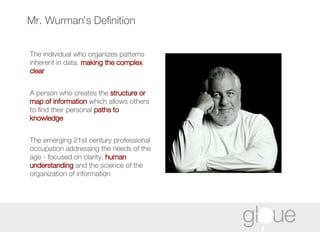
Mr. Wurman’s Definition The individual who organizes patterns inherent in data,  making the complex clear A person who creates the  structure or map of information  which allows others to find their personal  paths to knowledge The emerging 21st century professional occupation addressing the needs of the age - focused on clarity,  human understanding  and the science of the organization of information
Then Came the Digital Influences Computers and Software  Originally for hobbyists and "nerds" or used as specialist tools for business and industry,  computers and software become mainstream. The Web  The internet starts out as a data network, but mark-up languages enable the  emergence of the Web as a communications channel and display medium.
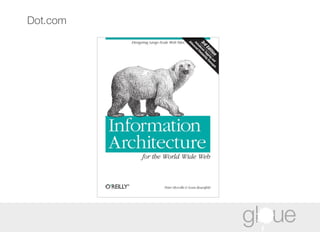
Dot.com
~ http://iainstitute.org/
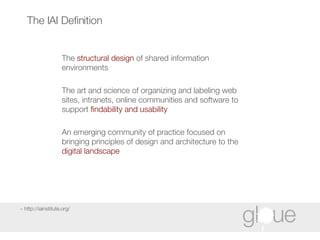
The IAI Definition The  structural design  of shared information environments  The art and science of organizing and labeling web sites, intranets, online communities and software to support  findability and usability An emerging community of practice focused on bringing principles of design and architecture to the  digital landscape ~ http://iainstitute.org/
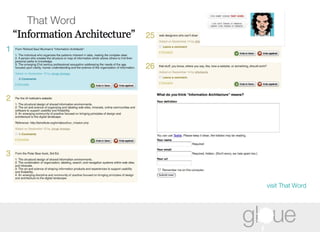
That Word visit That Word
That Word “ ...the perpetual need to define once and for all what we do when in fact it changes as the environment (social, tech, user, informational, business, markets etc.) changes…it isn’t about what we do, it’s about how we think…” ~ Added on September 17 by v   visit That Word
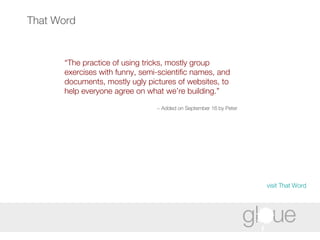
That Word “ The practice of using tricks, mostly group exercises with funny, semi-scientific names, and documents, mostly ugly pictures of websites, to help everyone agree on what we’re building.” ~ Added on September 16 by Peter   visit That Word
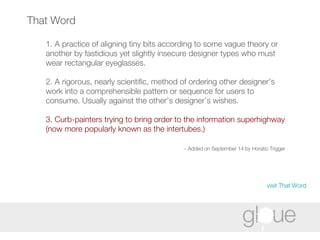
That Word 1. A practice of aligning tiny bits according to some vague theory or another by fastidious yet slightly insecure designer types who must wear rectangular eyeglasses. 2. A rigorous, nearly scientific, method of ordering other designer’s work into a comprehensible pattern or sequence for users to consume. Usually against the other’s designer’s wishes. 3. Curb-painters trying to bring order to the information superhighway (now more popularly known as the intertubes.) ~ Added on September 14 by Horatio Trigger   visit That Word
There has been a lot of discussion over the years about what exactly information architecture is. These “Defining The Damned Thing (DTDT)” conversations have been primarily around the What, rather than the Who.  But who are these people? Where do they come from? Why are they often crossing over from other disciplines, abandoning the comforts of an established professional identity, to become the synthesizers, connectors and interpreters - sometimes referred to as glue people - whose reward for doing a good job is often that their contribution seems so inevitable that becomes invisible?  And how long can they be satisfied with what is prematurely congealing into the role of "wireframer?" How can they leverage their previous experience, education and interests to offer more value to their projects and teams?  And, finally, what is the career path for an information architect?  What's next after IA? Who are these people?  Where do they come from?
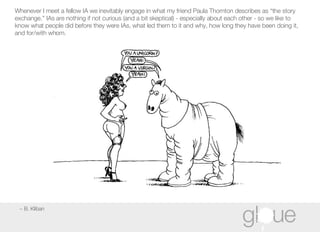
~ B. Kliban Whenever I meet a fellow IA we inevitably engage in what my friend Paula Thornton describes as “the story exchange.” IAs are nothing if not curious (and a bit skeptical) - especially about each other - so we like to know what people did before they were IAs, what led them to it and why, how long they have been doing it, and for/with whom.
A very unscientific study When did you decide to be an IA? Why? What were you before you became an IA? If you used to be an IA, what are you now?
Who are these people? Technical Editors  Advertising Copywriters Translators Web Developers Project Managers Writers Editors Artists Graphic Designers  Software Developers Musicians Programmers Teachers Instructional Designers Content Developers Bookbinders PREVIOUS ROLES
Where do they come from? Automotive Journalism Aerospace Law Psychology TV Music Audio-visual Production Document Management Civil Service Management Sales Software Publishing INDUSTRIES
Where do they come from? English Literature Creative Writing Non-fiction Writing  Japanese Fine Art Advertising Law French Radio/TV/Film Creative Writing Psychology (cognition) Landscape Architecture Canada, US, UK, Netherlands, Denmark, Finland EDUCATIONAL BACKGROUNDS COUNTRIES (so far)
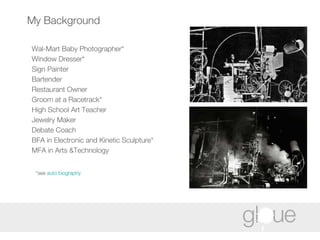
My Background Wal-Mart Baby Photographer* Window Dresser* Sign Painter Bartender Restaurant Owner Groom at a Racetrack* High School Art Teacher Jewelry Maker Debate Coach BFA in Electronic and Kinetic Sculpture* MFA in Arts &Technology *see  auto biography
What do we have in common?
Cognitive Styles: The Hedgehog and the Fox “ The fox knows many things, but the hedgehog knows one big thing.” ~ Archilochus (7th-century b.c.e.) Berlin, Sir Isaiah (1953), The Hedgehog and the Fox, New York, Simon & Schuster ~ excerpted from: http://www.chforum.org/scenarios/new/choice12.html
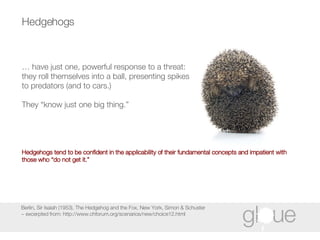
Hedgehogs Berlin, Sir Isaiah (1953), The Hedgehog and the Fox, New York, Simon & Schuster ~ excerpted from: http://www.chforum.org/scenarios/new/choice12.html …  have just one, powerful response to a threat: they roll themselves into a ball, presenting spikes to predators (and to cars.)  They “know just one big thing.”   Hedgehogs tend to be confident in the applicability of their fundamental concepts and impatient with those who “do not get it.”
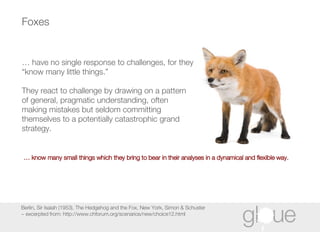
Foxes Berlin, Sir Isaiah (1953), The Hedgehog and the Fox, New York, Simon & Schuster ~ excerpted from: http://www.chforum.org/scenarios/new/choice12.html …  have no single response to challenges, for they “know many little things.”  They react to challenge by drawing on a pattern of general, pragmatic understanding, often making mistakes but seldom committing themselves to a potentially catastrophic grand strategy.   …  know many small things which they bring to bear in their analyses in a dynamical and flexible way.
Before you decide that you’re all foxes, think about this…
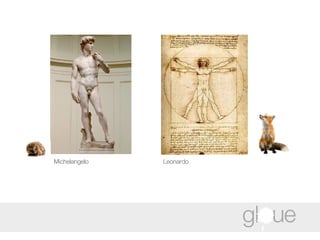
Michelangelo Leonardo
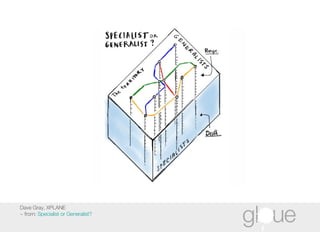
Dave Gray, XPLANE ~ from:  Specialist or Generalist?
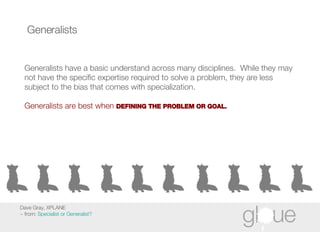
Generalists Generalists have a basic understand across many disciplines.  While they may not have the specific expertise required to solve a problem, they are less subject to the bias that comes with specialization. Generalists are best when  DEFINING THE PROBLEM OR GOAL. Dave Gray, XPLANE ~ from:  Specialist or Generalist?
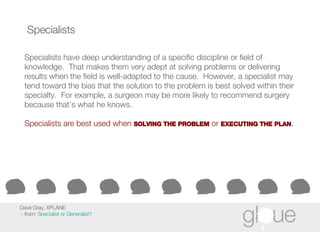
Specialists Specialists have deep understanding of a specific discipline or field of knowledge.  That makes them very adept at solving problems or delivering results when the field is well-adapted to the cause.  However, a specialist may tend toward the bias that the solution to the problem is best solved within their specialty.  For example, a surgeon may be more likely to recommend surgery because that’s what he knows. Specialists are best used when  SOLVING THE PROBLEM  or  EXECUTING THE PLAN . Dave Gray, XPLANE ~ from:  Specialist or Generalist?
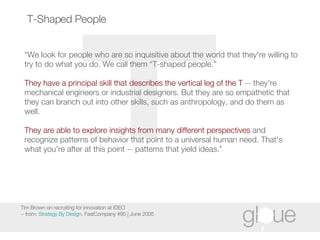
T-Shaped People “ We look for people who are so inquisitive about the world that they're willing to try to do what you do. We call them “T-shaped people.”  They have a principal skill that describes the vertical leg of the T  -- they're mechanical engineers or industrial designers. But they are so empathetic that they can branch out into other skills, such as anthropology, and do them as well.  They are able to explore insights from many different perspectives  and recognize patterns of behavior that point to a universal human need. That's what you're after at this point -- patterns that yield ideas.” Tim Brown on recruiting for innovation at IDEO ~ from:  Strategy By Design , FastCompany #95 | June 2005
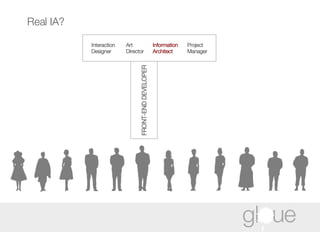
Real IA? Interaction Designer Art Director Information  Architect Project  Manager FRONT-END DEVELOPER
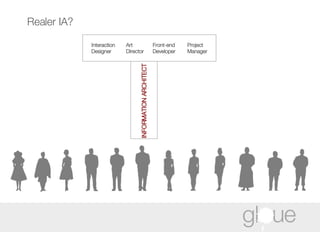
Realer IA? Interaction Designer Art Director Front-end Developer Project  Manager INFORMATION ARCHITECT
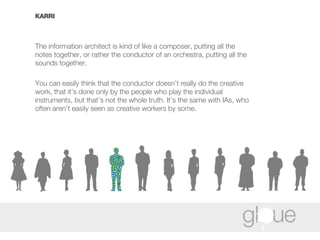
KARRI The information architect is kind of like a composer, putting all the notes together, or rather the conductor of an orchestra, putting all the sounds together.  You can easily think that the conductor doesn’t really do the creative work, that it’s done only by the people who play the individual instruments, but that’s not the whole truth. It’s the same with IAs, who often aren’t easily seen as creative workers by some.
JIM I am beginning to think that IA is less of a profession and more of a set of skills that several people on a web team need. In my personal work, IA is only one tool in my toolbox, much in the same way that a general contractor will not specialize in just the use of rivet guns.
There has been a lot of discussion over the years about what exactly information architecture is. These “Defining The Damned Thing (DTDT)” conversations have been primarily around the What, rather than the Who.  But who are these people? Where do they come from? Why are they often crossing over from other disciplines, abandoning the comforts of an established professional identity, to become the synthesizers, connectors and interpreters - sometimes referred to as glue people - whose reward for doing a good job is often that their contribution seems so inevitable that becomes invisible?  And how long can they be satisfied with what is prematurely congealing into the role of "wireframer?" How can they leverage their previous experience, education and interests to offer more value to their projects and teams?  And, finally, what is the career path for an information architect?  What's next after IA? Why do they do it?
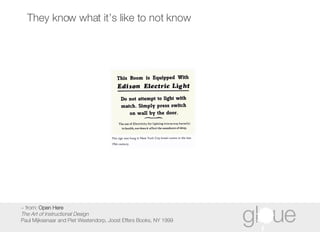
They know what it’s like to not know ~ from:  Open Here The Art of Instructional Design Paul Mijksenaar and Piet Westendorp, Joost Effers Books, NY 1999
RUDD My main motivation to become and remain an IA is to help people with their struggle to find, filter and understand the information they need in an efficient and pleasant manner.
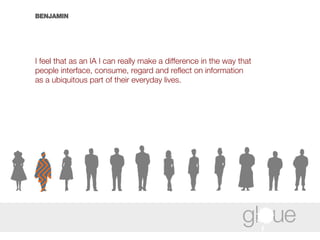
BENJAMIN I feel that as an IA I can really make a difference in the way that people interface, consume, regard and reflect on information as a ubiquitous part of their everyday lives.
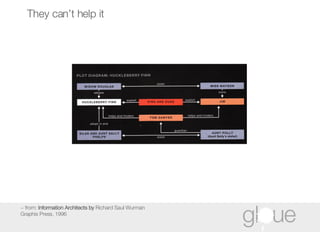
They can’t help it ~ from:  Information Architects by  Richard Saul Wurman  Graphis Press, 1996
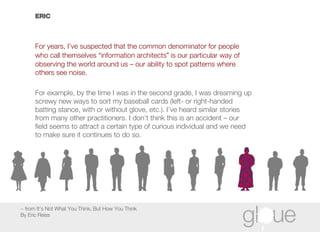
ERIC For years, I’ve suspected that the common denominator for people who call themselves  “in formation architects ”  is our particular way of observing the world around us – our ability to spot patterns where others see noise.   For example, by the time I was in the second grade, I was dreaming up screwy new ways to sort my baseball cards (left- or right-handed batting stance, with or without glove, etc.). I’ve heard similar stories from many other practitioners. I don’t think this is an accident – our field seems to attract a certain type of curious individual and we need to make sure it continues to do so. ~ from It’s Not What You Think, But How You Think By Eric Reiss
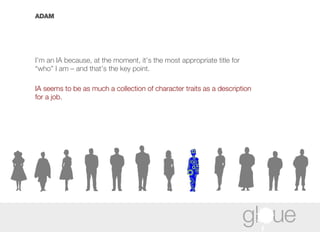
ADAM I’m an IA because, at the moment, it’s the most appropriate title for “who” I am – and that’s the key point.   IA seems to be as much a collection of character traits as a description for a job.
TOM I fell into it, having been in IT but having far more capability speaking to the users to understand their needs than I was of coding hardcore code.  And of course the hardcore coders liked nothing less than having to talk to people. I was an IA long before I knew what one was.
OLGA We can't control being IAs ... It's in our genes and is very much a state of mind. I think that's why our backgrounds, as you've noted, are so diverse. I studied Fine Art. So the answer to why I am an IA is:  I am an IA because I can't help it. :) I didn't actually know I was an IA until I started doing IA work and found how much I dug it. I had always had a "problem" with the need to organize and label and figure out systems. When I came upon the actual job of IA it was like the skies opened up and I saw the light.  Crazy ha?
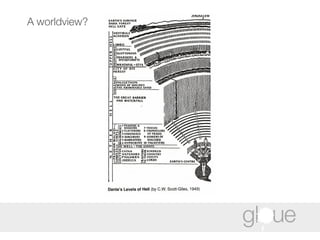
A worldview?
I can't stress enough how beneficial it was to have that early experience working with the criminally insane. ~ mike L. A disorder?
There has been a lot of discussion over the years about what exactly information architecture is. These “Defining The Damned Thing (DTDT)” conversations have been primarily around the What, rather than the Who.  But who are these people? Where do they come from? Why are they often crossing over from other disciplines, abandoning the comforts of an established professional identity, to become the synthesizers, connectors and interpreters - sometimes referred to as glue people - whose reward for doing a good job is often that their contribution seems so inevitable that becomes invisible?  And how long can they be satisfied with what is prematurely congealing into the role of "wireframer?" How can they leverage their previous experience, education and interests to offer more value to their projects and teams?  And, finally, what is the career path for an information architect?  What's next after IA? “ Just” a wireframer?
Typical Project Lifecycle RFP  Pitch  Brief  IA   Design  Development  Testing
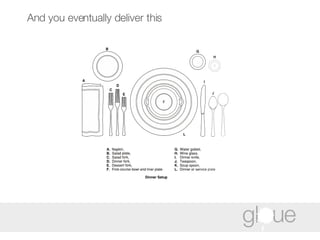
Client gives you this ~ images adapted from The Order of Things: How Everything in the World is Organized into Hierarchies, Structures and Pecking Orders Barbara Ann Kipfer, Random House NY 2000
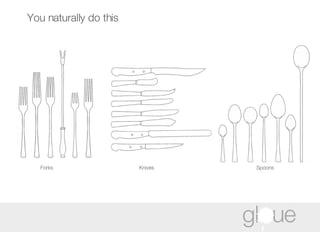
You naturally do this Forks Knives Spoons
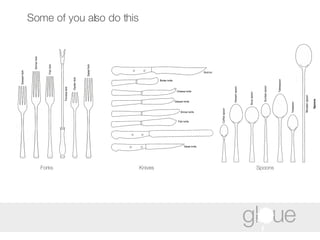
Some of you also do this Forks Knives Spoons
And you eventually deliver this
If you’re wondering why the hell it was decided in advance that the solution was a table setting?
You’re probably a Real IA
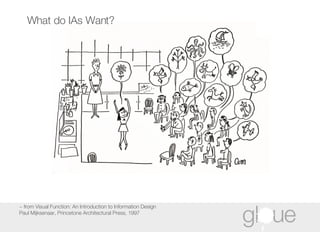
What do IAs Want? ~ from Visual Function: An Introduction to Information Design Paul Mijksenaar, Princetone Architectural Press, 1997
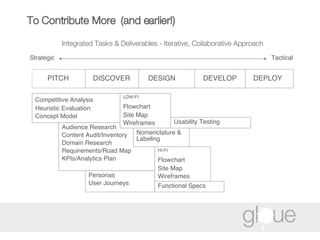
To Contribute More  (and earlier!) Integrated Tasks & Deliverables - Iterative, Collaborative Approach   DESIGN DEVELOP DEPLOY DISCOVER Competitive Analysis   Heuristic Evaluation Concept Model PITCH Audience Research Content Audit/Inventory Domain Research Requirements/Road Map KPIs/Analytics Plan Strategic Tactical Personas User Journeys LOW-FI Flowchart   Site Map Wireframes HI-FI Flowchart   Site Map Wireframes Nomenclature & Labeling Functional Specs Usability Testing
IA contribution to Planning Articulates, both verbally and visually, the  benefits of the interactive strategy Gains and provides  expertise in the subject matter  and industry landscape of the client, including unique conventions, standards, nomenclature and regulations Researches interactive  initiatives of   the competition  and assess their impact
IA contribution to Creative Generates  unified visual schemes  and navigational devices that reinforce the  structure, content and purpose  of the interactive experience Distills a variety of content types and user tasks into meaningful  workflows that are modular and scalable Determines  organizational models  that best provide  context and meaning  to the information, i.e. hierarchical structures, lists, environments, narratives, etc
IA contribution to Technical Combines knowledge of human behavior and motivation with an understanding of the  structure and functionality  of complex systems Identifies and documents the functional  requirements  of the project, based on familiarity with both technical constraints and the user needs Creates the necessary  blueprints  and/or information models needed to guide the programming of the project, including flowcharts, schematics, scenarios, etc Performs usability  testing  and translates user feedback into appropriate features and functionality
There has been a lot of discussion over the years about what exactly information architecture is. These “Defining The Damned Thing (DTDT)” conversations have been primarily around the What, rather than the Who.  But who are these people? Where do they come from? Why are they often crossing over from other disciplines, abandoning the comforts of an established professional identity, to become the synthesizers, connectors and interpreters - sometimes referred to as glue people - whose reward for doing a good job is often that their contribution seems so inevitable that becomes invisible?  And how long can they be satisfied with what is prematurely congealing into the role of "wireframer?" How can they leverage their previous experience, education and interests to offer more value to their projects and teams?  And, finally, what is the career path for an information architect?  What's next after IA? Beyond wireframes
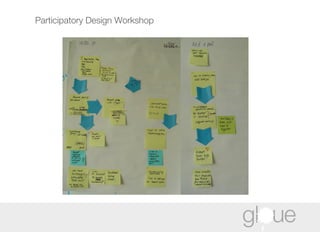
Participatory Design Workshop
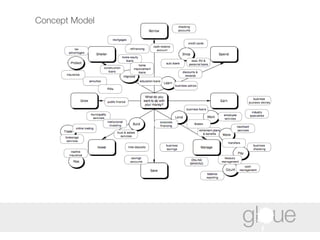
Concept Model
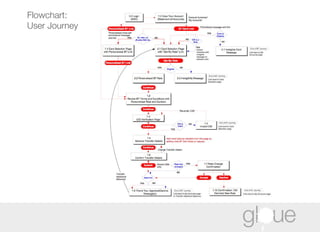
Flowchart: User Journey
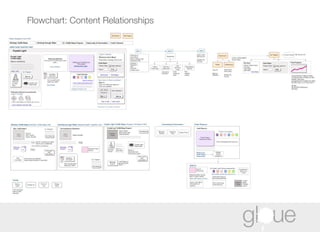
Flowchart: Content Relationships
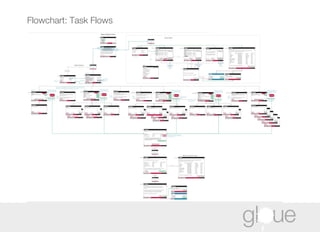
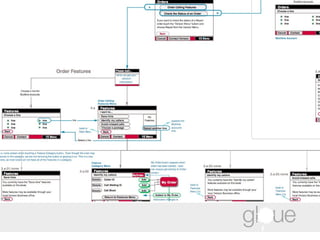
Flowchart: Task Flows
Flowchart
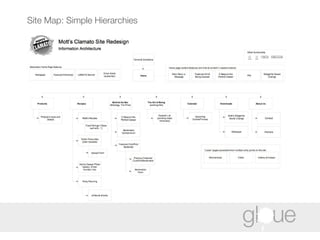
Site Map: Simple Hierarchies
Site Map: Content Gaps
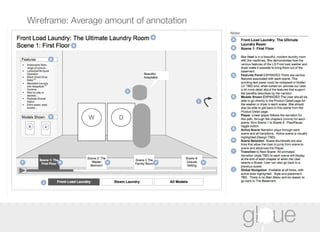
Wireframe: Average amount of annotation
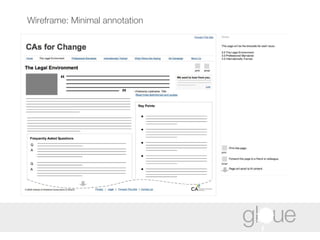
Wireframe: Minimal annotation
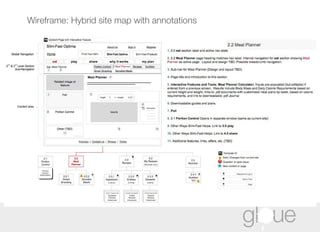
Wireframe: Hybrid site map with annotations
Content Templates: Common elements - modular development
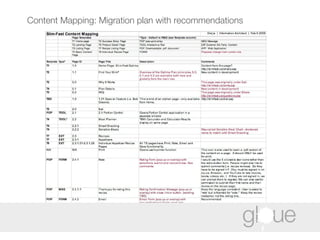
Content Mapping: Migration plan with recommendations
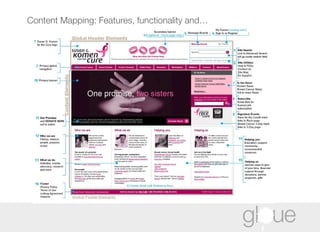
Content Mapping: Features, functionality and…
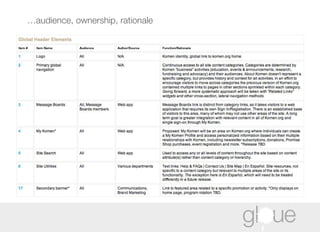
… audience, ownership, rationale
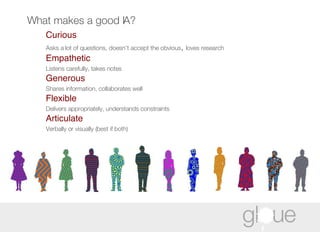
What makes a good IA? Curious Asks a lot of questions, doesn’t accept the obvious ,  loves research Empathetic Listens carefully, takes notes Generous Shares information, collaborates well Flexible Delivers appropriately, understands constraints Articulate Verbally or visually (best if both)
PROJECTS Web applications Internet sites  Microsites Intranets Extranets Mobile And versatile COMPANIES Traditional Ad Agency Interactive Agency  Internal Web Marketing or IT Group Software Development Company Start-up Consultancy use it on anything
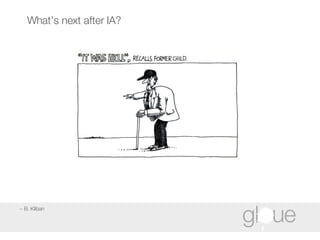
What’s next after IA? ~ B. Kliban
Possible Career Paths IA > Senior IA > IA Manager > IA Director Planner Creative Director, ACD Agency: Traditional or Interactive Internal Group: Large corporation (banking, telecom, etc) Freelance and/or Contract Small Business Author, Speaker, Pundit, Guru
Challenges Mobile Wireless Networked Apps Pervasive Computing, Smart Devices Social Networking Personal Dashboards Metrics and Analytics
Fame and Glory? As  the creator of my own field of specialization – Information Architecture – I am as famous as I can be, which is marginally more than an accountant.  No matter what I do, I cannot become more famous – unless I were to achieve widespread notoriety for doing something like killing someone universally famous, but not as an Information Architect.   ~ Richard Saul Wurman
Thanks! Gail  Leija  (and then we had more drinks)

Will the Real Information Architect Please Stand Up?

  • 1.
    November 17 2008Gladstone Hotel, Toronto Will the real information architect please stand up?
  • 2.
    Who are you?Information Architects? Creative Directors Designers? Project Managers? Developers? Writers? Other? Why are you here? Meet other IAs? Find an IA? Be an IA? Stop being an IA? Other?
  • 3.
    This is thepart where I explain that the title of this presentation comes from an old American TV show called To Tell The Truth. No one in the audience seemed to know what I was referring to (blank, but polite stares all around) so I attempted to act it out - mugging as 3 different people all claiming to be Information Architects. Since I can’t do my improv for you online (consider yourself lucky!) you can watch this. About the title
  • 4.
    A lot ofpeople claim to be information architects
  • 5.
    But are theyreal information architects? Usability Specialist Interaction Designer Art Director Front-end Developer Flash Developer Software Architect Copywriter Technical Writer Content Specialist Project Manager Account Planner Analyst
  • 6.
    Real IAs Whoare they? What do they do? Why do they do it? What’s next? Where are they from?
  • 7.
    Did you thinkthat that mock flowchart was a totally lame and gratuitously gimmicky way to organize the topics in this presentation?
  • 8.
  • 9.
    There has beena lot of discussion over the years about what exactly information architecture is. These “Defining The Damned Thing (DTDT)” conversations have been primarily around the What, rather than the Who. But who are these people? Where do they come from? Why are they often crossing over from other disciplines, abandoning the comforts of an established professional identity, to become the synthesizers, connectors and interpreters - sometimes referred to as glue people - whose reward for doing a good job is often that their contribution seems so inevitable that becomes invisible? And how long can they be satisfied with what is prematurely congealing into the role of "wireframer?" How can they leverage their previous experience, education and interests to offer more value to their projects and teams? And, finally, what is the career path for an information architect? What's next after IA?
  • 10.
    There has beena lot of discussion over the years about what exactly information architecture is. These “Defining The Damned Thing (DTDT)” conversations have been primarily around the What, rather than the Who. But who are these people? Where do they come from? Why are they often crossing over from other disciplines, abandoning the comforts of an established professional identity, to become the synthesizers, connectors and interpreters - sometimes referred to as glue people - whose reward for doing a good job is often that their contribution seems so inevitable that becomes invisible? And how long can they be satisfied with what is prematurely congealing into the role of "wireframer?" How can they leverage their previous experience, education and interests to offer more value to their projects and teams? And, finally, what is the career path for an information architect? What's next after IA? “ Defining The Damned Thing (DTDT)”
  • 11.
    History of InformationArchitecture Information architecture has its roots in pre-digital methods of structuring information for various uses & environments.
  • 12.
    First Came thePre-digital Influences Library Science Directories, classification systems, indices Architecture Sketches, blueprints, floorplans, elevations Communication Design Layouts, infographics, typesetting, copywriting Environmental Design Wayfinding, signage, urban planning Industrial Design Affordances, ergonomics, human factors Education & Instructional Design Outcome-based learning, behavioral psychology Engineering Systems and network design Marketing Focus groups, consumer research
  • 13.
    The term “information architecture” was coined by Richard Saul Wurman
  • 14.
    Mr. Wurman’s DefinitionThe individual who organizes patterns inherent in data, making the complex clear A person who creates the structure or map of information which allows others to find their personal paths to knowledge The emerging 21st century professional occupation addressing the needs of the age - focused on clarity, human understanding and the science of the organization of information
  • 15.
    Then Came theDigital Influences Computers and Software Originally for hobbyists and "nerds" or used as specialist tools for business and industry, computers and software become mainstream. The Web The internet starts out as a data network, but mark-up languages enable the emergence of the Web as a communications channel and display medium.
  • 16.
  • 17.
  • 18.
    The IAI DefinitionThe structural design of shared information environments The art and science of organizing and labeling web sites, intranets, online communities and software to support findability and usability An emerging community of practice focused on bringing principles of design and architecture to the digital landscape ~ http://iainstitute.org/
  • 19.
    That Word visitThat Word
  • 20.
    That Word “...the perpetual need to define once and for all what we do when in fact it changes as the environment (social, tech, user, informational, business, markets etc.) changes…it isn’t about what we do, it’s about how we think…” ~ Added on September 17 by v visit That Word
  • 21.
    That Word “The practice of using tricks, mostly group exercises with funny, semi-scientific names, and documents, mostly ugly pictures of websites, to help everyone agree on what we’re building.” ~ Added on September 16 by Peter visit That Word
  • 22.
    That Word 1.A practice of aligning tiny bits according to some vague theory or another by fastidious yet slightly insecure designer types who must wear rectangular eyeglasses. 2. A rigorous, nearly scientific, method of ordering other designer’s work into a comprehensible pattern or sequence for users to consume. Usually against the other’s designer’s wishes. 3. Curb-painters trying to bring order to the information superhighway (now more popularly known as the intertubes.) ~ Added on September 14 by Horatio Trigger visit That Word
  • 23.
    There has beena lot of discussion over the years about what exactly information architecture is. These “Defining The Damned Thing (DTDT)” conversations have been primarily around the What, rather than the Who. But who are these people? Where do they come from? Why are they often crossing over from other disciplines, abandoning the comforts of an established professional identity, to become the synthesizers, connectors and interpreters - sometimes referred to as glue people - whose reward for doing a good job is often that their contribution seems so inevitable that becomes invisible? And how long can they be satisfied with what is prematurely congealing into the role of "wireframer?" How can they leverage their previous experience, education and interests to offer more value to their projects and teams? And, finally, what is the career path for an information architect? What's next after IA? Who are these people? Where do they come from?
  • 24.
    ~ B. KlibanWhenever I meet a fellow IA we inevitably engage in what my friend Paula Thornton describes as “the story exchange.” IAs are nothing if not curious (and a bit skeptical) - especially about each other - so we like to know what people did before they were IAs, what led them to it and why, how long they have been doing it, and for/with whom.
  • 25.
    A very unscientificstudy When did you decide to be an IA? Why? What were you before you became an IA? If you used to be an IA, what are you now?
  • 26.
    Who are thesepeople? Technical Editors Advertising Copywriters Translators Web Developers Project Managers Writers Editors Artists Graphic Designers Software Developers Musicians Programmers Teachers Instructional Designers Content Developers Bookbinders PREVIOUS ROLES
  • 27.
    Where do theycome from? Automotive Journalism Aerospace Law Psychology TV Music Audio-visual Production Document Management Civil Service Management Sales Software Publishing INDUSTRIES
  • 28.
    Where do theycome from? English Literature Creative Writing Non-fiction Writing Japanese Fine Art Advertising Law French Radio/TV/Film Creative Writing Psychology (cognition) Landscape Architecture Canada, US, UK, Netherlands, Denmark, Finland EDUCATIONAL BACKGROUNDS COUNTRIES (so far)
  • 29.
    My Background Wal-MartBaby Photographer* Window Dresser* Sign Painter Bartender Restaurant Owner Groom at a Racetrack* High School Art Teacher Jewelry Maker Debate Coach BFA in Electronic and Kinetic Sculpture* MFA in Arts &Technology *see auto biography
  • 30.
    What do wehave in common?
  • 31.
    Cognitive Styles: TheHedgehog and the Fox “ The fox knows many things, but the hedgehog knows one big thing.” ~ Archilochus (7th-century b.c.e.) Berlin, Sir Isaiah (1953), The Hedgehog and the Fox, New York, Simon & Schuster ~ excerpted from: http://www.chforum.org/scenarios/new/choice12.html
  • 32.
    Hedgehogs Berlin, SirIsaiah (1953), The Hedgehog and the Fox, New York, Simon & Schuster ~ excerpted from: http://www.chforum.org/scenarios/new/choice12.html … have just one, powerful response to a threat: they roll themselves into a ball, presenting spikes to predators (and to cars.) They “know just one big thing.” Hedgehogs tend to be confident in the applicability of their fundamental concepts and impatient with those who “do not get it.”
  • 33.
    Foxes Berlin, SirIsaiah (1953), The Hedgehog and the Fox, New York, Simon & Schuster ~ excerpted from: http://www.chforum.org/scenarios/new/choice12.html … have no single response to challenges, for they “know many little things.” They react to challenge by drawing on a pattern of general, pragmatic understanding, often making mistakes but seldom committing themselves to a potentially catastrophic grand strategy. … know many small things which they bring to bear in their analyses in a dynamical and flexible way.
  • 34.
    Before you decidethat you’re all foxes, think about this…
  • 35.
  • 36.
    Dave Gray, XPLANE~ from: Specialist or Generalist?
  • 37.
    Generalists Generalists havea basic understand across many disciplines. While they may not have the specific expertise required to solve a problem, they are less subject to the bias that comes with specialization. Generalists are best when DEFINING THE PROBLEM OR GOAL. Dave Gray, XPLANE ~ from: Specialist or Generalist?
  • 38.
    Specialists Specialists havedeep understanding of a specific discipline or field of knowledge. That makes them very adept at solving problems or delivering results when the field is well-adapted to the cause. However, a specialist may tend toward the bias that the solution to the problem is best solved within their specialty. For example, a surgeon may be more likely to recommend surgery because that’s what he knows. Specialists are best used when SOLVING THE PROBLEM or EXECUTING THE PLAN . Dave Gray, XPLANE ~ from: Specialist or Generalist?
  • 39.
    T-Shaped People “We look for people who are so inquisitive about the world that they're willing to try to do what you do. We call them “T-shaped people.” They have a principal skill that describes the vertical leg of the T -- they're mechanical engineers or industrial designers. But they are so empathetic that they can branch out into other skills, such as anthropology, and do them as well. They are able to explore insights from many different perspectives and recognize patterns of behavior that point to a universal human need. That's what you're after at this point -- patterns that yield ideas.” Tim Brown on recruiting for innovation at IDEO ~ from: Strategy By Design , FastCompany #95 | June 2005
  • 40.
    Real IA? InteractionDesigner Art Director Information Architect Project Manager FRONT-END DEVELOPER
  • 41.
    Realer IA? InteractionDesigner Art Director Front-end Developer Project Manager INFORMATION ARCHITECT
  • 42.
    KARRI The informationarchitect is kind of like a composer, putting all the notes together, or rather the conductor of an orchestra, putting all the sounds together. You can easily think that the conductor doesn’t really do the creative work, that it’s done only by the people who play the individual instruments, but that’s not the whole truth. It’s the same with IAs, who often aren’t easily seen as creative workers by some.
  • 43.
    JIM I ambeginning to think that IA is less of a profession and more of a set of skills that several people on a web team need. In my personal work, IA is only one tool in my toolbox, much in the same way that a general contractor will not specialize in just the use of rivet guns.
  • 44.
    There has beena lot of discussion over the years about what exactly information architecture is. These “Defining The Damned Thing (DTDT)” conversations have been primarily around the What, rather than the Who. But who are these people? Where do they come from? Why are they often crossing over from other disciplines, abandoning the comforts of an established professional identity, to become the synthesizers, connectors and interpreters - sometimes referred to as glue people - whose reward for doing a good job is often that their contribution seems so inevitable that becomes invisible? And how long can they be satisfied with what is prematurely congealing into the role of "wireframer?" How can they leverage their previous experience, education and interests to offer more value to their projects and teams? And, finally, what is the career path for an information architect? What's next after IA? Why do they do it?
  • 45.
    They know whatit’s like to not know ~ from: Open Here The Art of Instructional Design Paul Mijksenaar and Piet Westendorp, Joost Effers Books, NY 1999
  • 46.
    RUDD My mainmotivation to become and remain an IA is to help people with their struggle to find, filter and understand the information they need in an efficient and pleasant manner.
  • 47.
    BENJAMIN I feelthat as an IA I can really make a difference in the way that people interface, consume, regard and reflect on information as a ubiquitous part of their everyday lives.
  • 48.
    They can’t helpit ~ from: Information Architects by Richard Saul Wurman Graphis Press, 1996
  • 49.
    ERIC For years,I’ve suspected that the common denominator for people who call themselves “in formation architects ” is our particular way of observing the world around us – our ability to spot patterns where others see noise. For example, by the time I was in the second grade, I was dreaming up screwy new ways to sort my baseball cards (left- or right-handed batting stance, with or without glove, etc.). I’ve heard similar stories from many other practitioners. I don’t think this is an accident – our field seems to attract a certain type of curious individual and we need to make sure it continues to do so. ~ from It’s Not What You Think, But How You Think By Eric Reiss
  • 50.
    ADAM I’m anIA because, at the moment, it’s the most appropriate title for “who” I am – and that’s the key point. IA seems to be as much a collection of character traits as a description for a job.
  • 51.
    TOM I fellinto it, having been in IT but having far more capability speaking to the users to understand their needs than I was of coding hardcore code. And of course the hardcore coders liked nothing less than having to talk to people. I was an IA long before I knew what one was.
  • 52.
    OLGA We can'tcontrol being IAs ... It's in our genes and is very much a state of mind. I think that's why our backgrounds, as you've noted, are so diverse. I studied Fine Art. So the answer to why I am an IA is: I am an IA because I can't help it. :) I didn't actually know I was an IA until I started doing IA work and found how much I dug it. I had always had a "problem" with the need to organize and label and figure out systems. When I came upon the actual job of IA it was like the skies opened up and I saw the light. Crazy ha?
  • 53.
  • 54.
    I can't stressenough how beneficial it was to have that early experience working with the criminally insane. ~ mike L. A disorder?
  • 55.
    There has beena lot of discussion over the years about what exactly information architecture is. These “Defining The Damned Thing (DTDT)” conversations have been primarily around the What, rather than the Who. But who are these people? Where do they come from? Why are they often crossing over from other disciplines, abandoning the comforts of an established professional identity, to become the synthesizers, connectors and interpreters - sometimes referred to as glue people - whose reward for doing a good job is often that their contribution seems so inevitable that becomes invisible? And how long can they be satisfied with what is prematurely congealing into the role of "wireframer?" How can they leverage their previous experience, education and interests to offer more value to their projects and teams? And, finally, what is the career path for an information architect? What's next after IA? “ Just” a wireframer?
  • 56.
    Typical Project LifecycleRFP Pitch Brief IA Design Development Testing
  • 57.
    Client gives youthis ~ images adapted from The Order of Things: How Everything in the World is Organized into Hierarchies, Structures and Pecking Orders Barbara Ann Kipfer, Random House NY 2000
  • 58.
    You naturally dothis Forks Knives Spoons
  • 59.
    Some of youalso do this Forks Knives Spoons
  • 60.
    And you eventuallydeliver this
  • 61.
    If you’re wonderingwhy the hell it was decided in advance that the solution was a table setting?
  • 62.
  • 63.
    What do IAsWant? ~ from Visual Function: An Introduction to Information Design Paul Mijksenaar, Princetone Architectural Press, 1997
  • 64.
    To Contribute More (and earlier!) Integrated Tasks & Deliverables - Iterative, Collaborative Approach DESIGN DEVELOP DEPLOY DISCOVER Competitive Analysis Heuristic Evaluation Concept Model PITCH Audience Research Content Audit/Inventory Domain Research Requirements/Road Map KPIs/Analytics Plan Strategic Tactical Personas User Journeys LOW-FI Flowchart Site Map Wireframes HI-FI Flowchart Site Map Wireframes Nomenclature & Labeling Functional Specs Usability Testing
  • 65.
    IA contribution toPlanning Articulates, both verbally and visually, the benefits of the interactive strategy Gains and provides expertise in the subject matter and industry landscape of the client, including unique conventions, standards, nomenclature and regulations Researches interactive initiatives of the competition and assess their impact
  • 66.
    IA contribution toCreative Generates unified visual schemes and navigational devices that reinforce the structure, content and purpose of the interactive experience Distills a variety of content types and user tasks into meaningful workflows that are modular and scalable Determines organizational models that best provide context and meaning to the information, i.e. hierarchical structures, lists, environments, narratives, etc
  • 67.
    IA contribution toTechnical Combines knowledge of human behavior and motivation with an understanding of the structure and functionality of complex systems Identifies and documents the functional requirements of the project, based on familiarity with both technical constraints and the user needs Creates the necessary blueprints and/or information models needed to guide the programming of the project, including flowcharts, schematics, scenarios, etc Performs usability testing and translates user feedback into appropriate features and functionality
  • 68.
    There has beena lot of discussion over the years about what exactly information architecture is. These “Defining The Damned Thing (DTDT)” conversations have been primarily around the What, rather than the Who. But who are these people? Where do they come from? Why are they often crossing over from other disciplines, abandoning the comforts of an established professional identity, to become the synthesizers, connectors and interpreters - sometimes referred to as glue people - whose reward for doing a good job is often that their contribution seems so inevitable that becomes invisible? And how long can they be satisfied with what is prematurely congealing into the role of "wireframer?" How can they leverage their previous experience, education and interests to offer more value to their projects and teams? And, finally, what is the career path for an information architect? What's next after IA? Beyond wireframes
  • 69.
  • 70.
  • 71.
  • 72.
  • 73.
  • 74.
  • 75.
    Site Map: SimpleHierarchies
  • 76.
  • 77.
  • 78.
  • 79.
    Wireframe: Hybrid sitemap with annotations
  • 80.
    Content Templates: Commonelements - modular development
  • 81.
    Content Mapping: Migrationplan with recommendations
  • 82.
    Content Mapping: Features,functionality and…
  • 83.
  • 84.
    What makes agood IA? Curious Asks a lot of questions, doesn’t accept the obvious , loves research Empathetic Listens carefully, takes notes Generous Shares information, collaborates well Flexible Delivers appropriately, understands constraints Articulate Verbally or visually (best if both)
  • 85.
    PROJECTS Web applicationsInternet sites Microsites Intranets Extranets Mobile And versatile COMPANIES Traditional Ad Agency Interactive Agency Internal Web Marketing or IT Group Software Development Company Start-up Consultancy use it on anything
  • 86.
    What’s next afterIA? ~ B. Kliban
  • 87.
    Possible Career PathsIA > Senior IA > IA Manager > IA Director Planner Creative Director, ACD Agency: Traditional or Interactive Internal Group: Large corporation (banking, telecom, etc) Freelance and/or Contract Small Business Author, Speaker, Pundit, Guru
  • 88.
    Challenges Mobile WirelessNetworked Apps Pervasive Computing, Smart Devices Social Networking Personal Dashboards Metrics and Analytics
  • 89.
    Fame and Glory?As the creator of my own field of specialization – Information Architecture – I am as famous as I can be, which is marginally more than an accountant. No matter what I do, I cannot become more famous – unless I were to achieve widespread notoriety for doing something like killing someone universally famous, but not as an Information Architect. ~ Richard Saul Wurman
  • 90.
    Thanks! Gail Leija (and then we had more drinks)