Slides
Prepared
by:
Dr.
Mahtab
Alam
UNIT
-II
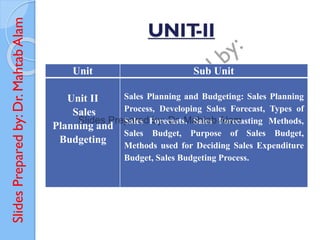
Unit Sub Unit
UnitII
Sales
Planning and
Budgeting
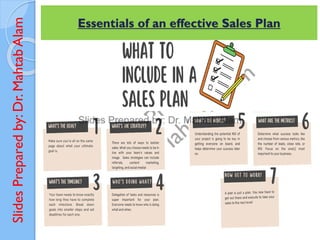
Sales Planning and Budgeting: Sales Planning
Process, Developing Sales Forecast, Types of
Sales Forecasts. Sales Forecasting Methods,
Sales Budget, Purpose of Sales Budget,
Methods used for Deciding Sales Expenditure
Budget, Sales Budgeting Process.
Slides
Prepared
by:
Dr.
Mahtab
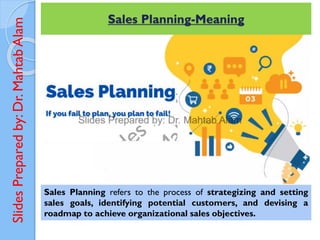
Alam Sales Planning-Definition
PhilipKotler: "Sales planning is the structured
development of sales strategies and operational
plans that align with the company's marketing
objectives, ensuring effective customer targeting and
resource utilization.”
William J. Stanton: "Sales planning involves
analyzing the market, setting achievable sales targets,
and preparing the necessary steps to direct and
control the sales efforts of an organization."
5.
Slides
Prepared
by:
Dr.
Mahtab
Alam
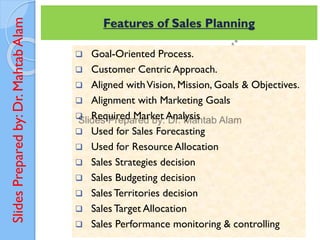
Goal-Oriented Process.
Customer Centric Approach.
Aligned withVision, Mission, Goals & Objectives.
Alignment with Marketing Goals
Required Market Analysis
Used for Sales Forecasting
Used for Resource Allocation
Sales Strategies decision
Sales Budgeting decision
Sales Territories decision
Sales Target Allocation
Sales Performance monitoring & controlling
Features of Sales Planning
6.
Slides
Prepared
by:
Dr.
Mahtab
Alam
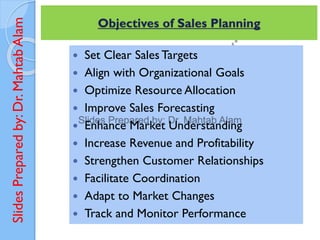
Set ClearSales Targets
Align with Organizational Goals
Optimize Resource Allocation
Improve Sales Forecasting
Enhance Market Understanding
Increase Revenue and Profitability
Strengthen Customer Relationships
Facilitate Coordination
Adapt to Market Changes
Track and Monitor Performance
Objectives of Sales Planning
7.
Slides
Prepared
by:
Dr.
Mahtab
Alam
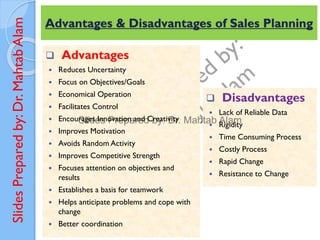
Advantages
ReducesUncertainty
Focus on Objectives/Goals
Economical Operation
Facilitates Control
Encourages Innovation and Creativity
Improves Motivation
Avoids Random Activity
Improves Competitive Strength
Focuses attention on objectives and
results
Establishes a basis for teamwork
Helps anticipate problems and cope with
change
Better coordination
Advantages & Disadvantages of Sales Planning
Disadvantages
Lack of Reliable Data
Rigidity
Time Consuming Process
Costly Process
Rapid Change
Resistance to Change
Slides
Prepared
by:
Dr.
Mahtab
Alam Sales ForecastingMeaning
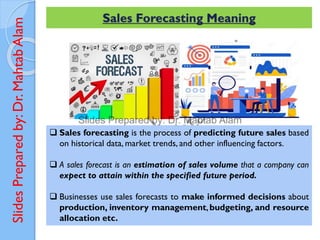
Sales forecasting is the process of predicting future sales based
on historical data, market trends, and other influencing factors.
A sales forecast is an estimation of sales volume that a company can
expect to attain within the specified future period.
Businesses use sales forecasts to make informed decisions about
production, inventory management, budgeting, and resource
allocation etc.
12.
Slides
Prepared
by:
Dr.
Mahtab
Alam
•Philip Kotler –"Sales forecasting is the art of anticipating what buyers
are likely to do under a given set of conditions.“
•William J. Stanton – "Sales forecasting is an estimate of sales, in
monetary or physical units, for a specified future period under a proposed
marketing plan or program and under an assumed set of economic and
other forces outside the unit for which the forecast is made.“
•Cundiff and Still – "Sales forecast is an estimate of sales during a
specified future period which is based on one or more specified
assumptions.“
•American Marketing Association (AMA) – "Sales forecasting is the
process of estimating future sales. Accurate sales forecasts enable
companies to make informed business decisions and predict short-term
and long-term performance."
Sales Forecasting-Definition
Slides
Prepared
by:
Dr.
Mahtab
Alam
3. Based onApproach
Top Down Sales Forecast
The forecast starts with the overall
company goal or industry growth
rate and then breaks it down into smaller
segments (regions, products, or
departments).
Example: A tech company predicts
global sales growth and then allocates
targets to various departments (like
product development and marketing).
Bottom Up Sales Forecast
The forecast begins with the individual
sales teams or departments, where each
part predicts its own sales and the total is
then aggregated.
Example: A chain of restaurants gets
input from individual locations, each
predicting its monthly sales, and the totals
are then added up to forecast the overall
sales.
3. Based on Purpose
Demand Forecast
To estimate future demand for products
or services, and help in planning
production, inventory, staffing, and marketing
efforts.
Example: A clothing brand forecasts its
sales for the next quarter by analyzing
past sales trends, current season, and
consumer demand.
Budget Forecast
A Budget Forecast is an estimate of
future income and expenses over a
specific period. It helps businesses plan their
financial resources and allocate budgets
across departments, projects, or activities.
Example: A tech company forecasts its
budget for the year by estimating income
from product sales and then calculating
anticipated expenses like R&D, marketing,
and staffing costs
Slides
Prepared
by:
Dr.
Mahtab
Alam
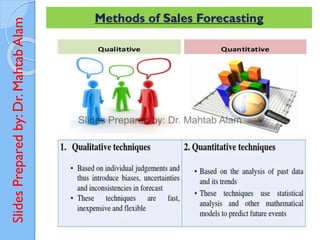
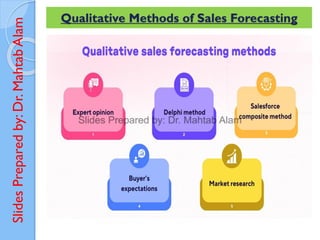
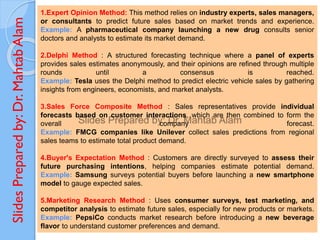
1.Expert Opinion Method:This method relies on industry experts, sales managers,
or consultants to predict future sales based on market trends and experience.
Example: A pharmaceutical company launching a new drug consults senior
doctors and analysts to estimate its market demand.
2.Delphi Method : A structured forecasting technique where a panel of experts
provides sales estimates anonymously, and their opinions are refined through multiple
rounds until a consensus is reached.
Example: Tesla uses the Delphi method to predict electric vehicle sales by gathering
insights from engineers, economists, and market analysts.
3.Sales Force Composite Method : Sales representatives provide individual
forecasts based on customer interactions, which are then combined to form the
overall company forecast.
Example: FMCG companies like Unilever collect sales predictions from regional
sales teams to estimate total product demand.
4.Buyer's Expectation Method : Customers are directly surveyed to assess their
future purchasing intentions, helping companies estimate potential demand.
Example: Samsung surveys potential buyers before launching a new smartphone
model to gauge expected sales.
5.Marketing Research Method : Uses consumer surveys, test marketing, and
competitor analysis to estimate future sales, especially for new products or markets.
Example: PepsiCo conducts market research before introducing a new beverage
flavor to understand customer preferences and demand.
22.
Slides
Prepared
by:
Dr.
Mahtab
Alam Quantitative Methodsof Sales Forecasting
1. Moving Average Method: This method predicts future sales by
calculating the average of past sales over a specific period, helping to
smooth out short-term fluctuations.
Example: Maruti Suzuki uses the moving average method to forecast
monthly car demand by averaging sales data from the last six months.
23.
Slides
Prepared
by:
Dr.
Mahtab
Alam
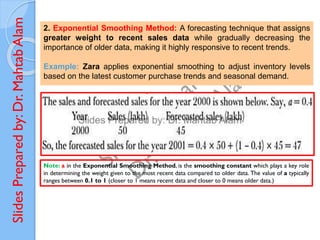
2. Exponential SmoothingMethod: A forecasting technique that assigns
greater weight to recent sales data while gradually decreasing the
importance of older data, making it highly responsive to recent trends.
Example: Zara applies exponential smoothing to adjust inventory levels
based on the latest customer purchase trends and seasonal demand.
Note: a in the Exponential Smoothing Method, is the smoothing constant which plays a key role
in determining the weight given to the most recent data compared to older data. The value of a typically
ranges between 0.1 to 1 (closer to 1 means recent data and closer to 0 means older data.)
24.
Slides
Prepared
by:
Dr.
Mahtab
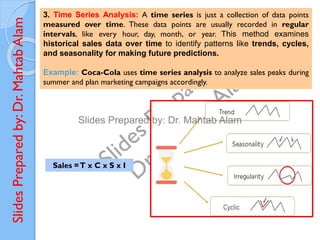
Alam 3. TimeSeries Analysis: A time series is just a collection of data points
measured over time. These data points are usually recorded in regular
intervals, like every hour, day, month, or year. This method examines
historical sales data over time to identify patterns like trends, cycles,
and seasonality for making future predictions.
Example: Coca-Cola uses time series analysis to analyze sales peaks during
summer and plan marketing campaigns accordingly.
Sales =T x C x S x I
25.
Slides
Prepared
by:
Dr.
Mahtab
Alam
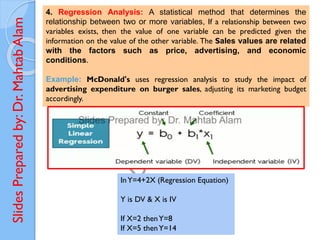
4. Regression Analysis:A statistical method that determines the
relationship between two or more variables, If a relationship between two
variables exists, then the value of one variable can be predicted given the
information on the value of the other variable. The Sales values are related
with the factors such as price, advertising, and economic
conditions.
Example: McDonald's uses regression analysis to study the impact of
advertising expenditure on burger sales, adjusting its marketing budget
accordingly.
InY=4+2X (Regression Equation)
Y is DV & X is IV
If X=2 thenY=8
If X=5 thenY=14
26.
Slides
Prepared
by:
Dr.
Mahtab
Alam
5. Econometric Analysis:A complex statistical method that considers
multiple economic variables (like GDP, inflation, consumer income) to
forecast sales based on broader economic trends.
Example: Airbus uses econometric analysis to predict future aircraft
demand based on GDP growth, fuel prices, and airline profitability trends.
Y=a+b1X1+b2X2+...+bnXn
where:
•Y = Sales Forecasting
•X1,X2,...,XnX_1, X_2, ..., X_nX1,X2,...,Xn = Economic factors (e.g., GDP,
inflation, employment)
•b1,b2,...,bnb_1, b_2, ..., b_nb1,b2,...,bn = Coefficients measuring impact
27.
Slides
Prepared
by:
Dr.
Mahtab
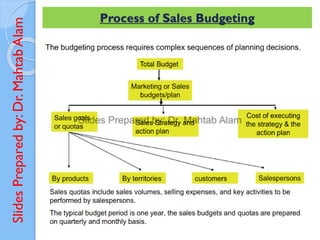
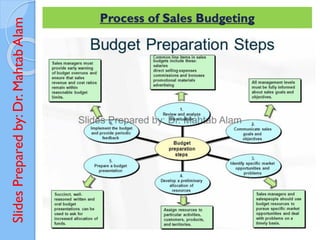
Alam Sales Budgeting-Meaning
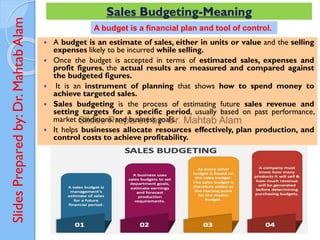
A budget is an estimate of sales, either in units or value and the selling
expenses likely to be incurred while selling.
Once the budget is accepted in terms of estimated sales, expenses and
profit figures, the actual results are measured and compared against
the budgeted figures.
It is an instrument of planning that shows how to spend money to
achieve targeted sales.
Sales budgeting is the process of estimating future sales revenue and
setting targets for a specific period, usually based on past performance,
market conditions, and business goals.
It helps businesses allocate resources effectively, plan production, and
control costs to achieve profitability.
A budget is a financial plan and tool of control.
28.
Slides
Prepared
by:
Dr.
Mahtab
Alam Sales Budgeting-Definition
•Cundiffand Still: "A sales budget is a forecast of expected sales during
a future period, expressed in monetary or quantitative terms.“
•Ronald Hilton: "A sales budget is a detailed schedule showing the
expected sales for the budget period, typically expressed in both units
and dollars.“
•Wheldon: "A sales budget is an estimate of expected total sales
revenue and selling expenses of the firm for a future period.“
•Terry Lucey: "Sales budgeting is the process of predicting and
controlling sales revenue, considering external factors like market
demand and internal capabilities."
29.
Slides
Prepared
by:
Dr.
Mahtab
Alam Sales Budgeting-Features
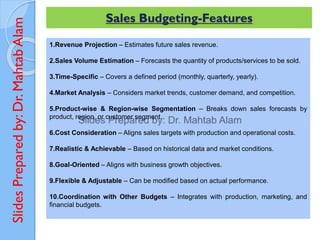
1.RevenueProjection – Estimates future sales revenue.
2.Sales Volume Estimation – Forecasts the quantity of products/services to be sold.
3.Time-Specific – Covers a defined period (monthly, quarterly, yearly).
4.Market Analysis – Considers market trends, customer demand, and competition.
5.Product-wise & Region-wise Segmentation – Breaks down sales forecasts by
product, region, or customer segment.
6.Cost Consideration – Aligns sales targets with production and operational costs.
7.Realistic & Achievable – Based on historical data and market conditions.
8.Goal-Oriented – Aligns with business growth objectives.
9.Flexible & Adjustable – Can be modified based on actual performance.
10.Coordination with Other Budgets – Integrates with production, marketing, and
financial budgets.
Slides
Prepared
by:
Dr.
Mahtab
Alam Purpose ofSales Budgeting
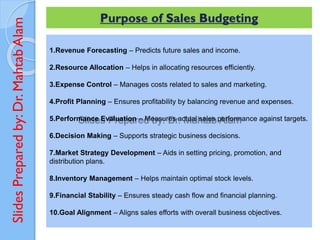
1.Revenue Forecasting – Predicts future sales and income.
2.Resource Allocation – Helps in allocating resources efficiently.
3.Expense Control – Manages costs related to sales and marketing.
4.Profit Planning – Ensures profitability by balancing revenue and expenses.
5.Performance Evaluation – Measures actual sales performance against targets.
6.Decision Making – Supports strategic business decisions.
7.Market Strategy Development – Aids in setting pricing, promotion, and
distribution plans.
8.Inventory Management – Helps maintain optimal stock levels.
9.Financial Stability – Ensures steady cash flow and financial planning.
10.Goal Alignment – Aligns sales efforts with overall business objectives.
32.
Slides
Prepared
by:
Dr.
Mahtab
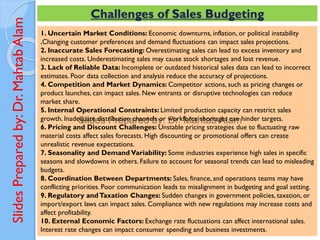
Alam Challenges ofSales Budgeting
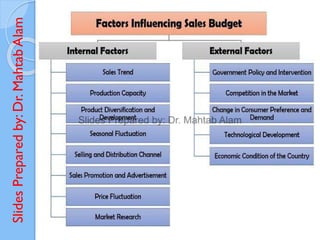
1. Uncertain Market Conditions: Economic downturns, inflation, or political instability
,Changing customer preferences and demand fluctuations can impact sales projections.
2. Inaccurate Sales Forecasting: Overestimating sales can lead to excess inventory and
increased costs. Underestimating sales may cause stock shortages and lost revenue.
3. Lack of Reliable Data: Incomplete or outdated historical sales data can lead to incorrect
estimates. Poor data collection and analysis reduce the accuracy of projections.
4. Competition and Market Dynamics: Competitor actions, such as pricing changes or
product launches, can impact sales. New entrants or disruptive technologies can reduce
market share.
5. Internal Operational Constraints: Limited production capacity can restrict sales
growth. Inadequate distribution channels or workforce shortages can hinder targets.
6. Pricing and Discount Challenges: Unstable pricing strategies due to fluctuating raw
material costs affect sales forecasts. High discounting or promotional offers can create
unrealistic revenue expectations.
7. Seasonality and Demand Variability: Some industries experience high sales in specific
seasons and slowdowns in others. Failure to account for seasonal trends can lead to misleading
budgets.
8. Coordination Between Departments: Sales, finance, and operations teams may have
conflicting priorities. Poor communication leads to misalignment in budgeting and goal setting.
9. Regulatory andTaxation Changes: Sudden changes in government policies, taxation, or
import/export laws can impact sales. Compliance with new regulations may increase costs and
affect profitability.
10. External Economic Factors: Exchange rate fluctuations can affect international sales.
Interest rate changes can impact consumer spending and business investments.
Slides
Prepared
by:
Dr.
Mahtab
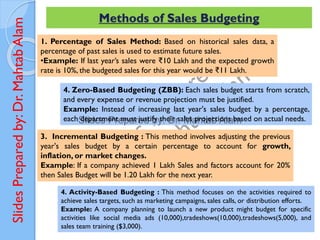
Alam Methods ofSales Budgeting
1. Percentage of Sales Method: Based on historical sales data, a
percentage of past sales is used to estimate future sales.
•Example: If last year’s sales were ₹10 Lakh and the expected growth
rate is 10%, the budgeted sales for this year would be ₹11 Lakh.
3. Incremental Budgeting : This method involves adjusting the previous
year's sales budget by a certain percentage to account for growth,
inflation, or market changes.
Example: If a company achieved 1 Lakh Sales and factors account for 20%
then Sales Budget will be 1.20 Lakh for the next year.
4. Zero-Based Budgeting (ZBB): Each sales budget starts from scratch,
and every expense or revenue projection must be justified.
Example: Instead of increasing last year's sales budget by a percentage,
each department must justify their sales projections based on actual needs.
4. Activity-Based Budgeting : This method focuses on the activities required to
achieve sales targets, such as marketing campaigns, sales calls, or distribution efforts.
Example: A company planning to launch a new product might budget for specific
activities like social media ads (10,000),tradeshows(10,000),tradeshows(5,000), and
sales team training ($3,000).
36.
Slides
Prepared
by:
Dr.
Mahtab
Alam Methods ofSales Budgeting
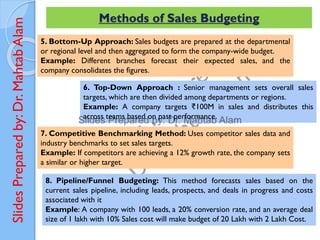
5. Bottom-Up Approach: Sales budgets are prepared at the departmental
or regional level and then aggregated to form the company-wide budget.
Example: Different branches forecast their expected sales, and the
company consolidates the figures.
6. Top-Down Approach : Senior management sets overall sales
targets, which are then divided among departments or regions.
Example: A company targets ₹100M in sales and distributes this
across teams based on past performance.
7. Competitive Benchmarking Method: Uses competitor sales data and
industry benchmarks to set sales targets.
Example: If competitors are achieving a 12% growth rate, the company sets
a similar or higher target.
8. Pipeline/Funnel Budgeting: This method forecasts sales based on the
current sales pipeline, including leads, prospects, and deals in progress and costs
associated with it
Example: A company with 100 leads, a 20% conversion rate, and an average deal
size of 1 lakh with 10% Sales cost will make budget of 20 Lakh with 2 Lakh Cost.
37.
Slides
Prepared
by:
Dr.
Mahtab
Alam Methods ofSales Budgeting
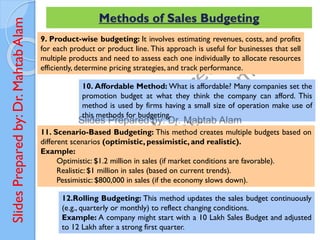
9. Product-wise budgeting: It involves estimating revenues, costs, and profits
for each product or product line. This approach is useful for businesses that sell
multiple products and need to assess each one individually to allocate resources
efficiently, determine pricing strategies, and track performance.
10. Affordable Method: What is affordable? Many companies set the
promotion budget at what they think the company can afford. This
method is used by firms having a small size of operation make use of
this methods for budgeting.
11. Scenario-Based Budgeting: This method creates multiple budgets based on
different scenarios (optimistic, pessimistic, and realistic).
Example:
Optimistic: $1.2 million in sales (if market conditions are favorable).
Realistic: $1 million in sales (based on current trends).
Pessimistic: $800,000 in sales (if the economy slows down).
12.Rolling Budgeting: This method updates the sales budget continuously
(e.g., quarterly or monthly) to reflect changing conditions.
Example: A company might start with a 10 Lakh Sales Budget and adjusted
to 12 Lakh after a strong first quarter.
38.
Slides
Prepared
by:
Dr.
Mahtab
Alam Sample ofSales Budget
Green Tech Solutions Sales Budget Plan for 2025
Product
Line
Q1 Sales
(Units)
Q2
Sales
(Units)
Q3
Sales
(Units)
Q4
Sales
(Units)
Average
Price per
Unit
Total
Revenue
Solar-
Powered
Lights
5,000 6,000 7,000 8,000 $50 $1,300,000
Energy-
Efficient
Fans
3,000 4,000 5,000 6,000 $80 $1,440,000
Smart
Thermostats
2,000 2,500 3,000 3,500 $120 $1,320,000
$4,060,000
1. Revenue Projections
Total Revenue
Product
Line
Units
Sold
(Annual)
COGS per
Unit
Total
COGS
Solar-
Powered
Lights
26,000 $30 $780,000
Energy-
Efficient
Fans
18,000 $50 $900,000
Smart
Thermostats
11,000 $80 $880,000
$2,560,000
2. Cost of Goods Sold (COGS)
Total COGS
39.
Slides
Prepared
by:
Dr.
Mahtab
Alam
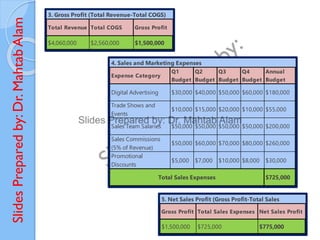
Expense Category
Q1
Budget
Q2
Budget
Q3
Budget
Q4
Budget
Annual
Budget
Digital Advertising$30,000 $40,000 $50,000 $60,000 $180,000
Trade Shows and
Events
$10,000 $15,000 $20,000 $10,000 $55,000
Sales Team Salaries $50,000 $50,000 $50,000 $50,000 $200,000
Sales Commissions
(5% of Revenue)
$50,000 $60,000 $70,000 $80,000 $260,000
Promotional
Discounts
$5,000 $7,000 $10,000 $8,000 $30,000
$725,000
4. Sales and Marketing Expenses
Total Sales Expenses
Gross Profit Total Sales Expenses Net Sales Profit
$1,500,000 $725,000 $775,000
5. Net Sales Profit (Gross Profit-Total Sales
Total Revenue Total COGS Gross Profit
$4,060,000 $2,560,000 $1,500,000
3. Gross Profit (Total Revenue-Total COGS)