Sakai and the Academic Enterprise
       Oracle’s Perspective
 Michael Feldstein, Principal Product Manager, Oracle
Eric Chan, Consulting Member of Technical Staff, Oracle
The following is intended to outline our general
product direction. It is intended for information
purposes only, and may not be incorporated into any
contract. It is not a commitment to deliver any
material, code, or functionality, and should not be
relied upon in making purchasing decisions.
The development, release, and timing of any
features or functionality described for Oracle’s
products remains at the sole discretion of Oracle.


  July 2009           10th Sakai Conference - Boston, MA, U.S.A.
The Problem Space


 July 2009   10th Sakai Conference - Boston, MA, U.S.A.   3
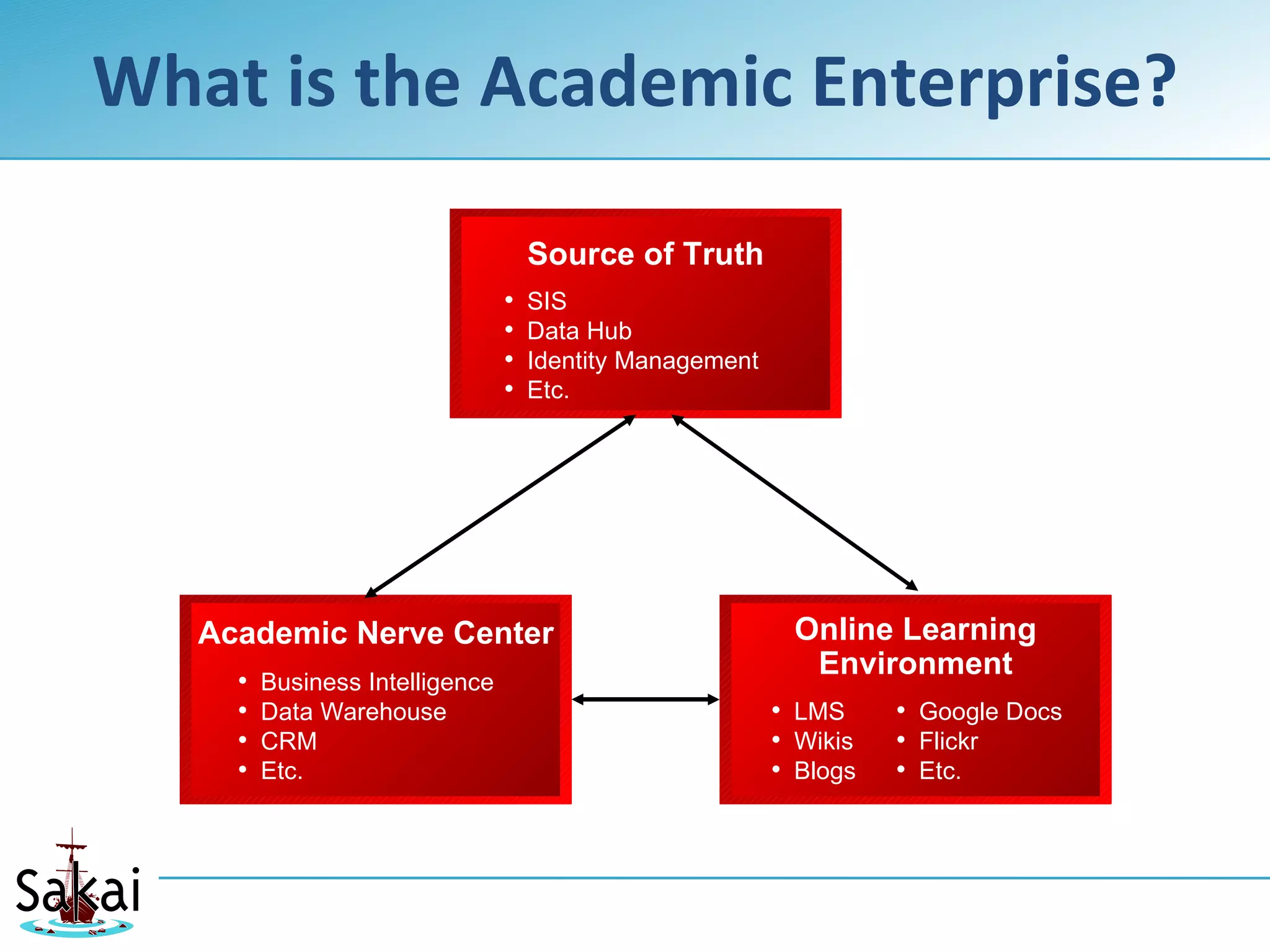
What is the Academic Enterprise?

                                     Source of Truth
                                 •   SIS
                                 •   Data Hub
                                 •   Identity Management
                                 •   Etc.


   Academic Nerve Center                                    Online Learning
                                                             Environment
     •   Business Intelligence
     •   Data Warehouse                                    • LMS     • Google Docs
     •   CRM                                               • Wikis   • Flickr
     •   Etc.                                              • Blogs   • Etc.
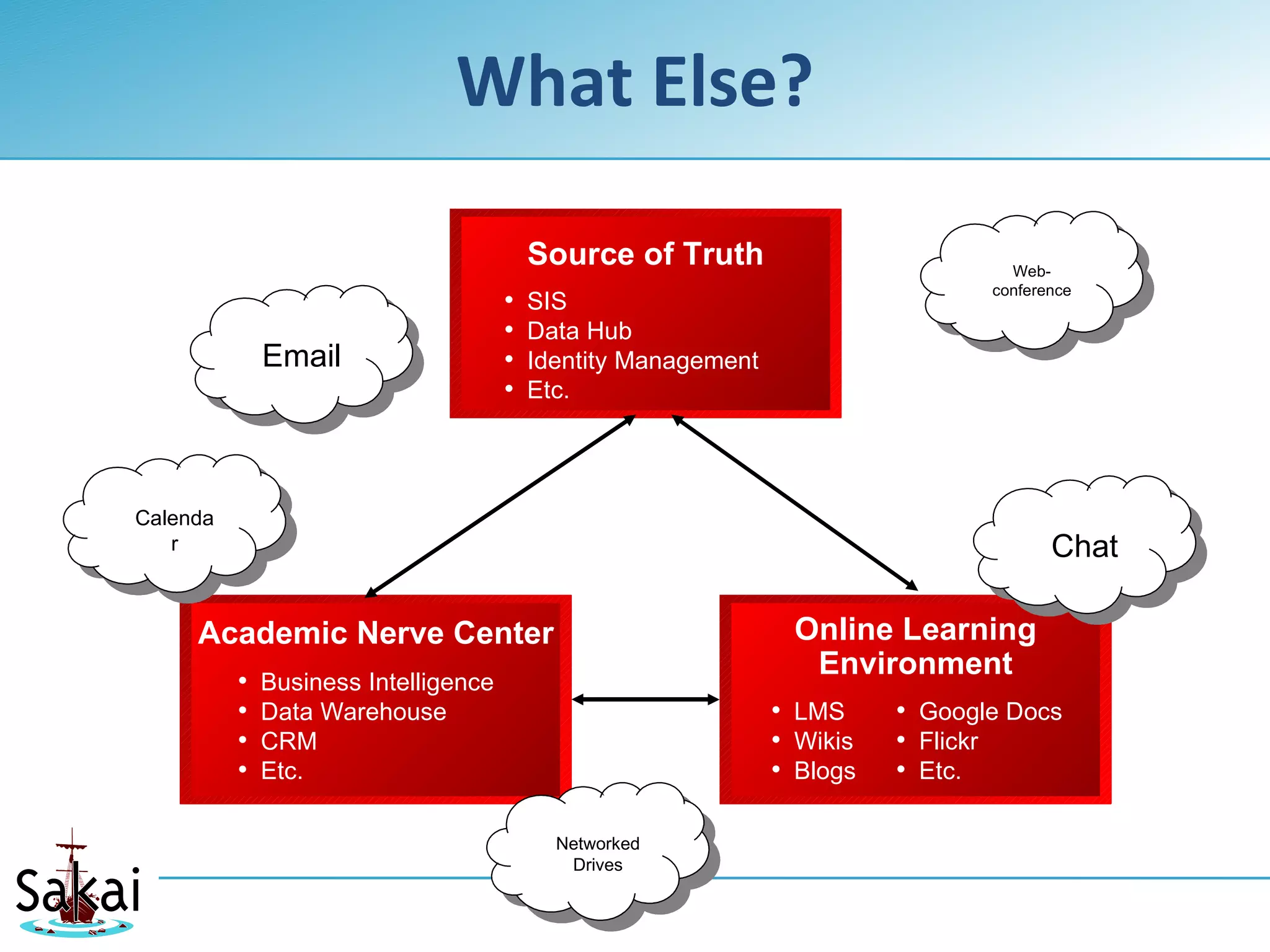
What Else?

                                          Source of Truth                          Web-
                                                                                 conference
                                      •   SIS
                                      •   Data Hub
              Email                   •   Identity Management
                                      •   Etc.


Calenda
   r                                                                                    Chat

     Academic Nerve Center                                       Online Learning
                                                                  Environment
          •   Business Intelligence
          •   Data Warehouse                                    • LMS     • Google Docs
          •   CRM                                               • Wikis   • Flickr
          •   Etc.                                              • Blogs   • Etc.

                                            Networked
                                             Drives
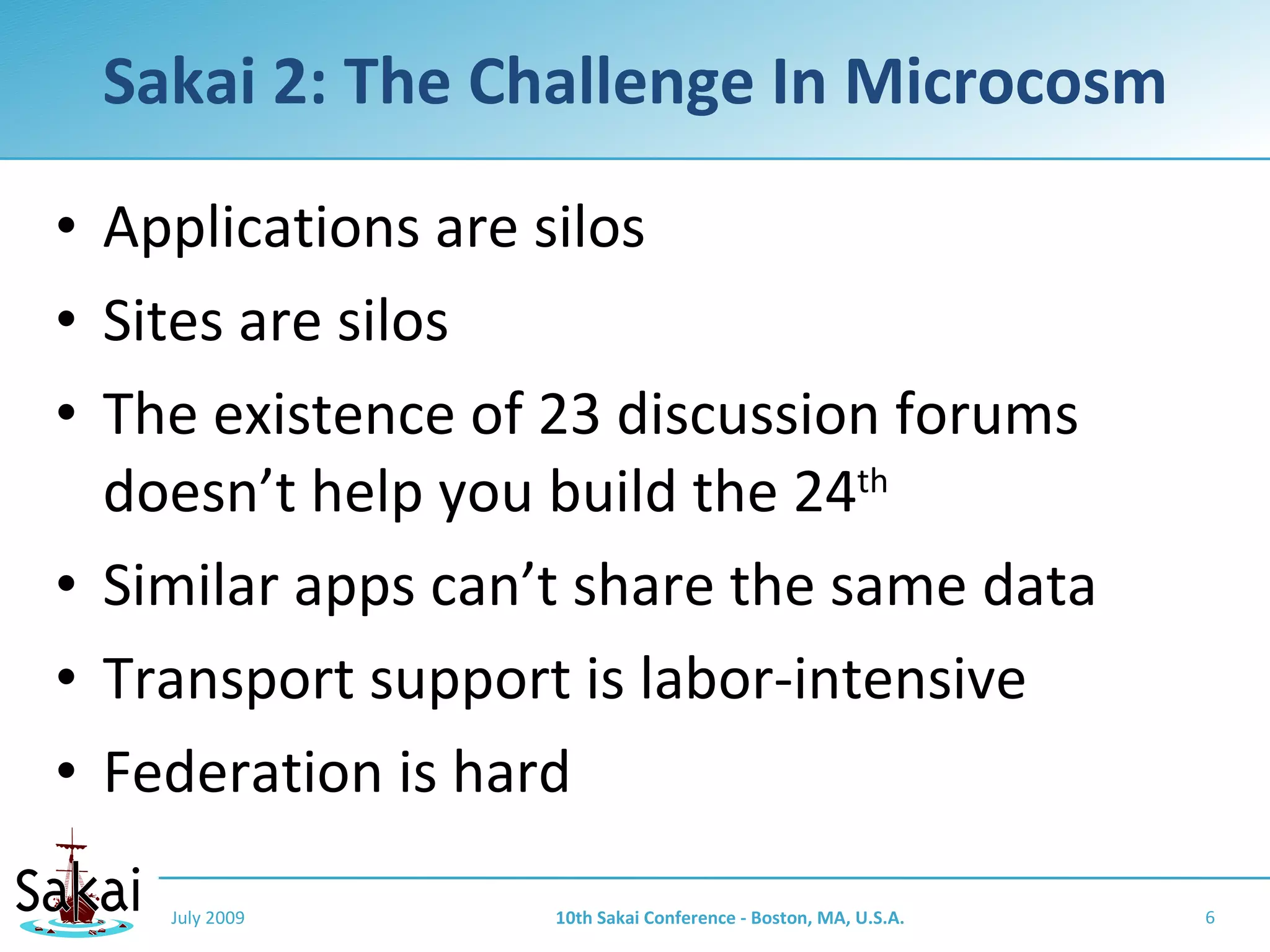
Sakai 2: The Challenge In Microcosm

• Applications are silos
• Sites are silos
• The existence of 23 discussion forums
  doesn’t help you build the 24th
• Similar apps can’t share the same data
• Transport support is labor-intensive
• Federation is hard

    July 2009      10th Sakai Conference - Boston, MA, U.S.A.   6
Sakai 3 Gets You Partway There
• No more site silos
• Reduced application silos
• A REST erector set for building capabilities
  (e.g., discussions)
But Wouldn’t It Be Great If…
• Your presence indicator knew you were in class in Room 301
• A teacher could add an assignment from her desktop calendar
• The student would get that assignment added to his PIM task
  list
• Activities (including archives) taking place in external apps like
  DimDim or Google Wave would be surfaced in the course site
• Course sites from a partner school could be surfaced in your
  Sakai instance
• Students and teachers could aggregate course content from
  several universities in a rich desktop client (PLE)
• You could save not only the end product but all the related
  collaborative artifacts of student work to an ePortfolio
• Somebody else did some of the programming work of all of this
  for you
A New Standard: ICOM


 July 2009   10th Sakai Conference - Boston, MA, U.S.A.   9
Integrated Collaboration Object Model

Collaborative access to global networked knowledge
• assists humans, organisations, and systems
• with individual, collective learning and problem
  solving
• by encompassing multidisciplinary contributions
• enabling increased innovation and knowledge
  production on individual, organisational, and global
  levels.
                                                                    Inspired by Doug Engelbart’s original
                                                                       1962 report of: AUGMENTING
                                                                           HUMAN INTELLECT: A
                                                                       CONCEPTUAL FRAMEWORK

    July 2009          10th Sakai Conference - Boston, MA, U.S.A.                                    10
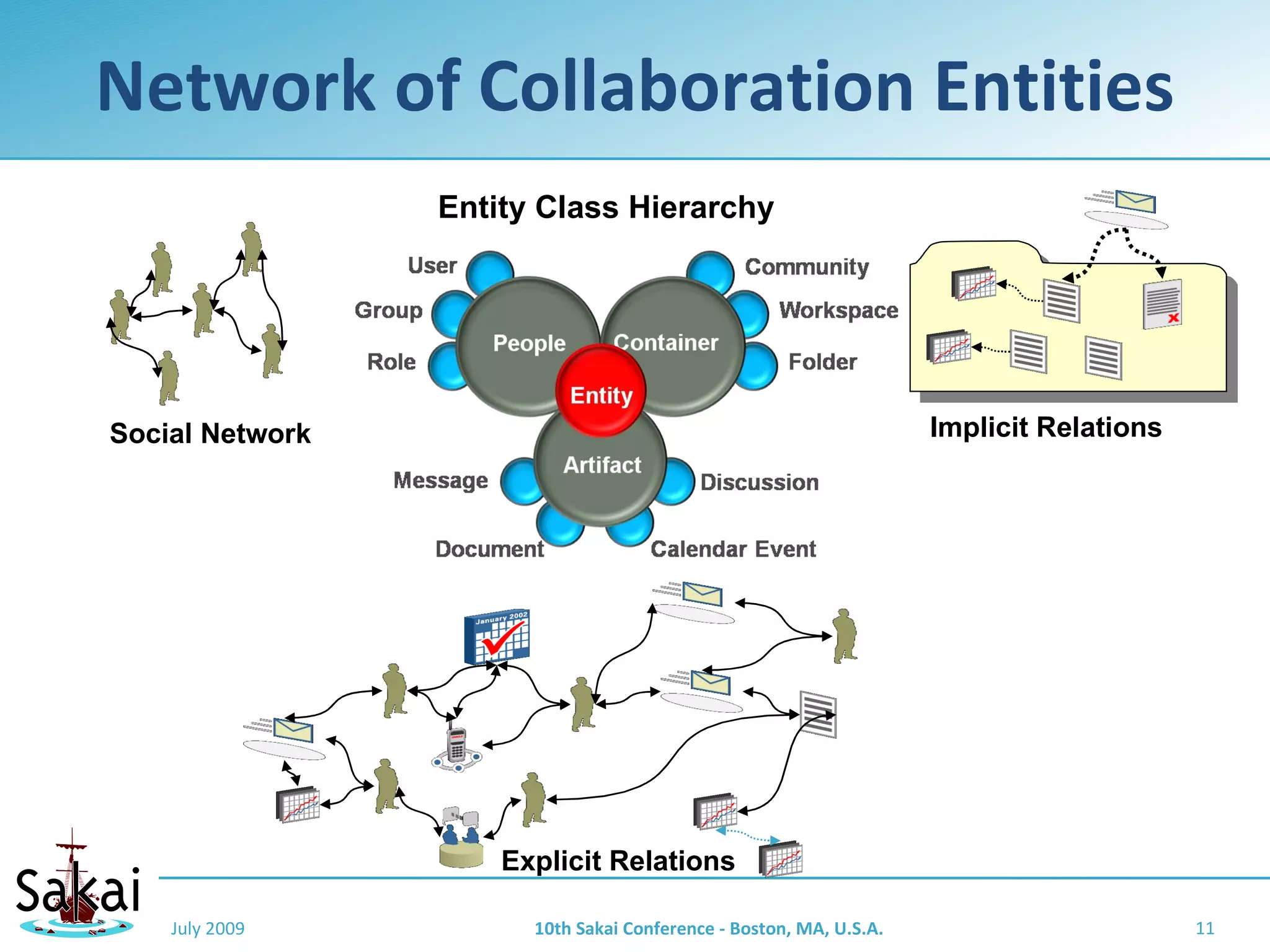
Network of Collaboration Entities
                 Entity Class Hierarchy


Social Network                                                      Implicit Relations


                     Explicit Relations

    July 2009          10th Sakai Conference - Boston, MA, U.S.A.                        11
Current State of Fragmented Collaboration
                  Applications
Productivity eroded by
• incompatible collaboration tools
• technology driven tools require constant context switching to perform a
   single task
• incomplete threads of conversations when users communicate through
   multiple channels
• unable to relate, aggregate, and reason about diverse types of
   collaboration artifacts by project, task, or metadata
• lack of uniform relevance rankings of search results from isolated
   repositories
• soaring costs or technical barriers for integrating silos of repositories
• weakening governance amid proliferation of web 2.0 content silos


      July 2009                  10th Sakai Conference - Boston, MA, U.S.A.   12
Why Integrated Model?
An integrated collaboration model is essential for
• (users) role-aware and task-driven collaboration
    • seamless transitions among the diverse collaboration activities
• (developers) application development platform
    • custom composite applications,
    • contextual collaboration in enterprise business applications,
    • enterprise workplace portals,
    • new modes of collaboration
• (integrators) application integration architecture
    • interoperable standard modules
    • canonical data and message model
    • model-driven development and integration


      July 2009                  10th Sakai Conference - Boston, MA, U.S.A.   13
Benefits of Integrated Model
Common policy enforcement of heterogeneous contents coupled with an
  extended common infrastructure
   • identity management
   • access control
   • governance and record management
   • business rules and processes
   • business intelligence
   • task/project oriented organization of disparate types of contents
   • conversation threads through multi-channel, multi-modal
      communication artifacts
   • classification, tagging, meta-data associations, activity streams
   • faceted search and relational navigation
   • search and relevance ranking
   • subscriptions and notifications
      July 2009                10th Sakai Conference - Boston, MA, U.S.A.   14
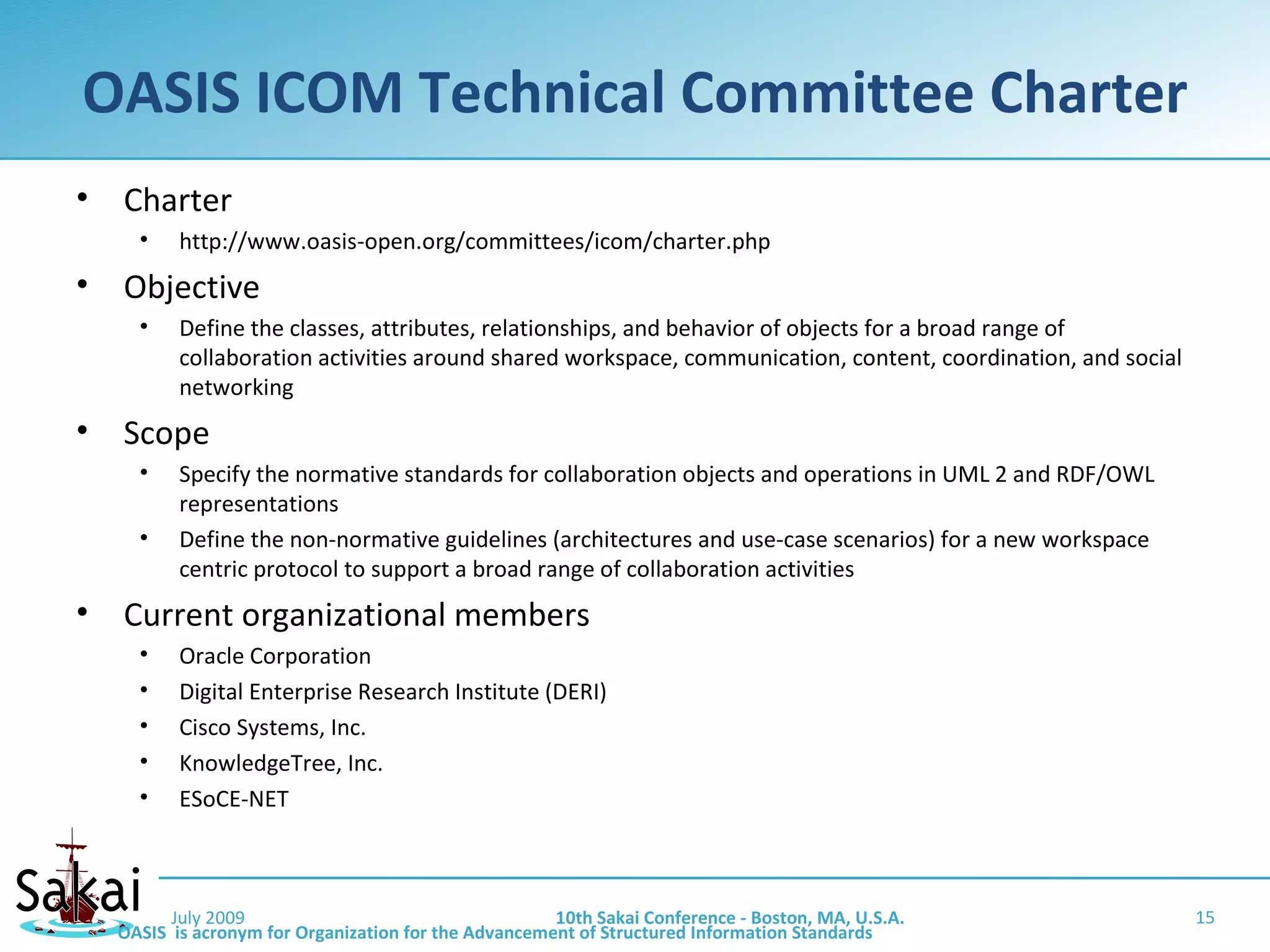
OASIS ICOM Technical Committee Charter
•   Charter
      •    http://www.oasis-open.org/committees/icom/charter.php
•   Objective
      •    Define the classes, attributes, relationships, and behavior of objects for a broad range of
           collaboration activities around shared workspace, communication, content, coordination, and social
           networking
•   Scope
      •    Specify the normative standards for collaboration objects and operations in UML 2 and RDF/OWL
           representations
      •    Define the non-normative guidelines (architectures and use-case scenarios) for a new workspace
           centric protocol to support a broad range of collaboration activities
•   Current organizational members
      •    Oracle Corporation
      •    Digital Enterprise Research Institute (DERI)
      •    Cisco Systems, Inc.
      •    KnowledgeTree, Inc.
      •    ESoCE-NET


          July 2009                                    10th Sakai Conference - Boston, MA, U.S.A.               15
    OASIS is acronym for Organization for the Advancement of Structured Information Standards
Include a Broad Range of Collaboration
                    Activities
ICOM is extensible and includes diverse classes of objects:
• teamwork (shared workspaces, discussion forums, real-time conferences,
    presence, etc.);
• communication (e-mail, instant message, telephony, RSS, etc.);
• content (text and multi-media contents, contextual connections,
    taxonomies, folksonomies, tags, saved searches, etc.);
• coordination (address books, calendars, tasks, journals, etc.); and
• social networking (articulated social networks among users, communities,
    groups, activities, wiki pages, blogs, recommendations, social bookmarking,
    etc.)
Virtually all ICOM objects are entities which are assigned universal resource
    identifiers


      July 2009                  10th Sakai Conference - Boston, MA, U.S.A.   16
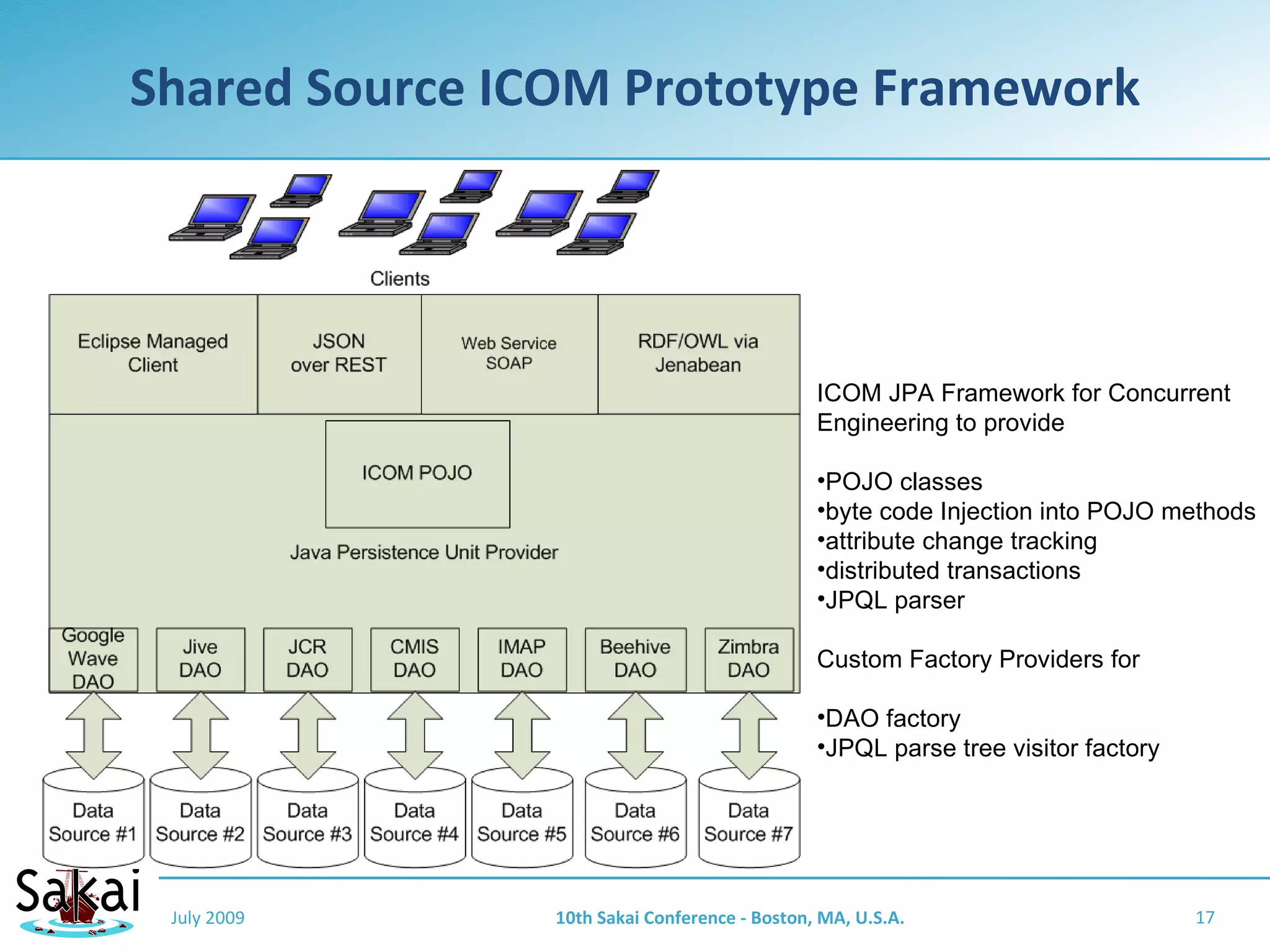
Shared Source ICOM Prototype Framework


                                               ICOM JPA Framework for Concurrent
                                               Engineering to provide

                                               •POJO classes
                                               •byte code Injection into POJO methods
                                               •attribute change tracking
                                               •distributed transactions
                                               •JPQL parser

                                               Custom Factory Providers for

                                               •DAO factory
                                               •JPQL parse tree visitor factory


 July 2009      10th Sakai Conference - Boston, MA, U.S.A.                        17
Integrated Model enables Federation
              Jane’s Personal Learning /Research       Joe’s Personal Learning /Research
                         Environment                              Environment


                                Online Learning /Research Environment


                                            ICOM POJO


                                          Federation of LMS

                 Cambridge
                 University                 Georgia Tech                  UC Davis
                    LMS                     LMS Provider                 LMS Provider
                  Provider


  July 2009                               10th Sakai Conference - Boston, MA, U.S.A.       18
ICOM’s Workspace Centric Design Pattern

•   Workspace is a durable context and place to collaborate.
     •   examples of contexts are projects, libraries, personal learning environments, personal
         information management, e-Portfolios, asynchronous meetings
•   Workspace involves participants with different membership roles.
     •   participants can observe the presence of other participants in the workspace.
•   Workspace contains one or more
     •   message and document folders
     •   address books
     •   calendars, task lists
     •   web conferences, chat rooms
     •   wiki pages, forums, etc.
•   Workspace is an integration hub for multi-vendor
     •   collaboration services
     •   content repositories
     •   metadata facilities
     •   infrastructure


         July 2009                       10th Sakai Conference - Boston, MA, U.S.A.               19
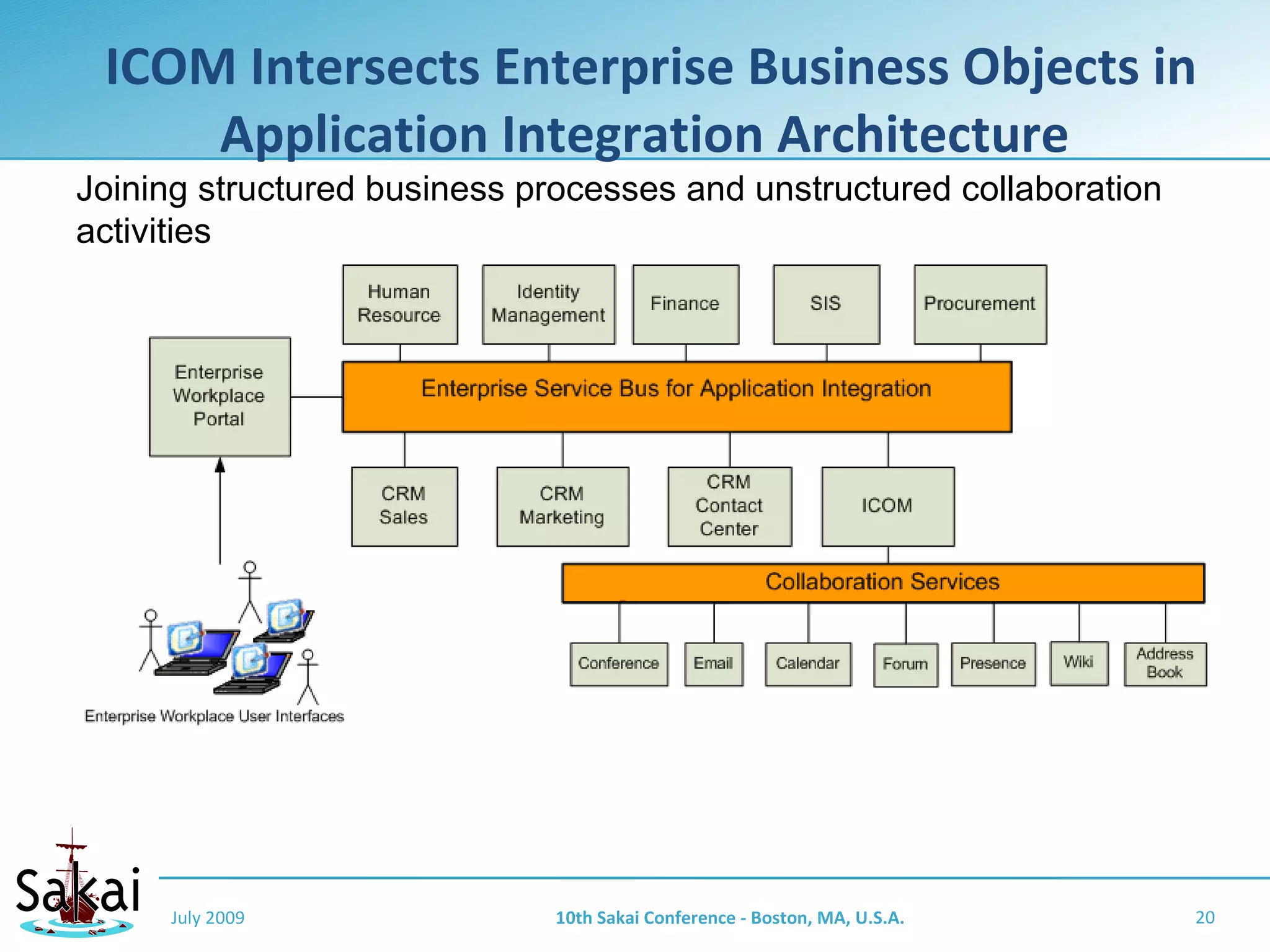
ICOM Intersects Enterprise Business Objects in
     Application Integration Architecture
Joining structured business processes and unstructured collaboration
activities


     July 2009                10th Sakai Conference - Boston, MA, U.S.A.   20
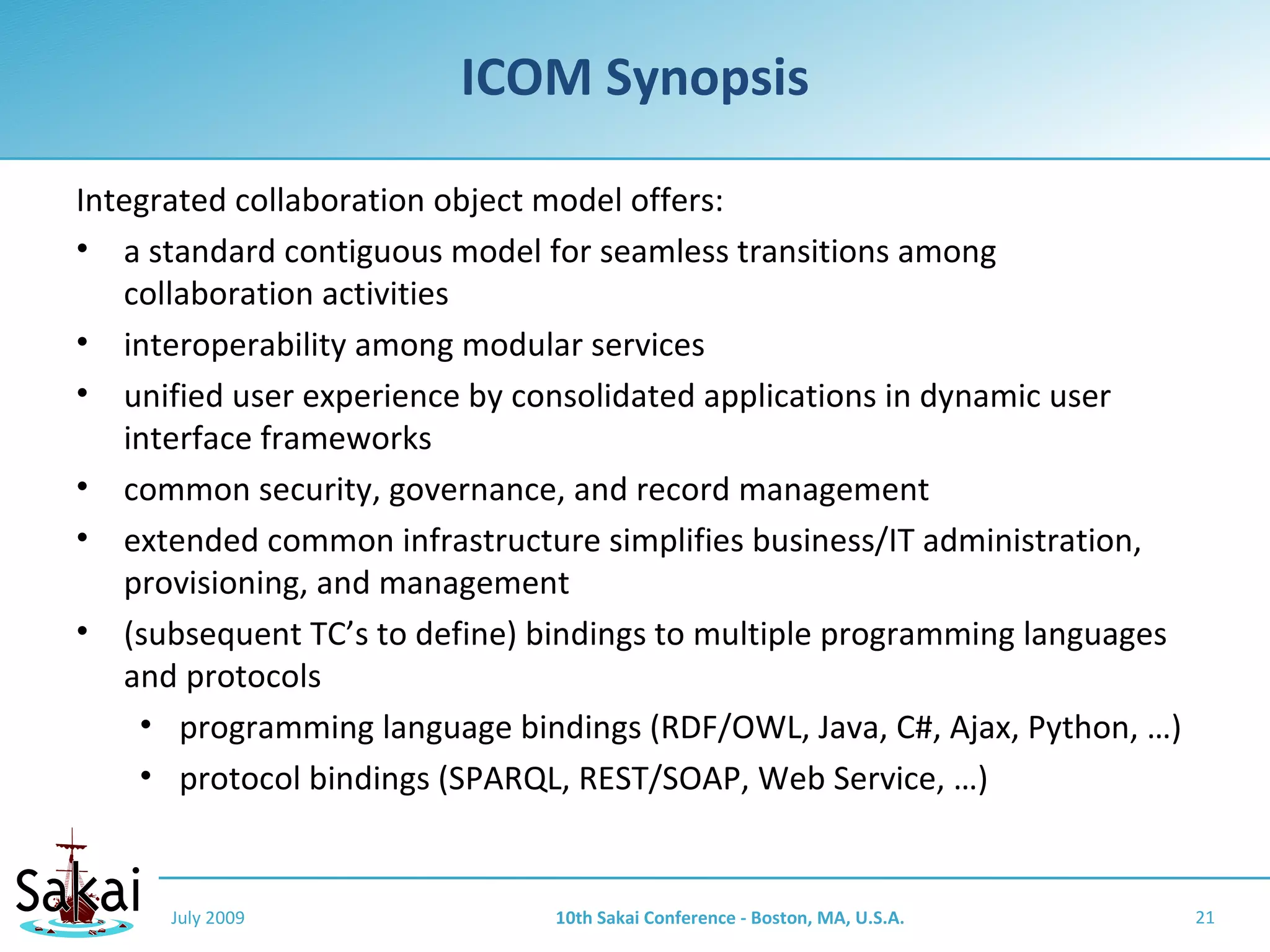
ICOM Synopsis

Integrated collaboration object model offers:
• a standard contiguous model for seamless transitions among
   collaboration activities
• interoperability among modular services
• unified user experience by consolidated applications in dynamic user
   interface frameworks
• common security, governance, and record management
• extended common infrastructure simplifies business/IT administration,
   provisioning, and management
• (subsequent TC’s to define) bindings to multiple programming languages
   and protocols
    • programming language bindings (RDF/OWL, Java, C#, Ajax, Python, …)
    • protocol bindings (SPARQL, REST/SOAP, Web Service, …)


      July 2009                10th Sakai Conference - Boston, MA, U.S.A.   21
Join the Effort!

http://www.oasis-open.org/committees/icom/


     July 2009        10th Sakai Conference - Boston, MA, U.S.A.   22
A Modest Proposal


 July 2009   10th Sakai Conference - Boston, MA, U.S.A.   23
Consider ICOM for Sakai 3
• For Now: Adopt/adapt the REST API
   •   You have to develop one anyway
   •   You get a major head start on design and documentation
   •   Provides the possibility of full ICOM adoption in the future
   •   Oracle can provide advice
• After 2010: Evaluate adoption of the object model
   • An open source reference implementation should be
     available
   • DAOs for integration with other platforms should be
     available
   • Migration should be relatively straightforward
Questions?


 July 2009   10th Sakai Conference - Boston, MA, U.S.A.   25
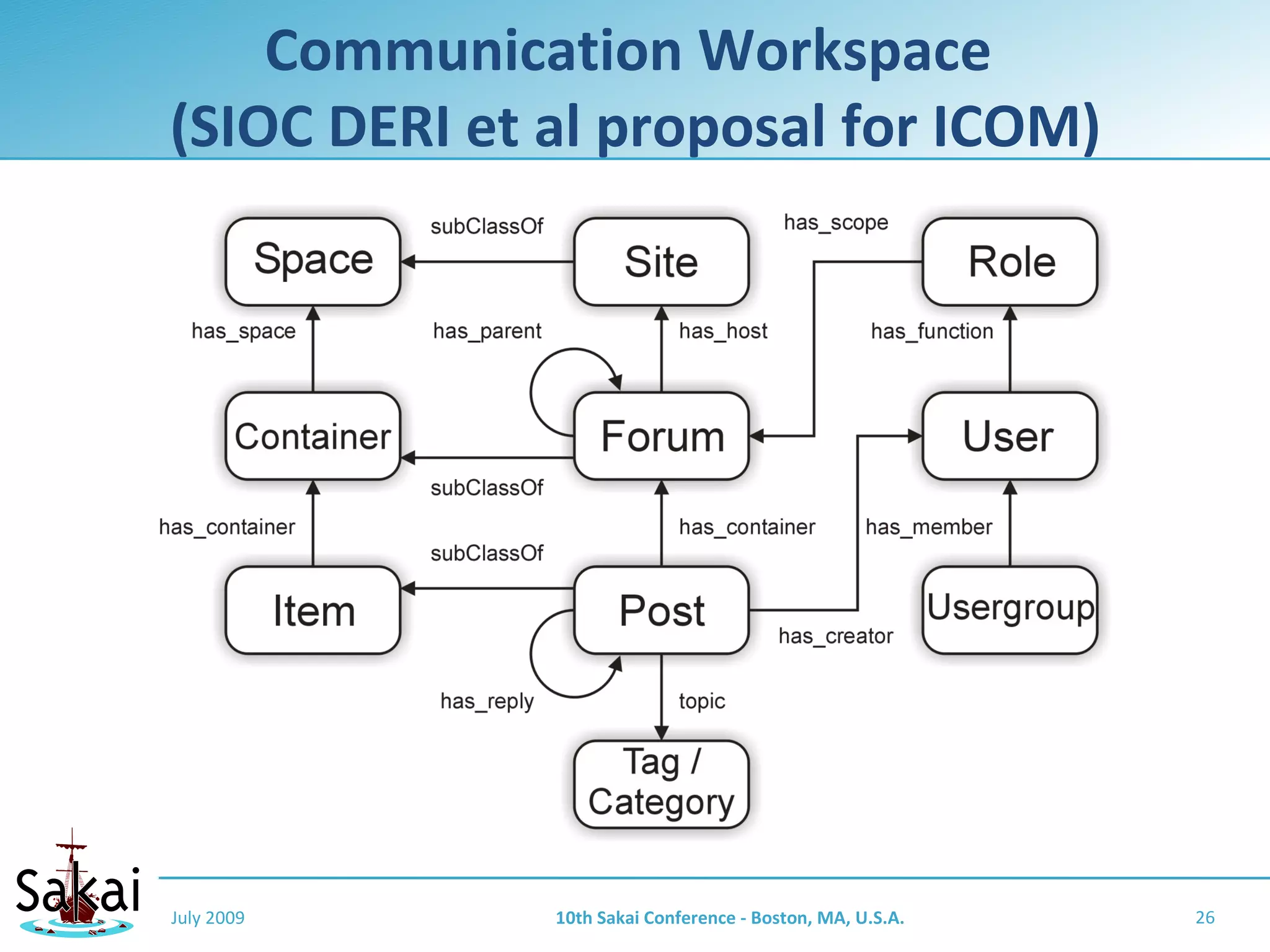
Communication Workspace
(SIOC DERI et al proposal for ICOM)


July 2009     10th Sakai Conference - Boston, MA, U.S.A.   26
Community of Actors and Workspaces
(Oracle Beehive’s proposal for ICOM)


July 2009     10th Sakai Conference - Boston, MA, U.S.A.   27
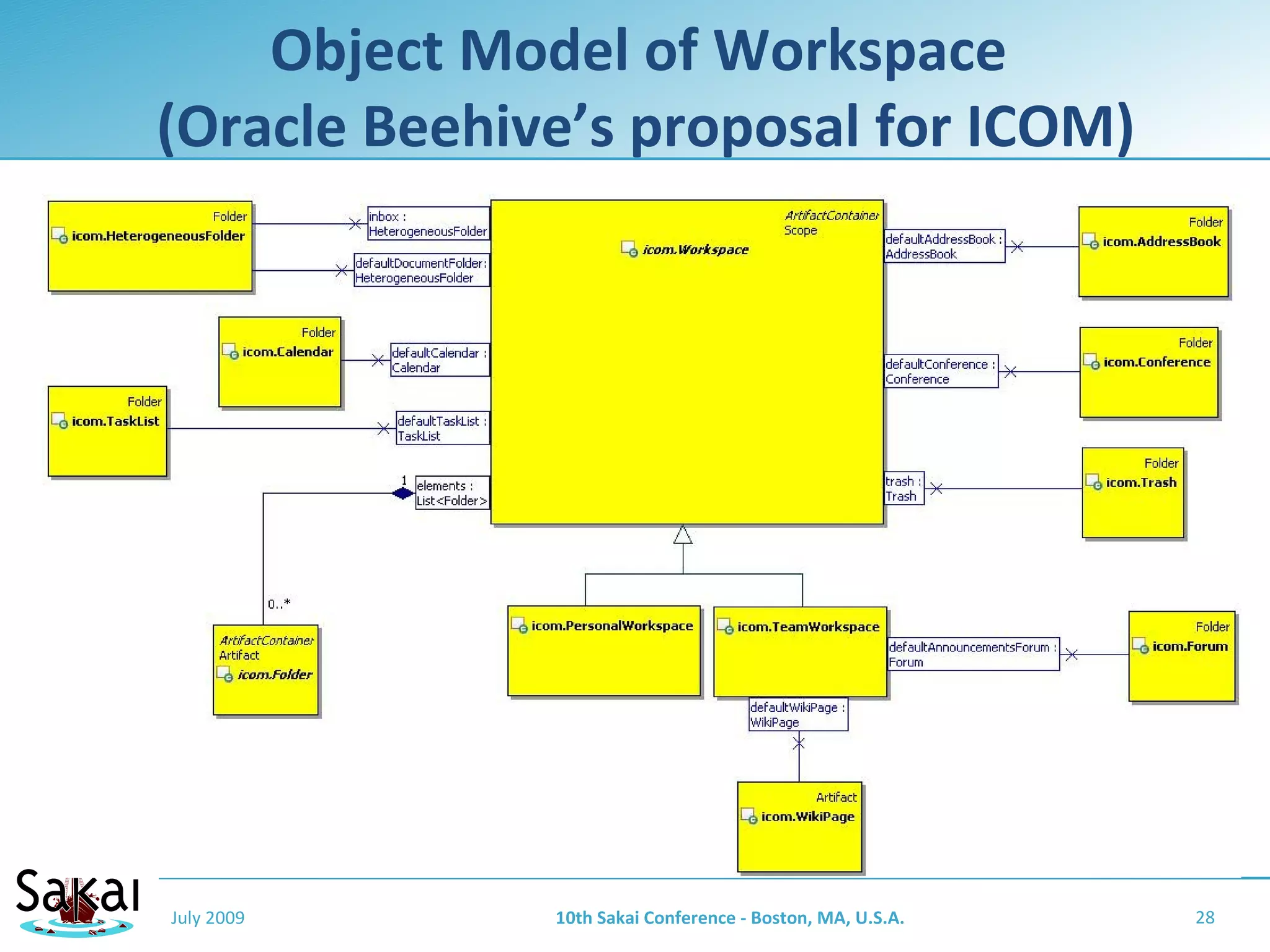
Object Model of Workspace
(Oracle Beehive’s proposal for ICOM)


July 2009     10th Sakai Conference - Boston, MA, U.S.A.   28
Community of Spaces


July 2009          10th Sakai Conference - Boston, MA, U.S.A.   29
Space of Multiple Conversations


 July 2009   10th Sakai Conference - Boston, MA, U.S.A.   30
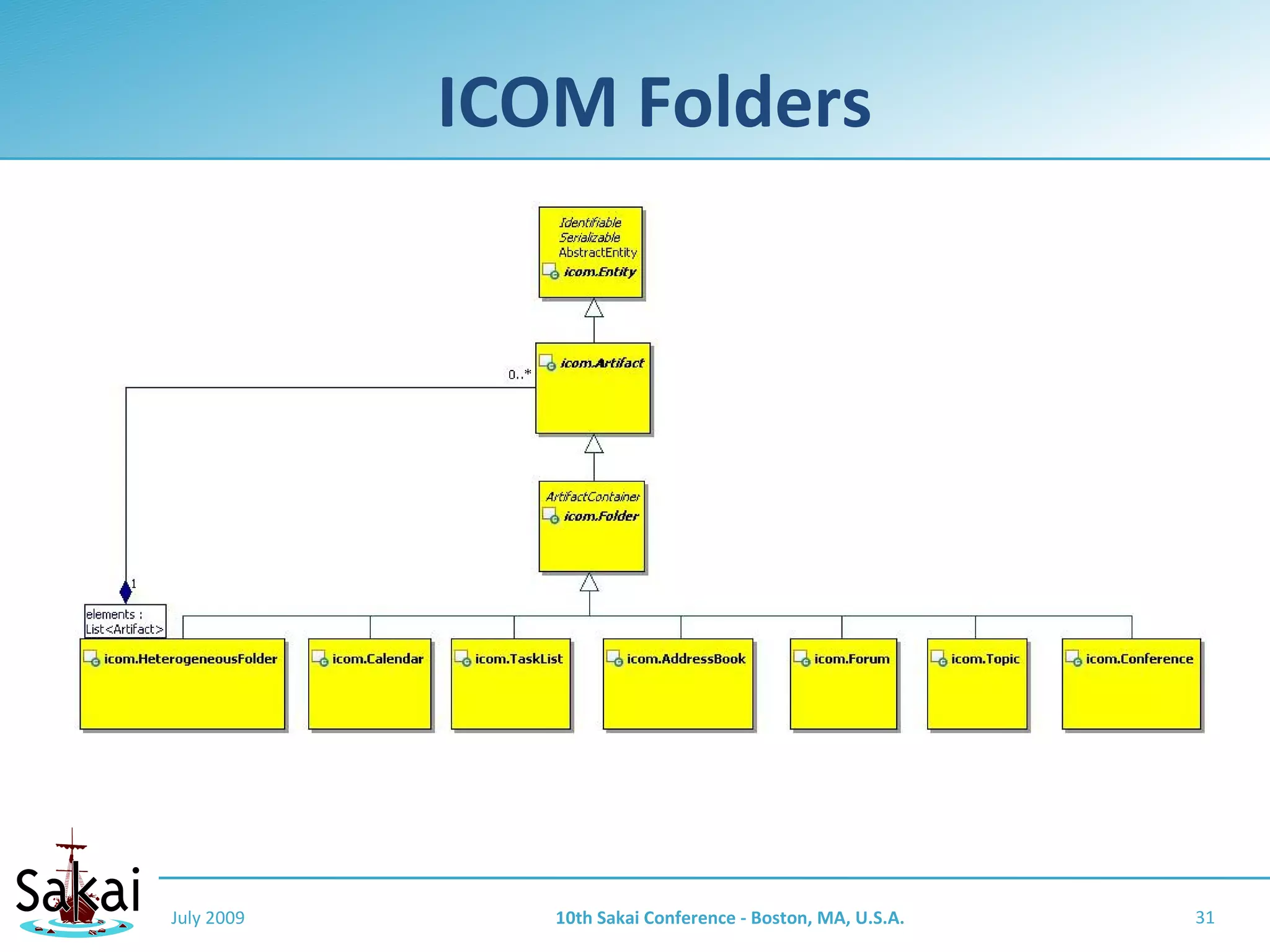
ICOM Folders


July 2009      10th Sakai Conference - Boston, MA, U.S.A.   31
ICOM Artifacts


July 2009     10th Sakai Conference - Boston, MA, U.S.A.   32
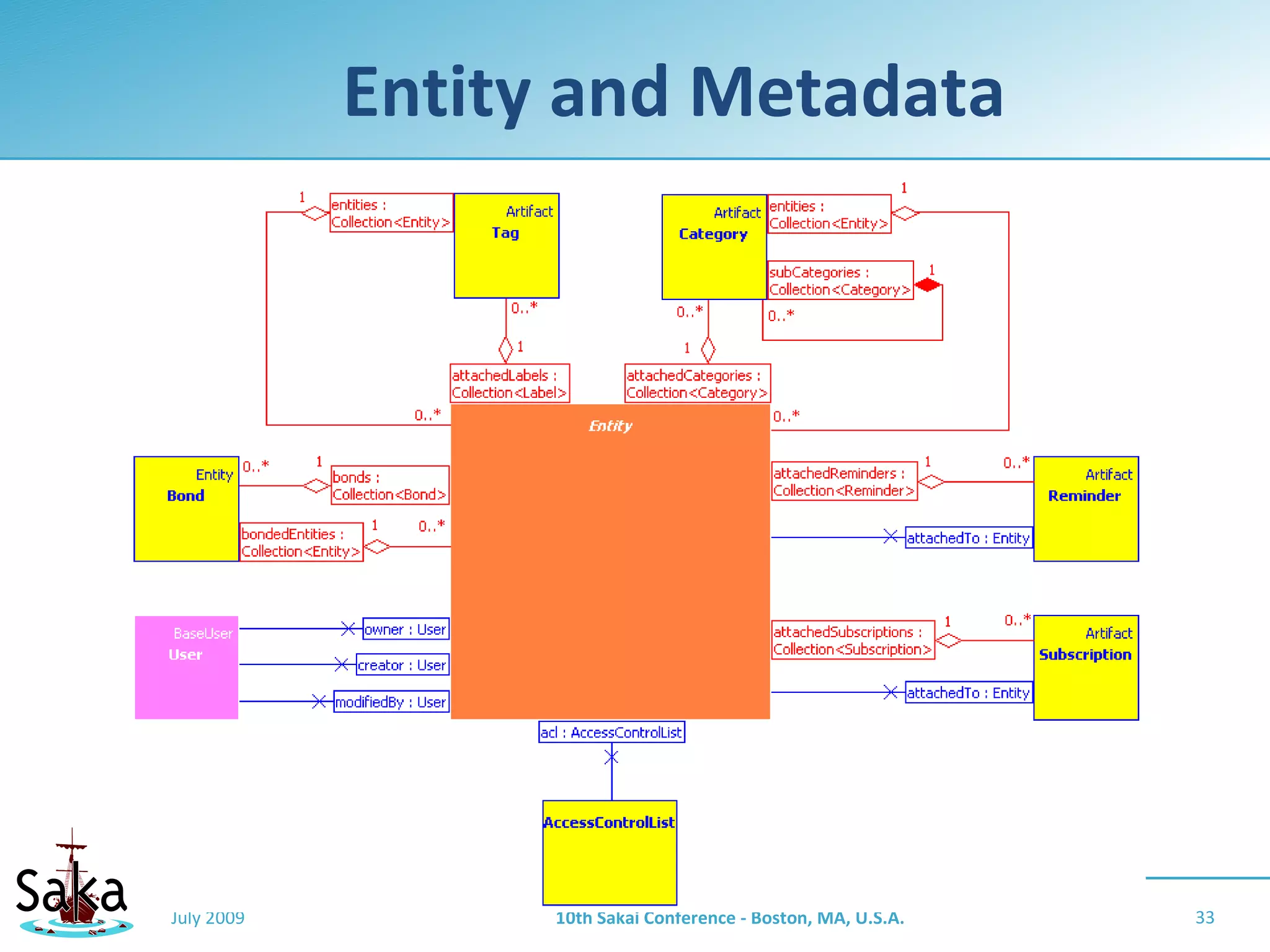
Entity and Metadata


July 2009         10th Sakai Conference - Boston, MA, U.S.A.   33
Document


July 2009     10th Sakai Conference - Boston, MA, U.S.A.   34
Calendar


July 2009    10th Sakai Conference - Boston, MA, U.S.A.   35
Task List


July 2009    10th Sakai Conference - Boston, MA, U.S.A.   36
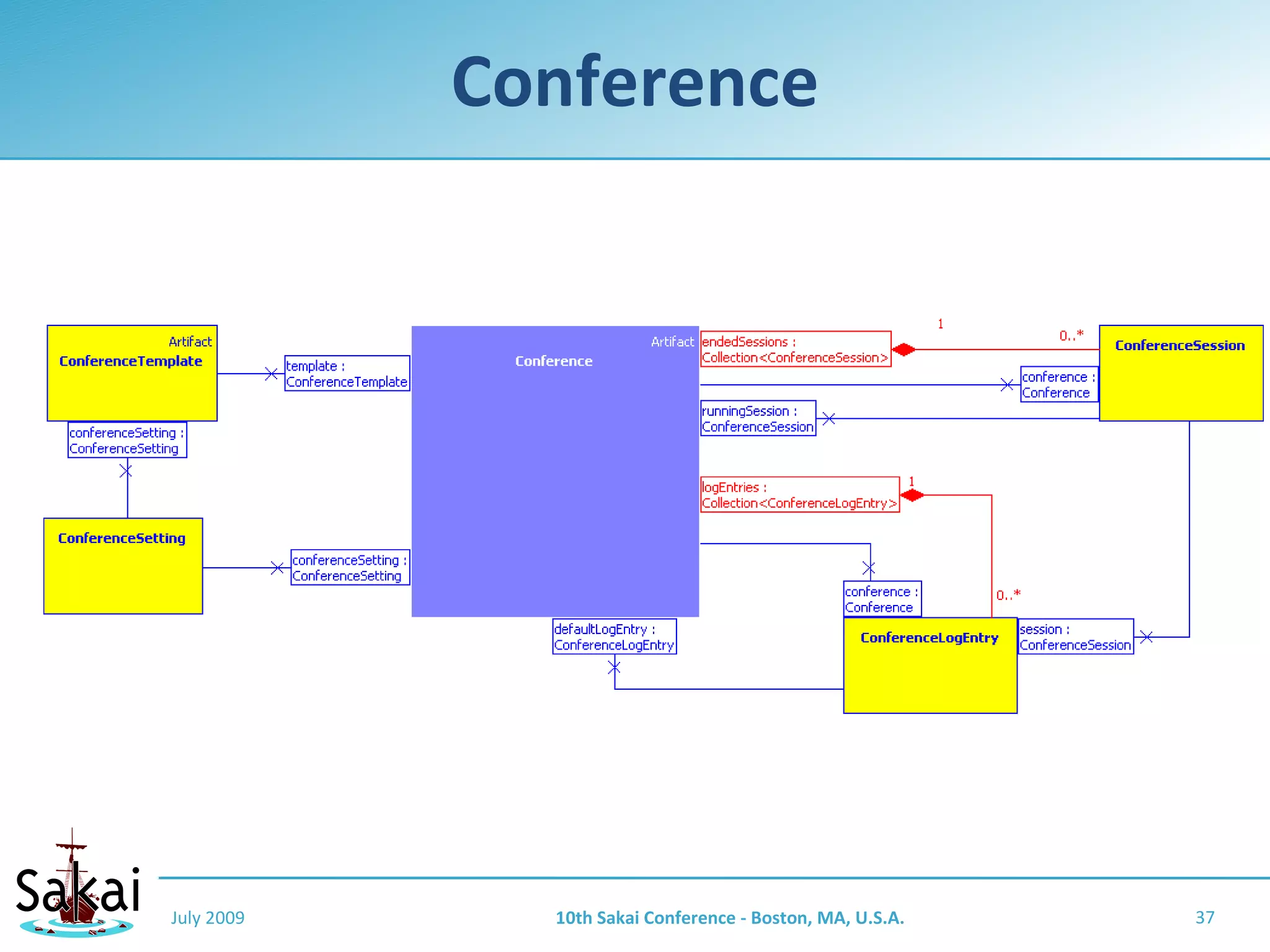
Conference


July 2009     10th Sakai Conference - Boston, MA, U.S.A.   37

Sakai And The Academic Enterprise

  • 1.
    Sakai and theAcademic Enterprise Oracle’s Perspective Michael Feldstein, Principal Product Manager, Oracle Eric Chan, Consulting Member of Technical Staff, Oracle
  • 2.
    The following isintended to outline our general product direction. It is intended for information purposes only, and may not be incorporated into any contract. It is not a commitment to deliver any material, code, or functionality, and should not be relied upon in making purchasing decisions. The development, release, and timing of any features or functionality described for Oracle’s products remains at the sole discretion of Oracle. July 2009 10th Sakai Conference - Boston, MA, U.S.A.
  • 3.
    The Problem Space July 2009 10th Sakai Conference - Boston, MA, U.S.A. 3
  • 4.
    What is theAcademic Enterprise? Source of Truth • SIS • Data Hub • Identity Management • Etc. Academic Nerve Center Online Learning Environment • Business Intelligence • Data Warehouse • LMS • Google Docs • CRM • Wikis • Flickr • Etc. • Blogs • Etc.
  • 5.
    What Else? Source of Truth Web- conference • SIS • Data Hub Email • Identity Management • Etc. Calenda r Chat Academic Nerve Center Online Learning Environment • Business Intelligence • Data Warehouse • LMS • Google Docs • CRM • Wikis • Flickr • Etc. • Blogs • Etc. Networked Drives
  • 6.
    Sakai 2: TheChallenge In Microcosm • Applications are silos • Sites are silos • The existence of 23 discussion forums doesn’t help you build the 24th • Similar apps can’t share the same data • Transport support is labor-intensive • Federation is hard July 2009 10th Sakai Conference - Boston, MA, U.S.A. 6
  • 7.
    Sakai 3 GetsYou Partway There • No more site silos • Reduced application silos • A REST erector set for building capabilities (e.g., discussions)
  • 8.
    But Wouldn’t ItBe Great If… • Your presence indicator knew you were in class in Room 301 • A teacher could add an assignment from her desktop calendar • The student would get that assignment added to his PIM task list • Activities (including archives) taking place in external apps like DimDim or Google Wave would be surfaced in the course site • Course sites from a partner school could be surfaced in your Sakai instance • Students and teachers could aggregate course content from several universities in a rich desktop client (PLE) • You could save not only the end product but all the related collaborative artifacts of student work to an ePortfolio • Somebody else did some of the programming work of all of this for you
  • 9.
    A New Standard:ICOM July 2009 10th Sakai Conference - Boston, MA, U.S.A. 9
  • 10.
    Integrated Collaboration ObjectModel Collaborative access to global networked knowledge • assists humans, organisations, and systems • with individual, collective learning and problem solving • by encompassing multidisciplinary contributions • enabling increased innovation and knowledge production on individual, organisational, and global levels. Inspired by Doug Engelbart’s original 1962 report of: AUGMENTING HUMAN INTELLECT: A CONCEPTUAL FRAMEWORK July 2009 10th Sakai Conference - Boston, MA, U.S.A. 10
  • 11.
    Network of CollaborationEntities Entity Class Hierarchy Social Network Implicit Relations Explicit Relations July 2009 10th Sakai Conference - Boston, MA, U.S.A. 11
  • 12.
    Current State ofFragmented Collaboration Applications Productivity eroded by • incompatible collaboration tools • technology driven tools require constant context switching to perform a single task • incomplete threads of conversations when users communicate through multiple channels • unable to relate, aggregate, and reason about diverse types of collaboration artifacts by project, task, or metadata • lack of uniform relevance rankings of search results from isolated repositories • soaring costs or technical barriers for integrating silos of repositories • weakening governance amid proliferation of web 2.0 content silos July 2009 10th Sakai Conference - Boston, MA, U.S.A. 12
  • 13.
    Why Integrated Model? Anintegrated collaboration model is essential for • (users) role-aware and task-driven collaboration • seamless transitions among the diverse collaboration activities • (developers) application development platform • custom composite applications, • contextual collaboration in enterprise business applications, • enterprise workplace portals, • new modes of collaboration • (integrators) application integration architecture • interoperable standard modules • canonical data and message model • model-driven development and integration July 2009 10th Sakai Conference - Boston, MA, U.S.A. 13
  • 14.
    Benefits of IntegratedModel Common policy enforcement of heterogeneous contents coupled with an extended common infrastructure • identity management • access control • governance and record management • business rules and processes • business intelligence • task/project oriented organization of disparate types of contents • conversation threads through multi-channel, multi-modal communication artifacts • classification, tagging, meta-data associations, activity streams • faceted search and relational navigation • search and relevance ranking • subscriptions and notifications July 2009 10th Sakai Conference - Boston, MA, U.S.A. 14
  • 15.
    OASIS ICOM TechnicalCommittee Charter • Charter • http://www.oasis-open.org/committees/icom/charter.php • Objective • Define the classes, attributes, relationships, and behavior of objects for a broad range of collaboration activities around shared workspace, communication, content, coordination, and social networking • Scope • Specify the normative standards for collaboration objects and operations in UML 2 and RDF/OWL representations • Define the non-normative guidelines (architectures and use-case scenarios) for a new workspace centric protocol to support a broad range of collaboration activities • Current organizational members • Oracle Corporation • Digital Enterprise Research Institute (DERI) • Cisco Systems, Inc. • KnowledgeTree, Inc. • ESoCE-NET July 2009 10th Sakai Conference - Boston, MA, U.S.A. 15 OASIS is acronym for Organization for the Advancement of Structured Information Standards
  • 16.
    Include a BroadRange of Collaboration Activities ICOM is extensible and includes diverse classes of objects: • teamwork (shared workspaces, discussion forums, real-time conferences, presence, etc.); • communication (e-mail, instant message, telephony, RSS, etc.); • content (text and multi-media contents, contextual connections, taxonomies, folksonomies, tags, saved searches, etc.); • coordination (address books, calendars, tasks, journals, etc.); and • social networking (articulated social networks among users, communities, groups, activities, wiki pages, blogs, recommendations, social bookmarking, etc.) Virtually all ICOM objects are entities which are assigned universal resource identifiers July 2009 10th Sakai Conference - Boston, MA, U.S.A. 16
  • 17.
    Shared Source ICOMPrototype Framework ICOM JPA Framework for Concurrent Engineering to provide •POJO classes •byte code Injection into POJO methods •attribute change tracking •distributed transactions •JPQL parser Custom Factory Providers for •DAO factory •JPQL parse tree visitor factory July 2009 10th Sakai Conference - Boston, MA, U.S.A. 17
  • 18.
    Integrated Model enablesFederation Jane’s Personal Learning /Research Joe’s Personal Learning /Research Environment Environment Online Learning /Research Environment ICOM POJO Federation of LMS Cambridge University Georgia Tech UC Davis LMS LMS Provider LMS Provider Provider July 2009 10th Sakai Conference - Boston, MA, U.S.A. 18
  • 19.
    ICOM’s Workspace CentricDesign Pattern • Workspace is a durable context and place to collaborate. • examples of contexts are projects, libraries, personal learning environments, personal information management, e-Portfolios, asynchronous meetings • Workspace involves participants with different membership roles. • participants can observe the presence of other participants in the workspace. • Workspace contains one or more • message and document folders • address books • calendars, task lists • web conferences, chat rooms • wiki pages, forums, etc. • Workspace is an integration hub for multi-vendor • collaboration services • content repositories • metadata facilities • infrastructure July 2009 10th Sakai Conference - Boston, MA, U.S.A. 19
  • 20.
    ICOM Intersects EnterpriseBusiness Objects in Application Integration Architecture Joining structured business processes and unstructured collaboration activities July 2009 10th Sakai Conference - Boston, MA, U.S.A. 20
  • 21.
    ICOM Synopsis Integrated collaborationobject model offers: • a standard contiguous model for seamless transitions among collaboration activities • interoperability among modular services • unified user experience by consolidated applications in dynamic user interface frameworks • common security, governance, and record management • extended common infrastructure simplifies business/IT administration, provisioning, and management • (subsequent TC’s to define) bindings to multiple programming languages and protocols • programming language bindings (RDF/OWL, Java, C#, Ajax, Python, …) • protocol bindings (SPARQL, REST/SOAP, Web Service, …) July 2009 10th Sakai Conference - Boston, MA, U.S.A. 21
  • 22.
    Join the Effort! http://www.oasis-open.org/committees/icom/ July 2009 10th Sakai Conference - Boston, MA, U.S.A. 22
  • 23.
    A Modest Proposal July 2009 10th Sakai Conference - Boston, MA, U.S.A. 23
  • 24.
    Consider ICOM forSakai 3 • For Now: Adopt/adapt the REST API • You have to develop one anyway • You get a major head start on design and documentation • Provides the possibility of full ICOM adoption in the future • Oracle can provide advice • After 2010: Evaluate adoption of the object model • An open source reference implementation should be available • DAOs for integration with other platforms should be available • Migration should be relatively straightforward
  • 25.
    Questions? July 2009 10th Sakai Conference - Boston, MA, U.S.A. 25
  • 26.
    Communication Workspace (SIOC DERIet al proposal for ICOM) July 2009 10th Sakai Conference - Boston, MA, U.S.A. 26
  • 27.
    Community of Actorsand Workspaces (Oracle Beehive’s proposal for ICOM) July 2009 10th Sakai Conference - Boston, MA, U.S.A. 27
  • 28.
    Object Model ofWorkspace (Oracle Beehive’s proposal for ICOM) July 2009 10th Sakai Conference - Boston, MA, U.S.A. 28
  • 29.
    Community of Spaces July2009 10th Sakai Conference - Boston, MA, U.S.A. 29
  • 30.
    Space of MultipleConversations July 2009 10th Sakai Conference - Boston, MA, U.S.A. 30
  • 31.
    ICOM Folders July 2009 10th Sakai Conference - Boston, MA, U.S.A. 31
  • 32.
    ICOM Artifacts July 2009 10th Sakai Conference - Boston, MA, U.S.A. 32
  • 33.
    Entity and Metadata July2009 10th Sakai Conference - Boston, MA, U.S.A. 33
  • 34.
    Document July 2009 10th Sakai Conference - Boston, MA, U.S.A. 34
  • 35.
    Calendar July 2009 10th Sakai Conference - Boston, MA, U.S.A. 35
  • 36.
    Task List July 2009 10th Sakai Conference - Boston, MA, U.S.A. 36
  • 37.
    Conference July 2009 10th Sakai Conference - Boston, MA, U.S.A. 37