Hospital Safety
Address: # 460 B, 4th Phase, Near
NTTF Circle, Adjacent to Indian Oil
Petrol Pump, Peenya Industrial Area,
Bengaluru.
Contact Number: 96636 11714
Done by : Shakthi vijay R
Guided by : Mr. Anand T.L Professor and Director – IIISM
Website : www.iiism.com
Facebook: www.facebook.com/iiismbangalore/
What is a Hospital?
Known facts:
 A Health care institution providing treatment for “Sick and
Injured” people.
 It is filled with emotions.
Unknown Facts:
 They work 24/7 i.e. 365 Days a year. Even on all holidays
they function without any delay.
 Occupational Hazards Involved in hospitals
 Accidents which are possible.
Contents
 Accidents in Hospitals.
 Fire prevention in Hospitals.
 Assembly points incase of any emergency situation.
 Electrical Accident
a) Short Circuit
b) Loose Connections
c) Overload
d) Arcing
 Radiation Hazards
 House keeping
 Inspection & Maintenance
 Bio-medical waste management
Accidents
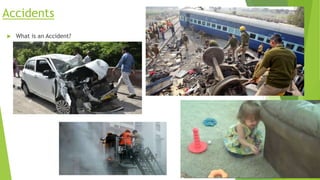
 What is an Accident?
Accident
 An unfortunate incident that happens unexpectedly and
unintentionally, typically resulting in damage or injury.
Types of accidents in hospital:
 Possible type of accidents are included fire, explosion,
electrocution, and gas leaks.
 Undesired effects of electromagnetic fields,
microwaves, laser and vibration.
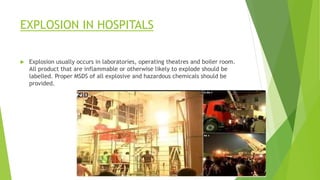
EXPLOSION IN HOSPITALS
 Explosion usually occurs in laboratories, operating theatres and boiler room.
All product that are inflammable or otherwise likely to explode should be
labelled. Proper MSDS of all explosive and hazardous chemicals should be
provided.
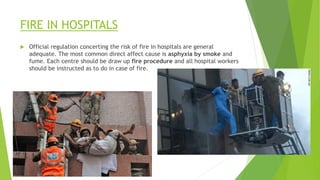
FIRE IN HOSPITALS
 Official regulation concerting the risk of fire in hospitals are general
adequate. The most common direct affect cause is asphyxia by smoke and
fume. Each centre should be draw up fire procedure and all hospital workers
should be instructed as to do in case of fire.
Fire prevention
Fire prevention should Aim to achieve all below statements
 Immediate Detection
 Activate the alarm
 Rescue anyone in the immediate area of the fire
 Isolation
 Extinguish the fire with the proper fire extinguisher
 Every hospital has a specific fire safety plan in the event of a fire emergency.
Be prepared for a fire emergency.
Always!
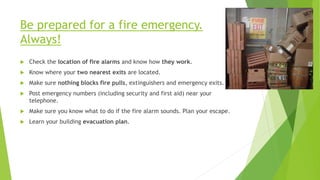
 Check the location of fire alarms and know how they work.
 Know where your two nearest exits are located.
 Make sure nothing blocks fire pulls, extinguishers and emergency exits.
 Post emergency numbers (including security and first aid) near your
telephone.
 Make sure you know what to do if the fire alarm sounds. Plan your escape.
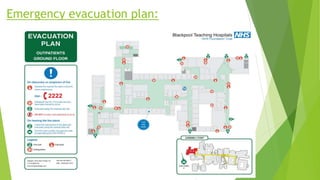
 Learn your building evacuation plan.
Emergency evacuation plan:
Assembly points in case of evacuation.
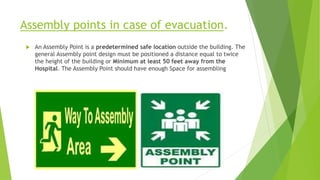
 An Assembly Point is a predetermined safe location outside the building. The
general Assembly point design must be positioned a distance equal to twice
the height of the building or Minimum at least 50 feet away from the
Hospital. The Assembly Point should have enough Space for assembling
Follow the Statement
1. When a fire alarm sounds, proceed to the nearest exit marked by an
exit sign
2. evacuate the building quickly, but do not panic or run ,
3. The designated points should be communicated by the faculty
instructor, staff member, building administrator or other designated
person.
4. Head count should be done, and make sure all person are evacuated,
otherwise make possible step.
5. Never renter the building without instructions from an authorized
designated college authority or the Fire department.
Electrical Accident
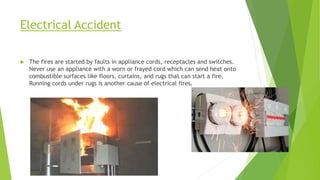
 The fires are started by faults in appliance cords, receptacles and switches.
Never use an appliance with a worn or frayed cord which can send heat onto
combustible surfaces like floors, curtains, and rugs that can start a fire.
Running cords under rugs is another cause of electrical fires.
Possible electric hazards.
 Accident due to Short Circuit
 Accident due to Loose Connections
 Accident due to Overload current
 Accident due to Arcing
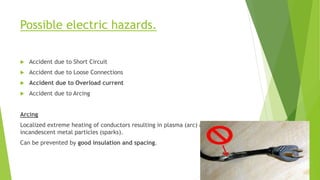
Arcing
Localized extreme heating of conductors resulting in plasma (arc) and
incandescent metal particles (sparks).
Can be prevented by good insulation and spacing.
Other Safety Precaution should taken
1. All Electrical equipment's should have Earthling connection & ELCB
for protect from leakage current.
2. All wire should inspect regularly and all wire should have Indian
Standard.
3. Damage ware should replace immediately.
4. If any electric spark or damage noticeable sudden inform.
5. All electrical wire should not hang on any path.
ELCB and Indian Standard:
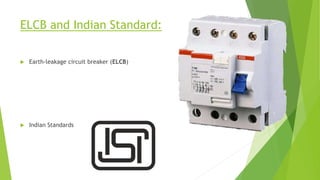
 Earth-leakage circuit breaker (ELCB)
 Indian Standards
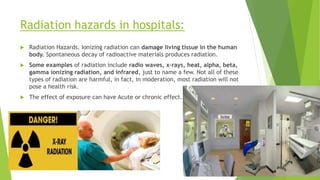
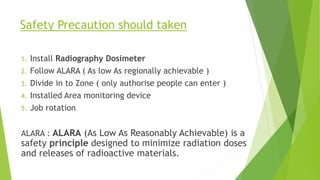
Radiation hazards in hospitals:
 Radiation Hazards. Ionizing radiation can damage living tissue in the human
body. Spontaneous decay of radioactive materials produces radiation.
 Some examples of radiation include radio waves, x-rays, heat, alpha, beta,
gamma ionizing radiation, and infrared, just to name a few. Not all of these
types of radiation are harmful, in fact, in moderation, most radiation will not
pose a health risk.
 The effect of exposure can have Acute or chronic effect.
Safety Precaution should taken
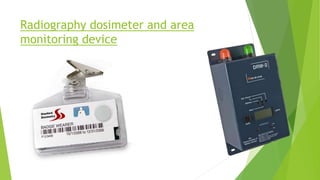
1. Install Radiography Dosimeter
2. Follow ALARA ( As low As regionally achievable )
3. Divide in to Zone ( only authorise people can enter )
4. Installed Area monitoring device
5. Job rotation
ALARA : ALARA (As Low As Reasonably Achievable) is a
safety principle designed to minimize radiation doses
and releases of radioactive materials.
Radiography dosimeter and area
monitoring device
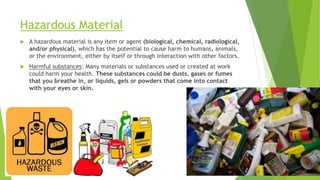
Hazardous Material
 A hazardous material is any item or agent (biological, chemical, radiological,
and/or physical), which has the potential to cause harm to humans, animals,
or the environment, either by itself or through interaction with other factors.
 Harmful substances: Many materials or substances used or created at work
could harm your health. These substances could be dusts, gases or fumes
that you breathe in, or liquids, gels or powders that come into contact
with your eyes or skin.
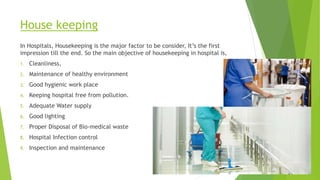
House keeping
In Hospitals, Housekeeping is the major factor to be consider, It’s the first
impression till the end. So the main objective of housekeeping in hospital is,
1. Cleanliness,
2. Maintenance of healthy environment
3. Good hygienic work place
4. Keeping hospital free from pollution.
5. Adequate Water supply
6. Good lighting
7. Proper Disposal of Bio-medical waste
8. Hospital Infection control
9. Inspection and maintenance
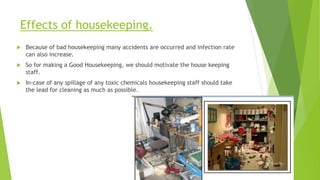
Effects of housekeeping.
 Because of bad housekeeping many accidents are occurred and infection rate
can also increase.
 So for making a Good Housekeeping, we should motivate the house keeping
staff.
 In-case of any spillage of any toxic chemicals housekeeping staff should take
the lead for cleaning as much as possible.
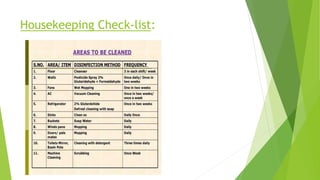
Housekeeping Check-list:
Waste – Management:
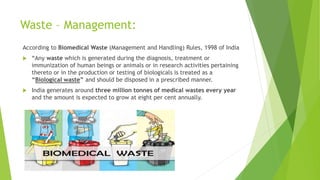
According to Biomedical Waste (Management and Handling) Rules, 1998 of India
 “Any waste which is generated during the diagnosis, treatment or
immunization of human beings or animals or in research activities pertaining
thereto or in the production or testing of biologicals is treated as a
“Biological waste” and should be disposed in a prescribed manner.
 India generates around three million tonnes of medical wastes every year
and the amount is expected to grow at eight per cent annually.
Hospital waste management process
1. Identification of waste types
2. Segregation of waste
3. Transport & storage of waste
4. Proper disposal of waste
5. Implementation of possible future plan
6. Identify the need for use of personal protective equipment
7. [ No untreated bio-medical waste shall be kept stored beyond a
period of 48 hours ]
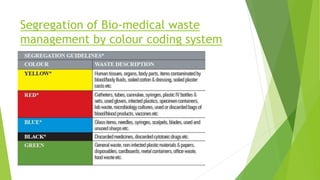
Segregation of Bio-medical waste
management by colour coding system
How does segregation help?
 Segregation reduces the amount of waste needs special handling and treatment
 Effective segregation process prevents the mixture of medical waste like sharps
with the general municipal waste.
 Prevents illegally reuse of certain components of medical waste like used
syringes, needles and other plastics.
 Provides an opportunity for recycling certain components of medical waste
like plastics after proper and thorough disinfection.
 Recycled plastic material can be used for non-food grade applications.
 Of the general waste, the biodegradable waste can be composted within the
hospital premises and can be used for gardening purposes.
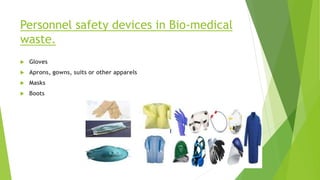
Personnel safety devices in Bio-medical
waste.
 Gloves
 Aprons, gowns, suits or other apparels
 Masks
 Boots
Reference
 Biomedical Waste (Management and Handling) Rules, 1998
 Safe Hospitals in Emergencies and Disasters web optimized
 Wikipedia.com/Hospital+safety
 Safety And Risk Management In Hospitals
 Occupational health and safety in hospitals and health enter
 Patient safety in hospitals
 F.Weibell,"ELECTRICAL SAFETY IN THE HOSPITAL - 1974." Ann. Biomed.
 Eng., vol. 2, pp. 126-148, 1974.
 M. R. Ortiz-Posadas, "Electrical safety priority index for medical equipment,"
Annual International Conference of the IEEE Engineering in Medicine and
Biology - Proceedings, pp. 6614-6617, 2006
Thankyou for your time..!
Shakthi vijay R
Website : www.iiism.com
Facebook: www.facebook.com/iiismbangalore/

Hospital safety

  • 1.
    Hospital Safety Address: #460 B, 4th Phase, Near NTTF Circle, Adjacent to Indian Oil Petrol Pump, Peenya Industrial Area, Bengaluru. Contact Number: 96636 11714 Done by : Shakthi vijay R Guided by : Mr. Anand T.L Professor and Director – IIISM Website : www.iiism.com Facebook: www.facebook.com/iiismbangalore/
  • 2.
    What is aHospital? Known facts:  A Health care institution providing treatment for “Sick and Injured” people.  It is filled with emotions. Unknown Facts:  They work 24/7 i.e. 365 Days a year. Even on all holidays they function without any delay.  Occupational Hazards Involved in hospitals  Accidents which are possible.
  • 3.
    Contents  Accidents inHospitals.  Fire prevention in Hospitals.  Assembly points incase of any emergency situation.  Electrical Accident a) Short Circuit b) Loose Connections c) Overload d) Arcing  Radiation Hazards  House keeping  Inspection & Maintenance  Bio-medical waste management
  • 4.
  • 5.
    Accident  An unfortunateincident that happens unexpectedly and unintentionally, typically resulting in damage or injury. Types of accidents in hospital:  Possible type of accidents are included fire, explosion, electrocution, and gas leaks.  Undesired effects of electromagnetic fields, microwaves, laser and vibration.
  • 6.
    EXPLOSION IN HOSPITALS Explosion usually occurs in laboratories, operating theatres and boiler room. All product that are inflammable or otherwise likely to explode should be labelled. Proper MSDS of all explosive and hazardous chemicals should be provided.
  • 7.
    FIRE IN HOSPITALS Official regulation concerting the risk of fire in hospitals are general adequate. The most common direct affect cause is asphyxia by smoke and fume. Each centre should be draw up fire procedure and all hospital workers should be instructed as to do in case of fire.
  • 8.
    Fire prevention Fire preventionshould Aim to achieve all below statements  Immediate Detection  Activate the alarm  Rescue anyone in the immediate area of the fire  Isolation  Extinguish the fire with the proper fire extinguisher  Every hospital has a specific fire safety plan in the event of a fire emergency.
  • 9.
    Be prepared fora fire emergency. Always!  Check the location of fire alarms and know how they work.  Know where your two nearest exits are located.  Make sure nothing blocks fire pulls, extinguishers and emergency exits.  Post emergency numbers (including security and first aid) near your telephone.  Make sure you know what to do if the fire alarm sounds. Plan your escape.  Learn your building evacuation plan.
  • 10.
  • 11.
    Assembly points incase of evacuation.  An Assembly Point is a predetermined safe location outside the building. The general Assembly point design must be positioned a distance equal to twice the height of the building or Minimum at least 50 feet away from the Hospital. The Assembly Point should have enough Space for assembling
  • 12.
    Follow the Statement 1.When a fire alarm sounds, proceed to the nearest exit marked by an exit sign 2. evacuate the building quickly, but do not panic or run , 3. The designated points should be communicated by the faculty instructor, staff member, building administrator or other designated person. 4. Head count should be done, and make sure all person are evacuated, otherwise make possible step. 5. Never renter the building without instructions from an authorized designated college authority or the Fire department.
  • 13.
    Electrical Accident  Thefires are started by faults in appliance cords, receptacles and switches. Never use an appliance with a worn or frayed cord which can send heat onto combustible surfaces like floors, curtains, and rugs that can start a fire. Running cords under rugs is another cause of electrical fires.
  • 14.
    Possible electric hazards. Accident due to Short Circuit  Accident due to Loose Connections  Accident due to Overload current  Accident due to Arcing Arcing Localized extreme heating of conductors resulting in plasma (arc) and incandescent metal particles (sparks). Can be prevented by good insulation and spacing.
  • 15.
    Other Safety Precautionshould taken 1. All Electrical equipment's should have Earthling connection & ELCB for protect from leakage current. 2. All wire should inspect regularly and all wire should have Indian Standard. 3. Damage ware should replace immediately. 4. If any electric spark or damage noticeable sudden inform. 5. All electrical wire should not hang on any path.
  • 16.
    ELCB and IndianStandard:  Earth-leakage circuit breaker (ELCB)  Indian Standards
  • 17.
    Radiation hazards inhospitals:  Radiation Hazards. Ionizing radiation can damage living tissue in the human body. Spontaneous decay of radioactive materials produces radiation.  Some examples of radiation include radio waves, x-rays, heat, alpha, beta, gamma ionizing radiation, and infrared, just to name a few. Not all of these types of radiation are harmful, in fact, in moderation, most radiation will not pose a health risk.  The effect of exposure can have Acute or chronic effect.
  • 18.
    Safety Precaution shouldtaken 1. Install Radiography Dosimeter 2. Follow ALARA ( As low As regionally achievable ) 3. Divide in to Zone ( only authorise people can enter ) 4. Installed Area monitoring device 5. Job rotation ALARA : ALARA (As Low As Reasonably Achievable) is a safety principle designed to minimize radiation doses and releases of radioactive materials.
  • 19.
    Radiography dosimeter andarea monitoring device
  • 20.
    Hazardous Material  Ahazardous material is any item or agent (biological, chemical, radiological, and/or physical), which has the potential to cause harm to humans, animals, or the environment, either by itself or through interaction with other factors.  Harmful substances: Many materials or substances used or created at work could harm your health. These substances could be dusts, gases or fumes that you breathe in, or liquids, gels or powders that come into contact with your eyes or skin.
  • 21.
    House keeping In Hospitals,Housekeeping is the major factor to be consider, It’s the first impression till the end. So the main objective of housekeeping in hospital is, 1. Cleanliness, 2. Maintenance of healthy environment 3. Good hygienic work place 4. Keeping hospital free from pollution. 5. Adequate Water supply 6. Good lighting 7. Proper Disposal of Bio-medical waste 8. Hospital Infection control 9. Inspection and maintenance
  • 22.
    Effects of housekeeping. Because of bad housekeeping many accidents are occurred and infection rate can also increase.  So for making a Good Housekeeping, we should motivate the house keeping staff.  In-case of any spillage of any toxic chemicals housekeeping staff should take the lead for cleaning as much as possible.
  • 23.
  • 24.
    Waste – Management: Accordingto Biomedical Waste (Management and Handling) Rules, 1998 of India  “Any waste which is generated during the diagnosis, treatment or immunization of human beings or animals or in research activities pertaining thereto or in the production or testing of biologicals is treated as a “Biological waste” and should be disposed in a prescribed manner.  India generates around three million tonnes of medical wastes every year and the amount is expected to grow at eight per cent annually.
  • 25.
    Hospital waste managementprocess 1. Identification of waste types 2. Segregation of waste 3. Transport & storage of waste 4. Proper disposal of waste 5. Implementation of possible future plan 6. Identify the need for use of personal protective equipment 7. [ No untreated bio-medical waste shall be kept stored beyond a period of 48 hours ]
  • 26.
    Segregation of Bio-medicalwaste management by colour coding system
  • 27.
    How does segregationhelp?  Segregation reduces the amount of waste needs special handling and treatment  Effective segregation process prevents the mixture of medical waste like sharps with the general municipal waste.  Prevents illegally reuse of certain components of medical waste like used syringes, needles and other plastics.  Provides an opportunity for recycling certain components of medical waste like plastics after proper and thorough disinfection.  Recycled plastic material can be used for non-food grade applications.  Of the general waste, the biodegradable waste can be composted within the hospital premises and can be used for gardening purposes.
  • 28.
    Personnel safety devicesin Bio-medical waste.  Gloves  Aprons, gowns, suits or other apparels  Masks  Boots
  • 29.
    Reference  Biomedical Waste(Management and Handling) Rules, 1998  Safe Hospitals in Emergencies and Disasters web optimized  Wikipedia.com/Hospital+safety  Safety And Risk Management In Hospitals  Occupational health and safety in hospitals and health enter  Patient safety in hospitals  F.Weibell,"ELECTRICAL SAFETY IN THE HOSPITAL - 1974." Ann. Biomed.  Eng., vol. 2, pp. 126-148, 1974.  M. R. Ortiz-Posadas, "Electrical safety priority index for medical equipment," Annual International Conference of the IEEE Engineering in Medicine and Biology - Proceedings, pp. 6614-6617, 2006
  • 30.
    Thankyou for yourtime..! Shakthi vijay R Website : www.iiism.com Facebook: www.facebook.com/iiismbangalore/