Working Safely in
Health-Care
Job Safety is every
worker’s concern
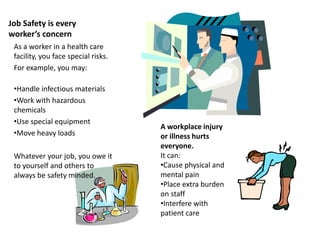
As a worker in a health care
facility, you face special risks.
For example, you may:
•Handle infectious materials
•Work with hazardous
chemicals
•Use special equipment
•Move heavy loads
Whatever your job, you owe it
to yourself and others to
always be safety minded.
A workplace injury
or illness hurts
everyone.
It can:
•Cause physical and
mental pain
•Place extra burden
on staff
•Interfere with
patient care
Safety is a team effort
AMI works to meet various safety standards.
These may include standards set by:
•Federal government – Occupational Safety
and Health Administration (OSHA) and other
agencies regulate workplace safety
•State and local governments (WISHA)
Advanced Medical Imaging values safety.
Help by doing your part.
Work with your supervisor to
make safety your personal
priority – all day, every day.
Doing your job safely is important for
patients , co-workers and you.
Don’t let blood or other body substances touch your skin,
get in your eyes or mouth, or enter your body in any way.
Body substances may contain
disease causing organisms.
These include:
• HBV (the virus that causes hepatitis B)
• HCV(the virus that causes hepatitis C)
• HIV (the virus that causes AIDS).
If you come in contact with infected
substances you can become infected too.
Take precautions with all patients
You can’t always know who is and isn’t
infected.
Follow Universal precautions –
practices recommended by the
•Center for Disease Control (CDC)
•Occupational Safety and Health
Administration (OSHA)
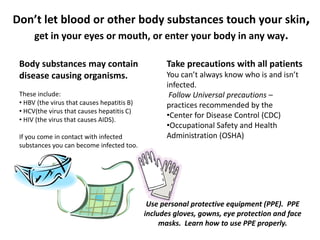
Use personal protective equipment (PPE). PPE
includes gloves, gowns, eye protection and face
masks. Learn how to use PPE properly.
Prevent injuries from sharps
These include safe ways to:
• Store and transport lab samples
• Handle laundry
• Clean up spills
• Dispose of infectious wastes.
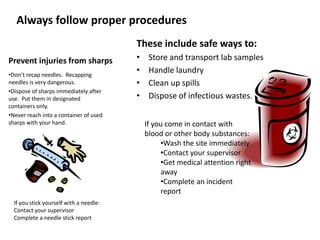
•Don’t recap needles. Recapping
needles is very dangerous.
•Dispose of sharps immediately after
use. Put them in designated
containers only.
•Never reach into a container of used
sharps with your hand. If you come in contact with
blood or other body substances:
•Wash the site immediately
•Contact your supervisor
•Get medical attention right
away
•Complete an incident
report
If you stick yourself with a needle:
Contact your supervisor
Complete a needle stick report
Always follow proper procedures
Be safe with chemicals and other
hazardous materials
Know what you’re working with
• Ask to see a list of the hazardous
chemicals in your workplace.
Read safety information
Read container labels and the
material safety data sheet (MSDS)
for every chemical you work with.
The MSDS list health hazards, fire
dangers, and what PPE to use and
other vital information. If you
have any questions about the
MSDS, ask your supervisor.
Follow safe practices
For example:
•Always use proper PPE
•Follow hand washing rules
•Eat, drink or smoke only where allowed
•If you are pregnant or breast feeding, learn
what special precautions you may need to take
around chemicals, radiation and other potential
hazards.
Help monitor your exposure
Treat spills safely
Never assume you can just mop up a spill
• Remember that different materials may require
different clean up methods
• Know who can handle which kinds of spills
For your own protection, help ensure
that any exposure you have is within
safe limits. For example, you may have
to wear a film badge to monitor
possible radiation exposure.
Know how to handle hazardous
wastes
Know what materials in your work area
are considered hazardous wastes. Learn
safe ways to dispose of, store and
transport them.
Learn:
•Which containers to use
•How to seal and label containers
•How long wastes can be stored, and
at what temperatures.
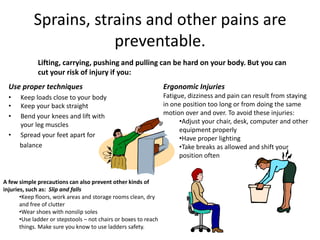
Sprains, strains and other pains are
preventable.
Use proper techniques
• Keep loads close to your body
• Keep your back straight
• Bend your knees and lift with
your leg muscles
• Spread your feet apart for
balance
Lifting, carrying, pushing and pulling can be hard on your body. But you can
cut your risk of injury if you:
A few simple precautions can also prevent other kinds of
injuries, such as: Slip and falls
•Keep floors, work areas and storage rooms clean, dry
and free of clutter
•Wear shoes with nonslip soles
•Use ladder or stepstools – not chairs or boxes to reach
things. Make sure you know to use ladders safety.
Ergonomic Injuries
Fatigue, dizziness and pain can result from staying
in one position too long or from doing the same
motion over and over. To avoid these injuries:
•Adjust your chair, desk, computer and other
equipment properly
•Have proper lighting
•Take breaks as allowed and shift your
position often
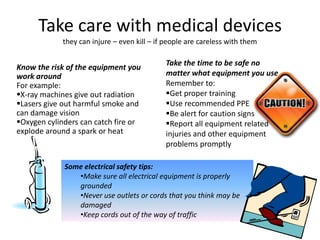
Take care with medical devices
they can injure – even kill – if people are careless with them
Know the risk of the equipment you
work around
For example:
X-ray machines give out radiation
Lasers give out harmful smoke and
can damage vision
Oxygen cylinders can catch fire or
explode around a spark or heat
Take the time to be safe no
matter what equipment you use
Remember to:
Get proper training
Use recommended PPE
Be alert for caution signs
Report all equipment related
injuries and other equipment
problems promptly
Some electrical safety tips:
•Make sure all electrical equipment is properly
grounded
•Never use outlets or cords that you think may be
damaged
•Keep cords out of the way of traffic
Make fire safety your business
Practice good housekeeping
• Loose trash
• Improperly stored chemicals
• Carelessly placed rags etc. can start fires or make them worse
Follow all smoking rules – remind patients and others to do the same
In case of fire, remember R.A.C.E.
Rescue/Remove – move patients and others away
from immediate danger
Alarm – sound the fire alarm
Confine-close doors and windows to help prevent
smoke and fire from spreading
Extinguish-try to put out small fires only – and only if
you are trained and have a clear escape route,
otherwise evacuate.
R
A
E
C
Be prepared for other emergencies
These include:
Storm and power outages
•Learn what your responsibilities are so you
can act quickly
•Take drills seriously. Drills let everyone
practice his or her role.
Bomb threats
If you get a bomb treat call, be calm and
polite. Get information such as:
•When the bomb is going off
•Where is the bomb
•What kind of bomb is it
Alert your supervisor or Administrator right
away. Don’t tell anyone unless instructed.
Violence
Violence can happen
anywhere. To help prevent
violence:
•Treat everyone with
respect
•Watch for rising tempers
and other warnings signs
of violence
•Stay calm if someone is
losing control
Alert security or other staff
as soon as you can do so
safely.
What if an injury or other safety
problem occurs?
Be sure to:
Get medical care, if needed
If you’re not sure whether
you need medical attention,
ask. Don’t delay. Early
treatment can keep many
injuries or illnesses from
getting worse. Report ALL incidents!
These include:
•Injuries, illnesses and
damage to property
•Situations that could have
led to an injury, illness or
damage to property (for
example, a needle left on a
counter, a puddle in the hall
or frayed cord.)
Benefits of reporting
Reporting safety incidents lets you and
your facility work on preventing
incidents by:
•Determining what caused the problem
•Finding safer work practices
•Replacing dangerous equipment
Learn more about job safety
Know your Safety Committee
The committee’s mission is to make AMI a safer
and healthier place to work. For example, the
committee may:
•Help AMI plan how to meet safety goals
•Monitor how well those plans are carried
out
•Provide education to staff and managers
Doing your job well means doing it safely.
The Safety Committee welcomes questions and suggestions.
Consider serving on the
committee!

Safety education

  • 1.
  • 2.
    Job Safety isevery worker’s concern As a worker in a health care facility, you face special risks. For example, you may: •Handle infectious materials •Work with hazardous chemicals •Use special equipment •Move heavy loads Whatever your job, you owe it to yourself and others to always be safety minded. A workplace injury or illness hurts everyone. It can: •Cause physical and mental pain •Place extra burden on staff •Interfere with patient care
  • 3.
    Safety is ateam effort AMI works to meet various safety standards. These may include standards set by: •Federal government – Occupational Safety and Health Administration (OSHA) and other agencies regulate workplace safety •State and local governments (WISHA) Advanced Medical Imaging values safety. Help by doing your part. Work with your supervisor to make safety your personal priority – all day, every day. Doing your job safely is important for patients , co-workers and you.
  • 4.
    Don’t let bloodor other body substances touch your skin, get in your eyes or mouth, or enter your body in any way. Body substances may contain disease causing organisms. These include: • HBV (the virus that causes hepatitis B) • HCV(the virus that causes hepatitis C) • HIV (the virus that causes AIDS). If you come in contact with infected substances you can become infected too. Take precautions with all patients You can’t always know who is and isn’t infected. Follow Universal precautions – practices recommended by the •Center for Disease Control (CDC) •Occupational Safety and Health Administration (OSHA) Use personal protective equipment (PPE). PPE includes gloves, gowns, eye protection and face masks. Learn how to use PPE properly.
  • 5.
    Prevent injuries fromsharps These include safe ways to: • Store and transport lab samples • Handle laundry • Clean up spills • Dispose of infectious wastes. •Don’t recap needles. Recapping needles is very dangerous. •Dispose of sharps immediately after use. Put them in designated containers only. •Never reach into a container of used sharps with your hand. If you come in contact with blood or other body substances: •Wash the site immediately •Contact your supervisor •Get medical attention right away •Complete an incident report If you stick yourself with a needle: Contact your supervisor Complete a needle stick report Always follow proper procedures
  • 6.
    Be safe withchemicals and other hazardous materials Know what you’re working with • Ask to see a list of the hazardous chemicals in your workplace. Read safety information Read container labels and the material safety data sheet (MSDS) for every chemical you work with. The MSDS list health hazards, fire dangers, and what PPE to use and other vital information. If you have any questions about the MSDS, ask your supervisor. Follow safe practices For example: •Always use proper PPE •Follow hand washing rules •Eat, drink or smoke only where allowed •If you are pregnant or breast feeding, learn what special precautions you may need to take around chemicals, radiation and other potential hazards.
  • 7.
    Help monitor yourexposure Treat spills safely Never assume you can just mop up a spill • Remember that different materials may require different clean up methods • Know who can handle which kinds of spills For your own protection, help ensure that any exposure you have is within safe limits. For example, you may have to wear a film badge to monitor possible radiation exposure. Know how to handle hazardous wastes Know what materials in your work area are considered hazardous wastes. Learn safe ways to dispose of, store and transport them. Learn: •Which containers to use •How to seal and label containers •How long wastes can be stored, and at what temperatures.
  • 8.
    Sprains, strains andother pains are preventable. Use proper techniques • Keep loads close to your body • Keep your back straight • Bend your knees and lift with your leg muscles • Spread your feet apart for balance Lifting, carrying, pushing and pulling can be hard on your body. But you can cut your risk of injury if you: A few simple precautions can also prevent other kinds of injuries, such as: Slip and falls •Keep floors, work areas and storage rooms clean, dry and free of clutter •Wear shoes with nonslip soles •Use ladder or stepstools – not chairs or boxes to reach things. Make sure you know to use ladders safety. Ergonomic Injuries Fatigue, dizziness and pain can result from staying in one position too long or from doing the same motion over and over. To avoid these injuries: •Adjust your chair, desk, computer and other equipment properly •Have proper lighting •Take breaks as allowed and shift your position often
  • 9.
    Take care withmedical devices they can injure – even kill – if people are careless with them Know the risk of the equipment you work around For example: X-ray machines give out radiation Lasers give out harmful smoke and can damage vision Oxygen cylinders can catch fire or explode around a spark or heat Take the time to be safe no matter what equipment you use Remember to: Get proper training Use recommended PPE Be alert for caution signs Report all equipment related injuries and other equipment problems promptly Some electrical safety tips: •Make sure all electrical equipment is properly grounded •Never use outlets or cords that you think may be damaged •Keep cords out of the way of traffic
  • 10.
    Make fire safetyyour business Practice good housekeeping • Loose trash • Improperly stored chemicals • Carelessly placed rags etc. can start fires or make them worse Follow all smoking rules – remind patients and others to do the same In case of fire, remember R.A.C.E. Rescue/Remove – move patients and others away from immediate danger Alarm – sound the fire alarm Confine-close doors and windows to help prevent smoke and fire from spreading Extinguish-try to put out small fires only – and only if you are trained and have a clear escape route, otherwise evacuate. R A E C
  • 11.
    Be prepared forother emergencies These include: Storm and power outages •Learn what your responsibilities are so you can act quickly •Take drills seriously. Drills let everyone practice his or her role. Bomb threats If you get a bomb treat call, be calm and polite. Get information such as: •When the bomb is going off •Where is the bomb •What kind of bomb is it Alert your supervisor or Administrator right away. Don’t tell anyone unless instructed. Violence Violence can happen anywhere. To help prevent violence: •Treat everyone with respect •Watch for rising tempers and other warnings signs of violence •Stay calm if someone is losing control Alert security or other staff as soon as you can do so safely.
  • 12.
    What if aninjury or other safety problem occurs? Be sure to: Get medical care, if needed If you’re not sure whether you need medical attention, ask. Don’t delay. Early treatment can keep many injuries or illnesses from getting worse. Report ALL incidents! These include: •Injuries, illnesses and damage to property •Situations that could have led to an injury, illness or damage to property (for example, a needle left on a counter, a puddle in the hall or frayed cord.) Benefits of reporting Reporting safety incidents lets you and your facility work on preventing incidents by: •Determining what caused the problem •Finding safer work practices •Replacing dangerous equipment
  • 13.
    Learn more aboutjob safety Know your Safety Committee The committee’s mission is to make AMI a safer and healthier place to work. For example, the committee may: •Help AMI plan how to meet safety goals •Monitor how well those plans are carried out •Provide education to staff and managers Doing your job well means doing it safely. The Safety Committee welcomes questions and suggestions. Consider serving on the committee!