SAFETY ORIENTATION
CHAPTER # 01
CONTROLS AND
SAFE WORK
PROCEDURES
SAFETY ATTITUDE:
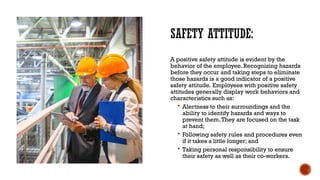
A positive safety attitude is evident by the
behavior of the employee. Recognizing hazards
before they occur and taking steps to eliminate
those hazards is a good indicator of a positive
safety attitude. Employees with positive safety
attitudes generally display work behaviors and
characteristics such as:
 Alertness to their surroundings and the
ability to identify hazards and ways to
prevent them.They are focused on the task
at hand;
 Following safety rules and procedures even
if it takes a little longer; and
 Taking personal responsibility to ensure
their safety as well as their co-workers.
SAFETY ATTITUDE:
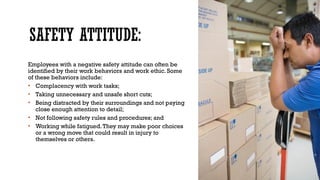
Employees with a negative safety attitude can often be
identified by their work behaviors and work ethic. Some
of these behaviors include:
• Complacency with work tasks;
• Taking unnecessary and unsafe short cuts;
• Being distracted by their surroundings and not paying
close enough attention to detail;
• Not following safety rules and procedures; and
• Working while fatigued.They may make poor choices
or a wrong move that could result in injury to
themselves or others.
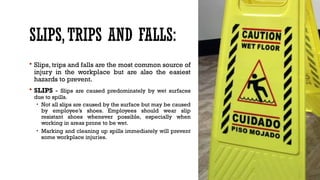
SLIPS,TRIPS AND FALLS:
 Slips, trips and falls are the most common source of
injury in the workplace but are also the easiest
hazards to prevent.
 SLIPS - Slips are caused predominately by wet surfaces
due to spills.
• Not all slips are caused by the surface but may be caused
by employee’s shoes. Employees should wear slip
resistant shoes whenever possible, especially when
working in areas prone to be wet.
• Marking and cleaning up spills immediately will prevent
some workplace injuries.
SLIPS,TRIPS AND
FALLS:
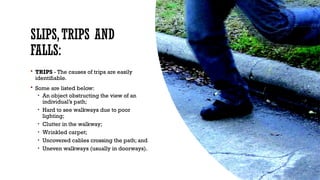
 TRIPS - The causes of trips are easily
identifiable.
 Some are listed below:
• An object obstructing the view of an
individual’s path;
• Hard to see walkways due to poor
lighting;
• Clutter in the walkway;
• Wrinkled carpet;
• Uncovered cables crossing the path; and
• Uneven walkways (usually in doorways).
SLIPS,TRIPS AND
FALLS:
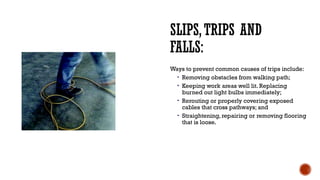
Ways to prevent common causes of trips include:
• Removing obstacles from walking path;
• Keeping work areas well lit. Replacing
burned out light bulbs immediately;
• Rerouting or properly covering exposed
cables that cross pathways; and
• Straightening, repairing or removing flooring
that is loose.
SLIPS,TRIPS AND FALLS:
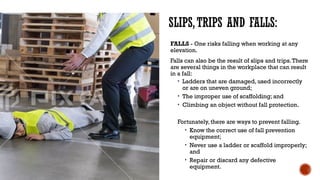
FALLS - One risks falling when working at any
elevation.
Falls can also be the result of slips and trips.There
are several things in the workplace that can result
in a fall:
• Ladders that are damaged, used incorrectly
or are on uneven ground;
• The improper use of scaffolding; and
• Climbing an object without fall protection.
Fortunately, there are ways to prevent falling.
• Know the correct use of fall prevention
equipment;
• Never use a ladder or scaffold improperly;
and
• Repair or discard any defective
equipment.
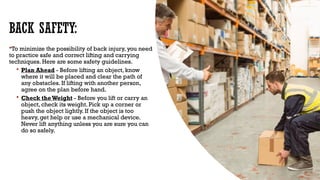
BACK SAFETY:
To minimize the possibility of back injury, you need
to practice safe and correct lifting and carrying
techniques. Here are some safety guidelines.
 Plan Ahead - Before lifting an object, know
where it will be placed and clear the path of
any obstacles. If lifting with another person,
agree on the plan before hand.
 Check theWeight - Before you lift or carry an
object, check its weight. Pick up a corner or
push the object lightly. If the object is too
heavy, get help or use a mechanical device.
Never lift anything unless you are sure you can
do so safely.
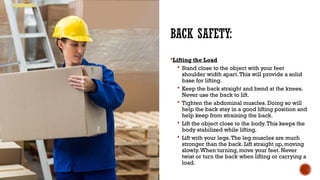
BACK SAFETY:
Lifting the Load
 Stand close to the object with your feet
shoulder width apart.This will provide a solid
base for lifting.
 Keep the back straight and bend at the knees.
Never use the back to lift.
 Tighten the abdominal muscles. Doing so will
help the back stay in a good lifting position and
help keep from straining the back.
 Lift the object close to the body.This keeps the
body stabilized while lifting.
 Lift with your legs.The leg muscles are much
stronger than the back. Lift straight up, moving
slowly.When turning, move your feet. Never
twist or turn the back when lifting or carrying a
load.
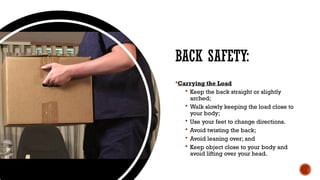
BACK SAFETY:
Carrying the Load
 Keep the back straight or slightly
arched;
 Walk slowly keeping the load close to
your body;
 Use your feet to change directions.
 Avoid twisting the back;
 Avoid leaning over; and
 Keep object close to your body and
avoid lifting over your head.
BACK SAFETY:
Setting the Load Down
 Stand as close as possible to where you
want to set the object;
 Squat down to lower the object using your
legs. Don’t bend at the waist;
 Keep your head up and avoid twisting your
body while setting the object down; and
 Only release the object when it is located
where you want it. To avoid injury don’t
release your grip until the object is
secured.
 Always work with another person when
lifting a heavy object.
 Use special equipment whenever possible
to move items.
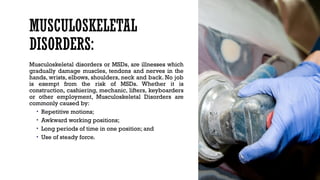
MUSCULOSKELETAL
DISORDERS:
Musculoskeletal disorders or MSDs, are illnesses which
gradually damage muscles, tendons and nerves in the
hands, wrists, elbows, shoulders, neck and back. No job
is exempt from the risk of MSDs. Whether it is
construction, cashiering, mechanic, lifters, keyboarders
or other employment, Musculoskeletal Disorders are
commonly caused by:
• Repetitive motions;
• Awkward working positions;
• Long periods of time in one position; and
• Use of steady force.
MUSCULOSKELETAL DISORDERS:
Many companies use ergonomics to help prevent
Musculoskeletal Disorders. Ergonomics is the science of
designing and arranging items and equipment people use, so the
person and items work together efficiently and safely. Some of
the ways employees can help minimize Musculoskeletal
Disorders are:
 Avoid repetitive motions;
 Alternate positions frequently;
 Take regular breaks;
 Use a power tool instead of a manual tool;
 Keep wrists straight rather than bent or flexed; and
 Adjust chairs for comfort and good posture.
GENERAL SAFETY
RULES
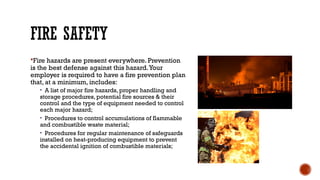
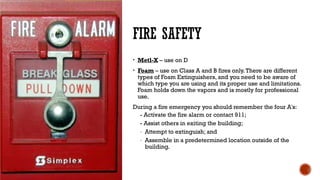
FIRE SAFETY
Fire hazards are present everywhere. Prevention
is the best defense against this hazard.Your
employer is required to have a fire prevention plan
that, at a minimum, includes:
• A list of major fire hazards, proper handling and
storage procedures, potential fire sources & their
control and the type of equipment needed to control
each major hazard;
• Procedures to control accumulations of flammable
and combustible waste material;
• Procedures for regular maintenance of safeguards
installed on heat-producing equipment to prevent
the accidental ignition of combustible materials;
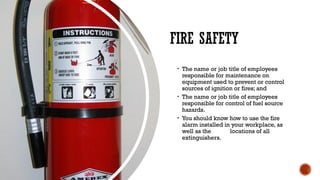
FIRE SAFETY
• The name or job title of employees
responsible for maintenance on
equipment used to prevent or control
sources of ignition or fires; and
• The name or job title of employees
responsible for control of fuel source
hazards.
• You should know how to use the fire
alarm installed in your workplace, as
well as the locations of all
extinguishers.
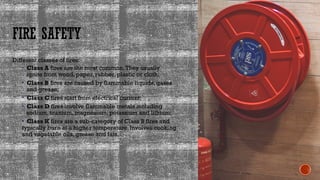
FIRE SAFETY
Different classes of fires:
• Class A fires are the most common.They usually
ignite from wood, paper, rubber, plastic or cloth;
• Class B fires are caused by flammable liquids, gases
and grease;
• Class C fires start from electrical current;
• Class D fires involve flammable metals including
sodium, titanium, magnesium, potassium and lithium;
• Class K fires are a sub-category of Class B fires and
typically burn at a higher temperature. Involves cooking
and vegetable oils, grease and fats.
FIRE SAFETY
Different fires require different extinguishing agents.
• Water - use on Class A only, removes heat
• Dry Chemical - use on A, B or C, inhibits
chemical reaction
• Wet Chemical - developed specifically for use
on Class K fires. Extinguishes fire by forming soapy
foam blanket over burning liquid and cooling
temps to below its ignition point. Can sometimes
be used on Class B and C fires.
• Carbon Dioxide – use on B or C, removes
oxygen from the fire. Ineffective on Class A fires
because the fire can continue to smolder and
possibly reignite. Also, the high-pressure
discharge can cause the burning materials to
scatter with a Class A fire.
•Halogenated or Clean Agent – used mainly on
Class C fires but can also be used on Class A
and B fires, as well.These types of extinguishers
also remove the oxygen from the fire.
FIRE SAFETY
• Metl-X – use on D
• Foam – use on Class A and B fires only.There are different
types of Foam Extinguishers, and you need to be aware of
which type you are using and its proper use and limitations.
Foam holds down the vapors and is mostly for professional
use.
During a fire emergency you should remember the four A's:
- Activate the fire alarm or contact 911;
- Assist others in exiting the building;
- Attempt to extinguish; and
- Assemble in a predetermined location outside of the
building.
FIRE SAFETY
Only attempt to extinguish a fire when:
• The fire is small and contained;
• You are safe from toxic smoke;
• You have a means of escape; and
• Your instincts tell you it is OK.
You must know how to use an extinguisher before attempting
to extinguish a fire. Make sure you are using the correct
extinguisher, or it could actually spread the fire. Use the
PASS system:
• Pull the pin by the handle;
• Aim the hose of the extinguisher at the base of the fire;
• Squeeze the trigger; and
• Sweep from side to side.
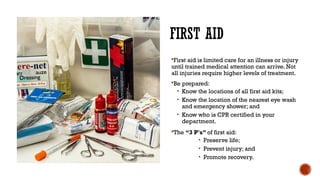
FIRST AID
First aid is limited care for an illness or injury
until trained medical attention can arrive. Not
all injuries require higher levels of treatment.
Be prepared:
• Know the locations of all first aid kits;
• Know the location of the nearest eye wash
and emergency shower; and
• Know who is CPR certified in your
department.
The “3 P's” of first aid:
• Preserve life;
• Prevent injury; and
• Promote recovery.
FIRST AID
Know what to do in an emergency.
• Call for medical help.
• Know the phone number to be contacted.
• Know the type of injury.
• Know the location of victim.
• Check to see if victim is breathing.
• If necessary, move victim from danger.
Report every incident to your employer.The accident will then
be investigated to help prevent it from happening again.
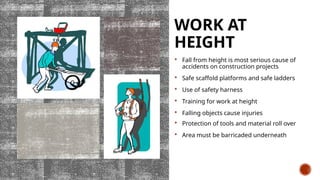
WORK AT
HEIGHT
 Fall from height is most serious cause of
accidents on construction projects
 Safe scaffold platforms and safe ladders
 Use of safety harness
 Training for work at height
 Falling objects cause injuries
 Protection of tools and material roll over
 Area must be barricaded underneath
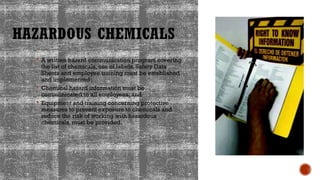
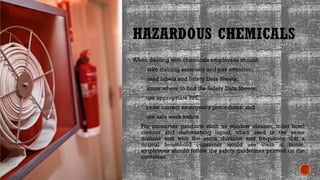
HAZARDOUS CHEMICALS
Chemical exposure may contribute to or cause many serious
health problems and many chemicals are also serious safety
hazards. Employees have a right to understand the hazards
and the identities of the chemicals to which they are exposed.
 The following steps are necessary to ensure the safety of all
employees:
A list of all hazardous chemicals must be kept in the
workplace or at the jobsite and must be kept current;
Safety Data Sheets must be obtained for each hazardous
chemical.The Safety Data Sheet is a standardized, 16-
section, detailed information bulletin prepared by the
manufacturer or importer of a chemical which describes
the chemical;
 Each chemical must be properly labeled;
HAZARDOUS CHEMICALS
 A written hazard communication program covering
the list of chemicals, use of labels, Safety Data
Sheets and employee training must be established
and implemented;
 Chemical hazard information must be
communicated to all employees; and
 Equipment and training concerning protective
measures to prevent exposure to chemicals and
reduce the risk of working with hazardous
chemicals, must be provided.
HAZARDOUS CHEMICALS
 When dealing with chemicals employees should:
 take training seriously and pay attention;
 read labels and Safety Data Sheets;
 know where to find the Safety Data Sheets;
 use appropriate PPE;
 know correct emergency procedures; and
 use safe work habits.
For consumer products such as window cleaner, toilet bowl
cleaner and dishwashing liquid, when used in the same
manner and with the same duration and frequency that a
normal household consumer would use them at home,
employees should follow the safety guidelines printed on the
container.
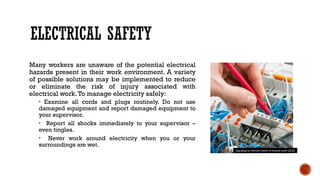
ELECTRICAL SAFETY
Many workers are unaware of the potential electrical
hazards present in their work environment. A variety
of possible solutions may be implemented to reduce
or eliminate the risk of injury associated with
electrical work.To manage electricity safely:
• Examine all cords and plugs routinely. Do not use
damaged equipment and report damaged equipment to
your supervisor.
• Report all shocks immediately to your supervisor –
even tingles.
• Never work around electricity when you or your
surroundings are wet.
This Photo by Unknown Author is licensed under CC BY
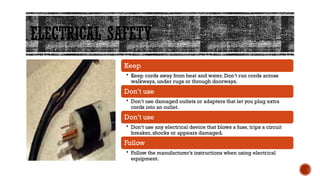
ELECTRICAL SAFETY
Keep
• Keep cords away from heat and water. Don’t run cords across
walkways, under rugs or through doorways.
Don’t use
• Don’t use damaged outlets or adapters that let you plug extra
cords into an outlet.
Don’t use
• Don’t use any electrical device that blows a fuse, trips a circuit
breaker, shocks or appears damaged.
Follow
• Follow the manufacturer’s instructions when using electrical
equipment.
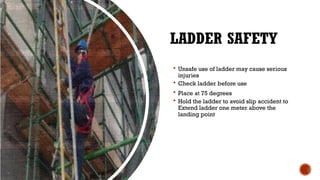
LADDER SAFETY
 Unsafe use of ladder may cause serious
injuries
 Check ladder before use
 Place at 75 degrees
 Hold the ladder to avoid slip accident to
Extend ladder one meter above the
landing point
FEW DO
AND
DON’TS
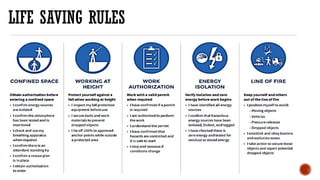
LIFE SAVING RULES
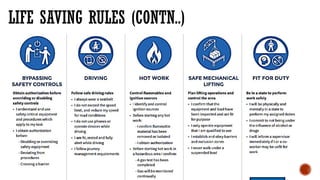
LIFE SAVING RULES (CONTN..)
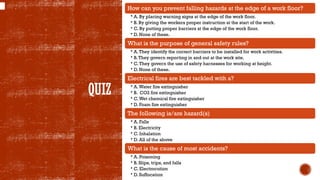
QUIZ
How can you prevent falling hazards at the edge of a work floor?
• A. By placing warning signs at the edge of the work floor.
• B. By giving the workers proper instruction at the start of the work.
• C. By putting proper barriers at the edge of the work floor.
• D. None of these.
What is the purpose of general safety rules?
• A.They identify the correct barriers to be installed for work activities.
• B.They govern reporting in and out at the work site.
• C.They govern the use of safety harnesses for working at height.
• D. None of these.
Electrical fires are best tackled with a?
• A.Water fire extinguisher
• B. CO2 fire extinguisher
• C.Wet chemical fire extinguisher
• D. Foam fire extinguisher
The following is/are hazard(s)
• A. Falls
• B. Electricity
• C. Inhalation
• D. All of the above
What is the cause of most accidents?
• A. Poisoning
• B. Slips, trips, and falls
• C. Electrocution
• D. Suffocation

Saftey Orientation Training Certificate.

  • 1.
  • 2.
  • 3.
    SAFETY ATTITUDE: A positivesafety attitude is evident by the behavior of the employee. Recognizing hazards before they occur and taking steps to eliminate those hazards is a good indicator of a positive safety attitude. Employees with positive safety attitudes generally display work behaviors and characteristics such as:  Alertness to their surroundings and the ability to identify hazards and ways to prevent them.They are focused on the task at hand;  Following safety rules and procedures even if it takes a little longer; and  Taking personal responsibility to ensure their safety as well as their co-workers.
  • 4.
    SAFETY ATTITUDE: Employees witha negative safety attitude can often be identified by their work behaviors and work ethic. Some of these behaviors include: • Complacency with work tasks; • Taking unnecessary and unsafe short cuts; • Being distracted by their surroundings and not paying close enough attention to detail; • Not following safety rules and procedures; and • Working while fatigued.They may make poor choices or a wrong move that could result in injury to themselves or others.
  • 5.
    SLIPS,TRIPS AND FALLS: Slips, trips and falls are the most common source of injury in the workplace but are also the easiest hazards to prevent.  SLIPS - Slips are caused predominately by wet surfaces due to spills. • Not all slips are caused by the surface but may be caused by employee’s shoes. Employees should wear slip resistant shoes whenever possible, especially when working in areas prone to be wet. • Marking and cleaning up spills immediately will prevent some workplace injuries.
  • 6.
    SLIPS,TRIPS AND FALLS:  TRIPS- The causes of trips are easily identifiable.  Some are listed below: • An object obstructing the view of an individual’s path; • Hard to see walkways due to poor lighting; • Clutter in the walkway; • Wrinkled carpet; • Uncovered cables crossing the path; and • Uneven walkways (usually in doorways).
  • 7.
    SLIPS,TRIPS AND FALLS: Ways toprevent common causes of trips include: • Removing obstacles from walking path; • Keeping work areas well lit. Replacing burned out light bulbs immediately; • Rerouting or properly covering exposed cables that cross pathways; and • Straightening, repairing or removing flooring that is loose.
  • 8.
    SLIPS,TRIPS AND FALLS: FALLS- One risks falling when working at any elevation. Falls can also be the result of slips and trips.There are several things in the workplace that can result in a fall: • Ladders that are damaged, used incorrectly or are on uneven ground; • The improper use of scaffolding; and • Climbing an object without fall protection. Fortunately, there are ways to prevent falling. • Know the correct use of fall prevention equipment; • Never use a ladder or scaffold improperly; and • Repair or discard any defective equipment.
  • 9.
    BACK SAFETY: To minimizethe possibility of back injury, you need to practice safe and correct lifting and carrying techniques. Here are some safety guidelines.  Plan Ahead - Before lifting an object, know where it will be placed and clear the path of any obstacles. If lifting with another person, agree on the plan before hand.  Check theWeight - Before you lift or carry an object, check its weight. Pick up a corner or push the object lightly. If the object is too heavy, get help or use a mechanical device. Never lift anything unless you are sure you can do so safely.
  • 10.
    BACK SAFETY: Lifting theLoad  Stand close to the object with your feet shoulder width apart.This will provide a solid base for lifting.  Keep the back straight and bend at the knees. Never use the back to lift.  Tighten the abdominal muscles. Doing so will help the back stay in a good lifting position and help keep from straining the back.  Lift the object close to the body.This keeps the body stabilized while lifting.  Lift with your legs.The leg muscles are much stronger than the back. Lift straight up, moving slowly.When turning, move your feet. Never twist or turn the back when lifting or carrying a load.
  • 11.
    BACK SAFETY: Carrying theLoad  Keep the back straight or slightly arched;  Walk slowly keeping the load close to your body;  Use your feet to change directions.  Avoid twisting the back;  Avoid leaning over; and  Keep object close to your body and avoid lifting over your head.
  • 12.
    BACK SAFETY: Setting theLoad Down  Stand as close as possible to where you want to set the object;  Squat down to lower the object using your legs. Don’t bend at the waist;  Keep your head up and avoid twisting your body while setting the object down; and  Only release the object when it is located where you want it. To avoid injury don’t release your grip until the object is secured.  Always work with another person when lifting a heavy object.  Use special equipment whenever possible to move items.
  • 13.
    MUSCULOSKELETAL DISORDERS: Musculoskeletal disorders orMSDs, are illnesses which gradually damage muscles, tendons and nerves in the hands, wrists, elbows, shoulders, neck and back. No job is exempt from the risk of MSDs. Whether it is construction, cashiering, mechanic, lifters, keyboarders or other employment, Musculoskeletal Disorders are commonly caused by: • Repetitive motions; • Awkward working positions; • Long periods of time in one position; and • Use of steady force.
  • 14.
    MUSCULOSKELETAL DISORDERS: Many companiesuse ergonomics to help prevent Musculoskeletal Disorders. Ergonomics is the science of designing and arranging items and equipment people use, so the person and items work together efficiently and safely. Some of the ways employees can help minimize Musculoskeletal Disorders are:  Avoid repetitive motions;  Alternate positions frequently;  Take regular breaks;  Use a power tool instead of a manual tool;  Keep wrists straight rather than bent or flexed; and  Adjust chairs for comfort and good posture.
  • 15.
  • 16.
    FIRE SAFETY Fire hazardsare present everywhere. Prevention is the best defense against this hazard.Your employer is required to have a fire prevention plan that, at a minimum, includes: • A list of major fire hazards, proper handling and storage procedures, potential fire sources & their control and the type of equipment needed to control each major hazard; • Procedures to control accumulations of flammable and combustible waste material; • Procedures for regular maintenance of safeguards installed on heat-producing equipment to prevent the accidental ignition of combustible materials;
  • 17.
    FIRE SAFETY • Thename or job title of employees responsible for maintenance on equipment used to prevent or control sources of ignition or fires; and • The name or job title of employees responsible for control of fuel source hazards. • You should know how to use the fire alarm installed in your workplace, as well as the locations of all extinguishers.
  • 18.
    FIRE SAFETY Different classesof fires: • Class A fires are the most common.They usually ignite from wood, paper, rubber, plastic or cloth; • Class B fires are caused by flammable liquids, gases and grease; • Class C fires start from electrical current; • Class D fires involve flammable metals including sodium, titanium, magnesium, potassium and lithium; • Class K fires are a sub-category of Class B fires and typically burn at a higher temperature. Involves cooking and vegetable oils, grease and fats.
  • 19.
    FIRE SAFETY Different firesrequire different extinguishing agents. • Water - use on Class A only, removes heat • Dry Chemical - use on A, B or C, inhibits chemical reaction • Wet Chemical - developed specifically for use on Class K fires. Extinguishes fire by forming soapy foam blanket over burning liquid and cooling temps to below its ignition point. Can sometimes be used on Class B and C fires. • Carbon Dioxide – use on B or C, removes oxygen from the fire. Ineffective on Class A fires because the fire can continue to smolder and possibly reignite. Also, the high-pressure discharge can cause the burning materials to scatter with a Class A fire. •Halogenated or Clean Agent – used mainly on Class C fires but can also be used on Class A and B fires, as well.These types of extinguishers also remove the oxygen from the fire.
  • 20.
    FIRE SAFETY • Metl-X– use on D • Foam – use on Class A and B fires only.There are different types of Foam Extinguishers, and you need to be aware of which type you are using and its proper use and limitations. Foam holds down the vapors and is mostly for professional use. During a fire emergency you should remember the four A's: - Activate the fire alarm or contact 911; - Assist others in exiting the building; - Attempt to extinguish; and - Assemble in a predetermined location outside of the building.
  • 21.
    FIRE SAFETY Only attemptto extinguish a fire when: • The fire is small and contained; • You are safe from toxic smoke; • You have a means of escape; and • Your instincts tell you it is OK. You must know how to use an extinguisher before attempting to extinguish a fire. Make sure you are using the correct extinguisher, or it could actually spread the fire. Use the PASS system: • Pull the pin by the handle; • Aim the hose of the extinguisher at the base of the fire; • Squeeze the trigger; and • Sweep from side to side.
  • 22.
    FIRST AID First aidis limited care for an illness or injury until trained medical attention can arrive. Not all injuries require higher levels of treatment. Be prepared: • Know the locations of all first aid kits; • Know the location of the nearest eye wash and emergency shower; and • Know who is CPR certified in your department. The “3 P's” of first aid: • Preserve life; • Prevent injury; and • Promote recovery.
  • 23.
    FIRST AID Know whatto do in an emergency. • Call for medical help. • Know the phone number to be contacted. • Know the type of injury. • Know the location of victim. • Check to see if victim is breathing. • If necessary, move victim from danger. Report every incident to your employer.The accident will then be investigated to help prevent it from happening again.
  • 24.
    WORK AT HEIGHT  Fallfrom height is most serious cause of accidents on construction projects  Safe scaffold platforms and safe ladders  Use of safety harness  Training for work at height  Falling objects cause injuries  Protection of tools and material roll over  Area must be barricaded underneath
  • 25.
    HAZARDOUS CHEMICALS Chemical exposuremay contribute to or cause many serious health problems and many chemicals are also serious safety hazards. Employees have a right to understand the hazards and the identities of the chemicals to which they are exposed.  The following steps are necessary to ensure the safety of all employees: A list of all hazardous chemicals must be kept in the workplace or at the jobsite and must be kept current; Safety Data Sheets must be obtained for each hazardous chemical.The Safety Data Sheet is a standardized, 16- section, detailed information bulletin prepared by the manufacturer or importer of a chemical which describes the chemical;  Each chemical must be properly labeled;
  • 26.
    HAZARDOUS CHEMICALS  Awritten hazard communication program covering the list of chemicals, use of labels, Safety Data Sheets and employee training must be established and implemented;  Chemical hazard information must be communicated to all employees; and  Equipment and training concerning protective measures to prevent exposure to chemicals and reduce the risk of working with hazardous chemicals, must be provided.
  • 27.
    HAZARDOUS CHEMICALS  Whendealing with chemicals employees should:  take training seriously and pay attention;  read labels and Safety Data Sheets;  know where to find the Safety Data Sheets;  use appropriate PPE;  know correct emergency procedures; and  use safe work habits. For consumer products such as window cleaner, toilet bowl cleaner and dishwashing liquid, when used in the same manner and with the same duration and frequency that a normal household consumer would use them at home, employees should follow the safety guidelines printed on the container.
  • 28.
    ELECTRICAL SAFETY Many workersare unaware of the potential electrical hazards present in their work environment. A variety of possible solutions may be implemented to reduce or eliminate the risk of injury associated with electrical work.To manage electricity safely: • Examine all cords and plugs routinely. Do not use damaged equipment and report damaged equipment to your supervisor. • Report all shocks immediately to your supervisor – even tingles. • Never work around electricity when you or your surroundings are wet. This Photo by Unknown Author is licensed under CC BY
  • 29.
    ELECTRICAL SAFETY Keep • Keepcords away from heat and water. Don’t run cords across walkways, under rugs or through doorways. Don’t use • Don’t use damaged outlets or adapters that let you plug extra cords into an outlet. Don’t use • Don’t use any electrical device that blows a fuse, trips a circuit breaker, shocks or appears damaged. Follow • Follow the manufacturer’s instructions when using electrical equipment.
  • 30.
    LADDER SAFETY  Unsafeuse of ladder may cause serious injuries  Check ladder before use  Place at 75 degrees  Hold the ladder to avoid slip accident to Extend ladder one meter above the landing point
  • 31.
  • 32.
  • 33.
  • 34.
    QUIZ How can youprevent falling hazards at the edge of a work floor? • A. By placing warning signs at the edge of the work floor. • B. By giving the workers proper instruction at the start of the work. • C. By putting proper barriers at the edge of the work floor. • D. None of these. What is the purpose of general safety rules? • A.They identify the correct barriers to be installed for work activities. • B.They govern reporting in and out at the work site. • C.They govern the use of safety harnesses for working at height. • D. None of these. Electrical fires are best tackled with a? • A.Water fire extinguisher • B. CO2 fire extinguisher • C.Wet chemical fire extinguisher • D. Foam fire extinguisher The following is/are hazard(s) • A. Falls • B. Electricity • C. Inhalation • D. All of the above What is the cause of most accidents? • A. Poisoning • B. Slips, trips, and falls • C. Electrocution • D. Suffocation