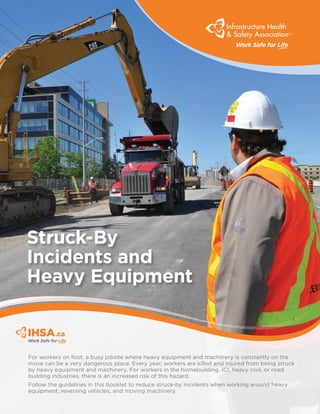
Struck-By
Incidents and
Heavy Equipment
For workers on foot, a busy jobsite where heavy equipment and machinery is constantly on the
move can be a very dangerous place. Every year, workers are killed and injured from being struck
by heavy equipment and machinery. For workers in the homebuilding, ICI, heavy civil, or road
building industries, there is an increased risk of this hazard.
Follow the guidelines in this booklet to reduce struck-by incidents when working around heavy
equipment, reversing vehicles, and moving machinery.
1.	 Avoid Operating Vehicles in Reverse
	 If workers are not restricted to certain safe work areas and are freely
moving around a jobsite, the potential for a struck-by incident increases
greatly, especially in congested areas where vehicles and equipment are
backing up. The main problem is that there are blind spots around the
equipment where the operator cannot see. In addition, the noise made by
vehicles and equipment makes it difficult to hear or be heard and dust can
make it difficult to see or be seen.
	 Section 104 of the Regulations for Construction Projects (O.Reg. 213/91)
requires that a construction project be planned and organized so that
vehicles, machines, and equipment are not operated in reverse (or
operated in reverse as little as possible) and only when there is no practical
alternative to doing so.
2.	 Use a Signaller (Spotter)
	 Section 104 also requires that if vehicles must operate in reverse and there
is a potential for injury to workers, the operator shall be assisted by a
signaller. The operator and the signaller must jointly establish procedures
for communication such as traffic control hand signals (Figure 1) and follow
those procedures. In addition, signs shall be posted in conspicuous areas to
warn workers of the danger.
	 Section 106 requires that the signaller be a competent worker, not perform
other work while acting as a signaller, wear the proper high-visibility
clothing, and receive adequate oral instructions and training.
	 A signaller or spotter is another set of eyes for the equipment operator.
However, often the spotter is the worker most in danger of being struck by
moving equipment. Workers who are designated as spotters should stand
where equipment operators can see them at all times and have a full view of
the intended path of travel. They must not only stay out of the path of the
vehicle they are signalling for but also be aware of other moving machinery
in the area.
Figure 1: Traffic Control Hand Signals
2
3. Avoid Blind Spots
Every worker on the jobsite should know where the blind spots are located
on different types of vehicles and equipment (Figure 2). If workers know
where the blind spots are, they can avoid them. A good practice is to
maintain eye contact with a driver or operator when working near heavy
equipment. If you can see them, they should be able to see you.
If you are the signaller or spotter, concentrate on the task at hand and do
not perform any other duties. Signalling requires your full attention. Losing
your focus around heavy equipment could cost you your life.
4. Use Warning Devices or Detection Systems
Section 105 of the construction regulations requires that dump trucks be
equipped with an automatic audible alarm that signals when they are being
operated in reverse. However, other technologies have been developed to
help reduce the number of struck-by incidents from vehicles backing up.
When used in conjunction with a signaller, as required under section 104,
these technologies can prevent injuries and fatalities from reversing vehicles.
Radar systems are designed to monitor the rear blind spots behind the vehicle.
When the vehicle is operating in reverse, they send out electronic pulses that
detect objects behind the vehicle near the radar beam and warn the operator.
These types of systems can be effective. However, the system will detect
anything behind the vehicle, even if it’s not a hazard. These “false positives” may
cause the operator to ignore the alarm if it goes off too many times.
Radio frequency detection systems send out a signal from an antenna
mounted on the back of the equipment. This signal detects personnel wearing
safety vests and hard hats that have been equipped with radio frequency
identification (RFID) tags. When a worker enters the transmitting area of the
antenna, a signal is sent to a display unit installed in the cab and an alarm
sounds to warn the operator that there is a worker behind them. While there
are obvious benefits to this type of automated system, one limitation is that
the operator may not be able to react in time to stop the vehicle once the
alarm sounds. Another limitation is that the system only works if people on the
jobsite wear RFID-tagged vests or hard hats (Figure 3).
Rear-view camera and monitor systems use cameras that are mounted on
the rear of the vehicle with a monitor in the cab. When the operator reverses
the vehicle, the camera provides the operator with a clear view of the blind
spot behind the vehicle by displaying it on the monitor. One of the limitations
of these types of systems is that the camera must be clean. Another
limitation is that the system relies on the operator to look at the monitor.
5. Look Out for Overhead Powerlines
Although not a typical struck-by incident, contact with overhead powerlines
has been a major cause of fatalities and critical injuries in construction.
These types of incidents usually involve heavy equipment such as backhoes,
dump trucks, boom trucks, cranes, and excavators.
A competent worker, designated as a signaller or spotter, must be used
if equipment is operated near a powerline and any part of the equipment
(e.g., a boom) or its load could approach the minimum allowable distance to
an energized overhead electrical conductor (Table 1). The signaller must be
in full view of the operator and have a clear view of the powerline.
In addition, the constructor must develop written procedures to ensure that
no part of a vehicle or its load encroaches on the minimum distance. These
procedures shall include warning devices and signs, and they must be
communicated to every employer and worker on the project.
Struck-By Incidents and Heavy Equipment
Figure 2: Blind Spots Around
Equipment
Never store materials and equipment
below overhead powerlines.
Table 1: Minimum Distances to Powerlines
Source: O. Reg. 213/91, s. 188
Voltage Rating Minimum Distance
750 to 150,000 volts 3 metres (10 feet)
150,000 to 250,000 volts 4.5 metres (15 feet)
More than 250,000 volts 6 metres (20 feet)
Figure 3: Components of a Radio
Frequency Detection System
3
6.	 Develop Safe Work Procedures
	 Before work begins, management must ensure that the work has been
planned and there is an effective method or system to identify and control
or eliminate hazards. Completing a job safety analysis (JSA), sometimes
called a job hazard analysis (JHA), is a good way to ensure that the
preplanning has been done and that safe work procedures have been put
in place to allow workers to do their job tasks safely.
	 In addition, section 67 (4) of the Regulations for Construction Projects
(O.Reg. 213/91) requires that employers develop and implement a written
traffic protection plan if workers are exposed to hazards from vehicular traffic.
	 It is important that workers understand and be trained on these safe
work plans and procedures. Employers should create a health and safety
policy for their company on working on or near heavy equipment and
communicate it to all workers. This health and safety policy should include
any requirements included in the legislation as well as some best practices.
	 Best practices
	 Include such best practices as those listed below in your health and safety policy:
	 Legislative requirements
	 Include these relevant sections from the construction regulations in your
health and safety policy:
•	 Facilitate drive-through operations wherever possible.
•	 Post warning signs to remind workers and operators of potential hazards.
•	 Level off the work area if possible. In areas where there are grade changes,
use a signaller if the operator’s view is limited or obstructed.
•	 Section 96 (1) requires that no worker operate a
vehicle at a project unless competent to do so.
•	 Section 102 requires that no operator leave the
controls of vehicles or equipment unattended
such as:
•	 a front-end loader, backhoe, or other
excavating machine with its bucket raised
•	 a bulldozer with its blade raised
•	 a lift truck with its forks raised
•	 a crane or other hoisting device with its 	
load raised.
A publication of the Civil Engineering Sector 	
Labour-Management Health and Safety Committee	
in partnership with IHSA
Make safety work
for you. IHSA is
your first step.
Find out what we
can do for you at ihsa.ca
IHSA046
Traffic Control and Backing
Vehicles Awareness Course
(1/2 day)
Learn about vehicle traffic hazards
and how to establish effective
procedures and control options.
Handbook for
Construction
Traffic Control
Persons (B016)
Order this pocket-
sized booklet to
help TCPs learn the
signals, signs, and
traffic designs for
safe traffic control.
Hand Signals Cards
Order these
pocket-sized
cards to ensure
operators and
spotters follow
the same signals.
•	 Traffic Control (V006)
•	 Hoisting Operations (V002)
•	 Excavators (V015)
•	 Ready-Mix Driver and Concrete
Pumping (V007)
•	 Pile Driving (V008)
•	 Variable Reach Lift Trucks (V014)
© Infrastructure Health and Safety Association
April 2015

IHSA046.pdf

  • 1.
    Struck-By Incidents and Heavy Equipment Forworkers on foot, a busy jobsite where heavy equipment and machinery is constantly on the move can be a very dangerous place. Every year, workers are killed and injured from being struck by heavy equipment and machinery. For workers in the homebuilding, ICI, heavy civil, or road building industries, there is an increased risk of this hazard. Follow the guidelines in this booklet to reduce struck-by incidents when working around heavy equipment, reversing vehicles, and moving machinery.
  • 2.
    1. Avoid OperatingVehicles in Reverse If workers are not restricted to certain safe work areas and are freely moving around a jobsite, the potential for a struck-by incident increases greatly, especially in congested areas where vehicles and equipment are backing up. The main problem is that there are blind spots around the equipment where the operator cannot see. In addition, the noise made by vehicles and equipment makes it difficult to hear or be heard and dust can make it difficult to see or be seen. Section 104 of the Regulations for Construction Projects (O.Reg. 213/91) requires that a construction project be planned and organized so that vehicles, machines, and equipment are not operated in reverse (or operated in reverse as little as possible) and only when there is no practical alternative to doing so. 2. Use a Signaller (Spotter) Section 104 also requires that if vehicles must operate in reverse and there is a potential for injury to workers, the operator shall be assisted by a signaller. The operator and the signaller must jointly establish procedures for communication such as traffic control hand signals (Figure 1) and follow those procedures. In addition, signs shall be posted in conspicuous areas to warn workers of the danger. Section 106 requires that the signaller be a competent worker, not perform other work while acting as a signaller, wear the proper high-visibility clothing, and receive adequate oral instructions and training. A signaller or spotter is another set of eyes for the equipment operator. However, often the spotter is the worker most in danger of being struck by moving equipment. Workers who are designated as spotters should stand where equipment operators can see them at all times and have a full view of the intended path of travel. They must not only stay out of the path of the vehicle they are signalling for but also be aware of other moving machinery in the area. Figure 1: Traffic Control Hand Signals 2
  • 3.
    3. Avoid BlindSpots Every worker on the jobsite should know where the blind spots are located on different types of vehicles and equipment (Figure 2). If workers know where the blind spots are, they can avoid them. A good practice is to maintain eye contact with a driver or operator when working near heavy equipment. If you can see them, they should be able to see you. If you are the signaller or spotter, concentrate on the task at hand and do not perform any other duties. Signalling requires your full attention. Losing your focus around heavy equipment could cost you your life. 4. Use Warning Devices or Detection Systems Section 105 of the construction regulations requires that dump trucks be equipped with an automatic audible alarm that signals when they are being operated in reverse. However, other technologies have been developed to help reduce the number of struck-by incidents from vehicles backing up. When used in conjunction with a signaller, as required under section 104, these technologies can prevent injuries and fatalities from reversing vehicles. Radar systems are designed to monitor the rear blind spots behind the vehicle. When the vehicle is operating in reverse, they send out electronic pulses that detect objects behind the vehicle near the radar beam and warn the operator. These types of systems can be effective. However, the system will detect anything behind the vehicle, even if it’s not a hazard. These “false positives” may cause the operator to ignore the alarm if it goes off too many times. Radio frequency detection systems send out a signal from an antenna mounted on the back of the equipment. This signal detects personnel wearing safety vests and hard hats that have been equipped with radio frequency identification (RFID) tags. When a worker enters the transmitting area of the antenna, a signal is sent to a display unit installed in the cab and an alarm sounds to warn the operator that there is a worker behind them. While there are obvious benefits to this type of automated system, one limitation is that the operator may not be able to react in time to stop the vehicle once the alarm sounds. Another limitation is that the system only works if people on the jobsite wear RFID-tagged vests or hard hats (Figure 3). Rear-view camera and monitor systems use cameras that are mounted on the rear of the vehicle with a monitor in the cab. When the operator reverses the vehicle, the camera provides the operator with a clear view of the blind spot behind the vehicle by displaying it on the monitor. One of the limitations of these types of systems is that the camera must be clean. Another limitation is that the system relies on the operator to look at the monitor. 5. Look Out for Overhead Powerlines Although not a typical struck-by incident, contact with overhead powerlines has been a major cause of fatalities and critical injuries in construction. These types of incidents usually involve heavy equipment such as backhoes, dump trucks, boom trucks, cranes, and excavators. A competent worker, designated as a signaller or spotter, must be used if equipment is operated near a powerline and any part of the equipment (e.g., a boom) or its load could approach the minimum allowable distance to an energized overhead electrical conductor (Table 1). The signaller must be in full view of the operator and have a clear view of the powerline. In addition, the constructor must develop written procedures to ensure that no part of a vehicle or its load encroaches on the minimum distance. These procedures shall include warning devices and signs, and they must be communicated to every employer and worker on the project. Struck-By Incidents and Heavy Equipment Figure 2: Blind Spots Around Equipment Never store materials and equipment below overhead powerlines. Table 1: Minimum Distances to Powerlines Source: O. Reg. 213/91, s. 188 Voltage Rating Minimum Distance 750 to 150,000 volts 3 metres (10 feet) 150,000 to 250,000 volts 4.5 metres (15 feet) More than 250,000 volts 6 metres (20 feet) Figure 3: Components of a Radio Frequency Detection System 3
  • 4.
    6. Develop SafeWork Procedures Before work begins, management must ensure that the work has been planned and there is an effective method or system to identify and control or eliminate hazards. Completing a job safety analysis (JSA), sometimes called a job hazard analysis (JHA), is a good way to ensure that the preplanning has been done and that safe work procedures have been put in place to allow workers to do their job tasks safely. In addition, section 67 (4) of the Regulations for Construction Projects (O.Reg. 213/91) requires that employers develop and implement a written traffic protection plan if workers are exposed to hazards from vehicular traffic. It is important that workers understand and be trained on these safe work plans and procedures. Employers should create a health and safety policy for their company on working on or near heavy equipment and communicate it to all workers. This health and safety policy should include any requirements included in the legislation as well as some best practices. Best practices Include such best practices as those listed below in your health and safety policy: Legislative requirements Include these relevant sections from the construction regulations in your health and safety policy: • Facilitate drive-through operations wherever possible. • Post warning signs to remind workers and operators of potential hazards. • Level off the work area if possible. In areas where there are grade changes, use a signaller if the operator’s view is limited or obstructed. • Section 96 (1) requires that no worker operate a vehicle at a project unless competent to do so. • Section 102 requires that no operator leave the controls of vehicles or equipment unattended such as: • a front-end loader, backhoe, or other excavating machine with its bucket raised • a bulldozer with its blade raised • a lift truck with its forks raised • a crane or other hoisting device with its load raised. A publication of the Civil Engineering Sector Labour-Management Health and Safety Committee in partnership with IHSA Make safety work for you. IHSA is your first step. Find out what we can do for you at ihsa.ca IHSA046 Traffic Control and Backing Vehicles Awareness Course (1/2 day) Learn about vehicle traffic hazards and how to establish effective procedures and control options. Handbook for Construction Traffic Control Persons (B016) Order this pocket- sized booklet to help TCPs learn the signals, signs, and traffic designs for safe traffic control. Hand Signals Cards Order these pocket-sized cards to ensure operators and spotters follow the same signals. • Traffic Control (V006) • Hoisting Operations (V002) • Excavators (V015) • Ready-Mix Driver and Concrete Pumping (V007) • Pile Driving (V008) • Variable Reach Lift Trucks (V014) © Infrastructure Health and Safety Association April 2015