MICHAEL BOWEN OIL AND GAS
1 General
1.1 Purpose: recommend practices and procedures for
promotion and maintenance of safe working
conditions for personnel engaged in drilling
operations and well servicing operations, including
special services
1 General
1.2 Scope: rotary drilling rigs, well servicing rigs,
special services
Operations on location
Not seismic or water well drilling
Not site preparation or site abandonment
1.3 Responsibility:
Each employer trains own employees
Operator and contractor share information
Immediate supervision of authorized person with
authority to commence, modify, cease or improve
2 References
API standards
ACGIH TLVs
ANSI standards
ASME Boiler and Pressure Vessel Code
NFPA standards
Incorporated for special topics
3 Definitions
3.1.88 shall: Recommended practice has universal
application to specific activity
3.1.89 should: Recommended practice
Safe comparable alternative available
May be impractical or unnecessary under certain
circumstances
4 Injuries and First Aid
4.1 General – immediate reporting and treatment;
follow-up reporting; cause investigation and
prevention
4.2 Medical services – Information available and
arrangements made
4.3 First aid – CPR trained individual and first aid kit at
worksite
4.4 Emergency eye or body wash stations where exposed
to injurious materials
5 Personal Protective Equipment
(PPE)
5.1 General:
Wear PPE when there is reasonable potential for
prevention of harm
PPE only used when engineering or administrative
controls impractical
5.2 Wearing Apparel
Hard hat: each person
Eye protection where probable injury
Safety-toe footwear
Alternative practice for extreme cold
Gloves, apron, boots, other appropriate PPE for
chemical handling
No loose or poorly fitted clothing
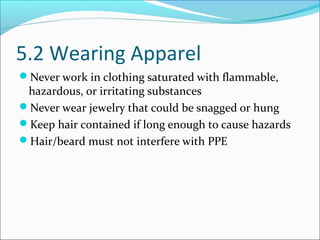
5.2 Wearing Apparel
Never work in clothing saturated with flammable,
hazardous, or irritating substances
Never wear jewelry that could be snagged or hung
Keep hair contained if long enough to cause hazards
Hair/beard must not interfere with PPE
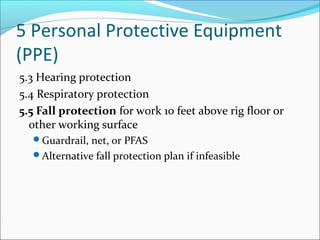
5 Personal Protective Equipment
(PPE)
5.3 Hearing protection
5.4 Respiratory protection
5.5 Fall protection for work 10 feet above rig floor or
other working surface
Guardrail, net, or PFAS
Alternative fall protection plan if infeasible
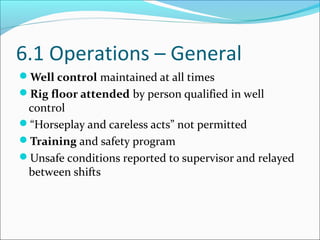
6.1 Operations – General
Well control maintained at all times
Rig floor attended by person qualified in well
control
“Horseplay and careless acts” not permitted
Training and safety program
Unsafe conditions reported to supervisor and relayed
between shifts
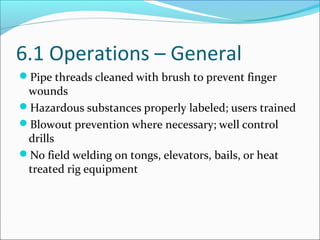
6.1 Operations – General
Pipe threads cleaned with brush to prevent finger
wounds
Hazardous substances properly labeled; users trained
Blowout prevention where necessary; well control
drills
No field welding on tongs, elevators, bails, or heat
treated rig equipment
6.1 Operations – General
Vehicles not involved in operations: at least 100 feet or
derrick height away from wellbore, or other safety
measures if not possible
Ground rig substructure, derrick, mast, and other
equipment as appropriate
6.2 Over Water Operations
Rules for crane transport of personnel
API RP 2D for offshore pedestal cranes
No crane operation during helicopter takeoff or
landing
Personal flotation devices for crane or swingrope
transfer to/from boats
Tag lines to steady all loads
6.3 Preliminary Rig-Up Operations
Review planned arrangement to avoid hazardous
conditions
Pipelines
Utility lines
Rig up safely before commencing well operations
Locate change rooms and outbuildings far enough
from boilers and fuel tanks
6.3 Preliminary Rig-Up Operations
Check well for pressure, and remove it or operate
safely under pressure
All personnel out of derrick or mast and cellar and
stand clear when
Subsurface pump is being unseated or
Initial pull on tubing is made
6.4 Blowout Prevention Equipment
Blowout prevention equipment installed and tested
where well might flow
Install, operate, maintain: API RP 53
Rig personnel must understand and be able to operate
blowout preventer
Discuss in pre-job meeting
Drills under variety of conditions
Anchor choke and kill lines – prevent whipping
6.5 Housekeeping
Clean work areas; remove trip hazards
Avoid / clean up wet floors (from leaks, spills, or
pulling wet pipe)
Keep cellar clear of fluids or loose equipment/material
Keep egress routes unblocked
Store tools & equipment to avoid falling
Keep fire fighting equipment accessible
6.7 Confined Space, Excavations, or
Hazardous Environments
Where unusually hazardous gases present, advise
employees, contractors, and service company
supervisors of hazards
Fill the cellar if it is not needed
Definition of confined space
Testing, permit system before entry
Declassification of confined spaces
6.7.5 Excavations
If deeper than 4 feet and may contain a hazardous
atmosphere:
Test for oxygen, flammable gases/vapors, toxic air
contaminants
Evaluate whether excavation is a confined space, and
permit if necessary
Precautions to prevent exposures
Emergency response procedures
6.8 Machinery and Tools
Personnel only operate machinery on which they are
qualified
Belts, drive chains, gears, and drives must have guards
installed
Except rotary table, catheads, kelly
Guards in place and properly maintained for
operation
Maintenance: report to rig supervisor
6.9 Lockout/Tagout
Locks/tags identify equipment or circuits being
worked on
Critical systems: include identity of worker
Train and discipline personnel
Lock/tag removed by person who installed it, or
authorized replacement
If neither available, supervisor may remove after
ensuring no hazard created
6.10 Auxiliary Escape
Tension on escape line:
Periodically checked and adjusted
6-12 feet of sag in middle
Ground anchor point distance ≥2x height
Ground anchor point should withstand 3000 lb pull
Alternate fast escape if line is infeasible
Training on use
Never ride except in emergency
6.11 Personnel Lifting Systems
Never ride the elevators.
Except in extreme emergency, as determined by
supervisor, with full fall protection and no pipe or other
equipment
Bosun’s chair attached to traveling block or tugger
line for inaccessible location
Hydraulic or air winch lines allowable under certain
conditions
6.12 Racking Tubulars and Drill
Collars
Secure rods, tubulars, drill pipe, drill collars when
racked or hung in derrick or mast to keep from falling
Safety clamps removed before hoisting continues
Use stops, pins, or chocks to keep round equipment
from rolling off storage rack
Prevent/remove ice plugs in tubulars
6.13 Handling Drilling Fluid
Chemicals and Additives
Never use asbestos as additive
Instruct personnel handling fluid and additives in
handling, disposal, and PPE
7.1 Fire Prevention
Store combustible and flammable materials safely
Prevent rubbish accumulation
No smoking, or source of ignition, near operations
that could cause fire hazard – signs necessary
Change rooms in safe areas for smoking
7.1 Fire Prevention
Never use natural gas or LPG to operate spray guns or
pneumatic tools
Cleaning solutions: flash point ≥100°F
Conductive containers (e.g. metal) to handle, store, or
transport flammable liquids
Ground and bond any plastic containers
NFPA 77 and API Publication 2003
7.2 Fire Protection
Fire fighting equipment not tampered with or
removed
Fire fighting water system may be used for wash down
if capacity is not compromised
Equipment accessible, plainly labeled
Equipment inspected & maintained
Crew familiar with location & use
8 Flammable Liquids
Approved portable containers
Tanks and Drums properly labeled
Refueling operations:
Procedures for over water transfers
Shut down engines while refueling unless shutdown
causes greater hazard
Assign a person to monitor filling tank to prevent
spillage
Ground during refueling
8.3 Liquefied Petroleum Gas (LPG)
Follow NFPA 58
Ignition source control
Protective caps on cylinders
Usual cylinder precautions
No temperatures >125°F, no direct heat
Protective gloves for refilling or replacing bottles:
freeze burns
8.4 Flammable Liquid Storage
Storage area requirements: ventilation, exits,
housekeeping, warning, extinguishers, classification
On land:
Not within 50 feet of wellbore, or equivalent safety
measures
LPG tanks >250 gallons at least 150 ft from and parallel
to closest side of rig; labeled
Offshore: appropriate precautions
8.4 Flammable Liquid Storage
Storage area requirements: ventilation, exits,
housekeeping, warning, extinguishers, classification
On land:
Not within 50 feet of wellbore, or equivalent safety
measures
LPG tanks >250 gallons at least 150 ft from and parallel
to closest side of rig; labeled
Offshore: appropriate precautions
9.1 Drilling and Well Servicing Rig
Equipment – General
Openings in rotary table kept covered when not
occupied
Rathole and mousehole openings kept covered when
not occupied with equipment
9.2 Derricks and Masts
Raising and lowering masts:
Not moved while raised (except for skidding)
Visual inspection of raising/lowering mechanism
before use
Tools and unsecured materials removed from mast
before raising/lowering
Base level and positioned before raising, lowering or
telescoping, or tightening guylines
Qualified person in charge of raising/lowering
9.2 Derricks and Masts
Raising and lowering masts:
Bolts, nuts and pins secured
No extra personnel in/under mast unless fully raised or
lowered
Guylines tensioned before load applied
During unusual loading:
Only essential personnel on rig floor
No one in derrick, mast, or cellar
9.2 Derricks and Masts
Bumper blocks:
Safety cable or strap along full length
Prevent wood fragment falling with screen
Counterweights:
Safety line anchored to derrick/mast if not encased or in
permanent guides
Travel of tong counterweights limited to elevations
needed for tongs
Safety devices for jacks
9.3 Ladders, Stairways, and
Platforms
Fixed ladder from rig floor to crown block and to
each intermediate platform
Ladders securely attached by manufacturer
specifications
Ladders must not lean back from vertical
Minimum clearances for ladders
Side rails extend ≥42 inches past landing
9.3 Ladders, Stairways, and
Platforms
At least 2 stairway exits on drilling rigs from rig floor
to ground level
Rig floor, ramps, stairways, ladders, platforms kept
free of slip/trip hazards
Derrick platforms:
Inside mast, except stabbing board, must completely
cover space from edge to legs
Secured to protect against dislodging
9.3 Ladders, Stairways, and
Platforms
Well servicing rigs:
Work not at ground level is on a working platform large
enough for 2 people
Safety fasteners when folded for storage
Finger board fingers bolted, welded, hinged-and-
pinned, or equivalent, to beam
9.3 Ladders, Stairways, and
Platforms
Floor and deck openings not left open
Floor holes people may walk into: securely covered
with no more than 1 inch opening
9.4 Drawworks
Visual inspection once per day
Guard remains in place and in good condition during
operation
Do not lubricate during operation
Do not leave brake without securing, unless equipped
with automatic driller
Shut-down switches at drum control console
9.4 Drawworks
Brake systems inspected and maintained per
manufacturer recommendations
Drilling rigs:
Double (auxiliary) braking system
Safety device to keep traveling block from striking
crown block
 Tested before each trip and after drill-line slipping or cutting
operation
9.5 Catheads and Lines Powered by
the Cathead
Shaft head covered by a thimble a rope cannot wind
around
Rope guide for manually operated rope
Check for grooves >1/4 inch; rebuild and turn to avoid
fouling
Keep lines from being entangled with cathead line
No rope or line on unattended cathead
9.5 Catheads and Lines Powered by
the Cathead
Training required before operation of cathead or lines
Maintain lines and automatic catheads in safe
working condition
When lifting tubulars, use slings that will not slip off.
9.6 Hoisting lines and other wire
rope
Visually inspect at least once per day; detailed
inspection once per month
Remove when too many broken wires
Consider removal for corrosion
Remove lines with corroded, cracked, bent, worn,
improper end connections
Remove for kinking, crushing, birdcaging, cutting,
cold working
9.6 Hoisting lines and other wire
rope
Hoisting line not removed from drum until traveling
block rests on rig floor or is suspended separately
Slings should be identified by size, grade, rated
capacity, reach
9.7 Hoisting Tools, Hooks, Bails, Elevators,
and Related Equipment
Good engineering practice; maintained safe. See API
Spec 8A, 8B, 8C
Never exceed design load
Safety latch on hoisting hook to prevent accidental
release
Traveling blocks guarded properly
Crown blocks secured to keep sheaves from jumping
out of bearings
9.8 Rotary
Only engage power when rotary table is clear of all
people and materials
Do not use rotary table for initial breakout of tool
joints – only spinning out after initial breakout
Use smooth kelly bushings to prevent catching of
people, clothes or material
9.9 Drill String Handling Equipment
Manual drill pipe slip handles:
Use manufacturer’s original or equivalent
Short enough to not project beyond master bushing
Lubricate tapered side of drill pipe slips
Do not kick slips into place
Attach tongs to fixed structure using wire rope or stiff
arm
9.9 Drill String Handling Equipment
Maintain tongs properly
Tong safety lines: long enough to use breakout
cathead, but short enough to prevent complete
rotation of tongs
Power tongs:
Pressure systems: safety relief valve
Power input pressure line disconnected to work on
tongs
9.11 Drilling Fluid Tanks
On land: Pits and tanks used to circulate flammables
located ≥100 feet from well, or equivalent
Drilling fluid tanks treated as confined spaces
Ventilation, ventilation alarms, gas detectors
Blowers with appropriate electrical classification
18 Gas, Air, or Mist Drilling
Operations
General (All other requirements apply)
Training
Equipment
Procedures
Minimizing Sources of Ignition

oil gas industry guidelines | Michael Bowen

  • 1.
  • 2.
    1 General 1.1 Purpose:recommend practices and procedures for promotion and maintenance of safe working conditions for personnel engaged in drilling operations and well servicing operations, including special services
  • 3.
    1 General 1.2 Scope:rotary drilling rigs, well servicing rigs, special services Operations on location Not seismic or water well drilling Not site preparation or site abandonment 1.3 Responsibility: Each employer trains own employees Operator and contractor share information Immediate supervision of authorized person with authority to commence, modify, cease or improve
  • 4.
    2 References API standards ACGIHTLVs ANSI standards ASME Boiler and Pressure Vessel Code NFPA standards Incorporated for special topics
  • 5.
    3 Definitions 3.1.88 shall:Recommended practice has universal application to specific activity 3.1.89 should: Recommended practice Safe comparable alternative available May be impractical or unnecessary under certain circumstances
  • 6.
    4 Injuries andFirst Aid 4.1 General – immediate reporting and treatment; follow-up reporting; cause investigation and prevention 4.2 Medical services – Information available and arrangements made 4.3 First aid – CPR trained individual and first aid kit at worksite 4.4 Emergency eye or body wash stations where exposed to injurious materials
  • 7.
    5 Personal ProtectiveEquipment (PPE) 5.1 General: Wear PPE when there is reasonable potential for prevention of harm PPE only used when engineering or administrative controls impractical
  • 8.
    5.2 Wearing Apparel Hardhat: each person Eye protection where probable injury Safety-toe footwear Alternative practice for extreme cold Gloves, apron, boots, other appropriate PPE for chemical handling No loose or poorly fitted clothing
  • 9.
    5.2 Wearing Apparel Neverwork in clothing saturated with flammable, hazardous, or irritating substances Never wear jewelry that could be snagged or hung Keep hair contained if long enough to cause hazards Hair/beard must not interfere with PPE
  • 10.
    5 Personal ProtectiveEquipment (PPE) 5.3 Hearing protection 5.4 Respiratory protection 5.5 Fall protection for work 10 feet above rig floor or other working surface Guardrail, net, or PFAS Alternative fall protection plan if infeasible
  • 11.
    6.1 Operations –General Well control maintained at all times Rig floor attended by person qualified in well control “Horseplay and careless acts” not permitted Training and safety program Unsafe conditions reported to supervisor and relayed between shifts
  • 12.
    6.1 Operations –General Pipe threads cleaned with brush to prevent finger wounds Hazardous substances properly labeled; users trained Blowout prevention where necessary; well control drills No field welding on tongs, elevators, bails, or heat treated rig equipment
  • 13.
    6.1 Operations –General Vehicles not involved in operations: at least 100 feet or derrick height away from wellbore, or other safety measures if not possible Ground rig substructure, derrick, mast, and other equipment as appropriate
  • 14.
    6.2 Over WaterOperations Rules for crane transport of personnel API RP 2D for offshore pedestal cranes No crane operation during helicopter takeoff or landing Personal flotation devices for crane or swingrope transfer to/from boats Tag lines to steady all loads
  • 15.
    6.3 Preliminary Rig-UpOperations Review planned arrangement to avoid hazardous conditions Pipelines Utility lines Rig up safely before commencing well operations Locate change rooms and outbuildings far enough from boilers and fuel tanks
  • 16.
    6.3 Preliminary Rig-UpOperations Check well for pressure, and remove it or operate safely under pressure All personnel out of derrick or mast and cellar and stand clear when Subsurface pump is being unseated or Initial pull on tubing is made
  • 17.
    6.4 Blowout PreventionEquipment Blowout prevention equipment installed and tested where well might flow Install, operate, maintain: API RP 53 Rig personnel must understand and be able to operate blowout preventer Discuss in pre-job meeting Drills under variety of conditions Anchor choke and kill lines – prevent whipping
  • 18.
    6.5 Housekeeping Clean workareas; remove trip hazards Avoid / clean up wet floors (from leaks, spills, or pulling wet pipe) Keep cellar clear of fluids or loose equipment/material Keep egress routes unblocked Store tools & equipment to avoid falling Keep fire fighting equipment accessible
  • 19.
    6.7 Confined Space,Excavations, or Hazardous Environments Where unusually hazardous gases present, advise employees, contractors, and service company supervisors of hazards Fill the cellar if it is not needed Definition of confined space Testing, permit system before entry Declassification of confined spaces
  • 20.
    6.7.5 Excavations If deeperthan 4 feet and may contain a hazardous atmosphere: Test for oxygen, flammable gases/vapors, toxic air contaminants Evaluate whether excavation is a confined space, and permit if necessary Precautions to prevent exposures Emergency response procedures
  • 21.
    6.8 Machinery andTools Personnel only operate machinery on which they are qualified Belts, drive chains, gears, and drives must have guards installed Except rotary table, catheads, kelly Guards in place and properly maintained for operation Maintenance: report to rig supervisor
  • 22.
    6.9 Lockout/Tagout Locks/tags identifyequipment or circuits being worked on Critical systems: include identity of worker Train and discipline personnel Lock/tag removed by person who installed it, or authorized replacement If neither available, supervisor may remove after ensuring no hazard created
  • 23.
    6.10 Auxiliary Escape Tensionon escape line: Periodically checked and adjusted 6-12 feet of sag in middle Ground anchor point distance ≥2x height Ground anchor point should withstand 3000 lb pull Alternate fast escape if line is infeasible Training on use Never ride except in emergency
  • 24.
    6.11 Personnel LiftingSystems Never ride the elevators. Except in extreme emergency, as determined by supervisor, with full fall protection and no pipe or other equipment Bosun’s chair attached to traveling block or tugger line for inaccessible location Hydraulic or air winch lines allowable under certain conditions
  • 25.
    6.12 Racking Tubularsand Drill Collars Secure rods, tubulars, drill pipe, drill collars when racked or hung in derrick or mast to keep from falling Safety clamps removed before hoisting continues Use stops, pins, or chocks to keep round equipment from rolling off storage rack Prevent/remove ice plugs in tubulars
  • 26.
    6.13 Handling DrillingFluid Chemicals and Additives Never use asbestos as additive Instruct personnel handling fluid and additives in handling, disposal, and PPE
  • 27.
    7.1 Fire Prevention Storecombustible and flammable materials safely Prevent rubbish accumulation No smoking, or source of ignition, near operations that could cause fire hazard – signs necessary Change rooms in safe areas for smoking
  • 28.
    7.1 Fire Prevention Neveruse natural gas or LPG to operate spray guns or pneumatic tools Cleaning solutions: flash point ≥100°F Conductive containers (e.g. metal) to handle, store, or transport flammable liquids Ground and bond any plastic containers NFPA 77 and API Publication 2003
  • 29.
    7.2 Fire Protection Firefighting equipment not tampered with or removed Fire fighting water system may be used for wash down if capacity is not compromised Equipment accessible, plainly labeled Equipment inspected & maintained Crew familiar with location & use
  • 30.
    8 Flammable Liquids Approvedportable containers Tanks and Drums properly labeled Refueling operations: Procedures for over water transfers Shut down engines while refueling unless shutdown causes greater hazard Assign a person to monitor filling tank to prevent spillage Ground during refueling
  • 31.
    8.3 Liquefied PetroleumGas (LPG) Follow NFPA 58 Ignition source control Protective caps on cylinders Usual cylinder precautions No temperatures >125°F, no direct heat Protective gloves for refilling or replacing bottles: freeze burns
  • 32.
    8.4 Flammable LiquidStorage Storage area requirements: ventilation, exits, housekeeping, warning, extinguishers, classification On land: Not within 50 feet of wellbore, or equivalent safety measures LPG tanks >250 gallons at least 150 ft from and parallel to closest side of rig; labeled Offshore: appropriate precautions
  • 33.
    8.4 Flammable LiquidStorage Storage area requirements: ventilation, exits, housekeeping, warning, extinguishers, classification On land: Not within 50 feet of wellbore, or equivalent safety measures LPG tanks >250 gallons at least 150 ft from and parallel to closest side of rig; labeled Offshore: appropriate precautions
  • 34.
    9.1 Drilling andWell Servicing Rig Equipment – General Openings in rotary table kept covered when not occupied Rathole and mousehole openings kept covered when not occupied with equipment
  • 35.
    9.2 Derricks andMasts Raising and lowering masts: Not moved while raised (except for skidding) Visual inspection of raising/lowering mechanism before use Tools and unsecured materials removed from mast before raising/lowering Base level and positioned before raising, lowering or telescoping, or tightening guylines Qualified person in charge of raising/lowering
  • 36.
    9.2 Derricks andMasts Raising and lowering masts: Bolts, nuts and pins secured No extra personnel in/under mast unless fully raised or lowered Guylines tensioned before load applied During unusual loading: Only essential personnel on rig floor No one in derrick, mast, or cellar
  • 37.
    9.2 Derricks andMasts Bumper blocks: Safety cable or strap along full length Prevent wood fragment falling with screen Counterweights: Safety line anchored to derrick/mast if not encased or in permanent guides Travel of tong counterweights limited to elevations needed for tongs Safety devices for jacks
  • 38.
    9.3 Ladders, Stairways,and Platforms Fixed ladder from rig floor to crown block and to each intermediate platform Ladders securely attached by manufacturer specifications Ladders must not lean back from vertical Minimum clearances for ladders Side rails extend ≥42 inches past landing
  • 39.
    9.3 Ladders, Stairways,and Platforms At least 2 stairway exits on drilling rigs from rig floor to ground level Rig floor, ramps, stairways, ladders, platforms kept free of slip/trip hazards Derrick platforms: Inside mast, except stabbing board, must completely cover space from edge to legs Secured to protect against dislodging
  • 40.
    9.3 Ladders, Stairways,and Platforms Well servicing rigs: Work not at ground level is on a working platform large enough for 2 people Safety fasteners when folded for storage Finger board fingers bolted, welded, hinged-and- pinned, or equivalent, to beam
  • 41.
    9.3 Ladders, Stairways,and Platforms Floor and deck openings not left open Floor holes people may walk into: securely covered with no more than 1 inch opening
  • 42.
    9.4 Drawworks Visual inspectiononce per day Guard remains in place and in good condition during operation Do not lubricate during operation Do not leave brake without securing, unless equipped with automatic driller Shut-down switches at drum control console
  • 43.
    9.4 Drawworks Brake systemsinspected and maintained per manufacturer recommendations Drilling rigs: Double (auxiliary) braking system Safety device to keep traveling block from striking crown block  Tested before each trip and after drill-line slipping or cutting operation
  • 44.
    9.5 Catheads andLines Powered by the Cathead Shaft head covered by a thimble a rope cannot wind around Rope guide for manually operated rope Check for grooves >1/4 inch; rebuild and turn to avoid fouling Keep lines from being entangled with cathead line No rope or line on unattended cathead
  • 45.
    9.5 Catheads andLines Powered by the Cathead Training required before operation of cathead or lines Maintain lines and automatic catheads in safe working condition When lifting tubulars, use slings that will not slip off.
  • 46.
    9.6 Hoisting linesand other wire rope Visually inspect at least once per day; detailed inspection once per month Remove when too many broken wires Consider removal for corrosion Remove lines with corroded, cracked, bent, worn, improper end connections Remove for kinking, crushing, birdcaging, cutting, cold working
  • 47.
    9.6 Hoisting linesand other wire rope Hoisting line not removed from drum until traveling block rests on rig floor or is suspended separately Slings should be identified by size, grade, rated capacity, reach
  • 48.
    9.7 Hoisting Tools,Hooks, Bails, Elevators, and Related Equipment Good engineering practice; maintained safe. See API Spec 8A, 8B, 8C Never exceed design load Safety latch on hoisting hook to prevent accidental release Traveling blocks guarded properly Crown blocks secured to keep sheaves from jumping out of bearings
  • 49.
    9.8 Rotary Only engagepower when rotary table is clear of all people and materials Do not use rotary table for initial breakout of tool joints – only spinning out after initial breakout Use smooth kelly bushings to prevent catching of people, clothes or material
  • 50.
    9.9 Drill StringHandling Equipment Manual drill pipe slip handles: Use manufacturer’s original or equivalent Short enough to not project beyond master bushing Lubricate tapered side of drill pipe slips Do not kick slips into place Attach tongs to fixed structure using wire rope or stiff arm
  • 51.
    9.9 Drill StringHandling Equipment Maintain tongs properly Tong safety lines: long enough to use breakout cathead, but short enough to prevent complete rotation of tongs Power tongs: Pressure systems: safety relief valve Power input pressure line disconnected to work on tongs
  • 52.
    9.11 Drilling FluidTanks On land: Pits and tanks used to circulate flammables located ≥100 feet from well, or equivalent Drilling fluid tanks treated as confined spaces Ventilation, ventilation alarms, gas detectors Blowers with appropriate electrical classification
  • 53.
    18 Gas, Air,or Mist Drilling Operations General (All other requirements apply) Training Equipment Procedures Minimizing Sources of Ignition