Safe Handling and Storage of

Styrene Monomer
THIS PAGE INTENTIONALLY LEFT BLANK
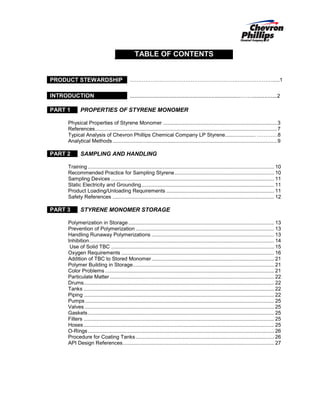
TABLE OF CONTENTS

PRODUCT STEWARDSHIP

…………………………………………………….………………….....1

INTRODUCTION

.....................................................................……................2

PART 1

PROPERTIES OF STYRENE MONOMER

Physical Properties of Styrene Monomer ............................................................................... 3
References .............................................................................................................................. 7
Typical Analysis of Chevron Phillips Chemical Company LP Styrene..................... …………8
Analytical Methods .................................................................................................................. 9

PART 2

SAMPLING AND HANDLING

Training ................................................................................................................................. 10
Recommended Practice for Sampling Styrene ..................................................................... 10
Sampling Devices ................................................................................................................. 11
Static Electricity and Grounding ............................................................................................ 11
Product Loading/Unloading Requirements ........................................................................... 11
Safety References ................................................................................................................ 12

PART 3

STYRENE MONOMER STORAGE

Polymerization in Storage ..................................................................................................... 13
Prevention of Polymerization ................................................................................................ 13
Handling Runaway Polymerizations ..................................................................................... 13
Inhibition ................................................................................................................................ 14
Use of Solid TBC ................................................................................................................. 15
Oxygen Requirements .......................................................................................................... 16
Addition of TBC to Stored Monomer ..................................................................................... 21
Polymer Building in Storage.................................................................................................. 21
Color Problems ..................................................................................................................... 21
Particulate Matter .................................................................................................................. 22
Drums .................................................................................................................................... 22
Tanks .................................................................................................................................... 22
Piping .................................................................................................................................... 22
Pumps ................................................................................................................................... 25
Valves ................................................................................................................................... 25
Gaskets ................................................................................................................................. 25
Filters .................................................................................................................................... 25
Hoses .................................................................................................................................... 25
O-Rings ................................................................................................................................. 26
Procedure for Coating Tanks ................................................................................................ 26
API Design References ......................................................................................................... 27
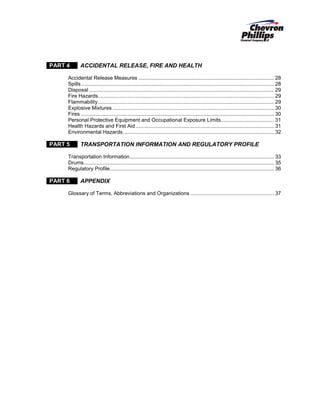
PART 4

ACCIDENTAL RELEASE, FIRE AND HEALTH

Accidental Release Measures .............................................................................................. 28
Spills ...................................................................................................................................... 28
Disposal ................................................................................................................................ 29
Fire Hazards .......................................................................................................................... 29
Flammability .......................................................................................................................... 29
Explosive Mixtures ................................................................................................................ 30
Fires ...................................................................................................................................... 30
Personal Protective Equipment and Occupational Exposure Limits..................................... 31
Health Hazards and First Aid ................................................................................................ 31
Environmental Hazards ......................................................................................................... 32

PART 5

TRANSPORTATION INFORMATION AND REGULATORY PROFILE

Transportation Information .................................................................................................... 33
Drums .................................................................................................................................... 35
Regulatory Profile.................................................................................................................. 36

PART 6

APPENDIX

Glossary of Terms, Abbreviations and Organizations .......................................................... 37
PRODUCT STEWARDSHIP
Chevron Phillips Chemical Company LP (“Chevron Phillips Chemical Company”) is
committed to being a good Product Steward of the products we produce. We want
anyone who comes in contact with one of our products to have access to information
that will help them to understand its potential risk and how to use it safely. The
thrust of our Product Stewardship program is the implementation of an Operation
Excellence Management System (OEMS) initiative, which makes health, safety and
environmental protection an integral part of our products.
Successful
implementation of this system must include a shared responsibility of all those who
come in contact with a product throughout its life cycle. Chevron Phillips Chemical
Company will continue to work with customers and others to help ensure that all who
use and handle our products follow safe and environmentally sound practices.
The information contained in this technical bulletin is not intended to, nor
does it, amend or replace the Material Safety Data Sheet for Styrene (MSDS
No. 100000068536). The most current Material Safety Data Sheet can be
obtained from Chevron Phillips Chemical Company by calling (800) 231-1212
and should be carefully examined prior to working with this product.

Styrene September 2010

1
INTRODUCTION
Chevron Phillips Chemical Company LP markets styrene monomer at its joint venture plant in Jubail,
Saudi Arabia. Styrene is one of the most important monomers produced by the chemical industry
today. Styrene monomer is a basic building block of the plastics industry. The conventional method of
producing styrene involves the alkylation of benzene with ethylene to produce ethylbenzene, followed
by dehydrogenation of ethylbenzene to styrene.
Styrene undergoes polymerization by all the common methods used in plastics technology to produce
a wide variety of polymers and copolymers. Styrene is readily polymerized and copolymerized by both
batch and continuous mass polymerization, emulsion, suspension, and solution processes. The most
important products are polystyrene (PS), rubber-modified high impact polystyrene (HIPS), styrene
butadiene
latex
(SBL),
styrene-acrylonitrile
copolymer
(SAN),
acrylonitrile-butadienestyrene/terpolymer (ABS), and styrene-butadiene copolymer (SBR, synthetic rubber). An approximate
breakdown of styrene’s markets are polystyrene 54%, expandable polystyrene 12%, ABS 10%, SBR
7%, SBL 6%, and other 11%. Other important uses of styrene are in styrene-polyester resins, latexes,
and styrenated oils and alkyls.
Polystyrene is primarily used in packaging, disposables, and low cost consumer products.
Expandable polystyrene beads (EPS) are primarily used in food and beverage packaging, insulation
and cushion packaging. Improved grades of resins are used in higher performance applications, such
as home electronics and appliances. ABS and SAN have many uses in the consumer durables
market. Styrene-based polyesters have lifetimes of over thirty years in both indoor and outdoor
applications, e.g., polyester boats typically last longer than boats made from conventional materials.
Thermoplastic elastomers are directly replacing natural and traditional synthetic rubbers in many
established applications and entering new markets. Other applications include carpet backing (SB
Latex), production of tires (SB Rubber) and castings for textiles and paper.
This publication addresses the need for an easy to use source of information describing the physical
properties, toxicity and first aid measures, safety, disposal, labeling and styrene storage information for
this relatively safe but perishable chemical. Styrene’s reactivity is such that it must be handled within a
range of specially prescribed conditions. This is necessary not only to avoid certain safety hazards but
also to prevent deterioration in the quality of the styrene. However, it has been well-demonstrated that
styrene can be used, handled, and stored without difficulty when its physical and chemical properties
are understood and the precautions associated with these properties are applied.
NOTE:
THIS BROCHURE DOES NOT AMEND OR REPLACE OFFICIAL PUBLICATIONS, SAFETY
REGULATIONS NOW IN USE, MATERIAL SAFETY DATA SHEETS OR COMMERCIAL TERMS OF
SALE. CHEVRON PHILLIPS CHEMICAL COMPANY LP MAKES NO GUARANTEE OF THE
ACCURACY OF THE CONTENTS OF THIS BROCHURE OR ANY WARRANTY OF ANY KIND,
EITHER EXPRESSED OR IMPLIED, WITH RESPECT TO THE USE OF THIS INFORMATION OR
ITS APPLICABILITY. THE USER ASSUMES ALL RISK AND LIABILITY ASSOCIATED WITH THE
INFORMATION IN THIS BROCHURE.

Styrene September 2010

2
PART 1
PROPERTIES OF STYRENE MONOMER
PHYSICAL PROPERTIES OF STYRENE MONOMER
The data contained in this section have been obtained experimentally or derived from the chemical
literature referenced at the end of the section.
Property
Value
Autoignition temperature (in air)
Boiling point:

2,9

1

760 mm Hg
100 mm Hg
30 mm Hg
10 mm Hg
1 mm Hg

490°C (914°F)
145.14°C (293.25°F)
82.4°C
54.7°C
33.6°C
-1.6°C

Color

Colorless

Corrosivity

Noncorrosive to metals except to copper and alloys
of copper.

Critical pressure (pc)

3

Critical temperature (tc)
Critical volume (Vc)

39.5 atm. (580 psia)
3

374.4°C (706°F)

3

0.369 L/mole
-4

Cubical coefficient of expansion
4
(per deg. C)

9.710 x 10 at 20°C
-4
9.805 x 10 at 30°C
-4
9.902 x 10 at 40°C

Density, (in air)

Temp. (°C)
0
10
20
30
40
50

g/cc
0.9223
0.9137
0.9050
0.8964
0.8877
0.8791

Temp. (°C)
20
40
60

∈
2.4257
2.3884
2.3510

Dielectric constant of liquid

Styrene September 2010

5

lb/US Gal.
7.701
7.627
7.553
7.479
7.405
7.329

3
Property
Entropy of gas at 25°C (S°)

Value
2

82.48 kcal/(gm-mole)-dy.
-14

Electrical Conductivity at 25°C

2.8 x 10

Evaporation Rate (Relative to Butyl Acetate)

1.92

Flash point:

6

(Tag. closed cup)
(Tag. open cup)

31°C (88°F)
37°C (98°F)

Free energy of formation of gas at 25°C (∆Gf°)
Freezing point

mhos/cm

2

2

51.10 kcal/gm-mole
-30.628°C (-23.13°F)

Heat of combustion gas at const. press., 25°C, to
2
form gaseous products (∆Ho)

-1018.83 kcal/(gm-mole)

2

gas at 25°C(∆Hf°)

35.22 kcal/(gm-mole)

liquid at 25°C(∆Hf°)

Heat of formation:

24.83 kcal/(gm-mole)

Heat of polymerization at 90°C (∆H)
Heat of vaporization at 145.1°C

7

9

-17.8 kcal/gm-mole
8.82 kcal/(gm-mole)

Molecular weight

104.14 gms/(gm-mole)

Odor

Characteristic, aromatic

Physical state at room temperature

Liquid

Refractive index:

4

Solubility of Oxygen (from air) in Styrene

Styrene September 2010

Temp. (°C)
0
10
15
20
25
30
40
50
60

ND
1.5579
1.5523
1.5495
1.5467
1.5439
1.5410
1.5354
1.5298
1.5242

Temp. (°C)
15
25
35

PPM
53
50
45

4
Property
Solubility: Styrene in water

Value
8

Solubility: Water in styrene

Temp. (°C)
0
20
40
60
80

8

Temp. (°C)
0
20
40
60
80

9

Solubility in:

Acetone
CCl4
Benzene
Ether
n-Heptane
Ethanol

Relative Density/(Specific Gravity)

2

(°C)

(gms/100gmsH20)
0.018
0.029
0.040
0.051
0.062

(gms/100gms styrene)
0.020
0.060
0.100
0.140
0.180
∞
∞
∞
∞
∞
∞
gm/cc

0
10
20
30
40
50
60
70
80
90
100
(°C)

Specific Heat (vapor)

2

(cal/gm-°C)

0
20
40
60
80
100

7

Specific Heat

0.9238
0.9151
0.9075
0.9009
0.8949
0.8897
0.8850
0.8809
0.8771
0.8738
0.8707

0.4004
0.4131
0.4269
0.4421
0.4590
0.4774

Temp. (°C)
0
25.0

Styrene September 2010

Cp
(cal/gm-°C)
0.256
0.280

5
Property
7
Surface Tension

(°C)
0
20
40
60
80
100

Value
dynes/cm
34.5
32.3
30.0
27.8
25.6
23.5

Temp. (°C)
0
20
40
60
80
100
120

Viscosity
(Centipoise)
1.040
0.763
0.586
0.470
0.385
0.326
0.278

Vapor Pressure

Temp. (°C)
0
10
20
30
40
50
60
70
80
90
100
110
120
130
140
150
160

Vapor
Pressure
mm/Hg
1.15
2.34
4.50
8.21
14.30
23.87
38.41
59.78
90.31
132.82
190.63
267.62
368.22
497.39
660.64
864.00
1113.97

Volumetric Shrinkage upon polymerization
(typical)

17%

Thermal Conductivity

Temp. °C(°F)
0 (32)
25 (77)
50 (122)
75 (167)
100 (212)
150 (302)
200 (392)

4

Viscosity

2

Styrene September 2010

BTU/(hr.ft °F)
0.080
0.079
0.076
0.0735
0.0708
0.063
0.0598
2

6
REFERENCES
1.

G. W. Jones, G. S. Scott, and W. E. Miller, Bureau of Mines Report of Investigations 3630.

2.

American Petroleum Institute Research Project 44, “Selected Values of Properties of
Hydrocarbons and Related Compounds.”

3.

“Physical Constants of Hydrocarbons C1 to C10,” ASTM Special Technical Publication No.
109A (1963).

4.

“Kirk-Othmer Encyclopedia of Chemical Technology,” (2nd Ed.), Vol. 19, Interscience, New
York, 1968, p. 56-57.

5.

J. Petro and C. P. Smyth, J. Amer. Chem. Soc., 80, 73 (1958).

6.

Manufacturing Chemists Association Chemical Safety Data Sheet SD-37 (Rev. 1971), p. 5.

7.

R. H. Boundy and R. F. Boyer (Eds.), “Styrene: Its Polymers, Copolymers, and Derivatives,”
Reinhold, New York, 1952, Ch. 3.

8.

W. H. Lane, Ind. Eng. Chem. (Anal. Ed.), 18, 295, (1946).

9.

R. R. Dreisbach, “Physical Properties of Chemical Compounds,” Vol. 1, Am. Chem. Soc.,
1955, p. 159.

10.

Styrene Monomer: Environmental, Health, Safety, Transport and Storage Guidelines, Styrene
Producers Association, CEFIC Sector Group, Brussels, Belgium, 3 March 2008

Styrene September 2010

7
TYPICAL ANALYSIS OF CHEVRON PHILLIPS CHEMICAL COMPANY LP STYRENE1
Component
Styrene………………………………………………%
Benzene……………………………………………. ppm
Toluene…………………………………………….. ppm
Ethylbenzene………………………………………. ppm
α methylstyrene…………………………………… ppm
m + p-xylene……………………………………….. ppm
o-Xylene……………………………………………. ppm
Cumene……………………………………………. ppm
n-Propylbenzene………………………………….. ppm
m + p-Ethyltoluene……………………………….. ppm
Vinyltoluene……………………………………….. ppm
Phenylacetylene………………………………….. ppm
m + p-Divinylbenzene…………………………….. ppm
o-Divinylbenzene………………………………….. ppm
Polymer…………………………………………….. ppm
TBC…………………………………………………. ppm
Aldehydes as Benzaldehyde…………………….. ppm
Peroxides as Benzoylperoxides………………….. ppm
Chlorides as Cl……………………………………...ppm
Sulfur as S………………………………………..... ppm

99.93
<1
<1
50
175
120
125
100
60
20
10
50
<10
<5
1
12
15
5
<1
<1

1

This typical analysis is for information only, and does not necessarily represent specification
limits.

Styrene September 2010

8
ANALYTICAL METHODS
The following ASTM methods are recommended for the analysis of styrene monomer:
1. D1209

Color of Clear Liquids (Platinum-Cobalt Scale)

2. D2119

Aldehydes in Styrene Monomer

3. D2121

Polymer Content of Styrene Monomer

4. D2340

Peroxides in Styrene Monomer

5. D4045 Sulfur in Petroleum Products by Hydrogenolysis and Rateometric Colorimetry
6. D4052

Density and Relative Density of Liquids by Digital Density Meter

7. D4590
Inhibitor, Colorimetric Determination of p-tert-Butylcatechol in Styrene
Monomer by Spectrophotometry
8. D5135

Analysis of Styrene by Capillary Gas Chromatography

9. D5386

Color of Liquids using Tristimulus Colorimetry

10. D5808
Determining Organic Chloride in Aromatic Hydrocarbons and Related
Chemicals by Microcoulometry
11. D7375
Trace Quantities of Water in Aromatic Hydrocarbons and Their Mixtures by
Coulometric Karl Fisher Titration

Styrene September 2010

9
PART 2
SAMPLING AND HANDLING
TRAINING
In any workplace where styrene is handled,
used, stored or transported, a training program
must be implemented to ensure worker’s
awareness of styrene properties, toxicity, and
safety procedures. The training program
should include the following:
1. Properties and health hazards of styrene.
2. Styrene physical hazards including the
potential for fire and explosion.
3. Styrene’s primary routes for entry into
body.
4. Safe work
practices.

and

good

housekeeping

5. The importance of protection from styrene
contact; the proper clothing and cleaning
requirements.
6. Signs and symptoms of styrene exposure
and action to be taken and medical
conditions aggravated by exposure to
styrene.
7. The care that must be taken whenever
and wherever styrene is used, handled,
stored and transported.
8. Emergency procedures for leaks, spills,
and fires, including protective clothing to
be worn in such instances.

9. The availability of written styrene usage,
health hazard
procedures.

and

training

program

It is recommended that this training program
should be part of a worker’s initial training and
should be scheduled at least annually
thereafter.

Styrene September 2010

Additional accidental release, fire and health
information is presented in a subsequent
section of this brochure.

RECOMMENDED PRACTICE FOR
SAMPLING STYRENE
This information is provided for use in
establishing
sampling
and
handling
procedures. This information should only be
utilized in conjunction with an existing health
and safety program and cannot be used as a
substitute for expert safety and medical
advice.
Take extreme care to prevent spills. In case
material is spilled, wash contaminated areas
thoroughly with large quantities of water and
collect the liquid in the plant chemical waste
system.
SAMPLING:
Samples may be taken through the manway
opening by means of a clean, dry 1-qt. (1-L)
glass bottle held in a clean, dry sheath of
nickel or stainless steel attached to a long rod
or lightweight chain of the same material. Fit
the bottle with a stopper to which is attached a
light metal chain. Lower the bottle to near the
bottom of the tank and pull out the stopper
with a sharp jerk of the chain. Raise it at such
a rate that it is about three fourths full when it
emerges from the liquid. Stopper the bottle
before attempting to rinse the material from
the outside. Label the sample bottle according
to OSHA Regulations. Note - Fresh air and
other personal protective gear may be
required
depending
on
predetermined
exposure limits.
Emphasis should be placed on cleanliness
and dryness. Both the sample bottle and its
holder must be CLEAN AND DRY. Transfer
the sample to a dry, dark brown bottle for
storage. A suitable bottle for storing the
sample is known as a “Boston Round”. The
closure should be a screw cap with a Teflon

10
or aluminum foil liner. If new bottles are used,
first rinse them thoroughly with acetone or
methanol and then dry in a hot-air oven. Hold
in a desiccator while cooling to ambient
temperature.
Protect them from dirt or
moisture by enclosure in a polyethylene bag.
Rinse used bottles very thoroughly with water,
detergents, and solvents and then treats as
new bottles.
The sampling system should be bonded to the
tank manway (e.g. by resting the chain on the
lip of the manway) prior to sampling.
REFERENCE DOCUMENTS:
ASTM D3437: Practice for Sampling and
Handling Cyclic Compounds
ASTM E300: Practice for Sampling Industrial
Chemicals
ANSI Z 288.1: Flammable and Combustible
Liquids Code
API RP 500A: Classification of Locations for
Electrical Installations in Petroleum Refineries
OSHA Regulations, 29 CFR, Paragraphs
1910.1000 and 190.2000
U.S.
DOT
Regulations,
49
CFR,
Transportation Subchapters B and C, Parts
171-179
Chevron Phillips Chemical
MSDS 100000068536

Company

LP

SAMPLING DEVICES
Quality control within the process industry is of
prime importance. This demands stringent
checks, not only of the finished product, but
also throughout the various stages of
production, distribution and use.
The need for representative samples plays a
critical role in ensuring product quality. Yet
sampling directly often includes the risks of
exposure to the operator as well as
contamination and pollution to the environment.
Use of a system such as the DOPAK sampling
method for process samples and HERMetric
Sampler for tank samples significantly reduces
such risks. Texas Sampling Inc. also markets
closed loop sampling systems.

Styrene September 2010

STATIC ELECTRICITY AND
GROUNDING
Static electricity can cause difficulties such as
fires
and
explosions
unless
certain
precautions are observed. Styrene monomer,
has a high volume resistivity, and can pick up
and hold a static charge during transfer
operations. Key operations which have the
potential
of
generating
a
flammable
atmosphere and/or static charge include tank
and container filling, splash filling, tank
cleaning, sampling, gauging, switch loading,
filtering, mixing/agitation, and vacuum truck
operations. To minimize the hazard of static
electricity during these operations, bonding
and grounding may be necessary but may not
by themselves be sufficient.
For more
information, refer to OSHA Standard 29 CFR
1910.106,
“Flammable and Combustible
Liquids”, National Fire Protection Association
(NFPA) 77, “Recommended Practice on Static
Electricity” and/or the American Petroleum
Institute (API) Recommended Practice 2003,
“Protection Against Ignitions Arising Out of
Static, Lightning, and Stray Currents.
The use of insulating flanges or non-insulating
hoses
are recommended
for marine
vessel/shore connections.
Submerged filling is recommended for all
flammable liquids. The inlet line should
discharge at, or near, the bottom and make
electrical contact with the tank to eliminate
uncontrolled electrical discharge.
Operators wearing rubber-soled shoes,
particularly on certain composition floors made
of good insulating materials, may pick up
considerable static electricity.

PRODUCT LOADING/UNLOADING
REQUIREMENTS
When loading or unloading a vessel or barge:
Refer to current ISGOTT and USCG rules.
When loading or unloading tank cars:
1. Use only clean, oil- and dirt-free, sparkresistant tools and implements.

11
2. Do not stand within the gauge of the track
until the hand brake of the tank car is
known to be secured and the brake shoes
are tight against the treads of the wheels.
3. Carefully place wheel chocks tight against
either side of the wheels and keep fingers
away from pinch points.
4. Place blue caution sign with white lettering
warning: “Stop: Crew at Work” or “Stop:
Tank Car”. Place on track or on tank car
facing either end of entrance to track.
5. Make sure the tank car’s internal pressure
has been relieved before removing the
manhole or outlet valve cap or plug..
6. Visually inspect hoses and fittings prior to
use and replace worn, corroded, or
damaged parts.
7. Ground the tank car before connecting
any part of it to the unloading lines or
equipment. Loading and unloading lines
should be continuously bonded during
loading/unloading.
8. Purging all lines with nitrogen prior to
transfer of product reduces risk of flash
fires.
9. Unload the car through the dome
connection or through the bottom outlet.
Check carefully for leaks. Never place
face or torso over any opening in a tank,
especially as you remove closure caps or
plugs, gauge the tank car, or examine the
safety relief valve or safety vent.. Before
removing bottom outlet valve end cap, or
plug, operate the valve several times to
ensure that it is not stuck in the open
position and that it can be closed quickly
and effectively if necessary.
10. Use of air pressure to unload tank cars is
not recommended. If pressure must be
used, the operator should demonstrate
caution.
11. Use an approved pump to unload the tank
car. If the car does not have an eductor
pipe, insert a pipe through the open dome
and pump its contents out that way.

Styrene September 2010

12. Carefully vent the car through a flame
arrester during unloading.
13. If unloading is interrupted, disconnect all
unloading connections, close all valves
tightly and securely apply all other
closures to a tool tight condition, except
the thermometer well which should be
applied hand tight.
14. The exteriors of tank cars should be
cleaned of any spilled material before
unloading them and before returning them
to transportation. Before using any of the
safety appliances inspect them to ensure
that they are safe to use and not
contaminated with spilled material. .
Before offering the residue tank car back
into
transportation
determine
that
applicable tank car openings are closed
too tight. Inspect the stencils to determine
that the tank and safety relief valve are
within their proper re-test periods. The
safety appliances such as ladders,
manway operating platforms, safety
railings, and walkways must not be
severely corroded, bent, loose or broken.
The placards and markings must be
legible and the shipment is prepared in
accordance with all applicable DOT
regulations.

SAFETY REFERENCES
The following publications are excellent
references for styrene monomer handling
information:
Manual Sheet TC-4,
Chemical Manufacturer’s Association
Recommended
Practice
for
Unloading
Flammable Liquids from Tank Cars
NFPA 30 Flammable and Combustible Liquids Code
NFPA 70 National Electrical Code
NFPA 77 Recommended Practice on Static Electricity
API RP 2003
Protection Against Ignitions Arising Out of
Static, Lightning, and Stray Currents

12
PART 3
STYRENE MONOMER STORAGE
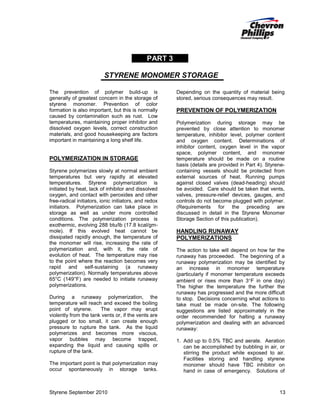
The prevention of polymer build-up is
generally of greatest concern in the storage of
styrene monomer. Prevention of color
formation is also important, but this is normally
caused by contamination such as rust. Low
temperatures, maintaining proper inhibitor and
dissolved oxygen levels, correct construction
materials, and good housekeeping are factors
important in maintaining a long shelf life.

POLYMERIZATION IN STORAGE
Styrene polymerizes slowly at normal ambient
temperatures but very rapidly at elevated
temperatures. Styrene polymerization is
initiated by heat, lack of inhibitor and dissolved
oxygen, and contact with peroxides and other
free-radical initiators, ionic initiators, and redox
initiators. Polymerization can take place in
storage as well as under more controlled
conditions. The polymerization process is
exothermic, evolving 288 btu/lb (17.8 kcal/gmmole). If this evolved heat cannot be
dissipated rapidly enough, the temperature of
the monomer will rise, increasing the rate of
polymerization and, with it, the rate of
evolution of heat. The temperature may rise
to the point where the reaction becomes very
rapid and self-sustaining (a runaway
polymerization). Normally temperatures above
65°C (149°F) are needed to initiate runaway
polymerizations.
During a runaway polymerization, the
temperature will reach and exceed the boiling
point of styrene.
The vapor may erupt
violently from the tank vents or, if the vents are
plugged or too small, it can create enough
pressure to rupture the tank. As the liquid
polymerizes and becomes more viscous,
vapor bubbles may become trapped,
expanding the liquid and causing spills or
rupture of the tank.
The important point is that polymerization may
occur spontaneously in storage tanks.

Styrene September 2010

Depending on the quantity of material being
stored, serious consequences may result.

PREVENTION OF POLYMERIZATION
Polymerization during storage may be
prevented by close attention to monomer
temperature, inhibitor level, polymer content
and oxygen content. Determinations of
inhibitor content, oxygen level in the vapor
space, polymer content, and monomer
temperature should be made on a routine
basis (details are provided in Part 4). Styrenecontaining vessels should be protected from
external sources of heat. Running pumps
against closed valves (dead-heading) should
be avoided. Care should be taken that vents,
valves, pressure-relief devices, gauges, and
controls do not become plugged with polymer.
(Requirements for the preceding are
discussed in detail in the Styrene Monomer
Storage Section of this publication).

HANDLING RUNAWAY
POLYMERIZATIONS
The action to take will depend on how far the
runaway has proceeded. The beginning of a
runaway polymerization may be identified by
an increase in monomer temperature
(particularly if monomer temperature exceeds
ambient or rises more than 3°F in one day)
The higher the temperature the further the
runaway has progressed and the more difficult
to stop. Decisions concerning what actions to
take must be made on-site. The following
suggestions are listed approximately in the
order recommended for halting a runaway
polymerization and dealing with an advanced
runaway:
1. Add up to 0.5% TBC and aerate. Aeration
can be accomplished by bubbling in air, or
stirring the product while exposed to air.
Facilities storing and handling styrene
monomer should have TBC inhibitor on
hand in case of emergency. Solutions of

13
TBC may be obtained by contacting your
Chevron Phillips Chemical Company LP
representative or through your purchasing
agent.
2. Reduce temperature of tank with water
spray.
If the tank is insulated, the
insulation should be removed as quickly as
possible and prior to spraying with water.
Use ice, if feasible, but not in the product
directly, as it will tend to remove the TBC.
If placed in the product, ice should be in a
sealed metal container.
3. Keep vessel vented.
4. Dilute with ethylbenzene or toluene if tank
is not venting and product temperature is
below
231°F
(110°C)
to
retard
polymerization and reduce viscosity.
5. If possible remove product from tank before
it solidifies, to save the tank. Use drums,
diked area, or float on water.

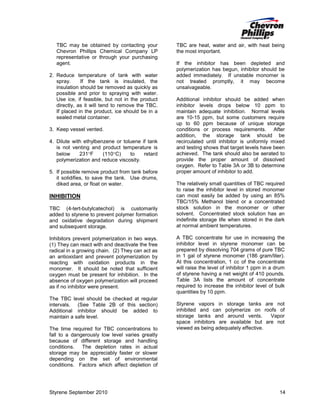
INHIBITION
TBC (4-tert-butylcatechol) is customarily
added to styrene to prevent polymer formation
and oxidative degradation during shipment
and subsequent storage.
Inhibitors prevent polymerization in two ways.
(1) They can react with and deactivate the free
radical in a growing chain. (2) They can act as
an antioxidant and prevent polymerization by
reacting with oxidation products in the
monomer. It should be noted that sufficient
oxygen must be present for inhibition. In the
absence of oxygen polymerization will proceed
as if no inhibitor were present.
The TBC level should be checked at regular
intervals. (See Table 2B of this section)
Additional inhibitor should be added to
maintain a safe level.
The time required for TBC concentrations to
fall to a dangerously low level varies greatly
because of different storage and handling
conditions. The depletion rates in actual
storage may be appreciably faster or slower
depending on the set of environmental
conditions. Factors which affect depletion of

Styrene September 2010

TBC are heat, water and air, with heat being
the most important.
If the inhibitor has been depleted and
polymerization has begun, inhibitor should be
added immediately. If unstable monomer is
not treated promptly, it may become
unsalvageable.
Additional inhibitor should be added when
inhibitor levels drops below 10 ppm to
maintain adequate inhibition. Normal levels
are 10-15 ppm, but some customers require
up to 60 ppm because of unique storage
conditions or process requirements. After
addition, the storage tank should be
recirculated until inhibitor is uniformly mixed
and testing shows that target levels have been
achieved. The tank should also be aerated to
provide the proper amount of dissolved
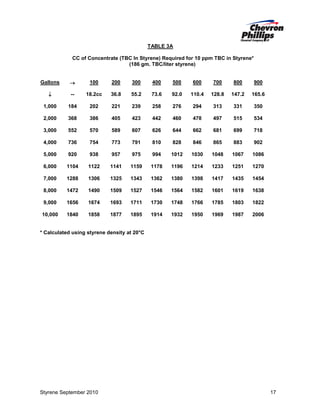
oxygen. Refer to Table 3A or 3B to determine
proper amount of inhibitor to add.
The relatively small quantities of TBC required
to raise the inhibitor level in stored monomer
can most easily be added by using an 85%
TBC/15% Methanol blend or a concentrated
stock solution in the monomer or other
solvent. Concentrated stock solution has an
indefinite storage life when stored in the dark
at normal ambient temperatures.
A TBC concentrate for use in increasing the
inhibitor level in styrene monomer can be
prepared by dissolving 704 grams of pure TBC
in 1 gal of styrene monomer (186 gram/liter).
At this concentration, 1 cc of the concentrate
will raise the level of inhibitor 1 ppm in a drum
of styrene having a net weight of 410 pounds.
Table 3A lists the amount of concentrate
required to increase the inhibitor level of bulk
quantities by 10 ppm.
Styrene vapors in storage tanks are not
inhibited and can polymerize on roofs of
storage tanks and around vents.
Vapor
space inhibitors are available but are not
viewed as being adequately effective.

14
containing the crystal. TBC Crystal
dissolve with mixing in 20 to 60 minutes.

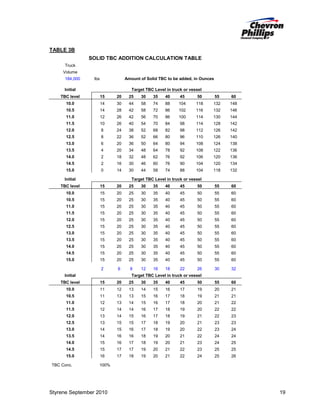
SPECIAL NOTE - USE OF SOLID TBC
TBC is also available in a solid or crystal form.
When packaged in a polystyrene bag of
various sizes, the TBC can be added to the
styrene by simply adding the prescribed
amount (see Table 3C) to the tank (trailer,
tank container, rail car, or vessel). The styrene
monomer will dissolve the polystyrene bag

will

Caution: Personal Protective Equipment is
required for handling solid TBC. In Addition,
solid TBC inventory must be monitored in
storage. The recommended shelf life of a
polystyrene bag containing TBC is no more
than 12 months (365 days), at which time the
solid TBC may be recycled and re-packaged.
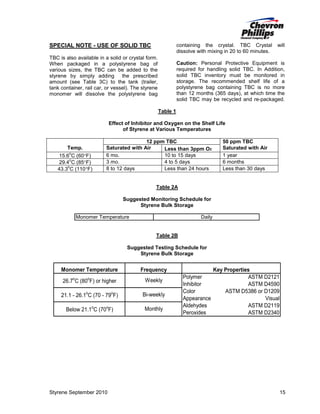
Table 1

Effect of Inhibitor and Oxygen on the Shelf Life
of Styrene at Various Temperatures

Temp.
o

15.6 C (60°F)
o
29.4 C (85°F)
o
43.3 C (110°F)

12 ppm TBC
Saturated with Air
Less than 3ppm O2
6 mo.
10 to 15 days
3 mo.
4 to 5 days
8 to 12 days
Less than 24 hours

50 ppm TBC
Saturated with Air
1 year
6 months
Less than 30 days

Table 2A
Suggested Monitoring Schedule for
Styrene Bulk Storage
Monomer Temperature

Daily

Table 2B
Suggested Testing Schedule for
Styrene Bulk Storage

Monomer Temperature

Frequency

26.7oC (80oF) or higher

Weekly

21.1 - 26.1oC (70 - 79oF)

Bi-weekly

Below 21.1oC (70oF)

Monthly

Styrene September 2010

Key Properties
Polymer
ASTM D2121
Inhibitor
ASTM D4590
Color
ASTM D5386 or D1209
Appearance
Visual
Aldehydes
ASTM D2119
Peroxides
ASTM D2340

15
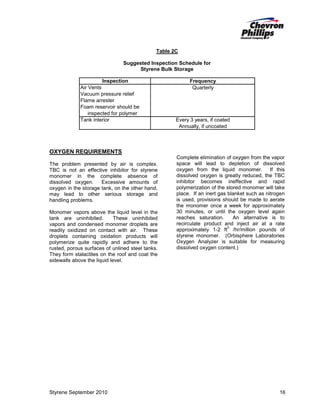
Table 2C
Suggested Inspection Schedule for
Styrene Bulk Storage

Inspection
Air Vents
Vacuum pressure relief
Flame arrester
Foam reservoir should be
inspected for polymer
Tank interior

Frequency
Quarterly

Every 3 years, if coated
Annually, if uncoated

OXYGEN REQUIREMENTS
The problem presented by air is complex.
TBC is not an effective inhibitor for styrene
monomer in the complete absence of
dissolved oxygen.
Excessive amounts of
oxygen in the storage tank, on the other hand,
may lead to other serious storage and
handling problems.
Monomer vapors above the liquid level in the
tank are uninhibited.
These uninhibited
vapors and condensed monomer droplets are
readily oxidized on contact with air. These
droplets containing oxidation products will
polymerize quite rapidly and adhere to the
rusted, porous surfaces of unlined steel tanks.
They form stalactites on the roof and coat the
sidewalls above the liquid level.

Styrene September 2010

Complete elimination of oxygen from the vapor
space will lead to depletion of dissolved
oxygen from the liquid monomer. If this
dissolved oxygen is greatly reduced, the TBC
inhibitor becomes ineffective and rapid
polymerization of the stored monomer will take
place. If an inert gas blanket such as nitrogen
is used, provisions should be made to aerate
the monomer once a week for approximately
30 minutes, or until the oxygen level again
reaches saturation.
An alternative is to
recirculate product and inject air at a rate
3
approximately 1-2 ft /hr/million pounds of
styrene monomer. (Orbisphere Laboratories
Oxygen Analyzer is suitable for measuring
dissolved oxygen content.)

16
TABLE 3A
CC of Concentrate (TBC In Styrene) Required for 10 ppm TBC in Styrene*
(186 gm. TBC/liter styrene)

Gallons

→

100

200

300

400

500

600

700

800

900

↓

--

18.2cc

36.8

55.2

73.6

92.0

110.4

128.8

147.2

165.6

1,000

184

202

221

239

258

276

294

313

331

350

2,000

368

386

405

423

442

460

478

497

515

534

3,000

552

570

589

607

626

644

662

681

699

718

4,000

736

754

773

791

810

828

846

865

883

902

5,000

920

938

957

975

994

1012

1030

1048

1067

1086

6,000

1104

1122

1141

1159

1178

1196

1214

1233

1251

1270

7,000

1288

1306

1325

1343

1362

1380

1398

1417

1435

1454

8,000

1472

1490

1509

1527

1546

1564

1582

1601

1619

1638

9,000

1656

1674

1693

1711

1730

1748

1766

1785

1803

1822

10,000

1840

1858

1877

1895

1914

1932

1950

1969

1987

2006

* Calculated using styrene density at 20°C

Styrene September 2010

17
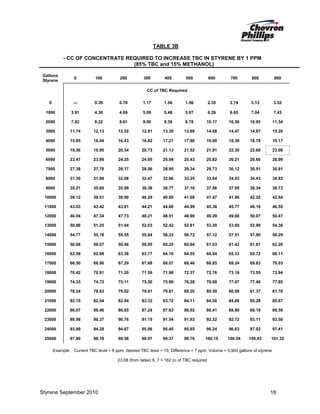
TABLE 3B
- CC OF CONCENTRATE REQUIRED TO INCREASE TBC IN STYRENE BY 1 PPM
(85% TBC and 15% METHANOL)
Gallons
Styrene

0

100

200

300

400

500

600

700

800

900

CC of TBC Required
0

---

0.39

0.78

1.17

1.56

1.96

2.35

2.74

3.13

3.52

1000

3.91

4.30

4.69

5.09

5.48

5.87

6.26

6.65

7.04

7.43

2000

7.82

8.22

8.61

9.00

9.39

9.78

10.17

10.56

10.95

11.34

3000

11.74

12.13

12.52

12.91

13.30

13.69

14.08

14.47

14.87

15.26

4000

15.65

16.04

16.43

16.82

17.21

17.60

18.00

18.39

18.78

19.17

5000

19.56

19.95

20.34

20.73

21.13

21.52

21.91

22.30

22.69

23.08

6000

23.47

23.86

24.25

24.65

25.04

25.43

25.82

26.21

26.60

26.99

7000

27.38

27.78

28.17

28.56

28.95

29.34

29.73

30.12

30.51

30.91

8000

31.30

31.69

32.08

32.47

32.86

33.25

33.64

34.03

34.43

34.82

9000

35.21

35.60

35.99

36.38

36.77

37.16

37.56

37.95

38.34

38.73

10000

39.12

39.51

39.90

40.29

40.69

41.08

41.47

41.86

42.25

42.64

11000

43.03

43.42

43.81

44.21

44.60

44.99

45.38

45.77

46.16

46.55

12000

46.94

47.34

47.73

48.21

48.51

48.90

49.29

49.68

50.07

50.47

13000

50.86

51.25

51.64

52.03

52.42

52.81

53.20

53.60

53.99

54.38

14000

54.77

55.16

55.55

55.94

56.33

56.72

57.12

57.51

57.90

58.29

15000

58.68

59.07

59.46

59.85

60.25

60.64

61.03

61.42

61.81

62.20

16000

62.59

62.98

63.38

63.77

64.16

64.55

64.94

65.33

65.72

66.11

17000

66.50

66.90

67.29

67.68

68.07

68.46

68.85

69.24

69.63

70.03

18000

70.42

70.81

71.20

71.59

71.98

72.37

72.76

73.16

73.55

73.94

19000

74.33

74.72

75.11

75.50

75.89

76.28

76.68

77.07

77.46

77.85

20000

78.24

78.63

79.02

79.41

79.81

80.20

80.59

80.98

81.37

81.76

21000

82.15

82.54

82.94

83.33

83.72

84.11

84.50

84.89

85.28

85.67

22000

86.07

86.46

86.85

87.24

87.63

88.02

88.41

88.80

89.19

89.59

23000

89.98

90.37

90.76

91.15

91.54

91.93

92.32

92.72

93.11

93.50

24000

93.89

94.28

94.67

95.06

95.45

95.85

96.24

96.63

97.02

97.41

25000

97.80

98.19

98.58

98.97

99.37

99.76

100.15

100.54

100.93

101.32

Example: Current TBC level = 8 ppm; desired TBC level = 15; Difference = 7 ppm; Volume = 5,900 gallons of styrene
23.08 (from table) X, 7 = 162 cc of TBC required

Styrene September 2010

18
TABLE 3B
SOLID TBC ADDITION CALCULATION TABLE
Truck
Volume
184,000

Amount of Solid TBC to be added, in Ounces

lbs

Initial

Target TBC Level in truck or vessel

TBC level

15

20

25

30

35

40

45

50

55

60

10.0

14

30

44

58

74

88

104

118

132

148

10.5

14

28

42

58

72

86

102

116

132

146

11.0

12

26

42

56

70

86

100

114

130

144

11.5

10

26

40

54

70

84

98

114

128

142

12.0

8

24

38

52

68

82

98

112

126

142

12.5

8

22

36

52

66

80

96

110

126

140

13.0

6

20

36

50

64

80

94

108

124

138

13.5

4

20

34

48

64

78

92

108

122

136

14.0

2

18

32

48

62

76

92

106

120

136

14.5

2

16

30

46

60

76

90

104

120

134

15.0

0

14

30

44

58

74

88

104

118

132

TBC level

15

20

25

30

35

40

45

50

55

60

10.0

15

20

25

30

35

40

45

50

55

60

10.5

15

20

25

30

35

40

45

50

55

60

11.0

15

20

25

30

35

40

45

50

55

60

11.5

15

20

25

30

35

40

45

50

55

60

12.0

15

20

25

30

35

40

45

50

55

60

12.5

15

20

25

30

35

40

45

50

55

60

13.0

15

20

25

30

35

40

45

50

55

60

13.5

15

20

25

30

35

40

45

50

55

60

14.0

15

20

25

30

35

40

45

50

55

60

14.5

15

20

25

30

35

40

45

50

55

60

15.0

15

20

25

30

35

40

45

50

55

60

2

6

8

12

16

18

22

26

30

32

Initial

Target TBC Level in truck or vessel

Initial

Target TBC Level in truck or vessel

TBC level

15

20

25

30

35

40

45

50

55

60

10.0

11

12

13

14

15

16

17

19

20

21

10.5

11

13

13

15

16

17

18

19

21

21

11.0

12

13

14

15

16

17

18

20

21

22

11.5

12

14

14

16

17

18

19

20

22

22

12.0

13

14

15

16

17

18

19

21

22

23

12.5

13

15

15

17

18

19

20

21

23

23

13.0

14

15

16

17

18

19

20

22

23

24

13.5

14

16

16

18

19

20

21

22

24

24

14.0

15

16

17

18

19

20

21

23

24

25

14.5

15

17

17

19

20

21

22

23

25

25

15.0

16

17

18

19

20

21

22

24

25

26

TBC Conc.

100%

Styrene September 2010

19
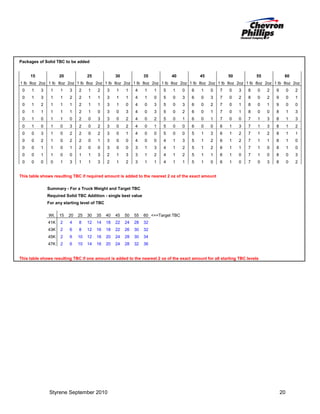
Packages of Solid TBC to be added
16

8

2

16

15

8

2

16

20

8

2

16

25

8

2

16

30

8

2

16

35

8

2

16

40

8

2

16

45

8

2

16

50

8

2

16

55

8

2

60

1 lb 8oz 2oz 1 lb 8oz 2oz 1 lb 8oz 2oz 1 lb 8oz 2oz 1 lb 8oz 2oz 1 lb 8oz 2oz 1 lb 8oz 2oz 1 lb 8oz 2oz 1 lb 8oz 2oz 1 lb 8oz 2oz
0

1

3

1

1

3

2

1

2

3

1

1

4

1

1

5

1

0

6

1

0

7

0

3

8

0

2

9

0

2

0

1

3

1

1

2

2

1

1

3

1

1

4

1

0

5

0

3

6

0

3

7

0

2

8

0

2

9

0

1

0

1

2

1

1

1

2

1

1

3

1

0

4

0

3

5

0

3

6

0

2

7

0

1

8

0

1

9

0

0

0

1

1

1

1

1

2

1

0

3

0

3

4

0

3

5

0

2

6

0

1

7

0

1

8

0

0

8

1

3

0

1

0

1

1

0

2

0

3

3

0

2

4

0

2

5

0

1

6

0

1

7

0

0

7

1

3

8

1

3

0

1

0

1

0

3

2

0

2

3

0

2

4

0

1

5

0

0

6

0

0

6

1

3

7

1

3

8

1

2

0

0

3

1

0

2

2

0

2

3

0

1

4

0

0

5

0

0

5

1

3

6

1

2

7

1

2

8

1

1

0

0

2

1

0

2

2

0

1

3

0

0

4

0

0

4

1

3

5

1

2

6

1

2

7

1

1

8

1

0

0

0

1

1

0

1

2

0

0

3

0

0

3

1

3

4

1

2

5

1

2

6

1

1

7

1

0

8

1

0

0

0

1

1

0

0

1

1

3

2

1

3

3

1

2

4

1

2

5

1

1

6

1

0

7

1

0

8

0

3

0

0

0

0

1

3

1

1

3

2

1

2

3

1

1

4

1

1

5

1

0

6

1

0

7

0

3

8

0

2

This table shows resulting TBC if required amount is added to the nearest 2 oz of the exact amount
Summary - For a Truck Weight and Target TBC
Required Solid TBC Addition - single best value
For any starting level of TBC
Wt.

15

20

25

30

35

40

45

50

55

60 <==Target TBC

41K

2

4

8

12

14

18

22

24

28

32

43K

2

6

8

12

16

18

22

26

30

32

45K

2

6

10

12

16

20

24

28

30

34

47K

2

6

10

14

16

20

24

28

32

36

This table shows resulting TBC if one amount is added to the nearest 2 oz of the exact amount for all starting TBC levels

Styrene September 2010

20
ADDITION OF TBC TO STORED
MONOMER
Styrene monomer in storage should be
checked periodically for TBC content and
additional inhibitor added as required (see
previous section on Inhibition). A good policy
is to add additional inhibitor when the level
drops to the minimum specification level. The
TBC content of styrene monomer in storage
should never be allowed to be depleted or
remain below the 10 ppm level. The storage
tank (or drum) should always be recirculated
or mixed after inhibitor is added. This ensures
uniform blending of the TBC and supplies an
adequate amount of dissolved oxygen in the
monomer for effective inhibition. Caution must
be exercised in handling TBC.
See
information on toxicological properties and
safe handling of TBC as well as
manufacturer’s MSDS.
TBC concentrates (85% TBC in 15%
methanol) can also be obtained from Chevron
Phillips Chemical Company on an emergency
basis.
Table 3B lists the amount of
concentrate required to increase the bulk
quantity by 1 ppm. The amount of inhibitor
required to achieve the assured inhibition level
can also be calculated using the following
formula:

are allowed to grow, their weight may damage
the roof or roof-supporting structure of large
vertical storage tanks.

COLOR PROBLEMS
Styrene in storage occasionally develops color
which can be carried into the polymerization
product. For this reason, a maximum color
specification of APHA 10 has been set for
many styrene end uses.
Color may develop in several ways:
1.
Copper or copper-containing alloys can
form soluble copper salts when contacted by
styrene. These will impart a green or bluegreen color to the monomer and may also
inhibit its polymerization.
2.
Highly-colored
styrene
oxidation
products may form in the liquid monomer or be
introduced by polymer falling or dissolving
from the walls and roof.
3.
TBC may oxidize to form highly-colored
reaction products.
4.
Iron, usually originating from rust in
tanks or in piping, may react or complex with
TBC at the ppm level to give styrene a yellow
or yellow-green color.

cc’s of TBC concentrate =
lbs. of styrene x PPM TBC - PPM TBC required in product x 503
1,000,000

POLYMER BUILDING IN STORAGE
The polymer deposited under storage
conditions will be discolored, cross-linked, and
high in peroxides, aldehydes, and other
oxidation products. Deposits of contaminated
polymer could eventually produce serious
color and polymer problems in monomer
stored under air in unlined steel tanks.
Internal reflux, (the vaporization and
condensation due to normal temperature
differentials) will dissolve small amounts of this
polymer and carry it back into the tank,
thereby increasing both the polymer content
and the color of the stored monomer.
Polymer deposits in tanks also create difficult
removal and cleaning problems. If stalactites

Styrene September 2010

5.
Styrene lying stagnant in a line may
develop color and, if flushed into a tank, may
make the entire tank off color.
Color problems in storage can be minimized
by:
1.
Avoiding use of copper or copper
alloyed material in contact with styrene
monomer.
2.
Paying careful attention to the oxygen
level in the styrene and in the vapor space
above the styrene.
3.
Employing proper tank design and
maintenance to avoid rust and polymer buildup on tank walls and roof.
4.

Applying good transfer practices.

21
Color in styrene monomer can be reduced to
acceptable limits by:
1.

Distilling the colored monomer.

2.
Blending with non-colored styrene.
Caution should be used, however, since color
does not always blend proportionately. Small
trial blends should be made to determine the
feasibility of this approach.
3.
Passing the styrene over silica gel or
alumina. This method has the disadvantage of
removing the TBC inhibitor, which must be
replaced. Acidic or highly-activated alumina
may cause the styrene to polymerize. Verify
the applicability of the material selected by
using a small bench scale test.

PARTICULATE MATTER
Styrene should be free of particulate matter
when it is polymerized.
Although some
particulate matter in styrene originates from
outside contamination via the receivingtransfer system, it is also formed by the
reaction of concentrated TBC solutions with
iron. This may happen in lines which have
contained styrene but have been blown dry.
Particulate matter in styrene may be avoided
by:
1.

Paying careful attention to cleanliness.

advisable that inventories be kept to a
minimum during summer months and that
monomer is stored no longer than necessary.
Adding additional TBC during hot weather is
also recommended. Styrene should be stored
in white drums that reflect sunlight as a means
to control temperature.

TANKS
In designing bulk storage facilities, certain
basic factors must be considered. Styrene
monomer can be stored for relatively long
periods of time if simple, but carefully
prescribed conditions are met. In addition to
the usual precautions taken with flammable
liquids against fire and explosion hazards,
precautions must be taken against conditions
that will promote the formation of polymer and
oxidation products. To accomplish this, the
design and construction of a satisfactory bulk
storage system for styrene requires careful
consideration
to
eliminate
excessive
temperatures and to prevent contamination
with polymer from infrequently used lines and
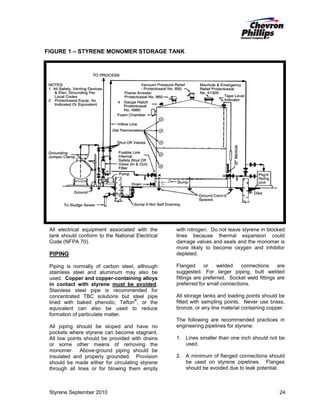
other equipment. Figures 1 illustrates a typical
tank design.
A
self-supporting-type
dome
roof
is
recommended for vertical storage tanks. This
type of construction simplifies the installation
of linings and permits rapid drainage of
uninhibited condensed vapors back into the
liquid monomer, thus reducing the polymer
and stalactite problem. Roof and sidewall
openings above the normal liquid levels in the
tank should be of large diameter and the
number kept to a minimum.

2.
Properly coating the inside of tanks and
transfer lines which may contain high
concentrations of TBC or which may be blown
dry after carrying TBC-inhibited styrene.
Stainless steel vessels and lines are also
recommended.

Large diameter openings are easily lined and
can also be used for dual-service purposes
where feasible.

3.
Filtering styrene to remove particulate
matter before storage, shipment, or use.

Insulation and refrigeration of storage tanks
are recommended for environments where
temperatures exceed 75°F for long periods of
time.

DRUMS
Drums of styrene monomer should not be
permitted to stand in the sun for more than a
short period of time. As soon as possible after
being received, drums should be moved to a
cool, shaded area. In hot weather drums can
be cooled with a water spray. It is also

Styrene September 2010

Most consuming locations insulate storage
tanks to dampen the effect of high day time
temperatures but do not install refrigeration
due to cost.
Lined carbon steel tanks are generally used
for the bulk storage of styrene monomer.

22
Vertical storage tanks are commonly used for
large volume storage. Horizontal tanks are
equally satisfactory for bulk storage, but are
generally used for smaller installations. The
inlet and outlet lines for these tanks are
normally located near the bottom.
Tank linings have proven successful in
controlling or reducing polymer and stalactite
formation. A tight, nonporous, non-wettable,
smooth surface prevents retention and
attachment of the condensed uninhibited
monomer droplets, and they rapidly drain back
into the inhibited liquid monomer before
polymerization takes place. Baked phenolic,
modified epoxy and inorganic zinc silicates
have proven satisfactory for this purpose.
Baked phenolic and modified epoxy coatings
are nonconductive, however, and it is
recommended that the bottom and lower 6 to
8 inches of vertical storage tanks be coated
with inorganic zinc silicate linings to provide
electrical grounding.
Table 4 lists some suppliers and specific
products for the various types of coatings as of
this printing. List is subject to change and
Chevron Philips does warrant or certify any
product or supplier.
Various Phenguard coatings applied with TBC
have reportedly been effective in controlling
polymer growth inside storage tank (including
vapor space) and reducing maintenance. The
specific Phenguard coating and the supplier
(who will supply specific directions for
preparing and applying these coatings) are
listed in Table 4.
Table 4
Type of Coatings and Suppliers

2. Lithcote Phenolic Lithcote Corporation
LC-24
111 West Jackson
Blvd.
Chicago, IL 60604
3. Phenguard 7409, Sigma Coatings
7435 and 7436 P.O. Box 816
Harvey, LA. 70058
Modified Epoxy
1. Lithcote LC34

Lithcote Corporation
111 West Jackson
Blvd.
Chicago, IL 60604

2. Amercoat 346

Ameron Protective
Coatings Division
201 North Berry St.
Brea, CA 92621

Other equivalent or comparable coatings are
undoubtedly available and may be equally
satisfactory, but it would be advisable to check
their resistance characteristics and obtain
information on their performance for this
application from the manufacturer before use.
Rubber-based linings should not be used.
Requirements of diking, tank spacing, and
other features pertaining to safety are detailed
in guidelines set by the National Fire
Protection Association (see NFPA 30). These,
as well as local building codes and
governmental regulations, should be consulted
since some requirements vary with the size
and configuration of an installation.

Inorganic Zinc Silicate
1. Interzinc 98
2. Interzinc 88

Matcote Co.
P.O. Box 920762
Houston, TX 77292

3. Dimetcote No. 4 Ameron Protective
4. Dimetcote No. 6 Coatings Division
201 North Berry St.
Brea, CA 92621
Baked Phenolic
1. Heresite P403

Heresite Chemical Co.
822 South 14th Street
Manitowac, WI 54220

Styrene September 2010

23
FIGURE 1 – STYRENE MONOMER STORAGE TANK

All electrical equipment associated with the
tank should conform to the National Electrical
Code (NFPA 70).

PIPING
Piping is normally of carbon steel, although
stainless steel and aluminum may also be
used. Copper and copper-containing alloys
in contact with styrene must be avoided.
Stainless steel pipe is recommended for
concentrated TBC solutions but steel pipe
®
lined with baked phenolic, Teflon , or the
equivalent can also be used to reduce
formation of particulate matter.
All piping should be sloped and have no
pockets where styrene can become stagnant.
All low points should be provided with drains
or some other means of removing the
monomer. Above-ground piping should be
insulated and properly grounded. Provision
should be made either for circulating styrene
through all lines or for blowing them empty

Styrene September 2010

with nitrogen. Do not leave styrene in blocked
lines because thermal expansion could
damage valves and seals and the monomer is
more likely to become oxygen and inhibitor
depleted.
Flanged
or
welded
connections
are
suggested. For larger piping, butt welded
fittings are preferred. Socket weld fittings are
preferred for small connections.
All storage tanks and loading points should be
fitted with sampling points. Never use brass,
bronze, or any line material containing copper.
The following are recommended practices in
engineering pipelines for styrene:
1. Lines smaller than one inch should not be
used.
2. A minimum of flanged connections should
be used on styrene pipelines. Flanges
should be avoided due to leak potential.

24
4. The pump shaft should be highly polished.
3. Styrene lines should not be buried
because of the difficulty of checking for
leakage.
4. All lines should be sloped so that they can
be completely drained for maintenance.
5. All newly installed styrene pipelines should
be pressure tested by an approved
method before insulation is applied.

5. Pumps should not be subjected to forces
beyond specified pump tolerances.

6. Vibration monitoring with automatic pump
shutdown may be applicable in certain
situations.

VALVES
6. Bellows valves are recommended for 2inch and smaller lines to eliminate
emissions from packing.

PUMPS
Centrifugal pumps are preferred for styrene
service. They should be fitted with closed
impellers and mechanical seals.

®

are
Ball valves with seats of Viton
satisfactory for styrene service under ambient
storage conditions. Gate valves are less
satisfactory but they are usually less
expensive and may be used.

GASKETS
Garlock No. 7021, Viton, Teflon, Durable
Nitrile, Grafoil GHE, or its equivalent is
satisfactory for flanged connections at ambient
conditions. Reinforced graphite composite
gaskets are also recommended. Gaskets
made of rubber or other styrene-soluble
materials should not be used.
®

The pump manufacturers can recommend the
proper pump if the following parameters are
known: 1) flow rate, 2) size and length of
suction and discharge lines, 3) suction and
discharge pressures and, 4) the styrene
monomer temperature. A drain valve should
be installed at the lowest point in the system
so that the pump and all piping can be
completely drained before any maintenance
work is done. Totally closed fan cooled
motors are recommended; however local fire
and insurance codes should be consulted to
determine if an explosion proof motor must be
used.

FILTERS

All pump motors should meet National
Electrical Code standards (NFPA 70).

Since small amounts of foreign matter may
enter storage tanks from various sources, a
filter in the transfer piping between the tank
and processing equipment is recommended.
Cartridge type filters with a fine or medium
replaceable cartridge or bag filters are
suggested. Polyester, Nomex, Rayon and
Nylon fiber filters are compatible with styrene.

The following practices are recommended to
minimize the possibility of pump leakage.

Filter cartridges should be inspected and
renewed periodically.

1. Mechanical seals in conformance with API
RP 682. Tandem seals with barrier fluid
are recommended.

HOSES

2. Pumps in conformance with API Standard
610.
3. The pump should be designed so that the
pump bearings will be able to carry thrust
at no flow.
Consider selecting nonmetallic (PEEK) wear rings to minimize
damage if the pumps run dry.

Styrene September 2010

If hoses are needed for loading or unloading
operations, they should be flexible and
chemical-resistant.
A satisfactory type is
®
Goodyear, rough-bore, style WH-7 with Viton
tube, or the equivalent.
Multi-layered
®
are
also
polypropylene
and
Teflon
recommended.
Flexible metal hoses are widely used and
recommended but require special care to
prevent damage during use.

25
Styrene monomer should not be allowed to
remain in any hose after use because the
monomer will polymerize and form undesirable
reaction products. Promptly drain and clean
these lines after usage.
Toluene or
ethylbenzene may be used to clean lines.
All lines must be adequately grounded to
discharge static electricity.
All hoses should have suitable pressure and
temperature ratings and be grounded to
discharge static electricity.

The first coating should be applied within eight
hours after sandblasting is completed. It must
be applied before any rust appears or “turning”
occurs in the “White Blast.”
Otherwise,
reblasting to the “White” condition will be
necessary.
1. A brushed prime coat should be applied to
all welds, rounded edges and other
irregular surfaces, working the paint well
into the metal.
2. Apply a full sprayed coat of primer over
brushed surfaces. Allow to dry overnight.
Dry film thickness should be 1.5-2.5 mils.

O-RINGS
Viton, Teflon, Fluoul, or their equivalents
are recommended.

PROCEDURE FOR COATING TANKS
All internal surfaces should be coated (except
for the floor and bottom of the vertical walls
below the normal liquid level) to prevent
accumulation of static electricity. This
includes, in addition to the tank, all internal
surfaces of nozzles, manholes, manhole
covers, internal fittings and all surfaces that
may contact the liquid contents of the tank or
be exposed to vapors from the liquid. If any
internal fittings are of non-ferrous metal, they
should be removed and replaced when the
lining is completed.
All sharp edges and high points should be
ground smooth and rounded to a minimum
radius of 1/8”. Welded seams need not be
ground flush; however, welds should be free
from undercuts or pinholes. If either exists,
they should be ground out, filled with weld
metal or epoxy putty, and ground smooth.
Weld spatter beads should be removed by
grinding or by the sand blasting which follows.
All internal surfaces to be lined should be
sandblasted to the degree defined as “White
Metal Blast” by Steel structures Painting
Council Specification SP-5-63. Anchor pattern
depth should conform to a minimum of 1.5
mils and a maximum of 2 mils. Loose material
such as sand, grit, dust, or any foreign matter
should be removed from the tank, preferably
by use of an industrial vacuum cleaner.

Styrene September 2010

3. Apply one sprayed coat of intermediate
primer to all surfaces.
Allow to dry
overnight. The total dry film thickness of
this and the preceding coat should be 3-4
mils. (Note: some colored primers may
dissolve in styrene and discolor it unless
the primer is completely covered by
subsequent coats of paint.)
4. Apply one sprayed coat of finish paint to
all surfaces. Allow to dry overnight. The
total dry film thickness following this step
should be 4.5-6 mils
Recommendations of the paint manufacturer
regarding mixing, thinning, etc. should be
followed. Curing and drying times, should be
in accordance with the paint manufacturer’s
recommendations.
The completed lining should be free of
pinholes, abrasions or other breaks in film
continuity, runs, sags and overspray. Each
coat should be inspected after it has dried and
before the following coat is applied).
Caution - The solvents used in these paints
can be toxic if breathed or absorbed in large
quantities. They may also cause dermatitis in
some individuals.
Consequently, it is
recommended that personnel wear suppliedair respirators and protective clothing while
working.
Forced-air ventilation should be
provided during blast-cleaning and liningsapplication work since the solvents are also
flammable.
The ventilation should be
maintained at all times while personnel are in
enclosed areas and for thirty minutes to an
hour after lining work has been completed for

26
the day. An adequate number of air changes
must be provided to keep solvent vapors
below lower explosive limits. After lining work
has been completed, forced-air ventilation
should be maintained until all solvent fumes
have been removed.
Personnel should never be permitted to
enter an empty tank which has been used
for Styrene until the requirements of the
OSHA confined space standard (29 CFR
1910.146) have been met and the safe entry
recommendations of API Standard 2015
have been met including, but not limited to,
required concentrations for oxygen and
limitations on concentrations of Styrene.
Specific bulk storage designs must
conform to insurance underwriter’s codes
and local fire and building regulations.
Critical design, placement, installation and
maintenance requirements are usually
addressed in these codes and regulations
and must be followed.

API RP 2003: Protection Against Ignitions
Arising Out of Static, Lightning, and Stray
Currents
API RP 2028:
Systems

Flame Arresters in Piping

API RP 2210: Flame Arresters for Vents of
Tanks Storing Petroleum Products
API RP 2350: Overfill Protection for Storage
Tanks in Petroleum Facilities
API Standard 2015: Requirements for Safe
Entry and Cleaning of Petroleum Storage
Tanks
API Standard 653: Tank Inspection, Repair,
Alteration, and Reconstruction

API DESIGN REFERENCES
API Petroleum Institute
1220 L Street, NW
Washington, DC 20005
Part I - Design
API RP 520: Sizing, Selection and Installation
of Pressure-relieving Devices in Refineries
Part II - Installation
API Standard 601:
Metallic Gaskets for
Raised-Face Pipe Flanges and Flanged
Connections (Double-Jacketed Corrugated
and Spiral-Wound)
API Standard 620: Design and Construction
of Large, Welded, Low-Pressure Storage
Tanks
API Standard 650: Welded Steel Tanks for Oil
Storage
API Standard 2000: Venting Atmospheric and
Low-Pressure Storage Tanks; Nonrefrigerated
and Refrigerated

Styrene September 2010

27
PART 4
ACCIDENTAL RELEASE, FIRE AND HEALTH
Although the handling of styrene is considered
to present a low degree of health risk,
exposure to this product should always be
minimized. Extensive experience has shown
that this monomer can be handled safely if its
toxicological properties are clearly understood
and proper precautions are practiced.
Material Safety Data Sheets for styrene are
available from Chevron Phillips Chemical
Company LP to help customers further satisfy
their own safe handling and disposal needs
and OSHA Hazard Communication Rule
requirements. Such information should be
requested and studied prior to working with
this product. Please call Chevron Phillips
Chemical Company LP at (800) 231-1212 to
request the MSDS for styrene. NOTE: This
booklet does not substitute for the MSDS.
The following briefly summarizes the
toxicological information.
The precautions
recommended are, of necessity, general in
nature, because specific recommendations
can be made only when the conditions of
handling are known.

ACCIDENTAL RELEASE MEASURES
If a transportation incident involving styrene
does occur, the Chemical Transportation
Emergency Center (CHEMTREC) should be
contacted
for
immediate
assistance.
CHEMTREC is a public service organization
established by the American Chemistry
Council to provide assistance in hazardous
material incidents. FOR A CHEMICAL
EMERGENCY CALL CHEMTREC AT (800)
424-9300 toll free in the United States,
Canada, Puerto Rico, and the Virgin
Islands. For emergency calls outside the
United States call + (703) 527-3887. Collect
calls are accepted.
CHEMTREC will provide the caller preliminary
emergency assistance in the form of Material
Safety Data Sheet (MSDS) information. In all
cases once CHEMTREC determines the

Styrene September 2010

incident involves a Chevron Phillips Chemical
material, CHEMTREC will immediately contact
the on-call Chevron Phillips Chemical
Company LP Crisis Management Team (CMT)
member at 1-866-4HAZMAT (442-9628). The
contacted Chevron Phillips Chemical CMT
member will then be responsible for
coordinating an appropriate response to the
transportation incident. In addition, if the CMT
member determines that the incident involves
exposure or potential health effects, the oncall Chevron Phillips Chemical toxicologist will
also be contacted.
Eliminate all sources of ignition in the vicinity
of the spill or released vapor. Stop the source
of the leak or release. Clean up releases as
soon as possible, observing personal
protection precautions (see below). Contain
liquid to prevent further contamination of soil,
surface water or groundwater. Styrene is
expected to be toxic to aquatic organisms.
Avoid contaminating soil or releasing this
material into sewage or drainage systems and
bodies of water. Clean up small spills using
appropriate techniques such as sorbent
materials or pumping. Where feasible and
appropriate, remove contaminated soil.
Follow prescribed procedures for reporting
and responding to larger releases.
The
Reportable Quantity (RQ) under CERCLA
Section 302.4 is 1000 lbs. USA regulations
require reporting spills of this material that
could reach any surface waters. The toll free
number for the U.S. Coast Guard National
Response Center is (800) 424-8802.

SPILLS
If styrene has been spilled, it can be removed
safely for disposal. Before attempting to clean
up the spill be sure that the flow of liquid has
been stopped and that all sources of ignition
are eliminated. Small spills (non-marine) can
be removed by covering the spill with sand or
a suitable absorbent. Some absorbing agents,
such as untreated clays and micas, will cause
an exothermic reaction which might ignite the

28
monomer. For this reason, absorbing agents
should be tested for their effect on
polymerization of the monomer before they
®
are used on large spills. Claymax , a loose
“vermiculite-like” material has proved to be an
®
effective absorbent.
Claymax may be
purchased from:
Road Fabric, Inc.
Environmental Division
27 West 045 St. Charles Road
Carol Stream, IL 60188
Phone: (630) 293-3111
Contact local environmental or health
authorities for approved disposal of the
absorbing agent. If the spill is on a hard
surface, the area should be scrubbed with
soap and water after the bulk of the monomer
has been removed.

include self-contained breathing apparatus to
protect against the hazardous effects of
normal products of combustion or oxygen
deficiency. Normal combustion forms carbon
dioxide and water vapor; incomplete
combustion can produce carbon monoxide.
Extinguish with foam, dry chemical or carbon
dioxide. Use water in flooding quantities as
fog; solid streams of water may be ineffective.
Cool exposed containers with water.
Flash Point:

31°C (88°F) Closed
Cup

Ignition Temp.:

490°C (914°F)

Flammable Limits in Air: 1.1 - 6.1 Vol%
Electrical Hazards:

Class 1, Group D

Behavior in Fire:

Vapor is heavier
than air and may
travel a considerable
distance to a source
of ignition and flash
back. At elevated
temperatures, such
as in fire conditions,
polymerization may
take place, which
may lead to
container explosion.

Larger spills should be contained within a dike,
and water pumped into the area immediately.
This will prevent the monomer from soaking
into the ground and will allow it to be pumped
off the water layer for recovery.
Styrene is toxic to aquatic organisms and
should be kept out of sewage and drainage
systems and all bodies of water.

DISPOSAL
All disposal procedures are to be carried out in
strict conformance to federal, state and local
regulations. Styrene monomer and absorbentcontaining styrene must be incinerated in an
approved designated furnace. Please contact
Chevron
Phillips
Chemical
Company
Aromatics Technical Service Group at (877)
771-7176 if additional assistance is required.

FIRE HAZARDS
This product presents a fire hazard. The liquid
evaporates, and forms vapor (fumes) which
can catch fire and burn with explosive
violence. Invisible vapor spreads easily and
can be set on fire by many sources such as
pilot lights, welding equipment, and electrical
motors and switches.

Burning Rate:

5.2 mm/min.

NFPA Fire Hazard Rating:

3

FLAMMABILITY
Styrene monomer is classified by both OSHA
29 CFR 1910.26 and National Fire Protection
Association (NFPA) Code 30 as a Class IC
flammable liquid. The National Electric Code
(NFPA 70) refers to styrene as a Class I,
Group D material.
Styrene will burn and requires the same
precautions against fire and explosion hazards
that commonly apply to other combustible and
flammable liquids. The flammability properties
of styrene are given in the Physical Properties
section (Part 1, Pages 3-6).

For fires involving this material, do not enter
any enclosed or confined fire space without
proper protective equipment.
This may

Styrene September 2010

29
EXPLOSIVE MIXTURES
Styrene vapor is heavier than air and could
travel considerable distances to an ignition
source and flash back to the source.
It is important to prevent the formation of
explosive or combustible mixtures, and to take
precautions to avoid ignition of any such
mixtures.
Monomer handling areas should be well
ventilated and motors must be explosionproof. ALL TANK CARS, TANK TRUCKS,
HOSE
CONNECTIONS
AND
OTHER
EQUIPMENT MUST BE GROUNDED FOR
THE SAFE DISCHARGE OF STATIC
ELECTRICITY.
Storage tanks and other
containers that have been emptied of
monomer must be flushed out with steam,
nitrogen, or water to remove monomer vapor.
The tank atmosphere should be tested before
the tank is entered or worked on with welding
equipment.
The dangers of fire and explosion are real
because styrene can form explosive mixtures
in air at room temperatures. Precautions
should be taken to assure that no ignition of
vapors can occur, especially where elevated
temperatures are involved.
Precautions include:
1. Regular equipment inspections
2. Immediate repair of leaks
3. Good ventilation
4. Proper facilities to contain spills
quickly
5. Use of special alloy, non-sparking
tools
6. Periodic tests of pressure equipment
7. Elimination of all possible ignition
sources
It is also important, at all times, to prevent the
formation of explosive or combustible mixtures
at other than normal pressures and
temperatures.
While the actual operating
conditions may be outside the explosive limits,

Styrene September 2010

the vapor system may pass through the
explosive range in reaching the desired
operating conditions. Thus, a vacuum
impregnation at 50°C and 100 mm Hg
pressure involves a non-explosive mixture of
styrene vapor and air. However, during the
evacuation step from atmospheric pressure to
100 mm pressure, the system goes through
the explosive range. If the evacuation is
performed at 20°C and the system is then
heated to 50°C, the explosive range will be
avoided completely.
If the system is properly flushed with nitrogen
or other inert gases (helium, carbon dioxide)
prior to evacuation, or if such gases are used
for pressurizing, all such dangers are reduced.

FIRES
Locations that depend on local fire companies
should provide them with information
concerning the properties of styrene, their
operations and details (including diagrams) of
storage vessels, quantities stored and other
pertinent details.
Fires involving styrene monomer can be safely
extinguished with foam, dry chemical, or
carbon dioxide. Water fog can also be used,
however, a water stream is not an effective
extinguishing agent for styrene. If electrical
equipment such as motors, open hot plates, or
open electrical switches are involved, foam
should be used with caution. When burning,
styrene gives off toxic by-products, such as
carbon monoxide gas. For this reason,
breathing of fumes, smoke, and gas from a
styrene fire should be avoided. Do not enter
any enclosed or confined fire space without
full protective equipment, which include a selfcontained breathing apparatus.
People conducting the clean up should be
trained to satisfy OSHA Hazardous Operations
and Emergency Response Standard 29 CFR
1910.120 requirements.
After the fire has been put out, any residual
monomer should be secured in proper storage
or cleaned up to prevent loss to the
environment. If significant product is lost
contact your local environmental agency.

30
PERSONAL PROTECTIVE EQUIPMENT
AND OCCUPATIONAL EXPOSURE
LIMITS
Wear safety glasses with side shields as a
good safety practice when working with
styrene. Wear impervious protective clothing
to prevent skin contact. Selection of protective
clothing may include gloves, apron, boots and
complete facial protection and will depend on
operations conducted.
Users should
determine
acceptable
performance
characteristics of protective clothing. Consider
physical requirements and other substances
present when selecting protective clothing.
Suggested materials for protective gloves
include Viton, 4H (Polyethylene-Ethylene
Vinyl Alcohol laminate), and Polyvinyl Alcohol
(PVA) (avoid contact with water; PVA
deteriorates in water). Determine if airborne
concentrations are below the recommended
exposure limits. If not, select a NIOSH/MSHAapproved organic vapor respirator that
provides adequate protection from measured
concentrations of this material. Use a positivepressure, air-supplying respirator if there is
potential for uncontrolled release, if exposure
levels are not known, or if other circumstances
exist where air-purifying respirators may not
provide adequate protection.
The OSHA Permissible Exposure Limit (timeweighted average) is 100 ppm. The styrene
industry, represented by SIRC, CFA, CI, ICPA
and NMMA has agreed to establish a
voluntary program with OSHA to comply with
an
8-hour
(time-weighted
average)
occupational exposure limit of 50 ppm and a
15 minute limit of 100 ppm. The American
Conference of Governmental Industrial
Hygienists (ACGIH) recommends a Threshold
Limit Value (TLV) of 20 ppm (8 hour timeweighted average) and a Short Term
Exposure Limit (15 min) of 40 ppm.
OSHA Permissible Exposure Limit:
Time Weighted Average (TWA) = 100 ppm

ACGIH Threshold Limit Value:
Time Weighted Average (TWA) = 20 ppm

HEALTH HAZARDS AND FIRST AID
EYE CONTACT: Styrene is not expected to
cause prolonged or significant eye irritation.

Styrene September 2010

First Aid: If styrene gets into the eyes, no
specific first aid measures are required. As a
precaution, remove contact lenses, if worn,
and flush eyes with water.
SKIN CONTACT: Contact with the skin
causes irritation which may include pain,
reddening, swelling, and blistering.
Skin
contact may cause drying or defatting of the
skin. Styrene is not expected to cause an
allergic skin response. First Aid: If skin
contact should occur, wash skin immediately
with
soap
and
water
and
remove
contaminated clothing and shoes.
Get
medical attention if irritation persists. Discard
contaminated
clothing
and
shoes
or
thoroughly clean before reuse.
INGESTION: Harmful or fatal if swallowed.
Because of its low viscosity, styrene can
directly enter the lungs if swallowed or if
subsequently vomited. Once in the lungs it is
very difficult to remove and can cause severe
injury or death. First Aid: If swallowed, do not
induce vomiting. Give the person a glass of
water or milk to drink and get immediate
medical attention. Never give anything by
mouth to an unconscious person.
Note to Physician: Ingestion of this product or
subsequent vomiting may result in aspiration
of light hydrocarbon liquid, which may cause
pneumonitis.
INHALATION: Most humans can detect the
odor of styrene vapor around 2-5 ppm and, at
around 100 ppm, begin to feel discomfort due
to eye and nose irritation. The vapor or fumes
from this material may cause respiratory
irritation, including coughing or difficulty
breathing.
Breathing this material at
concentrations above the recommended
exposure limit may cause central nervous
system
effects,
including
drowsiness,
dizziness, headache, nausea, vomiting,
weakness, loss of coordination, blurred vision,
confusion, or disorientation.
At extreme
exposure, central nervous system effects may
include respiratory depression, tremor or
convulsions, loss of consciousness, coma or
death. Several epidemiology studies involving
over 90,000 workers in the styrene,
polystyrene and reinforced plastics industries
together show no increased cancer risk from
occupational exposure to styrene. Styrene
may cause cancer in laboratory animals (mice

31
only), but the available information is
inadequate to determine if this material can
cause cancer in humans. Repeated inhalation
of this material at concentrations above the
recommended exposure limit may cause
damage to the liver based on animal data.
Although damage to the olfactory cells in the
nose has been found in mice and rats,
reinforced plastics workers exposed to an
average of 26 ppm of styrene showed no
evidence of impairment in the ability to detect
or identify odors. Information from human
experience and the results of animal studies
suggest no significant risk of birth defects or
reproductive toxicity of styrene in humans.
First Aid: If a person should accidentally be
overcome or experience any ill effects caused
by breathing styrene, move the exposed
person to fresh air. If not breathing, give
artificial respiration. If breathing is difficult,
give oxygen.
Get medical attention if
symptoms continue.

solutions. It should not be pipetted by mouth.
In case an accidental contact with TBC or its
strong solutions should occur, it should be
removed immediately from the skin by
washing with soap and plenty of water; for
eyes, flush them with plenty of water; for at
least 30 minutes and get medical attention
immediately.
PLEASE CONSULT THE MSDS FOR TBC
PRIOR TO HANDLING THIS CHEMICAL.

ENVIRONMENTAL HAZARDS
Styrene is expected to be toxic to aquatic
organisms. Styrene is expected to be readily
biodegradable.

See the MSDS for styrene for a more
complete discussion of the toxicity of styrene.
4-TERT-BUTYLCATECHOL (TBC):
TBC is typically added to styrene monomer to
inhibit polymer formation and oxidative
degradation during storage and shipment.
Typically, product is inhibited when TBC levels
are between 10-15 ppm, but if long storage
times or high temperatures are anticipated,
product is inhibited up to 100 ppm. Many
customers store limited quantities of TBC
concentrate or solid TBC for emergency use.
TBC is severely injurious (extremely corrosive)
to the skin and eyes, and may be absorbed
through the skin in toxic amounts. TBC is a
known skin sensitizer and may cause
depigmentation of the skin.
Once an
individual has become sensitive, even
exposure to very small amounts can cause a
response. Concentrated solutions in styrene
can be expected to cause greater irritation
than would be expected from just the
monomer. Slight damage to the liver has
been reported in a rat feeding study.
Personnel should wear goggles and/or full
face shield and protective clothing including
gloves and apron made of Viton while
working with TBC or its concentrated

Styrene September 2010

32
PART 5
TRANSPORTATION INFORMATION AND REGULATORY PROFILE
TRANSPORTATION INFORMATION
STYRENE MONOMER HANDLING CLAUSE
PRIOR CARGO’S AND CONTENTS
The Owner is to notify the Charterer of
vessel’s stowage and last 3 cargoes at least 7
days prior to loading. Owner’s failure to
provide last cargo information within the
timeframe stipulated above may result in a
mandatory wall wash requirement.
Charterers will provide Owners a copy of
instructions sent to their load port surveyor for
any wall wash requirements for ship’s cargo
tank (s) inspection at the load port. These
instructions will be based on the last cargoes
which Owners provide. Last 3 cargoes in ships
tanks, pumps and lines (including sampling
system) are to be clean and unleaded.
STOWAGE, WALL WASHES AND SAFE
CARRIAGE
Ship’s cargo tanks are to be properly cleaned
for the safe carriage of Styrene Monomer by
the Master/Owner. Styrene Monomer cargoes
should be stowed as per relevant international
and IMO regulations with respect to
compatibility, heat adjacency and other
requirements. Ship’s cargo tanks utilized for
the carriage of Styrene monomer shall have
separate cargo pumps, cargo lines, vent lines,
and sample lines constructed of suitable
stainless steel material. Cargo tanks may be
of either stainless steel or suitably coated with
coatings in excellent condition. The tank
coating shall be fully compatible with the
carriage of styrene monomer. Piping systems
should not pass through other cargo tanks
containing incompatible cargoes. Heating
coils in cargo tanks carrying Styrene monomer
shall be of constructed of suitable material
compatible with styrene monomer and shall be
blown free of any moisture, disconnected and
blanked closed.

peeling, and blistering of the coating which
lines the base material of the tank. Fully
exposed areas, particularly at the bottom of
the cargo tanks will be noted and reported to
the Charterer.
Charterer may order additional testing such as
wall washes to determine if any prior cargos
are detectable for any and all types of cargo
tanks. Sampling and subsequent analysis by
the Charterer’s representative is not consider
approval of the Master’s/Owner’s cleaning
method or the condition of the ship’s tanks,
piping, pumps, and associated equipment.
(See API MPMS 17.12)
MONITORING AND REPORTING
During the voyage, the product temperature
(in °C) in the tank, and the oxygen content in
the tank vapor phase must be checked and
documented at least once a day. The
monitoring results of the tests should be sent
to Charterer twice a week via email.
The results must be recorded also in a
temperature and oxygen log on board. When
instructed by Charterers, such records are to
be surrendered to the charterer’s
representative (or charterer appointed
surveyor) prior to discharge. Charterer’s
representative (or charterer appointed
surveyor) would be made known to the vessel
owner prior vessel arrival at discharge port.

An alert must be send to the Charterer on a
daily basis via email when:
- The temperature exceeds the 30°C (85°F)
- The temperature increased more than 2°C
in one day
ON BOARD INHIBITOR AND HANDLING
The storage of TBC is not recommended on
vessels.

Charterer may at the Charterer’s discretion
request a visual inspection of the cargo tanks,
especially those tanks with coatings, where
the tanks will be observed for cracking,

Styrene September 2010

33
LABELING:
Bulk or non-bulk packages must be marked,
labeled and/or placarded in accordance with
applicable International safety, health or
transport regulations, OSHA, and/or DOT
requirements.
Identification number markings are required
on each side and each end if a packaging
capacity is 1000 gallons or more; on two
opposing sides if the packaging capacity is
greater than 119 gallons but less than 1000
gallons. Each bulk packaging must also be
marked with the proper shipping name.
Markings for non-bulk packaging (119 gallons
or less) must include the identification number
preceded by UN or NA followed by the proper
shipping name,. The “RQ” marking is required
on non-bulk packages that contain a
reportable quantity of Styrene, which is a
Hazardous Substance.

When labels are required on non-bulk
packages and they must be located on the
same surface and near the markings.
Placards are required on each side and each
end of bulk packaging.
Requirements concerning marking, labeling,
placarding, and the preparation of shipping
papers vary
depending on the transport
mode, packaging configuration, and quantity
of hazardous material being transported.
Marking,
labeling,
and
placarding
requirements are explained in detail in 49 CFR
172 Subparts D, E, and F respectively.
Subparts E and F display sample labels and
placards. Labels and placards applicable to
flammable liquids are required for styrene.
Bulk packaging
should remain placarded
when emptied unless the special requirements
of Subpart F are met.

CHEMICAL DESIGNATIONS:
CG Compatibility Class:
Formula:
UNI/UN Designation:
DOT ID No.:
CAS Registry No.:

Aromatic Hydrocarbon
C6H5CH=CH2
3.0/2055
2055
100-42-5

INTERNATIONAL MARITIME ORGANIZATION (IMO):
Proper Shipping Name:
Class
UN Number
Symbol
Pollution Category
European Behavior Classification

Styrene Monomer, stabilized
3
UN 2055
Flammable Liquid
C
F, E, R (Floater, Evaporator, Reactide)

SHIPPING INFORMATION:
Grades of Purity:
Storage Temperature:
Inert Atmosphere:
Venting:

Styrene September 2010

99.9%
Ambient
No requirement
Open (flame arrester)

34
Hazard Classifications
Code of Federal Regulations: Flammable liquid NAS Hazard Rating for Bulk Water Transportation:
Category
Rating
Fire
3
Health
Vapor Irritant
Liquid or Solid Irritant
Poisons

2
2
2

Water Pollution
Human Toxicity
Aquatic Toxicity
Aesthetic Effect

1
3
2

Reactivity
Other Chemicals
Water
Self Reaction

2
0
3

NFPA HAZARD CLASSIFICATION:
Category
Health Hazard (Blue)
Flammability (Red)
Reactivity (Yellow)

Rating
2
3
2

WATER POLLUTION:
Harmful to aquatic life in very low concentrations
Fouling of shoreline
May be dangerous if it enters water intakes
Notify local health and wildlife officials
Notify operators of nearby water intakes

DRUMS
The UN Standard 1A1 steel, non-removable
head drum should be used to transport
styrene monomer. The performance-oriented
standards for the 1A1 are described in 49 CFR
178 Subpart M. For styrene monomer the
following level three tests must be performed:
hydrostatic pressure, leak proof, drop,
stacking, and vibration.

Styrene September 2010

When the drums used to ship styrene
monomer are emptied, they should be
immediately triple rinsed with a suitable
solvent. The drums should not be cut or
punctured prior to complete cleaning.
If over packing is used, the inner drum must
be isolated from the outer drum as described
in 49 CFR 173 Subpart E and must be
segregated on the vehicle as described by 49
CRF 177 Subpart C.

35
REGULATORY PROFILE
Styrene
1) ODCs: Contains Class 1 or Class 2 Ozone Depleting Chemicals( ODCs)?

NO

2) TSCA: Is this product or its components subject to any of the following TSCA requirements of 40
CFR, Part:
707
712
716
721
790

(Export Notifications) (12b)
(Chemical Information Reporting) (8a)
(Health & Safety Data Reporting) (8d)
(Significant New Use) (5e)
(Health and/or Environmental Effects Testing(4e)

NO
NO
NO
NO
NO

Is this material distribution under limitations of a 5(e) or 5(f) Consent Order?

NO

Have there been any Section 8(e) submissions for this material?

YES

3) International Registration: Are all components of this material listed on the following
international inventories?:
TSCA
DSL
EINECS
METI
AICS
PICCS
KMOE

(United States)
(Canada)
(Europe)
(Japan)
(Australia)
(Philippines)
(Korean)

YES
YES
YES
YES
YES
YES
YES

(EINECS reg. no. 202-851-5)

(KMOE reg. no. 3-1289)

4) FDA: Do FDA regulations permit use of this material as a direct or indirect food additive?
DIRECT
YES
(21 CFR 172.515)
INDIRECT
YES
(21 CFR 177.1640):
limited to 1.0 wt% as residue in polystyrene basic polymer or 0.5 wt% in rubber-modified
polystyrene basic polymer.
5) HAZARDOUS METALS: Does the sum of the concentration levels of lead, cadmium, mercury
and hexavalent chromium present in this material exceed 100 ppm by weight?
NO
6)

ADDITIONAL REGULATORY INFORMATION: See Chevron Phillips Chemical Company LP
MSDS CPC00089, Section 15 for additional regulatory information.

Styrene September 2010

36
PART 6
APPENDIX
GLOSSARY OF TERMS, ABBREVIATIONS AND ORGANIZATIONS
ACGIH

American Conference of Governmental Industrial Hygienists

AIAG

Automotive Industry Action Group

AIHA

American Industrial Hygiene Association

AALA

American Association for Laboratory Accreditation

ACC

American Chemistry Council

ANSI

American National Standards Institute

API

American Petroleum Institute

ASME

American Society of Mechanical Engineers

ASQ

American Society for Quality

ASTM

American Society for Testing and Materials

BABT

British Approvals Board of Communication

Bonding

The connection of two or more conductive objects by means of a conductor (most
commonly a wire or metal plate)

BSI

British Standards Institute

CAA

Clean Air Act

CAAA

Clean Air Act Amendments

CAD

Computer-Aided Design

CANUTEC

Canadian Transport Emergency Centre

CE mark

Conformity European Union Mark

CEFIC

European Chemical Industry Council

CERCLA

Comprehensive Environmental Response, Compensation, and Liability Act

CFR

Code of Federal Regulations

CG

Coast Guard

Styrene September 2010

37
CHEMTREC

Chemical Transportation Emergency Center

Confined Space

An area that by design has limited openings for entry and exit. A confined space
has unfavorable natural ventilation and is not intended for continuous worker
occupancy.

CPC

Chemical protective clothing

DOT

Department of Transportation

ECHA

European Chemical Agency (Helsinki)

EPA

Environmental Protection Agency

ESD

Electro static discharge

EU

European Union

FDA

Food & Drug Administration

Flashpoint

The minimum temperature at which a liquid gives off vapor in sufficient
concentrations to form an ignitable mixture with air near the surface of a liquid.

FMEA

Failure Mode Effect Analysis

GLP

Good Laboratory Practices

Grounding

The connection of one or more conductive objects to the ground: a specific form of
bonding. Grounding is also referred to as earthing.

HAP

Hazardous Air Pollutant

HAZWOPER

Hazardous Waste Operations and Emergency Response

HON

Hazardous Organic NESHAP

IATA

International Air Transport Association

ICAO

International Civil Aviation Organization

IDLH

Immediately dangerous to life and health, the airborne concentration of a toxic
material from which one could escape within 30 minutes without any escapeimpairing symptoms or irreversible health effects.

IEEE

Institute of Electrical and Electronics Engineers

IMDG

International Maritime Dangerous Goods

IMO

International Maritime Organization

IQA

Institute of Quality Assurance

Styrene September 2010

38
ISGOTT

International Safety Guide for Oil Tanker and Terminals

ISO

International Organization of Standardization

LFL

Lower Flammability Limit

MACT

Maximum Achievable Control Technology

MIL

Military

MPMS

Manual of Petroleum Measurement Standards (API)

MSDS

Material Safety Data Sheet

MSHA

Mine Safety and Health Administration

NACCB

National Accreditation Council for Certification Board

NDE

Nondestructive Evaluation

NDT

Nondestructive Testing

NEC

National Electrical Code

NESHAP

National Emission Standard for Hazardous Air Pollutants

NFPA

National Fire Protection Association

NIST

National Institutes of Standards and Technology

NIOSH

National Institute for Occupational Safety and Health

NPDES

National Pollutant Discharge Elimination System

OEM

Original Equipment Manufacture

OSHA

Occupational Safety and Health Administration

PM

Preventative Maintenance

PPE

Personal protective equipment

ppm

Parts per million.

QA

Quality Assurance

QC

Quality Control

RAB

Registrar Accreditation Board

RCRA

Resource Conservation and Recovery Act

REACh

European Community (EU) regulations - Registration, Evaluation, Authorization,
and Restriction of Chemical Substances

Styrene September 2010

39
RQ

Reportable Quantity

SARA

Superfund Amendment and Reauthorization Act

SCC

Standards Council of Canada

SIRC

Styrene Information and Research Center

SPC

Statistical Process Control

SQC

Statistical Quality Control

STEL

Short Term Exposure Limit

TOC

Total Organic Carbon

TPQ

Threshold planning quantity - under the Superfund Amendments Reauthorization
Act (SARA Title III) Section 302, 304, 4311/312, a chemical specific quantity, in
pounds, that triggers certain reporting requirements

TQC

Total Quality Control

TQM

Total Quality Management

TWA

Time-Weighted Average

UL

Underwriters Laboratory

Ullage

Amount by which a packaging falls short of being liquid full

UN

United Nations

USCG

United States Coast Guard

Vapor Pressure

The pressure exerted by a volatile liquid while under defined equilibrium
conditions. Vapor pressure is usually measured in millimeters of mercury (mm
Hg).

VOC

Volatile Organic Compound

Styrene September 2010

40

Safe handling and_storage_of_styrene_monomer

  • 1.
    Safe Handling andStorage of Styrene Monomer
  • 2.
  • 4.
    TABLE OF CONTENTS PRODUCTSTEWARDSHIP …………………………………………………….………………….....1 INTRODUCTION .....................................................................……................2 PART 1 PROPERTIES OF STYRENE MONOMER Physical Properties of Styrene Monomer ............................................................................... 3 References .............................................................................................................................. 7 Typical Analysis of Chevron Phillips Chemical Company LP Styrene..................... …………8 Analytical Methods .................................................................................................................. 9 PART 2 SAMPLING AND HANDLING Training ................................................................................................................................. 10 Recommended Practice for Sampling Styrene ..................................................................... 10 Sampling Devices ................................................................................................................. 11 Static Electricity and Grounding ............................................................................................ 11 Product Loading/Unloading Requirements ........................................................................... 11 Safety References ................................................................................................................ 12 PART 3 STYRENE MONOMER STORAGE Polymerization in Storage ..................................................................................................... 13 Prevention of Polymerization ................................................................................................ 13 Handling Runaway Polymerizations ..................................................................................... 13 Inhibition ................................................................................................................................ 14 Use of Solid TBC ................................................................................................................. 15 Oxygen Requirements .......................................................................................................... 16 Addition of TBC to Stored Monomer ..................................................................................... 21 Polymer Building in Storage.................................................................................................. 21 Color Problems ..................................................................................................................... 21 Particulate Matter .................................................................................................................. 22 Drums .................................................................................................................................... 22 Tanks .................................................................................................................................... 22 Piping .................................................................................................................................... 22 Pumps ................................................................................................................................... 25 Valves ................................................................................................................................... 25 Gaskets ................................................................................................................................. 25 Filters .................................................................................................................................... 25 Hoses .................................................................................................................................... 25 O-Rings ................................................................................................................................. 26 Procedure for Coating Tanks ................................................................................................ 26 API Design References ......................................................................................................... 27
  • 5.
    PART 4 ACCIDENTAL RELEASE,FIRE AND HEALTH Accidental Release Measures .............................................................................................. 28 Spills ...................................................................................................................................... 28 Disposal ................................................................................................................................ 29 Fire Hazards .......................................................................................................................... 29 Flammability .......................................................................................................................... 29 Explosive Mixtures ................................................................................................................ 30 Fires ...................................................................................................................................... 30 Personal Protective Equipment and Occupational Exposure Limits..................................... 31 Health Hazards and First Aid ................................................................................................ 31 Environmental Hazards ......................................................................................................... 32 PART 5 TRANSPORTATION INFORMATION AND REGULATORY PROFILE Transportation Information .................................................................................................... 33 Drums .................................................................................................................................... 35 Regulatory Profile.................................................................................................................. 36 PART 6 APPENDIX Glossary of Terms, Abbreviations and Organizations .......................................................... 37
  • 6.
    PRODUCT STEWARDSHIP Chevron PhillipsChemical Company LP (“Chevron Phillips Chemical Company”) is committed to being a good Product Steward of the products we produce. We want anyone who comes in contact with one of our products to have access to information that will help them to understand its potential risk and how to use it safely. The thrust of our Product Stewardship program is the implementation of an Operation Excellence Management System (OEMS) initiative, which makes health, safety and environmental protection an integral part of our products. Successful implementation of this system must include a shared responsibility of all those who come in contact with a product throughout its life cycle. Chevron Phillips Chemical Company will continue to work with customers and others to help ensure that all who use and handle our products follow safe and environmentally sound practices. The information contained in this technical bulletin is not intended to, nor does it, amend or replace the Material Safety Data Sheet for Styrene (MSDS No. 100000068536). The most current Material Safety Data Sheet can be obtained from Chevron Phillips Chemical Company by calling (800) 231-1212 and should be carefully examined prior to working with this product. Styrene September 2010 1
  • 7.
    INTRODUCTION Chevron Phillips ChemicalCompany LP markets styrene monomer at its joint venture plant in Jubail, Saudi Arabia. Styrene is one of the most important monomers produced by the chemical industry today. Styrene monomer is a basic building block of the plastics industry. The conventional method of producing styrene involves the alkylation of benzene with ethylene to produce ethylbenzene, followed by dehydrogenation of ethylbenzene to styrene. Styrene undergoes polymerization by all the common methods used in plastics technology to produce a wide variety of polymers and copolymers. Styrene is readily polymerized and copolymerized by both batch and continuous mass polymerization, emulsion, suspension, and solution processes. The most important products are polystyrene (PS), rubber-modified high impact polystyrene (HIPS), styrene butadiene latex (SBL), styrene-acrylonitrile copolymer (SAN), acrylonitrile-butadienestyrene/terpolymer (ABS), and styrene-butadiene copolymer (SBR, synthetic rubber). An approximate breakdown of styrene’s markets are polystyrene 54%, expandable polystyrene 12%, ABS 10%, SBR 7%, SBL 6%, and other 11%. Other important uses of styrene are in styrene-polyester resins, latexes, and styrenated oils and alkyls. Polystyrene is primarily used in packaging, disposables, and low cost consumer products. Expandable polystyrene beads (EPS) are primarily used in food and beverage packaging, insulation and cushion packaging. Improved grades of resins are used in higher performance applications, such as home electronics and appliances. ABS and SAN have many uses in the consumer durables market. Styrene-based polyesters have lifetimes of over thirty years in both indoor and outdoor applications, e.g., polyester boats typically last longer than boats made from conventional materials. Thermoplastic elastomers are directly replacing natural and traditional synthetic rubbers in many established applications and entering new markets. Other applications include carpet backing (SB Latex), production of tires (SB Rubber) and castings for textiles and paper. This publication addresses the need for an easy to use source of information describing the physical properties, toxicity and first aid measures, safety, disposal, labeling and styrene storage information for this relatively safe but perishable chemical. Styrene’s reactivity is such that it must be handled within a range of specially prescribed conditions. This is necessary not only to avoid certain safety hazards but also to prevent deterioration in the quality of the styrene. However, it has been well-demonstrated that styrene can be used, handled, and stored without difficulty when its physical and chemical properties are understood and the precautions associated with these properties are applied. NOTE: THIS BROCHURE DOES NOT AMEND OR REPLACE OFFICIAL PUBLICATIONS, SAFETY REGULATIONS NOW IN USE, MATERIAL SAFETY DATA SHEETS OR COMMERCIAL TERMS OF SALE. CHEVRON PHILLIPS CHEMICAL COMPANY LP MAKES NO GUARANTEE OF THE ACCURACY OF THE CONTENTS OF THIS BROCHURE OR ANY WARRANTY OF ANY KIND, EITHER EXPRESSED OR IMPLIED, WITH RESPECT TO THE USE OF THIS INFORMATION OR ITS APPLICABILITY. THE USER ASSUMES ALL RISK AND LIABILITY ASSOCIATED WITH THE INFORMATION IN THIS BROCHURE. Styrene September 2010 2
  • 8.
    PART 1 PROPERTIES OFSTYRENE MONOMER PHYSICAL PROPERTIES OF STYRENE MONOMER The data contained in this section have been obtained experimentally or derived from the chemical literature referenced at the end of the section. Property Value Autoignition temperature (in air) Boiling point: 2,9 1 760 mm Hg 100 mm Hg 30 mm Hg 10 mm Hg 1 mm Hg 490°C (914°F) 145.14°C (293.25°F) 82.4°C 54.7°C 33.6°C -1.6°C Color Colorless Corrosivity Noncorrosive to metals except to copper and alloys of copper. Critical pressure (pc) 3 Critical temperature (tc) Critical volume (Vc) 39.5 atm. (580 psia) 3 374.4°C (706°F) 3 0.369 L/mole -4 Cubical coefficient of expansion 4 (per deg. C) 9.710 x 10 at 20°C -4 9.805 x 10 at 30°C -4 9.902 x 10 at 40°C Density, (in air) Temp. (°C) 0 10 20 30 40 50 g/cc 0.9223 0.9137 0.9050 0.8964 0.8877 0.8791 Temp. (°C) 20 40 60 ∈ 2.4257 2.3884 2.3510 Dielectric constant of liquid Styrene September 2010 5 lb/US Gal. 7.701 7.627 7.553 7.479 7.405 7.329 3
  • 9.
    Property Entropy of gasat 25°C (S°) Value 2 82.48 kcal/(gm-mole)-dy. -14 Electrical Conductivity at 25°C 2.8 x 10 Evaporation Rate (Relative to Butyl Acetate) 1.92 Flash point: 6 (Tag. closed cup) (Tag. open cup) 31°C (88°F) 37°C (98°F) Free energy of formation of gas at 25°C (∆Gf°) Freezing point mhos/cm 2 2 51.10 kcal/gm-mole -30.628°C (-23.13°F) Heat of combustion gas at const. press., 25°C, to 2 form gaseous products (∆Ho) -1018.83 kcal/(gm-mole) 2 gas at 25°C(∆Hf°) 35.22 kcal/(gm-mole) liquid at 25°C(∆Hf°) Heat of formation: 24.83 kcal/(gm-mole) Heat of polymerization at 90°C (∆H) Heat of vaporization at 145.1°C 7 9 -17.8 kcal/gm-mole 8.82 kcal/(gm-mole) Molecular weight 104.14 gms/(gm-mole) Odor Characteristic, aromatic Physical state at room temperature Liquid Refractive index: 4 Solubility of Oxygen (from air) in Styrene Styrene September 2010 Temp. (°C) 0 10 15 20 25 30 40 50 60 ND 1.5579 1.5523 1.5495 1.5467 1.5439 1.5410 1.5354 1.5298 1.5242 Temp. (°C) 15 25 35 PPM 53 50 45 4
  • 10.
    Property Solubility: Styrene inwater Value 8 Solubility: Water in styrene Temp. (°C) 0 20 40 60 80 8 Temp. (°C) 0 20 40 60 80 9 Solubility in: Acetone CCl4 Benzene Ether n-Heptane Ethanol Relative Density/(Specific Gravity) 2 (°C) (gms/100gmsH20) 0.018 0.029 0.040 0.051 0.062 (gms/100gms styrene) 0.020 0.060 0.100 0.140 0.180 ∞ ∞ ∞ ∞ ∞ ∞ gm/cc 0 10 20 30 40 50 60 70 80 90 100 (°C) Specific Heat (vapor) 2 (cal/gm-°C) 0 20 40 60 80 100 7 Specific Heat 0.9238 0.9151 0.9075 0.9009 0.8949 0.8897 0.8850 0.8809 0.8771 0.8738 0.8707 0.4004 0.4131 0.4269 0.4421 0.4590 0.4774 Temp. (°C) 0 25.0 Styrene September 2010 Cp (cal/gm-°C) 0.256 0.280 5
  • 11.
    Property 7 Surface Tension (°C) 0 20 40 60 80 100 Value dynes/cm 34.5 32.3 30.0 27.8 25.6 23.5 Temp. (°C) 0 20 40 60 80 100 120 Viscosity (Centipoise) 1.040 0.763 0.586 0.470 0.385 0.326 0.278 VaporPressure Temp. (°C) 0 10 20 30 40 50 60 70 80 90 100 110 120 130 140 150 160 Vapor Pressure mm/Hg 1.15 2.34 4.50 8.21 14.30 23.87 38.41 59.78 90.31 132.82 190.63 267.62 368.22 497.39 660.64 864.00 1113.97 Volumetric Shrinkage upon polymerization (typical) 17% Thermal Conductivity Temp. °C(°F) 0 (32) 25 (77) 50 (122) 75 (167) 100 (212) 150 (302) 200 (392) 4 Viscosity 2 Styrene September 2010 BTU/(hr.ft °F) 0.080 0.079 0.076 0.0735 0.0708 0.063 0.0598 2 6
  • 12.
    REFERENCES 1. G. W. Jones,G. S. Scott, and W. E. Miller, Bureau of Mines Report of Investigations 3630. 2. American Petroleum Institute Research Project 44, “Selected Values of Properties of Hydrocarbons and Related Compounds.” 3. “Physical Constants of Hydrocarbons C1 to C10,” ASTM Special Technical Publication No. 109A (1963). 4. “Kirk-Othmer Encyclopedia of Chemical Technology,” (2nd Ed.), Vol. 19, Interscience, New York, 1968, p. 56-57. 5. J. Petro and C. P. Smyth, J. Amer. Chem. Soc., 80, 73 (1958). 6. Manufacturing Chemists Association Chemical Safety Data Sheet SD-37 (Rev. 1971), p. 5. 7. R. H. Boundy and R. F. Boyer (Eds.), “Styrene: Its Polymers, Copolymers, and Derivatives,” Reinhold, New York, 1952, Ch. 3. 8. W. H. Lane, Ind. Eng. Chem. (Anal. Ed.), 18, 295, (1946). 9. R. R. Dreisbach, “Physical Properties of Chemical Compounds,” Vol. 1, Am. Chem. Soc., 1955, p. 159. 10. Styrene Monomer: Environmental, Health, Safety, Transport and Storage Guidelines, Styrene Producers Association, CEFIC Sector Group, Brussels, Belgium, 3 March 2008 Styrene September 2010 7
  • 13.
    TYPICAL ANALYSIS OFCHEVRON PHILLIPS CHEMICAL COMPANY LP STYRENE1 Component Styrene………………………………………………% Benzene……………………………………………. ppm Toluene…………………………………………….. ppm Ethylbenzene………………………………………. ppm α methylstyrene…………………………………… ppm m + p-xylene……………………………………….. ppm o-Xylene……………………………………………. ppm Cumene……………………………………………. ppm n-Propylbenzene………………………………….. ppm m + p-Ethyltoluene……………………………….. ppm Vinyltoluene……………………………………….. ppm Phenylacetylene………………………………….. ppm m + p-Divinylbenzene…………………………….. ppm o-Divinylbenzene………………………………….. ppm Polymer…………………………………………….. ppm TBC…………………………………………………. ppm Aldehydes as Benzaldehyde…………………….. ppm Peroxides as Benzoylperoxides………………….. ppm Chlorides as Cl……………………………………...ppm Sulfur as S………………………………………..... ppm 99.93 <1 <1 50 175 120 125 100 60 20 10 50 <10 <5 1 12 15 5 <1 <1 1 This typical analysis is for information only, and does not necessarily represent specification limits. Styrene September 2010 8
  • 14.
    ANALYTICAL METHODS The followingASTM methods are recommended for the analysis of styrene monomer: 1. D1209 Color of Clear Liquids (Platinum-Cobalt Scale) 2. D2119 Aldehydes in Styrene Monomer 3. D2121 Polymer Content of Styrene Monomer 4. D2340 Peroxides in Styrene Monomer 5. D4045 Sulfur in Petroleum Products by Hydrogenolysis and Rateometric Colorimetry 6. D4052 Density and Relative Density of Liquids by Digital Density Meter 7. D4590 Inhibitor, Colorimetric Determination of p-tert-Butylcatechol in Styrene Monomer by Spectrophotometry 8. D5135 Analysis of Styrene by Capillary Gas Chromatography 9. D5386 Color of Liquids using Tristimulus Colorimetry 10. D5808 Determining Organic Chloride in Aromatic Hydrocarbons and Related Chemicals by Microcoulometry 11. D7375 Trace Quantities of Water in Aromatic Hydrocarbons and Their Mixtures by Coulometric Karl Fisher Titration Styrene September 2010 9
  • 15.
    PART 2 SAMPLING ANDHANDLING TRAINING In any workplace where styrene is handled, used, stored or transported, a training program must be implemented to ensure worker’s awareness of styrene properties, toxicity, and safety procedures. The training program should include the following: 1. Properties and health hazards of styrene. 2. Styrene physical hazards including the potential for fire and explosion. 3. Styrene’s primary routes for entry into body. 4. Safe work practices. and good housekeeping 5. The importance of protection from styrene contact; the proper clothing and cleaning requirements. 6. Signs and symptoms of styrene exposure and action to be taken and medical conditions aggravated by exposure to styrene. 7. The care that must be taken whenever and wherever styrene is used, handled, stored and transported. 8. Emergency procedures for leaks, spills, and fires, including protective clothing to be worn in such instances. 9. The availability of written styrene usage, health hazard procedures. and training program It is recommended that this training program should be part of a worker’s initial training and should be scheduled at least annually thereafter. Styrene September 2010 Additional accidental release, fire and health information is presented in a subsequent section of this brochure. RECOMMENDED PRACTICE FOR SAMPLING STYRENE This information is provided for use in establishing sampling and handling procedures. This information should only be utilized in conjunction with an existing health and safety program and cannot be used as a substitute for expert safety and medical advice. Take extreme care to prevent spills. In case material is spilled, wash contaminated areas thoroughly with large quantities of water and collect the liquid in the plant chemical waste system. SAMPLING: Samples may be taken through the manway opening by means of a clean, dry 1-qt. (1-L) glass bottle held in a clean, dry sheath of nickel or stainless steel attached to a long rod or lightweight chain of the same material. Fit the bottle with a stopper to which is attached a light metal chain. Lower the bottle to near the bottom of the tank and pull out the stopper with a sharp jerk of the chain. Raise it at such a rate that it is about three fourths full when it emerges from the liquid. Stopper the bottle before attempting to rinse the material from the outside. Label the sample bottle according to OSHA Regulations. Note - Fresh air and other personal protective gear may be required depending on predetermined exposure limits. Emphasis should be placed on cleanliness and dryness. Both the sample bottle and its holder must be CLEAN AND DRY. Transfer the sample to a dry, dark brown bottle for storage. A suitable bottle for storing the sample is known as a “Boston Round”. The closure should be a screw cap with a Teflon 10
  • 16.
    or aluminum foilliner. If new bottles are used, first rinse them thoroughly with acetone or methanol and then dry in a hot-air oven. Hold in a desiccator while cooling to ambient temperature. Protect them from dirt or moisture by enclosure in a polyethylene bag. Rinse used bottles very thoroughly with water, detergents, and solvents and then treats as new bottles. The sampling system should be bonded to the tank manway (e.g. by resting the chain on the lip of the manway) prior to sampling. REFERENCE DOCUMENTS: ASTM D3437: Practice for Sampling and Handling Cyclic Compounds ASTM E300: Practice for Sampling Industrial Chemicals ANSI Z 288.1: Flammable and Combustible Liquids Code API RP 500A: Classification of Locations for Electrical Installations in Petroleum Refineries OSHA Regulations, 29 CFR, Paragraphs 1910.1000 and 190.2000 U.S. DOT Regulations, 49 CFR, Transportation Subchapters B and C, Parts 171-179 Chevron Phillips Chemical MSDS 100000068536 Company LP SAMPLING DEVICES Quality control within the process industry is of prime importance. This demands stringent checks, not only of the finished product, but also throughout the various stages of production, distribution and use. The need for representative samples plays a critical role in ensuring product quality. Yet sampling directly often includes the risks of exposure to the operator as well as contamination and pollution to the environment. Use of a system such as the DOPAK sampling method for process samples and HERMetric Sampler for tank samples significantly reduces such risks. Texas Sampling Inc. also markets closed loop sampling systems. Styrene September 2010 STATIC ELECTRICITY AND GROUNDING Static electricity can cause difficulties such as fires and explosions unless certain precautions are observed. Styrene monomer, has a high volume resistivity, and can pick up and hold a static charge during transfer operations. Key operations which have the potential of generating a flammable atmosphere and/or static charge include tank and container filling, splash filling, tank cleaning, sampling, gauging, switch loading, filtering, mixing/agitation, and vacuum truck operations. To minimize the hazard of static electricity during these operations, bonding and grounding may be necessary but may not by themselves be sufficient. For more information, refer to OSHA Standard 29 CFR 1910.106, “Flammable and Combustible Liquids”, National Fire Protection Association (NFPA) 77, “Recommended Practice on Static Electricity” and/or the American Petroleum Institute (API) Recommended Practice 2003, “Protection Against Ignitions Arising Out of Static, Lightning, and Stray Currents. The use of insulating flanges or non-insulating hoses are recommended for marine vessel/shore connections. Submerged filling is recommended for all flammable liquids. The inlet line should discharge at, or near, the bottom and make electrical contact with the tank to eliminate uncontrolled electrical discharge. Operators wearing rubber-soled shoes, particularly on certain composition floors made of good insulating materials, may pick up considerable static electricity. PRODUCT LOADING/UNLOADING REQUIREMENTS When loading or unloading a vessel or barge: Refer to current ISGOTT and USCG rules. When loading or unloading tank cars: 1. Use only clean, oil- and dirt-free, sparkresistant tools and implements. 11
  • 17.
    2. Do notstand within the gauge of the track until the hand brake of the tank car is known to be secured and the brake shoes are tight against the treads of the wheels. 3. Carefully place wheel chocks tight against either side of the wheels and keep fingers away from pinch points. 4. Place blue caution sign with white lettering warning: “Stop: Crew at Work” or “Stop: Tank Car”. Place on track or on tank car facing either end of entrance to track. 5. Make sure the tank car’s internal pressure has been relieved before removing the manhole or outlet valve cap or plug.. 6. Visually inspect hoses and fittings prior to use and replace worn, corroded, or damaged parts. 7. Ground the tank car before connecting any part of it to the unloading lines or equipment. Loading and unloading lines should be continuously bonded during loading/unloading. 8. Purging all lines with nitrogen prior to transfer of product reduces risk of flash fires. 9. Unload the car through the dome connection or through the bottom outlet. Check carefully for leaks. Never place face or torso over any opening in a tank, especially as you remove closure caps or plugs, gauge the tank car, or examine the safety relief valve or safety vent.. Before removing bottom outlet valve end cap, or plug, operate the valve several times to ensure that it is not stuck in the open position and that it can be closed quickly and effectively if necessary. 10. Use of air pressure to unload tank cars is not recommended. If pressure must be used, the operator should demonstrate caution. 11. Use an approved pump to unload the tank car. If the car does not have an eductor pipe, insert a pipe through the open dome and pump its contents out that way. Styrene September 2010 12. Carefully vent the car through a flame arrester during unloading. 13. If unloading is interrupted, disconnect all unloading connections, close all valves tightly and securely apply all other closures to a tool tight condition, except the thermometer well which should be applied hand tight. 14. The exteriors of tank cars should be cleaned of any spilled material before unloading them and before returning them to transportation. Before using any of the safety appliances inspect them to ensure that they are safe to use and not contaminated with spilled material. . Before offering the residue tank car back into transportation determine that applicable tank car openings are closed too tight. Inspect the stencils to determine that the tank and safety relief valve are within their proper re-test periods. The safety appliances such as ladders, manway operating platforms, safety railings, and walkways must not be severely corroded, bent, loose or broken. The placards and markings must be legible and the shipment is prepared in accordance with all applicable DOT regulations. SAFETY REFERENCES The following publications are excellent references for styrene monomer handling information: Manual Sheet TC-4, Chemical Manufacturer’s Association Recommended Practice for Unloading Flammable Liquids from Tank Cars NFPA 30 Flammable and Combustible Liquids Code NFPA 70 National Electrical Code NFPA 77 Recommended Practice on Static Electricity API RP 2003 Protection Against Ignitions Arising Out of Static, Lightning, and Stray Currents 12
  • 18.
    PART 3 STYRENE MONOMERSTORAGE The prevention of polymer build-up is generally of greatest concern in the storage of styrene monomer. Prevention of color formation is also important, but this is normally caused by contamination such as rust. Low temperatures, maintaining proper inhibitor and dissolved oxygen levels, correct construction materials, and good housekeeping are factors important in maintaining a long shelf life. POLYMERIZATION IN STORAGE Styrene polymerizes slowly at normal ambient temperatures but very rapidly at elevated temperatures. Styrene polymerization is initiated by heat, lack of inhibitor and dissolved oxygen, and contact with peroxides and other free-radical initiators, ionic initiators, and redox initiators. Polymerization can take place in storage as well as under more controlled conditions. The polymerization process is exothermic, evolving 288 btu/lb (17.8 kcal/gmmole). If this evolved heat cannot be dissipated rapidly enough, the temperature of the monomer will rise, increasing the rate of polymerization and, with it, the rate of evolution of heat. The temperature may rise to the point where the reaction becomes very rapid and self-sustaining (a runaway polymerization). Normally temperatures above 65°C (149°F) are needed to initiate runaway polymerizations. During a runaway polymerization, the temperature will reach and exceed the boiling point of styrene. The vapor may erupt violently from the tank vents or, if the vents are plugged or too small, it can create enough pressure to rupture the tank. As the liquid polymerizes and becomes more viscous, vapor bubbles may become trapped, expanding the liquid and causing spills or rupture of the tank. The important point is that polymerization may occur spontaneously in storage tanks. Styrene September 2010 Depending on the quantity of material being stored, serious consequences may result. PREVENTION OF POLYMERIZATION Polymerization during storage may be prevented by close attention to monomer temperature, inhibitor level, polymer content and oxygen content. Determinations of inhibitor content, oxygen level in the vapor space, polymer content, and monomer temperature should be made on a routine basis (details are provided in Part 4). Styrenecontaining vessels should be protected from external sources of heat. Running pumps against closed valves (dead-heading) should be avoided. Care should be taken that vents, valves, pressure-relief devices, gauges, and controls do not become plugged with polymer. (Requirements for the preceding are discussed in detail in the Styrene Monomer Storage Section of this publication). HANDLING RUNAWAY POLYMERIZATIONS The action to take will depend on how far the runaway has proceeded. The beginning of a runaway polymerization may be identified by an increase in monomer temperature (particularly if monomer temperature exceeds ambient or rises more than 3°F in one day) The higher the temperature the further the runaway has progressed and the more difficult to stop. Decisions concerning what actions to take must be made on-site. The following suggestions are listed approximately in the order recommended for halting a runaway polymerization and dealing with an advanced runaway: 1. Add up to 0.5% TBC and aerate. Aeration can be accomplished by bubbling in air, or stirring the product while exposed to air. Facilities storing and handling styrene monomer should have TBC inhibitor on hand in case of emergency. Solutions of 13
  • 19.
    TBC may beobtained by contacting your Chevron Phillips Chemical Company LP representative or through your purchasing agent. 2. Reduce temperature of tank with water spray. If the tank is insulated, the insulation should be removed as quickly as possible and prior to spraying with water. Use ice, if feasible, but not in the product directly, as it will tend to remove the TBC. If placed in the product, ice should be in a sealed metal container. 3. Keep vessel vented. 4. Dilute with ethylbenzene or toluene if tank is not venting and product temperature is below 231°F (110°C) to retard polymerization and reduce viscosity. 5. If possible remove product from tank before it solidifies, to save the tank. Use drums, diked area, or float on water. INHIBITION TBC (4-tert-butylcatechol) is customarily added to styrene to prevent polymer formation and oxidative degradation during shipment and subsequent storage. Inhibitors prevent polymerization in two ways. (1) They can react with and deactivate the free radical in a growing chain. (2) They can act as an antioxidant and prevent polymerization by reacting with oxidation products in the monomer. It should be noted that sufficient oxygen must be present for inhibition. In the absence of oxygen polymerization will proceed as if no inhibitor were present. The TBC level should be checked at regular intervals. (See Table 2B of this section) Additional inhibitor should be added to maintain a safe level. The time required for TBC concentrations to fall to a dangerously low level varies greatly because of different storage and handling conditions. The depletion rates in actual storage may be appreciably faster or slower depending on the set of environmental conditions. Factors which affect depletion of Styrene September 2010 TBC are heat, water and air, with heat being the most important. If the inhibitor has been depleted and polymerization has begun, inhibitor should be added immediately. If unstable monomer is not treated promptly, it may become unsalvageable. Additional inhibitor should be added when inhibitor levels drops below 10 ppm to maintain adequate inhibition. Normal levels are 10-15 ppm, but some customers require up to 60 ppm because of unique storage conditions or process requirements. After addition, the storage tank should be recirculated until inhibitor is uniformly mixed and testing shows that target levels have been achieved. The tank should also be aerated to provide the proper amount of dissolved oxygen. Refer to Table 3A or 3B to determine proper amount of inhibitor to add. The relatively small quantities of TBC required to raise the inhibitor level in stored monomer can most easily be added by using an 85% TBC/15% Methanol blend or a concentrated stock solution in the monomer or other solvent. Concentrated stock solution has an indefinite storage life when stored in the dark at normal ambient temperatures. A TBC concentrate for use in increasing the inhibitor level in styrene monomer can be prepared by dissolving 704 grams of pure TBC in 1 gal of styrene monomer (186 gram/liter). At this concentration, 1 cc of the concentrate will raise the level of inhibitor 1 ppm in a drum of styrene having a net weight of 410 pounds. Table 3A lists the amount of concentrate required to increase the inhibitor level of bulk quantities by 10 ppm. Styrene vapors in storage tanks are not inhibited and can polymerize on roofs of storage tanks and around vents. Vapor space inhibitors are available but are not viewed as being adequately effective. 14
  • 20.
    containing the crystal.TBC Crystal dissolve with mixing in 20 to 60 minutes. SPECIAL NOTE - USE OF SOLID TBC TBC is also available in a solid or crystal form. When packaged in a polystyrene bag of various sizes, the TBC can be added to the styrene by simply adding the prescribed amount (see Table 3C) to the tank (trailer, tank container, rail car, or vessel). The styrene monomer will dissolve the polystyrene bag will Caution: Personal Protective Equipment is required for handling solid TBC. In Addition, solid TBC inventory must be monitored in storage. The recommended shelf life of a polystyrene bag containing TBC is no more than 12 months (365 days), at which time the solid TBC may be recycled and re-packaged. Table 1 Effect of Inhibitor and Oxygen on the Shelf Life of Styrene at Various Temperatures Temp. o 15.6 C (60°F) o 29.4 C (85°F) o 43.3 C (110°F) 12 ppm TBC Saturated with Air Less than 3ppm O2 6 mo. 10 to 15 days 3 mo. 4 to 5 days 8 to 12 days Less than 24 hours 50 ppm TBC Saturated with Air 1 year 6 months Less than 30 days Table 2A Suggested Monitoring Schedule for Styrene Bulk Storage Monomer Temperature Daily Table 2B Suggested Testing Schedule for Styrene Bulk Storage Monomer Temperature Frequency 26.7oC (80oF) or higher Weekly 21.1 - 26.1oC (70 - 79oF) Bi-weekly Below 21.1oC (70oF) Monthly Styrene September 2010 Key Properties Polymer ASTM D2121 Inhibitor ASTM D4590 Color ASTM D5386 or D1209 Appearance Visual Aldehydes ASTM D2119 Peroxides ASTM D2340 15
  • 21.
    Table 2C Suggested InspectionSchedule for Styrene Bulk Storage Inspection Air Vents Vacuum pressure relief Flame arrester Foam reservoir should be inspected for polymer Tank interior Frequency Quarterly Every 3 years, if coated Annually, if uncoated OXYGEN REQUIREMENTS The problem presented by air is complex. TBC is not an effective inhibitor for styrene monomer in the complete absence of dissolved oxygen. Excessive amounts of oxygen in the storage tank, on the other hand, may lead to other serious storage and handling problems. Monomer vapors above the liquid level in the tank are uninhibited. These uninhibited vapors and condensed monomer droplets are readily oxidized on contact with air. These droplets containing oxidation products will polymerize quite rapidly and adhere to the rusted, porous surfaces of unlined steel tanks. They form stalactites on the roof and coat the sidewalls above the liquid level. Styrene September 2010 Complete elimination of oxygen from the vapor space will lead to depletion of dissolved oxygen from the liquid monomer. If this dissolved oxygen is greatly reduced, the TBC inhibitor becomes ineffective and rapid polymerization of the stored monomer will take place. If an inert gas blanket such as nitrogen is used, provisions should be made to aerate the monomer once a week for approximately 30 minutes, or until the oxygen level again reaches saturation. An alternative is to recirculate product and inject air at a rate 3 approximately 1-2 ft /hr/million pounds of styrene monomer. (Orbisphere Laboratories Oxygen Analyzer is suitable for measuring dissolved oxygen content.) 16
  • 22.
    TABLE 3A CC ofConcentrate (TBC In Styrene) Required for 10 ppm TBC in Styrene* (186 gm. TBC/liter styrene) Gallons → 100 200 300 400 500 600 700 800 900 ↓ -- 18.2cc 36.8 55.2 73.6 92.0 110.4 128.8 147.2 165.6 1,000 184 202 221 239 258 276 294 313 331 350 2,000 368 386 405 423 442 460 478 497 515 534 3,000 552 570 589 607 626 644 662 681 699 718 4,000 736 754 773 791 810 828 846 865 883 902 5,000 920 938 957 975 994 1012 1030 1048 1067 1086 6,000 1104 1122 1141 1159 1178 1196 1214 1233 1251 1270 7,000 1288 1306 1325 1343 1362 1380 1398 1417 1435 1454 8,000 1472 1490 1509 1527 1546 1564 1582 1601 1619 1638 9,000 1656 1674 1693 1711 1730 1748 1766 1785 1803 1822 10,000 1840 1858 1877 1895 1914 1932 1950 1969 1987 2006 * Calculated using styrene density at 20°C Styrene September 2010 17
  • 23.
    TABLE 3B - CCOF CONCENTRATE REQUIRED TO INCREASE TBC IN STYRENE BY 1 PPM (85% TBC and 15% METHANOL) Gallons Styrene 0 100 200 300 400 500 600 700 800 900 CC of TBC Required 0 --- 0.39 0.78 1.17 1.56 1.96 2.35 2.74 3.13 3.52 1000 3.91 4.30 4.69 5.09 5.48 5.87 6.26 6.65 7.04 7.43 2000 7.82 8.22 8.61 9.00 9.39 9.78 10.17 10.56 10.95 11.34 3000 11.74 12.13 12.52 12.91 13.30 13.69 14.08 14.47 14.87 15.26 4000 15.65 16.04 16.43 16.82 17.21 17.60 18.00 18.39 18.78 19.17 5000 19.56 19.95 20.34 20.73 21.13 21.52 21.91 22.30 22.69 23.08 6000 23.47 23.86 24.25 24.65 25.04 25.43 25.82 26.21 26.60 26.99 7000 27.38 27.78 28.17 28.56 28.95 29.34 29.73 30.12 30.51 30.91 8000 31.30 31.69 32.08 32.47 32.86 33.25 33.64 34.03 34.43 34.82 9000 35.21 35.60 35.99 36.38 36.77 37.16 37.56 37.95 38.34 38.73 10000 39.12 39.51 39.90 40.29 40.69 41.08 41.47 41.86 42.25 42.64 11000 43.03 43.42 43.81 44.21 44.60 44.99 45.38 45.77 46.16 46.55 12000 46.94 47.34 47.73 48.21 48.51 48.90 49.29 49.68 50.07 50.47 13000 50.86 51.25 51.64 52.03 52.42 52.81 53.20 53.60 53.99 54.38 14000 54.77 55.16 55.55 55.94 56.33 56.72 57.12 57.51 57.90 58.29 15000 58.68 59.07 59.46 59.85 60.25 60.64 61.03 61.42 61.81 62.20 16000 62.59 62.98 63.38 63.77 64.16 64.55 64.94 65.33 65.72 66.11 17000 66.50 66.90 67.29 67.68 68.07 68.46 68.85 69.24 69.63 70.03 18000 70.42 70.81 71.20 71.59 71.98 72.37 72.76 73.16 73.55 73.94 19000 74.33 74.72 75.11 75.50 75.89 76.28 76.68 77.07 77.46 77.85 20000 78.24 78.63 79.02 79.41 79.81 80.20 80.59 80.98 81.37 81.76 21000 82.15 82.54 82.94 83.33 83.72 84.11 84.50 84.89 85.28 85.67 22000 86.07 86.46 86.85 87.24 87.63 88.02 88.41 88.80 89.19 89.59 23000 89.98 90.37 90.76 91.15 91.54 91.93 92.32 92.72 93.11 93.50 24000 93.89 94.28 94.67 95.06 95.45 95.85 96.24 96.63 97.02 97.41 25000 97.80 98.19 98.58 98.97 99.37 99.76 100.15 100.54 100.93 101.32 Example: Current TBC level = 8 ppm; desired TBC level = 15; Difference = 7 ppm; Volume = 5,900 gallons of styrene 23.08 (from table) X, 7 = 162 cc of TBC required Styrene September 2010 18
  • 24.
    TABLE 3B SOLID TBCADDITION CALCULATION TABLE Truck Volume 184,000 Amount of Solid TBC to be added, in Ounces lbs Initial Target TBC Level in truck or vessel TBC level 15 20 25 30 35 40 45 50 55 60 10.0 14 30 44 58 74 88 104 118 132 148 10.5 14 28 42 58 72 86 102 116 132 146 11.0 12 26 42 56 70 86 100 114 130 144 11.5 10 26 40 54 70 84 98 114 128 142 12.0 8 24 38 52 68 82 98 112 126 142 12.5 8 22 36 52 66 80 96 110 126 140 13.0 6 20 36 50 64 80 94 108 124 138 13.5 4 20 34 48 64 78 92 108 122 136 14.0 2 18 32 48 62 76 92 106 120 136 14.5 2 16 30 46 60 76 90 104 120 134 15.0 0 14 30 44 58 74 88 104 118 132 TBC level 15 20 25 30 35 40 45 50 55 60 10.0 15 20 25 30 35 40 45 50 55 60 10.5 15 20 25 30 35 40 45 50 55 60 11.0 15 20 25 30 35 40 45 50 55 60 11.5 15 20 25 30 35 40 45 50 55 60 12.0 15 20 25 30 35 40 45 50 55 60 12.5 15 20 25 30 35 40 45 50 55 60 13.0 15 20 25 30 35 40 45 50 55 60 13.5 15 20 25 30 35 40 45 50 55 60 14.0 15 20 25 30 35 40 45 50 55 60 14.5 15 20 25 30 35 40 45 50 55 60 15.0 15 20 25 30 35 40 45 50 55 60 2 6 8 12 16 18 22 26 30 32 Initial Target TBC Level in truck or vessel Initial Target TBC Level in truck or vessel TBC level 15 20 25 30 35 40 45 50 55 60 10.0 11 12 13 14 15 16 17 19 20 21 10.5 11 13 13 15 16 17 18 19 21 21 11.0 12 13 14 15 16 17 18 20 21 22 11.5 12 14 14 16 17 18 19 20 22 22 12.0 13 14 15 16 17 18 19 21 22 23 12.5 13 15 15 17 18 19 20 21 23 23 13.0 14 15 16 17 18 19 20 22 23 24 13.5 14 16 16 18 19 20 21 22 24 24 14.0 15 16 17 18 19 20 21 23 24 25 14.5 15 17 17 19 20 21 22 23 25 25 15.0 16 17 18 19 20 21 22 24 25 26 TBC Conc. 100% Styrene September 2010 19
  • 25.
    Packages of SolidTBC to be added 16 8 2 16 15 8 2 16 20 8 2 16 25 8 2 16 30 8 2 16 35 8 2 16 40 8 2 16 45 8 2 16 50 8 2 16 55 8 2 60 1 lb 8oz 2oz 1 lb 8oz 2oz 1 lb 8oz 2oz 1 lb 8oz 2oz 1 lb 8oz 2oz 1 lb 8oz 2oz 1 lb 8oz 2oz 1 lb 8oz 2oz 1 lb 8oz 2oz 1 lb 8oz 2oz 0 1 3 1 1 3 2 1 2 3 1 1 4 1 1 5 1 0 6 1 0 7 0 3 8 0 2 9 0 2 0 1 3 1 1 2 2 1 1 3 1 1 4 1 0 5 0 3 6 0 3 7 0 2 8 0 2 9 0 1 0 1 2 1 1 1 2 1 1 3 1 0 4 0 3 5 0 3 6 0 2 7 0 1 8 0 1 9 0 0 0 1 1 1 1 1 2 1 0 3 0 3 4 0 3 5 0 2 6 0 1 7 0 1 8 0 0 8 1 3 0 1 0 1 1 0 2 0 3 3 0 2 4 0 2 5 0 1 6 0 1 7 0 0 7 1 3 8 1 3 0 1 0 1 0 3 2 0 2 3 0 2 4 0 1 5 0 0 6 0 0 6 1 3 7 1 3 8 1 2 0 0 3 1 0 2 2 0 2 3 0 1 4 0 0 5 0 0 5 1 3 6 1 2 7 1 2 8 1 1 0 0 2 1 0 2 2 0 1 3 0 0 4 0 0 4 1 3 5 1 2 6 1 2 7 1 1 8 1 0 0 0 1 1 0 1 2 0 0 3 0 0 3 1 3 4 1 2 5 1 2 6 1 1 7 1 0 8 1 0 0 0 1 1 0 0 1 1 3 2 1 3 3 1 2 4 1 2 5 1 1 6 1 0 7 1 0 8 0 3 0 0 0 0 1 3 1 1 3 2 1 2 3 1 1 4 1 1 5 1 0 6 1 0 7 0 3 8 0 2 This table shows resulting TBC if required amount is added to the nearest 2 oz of the exact amount Summary - For a Truck Weight and Target TBC Required Solid TBC Addition - single best value For any starting level of TBC Wt. 15 20 25 30 35 40 45 50 55 60 <==Target TBC 41K 2 4 8 12 14 18 22 24 28 32 43K 2 6 8 12 16 18 22 26 30 32 45K 2 6 10 12 16 20 24 28 30 34 47K 2 6 10 14 16 20 24 28 32 36 This table shows resulting TBC if one amount is added to the nearest 2 oz of the exact amount for all starting TBC levels Styrene September 2010 20
  • 26.
    ADDITION OF TBCTO STORED MONOMER Styrene monomer in storage should be checked periodically for TBC content and additional inhibitor added as required (see previous section on Inhibition). A good policy is to add additional inhibitor when the level drops to the minimum specification level. The TBC content of styrene monomer in storage should never be allowed to be depleted or remain below the 10 ppm level. The storage tank (or drum) should always be recirculated or mixed after inhibitor is added. This ensures uniform blending of the TBC and supplies an adequate amount of dissolved oxygen in the monomer for effective inhibition. Caution must be exercised in handling TBC. See information on toxicological properties and safe handling of TBC as well as manufacturer’s MSDS. TBC concentrates (85% TBC in 15% methanol) can also be obtained from Chevron Phillips Chemical Company on an emergency basis. Table 3B lists the amount of concentrate required to increase the bulk quantity by 1 ppm. The amount of inhibitor required to achieve the assured inhibition level can also be calculated using the following formula: are allowed to grow, their weight may damage the roof or roof-supporting structure of large vertical storage tanks. COLOR PROBLEMS Styrene in storage occasionally develops color which can be carried into the polymerization product. For this reason, a maximum color specification of APHA 10 has been set for many styrene end uses. Color may develop in several ways: 1. Copper or copper-containing alloys can form soluble copper salts when contacted by styrene. These will impart a green or bluegreen color to the monomer and may also inhibit its polymerization. 2. Highly-colored styrene oxidation products may form in the liquid monomer or be introduced by polymer falling or dissolving from the walls and roof. 3. TBC may oxidize to form highly-colored reaction products. 4. Iron, usually originating from rust in tanks or in piping, may react or complex with TBC at the ppm level to give styrene a yellow or yellow-green color. cc’s of TBC concentrate = lbs. of styrene x PPM TBC - PPM TBC required in product x 503 1,000,000 POLYMER BUILDING IN STORAGE The polymer deposited under storage conditions will be discolored, cross-linked, and high in peroxides, aldehydes, and other oxidation products. Deposits of contaminated polymer could eventually produce serious color and polymer problems in monomer stored under air in unlined steel tanks. Internal reflux, (the vaporization and condensation due to normal temperature differentials) will dissolve small amounts of this polymer and carry it back into the tank, thereby increasing both the polymer content and the color of the stored monomer. Polymer deposits in tanks also create difficult removal and cleaning problems. If stalactites Styrene September 2010 5. Styrene lying stagnant in a line may develop color and, if flushed into a tank, may make the entire tank off color. Color problems in storage can be minimized by: 1. Avoiding use of copper or copper alloyed material in contact with styrene monomer. 2. Paying careful attention to the oxygen level in the styrene and in the vapor space above the styrene. 3. Employing proper tank design and maintenance to avoid rust and polymer buildup on tank walls and roof. 4. Applying good transfer practices. 21
  • 27.
    Color in styrenemonomer can be reduced to acceptable limits by: 1. Distilling the colored monomer. 2. Blending with non-colored styrene. Caution should be used, however, since color does not always blend proportionately. Small trial blends should be made to determine the feasibility of this approach. 3. Passing the styrene over silica gel or alumina. This method has the disadvantage of removing the TBC inhibitor, which must be replaced. Acidic or highly-activated alumina may cause the styrene to polymerize. Verify the applicability of the material selected by using a small bench scale test. PARTICULATE MATTER Styrene should be free of particulate matter when it is polymerized. Although some particulate matter in styrene originates from outside contamination via the receivingtransfer system, it is also formed by the reaction of concentrated TBC solutions with iron. This may happen in lines which have contained styrene but have been blown dry. Particulate matter in styrene may be avoided by: 1. Paying careful attention to cleanliness. advisable that inventories be kept to a minimum during summer months and that monomer is stored no longer than necessary. Adding additional TBC during hot weather is also recommended. Styrene should be stored in white drums that reflect sunlight as a means to control temperature. TANKS In designing bulk storage facilities, certain basic factors must be considered. Styrene monomer can be stored for relatively long periods of time if simple, but carefully prescribed conditions are met. In addition to the usual precautions taken with flammable liquids against fire and explosion hazards, precautions must be taken against conditions that will promote the formation of polymer and oxidation products. To accomplish this, the design and construction of a satisfactory bulk storage system for styrene requires careful consideration to eliminate excessive temperatures and to prevent contamination with polymer from infrequently used lines and other equipment. Figures 1 illustrates a typical tank design. A self-supporting-type dome roof is recommended for vertical storage tanks. This type of construction simplifies the installation of linings and permits rapid drainage of uninhibited condensed vapors back into the liquid monomer, thus reducing the polymer and stalactite problem. Roof and sidewall openings above the normal liquid levels in the tank should be of large diameter and the number kept to a minimum. 2. Properly coating the inside of tanks and transfer lines which may contain high concentrations of TBC or which may be blown dry after carrying TBC-inhibited styrene. Stainless steel vessels and lines are also recommended. Large diameter openings are easily lined and can also be used for dual-service purposes where feasible. 3. Filtering styrene to remove particulate matter before storage, shipment, or use. Insulation and refrigeration of storage tanks are recommended for environments where temperatures exceed 75°F for long periods of time. DRUMS Drums of styrene monomer should not be permitted to stand in the sun for more than a short period of time. As soon as possible after being received, drums should be moved to a cool, shaded area. In hot weather drums can be cooled with a water spray. It is also Styrene September 2010 Most consuming locations insulate storage tanks to dampen the effect of high day time temperatures but do not install refrigeration due to cost. Lined carbon steel tanks are generally used for the bulk storage of styrene monomer. 22
  • 28.
    Vertical storage tanksare commonly used for large volume storage. Horizontal tanks are equally satisfactory for bulk storage, but are generally used for smaller installations. The inlet and outlet lines for these tanks are normally located near the bottom. Tank linings have proven successful in controlling or reducing polymer and stalactite formation. A tight, nonporous, non-wettable, smooth surface prevents retention and attachment of the condensed uninhibited monomer droplets, and they rapidly drain back into the inhibited liquid monomer before polymerization takes place. Baked phenolic, modified epoxy and inorganic zinc silicates have proven satisfactory for this purpose. Baked phenolic and modified epoxy coatings are nonconductive, however, and it is recommended that the bottom and lower 6 to 8 inches of vertical storage tanks be coated with inorganic zinc silicate linings to provide electrical grounding. Table 4 lists some suppliers and specific products for the various types of coatings as of this printing. List is subject to change and Chevron Philips does warrant or certify any product or supplier. Various Phenguard coatings applied with TBC have reportedly been effective in controlling polymer growth inside storage tank (including vapor space) and reducing maintenance. The specific Phenguard coating and the supplier (who will supply specific directions for preparing and applying these coatings) are listed in Table 4. Table 4 Type of Coatings and Suppliers 2. Lithcote Phenolic Lithcote Corporation LC-24 111 West Jackson Blvd. Chicago, IL 60604 3. Phenguard 7409, Sigma Coatings 7435 and 7436 P.O. Box 816 Harvey, LA. 70058 Modified Epoxy 1. Lithcote LC34 Lithcote Corporation 111 West Jackson Blvd. Chicago, IL 60604 2. Amercoat 346 Ameron Protective Coatings Division 201 North Berry St. Brea, CA 92621 Other equivalent or comparable coatings are undoubtedly available and may be equally satisfactory, but it would be advisable to check their resistance characteristics and obtain information on their performance for this application from the manufacturer before use. Rubber-based linings should not be used. Requirements of diking, tank spacing, and other features pertaining to safety are detailed in guidelines set by the National Fire Protection Association (see NFPA 30). These, as well as local building codes and governmental regulations, should be consulted since some requirements vary with the size and configuration of an installation. Inorganic Zinc Silicate 1. Interzinc 98 2. Interzinc 88 Matcote Co. P.O. Box 920762 Houston, TX 77292 3. Dimetcote No. 4 Ameron Protective 4. Dimetcote No. 6 Coatings Division 201 North Berry St. Brea, CA 92621 Baked Phenolic 1. Heresite P403 Heresite Chemical Co. 822 South 14th Street Manitowac, WI 54220 Styrene September 2010 23
  • 29.
    FIGURE 1 –STYRENE MONOMER STORAGE TANK All electrical equipment associated with the tank should conform to the National Electrical Code (NFPA 70). PIPING Piping is normally of carbon steel, although stainless steel and aluminum may also be used. Copper and copper-containing alloys in contact with styrene must be avoided. Stainless steel pipe is recommended for concentrated TBC solutions but steel pipe ® lined with baked phenolic, Teflon , or the equivalent can also be used to reduce formation of particulate matter. All piping should be sloped and have no pockets where styrene can become stagnant. All low points should be provided with drains or some other means of removing the monomer. Above-ground piping should be insulated and properly grounded. Provision should be made either for circulating styrene through all lines or for blowing them empty Styrene September 2010 with nitrogen. Do not leave styrene in blocked lines because thermal expansion could damage valves and seals and the monomer is more likely to become oxygen and inhibitor depleted. Flanged or welded connections are suggested. For larger piping, butt welded fittings are preferred. Socket weld fittings are preferred for small connections. All storage tanks and loading points should be fitted with sampling points. Never use brass, bronze, or any line material containing copper. The following are recommended practices in engineering pipelines for styrene: 1. Lines smaller than one inch should not be used. 2. A minimum of flanged connections should be used on styrene pipelines. Flanges should be avoided due to leak potential. 24
  • 30.
    4. The pumpshaft should be highly polished. 3. Styrene lines should not be buried because of the difficulty of checking for leakage. 4. All lines should be sloped so that they can be completely drained for maintenance. 5. All newly installed styrene pipelines should be pressure tested by an approved method before insulation is applied. 5. Pumps should not be subjected to forces beyond specified pump tolerances. 6. Vibration monitoring with automatic pump shutdown may be applicable in certain situations. VALVES 6. Bellows valves are recommended for 2inch and smaller lines to eliminate emissions from packing. PUMPS Centrifugal pumps are preferred for styrene service. They should be fitted with closed impellers and mechanical seals. ® are Ball valves with seats of Viton satisfactory for styrene service under ambient storage conditions. Gate valves are less satisfactory but they are usually less expensive and may be used. GASKETS Garlock No. 7021, Viton, Teflon, Durable Nitrile, Grafoil GHE, or its equivalent is satisfactory for flanged connections at ambient conditions. Reinforced graphite composite gaskets are also recommended. Gaskets made of rubber or other styrene-soluble materials should not be used. ® The pump manufacturers can recommend the proper pump if the following parameters are known: 1) flow rate, 2) size and length of suction and discharge lines, 3) suction and discharge pressures and, 4) the styrene monomer temperature. A drain valve should be installed at the lowest point in the system so that the pump and all piping can be completely drained before any maintenance work is done. Totally closed fan cooled motors are recommended; however local fire and insurance codes should be consulted to determine if an explosion proof motor must be used. FILTERS All pump motors should meet National Electrical Code standards (NFPA 70). Since small amounts of foreign matter may enter storage tanks from various sources, a filter in the transfer piping between the tank and processing equipment is recommended. Cartridge type filters with a fine or medium replaceable cartridge or bag filters are suggested. Polyester, Nomex, Rayon and Nylon fiber filters are compatible with styrene. The following practices are recommended to minimize the possibility of pump leakage. Filter cartridges should be inspected and renewed periodically. 1. Mechanical seals in conformance with API RP 682. Tandem seals with barrier fluid are recommended. HOSES 2. Pumps in conformance with API Standard 610. 3. The pump should be designed so that the pump bearings will be able to carry thrust at no flow. Consider selecting nonmetallic (PEEK) wear rings to minimize damage if the pumps run dry. Styrene September 2010 If hoses are needed for loading or unloading operations, they should be flexible and chemical-resistant. A satisfactory type is ® Goodyear, rough-bore, style WH-7 with Viton tube, or the equivalent. Multi-layered ® are also polypropylene and Teflon recommended. Flexible metal hoses are widely used and recommended but require special care to prevent damage during use. 25
  • 31.
    Styrene monomer shouldnot be allowed to remain in any hose after use because the monomer will polymerize and form undesirable reaction products. Promptly drain and clean these lines after usage. Toluene or ethylbenzene may be used to clean lines. All lines must be adequately grounded to discharge static electricity. All hoses should have suitable pressure and temperature ratings and be grounded to discharge static electricity. The first coating should be applied within eight hours after sandblasting is completed. It must be applied before any rust appears or “turning” occurs in the “White Blast.” Otherwise, reblasting to the “White” condition will be necessary. 1. A brushed prime coat should be applied to all welds, rounded edges and other irregular surfaces, working the paint well into the metal. 2. Apply a full sprayed coat of primer over brushed surfaces. Allow to dry overnight. Dry film thickness should be 1.5-2.5 mils. O-RINGS Viton, Teflon, Fluoul, or their equivalents are recommended. PROCEDURE FOR COATING TANKS All internal surfaces should be coated (except for the floor and bottom of the vertical walls below the normal liquid level) to prevent accumulation of static electricity. This includes, in addition to the tank, all internal surfaces of nozzles, manholes, manhole covers, internal fittings and all surfaces that may contact the liquid contents of the tank or be exposed to vapors from the liquid. If any internal fittings are of non-ferrous metal, they should be removed and replaced when the lining is completed. All sharp edges and high points should be ground smooth and rounded to a minimum radius of 1/8”. Welded seams need not be ground flush; however, welds should be free from undercuts or pinholes. If either exists, they should be ground out, filled with weld metal or epoxy putty, and ground smooth. Weld spatter beads should be removed by grinding or by the sand blasting which follows. All internal surfaces to be lined should be sandblasted to the degree defined as “White Metal Blast” by Steel structures Painting Council Specification SP-5-63. Anchor pattern depth should conform to a minimum of 1.5 mils and a maximum of 2 mils. Loose material such as sand, grit, dust, or any foreign matter should be removed from the tank, preferably by use of an industrial vacuum cleaner. Styrene September 2010 3. Apply one sprayed coat of intermediate primer to all surfaces. Allow to dry overnight. The total dry film thickness of this and the preceding coat should be 3-4 mils. (Note: some colored primers may dissolve in styrene and discolor it unless the primer is completely covered by subsequent coats of paint.) 4. Apply one sprayed coat of finish paint to all surfaces. Allow to dry overnight. The total dry film thickness following this step should be 4.5-6 mils Recommendations of the paint manufacturer regarding mixing, thinning, etc. should be followed. Curing and drying times, should be in accordance with the paint manufacturer’s recommendations. The completed lining should be free of pinholes, abrasions or other breaks in film continuity, runs, sags and overspray. Each coat should be inspected after it has dried and before the following coat is applied). Caution - The solvents used in these paints can be toxic if breathed or absorbed in large quantities. They may also cause dermatitis in some individuals. Consequently, it is recommended that personnel wear suppliedair respirators and protective clothing while working. Forced-air ventilation should be provided during blast-cleaning and liningsapplication work since the solvents are also flammable. The ventilation should be maintained at all times while personnel are in enclosed areas and for thirty minutes to an hour after lining work has been completed for 26
  • 32.
    the day. Anadequate number of air changes must be provided to keep solvent vapors below lower explosive limits. After lining work has been completed, forced-air ventilation should be maintained until all solvent fumes have been removed. Personnel should never be permitted to enter an empty tank which has been used for Styrene until the requirements of the OSHA confined space standard (29 CFR 1910.146) have been met and the safe entry recommendations of API Standard 2015 have been met including, but not limited to, required concentrations for oxygen and limitations on concentrations of Styrene. Specific bulk storage designs must conform to insurance underwriter’s codes and local fire and building regulations. Critical design, placement, installation and maintenance requirements are usually addressed in these codes and regulations and must be followed. API RP 2003: Protection Against Ignitions Arising Out of Static, Lightning, and Stray Currents API RP 2028: Systems Flame Arresters in Piping API RP 2210: Flame Arresters for Vents of Tanks Storing Petroleum Products API RP 2350: Overfill Protection for Storage Tanks in Petroleum Facilities API Standard 2015: Requirements for Safe Entry and Cleaning of Petroleum Storage Tanks API Standard 653: Tank Inspection, Repair, Alteration, and Reconstruction API DESIGN REFERENCES API Petroleum Institute 1220 L Street, NW Washington, DC 20005 Part I - Design API RP 520: Sizing, Selection and Installation of Pressure-relieving Devices in Refineries Part II - Installation API Standard 601: Metallic Gaskets for Raised-Face Pipe Flanges and Flanged Connections (Double-Jacketed Corrugated and Spiral-Wound) API Standard 620: Design and Construction of Large, Welded, Low-Pressure Storage Tanks API Standard 650: Welded Steel Tanks for Oil Storage API Standard 2000: Venting Atmospheric and Low-Pressure Storage Tanks; Nonrefrigerated and Refrigerated Styrene September 2010 27
  • 33.
    PART 4 ACCIDENTAL RELEASE,FIRE AND HEALTH Although the handling of styrene is considered to present a low degree of health risk, exposure to this product should always be minimized. Extensive experience has shown that this monomer can be handled safely if its toxicological properties are clearly understood and proper precautions are practiced. Material Safety Data Sheets for styrene are available from Chevron Phillips Chemical Company LP to help customers further satisfy their own safe handling and disposal needs and OSHA Hazard Communication Rule requirements. Such information should be requested and studied prior to working with this product. Please call Chevron Phillips Chemical Company LP at (800) 231-1212 to request the MSDS for styrene. NOTE: This booklet does not substitute for the MSDS. The following briefly summarizes the toxicological information. The precautions recommended are, of necessity, general in nature, because specific recommendations can be made only when the conditions of handling are known. ACCIDENTAL RELEASE MEASURES If a transportation incident involving styrene does occur, the Chemical Transportation Emergency Center (CHEMTREC) should be contacted for immediate assistance. CHEMTREC is a public service organization established by the American Chemistry Council to provide assistance in hazardous material incidents. FOR A CHEMICAL EMERGENCY CALL CHEMTREC AT (800) 424-9300 toll free in the United States, Canada, Puerto Rico, and the Virgin Islands. For emergency calls outside the United States call + (703) 527-3887. Collect calls are accepted. CHEMTREC will provide the caller preliminary emergency assistance in the form of Material Safety Data Sheet (MSDS) information. In all cases once CHEMTREC determines the Styrene September 2010 incident involves a Chevron Phillips Chemical material, CHEMTREC will immediately contact the on-call Chevron Phillips Chemical Company LP Crisis Management Team (CMT) member at 1-866-4HAZMAT (442-9628). The contacted Chevron Phillips Chemical CMT member will then be responsible for coordinating an appropriate response to the transportation incident. In addition, if the CMT member determines that the incident involves exposure or potential health effects, the oncall Chevron Phillips Chemical toxicologist will also be contacted. Eliminate all sources of ignition in the vicinity of the spill or released vapor. Stop the source of the leak or release. Clean up releases as soon as possible, observing personal protection precautions (see below). Contain liquid to prevent further contamination of soil, surface water or groundwater. Styrene is expected to be toxic to aquatic organisms. Avoid contaminating soil or releasing this material into sewage or drainage systems and bodies of water. Clean up small spills using appropriate techniques such as sorbent materials or pumping. Where feasible and appropriate, remove contaminated soil. Follow prescribed procedures for reporting and responding to larger releases. The Reportable Quantity (RQ) under CERCLA Section 302.4 is 1000 lbs. USA regulations require reporting spills of this material that could reach any surface waters. The toll free number for the U.S. Coast Guard National Response Center is (800) 424-8802. SPILLS If styrene has been spilled, it can be removed safely for disposal. Before attempting to clean up the spill be sure that the flow of liquid has been stopped and that all sources of ignition are eliminated. Small spills (non-marine) can be removed by covering the spill with sand or a suitable absorbent. Some absorbing agents, such as untreated clays and micas, will cause an exothermic reaction which might ignite the 28
  • 34.
    monomer. For thisreason, absorbing agents should be tested for their effect on polymerization of the monomer before they ® are used on large spills. Claymax , a loose “vermiculite-like” material has proved to be an ® effective absorbent. Claymax may be purchased from: Road Fabric, Inc. Environmental Division 27 West 045 St. Charles Road Carol Stream, IL 60188 Phone: (630) 293-3111 Contact local environmental or health authorities for approved disposal of the absorbing agent. If the spill is on a hard surface, the area should be scrubbed with soap and water after the bulk of the monomer has been removed. include self-contained breathing apparatus to protect against the hazardous effects of normal products of combustion or oxygen deficiency. Normal combustion forms carbon dioxide and water vapor; incomplete combustion can produce carbon monoxide. Extinguish with foam, dry chemical or carbon dioxide. Use water in flooding quantities as fog; solid streams of water may be ineffective. Cool exposed containers with water. Flash Point: 31°C (88°F) Closed Cup Ignition Temp.: 490°C (914°F) Flammable Limits in Air: 1.1 - 6.1 Vol% Electrical Hazards: Class 1, Group D Behavior in Fire: Vapor is heavier than air and may travel a considerable distance to a source of ignition and flash back. At elevated temperatures, such as in fire conditions, polymerization may take place, which may lead to container explosion. Larger spills should be contained within a dike, and water pumped into the area immediately. This will prevent the monomer from soaking into the ground and will allow it to be pumped off the water layer for recovery. Styrene is toxic to aquatic organisms and should be kept out of sewage and drainage systems and all bodies of water. DISPOSAL All disposal procedures are to be carried out in strict conformance to federal, state and local regulations. Styrene monomer and absorbentcontaining styrene must be incinerated in an approved designated furnace. Please contact Chevron Phillips Chemical Company Aromatics Technical Service Group at (877) 771-7176 if additional assistance is required. FIRE HAZARDS This product presents a fire hazard. The liquid evaporates, and forms vapor (fumes) which can catch fire and burn with explosive violence. Invisible vapor spreads easily and can be set on fire by many sources such as pilot lights, welding equipment, and electrical motors and switches. Burning Rate: 5.2 mm/min. NFPA Fire Hazard Rating: 3 FLAMMABILITY Styrene monomer is classified by both OSHA 29 CFR 1910.26 and National Fire Protection Association (NFPA) Code 30 as a Class IC flammable liquid. The National Electric Code (NFPA 70) refers to styrene as a Class I, Group D material. Styrene will burn and requires the same precautions against fire and explosion hazards that commonly apply to other combustible and flammable liquids. The flammability properties of styrene are given in the Physical Properties section (Part 1, Pages 3-6). For fires involving this material, do not enter any enclosed or confined fire space without proper protective equipment. This may Styrene September 2010 29
  • 35.
    EXPLOSIVE MIXTURES Styrene vaporis heavier than air and could travel considerable distances to an ignition source and flash back to the source. It is important to prevent the formation of explosive or combustible mixtures, and to take precautions to avoid ignition of any such mixtures. Monomer handling areas should be well ventilated and motors must be explosionproof. ALL TANK CARS, TANK TRUCKS, HOSE CONNECTIONS AND OTHER EQUIPMENT MUST BE GROUNDED FOR THE SAFE DISCHARGE OF STATIC ELECTRICITY. Storage tanks and other containers that have been emptied of monomer must be flushed out with steam, nitrogen, or water to remove monomer vapor. The tank atmosphere should be tested before the tank is entered or worked on with welding equipment. The dangers of fire and explosion are real because styrene can form explosive mixtures in air at room temperatures. Precautions should be taken to assure that no ignition of vapors can occur, especially where elevated temperatures are involved. Precautions include: 1. Regular equipment inspections 2. Immediate repair of leaks 3. Good ventilation 4. Proper facilities to contain spills quickly 5. Use of special alloy, non-sparking tools 6. Periodic tests of pressure equipment 7. Elimination of all possible ignition sources It is also important, at all times, to prevent the formation of explosive or combustible mixtures at other than normal pressures and temperatures. While the actual operating conditions may be outside the explosive limits, Styrene September 2010 the vapor system may pass through the explosive range in reaching the desired operating conditions. Thus, a vacuum impregnation at 50°C and 100 mm Hg pressure involves a non-explosive mixture of styrene vapor and air. However, during the evacuation step from atmospheric pressure to 100 mm pressure, the system goes through the explosive range. If the evacuation is performed at 20°C and the system is then heated to 50°C, the explosive range will be avoided completely. If the system is properly flushed with nitrogen or other inert gases (helium, carbon dioxide) prior to evacuation, or if such gases are used for pressurizing, all such dangers are reduced. FIRES Locations that depend on local fire companies should provide them with information concerning the properties of styrene, their operations and details (including diagrams) of storage vessels, quantities stored and other pertinent details. Fires involving styrene monomer can be safely extinguished with foam, dry chemical, or carbon dioxide. Water fog can also be used, however, a water stream is not an effective extinguishing agent for styrene. If electrical equipment such as motors, open hot plates, or open electrical switches are involved, foam should be used with caution. When burning, styrene gives off toxic by-products, such as carbon monoxide gas. For this reason, breathing of fumes, smoke, and gas from a styrene fire should be avoided. Do not enter any enclosed or confined fire space without full protective equipment, which include a selfcontained breathing apparatus. People conducting the clean up should be trained to satisfy OSHA Hazardous Operations and Emergency Response Standard 29 CFR 1910.120 requirements. After the fire has been put out, any residual monomer should be secured in proper storage or cleaned up to prevent loss to the environment. If significant product is lost contact your local environmental agency. 30
  • 36.
    PERSONAL PROTECTIVE EQUIPMENT ANDOCCUPATIONAL EXPOSURE LIMITS Wear safety glasses with side shields as a good safety practice when working with styrene. Wear impervious protective clothing to prevent skin contact. Selection of protective clothing may include gloves, apron, boots and complete facial protection and will depend on operations conducted. Users should determine acceptable performance characteristics of protective clothing. Consider physical requirements and other substances present when selecting protective clothing. Suggested materials for protective gloves include Viton, 4H (Polyethylene-Ethylene Vinyl Alcohol laminate), and Polyvinyl Alcohol (PVA) (avoid contact with water; PVA deteriorates in water). Determine if airborne concentrations are below the recommended exposure limits. If not, select a NIOSH/MSHAapproved organic vapor respirator that provides adequate protection from measured concentrations of this material. Use a positivepressure, air-supplying respirator if there is potential for uncontrolled release, if exposure levels are not known, or if other circumstances exist where air-purifying respirators may not provide adequate protection. The OSHA Permissible Exposure Limit (timeweighted average) is 100 ppm. The styrene industry, represented by SIRC, CFA, CI, ICPA and NMMA has agreed to establish a voluntary program with OSHA to comply with an 8-hour (time-weighted average) occupational exposure limit of 50 ppm and a 15 minute limit of 100 ppm. The American Conference of Governmental Industrial Hygienists (ACGIH) recommends a Threshold Limit Value (TLV) of 20 ppm (8 hour timeweighted average) and a Short Term Exposure Limit (15 min) of 40 ppm. OSHA Permissible Exposure Limit: Time Weighted Average (TWA) = 100 ppm ACGIH Threshold Limit Value: Time Weighted Average (TWA) = 20 ppm HEALTH HAZARDS AND FIRST AID EYE CONTACT: Styrene is not expected to cause prolonged or significant eye irritation. Styrene September 2010 First Aid: If styrene gets into the eyes, no specific first aid measures are required. As a precaution, remove contact lenses, if worn, and flush eyes with water. SKIN CONTACT: Contact with the skin causes irritation which may include pain, reddening, swelling, and blistering. Skin contact may cause drying or defatting of the skin. Styrene is not expected to cause an allergic skin response. First Aid: If skin contact should occur, wash skin immediately with soap and water and remove contaminated clothing and shoes. Get medical attention if irritation persists. Discard contaminated clothing and shoes or thoroughly clean before reuse. INGESTION: Harmful or fatal if swallowed. Because of its low viscosity, styrene can directly enter the lungs if swallowed or if subsequently vomited. Once in the lungs it is very difficult to remove and can cause severe injury or death. First Aid: If swallowed, do not induce vomiting. Give the person a glass of water or milk to drink and get immediate medical attention. Never give anything by mouth to an unconscious person. Note to Physician: Ingestion of this product or subsequent vomiting may result in aspiration of light hydrocarbon liquid, which may cause pneumonitis. INHALATION: Most humans can detect the odor of styrene vapor around 2-5 ppm and, at around 100 ppm, begin to feel discomfort due to eye and nose irritation. The vapor or fumes from this material may cause respiratory irritation, including coughing or difficulty breathing. Breathing this material at concentrations above the recommended exposure limit may cause central nervous system effects, including drowsiness, dizziness, headache, nausea, vomiting, weakness, loss of coordination, blurred vision, confusion, or disorientation. At extreme exposure, central nervous system effects may include respiratory depression, tremor or convulsions, loss of consciousness, coma or death. Several epidemiology studies involving over 90,000 workers in the styrene, polystyrene and reinforced plastics industries together show no increased cancer risk from occupational exposure to styrene. Styrene may cause cancer in laboratory animals (mice 31
  • 37.
    only), but theavailable information is inadequate to determine if this material can cause cancer in humans. Repeated inhalation of this material at concentrations above the recommended exposure limit may cause damage to the liver based on animal data. Although damage to the olfactory cells in the nose has been found in mice and rats, reinforced plastics workers exposed to an average of 26 ppm of styrene showed no evidence of impairment in the ability to detect or identify odors. Information from human experience and the results of animal studies suggest no significant risk of birth defects or reproductive toxicity of styrene in humans. First Aid: If a person should accidentally be overcome or experience any ill effects caused by breathing styrene, move the exposed person to fresh air. If not breathing, give artificial respiration. If breathing is difficult, give oxygen. Get medical attention if symptoms continue. solutions. It should not be pipetted by mouth. In case an accidental contact with TBC or its strong solutions should occur, it should be removed immediately from the skin by washing with soap and plenty of water; for eyes, flush them with plenty of water; for at least 30 minutes and get medical attention immediately. PLEASE CONSULT THE MSDS FOR TBC PRIOR TO HANDLING THIS CHEMICAL. ENVIRONMENTAL HAZARDS Styrene is expected to be toxic to aquatic organisms. Styrene is expected to be readily biodegradable. See the MSDS for styrene for a more complete discussion of the toxicity of styrene. 4-TERT-BUTYLCATECHOL (TBC): TBC is typically added to styrene monomer to inhibit polymer formation and oxidative degradation during storage and shipment. Typically, product is inhibited when TBC levels are between 10-15 ppm, but if long storage times or high temperatures are anticipated, product is inhibited up to 100 ppm. Many customers store limited quantities of TBC concentrate or solid TBC for emergency use. TBC is severely injurious (extremely corrosive) to the skin and eyes, and may be absorbed through the skin in toxic amounts. TBC is a known skin sensitizer and may cause depigmentation of the skin. Once an individual has become sensitive, even exposure to very small amounts can cause a response. Concentrated solutions in styrene can be expected to cause greater irritation than would be expected from just the monomer. Slight damage to the liver has been reported in a rat feeding study. Personnel should wear goggles and/or full face shield and protective clothing including gloves and apron made of Viton while working with TBC or its concentrated Styrene September 2010 32
  • 38.
    PART 5 TRANSPORTATION INFORMATIONAND REGULATORY PROFILE TRANSPORTATION INFORMATION STYRENE MONOMER HANDLING CLAUSE PRIOR CARGO’S AND CONTENTS The Owner is to notify the Charterer of vessel’s stowage and last 3 cargoes at least 7 days prior to loading. Owner’s failure to provide last cargo information within the timeframe stipulated above may result in a mandatory wall wash requirement. Charterers will provide Owners a copy of instructions sent to their load port surveyor for any wall wash requirements for ship’s cargo tank (s) inspection at the load port. These instructions will be based on the last cargoes which Owners provide. Last 3 cargoes in ships tanks, pumps and lines (including sampling system) are to be clean and unleaded. STOWAGE, WALL WASHES AND SAFE CARRIAGE Ship’s cargo tanks are to be properly cleaned for the safe carriage of Styrene Monomer by the Master/Owner. Styrene Monomer cargoes should be stowed as per relevant international and IMO regulations with respect to compatibility, heat adjacency and other requirements. Ship’s cargo tanks utilized for the carriage of Styrene monomer shall have separate cargo pumps, cargo lines, vent lines, and sample lines constructed of suitable stainless steel material. Cargo tanks may be of either stainless steel or suitably coated with coatings in excellent condition. The tank coating shall be fully compatible with the carriage of styrene monomer. Piping systems should not pass through other cargo tanks containing incompatible cargoes. Heating coils in cargo tanks carrying Styrene monomer shall be of constructed of suitable material compatible with styrene monomer and shall be blown free of any moisture, disconnected and blanked closed. peeling, and blistering of the coating which lines the base material of the tank. Fully exposed areas, particularly at the bottom of the cargo tanks will be noted and reported to the Charterer. Charterer may order additional testing such as wall washes to determine if any prior cargos are detectable for any and all types of cargo tanks. Sampling and subsequent analysis by the Charterer’s representative is not consider approval of the Master’s/Owner’s cleaning method or the condition of the ship’s tanks, piping, pumps, and associated equipment. (See API MPMS 17.12) MONITORING AND REPORTING During the voyage, the product temperature (in °C) in the tank, and the oxygen content in the tank vapor phase must be checked and documented at least once a day. The monitoring results of the tests should be sent to Charterer twice a week via email. The results must be recorded also in a temperature and oxygen log on board. When instructed by Charterers, such records are to be surrendered to the charterer’s representative (or charterer appointed surveyor) prior to discharge. Charterer’s representative (or charterer appointed surveyor) would be made known to the vessel owner prior vessel arrival at discharge port. An alert must be send to the Charterer on a daily basis via email when: - The temperature exceeds the 30°C (85°F) - The temperature increased more than 2°C in one day ON BOARD INHIBITOR AND HANDLING The storage of TBC is not recommended on vessels. Charterer may at the Charterer’s discretion request a visual inspection of the cargo tanks, especially those tanks with coatings, where the tanks will be observed for cracking, Styrene September 2010 33
  • 39.
    LABELING: Bulk or non-bulkpackages must be marked, labeled and/or placarded in accordance with applicable International safety, health or transport regulations, OSHA, and/or DOT requirements. Identification number markings are required on each side and each end if a packaging capacity is 1000 gallons or more; on two opposing sides if the packaging capacity is greater than 119 gallons but less than 1000 gallons. Each bulk packaging must also be marked with the proper shipping name. Markings for non-bulk packaging (119 gallons or less) must include the identification number preceded by UN or NA followed by the proper shipping name,. The “RQ” marking is required on non-bulk packages that contain a reportable quantity of Styrene, which is a Hazardous Substance. When labels are required on non-bulk packages and they must be located on the same surface and near the markings. Placards are required on each side and each end of bulk packaging. Requirements concerning marking, labeling, placarding, and the preparation of shipping papers vary depending on the transport mode, packaging configuration, and quantity of hazardous material being transported. Marking, labeling, and placarding requirements are explained in detail in 49 CFR 172 Subparts D, E, and F respectively. Subparts E and F display sample labels and placards. Labels and placards applicable to flammable liquids are required for styrene. Bulk packaging should remain placarded when emptied unless the special requirements of Subpart F are met. CHEMICAL DESIGNATIONS: CG Compatibility Class: Formula: UNI/UN Designation: DOT ID No.: CAS Registry No.: Aromatic Hydrocarbon C6H5CH=CH2 3.0/2055 2055 100-42-5 INTERNATIONAL MARITIME ORGANIZATION (IMO): Proper Shipping Name: Class UN Number Symbol Pollution Category European Behavior Classification Styrene Monomer, stabilized 3 UN 2055 Flammable Liquid C F, E, R (Floater, Evaporator, Reactide) SHIPPING INFORMATION: Grades of Purity: Storage Temperature: Inert Atmosphere: Venting: Styrene September 2010 99.9% Ambient No requirement Open (flame arrester) 34
  • 40.
    Hazard Classifications Code ofFederal Regulations: Flammable liquid NAS Hazard Rating for Bulk Water Transportation: Category Rating Fire 3 Health Vapor Irritant Liquid or Solid Irritant Poisons 2 2 2 Water Pollution Human Toxicity Aquatic Toxicity Aesthetic Effect 1 3 2 Reactivity Other Chemicals Water Self Reaction 2 0 3 NFPA HAZARD CLASSIFICATION: Category Health Hazard (Blue) Flammability (Red) Reactivity (Yellow) Rating 2 3 2 WATER POLLUTION: Harmful to aquatic life in very low concentrations Fouling of shoreline May be dangerous if it enters water intakes Notify local health and wildlife officials Notify operators of nearby water intakes DRUMS The UN Standard 1A1 steel, non-removable head drum should be used to transport styrene monomer. The performance-oriented standards for the 1A1 are described in 49 CFR 178 Subpart M. For styrene monomer the following level three tests must be performed: hydrostatic pressure, leak proof, drop, stacking, and vibration. Styrene September 2010 When the drums used to ship styrene monomer are emptied, they should be immediately triple rinsed with a suitable solvent. The drums should not be cut or punctured prior to complete cleaning. If over packing is used, the inner drum must be isolated from the outer drum as described in 49 CFR 173 Subpart E and must be segregated on the vehicle as described by 49 CRF 177 Subpart C. 35
  • 41.
    REGULATORY PROFILE Styrene 1) ODCs:Contains Class 1 or Class 2 Ozone Depleting Chemicals( ODCs)? NO 2) TSCA: Is this product or its components subject to any of the following TSCA requirements of 40 CFR, Part: 707 712 716 721 790 (Export Notifications) (12b) (Chemical Information Reporting) (8a) (Health & Safety Data Reporting) (8d) (Significant New Use) (5e) (Health and/or Environmental Effects Testing(4e) NO NO NO NO NO Is this material distribution under limitations of a 5(e) or 5(f) Consent Order? NO Have there been any Section 8(e) submissions for this material? YES 3) International Registration: Are all components of this material listed on the following international inventories?: TSCA DSL EINECS METI AICS PICCS KMOE (United States) (Canada) (Europe) (Japan) (Australia) (Philippines) (Korean) YES YES YES YES YES YES YES (EINECS reg. no. 202-851-5) (KMOE reg. no. 3-1289) 4) FDA: Do FDA regulations permit use of this material as a direct or indirect food additive? DIRECT YES (21 CFR 172.515) INDIRECT YES (21 CFR 177.1640): limited to 1.0 wt% as residue in polystyrene basic polymer or 0.5 wt% in rubber-modified polystyrene basic polymer. 5) HAZARDOUS METALS: Does the sum of the concentration levels of lead, cadmium, mercury and hexavalent chromium present in this material exceed 100 ppm by weight? NO 6) ADDITIONAL REGULATORY INFORMATION: See Chevron Phillips Chemical Company LP MSDS CPC00089, Section 15 for additional regulatory information. Styrene September 2010 36
  • 42.
    PART 6 APPENDIX GLOSSARY OFTERMS, ABBREVIATIONS AND ORGANIZATIONS ACGIH American Conference of Governmental Industrial Hygienists AIAG Automotive Industry Action Group AIHA American Industrial Hygiene Association AALA American Association for Laboratory Accreditation ACC American Chemistry Council ANSI American National Standards Institute API American Petroleum Institute ASME American Society of Mechanical Engineers ASQ American Society for Quality ASTM American Society for Testing and Materials BABT British Approvals Board of Communication Bonding The connection of two or more conductive objects by means of a conductor (most commonly a wire or metal plate) BSI British Standards Institute CAA Clean Air Act CAAA Clean Air Act Amendments CAD Computer-Aided Design CANUTEC Canadian Transport Emergency Centre CE mark Conformity European Union Mark CEFIC European Chemical Industry Council CERCLA Comprehensive Environmental Response, Compensation, and Liability Act CFR Code of Federal Regulations CG Coast Guard Styrene September 2010 37
  • 43.
    CHEMTREC Chemical Transportation EmergencyCenter Confined Space An area that by design has limited openings for entry and exit. A confined space has unfavorable natural ventilation and is not intended for continuous worker occupancy. CPC Chemical protective clothing DOT Department of Transportation ECHA European Chemical Agency (Helsinki) EPA Environmental Protection Agency ESD Electro static discharge EU European Union FDA Food & Drug Administration Flashpoint The minimum temperature at which a liquid gives off vapor in sufficient concentrations to form an ignitable mixture with air near the surface of a liquid. FMEA Failure Mode Effect Analysis GLP Good Laboratory Practices Grounding The connection of one or more conductive objects to the ground: a specific form of bonding. Grounding is also referred to as earthing. HAP Hazardous Air Pollutant HAZWOPER Hazardous Waste Operations and Emergency Response HON Hazardous Organic NESHAP IATA International Air Transport Association ICAO International Civil Aviation Organization IDLH Immediately dangerous to life and health, the airborne concentration of a toxic material from which one could escape within 30 minutes without any escapeimpairing symptoms or irreversible health effects. IEEE Institute of Electrical and Electronics Engineers IMDG International Maritime Dangerous Goods IMO International Maritime Organization IQA Institute of Quality Assurance Styrene September 2010 38
  • 44.
    ISGOTT International Safety Guidefor Oil Tanker and Terminals ISO International Organization of Standardization LFL Lower Flammability Limit MACT Maximum Achievable Control Technology MIL Military MPMS Manual of Petroleum Measurement Standards (API) MSDS Material Safety Data Sheet MSHA Mine Safety and Health Administration NACCB National Accreditation Council for Certification Board NDE Nondestructive Evaluation NDT Nondestructive Testing NEC National Electrical Code NESHAP National Emission Standard for Hazardous Air Pollutants NFPA National Fire Protection Association NIST National Institutes of Standards and Technology NIOSH National Institute for Occupational Safety and Health NPDES National Pollutant Discharge Elimination System OEM Original Equipment Manufacture OSHA Occupational Safety and Health Administration PM Preventative Maintenance PPE Personal protective equipment ppm Parts per million. QA Quality Assurance QC Quality Control RAB Registrar Accreditation Board RCRA Resource Conservation and Recovery Act REACh European Community (EU) regulations - Registration, Evaluation, Authorization, and Restriction of Chemical Substances Styrene September 2010 39
  • 45.
    RQ Reportable Quantity SARA Superfund Amendmentand Reauthorization Act SCC Standards Council of Canada SIRC Styrene Information and Research Center SPC Statistical Process Control SQC Statistical Quality Control STEL Short Term Exposure Limit TOC Total Organic Carbon TPQ Threshold planning quantity - under the Superfund Amendments Reauthorization Act (SARA Title III) Section 302, 304, 4311/312, a chemical specific quantity, in pounds, that triggers certain reporting requirements TQC Total Quality Control TQM Total Quality Management TWA Time-Weighted Average UL Underwriters Laboratory Ullage Amount by which a packaging falls short of being liquid full UN United Nations USCG United States Coast Guard Vapor Pressure The pressure exerted by a volatile liquid while under defined equilibrium conditions. Vapor pressure is usually measured in millimeters of mercury (mm Hg). VOC Volatile Organic Compound Styrene September 2010 40