When many molecules of a simple compound join together, the product is termed a polymer and the process
polymerization. The simple compounds whose molecules join together to form the polymers are called monomers.
The polymer is a chain of atoms, providing a backbone, to which atoms or groups of atoms are joined.
This unit provides an overview of the main types of polymers characterised by how they are made, how their
structures govern their general properties and how these properties can be refined by their formulation using a range
of additives. Finally the unit summarises the range of processing techniques that can be used to convert polymers
into a vast range of different products.
Each of the other units in the Polymers section describes the manufacture, properties and uses of an individual
polymer or group of polymers in more detail.
Polymers Polymers: an overview
Polymers: an overview
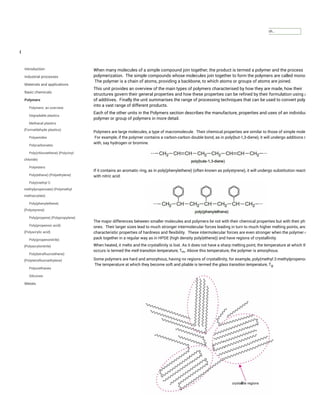
Polymers are large molecules, a type of macromolecule. Their chemical properties are similar to those of simple molecules.
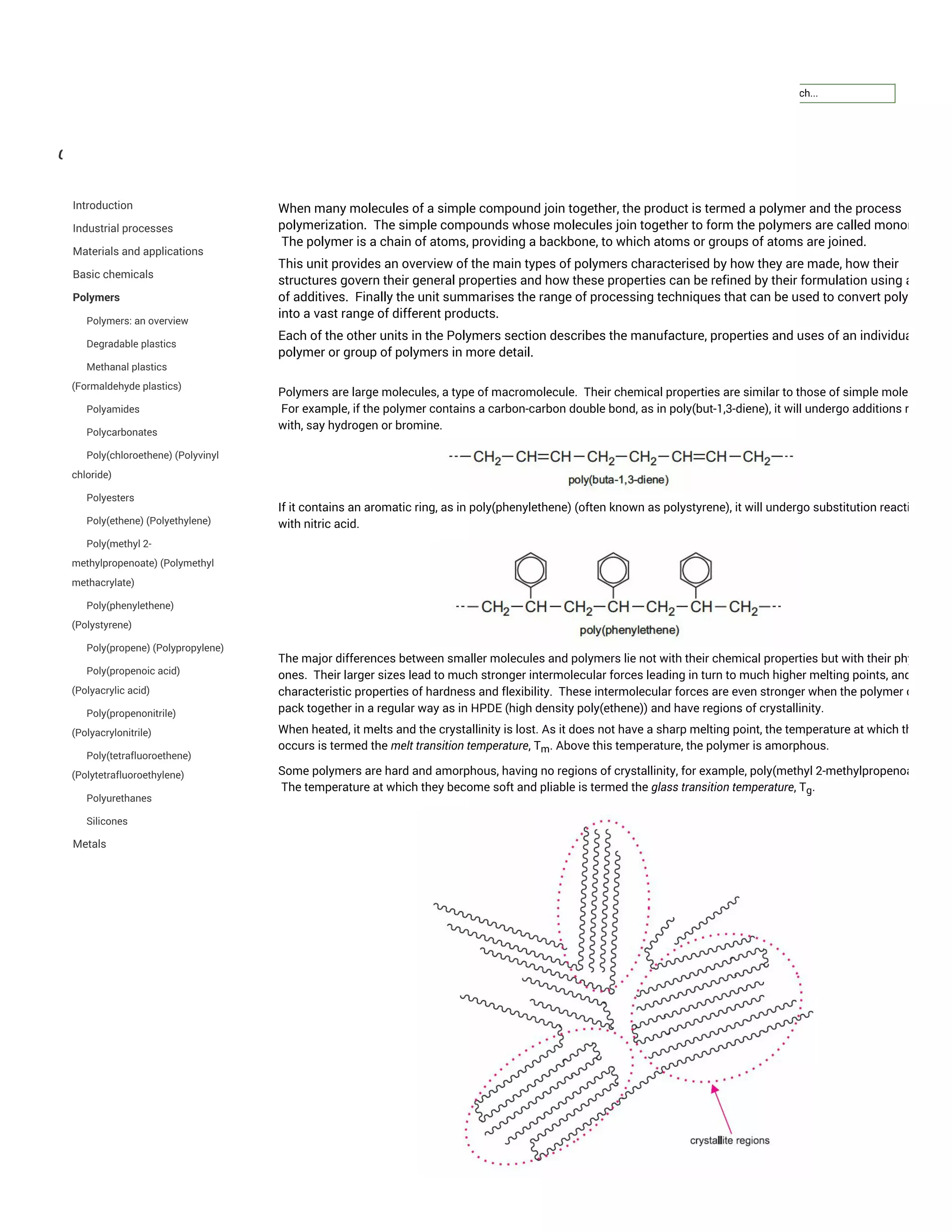
For example, if the polymer contains a carbon-carbon double bond, as in poly(but-1,3-diene), it will undergo additions reactions
with, say hydrogen or bromine.
If it contains an aromatic ring, as in poly(phenylethene) (often known as polystyrene), it will undergo substitution reactions, say
with nitric acid.
The major differences between smaller molecules and polymers lie not with their chemical properties but with their physical
ones. Their larger sizes lead to much stronger intermolecular forces leading in turn to much higher melting points, and the
characteristic properties of hardness and flexibility. These intermolecular forces are even stronger when the polymer chains
pack together in a regular way as in HPDE (high density poly(ethene)) and have regions of crystallinity.
When heated, it melts and the crystallinity is lost. As it does not have a sharp melting point, the temperature at which this
occurs is termed the melt transition temperature, Tm. Above this temperature, the polymer is amorphous.
Some polymers are hard and amorphous, having no regions of crystallinity, for example, poly(methyl 2-methylpropenoate).
The temperature at which they become soft and pliable is termed the glass transition temperature, Tg.
CONTENTS
Home
Introduction
Industrial processes
Materials and applications
Basic chemicals
Polymers
Polymers: an overview
Degradable plastics
Methanal plastics
(Formaldehyde plastics)
Polyamides
Polycarbonates
Poly(chloroethene) (Polyvinyl
chloride)
Polyesters
Poly(ethene) (Polyethylene)
Poly(methyl 2-
methylpropenoate) (Polymethyl
methacrylate)
Poly(phenylethene)
(Polystyrene)
Poly(propene) (Polypropylene)
Poly(propenoic acid)
(Polyacrylic acid)
Poly(propenonitrile)
(Polyacrylonitrile)
Poly(tetrafluoroethene)
(Polytetrafluoroethylene)
Polyurethanes
Silicones
Metals
search...
Figure 1 These crystallites have order in which the zigzag polymer chains
are held together in a regular pattern by intermolecular forces.
There are many examples of polymers that occur naturally, for example, starch, cellulose and proteins. Over the last 70 years,
synthetic polymers have been invented, often mimicking nature and they are now manufactured in millions of tonnes a year
and are one of the most essential materials we use. Many are used as fibres. Others are moulded into required shapes and
when they are used in this way, they are often termed plastics.
Characterising polymers
There are several ways in which polymers can be characterised:
a) how they are made, by addition or by condensation
b) whether they are homopolymers or heteropolymers (co-polymers)
c) whether they are themoplastics, thermosets, elastomers or fibres
d) by their steric structure
(a) Addition and condensation polymers
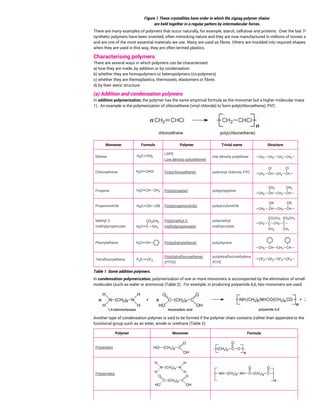
In addition polymerization, the polymer has the same empirical formula as the monomer but a higher molecular mass (Table
1). An example is the polymerization of chloroethene (vinyl chloride) to form poly(chloroethene), PVC:
Monomer Formula Polymer Trivial name Structure
Ethene
LDPE
Low density poly(ethene)
low density polythene
Chloroethene Poly(chloroethene) polyvinyl chlorine, PVC
Propene Poly(propene) polypropylene
Propenonitrile Poly(propenonitrile) polyacrylonitrile
Methyl 2-
methylpropenoate
Poly(methyl 2-
methylpropenoate)
polymethyl
methacrylate
Phenylethene Poly(phenylethene) polystyrene
Tetrafluoroethene
Poly(tetrafluoroethene)
(PTFE)
polytetrafluoroethylene
PTFE
Table 1 Some addition polymers.
In condensation polymerization, polymerization of one or more monomers is accompanied by the elimination of small
molecules (such as water or ammonia) (Table 2). For example, in producing polyamide 6,6, two monomers are used.
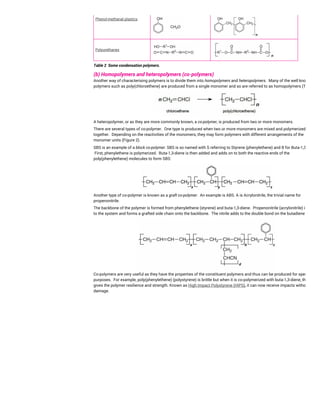
Another type of condensation polymer is said to be formed if the polymer chain contains (rather than appended to the chain) a
functional group such as an ester, amide or urethane (Table 2).
Polymer Monomer Formula
Polyesters
Polyamides
Phenol-methanal plastics
Polyurethanes
Table 2 Some condensation polymers.
(b) Homopolymers and heteropolymers (co-polymers)
Another way of characterising polymers is to divide them into homopolymers and heteropolymers. Many of the well known
polymers such as poly(chloroethene) are produced from a single monomer and so are referred to as homopolymers (Table 1):
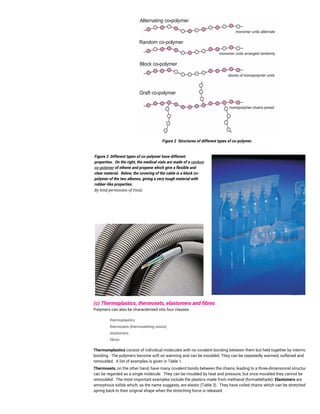
A heteropolymer, or as they are more commonly known, a co-polymer, is produced from two or more monomers.
There are several types of co-polymer. One type is produced when two or more monomers are mixed and polymerized
together. Depending on the reactivities of the monomers, they may form polymers with different arrangements of the
monomer units (Figure 2).
SBS is an example of a block co-polymer. SBS is so named with S referring to Styrene (phenylethene) and B for Buta-1,3-diene.
First, phenylethene is polymerized. Buta-1,3-diene is then added and adds on to both the reactive ends of the
poly(phenylethene) molecules to form SBS:
Another type of co-polymer is known as a graft co-polymer. An example is ABS. A is Acrylonitrile, the trivial name for
propenonitrile.
The backbone of the polymer is formed from phenylethene (styrene) and buta-1,3-diene. Propenonitrile (acrylonitrile) is added
to the system and forms a grafted side chain onto the backbone. The nitrile adds to the double bond on the butadiene unit:
Co-polymers are very useful as they have the properties of the constituent polymers and thus can be produced for specific
purposes. For example, poly(phenylethene) (polystyrene) is brittle but when it is co-polymerized with buta-1,3-diene, the latter
gives the polymer resilience and strength. Known as High Impact Polystyrene (HIPS), it can now receive impacts without
damage.
Figure 2 Structures of different types of co-polymer.
Figure 3 Different types of co-polymer have different
properties. On the right, the medical vials are made of a random
co-polymer of ethene and propene which give a flexible and
clear material. Below, the covering of the cable is a block co-
polymer of the two alkenes, giving a very tough material with
rubber-like properties.
By kind permission of Total.
(c) Thermoplastics, thermosets, elastomers and fibres
Polymers can also be characterised into four classes:
thermoplastics
thermosets (thermosetting resins)
elastomers
fibres
Thermomplastics consist of individual molecules with no covalent bonding between them but held together by intermolecular
bonding. The polymers become soft on warming and can be moulded. They can be repeatedly warmed, softened and
remoulded. A list of examples is given in Table 1.
Thermosets, on the other hand, have many covalent bonds between the chains, leading to a three-dimensional structure, which
can be regarded as a single molecule. They can be moulded by heat and pressure, but once moulded they cannot be
remoulded. The most important examples include the plastics made from methanal (formaldehyde). Elastomers are
amorphous solids which, as the name suggests, are elastic (Table 3). They have coiled chains which can be stretched out but
spring back to their original shape when the stretching force is released.
Fibres are thin threads which are produced by extruding a molten polymer through a die in which there are small holes.
Fibres produced in this way include the polyamides (such as nylon), the polyesters (such as terylene) and poly(propene) (Table
4).
Figure 4 After stretching to make a fibre, the crystallite regions are
aligned along the axis of the fibre, and this adds strength to it.
Having been extruded and stretched, the polymer molecules become aligned in the direction of the fibre. Any tendency to
return to a random orientation is prevented by the strong intermolecular forces between the molecules (Figure 4).
Fibres are twisted into threads and can then be woven into cloth or imbedded in a plastic to give it much greater strength
(Table 4).
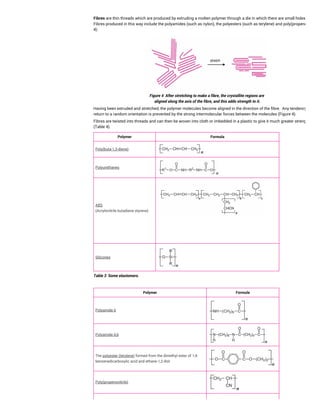
Polymer Formula
Poly(buta-1,3-diene)
Polyurethanes
ABS
(Acrylonitrile butadiene styrene)
Silicones
Table 3 Some elastomers.
Polymer Formula
Polyamide 6
Polyamide 6,6
The polyester (terylene) formed from the dimethyl ester of 1,4-
benzenedicarboxylic acid and ethane-1,2-diol
Poly(propenonitrile)
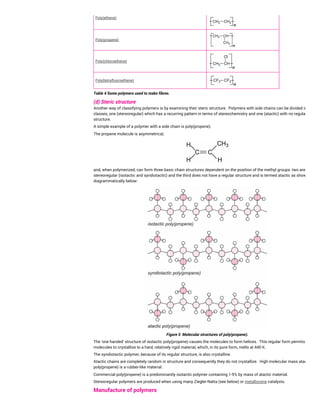
Poly(ethene)
Poly(propene)
Poly(chloroethene)
Poly(tetrafluoroethene)
Table 4 Some polymers used to make fibres.
(d) Steric structure
Another way of classifying polymers is by examining their steric structure. Polymers with side chains can be divided into two
classes, one (stereoregular) which has a recurring pattern in terms of stereochemistry and one (atactic) with no regular
structure.
A simple example of a polymer with a side chain is poly(propene).
The propene molecule is asymmetrical,
and, when polymerized, can form three basic chain structures dependent on the position of the methyl groups: two are
stereoregular (isotactic and syndiotactic) and the third does not have a regular structure and is termed atactic as shown
diagrammatically below:
Figure 5 Molecular structures of poly(propene).
The 'one handed' structure of isotactic poly(propene) causes the molecules to form helices. This regular form permits the
molecules to crystallize to a hard, relatively rigid material, which, in its pure form, melts at 440 K.
The syndiotactic polymer, because of its regular structure, is also crystalline.
Atactic chains are completely random in structure and consequently they do not crystallize. High molecular mass atactic
poly(propene) is a rubber-like material.
Commercial poly(propene) is a predominantly isotactic polymer containing 1-5% by mass of atactic material.
Stereoregular polymers are produced when using many Ziegler-Natta (see below) or metallocene catalysts.
Manufacture of polymers
As discussed above, polymers can be characterised by the method of polymerization, addition and condensation.
Many addition polymers are produced by using an organometallic compound, known as a Ziegler-Natta catalyst. They were
first developed by Karl Ziegler and Giulio Natta which led to the two chemists being awared the Nobel Prize in 1963 for this
brilliant work.
Other addition polymers are produced by generating free radicals using a compound, known as an initiator, to catalyse the
reaction.
Many condensation polymeriztion reactions, in which one or two monomers are the starting materials, also need catalysts.
The catalysts are described in the unit devoted to each condensation polymer.
Catalysts for polymerization reactions
Ziegler-Natta catalysts
Ziegler-Natta catalysts are organometallic compounds, prepared from titanium compounds with an aluminium trialkyl which
acts as a promoter:
The alkyl groups used include ethyl, hexyl and octyl.
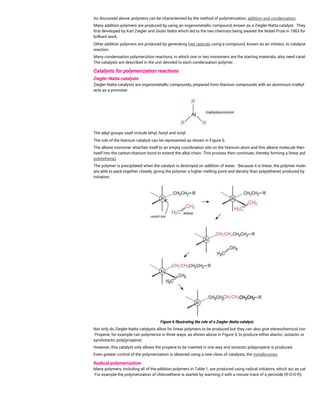
The role of the titanium catalyst can be represented as shown in Figure 6.
The alkene monomer attaches itself to an empty coordination site on the titanium atom and this alkene molecule then inserts
itself into the carbon-titanium bond to extend the alkyl chain. This process then continues, thereby forming a linear polymer,
poly(ethene).
The polymer is precipitated when the catalyst is destroyed on addition of water. Because it is linear, the polymer molecules
are able to pack together closely, giving the polymer a higher melting point and density than poly(ethene) produced by radical
initiation.
Figure 6 Illustrating the role of a Ziegler-Natta catalyst.
Not only do Ziegler-Natta catalysts allow for linear polymers to be produced but they can also give stereochemical control.
Propene, for example can polymerize in three ways, as shown above in Figure 5, to produce either atactic, isotactic or
syndiotactic poly(propene).
However, this catalyst only allows the propene to be inserted in one way and isotactic polypropene is produced.
Even greater control of the polymerization is obtained using a new class of catalysts, the metallocenes.
Radical polymerization
Many polymers, including all of the addition polymers in Table 1, are produced using radical initiators, which act as catalysts.
For example the polymerization of chloroethene is started by warming it with a minute trace of a peroxide (R-O-O-R):
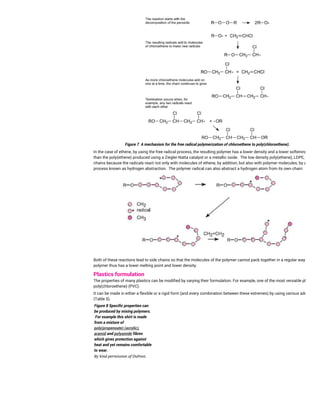
Figure 7 A mechanism for the free radical polymerization of chloroethene to poly(chloroethene).
In the case of ethene, by using the free radical process, the resulting polymer has a lower density and a lower softening point
than the poly(ethene) produced using a Ziegler-Natta catalyst or a metallic oxide. The low density poly(ethene), LDPE, has side
chains because the radicals react not only with molecules of ethene, by addition, but also with polymer molecules, by a
process known as hydrogen abstraction. The polymer radical can also abstract a hydrogen atom from its own chain:
Both of these reactions lead to side chains so that the molecules of the polymer cannot pack together in a regular way. The
polymer thus has a lower melting point and lower density.
Plastics formulation
The properties of many plastics can be modified by varying their formulation. For example, one of the most versatile plastics is
poly(chloroethene) (PVC).
It can be made in either a flexible or a rigid form (and every combination between these extremes) by using various additives
(Table 5).
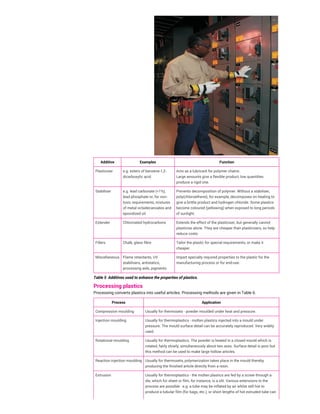
Figure 8 Specific properties can
be produced by mixing polymers.
For example this shirt is made
from a mixture of
poly(propenoate) (acrylic),
aramid and polyamide fibres
which gives protection against
heat and yet remains comfortable
to wear.
By kind permission of DuPont.
Additive Examples Function
Plasticiser e.g. esters of benzene-1,2-
dicarboxylic acid
Acts as a lubricant for polymer chains.
Large amounts give a flexible product, low quantities
produce a rigid one.
Stabiliser e.g. lead carbonate (<1%),
lead phosphate or, for non-
toxic requirements, mixtures
of metal octadecanoates and
epoxidized oil
Prevents decomposition of polymer. Without a stabiliser,
poly(chloroethene), for example, decomposes on heating to
give a brittle product and hydrogen chloride. Some plastics
become coloured (yellowing) when exposed to long periods
of sunlight.
Extender Chlorinated hydrocarbons Extends the effect of the plasticiser, but generally cannot
plasticise alone. They are cheaper than plasticisers, so help
reduce costs.
Fillers Chalk, glass fibre Tailor the plastic for special requirements, or make it
cheaper.
Miscellaneous Flame retardants, UV
stabilisers, antistatics,
processing aids, pigments
Impart specially required properties to the plastic for the
manufacturing process or for end-use.
Table 5 Additives used to enhance the properties of plastics.
Processing plastics
Processing converts plastics into useful articles. Processing methods are given in Table 6.
Process Application
Compression moulding Usually for thermosets - powder moulded under heat and pressure.
Injection moulding Usually for thermoplastics - molten plastics injected into a mould under
pressure. The mould surface detail can be accurately reproduced. Very widely
used.
Rotational moulding Usually for thermoplastics. The powder is heated in a closed mould which is
rotated, fairly slowly, simultaneously about two axes. Surface detail is poor but
this method can be used to make large hollow articles.
Reaction injection moulding Usually for thermosets, polymerization takes place in the mould thereby
producing the finished article directly from a resin.
Extrusion Usually for thermoplastics - the molten plastics are fed by a screw through a
die, which for sheet or film, for instance, is a slit. Various extensions to the
process are possible - e.g. a tube may be inflated by air whilst still hot to
produce a tubular film (for bags, etc.), or short lengths of hot extruded tube can
be inflated in moulds to form bottles.
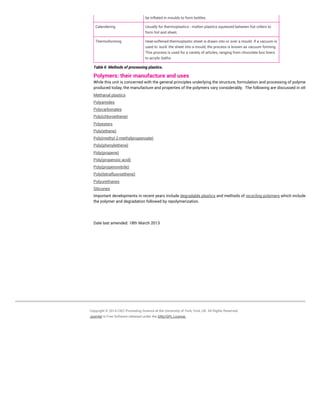
Calendering Usually for thermoplastics - molten plastics squeezed between hot rollers to
form foil and sheet.
Thermoforming Heat-softened thermoplastic sheet is drawn into or over a mould. If a vacuum is
used to 'suck' the sheet into a mould, the process is known as vacuum forming.
This process is used for a variety of articles, ranging from chocolate box liners
to acrylic baths.
Table 6 Methods of processing plastics.
Polymers: their manufacture and uses
While this unit is concerned with the general principles underlying the structure, formulation and processing of polymers
produced today, the manufacture and properties of the polymers vary considerably. The following are discussed in other units
Methanal plastics
Polyamides
Polycarbonates
Poly(chloroethene)
Polyesters
Poly(ethene)
Poly(methyl 2-methylpropenoate)
Poly(phenylethene)
Poly(propene)
Poly(propenoic acid)
Poly(propenonitrile)
Poly(tetrafluoroethene)
Polyurethanes
Silicones
Important developments in recent years include degradable plastics and methods of recycling polymers which include reusing
the polymer and degradation followed by repolymerization.
Date last amended: 18th March 2013
Copyright © 2014 CIEC Promoting Science at the University of York, York, UK. All Rights Reserved.
Joomla! is Free Software released under the GNU/GPL License.

Polymers an overview

  • 1.
    When many moleculesof a simple compound join together, the product is termed a polymer and the process polymerization. The simple compounds whose molecules join together to form the polymers are called monomers. The polymer is a chain of atoms, providing a backbone, to which atoms or groups of atoms are joined. This unit provides an overview of the main types of polymers characterised by how they are made, how their structures govern their general properties and how these properties can be refined by their formulation using a range of additives. Finally the unit summarises the range of processing techniques that can be used to convert polymers into a vast range of different products. Each of the other units in the Polymers section describes the manufacture, properties and uses of an individual polymer or group of polymers in more detail. Polymers Polymers: an overview Polymers: an overview Polymers are large molecules, a type of macromolecule. Their chemical properties are similar to those of simple molecules. For example, if the polymer contains a carbon-carbon double bond, as in poly(but-1,3-diene), it will undergo additions reactions with, say hydrogen or bromine. If it contains an aromatic ring, as in poly(phenylethene) (often known as polystyrene), it will undergo substitution reactions, say with nitric acid. The major differences between smaller molecules and polymers lie not with their chemical properties but with their physical ones. Their larger sizes lead to much stronger intermolecular forces leading in turn to much higher melting points, and the characteristic properties of hardness and flexibility. These intermolecular forces are even stronger when the polymer chains pack together in a regular way as in HPDE (high density poly(ethene)) and have regions of crystallinity. When heated, it melts and the crystallinity is lost. As it does not have a sharp melting point, the temperature at which this occurs is termed the melt transition temperature, Tm. Above this temperature, the polymer is amorphous. Some polymers are hard and amorphous, having no regions of crystallinity, for example, poly(methyl 2-methylpropenoate). The temperature at which they become soft and pliable is termed the glass transition temperature, Tg. CONTENTS Home Introduction Industrial processes Materials and applications Basic chemicals Polymers Polymers: an overview Degradable plastics Methanal plastics (Formaldehyde plastics) Polyamides Polycarbonates Poly(chloroethene) (Polyvinyl chloride) Polyesters Poly(ethene) (Polyethylene) Poly(methyl 2- methylpropenoate) (Polymethyl methacrylate) Poly(phenylethene) (Polystyrene) Poly(propene) (Polypropylene) Poly(propenoic acid) (Polyacrylic acid) Poly(propenonitrile) (Polyacrylonitrile) Poly(tetrafluoroethene) (Polytetrafluoroethylene) Polyurethanes Silicones Metals search...
  • 2.
    Figure 1 Thesecrystallites have order in which the zigzag polymer chains are held together in a regular pattern by intermolecular forces. There are many examples of polymers that occur naturally, for example, starch, cellulose and proteins. Over the last 70 years, synthetic polymers have been invented, often mimicking nature and they are now manufactured in millions of tonnes a year and are one of the most essential materials we use. Many are used as fibres. Others are moulded into required shapes and when they are used in this way, they are often termed plastics. Characterising polymers There are several ways in which polymers can be characterised: a) how they are made, by addition or by condensation b) whether they are homopolymers or heteropolymers (co-polymers) c) whether they are themoplastics, thermosets, elastomers or fibres d) by their steric structure (a) Addition and condensation polymers In addition polymerization, the polymer has the same empirical formula as the monomer but a higher molecular mass (Table 1). An example is the polymerization of chloroethene (vinyl chloride) to form poly(chloroethene), PVC: Monomer Formula Polymer Trivial name Structure Ethene LDPE Low density poly(ethene) low density polythene Chloroethene Poly(chloroethene) polyvinyl chlorine, PVC Propene Poly(propene) polypropylene Propenonitrile Poly(propenonitrile) polyacrylonitrile Methyl 2- methylpropenoate Poly(methyl 2- methylpropenoate) polymethyl methacrylate Phenylethene Poly(phenylethene) polystyrene Tetrafluoroethene Poly(tetrafluoroethene) (PTFE) polytetrafluoroethylene PTFE Table 1 Some addition polymers. In condensation polymerization, polymerization of one or more monomers is accompanied by the elimination of small molecules (such as water or ammonia) (Table 2). For example, in producing polyamide 6,6, two monomers are used. Another type of condensation polymer is said to be formed if the polymer chain contains (rather than appended to the chain) a functional group such as an ester, amide or urethane (Table 2). Polymer Monomer Formula Polyesters Polyamides
  • 3.
    Phenol-methanal plastics Polyurethanes Table 2Some condensation polymers. (b) Homopolymers and heteropolymers (co-polymers) Another way of characterising polymers is to divide them into homopolymers and heteropolymers. Many of the well known polymers such as poly(chloroethene) are produced from a single monomer and so are referred to as homopolymers (Table 1): A heteropolymer, or as they are more commonly known, a co-polymer, is produced from two or more monomers. There are several types of co-polymer. One type is produced when two or more monomers are mixed and polymerized together. Depending on the reactivities of the monomers, they may form polymers with different arrangements of the monomer units (Figure 2). SBS is an example of a block co-polymer. SBS is so named with S referring to Styrene (phenylethene) and B for Buta-1,3-diene. First, phenylethene is polymerized. Buta-1,3-diene is then added and adds on to both the reactive ends of the poly(phenylethene) molecules to form SBS: Another type of co-polymer is known as a graft co-polymer. An example is ABS. A is Acrylonitrile, the trivial name for propenonitrile. The backbone of the polymer is formed from phenylethene (styrene) and buta-1,3-diene. Propenonitrile (acrylonitrile) is added to the system and forms a grafted side chain onto the backbone. The nitrile adds to the double bond on the butadiene unit: Co-polymers are very useful as they have the properties of the constituent polymers and thus can be produced for specific purposes. For example, poly(phenylethene) (polystyrene) is brittle but when it is co-polymerized with buta-1,3-diene, the latter gives the polymer resilience and strength. Known as High Impact Polystyrene (HIPS), it can now receive impacts without damage.
  • 4.
    Figure 2 Structuresof different types of co-polymer. Figure 3 Different types of co-polymer have different properties. On the right, the medical vials are made of a random co-polymer of ethene and propene which give a flexible and clear material. Below, the covering of the cable is a block co- polymer of the two alkenes, giving a very tough material with rubber-like properties. By kind permission of Total. (c) Thermoplastics, thermosets, elastomers and fibres Polymers can also be characterised into four classes: thermoplastics thermosets (thermosetting resins) elastomers fibres Thermomplastics consist of individual molecules with no covalent bonding between them but held together by intermolecular bonding. The polymers become soft on warming and can be moulded. They can be repeatedly warmed, softened and remoulded. A list of examples is given in Table 1. Thermosets, on the other hand, have many covalent bonds between the chains, leading to a three-dimensional structure, which can be regarded as a single molecule. They can be moulded by heat and pressure, but once moulded they cannot be remoulded. The most important examples include the plastics made from methanal (formaldehyde). Elastomers are amorphous solids which, as the name suggests, are elastic (Table 3). They have coiled chains which can be stretched out but spring back to their original shape when the stretching force is released.
  • 5.
    Fibres are thinthreads which are produced by extruding a molten polymer through a die in which there are small holes. Fibres produced in this way include the polyamides (such as nylon), the polyesters (such as terylene) and poly(propene) (Table 4). Figure 4 After stretching to make a fibre, the crystallite regions are aligned along the axis of the fibre, and this adds strength to it. Having been extruded and stretched, the polymer molecules become aligned in the direction of the fibre. Any tendency to return to a random orientation is prevented by the strong intermolecular forces between the molecules (Figure 4). Fibres are twisted into threads and can then be woven into cloth or imbedded in a plastic to give it much greater strength (Table 4). Polymer Formula Poly(buta-1,3-diene) Polyurethanes ABS (Acrylonitrile butadiene styrene) Silicones Table 3 Some elastomers. Polymer Formula Polyamide 6 Polyamide 6,6 The polyester (terylene) formed from the dimethyl ester of 1,4- benzenedicarboxylic acid and ethane-1,2-diol Poly(propenonitrile)
  • 6.
    Poly(ethene) Poly(propene) Poly(chloroethene) Poly(tetrafluoroethene) Table 4 Somepolymers used to make fibres. (d) Steric structure Another way of classifying polymers is by examining their steric structure. Polymers with side chains can be divided into two classes, one (stereoregular) which has a recurring pattern in terms of stereochemistry and one (atactic) with no regular structure. A simple example of a polymer with a side chain is poly(propene). The propene molecule is asymmetrical, and, when polymerized, can form three basic chain structures dependent on the position of the methyl groups: two are stereoregular (isotactic and syndiotactic) and the third does not have a regular structure and is termed atactic as shown diagrammatically below: Figure 5 Molecular structures of poly(propene). The 'one handed' structure of isotactic poly(propene) causes the molecules to form helices. This regular form permits the molecules to crystallize to a hard, relatively rigid material, which, in its pure form, melts at 440 K. The syndiotactic polymer, because of its regular structure, is also crystalline. Atactic chains are completely random in structure and consequently they do not crystallize. High molecular mass atactic poly(propene) is a rubber-like material. Commercial poly(propene) is a predominantly isotactic polymer containing 1-5% by mass of atactic material. Stereoregular polymers are produced when using many Ziegler-Natta (see below) or metallocene catalysts. Manufacture of polymers
  • 7.
    As discussed above,polymers can be characterised by the method of polymerization, addition and condensation. Many addition polymers are produced by using an organometallic compound, known as a Ziegler-Natta catalyst. They were first developed by Karl Ziegler and Giulio Natta which led to the two chemists being awared the Nobel Prize in 1963 for this brilliant work. Other addition polymers are produced by generating free radicals using a compound, known as an initiator, to catalyse the reaction. Many condensation polymeriztion reactions, in which one or two monomers are the starting materials, also need catalysts. The catalysts are described in the unit devoted to each condensation polymer. Catalysts for polymerization reactions Ziegler-Natta catalysts Ziegler-Natta catalysts are organometallic compounds, prepared from titanium compounds with an aluminium trialkyl which acts as a promoter: The alkyl groups used include ethyl, hexyl and octyl. The role of the titanium catalyst can be represented as shown in Figure 6. The alkene monomer attaches itself to an empty coordination site on the titanium atom and this alkene molecule then inserts itself into the carbon-titanium bond to extend the alkyl chain. This process then continues, thereby forming a linear polymer, poly(ethene). The polymer is precipitated when the catalyst is destroyed on addition of water. Because it is linear, the polymer molecules are able to pack together closely, giving the polymer a higher melting point and density than poly(ethene) produced by radical initiation. Figure 6 Illustrating the role of a Ziegler-Natta catalyst. Not only do Ziegler-Natta catalysts allow for linear polymers to be produced but they can also give stereochemical control. Propene, for example can polymerize in three ways, as shown above in Figure 5, to produce either atactic, isotactic or syndiotactic poly(propene). However, this catalyst only allows the propene to be inserted in one way and isotactic polypropene is produced. Even greater control of the polymerization is obtained using a new class of catalysts, the metallocenes. Radical polymerization Many polymers, including all of the addition polymers in Table 1, are produced using radical initiators, which act as catalysts. For example the polymerization of chloroethene is started by warming it with a minute trace of a peroxide (R-O-O-R):
  • 8.
    Figure 7 Amechanism for the free radical polymerization of chloroethene to poly(chloroethene). In the case of ethene, by using the free radical process, the resulting polymer has a lower density and a lower softening point than the poly(ethene) produced using a Ziegler-Natta catalyst or a metallic oxide. The low density poly(ethene), LDPE, has side chains because the radicals react not only with molecules of ethene, by addition, but also with polymer molecules, by a process known as hydrogen abstraction. The polymer radical can also abstract a hydrogen atom from its own chain: Both of these reactions lead to side chains so that the molecules of the polymer cannot pack together in a regular way. The polymer thus has a lower melting point and lower density. Plastics formulation The properties of many plastics can be modified by varying their formulation. For example, one of the most versatile plastics is poly(chloroethene) (PVC). It can be made in either a flexible or a rigid form (and every combination between these extremes) by using various additives (Table 5). Figure 8 Specific properties can be produced by mixing polymers. For example this shirt is made from a mixture of poly(propenoate) (acrylic), aramid and polyamide fibres which gives protection against heat and yet remains comfortable to wear. By kind permission of DuPont.
  • 9.
    Additive Examples Function Plasticisere.g. esters of benzene-1,2- dicarboxylic acid Acts as a lubricant for polymer chains. Large amounts give a flexible product, low quantities produce a rigid one. Stabiliser e.g. lead carbonate (<1%), lead phosphate or, for non- toxic requirements, mixtures of metal octadecanoates and epoxidized oil Prevents decomposition of polymer. Without a stabiliser, poly(chloroethene), for example, decomposes on heating to give a brittle product and hydrogen chloride. Some plastics become coloured (yellowing) when exposed to long periods of sunlight. Extender Chlorinated hydrocarbons Extends the effect of the plasticiser, but generally cannot plasticise alone. They are cheaper than plasticisers, so help reduce costs. Fillers Chalk, glass fibre Tailor the plastic for special requirements, or make it cheaper. Miscellaneous Flame retardants, UV stabilisers, antistatics, processing aids, pigments Impart specially required properties to the plastic for the manufacturing process or for end-use. Table 5 Additives used to enhance the properties of plastics. Processing plastics Processing converts plastics into useful articles. Processing methods are given in Table 6. Process Application Compression moulding Usually for thermosets - powder moulded under heat and pressure. Injection moulding Usually for thermoplastics - molten plastics injected into a mould under pressure. The mould surface detail can be accurately reproduced. Very widely used. Rotational moulding Usually for thermoplastics. The powder is heated in a closed mould which is rotated, fairly slowly, simultaneously about two axes. Surface detail is poor but this method can be used to make large hollow articles. Reaction injection moulding Usually for thermosets, polymerization takes place in the mould thereby producing the finished article directly from a resin. Extrusion Usually for thermoplastics - the molten plastics are fed by a screw through a die, which for sheet or film, for instance, is a slit. Various extensions to the process are possible - e.g. a tube may be inflated by air whilst still hot to produce a tubular film (for bags, etc.), or short lengths of hot extruded tube can
  • 10.
    be inflated inmoulds to form bottles. Calendering Usually for thermoplastics - molten plastics squeezed between hot rollers to form foil and sheet. Thermoforming Heat-softened thermoplastic sheet is drawn into or over a mould. If a vacuum is used to 'suck' the sheet into a mould, the process is known as vacuum forming. This process is used for a variety of articles, ranging from chocolate box liners to acrylic baths. Table 6 Methods of processing plastics. Polymers: their manufacture and uses While this unit is concerned with the general principles underlying the structure, formulation and processing of polymers produced today, the manufacture and properties of the polymers vary considerably. The following are discussed in other units Methanal plastics Polyamides Polycarbonates Poly(chloroethene) Polyesters Poly(ethene) Poly(methyl 2-methylpropenoate) Poly(phenylethene) Poly(propene) Poly(propenoic acid) Poly(propenonitrile) Poly(tetrafluoroethene) Polyurethanes Silicones Important developments in recent years include degradable plastics and methods of recycling polymers which include reusing the polymer and degradation followed by repolymerization. Date last amended: 18th March 2013 Copyright © 2014 CIEC Promoting Science at the University of York, York, UK. All Rights Reserved. Joomla! is Free Software released under the GNU/GPL License.