Southern Technical University
Engineering Technical College
Department of Fuel and Energy
Final Year Project / Group No.:
Fuel from Waste Plastic by Pyrolysis
By
Ali Kadhim Morwad Ali Jumah Thamer
Omar Montaser Abdul-Baqi Muslim Kareem Raheem
Supervision
M.Sc. Bahiya Jabbar
2018/2019
ii
Abstract
Waste plastic disposal and excessive use of fossil fuels have caused
environmental concerns in the world. Both plastics and petroleum-
derived fuels are hydrocarbons that contain the elements of carbon and
hydrogen. The difference between them is that plastic molecules have
longer carbon chains than those in LPG, petrol, and diesel fuels.
Therefore, it is possible to convert waste plastic into fuels.
The main objectives of this study were to understand and optimize the
processes of plastic pyrolysis for maximizing the diesel range products,
and to design a continuous pyrolysis apparatus as a semi-scale
commercial plant.
Pyrolysis of polyethylene (PE), polypropylene (PP), and polystyrene (PS)
has been investigated both theoretically and experimentally in a lab-scale
pyrolysis reactor. The key factors have been investigated and identified.
Pyrolysis of polyethylene (PE), polypropylene (PP), and polystyrene (PS)
has been investigated both theoretically and experimentally in a lab-scale.
The key factors have been investigated and identified. The cracking
temperature for PE, PP and PS in the pyrolysis is at range (324-188 ºC).
The high reaction temperature and heating rate can significantly promote
the production of light hydrocarbons. Long residence time also favors the
yield of the light hydrocarbon products. The effects of other factors like
the type of reactor, catalyst, pressure, and reflux rate.
The PP pyrolysis products have the value of API 61.5>31.1 and this value is
slightly light by API gravity classification
In the pyrolysis product of HDPE, have the value of API (47, 49)>31.1
and this value is slightly light by API gravity classification
iii
Acknowledgements
Without the support, assistance, and motivation provided by those around
me, this study would have never been accomplished.
In particular, I would like to thank my supervisor M.Sc. Bahiya for his
help and guidance during the period of research. M.Sc. Bahiya provided
significant comments and financial support on defining the topic and
proceeding with the research. His assistance in editing was very greatly
appreciated. His enthusiastic nature always encourages me. I have gained
much about this study from his rigorous attitude
I need to thank M.Sc. Akeel M. Ali for his valuable advice. I would also
like to acknowledge the technical staffs in the department, B.Sc. Jaffar
Abdurrahman for teaching me the experimental techniques and how to
use the analysis devices. Their valuable suggestions, discussions, and
endless enthusiasm were much appreciated.
iv
Reference
Abstract ................................................................. ii
Acknowledgements .............................................. iii
Reference...............................................................iv
List of Symbols ......................................................v
List of Abbreviations.............................................vi
1. Introduction........................................................1
1.1 Background.......................................................................................1
1.2 Objectives .........................................................................................3
1.3 Uses of different types of plastics.....................................................3
1.4 Properties of Plastics.........................................................................4
1.5 Environmental hazards due to mismanagement of plastics waste ...4
1.6 Side Effect of plastics in nature........................................................5
1.7 The project aims................................................................................6
1.8 The pyrolysis of Plastic Materials ....................................................6
1.9 Effect of raw material as plastics in production ...............................8
1.10 Physical and thermal properties of crude oil and its products........8
2. Methodology ....................................................11
2.1 Collection & Identification of waste plastic...................................11
2.2 Device description ..........................................................................12
2.3 Subjecting the Waste Plastic for Pyrolysis Process........................18
2-4 Process steps and materials ............................................................19
3. Results and Discussion.....................................20
4. Conclusion........................................................25
References............................................................26
v
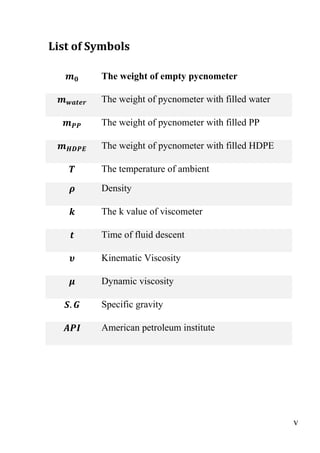
List of Symbols
The weight of empty pycnometer
The weight of pycnometer with filled water
The weight of pycnometer with filled PP
The weight of pycnometer with filled HDPE
The temperature of ambient
Density
The k value of viscometer
Time of fluid descent
Kinematic Viscosity
Dynamic viscosity
Specific gravity
American petroleum institute
vi
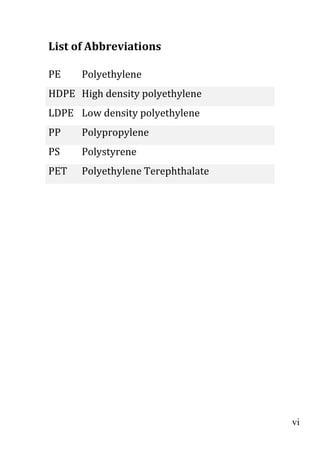
List of Abbreviations
PE Polyethylene
HDPE High density polyethylene
LDPE Low density polyethylene
PP Polypropylene
PS Polystyrene
PET Polyethylene Terephthalate
1
1. Introduction
1.1 Background
Plastic is a high molecular weight material that was invented by
Alexander Parke's in 1862. Plastics are also called polymers. The term
polymer means a molecule made up by repetition of the simple unit. For
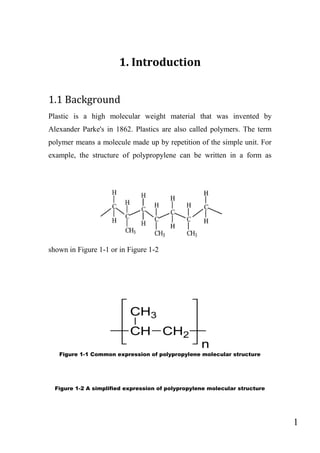
example, the structure of polypropylene can be written in a form as
shown in Figure 1-1 or in Figure 1-2
Figure 1-1 Common expression of polypropylene molecular structure
Figure 1-2 A simplified expression of polypropylene molecular structure
2
The repeating unit of the polymer is in the brackets with a subscript, n, to
represent the number of the unit in this polymer molecule.
Plastic is one of the most commonly used materials in daily life which
can be classified in many ways such as based on its chemical structure,
synthesis process, density, and other properties. In order to assist
recycling of the waste plastic, Society of Plastic Industry (SPI) defined a
resin identification code system that divides plastics into the following
seven groups based on the chemical structure and applications:
1) PET (Polyethylene Terephthalate)
2) HDPE (High Density Polyethylene)
3) PVC (Polyvinyl Chloride)
4) LDPE (Low Density Polyethylene)
5) PP (Polypropylene)
6) PS (Polystyrene)
7) Other
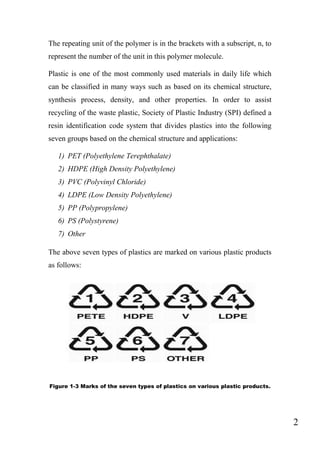
The above seven types of plastics are marked on various plastic products
as follows:
Figure 1-3 Marks of the seven types of plastics on various plastic products.
3
1.2 Objectives
The main objectives of this project are:
1) To raise the awareness in developing countries like Iraq about the
possibility of plastic waste recirculation as a source of liquid fuel,
this could be generated and marketed at cheaper rates compared to
that of the available diesel or oil in the market.
2) Contributing to the Economic growth of the country.
3) Find a new source of fuel oil rather than fossil fuel.
4) Plastic recovery decrease the air and water pollution.
1.3 Uses of different types of plastics
Table 1-1 Uses of different types of plastics
Type of Plastics Uses
PET
Carbonated drink bottles, plastics film
Supermarket bags, plastics bottle
HDPE
Milk jugs, detergent bottles, thicker
Plastics film, pipes
LDPE Floor tiles, shower curtains, cling film
PVC
Agriculture (fountain) pipe, guttering
Pipe, window frame, sheets for
building material
PP
Bottle caps, drinking straws,Bumper, house
ware, fiber carpeting and rope.
4
PS
foam use for insulation of roofs and
walls, disposal cups, plates, food
Container, CD and cassette box.
1.4 Properties of Plastics
1) They are less brittle than Glass, yet they can be made equally
transparent and smooth.
2) They are lightweight and at the same time possess good strength
and rigidity.
3) They possess good toughness.
4) Their high dielectric strength makes them suitable for electric
insulation.
5) They resist corrosion and the action of chemicals.
6) The ease at which they can be mass – produced contributes greatly
to the popularity as wrappers and bags.
7) Possess the property of low moisture absorption.
8) They can be easily molded to desired shapes.
1.5 Environmental hazards due to
mismanagement of plastics waste
Plastics is not biodegradable material. It al most taks 300-500 years for
biodegrading ,therefore; environmental hazards due to improper manage
include the following aspect:
1) Littered plastics spoils the beauty of the city and choke drains and
make important public places dirty.
2) Garbage containing plastics, when burnt may cause air pollution
by emitting polluting gases.
3) Garbage mix with plastics gives problem in landfill operation.
5
4) Lack of recycling plant to posing an unhygienic problem to the
environment.
1.6 Side Effect of plastics in nature
1) Durability and chemical structure greatly influences the
biodegradability of some organic compounds, therefore, an
increased number of functional groups (groups of atoms) attached
to the benzene ring in an organic molecule usually hinders
microbial attack.
2) Instead of biodegradation, plastics waste goes through photo-
degradation and turns into plastic dust which can enter in the food
chain and can cause complex health issues to earth habitants.
3) Plastics are produced from petroleum derivatives and are
composed primarily of hydrocarbons but also contain additives
such as antioxidants, colorants, and other stabilizers.
4) When plastic products are used and discarded, the additives are
undesirable from an environmental point of view.
5) Burning of plastics give , , , particulate, dioxins,
furans and fumes which is increase‟s air pollution and result in
acid rain and contriupute in global warming.
6
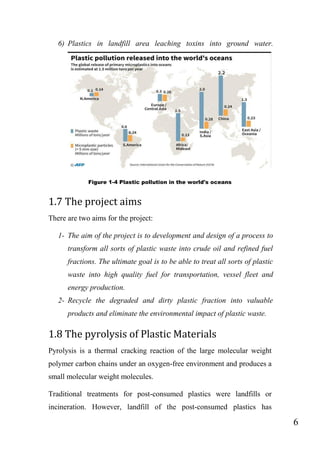
6) Plastics in landfill area leaching toxins into ground water.
Figure 1-4 Plastic pollution in the world's oceans
1.7 The project aims
There are two aims for the project:
1- The aim of the project is to development and design of a process to
transform all sorts of plastic waste into crude oil and refined fuel
fractions. The ultimate goal is to be able to treat all sorts of plastic
waste into high quality fuel for transportation, vessel fleet and
energy production.
2- Recycle the degraded and dirty plastic fraction into valuable
products and eliminate the environmental impact of plastic waste.
1.8 The pyrolysis of Plastic Materials
Pyrolysis is a thermal cracking reaction of the large molecular weight
polymer carbon chains under an oxygen-free environment and produces a
small molecular weight molecules.
Traditional treatments for post-consumed plastics were landfills or
incineration. However, landfill of the post-consumed plastics has
7
potential problems because of limited land resource and high durability of
plastics. The incomplete burn may generate poisonous substances and
causes serious health problems. Other methods like gasification and
bioconversion are mainly used for organic materials.
HDPE, LDPE, PP, and PS are all hydrocarbons. They consist of entirely
of carbon and hydrogen, which are similar to hydrocarbon fuels such as
liquefied petroleum gas (LPG), petrol and diesel.
Some commercial plastic pyrolysis plants have been in operation in
which all types of post-consumer plastics accepted need to be treated by
using hydrochloride scrubber which is mainly use for PVC cracking
process because of it chloride content because chloride is not desirable in
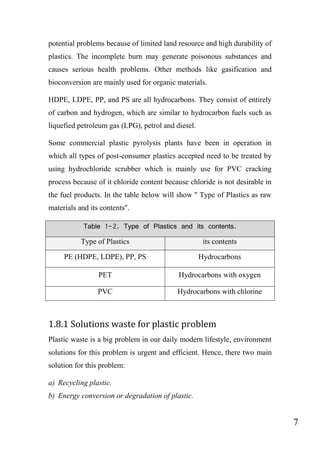
the fuel products. In the table below will show '' Type of Plastics as raw
materials and its contents''.
Table 1-2. Type of Plastics and its contents.
Type of Plastics its contents
PE (HDPE, LDPE), PP, PS Hydrocarbons
PET Hydrocarbons with oxygen
PVC Hydrocarbons with chlorine
1.8.1 Solutions waste for plastic problem
Plastic waste is a big problem in our daily modern lifestyle, environment
solutions for this problem is urgent and efficient. Hence, there two main
solution for this problem:
a) Recycling plastic.
b) Energy conversion or degradation of plastic.
8
1.9 Effect of raw material as plastics in
production
If PE, PS, PP with other plastics gives fuel gas pollution and
contaminated to the reactor by making other unexpected compounds. In
contamination to reactor resulting liquid may contain alcohol, waxy
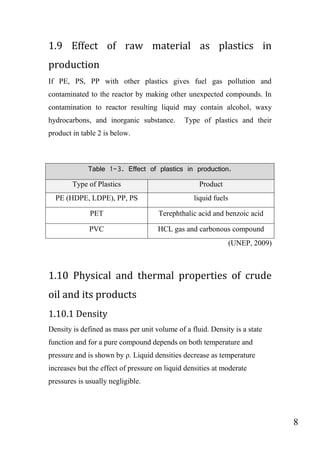
hydrocarbons, and inorganic substance. Type of plastics and their
product in table 2 is below.
Table 1-3. Effect of plastics in production.
Type of Plastics Product
PE (HDPE, LDPE), PP, PS liquid fuels
PET Terephthalic acid and benzoic acid
PVC HCL gas and carbonous compound
(UNEP, 2009)
1.10 Physical and thermal properties of crude
oil and its products
1.10.1 Density
Density is defined as mass per unit volume of a fluid. Density is a state
function and for a pure compound depends on both temperature and
pressure and is shown by ρ. Liquid densities decrease as temperature
increases but the effect of pressure on liquid densities at moderate
pressures is usually negligible.
9
1.10.2 Specific Gravity
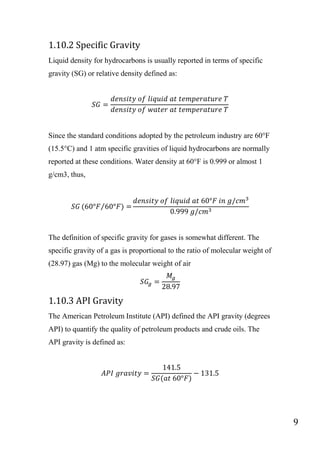
Liquid density for hydrocarbons is usually reported in terms of specific
gravity (SG) or relative density defined as:
Since the standard conditions adopted by the petroleum industry are 60°F
(15.5°C) and 1 atm specific gravities of liquid hydrocarbons are normally
reported at these conditions. Water density at 60°F is 0.999 or almost 1
g/cm3, thus,
⁄
The definition of specific gravity for gases is somewhat different. The
specific gravity of a gas is proportional to the ratio of molecular weight of
(28.97) gas (Mg) to the molecular weight of air
1.10.3 API Gravity
The American Petroleum Institute (API) defined the API gravity (degrees
API) to quantify the quality of petroleum products and crude oils. The
API gravity is defined as:
10
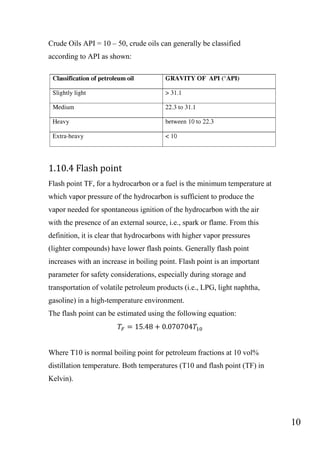
Crude Oils API = 10 – 50, crude oils can generally be classified
according to API as shown:
1.10.4 Flash point
Flash point TF, for a hydrocarbon or a fuel is the minimum temperature at
which vapor pressure of the hydrocarbon is sufficient to produce the
vapor needed for spontaneous ignition of the hydrocarbon with the air
with the presence of an external source, i.e., spark or flame. From this
definition, it is clear that hydrocarbons with higher vapor pressures
(lighter compounds) have lower flash points. Generally flash point
increases with an increase in boiling point. Flash point is an important
parameter for safety considerations, especially during storage and
transportation of volatile petroleum products (i.e., LPG, light naphtha,
gasoline) in a high-temperature environment.
The flash point can be estimated using the following equation:
Where T10 is normal boiling point for petroleum fractions at 10 vol%
distillation temperature. Both temperatures (T10 and flash point (TF) in
Kelvin).
11
2. Methodology
In our experiments, commercially available shredded plastics were
procured and washed before pyrolysis. Pyrolysis it is one of the most
favorable and effective disposing methods, the process is an
environmentally friendly and efficient way to eliminate the effect of
plastic. Pyrolysis is the thermal degradation of solid wastes at high
temperatures (250- 325℃) in the absence of air (and oxygen). The main
process given below:
1. Identification of waste plastics. (PE/PP/PS/LDPE/HDPE)
2. Crash and cut the plastic for the pyrolysis process
3. Condensation of the gas to obtain raw fuel.
4. Collect the sample and perform tests to identify the kinds of fuel
produced.
2.1 Collection & Identification of waste plastic
 The collection of waste plastic is quite an easy task as compared
to other wastes, the plastic wastes are abundant and can be
obtained in large quantities from the households, roadsides,
hospitals, hotels etc.
 Plastics are usually termed as following:
 Polypropylene (PP)
 High-Density Polyethylene (HDPE)
 Low-Density Polyethylene (LDPE)
 Polystyrene (PS)
 Usually, they are manufactured in the form of plastic bags, saline
bottles, plastic tools, chairs and other components which we
usually come across in our day to day life
12
2.2 Device description
1- Distillation Apparatus
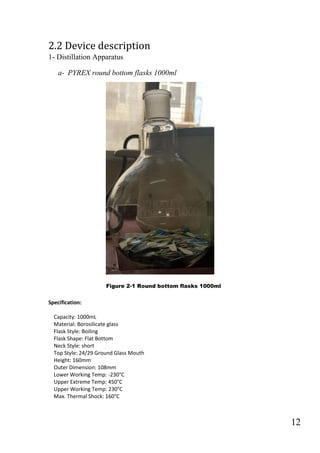
a- PYREX round bottom flasks 1000ml
Figure 2-1 Round bottom flasks 1000ml
Specification:
Capacity: 1000mL
Material: Borosilicate glass
Flask Style: Boiling
Flask Shape: Flat Bottom
Neck Style: short
Top Style: 24/29 Ground Glass Mouth
Height: 160mm
Outer Dimension: 108mm
Lower Working Temp: -230°C
Upper Extreme Temp: 450°C
Upper Working Temp: 230°C
Max. Thermal Shock: 160°C
13
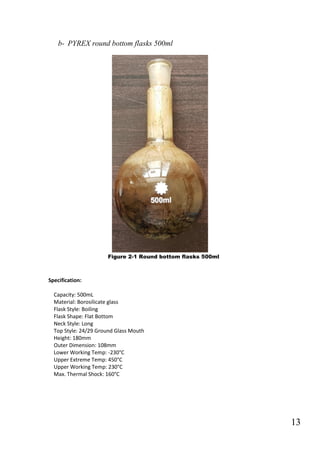
b- PYREX round bottom flasks 500ml
Figure 2-1 Round bottom flasks 500ml
Specification:
Capacity: 500mL
Material: Borosilicate glass
Flask Style: Boiling
Flask Shape: Flat Bottom
Neck Style: Long
Top Style: 24/29 Ground Glass Mouth
Height: 180mm
Outer Dimension: 108mm
Lower Working Temp: -230°C
Upper Extreme Temp: 450°C
Upper Working Temp: 230°C
Max. Thermal Shock: 160°C
14
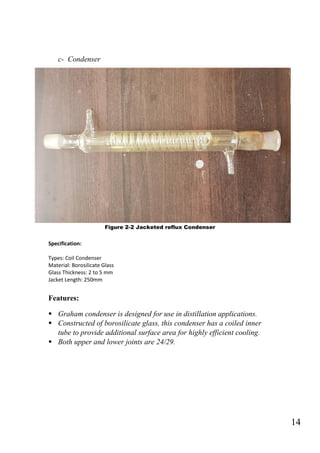
c- Condenser
Figure 2-2 Jacketed reflux Condenser
Specification:
Types: Coil Condenser
Material: Borosilicate Glass
Glass Thickness: 2 to 5 mm
Jacket Length: 250mm
Features:
 Graham condenser is designed for use in distillation applications.
 Constructed of borosilicate glass, this condenser has a coiled inner
tube to provide additional surface area for highly efficient cooling.
 Both upper and lower joints are 24/29.
15
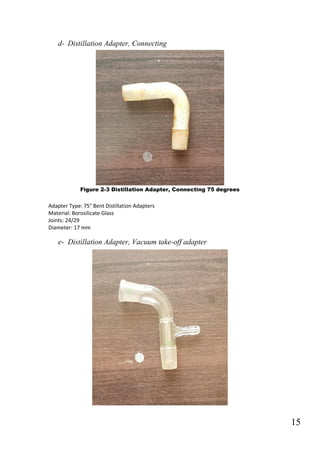
d- Distillation Adapter, Connecting
Figure 2-3 Distillation Adapter, Connecting 75 degrees
Adapter Type: 75° Bent Distillation Adapters
Material: Borosilicate Glass
Joints: 24/29
Diameter: 17 mm
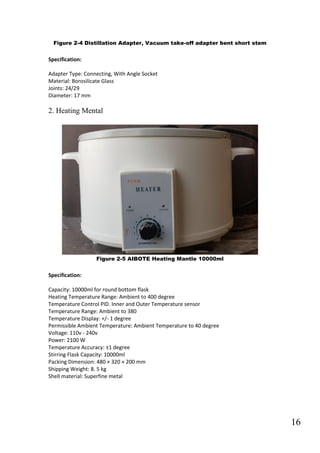
e- Distillation Adapter, Vacuum take-off adapter
16
Figure 2-4 Distillation Adapter, Vacuum take-off adapter bent short stem
Specification:
Adapter Type: Connecting, With Angle Socket
Material: Borosilicate Glass
Joints: 24/29
Diameter: 17 mm
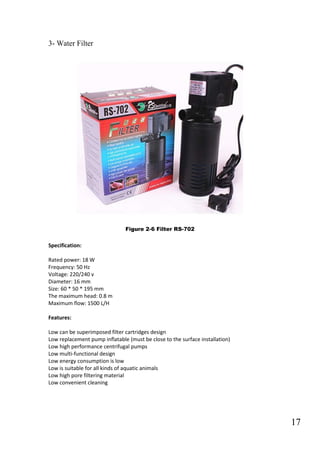
2. Heating Mental
Figure 2-5 AIBOTE Heating Mantle 10000ml
Specification:
Capacity: 10000ml for round bottom flask
Heating Temperature Range: Ambient to 400 degree
Temperature Control PID. Inner and Outer Temperature sensor
Temperature Range: Ambient to 380
Temperature Display: +/- 1 degree
Permissible Ambient Temperature: Ambient Temperature to 40 degree
Voltage: 110v - 240v
Power: 2100 W
Temperature Accuracy: ±1 degree
Stirring Flask Capacity: 10000ml
Packing Dimension: 480 × 320 × 200 mm
Shipping Weight: 8. 5 kg
Shell material: Superfine metal
17
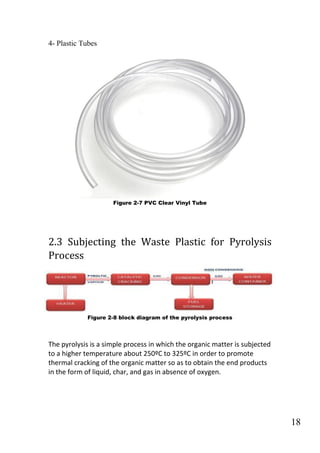
3- Water Filter
Figure 2-6 Filter RS-702
Specification:
Rated power: 18 W
Frequency: 50 Hz
Voltage: 220/240 v
Diameter: 16 mm
Size: 60 * 50 * 195 mm
The maximum head: 0.8 m
Maximum flow: 1500 L/H
Features:
Low can be superimposed filter cartridges design
Low replacement pump inflatable (must be close to the surface installation)
Low high performance centrifugal pumps
Low multi-functional design
Low energy consumption is low
Low is suitable for all kinds of aquatic animals
Low high pore filtering material
Low convenient cleaning
18
4- Plastic Tubes
Figure 2-7 PVC Clear Vinyl Tube
2.3 Subjecting the Waste Plastic for Pyrolysis
Process
Figure 2-8 block diagram of the pyrolysis process
The pyrolysis is a simple process in which the organic matter is subjected
to a higher temperature about 250ºC to 325ºC in order to promote
thermal cracking of the organic matter so as to obtain the end products
in the form of liquid, char, and gas in absence of oxygen.
19
2-4 Process steps and materials
2.4.1. Materials
The waste mixture of polyethylene, polypropylene, and polystyrene was
used as a raw material or use each one individually. The polymer mixture
pieces have a maximum particle size of 5-6 mm. The melting
temperatures of (HDPE, LDPE, PP, PS) mixture, as determined by
CLAW Environmental, were 135°C, 115°C, 165°C, and 90°C,
respectively.
2.4.2 Experimental Setup
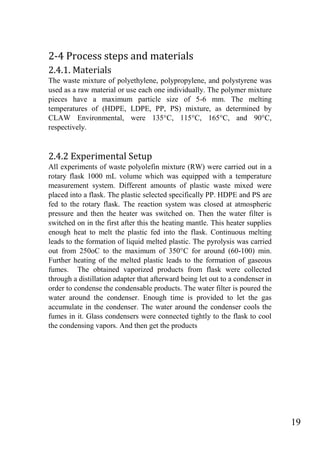
All experiments of waste polyolefin mixture (RW) were carried out in a
rotary flask 1000 mL volume which was equipped with a temperature
measurement system. Different amounts of plastic waste mixed were
placed into a flask. The plastic selected specifically PP. HDPE and PS are
fed to the rotary flask. The reaction system was closed at atmospheric
pressure and then the heater was switched on. Then the water filter is
switched on in the first after this the heating mantle. This heater supplies
enough heat to melt the plastic fed into the flask. Continuous melting
leads to the formation of liquid melted plastic. The pyrolysis was carried
out from 250oC to the maximum of 350°C for around (60-100) min.
Further heating of the melted plastic leads to the formation of gaseous
fumes. The obtained vaporized products from flask were collected
through a distillation adapter that afterward being let out to a condenser in
order to condense the condensable products. The water filter is poured the
water around the condenser. Enough time is provided to let the gas
accumulate in the condenser. The water around the condenser cools the
fumes in it. Glass condensers were connected tightly to the flask to cool
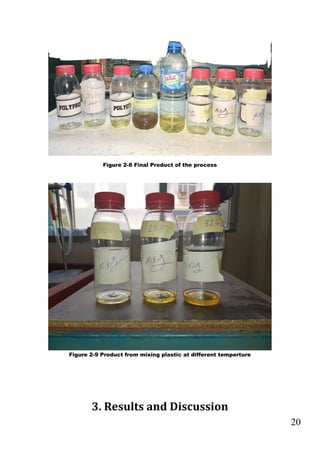
the condensing vapors. And then get the products
20
Figure 2-8 Final Product of the process
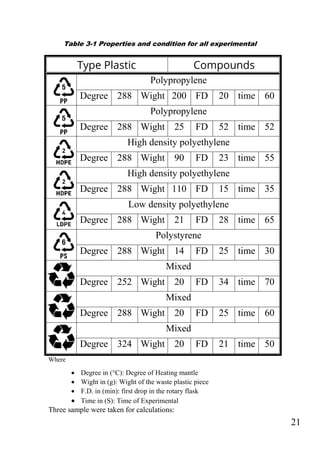
Figure 2-9 Product from mixing plastic at different temperture
3. Results and Discussion
21
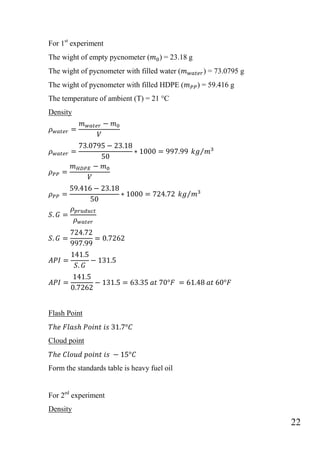
Table 3-1 Properties and condition for all experimental
Where
 Degree in (°C): Degree of Heating mantle
 Wight in (g): Wight of the waste plastic piece
 F.D. in (min): first drop in the rotary flask
 Time in (S): Time of Experimental
Three sample were taken for calculations:
Type Plastic Compounds
Polypropylene
Degree 288 Wight 200 FD 20 time 60
Polypropylene
Degree 288 Wight 25 FD 52 time 52
High density polyethylene
Degree 288 Wight 90 FD 23 time 55
High density polyethylene
Degree 288 Wight 110 FD 15 time 35
Low density polyethylene
Degree 288 Wight 21 FD 28 time 65
Polystyrene
Degree 288 Wight 14 FD 25 time 30
Mixed
Degree 252 Wight 20 FD 34 time 70
Mixed
Degree 288 Wight 20 FD 25 time 60
Mixed
Degree 324 Wight 20 FD 21 time 50
22
For 1st
experiment
The wight of empty pycnometer ( ) = 23.18 g
The wight of pycnometer with filled water ( ) = 73.0795 g
The wight of pycnometer with filled HDPE ( ) = 59.416 g
The temperature of ambient (T) = 21 °C
Density
⁄
⁄
Flash Point
Cloud point
Form the standards table is heavy fuel oil
For 2ed
experiment
Density
23
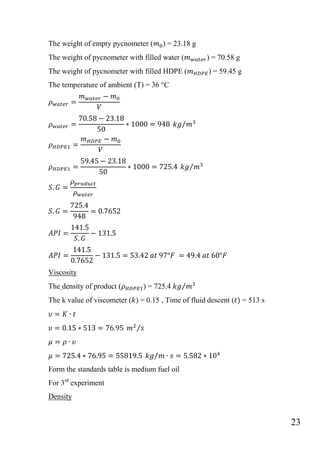
The weight of empty pycnometer ( ) = 23.18 g
The weight of pycnometer with filled water ( ) = 70.58 g
The weight of pycnometer with filled HDPE ( ) = 59.45 g
The temperature of ambient (T) = 36 °C
⁄
⁄
Viscosity
The density of product ( ) = 725.4 ⁄
The k value of viscometer ( ) = 0.15 , Time of fluid descent ( = 513 s
⁄
⁄
Form the standards table is medium fuel oil
For 3rd
experiment
Density
24
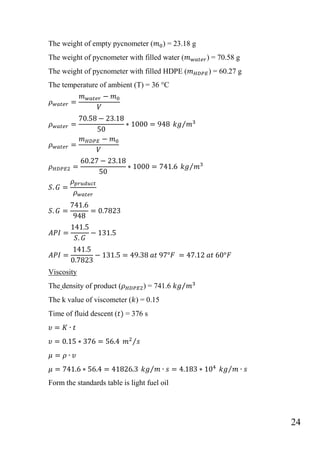
The weight of empty pycnometer ( ) = 23.18 g
The weight of pycnometer with filled water ( ) = 70.58 g
The weight of pycnometer with filled HDPE ( ) = 60.27 g
The temperature of ambient (T) = 36 °C
⁄
⁄
Viscosity
The density of product ( ) = 741.6 ⁄
The k value of viscometer ( ) = 0.15
Time of fluid descent ( = 376 s
⁄
⁄ ⁄
Form the standards table is light fuel oil
25
4. Conclusion
1-Pyrolysis is one of the most waste management efficient methods for
waste plastics), it saves more time, efforts and money than conventional
recycling.
2-Pyrolysis seems to be the only way we can keep the irreplaceable
industry of plastic alive by refreshing the feedstock with waste plastic
which means renewable feedstock independent of the oil availability
worldwide.
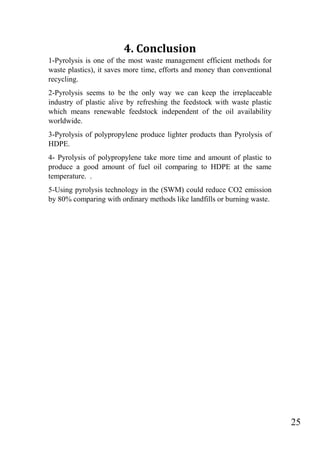
3-Pyrolysis of polypropylene produce lighter products than Pyrolysis of
HDPE.
4- Pyrolysis of polypropylene take more time and amount of plastic to
produce a good amount of fuel oil comparing to HDPE at the same
temperature. .
5-Using pyrolysis technology in the (SWM) could reduce CO2 emission
by 80% comparing with ordinary methods like landfills or burning waste.
26
Recommendation and Limitations
1-In Iraq, we are in need of technologies like this one, especially, with
much existing waste.
2-The next step of work is to design a bigger device that handle more
amount of plastic to produce more fuel and also take into consideration
the use of catalysts.
3-one of the biggest limitation we face is there is no available devices to
distinguish the products components precisely. Thus we use the rough
approach by use of API and viscosity properties.
References
[1] J. Walendziewski, Engine fuel derived from plastics by thermal
treatment, fuel 81 (2002) 473-481
[2] M. Mani, G. Nagaraja N, Influence of injection timing on
performance, emission and combustion characteristics of a DI diesel
engine running on waste plastic oil Energy 34 (2009) 1617–1623
[3] F. Murphy, K. M. Donnell, E. Butler, G. Devlin, The evaluation of
viscosity and density of blends of Cyn-diesel pyrolysis fuel with
conventional diesel fuel in relation to compliance with fuel
specifications EN 590:2009.
[4] N. Miskolczi, A. Angyal, L. Bartha, I. Valkai, Fuels by pyrolysis of
waste plastics from agricultural and packaging sectors in a pilot scale
reactor Fuel Processing Technology 90 (2009) 1032–104
27
[5] M. N. Siddiqui, H.H. Redhwi, Catalytic coprocessing of waste plastics
and petroleum residue into liquid fuel oils, Journal of Analytical and
Applied Pyrolysis 86 (2009) 141–147
[6] A.K. Panda, R.K. Singh, D.K. Mishra, Thermolysis of waste plastics
to liquid fuel A suitable method for plastic waste management and
manufacture of value added Products-A world prospective, Renewable
and Sustainable Energy Reviews 14 (2010) 233–248
[7] A. Demirbas, Waste management, waste resource facilities and waste
conversion processes, Energy Conversion and Management 52 (2011)
1280–1287
[8] M. F. Ali, S. Ahmed, M. S. Qureshi, Catalytic coprocessing of coal
and petroleum residues with waste plastics to produce transportation
fuels Fuel Processing Technology 92 (2011) 1109–1120
[9] Mitusuhara, waste plastics to produce transportation fuels Fuel
Processing Technology 72(2011)
[10] Anup T J1,et.al “Waste Plastic Pyrolysis Oil as Alternative For SI
and CI Engines” International Journal of Innovative Research in
Science, Engineering and Technology (An ISO 3297: 2007 Certified
Organization) Vol. 3, Issue 7, July 2014.
[11] Sam Haig,et.al Plastic to oil IFM002 final report “Zero Waste
Scotland”.
[12] Dr. Shinde „Conversion of waste plastic into resources‟-
International Journal on Innovation in Engineering and Technology-
Volume 6 issue 3 February 2016
[13] Vijaykumar B, Chanashetty and B M Patil, „Fuel from Plastic
Waste‟ International Journal on Emerging Technologies (Special
Issue on NCRIET- 2015)
[14] Mohamed M Garib Alla, Ahmed I Ahmed, Babiker K Abdalla,
„Conversion of Plastic waste into liquid fuel‟-International Journal of
Technical Research and Applications -Volume 2, Issue 3 (May-June
2014).
[15] Coulson & Richardson's. „Chemical engineering design textbook‟-
Volume 6. [5]. P Baggio- „Experimental & Modeling Analysis of a
batch gasification‟, „Energy conversion & management 2009‟.
[16] Merve Sogoncioglu – „Comparative study on Waste Plastic
Pyrolysis liquid products quantity &energy recovery potential 2017‟.
[17] Thallada Bhaskar – „Pyrolysis of waste plastic using CACO3‟,
„Progress in rubber, plastic & recycling technology Volume- 20,
2004‟.
28
[18] P Senthil Kumar – „Conversion of waste plastic into low emissive
hydrocarbon fuels through catalytic deploymerization in a new
laboratory scale batch reactor‟, International Journal of Energy
environment engineering Volume- 8, 2017.

Fuel from waste plastic by pyrolysis

  • 1.
    Southern Technical University EngineeringTechnical College Department of Fuel and Energy Final Year Project / Group No.: Fuel from Waste Plastic by Pyrolysis By Ali Kadhim Morwad Ali Jumah Thamer Omar Montaser Abdul-Baqi Muslim Kareem Raheem Supervision M.Sc. Bahiya Jabbar 2018/2019
  • 2.
    ii Abstract Waste plastic disposaland excessive use of fossil fuels have caused environmental concerns in the world. Both plastics and petroleum- derived fuels are hydrocarbons that contain the elements of carbon and hydrogen. The difference between them is that plastic molecules have longer carbon chains than those in LPG, petrol, and diesel fuels. Therefore, it is possible to convert waste plastic into fuels. The main objectives of this study were to understand and optimize the processes of plastic pyrolysis for maximizing the diesel range products, and to design a continuous pyrolysis apparatus as a semi-scale commercial plant. Pyrolysis of polyethylene (PE), polypropylene (PP), and polystyrene (PS) has been investigated both theoretically and experimentally in a lab-scale pyrolysis reactor. The key factors have been investigated and identified. Pyrolysis of polyethylene (PE), polypropylene (PP), and polystyrene (PS) has been investigated both theoretically and experimentally in a lab-scale. The key factors have been investigated and identified. The cracking temperature for PE, PP and PS in the pyrolysis is at range (324-188 ºC). The high reaction temperature and heating rate can significantly promote the production of light hydrocarbons. Long residence time also favors the yield of the light hydrocarbon products. The effects of other factors like the type of reactor, catalyst, pressure, and reflux rate. The PP pyrolysis products have the value of API 61.5>31.1 and this value is slightly light by API gravity classification In the pyrolysis product of HDPE, have the value of API (47, 49)>31.1 and this value is slightly light by API gravity classification
  • 3.
    iii Acknowledgements Without the support,assistance, and motivation provided by those around me, this study would have never been accomplished. In particular, I would like to thank my supervisor M.Sc. Bahiya for his help and guidance during the period of research. M.Sc. Bahiya provided significant comments and financial support on defining the topic and proceeding with the research. His assistance in editing was very greatly appreciated. His enthusiastic nature always encourages me. I have gained much about this study from his rigorous attitude I need to thank M.Sc. Akeel M. Ali for his valuable advice. I would also like to acknowledge the technical staffs in the department, B.Sc. Jaffar Abdurrahman for teaching me the experimental techniques and how to use the analysis devices. Their valuable suggestions, discussions, and endless enthusiasm were much appreciated.
  • 4.
    iv Reference Abstract ................................................................. ii Acknowledgements.............................................. iii Reference...............................................................iv List of Symbols ......................................................v List of Abbreviations.............................................vi 1. Introduction........................................................1 1.1 Background.......................................................................................1 1.2 Objectives .........................................................................................3 1.3 Uses of different types of plastics.....................................................3 1.4 Properties of Plastics.........................................................................4 1.5 Environmental hazards due to mismanagement of plastics waste ...4 1.6 Side Effect of plastics in nature........................................................5 1.7 The project aims................................................................................6 1.8 The pyrolysis of Plastic Materials ....................................................6 1.9 Effect of raw material as plastics in production ...............................8 1.10 Physical and thermal properties of crude oil and its products........8 2. Methodology ....................................................11 2.1 Collection & Identification of waste plastic...................................11 2.2 Device description ..........................................................................12 2.3 Subjecting the Waste Plastic for Pyrolysis Process........................18 2-4 Process steps and materials ............................................................19 3. Results and Discussion.....................................20 4. Conclusion........................................................25 References............................................................26
  • 5.
    v List of Symbols Theweight of empty pycnometer The weight of pycnometer with filled water The weight of pycnometer with filled PP The weight of pycnometer with filled HDPE The temperature of ambient Density The k value of viscometer Time of fluid descent Kinematic Viscosity Dynamic viscosity Specific gravity American petroleum institute
  • 6.
    vi List of Abbreviations PEPolyethylene HDPE High density polyethylene LDPE Low density polyethylene PP Polypropylene PS Polystyrene PET Polyethylene Terephthalate
  • 7.
    1 1. Introduction 1.1 Background Plasticis a high molecular weight material that was invented by Alexander Parke's in 1862. Plastics are also called polymers. The term polymer means a molecule made up by repetition of the simple unit. For example, the structure of polypropylene can be written in a form as shown in Figure 1-1 or in Figure 1-2 Figure 1-1 Common expression of polypropylene molecular structure Figure 1-2 A simplified expression of polypropylene molecular structure
  • 8.
    2 The repeating unitof the polymer is in the brackets with a subscript, n, to represent the number of the unit in this polymer molecule. Plastic is one of the most commonly used materials in daily life which can be classified in many ways such as based on its chemical structure, synthesis process, density, and other properties. In order to assist recycling of the waste plastic, Society of Plastic Industry (SPI) defined a resin identification code system that divides plastics into the following seven groups based on the chemical structure and applications: 1) PET (Polyethylene Terephthalate) 2) HDPE (High Density Polyethylene) 3) PVC (Polyvinyl Chloride) 4) LDPE (Low Density Polyethylene) 5) PP (Polypropylene) 6) PS (Polystyrene) 7) Other The above seven types of plastics are marked on various plastic products as follows: Figure 1-3 Marks of the seven types of plastics on various plastic products.
  • 9.
    3 1.2 Objectives The mainobjectives of this project are: 1) To raise the awareness in developing countries like Iraq about the possibility of plastic waste recirculation as a source of liquid fuel, this could be generated and marketed at cheaper rates compared to that of the available diesel or oil in the market. 2) Contributing to the Economic growth of the country. 3) Find a new source of fuel oil rather than fossil fuel. 4) Plastic recovery decrease the air and water pollution. 1.3 Uses of different types of plastics Table 1-1 Uses of different types of plastics Type of Plastics Uses PET Carbonated drink bottles, plastics film Supermarket bags, plastics bottle HDPE Milk jugs, detergent bottles, thicker Plastics film, pipes LDPE Floor tiles, shower curtains, cling film PVC Agriculture (fountain) pipe, guttering Pipe, window frame, sheets for building material PP Bottle caps, drinking straws,Bumper, house ware, fiber carpeting and rope.
  • 10.
    4 PS foam use forinsulation of roofs and walls, disposal cups, plates, food Container, CD and cassette box. 1.4 Properties of Plastics 1) They are less brittle than Glass, yet they can be made equally transparent and smooth. 2) They are lightweight and at the same time possess good strength and rigidity. 3) They possess good toughness. 4) Their high dielectric strength makes them suitable for electric insulation. 5) They resist corrosion and the action of chemicals. 6) The ease at which they can be mass – produced contributes greatly to the popularity as wrappers and bags. 7) Possess the property of low moisture absorption. 8) They can be easily molded to desired shapes. 1.5 Environmental hazards due to mismanagement of plastics waste Plastics is not biodegradable material. It al most taks 300-500 years for biodegrading ,therefore; environmental hazards due to improper manage include the following aspect: 1) Littered plastics spoils the beauty of the city and choke drains and make important public places dirty. 2) Garbage containing plastics, when burnt may cause air pollution by emitting polluting gases. 3) Garbage mix with plastics gives problem in landfill operation.
  • 11.
    5 4) Lack ofrecycling plant to posing an unhygienic problem to the environment. 1.6 Side Effect of plastics in nature 1) Durability and chemical structure greatly influences the biodegradability of some organic compounds, therefore, an increased number of functional groups (groups of atoms) attached to the benzene ring in an organic molecule usually hinders microbial attack. 2) Instead of biodegradation, plastics waste goes through photo- degradation and turns into plastic dust which can enter in the food chain and can cause complex health issues to earth habitants. 3) Plastics are produced from petroleum derivatives and are composed primarily of hydrocarbons but also contain additives such as antioxidants, colorants, and other stabilizers. 4) When plastic products are used and discarded, the additives are undesirable from an environmental point of view. 5) Burning of plastics give , , , particulate, dioxins, furans and fumes which is increase‟s air pollution and result in acid rain and contriupute in global warming.
  • 12.
    6 6) Plastics inlandfill area leaching toxins into ground water. Figure 1-4 Plastic pollution in the world's oceans 1.7 The project aims There are two aims for the project: 1- The aim of the project is to development and design of a process to transform all sorts of plastic waste into crude oil and refined fuel fractions. The ultimate goal is to be able to treat all sorts of plastic waste into high quality fuel for transportation, vessel fleet and energy production. 2- Recycle the degraded and dirty plastic fraction into valuable products and eliminate the environmental impact of plastic waste. 1.8 The pyrolysis of Plastic Materials Pyrolysis is a thermal cracking reaction of the large molecular weight polymer carbon chains under an oxygen-free environment and produces a small molecular weight molecules. Traditional treatments for post-consumed plastics were landfills or incineration. However, landfill of the post-consumed plastics has
  • 13.
    7 potential problems becauseof limited land resource and high durability of plastics. The incomplete burn may generate poisonous substances and causes serious health problems. Other methods like gasification and bioconversion are mainly used for organic materials. HDPE, LDPE, PP, and PS are all hydrocarbons. They consist of entirely of carbon and hydrogen, which are similar to hydrocarbon fuels such as liquefied petroleum gas (LPG), petrol and diesel. Some commercial plastic pyrolysis plants have been in operation in which all types of post-consumer plastics accepted need to be treated by using hydrochloride scrubber which is mainly use for PVC cracking process because of it chloride content because chloride is not desirable in the fuel products. In the table below will show '' Type of Plastics as raw materials and its contents''. Table 1-2. Type of Plastics and its contents. Type of Plastics its contents PE (HDPE, LDPE), PP, PS Hydrocarbons PET Hydrocarbons with oxygen PVC Hydrocarbons with chlorine 1.8.1 Solutions waste for plastic problem Plastic waste is a big problem in our daily modern lifestyle, environment solutions for this problem is urgent and efficient. Hence, there two main solution for this problem: a) Recycling plastic. b) Energy conversion or degradation of plastic.
  • 14.
    8 1.9 Effect ofraw material as plastics in production If PE, PS, PP with other plastics gives fuel gas pollution and contaminated to the reactor by making other unexpected compounds. In contamination to reactor resulting liquid may contain alcohol, waxy hydrocarbons, and inorganic substance. Type of plastics and their product in table 2 is below. Table 1-3. Effect of plastics in production. Type of Plastics Product PE (HDPE, LDPE), PP, PS liquid fuels PET Terephthalic acid and benzoic acid PVC HCL gas and carbonous compound (UNEP, 2009) 1.10 Physical and thermal properties of crude oil and its products 1.10.1 Density Density is defined as mass per unit volume of a fluid. Density is a state function and for a pure compound depends on both temperature and pressure and is shown by ρ. Liquid densities decrease as temperature increases but the effect of pressure on liquid densities at moderate pressures is usually negligible.
  • 15.
    9 1.10.2 Specific Gravity Liquiddensity for hydrocarbons is usually reported in terms of specific gravity (SG) or relative density defined as: Since the standard conditions adopted by the petroleum industry are 60°F (15.5°C) and 1 atm specific gravities of liquid hydrocarbons are normally reported at these conditions. Water density at 60°F is 0.999 or almost 1 g/cm3, thus, ⁄ The definition of specific gravity for gases is somewhat different. The specific gravity of a gas is proportional to the ratio of molecular weight of (28.97) gas (Mg) to the molecular weight of air 1.10.3 API Gravity The American Petroleum Institute (API) defined the API gravity (degrees API) to quantify the quality of petroleum products and crude oils. The API gravity is defined as:
  • 16.
    10 Crude Oils API= 10 – 50, crude oils can generally be classified according to API as shown: 1.10.4 Flash point Flash point TF, for a hydrocarbon or a fuel is the minimum temperature at which vapor pressure of the hydrocarbon is sufficient to produce the vapor needed for spontaneous ignition of the hydrocarbon with the air with the presence of an external source, i.e., spark or flame. From this definition, it is clear that hydrocarbons with higher vapor pressures (lighter compounds) have lower flash points. Generally flash point increases with an increase in boiling point. Flash point is an important parameter for safety considerations, especially during storage and transportation of volatile petroleum products (i.e., LPG, light naphtha, gasoline) in a high-temperature environment. The flash point can be estimated using the following equation: Where T10 is normal boiling point for petroleum fractions at 10 vol% distillation temperature. Both temperatures (T10 and flash point (TF) in Kelvin).
  • 17.
    11 2. Methodology In ourexperiments, commercially available shredded plastics were procured and washed before pyrolysis. Pyrolysis it is one of the most favorable and effective disposing methods, the process is an environmentally friendly and efficient way to eliminate the effect of plastic. Pyrolysis is the thermal degradation of solid wastes at high temperatures (250- 325℃) in the absence of air (and oxygen). The main process given below: 1. Identification of waste plastics. (PE/PP/PS/LDPE/HDPE) 2. Crash and cut the plastic for the pyrolysis process 3. Condensation of the gas to obtain raw fuel. 4. Collect the sample and perform tests to identify the kinds of fuel produced. 2.1 Collection & Identification of waste plastic  The collection of waste plastic is quite an easy task as compared to other wastes, the plastic wastes are abundant and can be obtained in large quantities from the households, roadsides, hospitals, hotels etc.  Plastics are usually termed as following:  Polypropylene (PP)  High-Density Polyethylene (HDPE)  Low-Density Polyethylene (LDPE)  Polystyrene (PS)  Usually, they are manufactured in the form of plastic bags, saline bottles, plastic tools, chairs and other components which we usually come across in our day to day life
  • 18.
    12 2.2 Device description 1-Distillation Apparatus a- PYREX round bottom flasks 1000ml Figure 2-1 Round bottom flasks 1000ml Specification: Capacity: 1000mL Material: Borosilicate glass Flask Style: Boiling Flask Shape: Flat Bottom Neck Style: short Top Style: 24/29 Ground Glass Mouth Height: 160mm Outer Dimension: 108mm Lower Working Temp: -230°C Upper Extreme Temp: 450°C Upper Working Temp: 230°C Max. Thermal Shock: 160°C
  • 19.
    13 b- PYREX roundbottom flasks 500ml Figure 2-1 Round bottom flasks 500ml Specification: Capacity: 500mL Material: Borosilicate glass Flask Style: Boiling Flask Shape: Flat Bottom Neck Style: Long Top Style: 24/29 Ground Glass Mouth Height: 180mm Outer Dimension: 108mm Lower Working Temp: -230°C Upper Extreme Temp: 450°C Upper Working Temp: 230°C Max. Thermal Shock: 160°C
  • 20.
    14 c- Condenser Figure 2-2Jacketed reflux Condenser Specification: Types: Coil Condenser Material: Borosilicate Glass Glass Thickness: 2 to 5 mm Jacket Length: 250mm Features:  Graham condenser is designed for use in distillation applications.  Constructed of borosilicate glass, this condenser has a coiled inner tube to provide additional surface area for highly efficient cooling.  Both upper and lower joints are 24/29.
  • 21.
    15 d- Distillation Adapter,Connecting Figure 2-3 Distillation Adapter, Connecting 75 degrees Adapter Type: 75° Bent Distillation Adapters Material: Borosilicate Glass Joints: 24/29 Diameter: 17 mm e- Distillation Adapter, Vacuum take-off adapter
  • 22.
    16 Figure 2-4 DistillationAdapter, Vacuum take-off adapter bent short stem Specification: Adapter Type: Connecting, With Angle Socket Material: Borosilicate Glass Joints: 24/29 Diameter: 17 mm 2. Heating Mental Figure 2-5 AIBOTE Heating Mantle 10000ml Specification: Capacity: 10000ml for round bottom flask Heating Temperature Range: Ambient to 400 degree Temperature Control PID. Inner and Outer Temperature sensor Temperature Range: Ambient to 380 Temperature Display: +/- 1 degree Permissible Ambient Temperature: Ambient Temperature to 40 degree Voltage: 110v - 240v Power: 2100 W Temperature Accuracy: ±1 degree Stirring Flask Capacity: 10000ml Packing Dimension: 480 × 320 × 200 mm Shipping Weight: 8. 5 kg Shell material: Superfine metal
  • 23.
    17 3- Water Filter Figure2-6 Filter RS-702 Specification: Rated power: 18 W Frequency: 50 Hz Voltage: 220/240 v Diameter: 16 mm Size: 60 * 50 * 195 mm The maximum head: 0.8 m Maximum flow: 1500 L/H Features: Low can be superimposed filter cartridges design Low replacement pump inflatable (must be close to the surface installation) Low high performance centrifugal pumps Low multi-functional design Low energy consumption is low Low is suitable for all kinds of aquatic animals Low high pore filtering material Low convenient cleaning
  • 24.
    18 4- Plastic Tubes Figure2-7 PVC Clear Vinyl Tube 2.3 Subjecting the Waste Plastic for Pyrolysis Process Figure 2-8 block diagram of the pyrolysis process The pyrolysis is a simple process in which the organic matter is subjected to a higher temperature about 250ºC to 325ºC in order to promote thermal cracking of the organic matter so as to obtain the end products in the form of liquid, char, and gas in absence of oxygen.
  • 25.
    19 2-4 Process stepsand materials 2.4.1. Materials The waste mixture of polyethylene, polypropylene, and polystyrene was used as a raw material or use each one individually. The polymer mixture pieces have a maximum particle size of 5-6 mm. The melting temperatures of (HDPE, LDPE, PP, PS) mixture, as determined by CLAW Environmental, were 135°C, 115°C, 165°C, and 90°C, respectively. 2.4.2 Experimental Setup All experiments of waste polyolefin mixture (RW) were carried out in a rotary flask 1000 mL volume which was equipped with a temperature measurement system. Different amounts of plastic waste mixed were placed into a flask. The plastic selected specifically PP. HDPE and PS are fed to the rotary flask. The reaction system was closed at atmospheric pressure and then the heater was switched on. Then the water filter is switched on in the first after this the heating mantle. This heater supplies enough heat to melt the plastic fed into the flask. Continuous melting leads to the formation of liquid melted plastic. The pyrolysis was carried out from 250oC to the maximum of 350°C for around (60-100) min. Further heating of the melted plastic leads to the formation of gaseous fumes. The obtained vaporized products from flask were collected through a distillation adapter that afterward being let out to a condenser in order to condense the condensable products. The water filter is poured the water around the condenser. Enough time is provided to let the gas accumulate in the condenser. The water around the condenser cools the fumes in it. Glass condensers were connected tightly to the flask to cool the condensing vapors. And then get the products
  • 26.
    20 Figure 2-8 FinalProduct of the process Figure 2-9 Product from mixing plastic at different temperture 3. Results and Discussion
  • 27.
    21 Table 3-1 Propertiesand condition for all experimental Where  Degree in (°C): Degree of Heating mantle  Wight in (g): Wight of the waste plastic piece  F.D. in (min): first drop in the rotary flask  Time in (S): Time of Experimental Three sample were taken for calculations: Type Plastic Compounds Polypropylene Degree 288 Wight 200 FD 20 time 60 Polypropylene Degree 288 Wight 25 FD 52 time 52 High density polyethylene Degree 288 Wight 90 FD 23 time 55 High density polyethylene Degree 288 Wight 110 FD 15 time 35 Low density polyethylene Degree 288 Wight 21 FD 28 time 65 Polystyrene Degree 288 Wight 14 FD 25 time 30 Mixed Degree 252 Wight 20 FD 34 time 70 Mixed Degree 288 Wight 20 FD 25 time 60 Mixed Degree 324 Wight 20 FD 21 time 50
  • 28.
    22 For 1st experiment The wightof empty pycnometer ( ) = 23.18 g The wight of pycnometer with filled water ( ) = 73.0795 g The wight of pycnometer with filled HDPE ( ) = 59.416 g The temperature of ambient (T) = 21 °C Density ⁄ ⁄ Flash Point Cloud point Form the standards table is heavy fuel oil For 2ed experiment Density
  • 29.
    23 The weight ofempty pycnometer ( ) = 23.18 g The weight of pycnometer with filled water ( ) = 70.58 g The weight of pycnometer with filled HDPE ( ) = 59.45 g The temperature of ambient (T) = 36 °C ⁄ ⁄ Viscosity The density of product ( ) = 725.4 ⁄ The k value of viscometer ( ) = 0.15 , Time of fluid descent ( = 513 s ⁄ ⁄ Form the standards table is medium fuel oil For 3rd experiment Density
  • 30.
    24 The weight ofempty pycnometer ( ) = 23.18 g The weight of pycnometer with filled water ( ) = 70.58 g The weight of pycnometer with filled HDPE ( ) = 60.27 g The temperature of ambient (T) = 36 °C ⁄ ⁄ Viscosity The density of product ( ) = 741.6 ⁄ The k value of viscometer ( ) = 0.15 Time of fluid descent ( = 376 s ⁄ ⁄ ⁄ Form the standards table is light fuel oil
  • 31.
    25 4. Conclusion 1-Pyrolysis isone of the most waste management efficient methods for waste plastics), it saves more time, efforts and money than conventional recycling. 2-Pyrolysis seems to be the only way we can keep the irreplaceable industry of plastic alive by refreshing the feedstock with waste plastic which means renewable feedstock independent of the oil availability worldwide. 3-Pyrolysis of polypropylene produce lighter products than Pyrolysis of HDPE. 4- Pyrolysis of polypropylene take more time and amount of plastic to produce a good amount of fuel oil comparing to HDPE at the same temperature. . 5-Using pyrolysis technology in the (SWM) could reduce CO2 emission by 80% comparing with ordinary methods like landfills or burning waste.
  • 32.
    26 Recommendation and Limitations 1-InIraq, we are in need of technologies like this one, especially, with much existing waste. 2-The next step of work is to design a bigger device that handle more amount of plastic to produce more fuel and also take into consideration the use of catalysts. 3-one of the biggest limitation we face is there is no available devices to distinguish the products components precisely. Thus we use the rough approach by use of API and viscosity properties. References [1] J. Walendziewski, Engine fuel derived from plastics by thermal treatment, fuel 81 (2002) 473-481 [2] M. Mani, G. Nagaraja N, Influence of injection timing on performance, emission and combustion characteristics of a DI diesel engine running on waste plastic oil Energy 34 (2009) 1617–1623 [3] F. Murphy, K. M. Donnell, E. Butler, G. Devlin, The evaluation of viscosity and density of blends of Cyn-diesel pyrolysis fuel with conventional diesel fuel in relation to compliance with fuel specifications EN 590:2009. [4] N. Miskolczi, A. Angyal, L. Bartha, I. Valkai, Fuels by pyrolysis of waste plastics from agricultural and packaging sectors in a pilot scale reactor Fuel Processing Technology 90 (2009) 1032–104
  • 33.
    27 [5] M. N.Siddiqui, H.H. Redhwi, Catalytic coprocessing of waste plastics and petroleum residue into liquid fuel oils, Journal of Analytical and Applied Pyrolysis 86 (2009) 141–147 [6] A.K. Panda, R.K. Singh, D.K. Mishra, Thermolysis of waste plastics to liquid fuel A suitable method for plastic waste management and manufacture of value added Products-A world prospective, Renewable and Sustainable Energy Reviews 14 (2010) 233–248 [7] A. Demirbas, Waste management, waste resource facilities and waste conversion processes, Energy Conversion and Management 52 (2011) 1280–1287 [8] M. F. Ali, S. Ahmed, M. S. Qureshi, Catalytic coprocessing of coal and petroleum residues with waste plastics to produce transportation fuels Fuel Processing Technology 92 (2011) 1109–1120 [9] Mitusuhara, waste plastics to produce transportation fuels Fuel Processing Technology 72(2011) [10] Anup T J1,et.al “Waste Plastic Pyrolysis Oil as Alternative For SI and CI Engines” International Journal of Innovative Research in Science, Engineering and Technology (An ISO 3297: 2007 Certified Organization) Vol. 3, Issue 7, July 2014. [11] Sam Haig,et.al Plastic to oil IFM002 final report “Zero Waste Scotland”. [12] Dr. Shinde „Conversion of waste plastic into resources‟- International Journal on Innovation in Engineering and Technology- Volume 6 issue 3 February 2016 [13] Vijaykumar B, Chanashetty and B M Patil, „Fuel from Plastic Waste‟ International Journal on Emerging Technologies (Special Issue on NCRIET- 2015) [14] Mohamed M Garib Alla, Ahmed I Ahmed, Babiker K Abdalla, „Conversion of Plastic waste into liquid fuel‟-International Journal of Technical Research and Applications -Volume 2, Issue 3 (May-June 2014). [15] Coulson & Richardson's. „Chemical engineering design textbook‟- Volume 6. [5]. P Baggio- „Experimental & Modeling Analysis of a batch gasification‟, „Energy conversion & management 2009‟. [16] Merve Sogoncioglu – „Comparative study on Waste Plastic Pyrolysis liquid products quantity &energy recovery potential 2017‟. [17] Thallada Bhaskar – „Pyrolysis of waste plastic using CACO3‟, „Progress in rubber, plastic & recycling technology Volume- 20, 2004‟.
  • 34.
    28 [18] P SenthilKumar – „Conversion of waste plastic into low emissive hydrocarbon fuels through catalytic deploymerization in a new laboratory scale batch reactor‟, International Journal of Energy environment engineering Volume- 8, 2017.