DELTECH CORPORATIONDELTECH CORPORATION
Deltech Corporation HistoryDeltech Corporation History
 1989 - Purchased Baton Rouge business and site from Hoechst Celanese1989 - Purchased Baton Rouge business and site from Hoechst Celanese
 1991 - Purchased polystyrene plant in Troy, Ohio1991 - Purchased polystyrene plant in Troy, Ohio
 1991 - Purchased Dow’s Vinyltoluene business1991 - Purchased Dow’s Vinyltoluene business
 1995 - Management buyout1995 - Management buyout
 1997 - Established NewChem, Inc.- Newell, WV1997 - Established NewChem, Inc.- Newell, WV
 1997 - Installed new dehydrogenation unit at Baton Rouge, LA site1997 - Installed new dehydrogenation unit at Baton Rouge, LA site
 2000 - Purchased UK Resin Plant- Haverhill England2000 - Purchased UK Resin Plant- Haverhill England
 2003 - Sold Polystyrene business kept assets2003 - Sold Polystyrene business kept assets
 2004 - Expanded distillation capacity2004 - Expanded distillation capacity
 2005 - Purchased T&W and formed Deltech Resins Company- Newark, NJ2005 - Purchased T&W and formed Deltech Resins Company- Newark, NJ
 2005 - Opened Priam Tintas Ltda sales office-Sao Paulo, Brazil2005 - Opened Priam Tintas Ltda sales office-Sao Paulo, Brazil
 2006 - Opened Brazil Plant- Itapeva, Brazil2006 - Opened Brazil Plant- Itapeva, Brazil
 2008 - Opened Shanghai sales office- Shanghai, China2008 - Opened Shanghai sales office- Shanghai, China
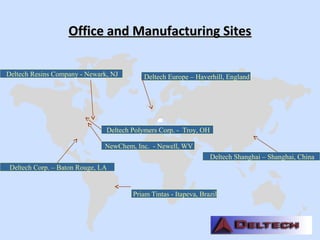
Office and Manufacturing SitesOffice and Manufacturing Sites
Deltech Polymers Corp. - Troy, OH
Priam Tintas - Itapeva, Brazil
Deltech Resins Company - Newark, NJ
NewChem, Inc. - Newell, WV
Deltech Europe – Haverhill, England
Deltech Shanghai – Shanghai, China
Deltech Corp. – Baton Rouge, LA
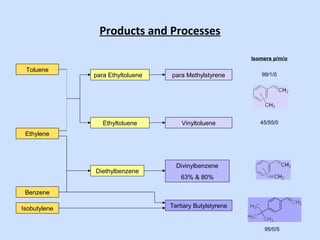
Products and Processes
Ethylene
Benzene
Isobutylene
para Ethyltoluene
Ethyltoluene
Diethylbenzene
para Methylstyrene
Vinyltoluene
Divinylbenzene
63% & 80%
Tertiary Butylstyrene
Toluene
Isomers p/m/o
99/1/0
45/55/0
95/0/5
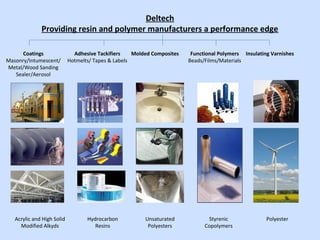
Deltech
Providing resin and polymer manufacturers a performance edge
Acrylic and High Solid
Modified Alkyds
Coatings
Masonry/Intumescent/
Metal/Wood Sanding
Sealer/Aerosol
Molded CompositesAdhesive Tackifiers
Hotmelts/ Tapes & Labels
Insulating VarnishesFunctional Polymers
Beads/Films/Materials
Hydrocarbon
Resins
Unsaturated
Polyesters
Styrenic
Copolymers
Polyester
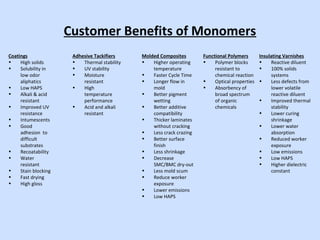
Customer Benefits of Monomers
Coatings
• High solids
• Solubility in
low odor
aliphatics
• Low HAPS
• Alkali & acid
resistant
• Improved UV
resistance
• Intumescents
• Good
adhesion to
difficult
substrates
• Recoatability
• Water
resistant
• Stain blocking
• Fast drying
• High gloss
Adhesive Tackifiers
• Thermal stability
• UV stability
• Moisture
resistant
• High
temperature
performance
• Acid and alkali
resistant
Molded Composites
• Higher operating
temperature
• Faster Cycle Time
• Longer flow in
mold
• Better pigment
wetting
• Better additive
compatibility
• Thicker laminates
without cracking
• Less crack crazing
• Better surface
finish
• Less shrinkage
• Decrease
SMC/BMC dry-out
• Less mold scum
• Reduce worker
exposure
• Lower emissions
• Low HAPS
Functional Polymers
• Polymer blocks
resistant to
chemical reaction
• Optical properties
• Absorbency of
broad spectrum
of organic
chemicals
Insulating Varnishes
• Reactive diluent
• 100% solids
systems
• Less defects from
lower volatile
reactive diluent
• Improved thermal
stability
• Lower curing
shrinkage
• Lower water
absorption
• Reduced worker
exposure
• Low emissions
• Low HAPS
• Higher dielectric
constant
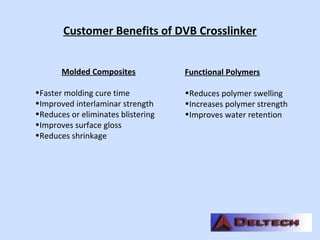
Customer Benefits of DVB Crosslinker
Functional Polymers
•Reduces polymer swelling
•Increases polymer strength
•Improves water retention
Molded Composites
•Faster molding cure time
•Improved interlaminar strength
•Reduces or eliminates blistering
•Improves surface gloss
•Reduces shrinkage
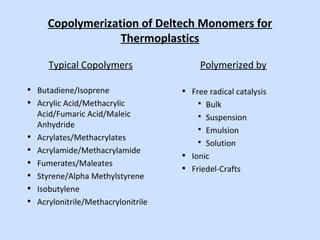
Copolymerization of Deltech Monomers for
Thermoplastics
Typical Copolymers
• Butadiene/Isoprene
• Acrylic Acid/Methacrylic
Acid/Fumaric Acid/Maleic
Anhydride
• Acrylates/Methacrylates
• Acrylamide/Methacrylamide
• Fumerates/Maleates
• Styrene/Alpha Methylstyrene
• Isobutylene
• Acrylonitrile/Methacrylonitrile
Polymerized by
• Free radical catalysis
 Bulk
 Suspension
 Emulsion
 Solution
• Ionic
• Friedel-Crafts
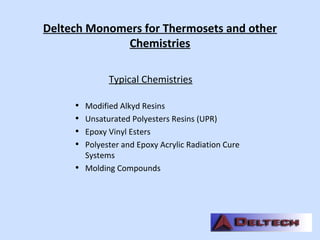
Deltech Monomers for Thermosets and other
Chemistries
Typical Chemistries
• Modified Alkyd Resins
• Unsaturated Polyesters Resins (UPR)
• Epoxy Vinyl Esters
• Polyester and Epoxy Acrylic Radiation Cure
Systems
• Molding Compounds
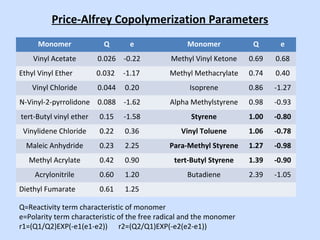
Price-Alfrey Copolymerization Parameters
Monomer Q e Monomer Q e
Vinyl Acetate 0.026 -0.22 Methyl Vinyl Ketone 0.69 0.68
Ethyl Vinyl Ether 0.032 -1.17 Methyl Methacrylate 0.74 0.40
Vinyl Chloride 0.044 0.20 Isoprene 0.86 -1.27
N-Vinyl-2-pyrrolidone 0.088 -1.62 Alpha Methylstyrene 0.98 -0.93
tert-Butyl vinyl ether 0.15 -1.58 Styrene 1.00 -0.80
Vinylidene Chloride 0.22 0.36 Vinyl Toluene 1.06 -0.78
Maleic Anhydride 0.23 2.25 Para-Methyl Styrene 1.27 -0.98
Methyl Acrylate 0.42 0.90 tert-Butyl Styrene 1.39 -0.90
Acrylonitrile 0.60 1.20 Butadiene 2.39 -1.05
Diethyl Fumarate 0.61 1.25
Q=Reactivity term characteristic of monomer
e=Polarity term characteristic of the free radical and the monomer
r1=(Q1/Q2)EXP(-e1(e1-e2)) r2=(Q2/Q1)EXP(-e2(e2-e1))
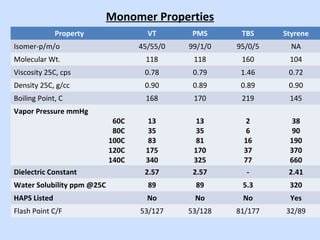
Monomer Properties
Property VT PMS TBS Styrene
Isomer-p/m/o 45/55/0 99/1/0 95/0/5 NA
Molecular Wt. 118 118 160 104
Viscosity 25C, cps 0.78 0.79 1.46 0.72
Density 25C, g/cc 0.90 0.89 0.89 0.90
Boiling Point, C 168 170 219 145
Vapor Pressure mmHg
60C
80C
100C
120C
140C
13
35
83
175
340
13
35
81
170
325
2
6
16
37
77
38
90
190
370
660
Dielectric Constant 2.57 2.57 - 2.41
Water Solubility ppm @25C 89 89 5.3 320
HAPS Listed No No No Yes
Flash Point C/F 53/127 53/128 81/177 32/89
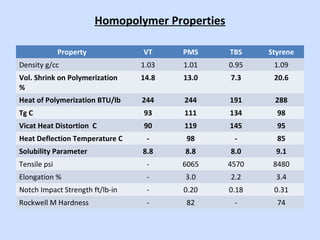
Homopolymer Properties
Property VT PMS TBS Styrene
Density g/cc 1.03 1.01 0.95 1.09
Vol. Shrink on Polymerization
%
14.8 13.0 7.3 20.6
Heat of Polymerization BTU/lb 244 244 191 288
Tg C 93 111 134 98
Vicat Heat Distortion C 90 119 145 95
Heat Deflection Temperature C - 98 - 85
Solubility Parameter 8.8 8.8 8.0 9.1
Tensile psi - 6065 4570 8480
Elongation % - 3.0 2.2 3.4
Notch Impact Strength ft/lb-in - 0.20 0.18 0.31
Rockwell M Hardness - 82 - 74
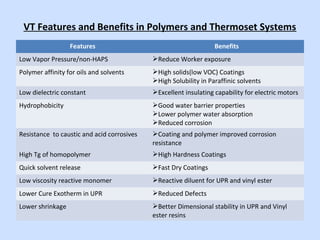
VT Features and Benefits in Polymers and Thermoset Systems
Features Benefits
Low Vapor Pressure/non-HAPS Reduce Worker exposure
Polymer affinity for oils and solvents High solids(low VOC) Coatings
High Solubility in Paraffinic solvents
Low dielectric constant Excellent insulating capability for electric motors
Hydrophobicity Good water barrier properties
Lower polymer water absorption
Reduced corrosion
Resistance to caustic and acid corrosives Coating and polymer improved corrosion
resistance
High Tg of homopolymer High Hardness Coatings
Quick solvent release Fast Dry Coatings
Low viscosity reactive monomer Reactive diluent for UPR and vinyl ester
Lower Cure Exotherm in UPR Reduced Defects
Lower shrinkage Better Dimensional stability in UPR and Vinyl
ester resins
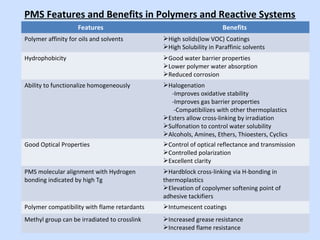
PMS Features and Benefits in Polymers and Reactive Systems
Features Benefits
Polymer affinity for oils and solvents High solids(low VOC) Coatings
High Solubility in Paraffinic solvents
Hydrophobicity Good water barrier properties
Lower polymer water absorption
Reduced corrosion
Ability to functionalize homogeneously Halogenation
-Improves oxidative stability
-Improves gas barrier properties
-Compatibilizes with other thermoplastics
Esters allow cross-linking by irradiation
Sulfonation to control water solubility
Alcohols, Amines, Ethers, Thioesters, Cyclics
Good Optical Properties Control of optical reflectance and transmission
Controlled polarization
Excellent clarity
PMS molecular alignment with Hydrogen
bonding indicated by high Tg
Hardblock cross-linking via H-bonding in
thermoplastics
Elevation of copolymer softening point of
adhesive tackifiers
Polymer compatibility with flame retardants Intumescent coatings
Methyl group can be irradiated to crosslink Increased grease resistance
Increased flame resistance
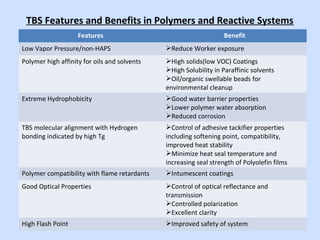
TBS Features and Benefits in Polymers and Reactive Systems
Features Benefit
Low Vapor Pressure/non-HAPS Reduce Worker exposure
Polymer high affinity for oils and solvents High solids(low VOC) Coatings
High Solubility in Paraffinic solvents
Oil/organic swellable beads for
environmental cleanup
Extreme Hydrophobicity Good water barrier properties
Lower polymer water absorption
Reduced corrosion
TBS molecular alignment with Hydrogen
bonding indicated by high Tg
Control of adhesive tackifier properties
including softening point, compatibility,
improved heat stability
Minimize heat seal temperature and
increasing seal strength of Polyolefin films
Polymer compatibility with flame retardants Intumescent coatings
Good Optical Properties Control of optical reflectance and
transmission
Controlled polarization
Excellent clarity
High Flash Point Improved safety of system
Deltech Advantage
• Multiple production lines within core process units
– Alkylation
– Dehydrogenation
– Distillation
• Multi-scale production from pilot plant to small and large scale production
• Major raw material sourcing by barge and pipeline in close proximity to raw
material source
• Global supplier with key offices in US, EU, China, and Brazil
• ISO 9001:2000 certified
• Custom production capability
• Dedicated customer support team
• Quick response time to meet your needs
• Up to date on REACH compliance

Deltech Advantage-Features and BenefitsRev3

  • 1.
  • 2.
    Deltech Corporation HistoryDeltechCorporation History  1989 - Purchased Baton Rouge business and site from Hoechst Celanese1989 - Purchased Baton Rouge business and site from Hoechst Celanese  1991 - Purchased polystyrene plant in Troy, Ohio1991 - Purchased polystyrene plant in Troy, Ohio  1991 - Purchased Dow’s Vinyltoluene business1991 - Purchased Dow’s Vinyltoluene business  1995 - Management buyout1995 - Management buyout  1997 - Established NewChem, Inc.- Newell, WV1997 - Established NewChem, Inc.- Newell, WV  1997 - Installed new dehydrogenation unit at Baton Rouge, LA site1997 - Installed new dehydrogenation unit at Baton Rouge, LA site  2000 - Purchased UK Resin Plant- Haverhill England2000 - Purchased UK Resin Plant- Haverhill England  2003 - Sold Polystyrene business kept assets2003 - Sold Polystyrene business kept assets  2004 - Expanded distillation capacity2004 - Expanded distillation capacity  2005 - Purchased T&W and formed Deltech Resins Company- Newark, NJ2005 - Purchased T&W and formed Deltech Resins Company- Newark, NJ  2005 - Opened Priam Tintas Ltda sales office-Sao Paulo, Brazil2005 - Opened Priam Tintas Ltda sales office-Sao Paulo, Brazil  2006 - Opened Brazil Plant- Itapeva, Brazil2006 - Opened Brazil Plant- Itapeva, Brazil  2008 - Opened Shanghai sales office- Shanghai, China2008 - Opened Shanghai sales office- Shanghai, China
  • 3.
    Office and ManufacturingSitesOffice and Manufacturing Sites Deltech Polymers Corp. - Troy, OH Priam Tintas - Itapeva, Brazil Deltech Resins Company - Newark, NJ NewChem, Inc. - Newell, WV Deltech Europe – Haverhill, England Deltech Shanghai – Shanghai, China Deltech Corp. – Baton Rouge, LA
  • 4.
    Products and Processes Ethylene Benzene Isobutylene paraEthyltoluene Ethyltoluene Diethylbenzene para Methylstyrene Vinyltoluene Divinylbenzene 63% & 80% Tertiary Butylstyrene Toluene Isomers p/m/o 99/1/0 45/55/0 95/0/5
  • 5.
    Deltech Providing resin andpolymer manufacturers a performance edge Acrylic and High Solid Modified Alkyds Coatings Masonry/Intumescent/ Metal/Wood Sanding Sealer/Aerosol Molded CompositesAdhesive Tackifiers Hotmelts/ Tapes & Labels Insulating VarnishesFunctional Polymers Beads/Films/Materials Hydrocarbon Resins Unsaturated Polyesters Styrenic Copolymers Polyester
  • 6.
    Customer Benefits ofMonomers Coatings • High solids • Solubility in low odor aliphatics • Low HAPS • Alkali & acid resistant • Improved UV resistance • Intumescents • Good adhesion to difficult substrates • Recoatability • Water resistant • Stain blocking • Fast drying • High gloss Adhesive Tackifiers • Thermal stability • UV stability • Moisture resistant • High temperature performance • Acid and alkali resistant Molded Composites • Higher operating temperature • Faster Cycle Time • Longer flow in mold • Better pigment wetting • Better additive compatibility • Thicker laminates without cracking • Less crack crazing • Better surface finish • Less shrinkage • Decrease SMC/BMC dry-out • Less mold scum • Reduce worker exposure • Lower emissions • Low HAPS Functional Polymers • Polymer blocks resistant to chemical reaction • Optical properties • Absorbency of broad spectrum of organic chemicals Insulating Varnishes • Reactive diluent • 100% solids systems • Less defects from lower volatile reactive diluent • Improved thermal stability • Lower curing shrinkage • Lower water absorption • Reduced worker exposure • Low emissions • Low HAPS • Higher dielectric constant
  • 7.
    Customer Benefits ofDVB Crosslinker Functional Polymers •Reduces polymer swelling •Increases polymer strength •Improves water retention Molded Composites •Faster molding cure time •Improved interlaminar strength •Reduces or eliminates blistering •Improves surface gloss •Reduces shrinkage
  • 8.
    Copolymerization of DeltechMonomers for Thermoplastics Typical Copolymers • Butadiene/Isoprene • Acrylic Acid/Methacrylic Acid/Fumaric Acid/Maleic Anhydride • Acrylates/Methacrylates • Acrylamide/Methacrylamide • Fumerates/Maleates • Styrene/Alpha Methylstyrene • Isobutylene • Acrylonitrile/Methacrylonitrile Polymerized by • Free radical catalysis  Bulk  Suspension  Emulsion  Solution • Ionic • Friedel-Crafts
  • 9.
    Deltech Monomers forThermosets and other Chemistries Typical Chemistries • Modified Alkyd Resins • Unsaturated Polyesters Resins (UPR) • Epoxy Vinyl Esters • Polyester and Epoxy Acrylic Radiation Cure Systems • Molding Compounds
  • 10.
    Price-Alfrey Copolymerization Parameters MonomerQ e Monomer Q e Vinyl Acetate 0.026 -0.22 Methyl Vinyl Ketone 0.69 0.68 Ethyl Vinyl Ether 0.032 -1.17 Methyl Methacrylate 0.74 0.40 Vinyl Chloride 0.044 0.20 Isoprene 0.86 -1.27 N-Vinyl-2-pyrrolidone 0.088 -1.62 Alpha Methylstyrene 0.98 -0.93 tert-Butyl vinyl ether 0.15 -1.58 Styrene 1.00 -0.80 Vinylidene Chloride 0.22 0.36 Vinyl Toluene 1.06 -0.78 Maleic Anhydride 0.23 2.25 Para-Methyl Styrene 1.27 -0.98 Methyl Acrylate 0.42 0.90 tert-Butyl Styrene 1.39 -0.90 Acrylonitrile 0.60 1.20 Butadiene 2.39 -1.05 Diethyl Fumarate 0.61 1.25 Q=Reactivity term characteristic of monomer e=Polarity term characteristic of the free radical and the monomer r1=(Q1/Q2)EXP(-e1(e1-e2)) r2=(Q2/Q1)EXP(-e2(e2-e1))
  • 11.
    Monomer Properties Property VTPMS TBS Styrene Isomer-p/m/o 45/55/0 99/1/0 95/0/5 NA Molecular Wt. 118 118 160 104 Viscosity 25C, cps 0.78 0.79 1.46 0.72 Density 25C, g/cc 0.90 0.89 0.89 0.90 Boiling Point, C 168 170 219 145 Vapor Pressure mmHg 60C 80C 100C 120C 140C 13 35 83 175 340 13 35 81 170 325 2 6 16 37 77 38 90 190 370 660 Dielectric Constant 2.57 2.57 - 2.41 Water Solubility ppm @25C 89 89 5.3 320 HAPS Listed No No No Yes Flash Point C/F 53/127 53/128 81/177 32/89
  • 12.
    Homopolymer Properties Property VTPMS TBS Styrene Density g/cc 1.03 1.01 0.95 1.09 Vol. Shrink on Polymerization % 14.8 13.0 7.3 20.6 Heat of Polymerization BTU/lb 244 244 191 288 Tg C 93 111 134 98 Vicat Heat Distortion C 90 119 145 95 Heat Deflection Temperature C - 98 - 85 Solubility Parameter 8.8 8.8 8.0 9.1 Tensile psi - 6065 4570 8480 Elongation % - 3.0 2.2 3.4 Notch Impact Strength ft/lb-in - 0.20 0.18 0.31 Rockwell M Hardness - 82 - 74
  • 13.
    VT Features andBenefits in Polymers and Thermoset Systems Features Benefits Low Vapor Pressure/non-HAPS Reduce Worker exposure Polymer affinity for oils and solvents High solids(low VOC) Coatings High Solubility in Paraffinic solvents Low dielectric constant Excellent insulating capability for electric motors Hydrophobicity Good water barrier properties Lower polymer water absorption Reduced corrosion Resistance to caustic and acid corrosives Coating and polymer improved corrosion resistance High Tg of homopolymer High Hardness Coatings Quick solvent release Fast Dry Coatings Low viscosity reactive monomer Reactive diluent for UPR and vinyl ester Lower Cure Exotherm in UPR Reduced Defects Lower shrinkage Better Dimensional stability in UPR and Vinyl ester resins
  • 14.
    PMS Features andBenefits in Polymers and Reactive Systems Features Benefits Polymer affinity for oils and solvents High solids(low VOC) Coatings High Solubility in Paraffinic solvents Hydrophobicity Good water barrier properties Lower polymer water absorption Reduced corrosion Ability to functionalize homogeneously Halogenation -Improves oxidative stability -Improves gas barrier properties -Compatibilizes with other thermoplastics Esters allow cross-linking by irradiation Sulfonation to control water solubility Alcohols, Amines, Ethers, Thioesters, Cyclics Good Optical Properties Control of optical reflectance and transmission Controlled polarization Excellent clarity PMS molecular alignment with Hydrogen bonding indicated by high Tg Hardblock cross-linking via H-bonding in thermoplastics Elevation of copolymer softening point of adhesive tackifiers Polymer compatibility with flame retardants Intumescent coatings Methyl group can be irradiated to crosslink Increased grease resistance Increased flame resistance
  • 15.
    TBS Features andBenefits in Polymers and Reactive Systems Features Benefit Low Vapor Pressure/non-HAPS Reduce Worker exposure Polymer high affinity for oils and solvents High solids(low VOC) Coatings High Solubility in Paraffinic solvents Oil/organic swellable beads for environmental cleanup Extreme Hydrophobicity Good water barrier properties Lower polymer water absorption Reduced corrosion TBS molecular alignment with Hydrogen bonding indicated by high Tg Control of adhesive tackifier properties including softening point, compatibility, improved heat stability Minimize heat seal temperature and increasing seal strength of Polyolefin films Polymer compatibility with flame retardants Intumescent coatings Good Optical Properties Control of optical reflectance and transmission Controlled polarization Excellent clarity High Flash Point Improved safety of system
  • 16.
    Deltech Advantage • Multipleproduction lines within core process units – Alkylation – Dehydrogenation – Distillation • Multi-scale production from pilot plant to small and large scale production • Major raw material sourcing by barge and pipeline in close proximity to raw material source • Global supplier with key offices in US, EU, China, and Brazil • ISO 9001:2000 certified • Custom production capability • Dedicated customer support team • Quick response time to meet your needs • Up to date on REACH compliance

Editor's Notes

  • #11 Indication of relative reaction rates in free radical polymerization If the molecules 1 and 2 differ widely in polarity, then the exponent in the rate equation will be large and therefore the exponential will be small
  • #12 Relative to styrene our monomers are less volatile which has lead to use in numerous applications Because of the alkyl groups on the aromatic structure water is less soluble. Additionally we have seen water barrier and reduced water absorption of polymers based on Deltech monomers
  • #13 In many thermoset systems we have seen lower shrinkage on cure similar to the lower shrinkage of homopolymerization Heat of polymerization relative to styrene is also lower with respect to styrene; and between this and lower shrinkage we have seen many thermoset systems have reduce rates of imperfections. Higher TG’s of PMS and VT lead to improve properties in coatings, thermoplastics and thermoset systems. The solubility parameter is an indication of improved solubility of our materials in solvents which can be beneficial in high solids coatings or absorbtion of organics
  • #14 Based on the uses of VT, PMS and TBS and review of patents demonstrating the use of our monomers we have seen common beneficial properties that our monomers provide polymers, resins and reative systems which transends polymer type. Low vapor pressure of VT relative to styrene reduces worker exposure. Also VT, PMS and TBS are not listed on HAPS whereas styrene is. Because of the additional methyl group attached to the aromatic part of the VT structure it improves it’s solubility as a monomer and in resins, and even more effective in parraffinic solvents like mineral spirits achieving high solids coatings demonstrated in alkyd and acrylic resins. Systems based on using VT as a reactive diluent have excellent electrical insulating properties Because of the methyl group on the aromatic it provides excellent hydrophobicity demonstrated in coating resins and UPR composites Coatings based on VT have good resistance to caustic and acids and cane be applied directly to fresh cement and plaster The elevated Tg’s of resins based on our polymers leads to higher hardness coatings Coating resins based on VT dry very quickly and their good solvent release makes VT excellent for dryfall applications As a reactive diluent VT keeps system viscosities low in UPR composite systems, insulating varnishes and coating systems. Because of the lower cure exotherm compared to styrene, VT based systems reduce composite defects Lower shrinkage of VT (as well aPMS and TBS) provide better dimensional stability.
  • #15 Because of the additional methyl group attached to the aromatic part of the PMS structure it improves it’s solubility as a monomer and in resins, and even more effective in parraffinic solvents like mineral spirits. This high solubility leads to high solids coatings. Because of the methyl group on the aromatic it provides excellent hydrophobicity demonstrated in coating resins (like acrylic based coatings) PMS blocks in a polymer can readily be functionalized homogeneously providing distinct properties to a resin including barrier properties, UV/EB crosslinking capability, or improved compatibility with other resins or solvents. Films of copolymers based on PMS demonstrate excellent clarity, light transmission and ability to polarize light. The alignment of PMS blocks can create hardblock structures with amorphous structures leading to hydrogen bond crosslinking in a thermoplastic (Kurraray’s Septon) The compatibility of PMS with flame retardants like polyphosphates leads to intumescent coatings.
  • #16 Because of the low vapor pressure (as well as not being listed on HAPS) TBS is used in reactive resin systems where limited worker exposure is required (like mines) Use of TBS can lead to high solids coatings of 85%. Additionally TBS polymers included in crosslinked copolymer beads can be used to absorb organic spills. Becausse of the large t-butyl group TBS can be used to provide high water barrier or corrosion reistant properties in a resin or composite. Due to molecular alignment and hydrogen bonding TBS homopolymer achieves high Tg. It has been used to control adhesive tackifier softening temperature as well as compatibility and heat stability in a hot melt system. TBS like PMS can provide films with good optical properties.