Dr. Namrata Gupta
      Prof. Dr. Chanda Karki
Gynaecology/obstretics dept.
   Ms. Limbu, 25 year old, unmarried girl presented
    in emergency dept. on 17th chaitra 066 at 1: 30 a.m
   c/o-heavy menstrual bleeding- 2 days
        headache and dizziness
   On eliciting she gave h/o amenorrhea for 2 months
   Patient also gave h/o previous irregular menses and
    heavy bleeding during menstruation.
   No h/o pain abdomen, use of any medication or any
    bleeding disorder.
   No h/o any contact or any other medical illness
    (patient was reluctant in giving proper history)
   All basic investigations were sent(including Urine
    pregnany test)

   Inj Tranexemic acid 500 mg IV STAT was given.

   IV Fluids were started.
GC- Ill- looking
 Pallor-+++(patient looked paper white)
 Vitals: T- 100°F, Pulse- 102/min,
          B.P- 90/60mmhg
S/E:
 P/A- Soft, non- tender, BS+ve
 P/S- active bleeding++
     - cervical os-open, cervical laceration,
 P/V- uterus- 12weeks size(approx), anteverted,
  cervical os open, bleeding+ with passage of clots
   Hb%- 6.2 gm%

   Blood group: AB+ve

   Total count- 22,100/mm3 (N- 84%, L- 15%)

   Platelets: 1,30,000/mm3

   Urine Pregnancy Test: POSITIVE
   All other investigations were within normal range
   Patient admitted by 2:00 a.m
   Patient immediately shifted to OT


   Whole blood transfusion was started


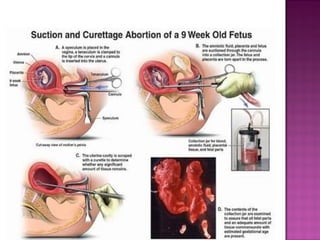
   Examination under anesthesia(EUA) and Suction &
    evacuation(S&E) done at around 2:30 a.m
   Operative findings:

   P/V- Cervix lacerated
        Os open
        Bleeding ++

   Plenty of Product of conception obtained and sent
    for HPE.
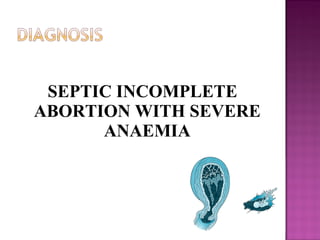
SEPTIC INCOMPLETE
ABORTION WITH SEVERE
      ANAEMIA
   Patient monitored closely .
   IV fuilds and IV antibioitics (Megapen, Metron, and
    gentamycin) given.
   IV Pint of whole blood transfused on POD and
    POD1
   Post transfusion Hb%- 11.3 gm%

   Patient became afebrile on POD2 , blood pressure
    maintained and was discharged on POD4 .
   Patient’s clinical examination and operative
    finding gave picture of unintended pregnancy
    which had been intervened by unsafe methods to
    induce abortion

   But patient denied any such history till last day of
    her hospital stay.
   The WHO defines an unsafe abortion as-
    "any procedure to terminate an unintended
    pregnancy done either by people lacking the
    necessary skills or in an environment that does not
    conform to minimal medical standards, or both."
 The most common abortion complications are
  haemorrhage, shock, sepsis and intra-
  abdominal injury.
Left untreated, each can lead to death
 Medium and long-term complications range from
  reproductive tract infections (RTI)- (20-30%) &
  pelvic inflammatory disease (PID)-(20-40% )to
  chronic pelvic pain and infertility.
 Late complications include increased risk of
  ectopic pregnancy, miscarriage or premature
  delivery in subsequent pregnancies.
   Each yr 75 million of women world-wide
    experience unwanted pregnancy

   46 million women have induced abortions

    Nearly 20 million of these are estimated to be
    unsafe.

   13% of total maternal death occur due to unsafe
    abortion.
"WHO: Unsafe Abortion - The Preventable Pandemic".
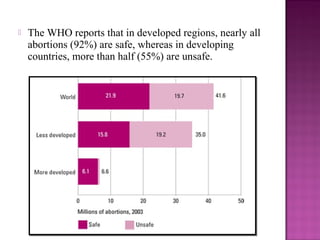
   The WHO reports that in developed regions, nearly all
    abortions (92%) are safe, whereas in developing
    countries, more than half (55%) are unsafe.
   Maternal Mortality Ratio-
    281/100,000 live births (MMR study 2006)


   Unintended Pregnancies
    33% (DHS, ORC Macro, 2002)

   Contraceptive Prevalence Rate
    44% (DHS 2006)
   Total Fertility rate
    3.6 (DHS 2006)
Background
 Abortion law was liberalised in Nepal in the month of
  Chaitra 2058 (March 2002) after many years of
  intensive research and advocacy.

   The law received royal Seal in September 2002.
    However, there was long delay of 15 months before
    the procedural order was approved on December 25,
    2003.

   Nepal began providing comprehensive abortion care
    (CAC) services in 2004
   245 sites listed for providing services

   704 Providers (doctors/Nurses) trained as a
    service providers

   Services expanded to 75 districts.


    Within three years time frame around 229,583
    women were reported receiving safe and legal
    abortion services (with around 90% of
    contraceptive acceptance rate)
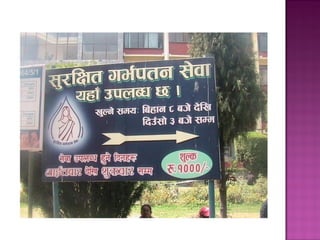
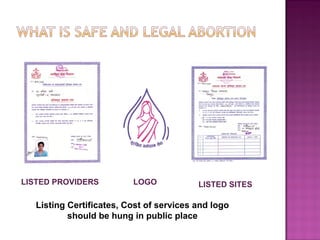
LISTED PROVIDERS          LOGO            LISTED SITES

   Listing Certificates, Cost of services and logo
           should be hung in public place
According to the new law, only listed (trained)
    doctors or health workers can provide safe abortion
    services at listed (approved) health facilities, under
    the following conditions:
   Within the first 12 weeks of pregnancy for any woman
    on her request. The permission of husband or guardian is
    not required for women above 16 years of age
   Within the first 18 weeks of pregnancy in cases of rape
    and incest
   At any time if the pregnancy poses danger to the life or
    physical or mental health of the pregnant woman or the
    foetus is seriously deformed and it is recommended by a
    doctor.
   Abortion is not allowed under coercion

   Sex selective abortion is not allowed

   Only listed Physicians/Health Workers
    registered in their respective councils are
    authorised

   Only listed health institutions are authorised
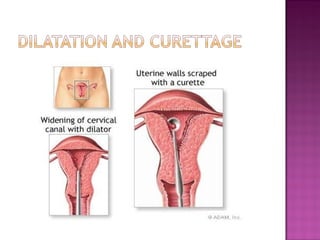
Surgical:
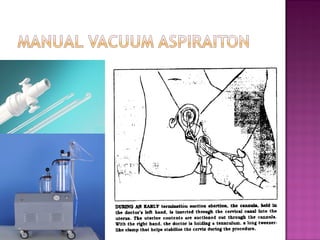
 Manual vacuum aspiration-up to 12 weeks
   D+C-dilation and curettage-less used-1st
    trimester
   D+E-Dilation +evacuation-2nd trimester
    12-16 weeks
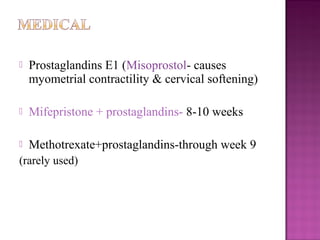
   Prostaglandins E1 (Misoprostol- causes
    myometrial contractility & cervical softening)

   Mifepristone + prostaglandins- 8-10 weeks

   Methotrexate+prostaglandins-through week 9
(rarely used)
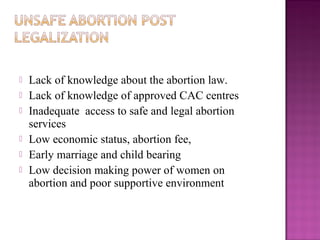
   Lack of knowledge about the abortion law.
   Lack of knowledge of approved CAC centres
   Inadequate access to safe and legal abortion
    services
   Low economic status, abortion fee,
   Early marriage and child bearing
   Low decision making power of women on
    abortion and poor supportive environment
   While unsafe abortion is one of the most common
    causes of maternal deaths,
    it is also the most easily preventable through the
    provision of, and access to, safe abortion services
    and care.
   SAS/CAC service has become accessible and
    affordable to Nepalese women even at peripheral
    level.

   CAC service has minimal complication and also
    gives the opportunity for contraception.

   Demographic and Health Survey, Nepal 2006
    show a steady decline in the Maternal Mortality
    Ratio (MMR) from 539 in 1996 to 281 in 2006.
    Legalization of abortion and provision of safe and
    legal abortion service may be one of the factors
    that may have contributed to this decline.
   www.ipas.org ©2009 Ipas.
   UNICEF nepal
   ^ "WHO: Unsafe Abortion - The Preventable
    Pandemic".
    http://www.who.int/reproductivehealth/publications/un
    safe_abortion. Retrieved 2010-01-16.
   Kathmandu University Medical Journal (2009), Vol. 7,
    No. 1, Issue 25, 31-39
    -Baseline survey on functioning of abortion services in government
     approved CAC centres in three pilot districts of Nepal
     Karki C1, Ojha M2, Rayamajhi RT3
Safe abortive services in nepal(sas)

Safe abortive services in nepal(sas)

  • 1.
    Dr. Namrata Gupta Prof. Dr. Chanda Karki Gynaecology/obstretics dept.
  • 2.
    Ms. Limbu, 25 year old, unmarried girl presented in emergency dept. on 17th chaitra 066 at 1: 30 a.m  c/o-heavy menstrual bleeding- 2 days headache and dizziness  On eliciting she gave h/o amenorrhea for 2 months  Patient also gave h/o previous irregular menses and heavy bleeding during menstruation.  No h/o pain abdomen, use of any medication or any bleeding disorder.  No h/o any contact or any other medical illness (patient was reluctant in giving proper history)
  • 3.
    All basic investigations were sent(including Urine pregnany test)  Inj Tranexemic acid 500 mg IV STAT was given.  IV Fluids were started.
  • 4.
    GC- Ill- looking Pallor-+++(patient looked paper white)  Vitals: T- 100°F, Pulse- 102/min, B.P- 90/60mmhg S/E:  P/A- Soft, non- tender, BS+ve  P/S- active bleeding++ - cervical os-open, cervical laceration,  P/V- uterus- 12weeks size(approx), anteverted, cervical os open, bleeding+ with passage of clots
  • 5.
    Hb%- 6.2 gm%  Blood group: AB+ve  Total count- 22,100/mm3 (N- 84%, L- 15%)  Platelets: 1,30,000/mm3  Urine Pregnancy Test: POSITIVE  All other investigations were within normal range
  • 6.
    Patient admitted by 2:00 a.m  Patient immediately shifted to OT  Whole blood transfusion was started  Examination under anesthesia(EUA) and Suction & evacuation(S&E) done at around 2:30 a.m
  • 7.
    Operative findings:  P/V- Cervix lacerated Os open Bleeding ++  Plenty of Product of conception obtained and sent for HPE.
  • 8.
  • 9.
    Patient monitored closely .  IV fuilds and IV antibioitics (Megapen, Metron, and gentamycin) given.  IV Pint of whole blood transfused on POD and POD1  Post transfusion Hb%- 11.3 gm%  Patient became afebrile on POD2 , blood pressure maintained and was discharged on POD4 .
  • 10.
    Patient’s clinical examination and operative finding gave picture of unintended pregnancy which had been intervened by unsafe methods to induce abortion  But patient denied any such history till last day of her hospital stay.
  • 11.
    The WHO defines an unsafe abortion as- "any procedure to terminate an unintended pregnancy done either by people lacking the necessary skills or in an environment that does not conform to minimal medical standards, or both."
  • 12.
     The mostcommon abortion complications are haemorrhage, shock, sepsis and intra- abdominal injury. Left untreated, each can lead to death  Medium and long-term complications range from reproductive tract infections (RTI)- (20-30%) & pelvic inflammatory disease (PID)-(20-40% )to chronic pelvic pain and infertility.  Late complications include increased risk of ectopic pregnancy, miscarriage or premature delivery in subsequent pregnancies.
  • 13.
    Each yr 75 million of women world-wide experience unwanted pregnancy  46 million women have induced abortions  Nearly 20 million of these are estimated to be unsafe.  13% of total maternal death occur due to unsafe abortion. "WHO: Unsafe Abortion - The Preventable Pandemic".
  • 14.
    The WHO reports that in developed regions, nearly all abortions (92%) are safe, whereas in developing countries, more than half (55%) are unsafe.
  • 15.
    Maternal Mortality Ratio- 281/100,000 live births (MMR study 2006)  Unintended Pregnancies 33% (DHS, ORC Macro, 2002)  Contraceptive Prevalence Rate 44% (DHS 2006)  Total Fertility rate 3.6 (DHS 2006)
  • 16.
    Background  Abortion lawwas liberalised in Nepal in the month of Chaitra 2058 (March 2002) after many years of intensive research and advocacy.  The law received royal Seal in September 2002. However, there was long delay of 15 months before the procedural order was approved on December 25, 2003.  Nepal began providing comprehensive abortion care (CAC) services in 2004
  • 17.
    245 sites listed for providing services  704 Providers (doctors/Nurses) trained as a service providers  Services expanded to 75 districts. Within three years time frame around 229,583 women were reported receiving safe and legal abortion services (with around 90% of contraceptive acceptance rate)
  • 19.
    LISTED PROVIDERS LOGO LISTED SITES Listing Certificates, Cost of services and logo should be hung in public place
  • 20.
    According to thenew law, only listed (trained) doctors or health workers can provide safe abortion services at listed (approved) health facilities, under the following conditions:  Within the first 12 weeks of pregnancy for any woman on her request. The permission of husband or guardian is not required for women above 16 years of age  Within the first 18 weeks of pregnancy in cases of rape and incest  At any time if the pregnancy poses danger to the life or physical or mental health of the pregnant woman or the foetus is seriously deformed and it is recommended by a doctor.
  • 21.
    Abortion is not allowed under coercion  Sex selective abortion is not allowed  Only listed Physicians/Health Workers registered in their respective councils are authorised  Only listed health institutions are authorised
  • 22.
    Surgical:  Manual vacuumaspiration-up to 12 weeks  D+C-dilation and curettage-less used-1st trimester  D+E-Dilation +evacuation-2nd trimester 12-16 weeks
  • 26.
    Prostaglandins E1 (Misoprostol- causes myometrial contractility & cervical softening)  Mifepristone + prostaglandins- 8-10 weeks  Methotrexate+prostaglandins-through week 9 (rarely used)
  • 27.
    Lack of knowledge about the abortion law.  Lack of knowledge of approved CAC centres  Inadequate access to safe and legal abortion services  Low economic status, abortion fee,  Early marriage and child bearing  Low decision making power of women on abortion and poor supportive environment
  • 28.
    While unsafe abortion is one of the most common causes of maternal deaths, it is also the most easily preventable through the provision of, and access to, safe abortion services and care.
  • 29.
    SAS/CAC service has become accessible and affordable to Nepalese women even at peripheral level.  CAC service has minimal complication and also gives the opportunity for contraception.  Demographic and Health Survey, Nepal 2006 show a steady decline in the Maternal Mortality Ratio (MMR) from 539 in 1996 to 281 in 2006. Legalization of abortion and provision of safe and legal abortion service may be one of the factors that may have contributed to this decline.
  • 30.
    www.ipas.org ©2009 Ipas.  UNICEF nepal  ^ "WHO: Unsafe Abortion - The Preventable Pandemic". http://www.who.int/reproductivehealth/publications/un safe_abortion. Retrieved 2010-01-16.  Kathmandu University Medical Journal (2009), Vol. 7, No. 1, Issue 25, 31-39 -Baseline survey on functioning of abortion services in government approved CAC centres in three pilot districts of Nepal Karki C1, Ojha M2, Rayamajhi RT3