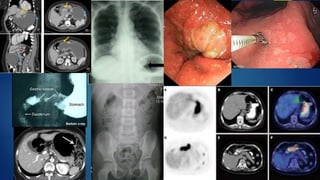
Malignant Gastric tumors
BY SABA SADEGHPOUR
◆ Gastric cancer is the sixth most common cancer and the
third most common cause of cancer-related death in the
world.
◆ Rates of gastric cancer are higher in Asian and South
American countries.
EPIDEMIOLOGY
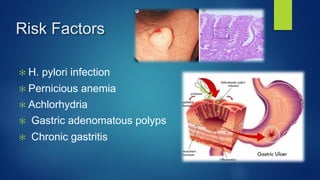
Risk Factors
✻ H. pylori infection
✻ Pernicious anemia
✻ Achlorhydria
✻ Gastric adenomatous polyps
✻ Chronic gastritis
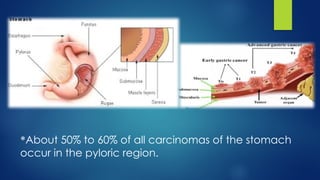
*About 50% to 60% of all carcinomas of the stomach
occur in the pyloric region.
Classification
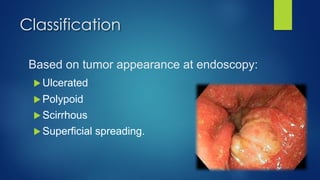
Based on tumor appearance at endoscopy:
u Ulcerated
u Polypoid
u Scirrhous
u Superficial spreading.
Classification
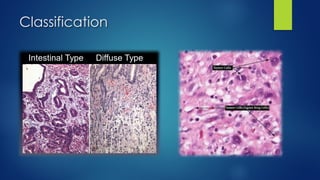
Based on histo-pathologic features:(Intestinal)
u +H.pylori infection
u Well differentiated(better prognosis)
u Regions with a high incidence of disease
u Older patients
u Spreads hematogenously
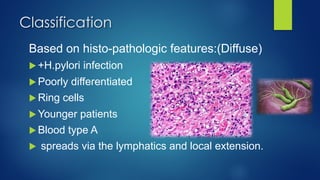
Based on histo-pathologic features:(Diffuse)
u +H.pylori infection
u Poorly differentiated
u Ring cells
u Younger patients
u Blood type A
u spreads via the lymphatics and local extension.
Classification
Classification
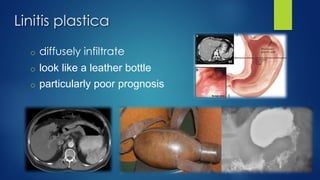
Linitis plastica
o diffusely infiltrate
o look like a leather bottle
o particularly poor prognosis
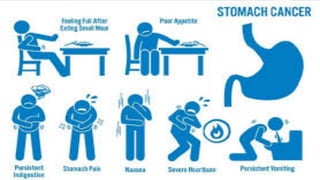
Clinical Presentation
Ø It depends on its stage.
Ø Early cancers are usually asymptomatic.
Ø In Japan, these cancers are diagnosed early because of
an aggressive endoscopic screening protocol.
More advanced disease leads to the development of
symptoms:
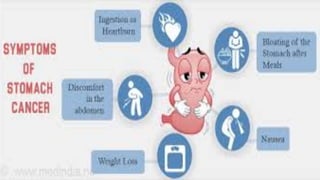
u Vague epigastric pain (similar to that produced by gastric ulceration)
u Unexplained weight loss
Clinical Presentation
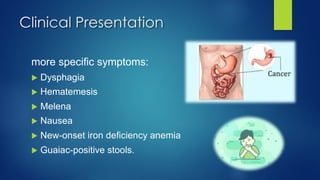
more specific symptoms:
u Dysphagia
u Hematemesis
u Melena
u Nausea
u New-onset iron deficiency anemia
u Guaiac-positive stools.
Clinical Presentation
Clinical Evaluation
History
u Lack of energy
u Unintentional weight loss
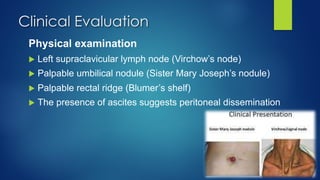
Physical examination
u Left supraclavicular lymph node (Virchow’s node)
u Palpable umbilical nodule (Sister Mary Joseph’s nodule)
u Palpable rectal ridge (Blumer’s shelf)
u The presence of ascites suggests peritoneal dissemination
Clinical Evaluation
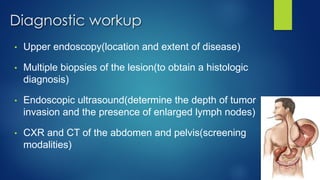
Diagnostic workup
• Upper endoscopy(location and extent of disease)
• Multiple biopsies of the lesion(to obtain a histologic
diagnosis)
• Endoscopic ultrasound(determine the depth of tumor
invasion and the presence of enlarged lymph nodes)
• CXR and CT of the abdomen and pelvis(screening
modalities)
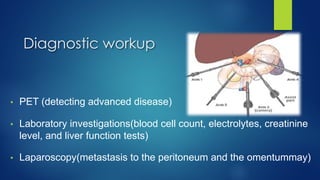
• PET (detecting advanced disease)
• Laboratory investigations(blood cell count, electrolytes, creatinine
level, and liver function tests)
• Laparoscopy(metastasis to the peritoneum and the omentummay)
Diagnostic workup
Treatment
u Complete surgical resection (localized disease)
u Radical subtotal gastrectomy (distal lesions)
u Pre and postoperative chemotherapy( with or without radiation)
*The appropriate extent of lymph node dissection at the time of resection is
controversial.
Gastric lymphoma
! The stomach is the primary site of almost two-thirds of all
GI lymphomas.
! Patients with gastric lymphoma tend to be older.
! Gastric lymphoma usually is non-Hodgkin’s.
! Endoscopy with tissue biopsies provides the diagnosis.
symptoms
Symptoms in gastric lymphoma are similar to those seen in
gastric adenocarcinoma:
✘ Upper abdominal pain
✘ Unexplained weight loss
✘ Fatigue
✘ Bleeding
Workup
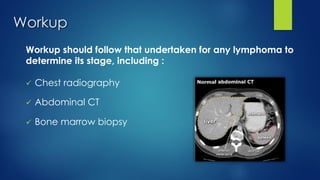
Workup should follow that undertaken for any lymphoma to
determine its stage, including :
ü Chest radiography
ü Abdominal CT
ü Bone marrow biopsy
Treatment
Most specialists advocate chemotherapy alone, citing high 5year
survival rates in early stage disease.
Such treatment, however, runs the risk of causing gastric
perforation or hemorrhage, necessitating surgical intervention.
Gastro-intestinal Stromal Tumor
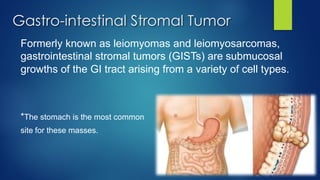
Formerly known as leiomyomas and leiomyosarcomas,
gastrointestinal stromal tumors (GISTs) are submucosal
growths of the GI tract arising from a variety of cell types.
*The stomach is the most common
site for these masses.
GIST
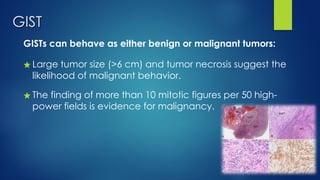
GISTs can behave as either benign or malignant tumors:
★ Large tumor size (>6 cm) and tumor necrosis suggest the
likelihood of malignant behavior.
★ The finding of more than 10 mitotic figures per 50 high-
power fields is evidence for malignancy.
Clinical Evaluation
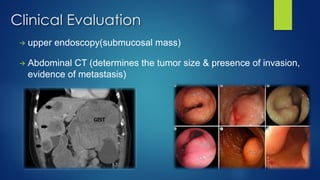
→ upper endoscopy(submucosal mass)
→ Abdominal CT (determines the tumor size & presence of invasion,
evidence of metastasis)
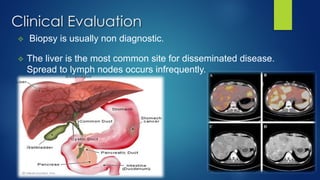
✧ Biopsy is usually non diagnostic.
✧ The liver is the most common site for disseminated disease.
Spread to lymph nodes occurs infrequently.
Clinical Evaluation
Treatment
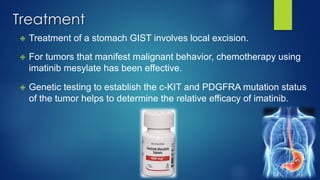
✙ Treatment of a stomach GIST involves local excision.
✙ For tumors that manifest malignant behavior, chemotherapy using
imatinib mesylate has been effective.
✙ Genetic testing to establish the c-KIT and PDGFRA mutation status
of the tumor helps to determine the relative efficacy of imatinib.
✍ Essentials of general surgical specialties 2019
✍ Medscape
✍ Uptodate
✍ http://www.drsoumenroy.com/about
References
Thanks for your attention

Sadeghpour gastric tumor

  • 1.
  • 2.
    ◆ Gastric canceris the sixth most common cancer and the third most common cause of cancer-related death in the world. ◆ Rates of gastric cancer are higher in Asian and South American countries. EPIDEMIOLOGY
  • 3.
    Risk Factors ✻ H.pylori infection ✻ Pernicious anemia ✻ Achlorhydria ✻ Gastric adenomatous polyps ✻ Chronic gastritis
  • 4.
    *About 50% to60% of all carcinomas of the stomach occur in the pyloric region.
  • 5.
    Classification Based on tumorappearance at endoscopy: u Ulcerated u Polypoid u Scirrhous u Superficial spreading.
  • 6.
    Classification Based on histo-pathologicfeatures:(Intestinal) u +H.pylori infection u Well differentiated(better prognosis) u Regions with a high incidence of disease u Older patients u Spreads hematogenously
  • 7.
    Based on histo-pathologicfeatures:(Diffuse) u +H.pylori infection u Poorly differentiated u Ring cells u Younger patients u Blood type A u spreads via the lymphatics and local extension. Classification
  • 8.
  • 9.
    Linitis plastica o diffuselyinfiltrate o look like a leather bottle o particularly poor prognosis
  • 10.
    Clinical Presentation Ø Itdepends on its stage. Ø Early cancers are usually asymptomatic. Ø In Japan, these cancers are diagnosed early because of an aggressive endoscopic screening protocol.
  • 12.
    More advanced diseaseleads to the development of symptoms: u Vague epigastric pain (similar to that produced by gastric ulceration) u Unexplained weight loss Clinical Presentation
  • 13.
    more specific symptoms: uDysphagia u Hematemesis u Melena u Nausea u New-onset iron deficiency anemia u Guaiac-positive stools. Clinical Presentation
  • 15.
    Clinical Evaluation History u Lackof energy u Unintentional weight loss
  • 16.
    Physical examination u Leftsupraclavicular lymph node (Virchow’s node) u Palpable umbilical nodule (Sister Mary Joseph’s nodule) u Palpable rectal ridge (Blumer’s shelf) u The presence of ascites suggests peritoneal dissemination Clinical Evaluation
  • 17.
    Diagnostic workup • Upperendoscopy(location and extent of disease) • Multiple biopsies of the lesion(to obtain a histologic diagnosis) • Endoscopic ultrasound(determine the depth of tumor invasion and the presence of enlarged lymph nodes) • CXR and CT of the abdomen and pelvis(screening modalities)
  • 18.
    • PET (detectingadvanced disease) • Laboratory investigations(blood cell count, electrolytes, creatinine level, and liver function tests) • Laparoscopy(metastasis to the peritoneum and the omentummay) Diagnostic workup
  • 20.
    Treatment u Complete surgicalresection (localized disease) u Radical subtotal gastrectomy (distal lesions) u Pre and postoperative chemotherapy( with or without radiation) *The appropriate extent of lymph node dissection at the time of resection is controversial.
  • 22.
    Gastric lymphoma ! Thestomach is the primary site of almost two-thirds of all GI lymphomas. ! Patients with gastric lymphoma tend to be older. ! Gastric lymphoma usually is non-Hodgkin’s. ! Endoscopy with tissue biopsies provides the diagnosis.
  • 23.
    symptoms Symptoms in gastriclymphoma are similar to those seen in gastric adenocarcinoma: ✘ Upper abdominal pain ✘ Unexplained weight loss ✘ Fatigue ✘ Bleeding
  • 25.
    Workup Workup should followthat undertaken for any lymphoma to determine its stage, including : ü Chest radiography ü Abdominal CT ü Bone marrow biopsy
  • 26.
    Treatment Most specialists advocatechemotherapy alone, citing high 5year survival rates in early stage disease. Such treatment, however, runs the risk of causing gastric perforation or hemorrhage, necessitating surgical intervention.
  • 28.
    Gastro-intestinal Stromal Tumor Formerlyknown as leiomyomas and leiomyosarcomas, gastrointestinal stromal tumors (GISTs) are submucosal growths of the GI tract arising from a variety of cell types. *The stomach is the most common site for these masses.
  • 29.
    GIST GISTs can behaveas either benign or malignant tumors: ★ Large tumor size (>6 cm) and tumor necrosis suggest the likelihood of malignant behavior. ★ The finding of more than 10 mitotic figures per 50 high- power fields is evidence for malignancy.
  • 30.
    Clinical Evaluation → upperendoscopy(submucosal mass) → Abdominal CT (determines the tumor size & presence of invasion, evidence of metastasis)
  • 31.
    ✧ Biopsy isusually non diagnostic. ✧ The liver is the most common site for disseminated disease. Spread to lymph nodes occurs infrequently. Clinical Evaluation
  • 32.
    Treatment ✙ Treatment ofa stomach GIST involves local excision. ✙ For tumors that manifest malignant behavior, chemotherapy using imatinib mesylate has been effective. ✙ Genetic testing to establish the c-KIT and PDGFRA mutation status of the tumor helps to determine the relative efficacy of imatinib.
  • 33.
    ✍ Essentials ofgeneral surgical specialties 2019 ✍ Medscape ✍ Uptodate ✍ http://www.drsoumenroy.com/about References
  • 34.
    Thanks for yourattention