By:
Devinta Sari
Departement of Information System
Faculty of Science and Technology
State Islamic University of Sultan Syarif Kasim of Riau
Testing Throughout The Software Life
Cycle:
Test Levels
Blog:devintasari8.blogspot.com Email:devinta8sari@gmail.com ig:@devintasari8
Componet Testing
Component testing, also known as unit, module and
program testing, searches for defects in, and verifies the
functioning of software (e.g. modules, programs, objects, classes,
etc.) that are separately testable.
Component testing may be done in isolation from the rest
of the system depend-ing on the context of the development life
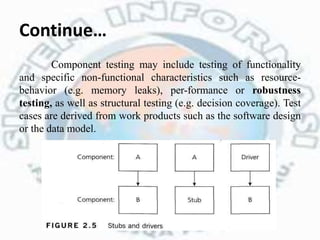
cycle and the system. Most often stubs and drivers are used to
replace the missing software and simulate the interface between
the software components in a simple manner. A stub is called
from the software component to be tested; a driver calls a
component to be tested (see Figure 2.5).
Continue…
Component testing may include testing of functionality
and specific non-functional characteristics such as resource-
behavior (e.g. memory leaks), per-formance or robustness
testing, as well as structural testing (e.g. decision coverage). Test
cases are derived from work products such as the software design
or the data model.
Continue…
Typically, component testing occurs with access to the code
being tested and with the support of the development environment,
such as a unit test frame-work or debugging tool, and in practice
usually involves the programmer who wrote the code. Sometimes,
depending on the applicable level of risk, compo-nent testing is carried
out by a different programmer thereby introducing inde-pendence.
Defects are typically fixed as soon as they are found, without formally
recording the incidents found.
One approach in component testing, used in Extreme
Programming (XP), is to prepare and automate test cases before coding.
This is called a test-first approach or test-driven development. This
approach is highly iterative and is based on cycles of developing test
cases, then building and integrating small pieces of code, and executing
the component tests until they pass.
Integration Testing
Integration testing tests interfaces between
components, interactions to dif-ferent parts of a
system such as an operating system, file system and
hard-ware or interfaces between systems. Note that
integration testing should be differentiated from other
integration activities. Integration testing is often
carried out by the integrator, but preferably by a
specific integration tester or test team.
System Testing
System testing is concerned with the behavior of the
whole system/product as defined by the scope of a
development project or product. It may include tests based
on risks and/or requirements specification, business
processes, use cases, or other high level descriptions of
system behavior, interactions with the oper-ating system,
and system resources. System testing is most often the final
test on behalf of development to verify that the system to be
delivered meets the spec-ification and its purpose may be to
find as many defects as possible.
Continue…
Most often it is carried out by specialist testers
that form a dedicated, and sometimes inde-pendent, test
team within development, reporting to the development
manager or project manager. In some organizations
system testing is carried out by a third party team or by
business analysts. Again the required level of independ-
ence is based on the applicable risk level and this will
have a high influence on the way system testing is
organized.
Continue…
System testing should investigate both functional
and non-functional requirements of the system. Typical
non-functional tests include performance and reliability.
Testers may also need to deal with incomplete or
undocumented requirements. System testing of functional
requirements starts by using the most appropriate
specification-based (black-box) techniques for the aspect of
the system to be tested. For example, a decision table may
be created for com-binations of effects described in business
rules. Structure-based (white-box) techniques may also be
used to assess the thoroughness of testing elements such as
menu dialog structure or web page navigation.
Continue…
System testing requires a controlled test
environment with regard to, amongst other things, control
of the software versions, testware and the test data (see
Chapter 5 for more on configuration management). A
system test is executed by the development organization in
a (properly controlled) environ-ment. The test
environment should correspond to the final target or
production environment as much as possible in order to
minimize the risk of environment-specific failures not
being found by testing.
Acceptance Testing
Acceptance testing is most often the
responsibility of the user or customer, although other
stakehold-ers may be involved as well. The execution
of the acceptance test requires a test environment that
is for most aspects, representative of the production
environ-ment ('as-if production')
Continue…
The goal of acceptance testing is to establish
confidence in the system, part of the system or specific non-
functional characteristics, e.g. usability, of the system.
Acceptance testing is most often focused on a validation
type of testing, whereby we are trying to determine whether
the system is fit for purpose. Finding defects should not be
the main focus in acceptance testing. Although it assesses
the system's readiness for deployment and use, it is not
necessarily the final level of testing. For example, a large-
scale system integration test may come after the acceptance
of a system.
Continue…
Alpha testing
This test takes place at the devel-oper's site. A
cross-section of potential users and members of the
developer's organization are invited to use the system.
Developers observe the users and note problems. Alpha
testing may also be carried out by an independent test
team.
Continue…
Beta testing or field testing
sends the system to a cross-section of users who
install it and use it under real-world working conditions.
The users send records of incidents with the system to
the development organization where the defects are
repaired.
• Graham et.al. (2011). ISTQB-Fondation of Software Testing.
London: Cengage Learning EMEA.
BIBLIOGRAPHY
• http://sif.uin-suska.ac.id/
• http://fst.uin-suska.ac.id/
• http://www.uin-suska.ac.id/
Link

Materi Testing dan Implementasi Sistem - Testing throughout the software life cycle test level-Test Level

  • 1.
    By: Devinta Sari Departement ofInformation System Faculty of Science and Technology State Islamic University of Sultan Syarif Kasim of Riau Testing Throughout The Software Life Cycle: Test Levels Blog:devintasari8.blogspot.com Email:devinta8sari@gmail.com ig:@devintasari8
  • 2.
    Componet Testing Component testing,also known as unit, module and program testing, searches for defects in, and verifies the functioning of software (e.g. modules, programs, objects, classes, etc.) that are separately testable. Component testing may be done in isolation from the rest of the system depend-ing on the context of the development life cycle and the system. Most often stubs and drivers are used to replace the missing software and simulate the interface between the software components in a simple manner. A stub is called from the software component to be tested; a driver calls a component to be tested (see Figure 2.5).
  • 3.
    Continue… Component testing mayinclude testing of functionality and specific non-functional characteristics such as resource- behavior (e.g. memory leaks), per-formance or robustness testing, as well as structural testing (e.g. decision coverage). Test cases are derived from work products such as the software design or the data model.
  • 4.
    Continue… Typically, component testingoccurs with access to the code being tested and with the support of the development environment, such as a unit test frame-work or debugging tool, and in practice usually involves the programmer who wrote the code. Sometimes, depending on the applicable level of risk, compo-nent testing is carried out by a different programmer thereby introducing inde-pendence. Defects are typically fixed as soon as they are found, without formally recording the incidents found. One approach in component testing, used in Extreme Programming (XP), is to prepare and automate test cases before coding. This is called a test-first approach or test-driven development. This approach is highly iterative and is based on cycles of developing test cases, then building and integrating small pieces of code, and executing the component tests until they pass.
  • 5.
    Integration Testing Integration testingtests interfaces between components, interactions to dif-ferent parts of a system such as an operating system, file system and hard-ware or interfaces between systems. Note that integration testing should be differentiated from other integration activities. Integration testing is often carried out by the integrator, but preferably by a specific integration tester or test team.
  • 6.
    System Testing System testingis concerned with the behavior of the whole system/product as defined by the scope of a development project or product. It may include tests based on risks and/or requirements specification, business processes, use cases, or other high level descriptions of system behavior, interactions with the oper-ating system, and system resources. System testing is most often the final test on behalf of development to verify that the system to be delivered meets the spec-ification and its purpose may be to find as many defects as possible.
  • 7.
    Continue… Most often itis carried out by specialist testers that form a dedicated, and sometimes inde-pendent, test team within development, reporting to the development manager or project manager. In some organizations system testing is carried out by a third party team or by business analysts. Again the required level of independ- ence is based on the applicable risk level and this will have a high influence on the way system testing is organized.
  • 8.
    Continue… System testing shouldinvestigate both functional and non-functional requirements of the system. Typical non-functional tests include performance and reliability. Testers may also need to deal with incomplete or undocumented requirements. System testing of functional requirements starts by using the most appropriate specification-based (black-box) techniques for the aspect of the system to be tested. For example, a decision table may be created for com-binations of effects described in business rules. Structure-based (white-box) techniques may also be used to assess the thoroughness of testing elements such as menu dialog structure or web page navigation.
  • 9.
    Continue… System testing requiresa controlled test environment with regard to, amongst other things, control of the software versions, testware and the test data (see Chapter 5 for more on configuration management). A system test is executed by the development organization in a (properly controlled) environ-ment. The test environment should correspond to the final target or production environment as much as possible in order to minimize the risk of environment-specific failures not being found by testing.
  • 10.
    Acceptance Testing Acceptance testingis most often the responsibility of the user or customer, although other stakehold-ers may be involved as well. The execution of the acceptance test requires a test environment that is for most aspects, representative of the production environ-ment ('as-if production')
  • 11.
    Continue… The goal ofacceptance testing is to establish confidence in the system, part of the system or specific non- functional characteristics, e.g. usability, of the system. Acceptance testing is most often focused on a validation type of testing, whereby we are trying to determine whether the system is fit for purpose. Finding defects should not be the main focus in acceptance testing. Although it assesses the system's readiness for deployment and use, it is not necessarily the final level of testing. For example, a large- scale system integration test may come after the acceptance of a system.
  • 12.
    Continue… Alpha testing This testtakes place at the devel-oper's site. A cross-section of potential users and members of the developer's organization are invited to use the system. Developers observe the users and note problems. Alpha testing may also be carried out by an independent test team.
  • 13.
    Continue… Beta testing orfield testing sends the system to a cross-section of users who install it and use it under real-world working conditions. The users send records of incidents with the system to the development organization where the defects are repaired.
  • 14.
    • Graham et.al.(2011). ISTQB-Fondation of Software Testing. London: Cengage Learning EMEA. BIBLIOGRAPHY
  • 15.