Enterprise Security
Architecture
Arnab Chattopadhayay
Vice President, Engineering
Infoworks Inc.
About Me
• Love to design, build and protect large scale systems
• IAM, Cryptography, Consulting, Program Management and Governance
• Large MNC to startup across the globe
• VP Engineering of Infoworks (a silicon valley Big Data Startup)
• Prior to this, I had worked with British Telecom Research, BT Consulting, iViZ and
MetricStream
• Patent – USPTO 9,348,901
• MS (Telecom Engineering), University College London
Enterprise Architecture
•A field born about 30 years ago
•Initially targeted to address two
problems
•System complexity
•Inadequate business alignment
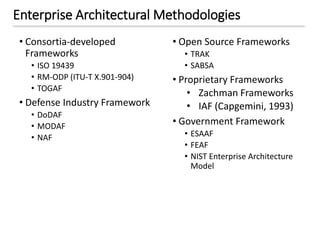
Enterprise Architectural Methodologies
• Consortia-developed
Frameworks
• ISO 19439
• RM-ODP (ITU-T X.901-904)
• TOGAF
• Defense Industry Framework
• DoDAF
• MODAF
• NAF
• Open Source Frameworks
• TRAK
• SABSA
• Proprietary Frameworks
• Zachman Frameworks
• IAF (Capgemini, 1993)
• Government Framework
• ESAAF
• FEAF
• NIST Enterprise Architecture
Model
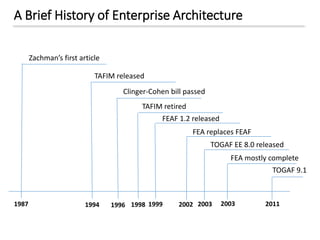
A Brief History of Enterprise Architecture
Zachman’s first article
1987
TAFIM released
1994
Clinger-Cohen bill passed
1996 1998
TAFIM retired
FEAF 1.2 released
1999 2002
FEA replaces FEAF
TOGAF EE 8.0 released
2003 2003
FEA mostly complete
2011
TOGAF 9.1
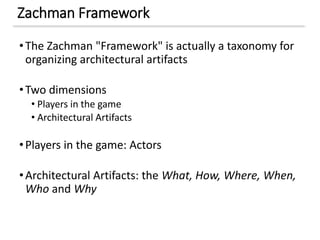
Zachman Framework
•The Zachman "Framework" is actually a taxonomy for
organizing architectural artifacts
•Two dimensions
• Players in the game
• Architectural Artifacts
•Players in the game: Actors
•Architectural Artifacts: the What, How, Where, When,
Who and Why
Zachman Framework
Source: zachmaninternational.com
[Executive Mgmt
Perspective]
[Business Mgmt
Perspective]
[Architect’s
Perspective]
[Engineer’s
Perspective]
[Technician’s
Perspective]
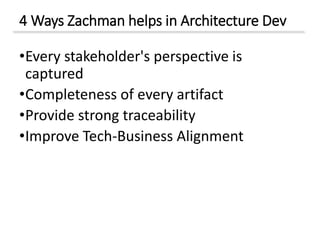
4 Ways Zachman helps in Architecture Dev
•Every stakeholder's perspective is
captured
•Completeness of every artifact
•Provide strong traceability
•Improve Tech-Business Alignment
What Zachman does not provide
•Step-by-step process to create new
architecture
•Validating an architecture
•Deciding future architecture
•It is not a Methodology
Enterprise Information Security Architecture
•Is the practice of applying comprehensive and rigorous
methods for describing security of current and future
systems
• Ref: Wikipedia
•Applied to people, process and technologies
•Goals
• Provide structure
• Enable business-to-security alignment
• Enforce Top down approach
• Strong traceability
• Abstract complex concepts
• Establish common lingua of information security
Well Known Cyber Security Frameworks
•NIST CSF
•Sherwood Applied Business Security
Architecture (SABSA)
•We will discuss SABSA in details
What is SABSA
•Methodology for Building Security Architecture:
•Business-driven
•Risk and opportunity focused
•Includes security service management
• Comprised of a number of integrated frameworks,
models, methods and processes
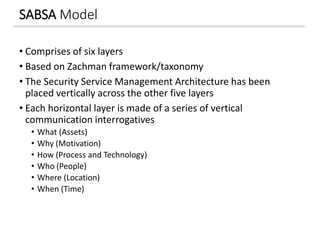
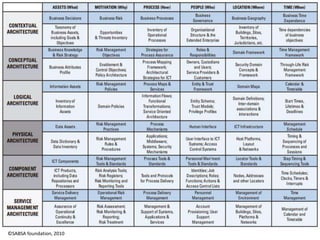
SABSA Model
• Comprises of six layers
• Based on Zachman framework/taxonomy
• The Security Service Management Architecture has been
placed vertically across the other five layers
• Each horizontal layer is made of a series of vertical
communication interrogatives
• What (Assets)
• Why (Motivation)
• How (Process and Technology)
• Who (People)
• Where (Location)
• When (Time)
©SABSA foundation, 2010
Business Driven Architecture
•Never losing site of the organisation’s
goals, objectives, success factors and
targets
•Contextual architecture captures and
presents the full set of relevant
requirements
Credible Abstraction is Key
•Meaningful traceability is enabled by
credible abstraction from business context
to business security context
•Traceability therefore starts by delivering
two slightly different sets of
requirements:
•Business Requirement: Business reputation
•Business Driver for Security: What can
security do to protect reputation
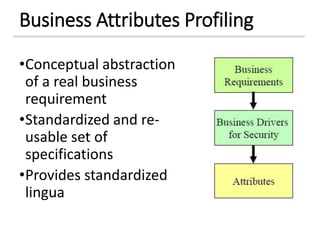
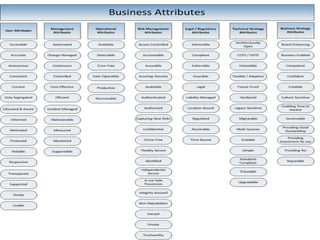
Business Attributes Profiling
•Conceptual abstraction
of a real business
requirement
•Standardized and re-
usable set of
specifications
•Provides standardized
lingua
Attributes Profiling Rules & Features
• Can be tangible or intangible
• Requires a meaningful name and details
• Can be customized specifically for a particular organization
• Requires a measurement approach and metric
• Must be validated (and preferably created) by senior
management & the business stake-holders
• Performance targets are basis for reporting and/or SLAs in the
SABSA Manage & Measure phase
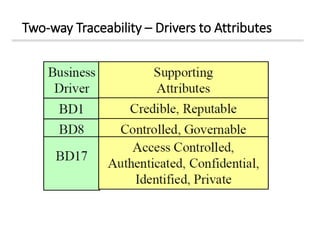
Two-way Traceability – Drivers to Attributes
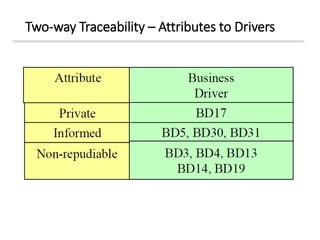
Two-way Traceability – Attributes to Drivers
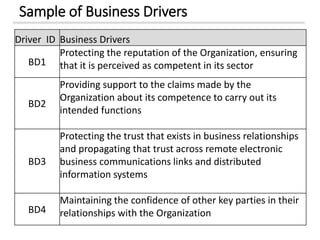
Sample of Business Drivers
Driver ID Business Drivers
BD1
Protecting the reputation of the Organization, ensuring
that it is perceived as competent in its sector
BD2
Providing support to the claims made by the
Organization about its competence to carry out its
intended functions
BD3
Protecting the trust that exists in business relationships
and propagating that trust across remote electronic
business communications links and distributed
information systems
BD4
Maintaining the confidence of other key parties in their
relationships with the Organization
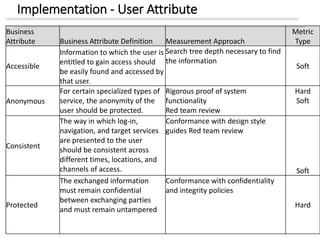
Implementation - User Attribute
Business
Attribute Business Attribute Definition Measurement Approach
Metric
Type
Accessible
Information to which the user is
entitled to gain access should
be easily found and accessed by
that user.
Search tree depth necessary to find
the information
Soft
Anonymous
For certain specialized types of
service, the anonymity of the
user should be protected.
Rigorous proof of system
functionality
Red team review
Hard
Soft
Consistent
The way in which log-in,
navigation, and target services
are presented to the user
should be consistent across
different times, locations, and
channels of access.
Conformance with design style
guides Red team review
Soft
Protected
The exchanged information
must remain confidential
between exchanging parties
and must remain untampered
Conformance with confidentiality
and integrity policies
Hard
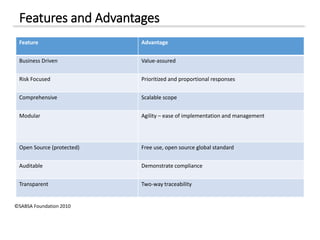
Features and Advantages
Feature Advantage
Business Driven Value-assured
Risk Focused Prioritized and proportional responses
Comprehensive Scalable scope
Modular Agility – ease of implementation and management
Open Source (protected) Free use, open source global standard
Auditable Demonstrate compliance
Transparent Two-way traceability
©SABSA Foundation 2010
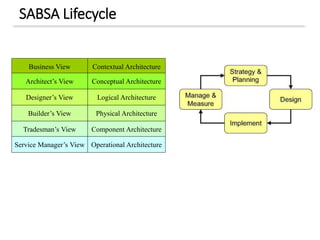
SABSA Lifecycle
Business View Contextual Architecture
Architect’s View Conceptual Architecture
Designer’s View Logical Architecture
Builder’s View Physical Architecture
Tradesman’s View Component Architecture
Service Manager’s View Operational Architecture
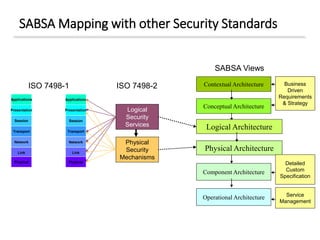
SABSA Mapping with other Security Standards
Applications
Presentation
Session
Transport
Network
Link
Physical
Applications
Presentation
Session
Transport
Network
Link
Physical
ISO 7498-1 ISO 7498-2
Logical
Security
Services
Physical
Security
Mechanisms
Contextual Architecture
Conceptual Architecture
Business
Driven
Requirements
& Strategy
SABSA Views
Logical Architecture
Physical Architecture
Component Architecture
Operational Architecture Service
Management
Detailed
Custom
Specification
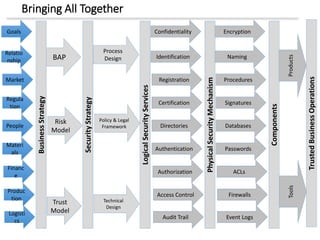
Bringing All Together
BusinessStrategy
Goals
Relatio
nship
Market
Regula
tion
People
Materi
als
Financ
e
Produc
tion
Logisti
cs
BAP
Risk
Model
Trust
Model
SecurityStrategy
Process
Design
Policy & Legal
Framework
Technical
Design
LogicalSecurityServices
Confidentiality
Identification
Registration
Certification
Directories
Authentication
Authorization
Access Control
Audit Trail
PhysicalSecurityMechanism
Encryption
Naming
Procedures
Signatures
Databases
Passwords
ACLs
Firewalls
Event Logs
Components
TrustedBusinessOperations
ProductsTools
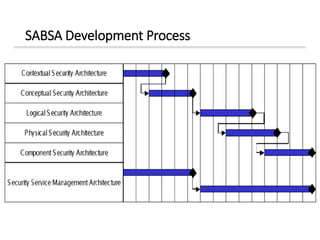
SABSA Development Process
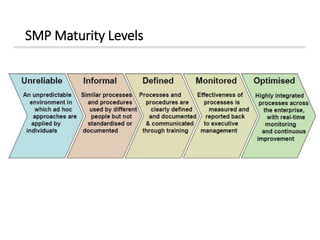
SMP Maturity Levels
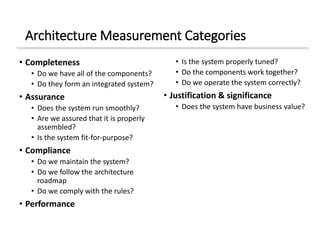
Architecture Measurement Categories
• Completeness
• Do we have all of the components?
• Do they form an integrated system?
• Assurance
• Does the system run smoothly?
• Are we assured that it is properly
assembled?
• Is the system fit-for-purpose?
• Compliance
• Do we maintain the system?
• Do we follow the architecture
roadmap
• Do we comply with the rules?
• Performance
• Is the system properly tuned?
• Do the components work together?
• Do we operate the system correctly?
• Justification & significance
• Does the system have business value?
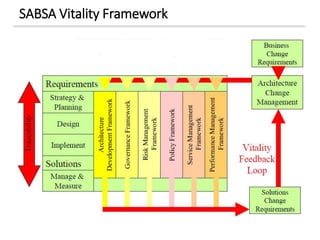
SABSA Vitality Framework
Thank You

Enterprise Security Architecture

  • 1.
  • 2.
    About Me • Loveto design, build and protect large scale systems • IAM, Cryptography, Consulting, Program Management and Governance • Large MNC to startup across the globe • VP Engineering of Infoworks (a silicon valley Big Data Startup) • Prior to this, I had worked with British Telecom Research, BT Consulting, iViZ and MetricStream • Patent – USPTO 9,348,901 • MS (Telecom Engineering), University College London
  • 3.
    Enterprise Architecture •A fieldborn about 30 years ago •Initially targeted to address two problems •System complexity •Inadequate business alignment
  • 4.
    Enterprise Architectural Methodologies •Consortia-developed Frameworks • ISO 19439 • RM-ODP (ITU-T X.901-904) • TOGAF • Defense Industry Framework • DoDAF • MODAF • NAF • Open Source Frameworks • TRAK • SABSA • Proprietary Frameworks • Zachman Frameworks • IAF (Capgemini, 1993) • Government Framework • ESAAF • FEAF • NIST Enterprise Architecture Model
  • 5.
    A Brief Historyof Enterprise Architecture Zachman’s first article 1987 TAFIM released 1994 Clinger-Cohen bill passed 1996 1998 TAFIM retired FEAF 1.2 released 1999 2002 FEA replaces FEAF TOGAF EE 8.0 released 2003 2003 FEA mostly complete 2011 TOGAF 9.1
  • 6.
    Zachman Framework •The Zachman"Framework" is actually a taxonomy for organizing architectural artifacts •Two dimensions • Players in the game • Architectural Artifacts •Players in the game: Actors •Architectural Artifacts: the What, How, Where, When, Who and Why
  • 7.
    Zachman Framework Source: zachmaninternational.com [ExecutiveMgmt Perspective] [Business Mgmt Perspective] [Architect’s Perspective] [Engineer’s Perspective] [Technician’s Perspective]
  • 8.
    4 Ways Zachmanhelps in Architecture Dev •Every stakeholder's perspective is captured •Completeness of every artifact •Provide strong traceability •Improve Tech-Business Alignment
  • 9.
    What Zachman doesnot provide •Step-by-step process to create new architecture •Validating an architecture •Deciding future architecture •It is not a Methodology
  • 10.
    Enterprise Information SecurityArchitecture •Is the practice of applying comprehensive and rigorous methods for describing security of current and future systems • Ref: Wikipedia •Applied to people, process and technologies •Goals • Provide structure • Enable business-to-security alignment • Enforce Top down approach • Strong traceability • Abstract complex concepts • Establish common lingua of information security
  • 11.
    Well Known CyberSecurity Frameworks •NIST CSF •Sherwood Applied Business Security Architecture (SABSA) •We will discuss SABSA in details
  • 12.
    What is SABSA •Methodologyfor Building Security Architecture: •Business-driven •Risk and opportunity focused •Includes security service management • Comprised of a number of integrated frameworks, models, methods and processes
  • 13.
    SABSA Model • Comprisesof six layers • Based on Zachman framework/taxonomy • The Security Service Management Architecture has been placed vertically across the other five layers • Each horizontal layer is made of a series of vertical communication interrogatives • What (Assets) • Why (Motivation) • How (Process and Technology) • Who (People) • Where (Location) • When (Time)
  • 14.
  • 15.
    Business Driven Architecture •Neverlosing site of the organisation’s goals, objectives, success factors and targets •Contextual architecture captures and presents the full set of relevant requirements
  • 16.
    Credible Abstraction isKey •Meaningful traceability is enabled by credible abstraction from business context to business security context •Traceability therefore starts by delivering two slightly different sets of requirements: •Business Requirement: Business reputation •Business Driver for Security: What can security do to protect reputation
  • 17.
    Business Attributes Profiling •Conceptualabstraction of a real business requirement •Standardized and re- usable set of specifications •Provides standardized lingua
  • 18.
    Attributes Profiling Rules& Features • Can be tangible or intangible • Requires a meaningful name and details • Can be customized specifically for a particular organization • Requires a measurement approach and metric • Must be validated (and preferably created) by senior management & the business stake-holders • Performance targets are basis for reporting and/or SLAs in the SABSA Manage & Measure phase
  • 19.
    Two-way Traceability –Drivers to Attributes
  • 20.
    Two-way Traceability –Attributes to Drivers
  • 21.
    Sample of BusinessDrivers Driver ID Business Drivers BD1 Protecting the reputation of the Organization, ensuring that it is perceived as competent in its sector BD2 Providing support to the claims made by the Organization about its competence to carry out its intended functions BD3 Protecting the trust that exists in business relationships and propagating that trust across remote electronic business communications links and distributed information systems BD4 Maintaining the confidence of other key parties in their relationships with the Organization
  • 23.
    Implementation - UserAttribute Business Attribute Business Attribute Definition Measurement Approach Metric Type Accessible Information to which the user is entitled to gain access should be easily found and accessed by that user. Search tree depth necessary to find the information Soft Anonymous For certain specialized types of service, the anonymity of the user should be protected. Rigorous proof of system functionality Red team review Hard Soft Consistent The way in which log-in, navigation, and target services are presented to the user should be consistent across different times, locations, and channels of access. Conformance with design style guides Red team review Soft Protected The exchanged information must remain confidential between exchanging parties and must remain untampered Conformance with confidentiality and integrity policies Hard
  • 24.
    Features and Advantages FeatureAdvantage Business Driven Value-assured Risk Focused Prioritized and proportional responses Comprehensive Scalable scope Modular Agility – ease of implementation and management Open Source (protected) Free use, open source global standard Auditable Demonstrate compliance Transparent Two-way traceability ©SABSA Foundation 2010
  • 25.
    SABSA Lifecycle Business ViewContextual Architecture Architect’s View Conceptual Architecture Designer’s View Logical Architecture Builder’s View Physical Architecture Tradesman’s View Component Architecture Service Manager’s View Operational Architecture
  • 26.
    SABSA Mapping withother Security Standards Applications Presentation Session Transport Network Link Physical Applications Presentation Session Transport Network Link Physical ISO 7498-1 ISO 7498-2 Logical Security Services Physical Security Mechanisms Contextual Architecture Conceptual Architecture Business Driven Requirements & Strategy SABSA Views Logical Architecture Physical Architecture Component Architecture Operational Architecture Service Management Detailed Custom Specification
  • 27.
    Bringing All Together BusinessStrategy Goals Relatio nship Market Regula tion People Materi als Financ e Produc tion Logisti cs BAP Risk Model Trust Model SecurityStrategy Process Design Policy& Legal Framework Technical Design LogicalSecurityServices Confidentiality Identification Registration Certification Directories Authentication Authorization Access Control Audit Trail PhysicalSecurityMechanism Encryption Naming Procedures Signatures Databases Passwords ACLs Firewalls Event Logs Components TrustedBusinessOperations ProductsTools
  • 28.
  • 29.
  • 30.
    Architecture Measurement Categories •Completeness • Do we have all of the components? • Do they form an integrated system? • Assurance • Does the system run smoothly? • Are we assured that it is properly assembled? • Is the system fit-for-purpose? • Compliance • Do we maintain the system? • Do we follow the architecture roadmap • Do we comply with the rules? • Performance • Is the system properly tuned? • Do the components work together? • Do we operate the system correctly? • Justification & significance • Does the system have business value?
  • 31.
  • 32.

Editor's Notes

  • #6 Essentially started in 1987 with the publication of in the IBM Systems Journal of an article titled "A Framework for Information Systems Architecture," by J.A. Zachman where he laid out both the challenge and the vision of enterprise architectures that would guide the field for the next 20 years U.S. DoD Technical Architecture Framework for Information Management (TAFIM) and was introduced in 1994 which had influenced creation of Clinger-Cohen Act of 1996 which was aimed at improving effectiveness of Govt. IT investments Federal Enterprise Architecture Framework version 1.1 was released in 1999 FEAF renamed to FEA in 2002 TAFIM was retired in 1998 and the work done was turned over to The Open Group who morphed into what is today knows as TOGAF (The Open Group Architecture Framework)
  • #9 First: use Zachman Taxonomy to the fact that every architecture artifact must live in one and only one cell Second: achieve architectural completeness by completing every cell Third: cells in columns should be related to each other.
  • #11 Provide structure, coherence and cohesiveness. Must enable business-to-security alignment. Defined top-down beginning with business strategy. Ensure that all models and implementations can be traced back to the business strategy, specific business requirements and key principles. Provide abstraction so that complicating factors, such as geography and technology religion, can be removed and reinstated at different levels of detail only when required. Establish a common "language" for information security within the organization
  • #12 From a security architecture point of view, when compared to other security frameworks such as SABSA, NCF has gaps. Among other things, NCF lacks business alignment, traceability and assurance capabilities. For example, the NCF implementation process relies heavily on executives to inform the business about mission priority, risk appetite and budget. This information is critical to the selection of NCF Profiles for an organization. However, business executives are just now starting to engage in conversations about cybersecurity. This is a marked improvement over years past and NCF deserves credit for acting as a catalyst to start those conversations. Executive involvement is a step in the right direction but we still need to help executives and security professionals articulate their organization's security requirements in a way that yields business alignment and leads to successful implementations. Without a good understanding of the business drivers for security and the strategies that go along with them, it is very difficult for security architects to tailor their NCF Profiles effectively in a way that aligns the security technical solutions with the business risk appetite.
  • #13 Business Requirements Engineering Framework (also known as Attributes Profiling) Risk & Opportunity Management Framework Policy Architecture Framework Security Services-Oriented Architecture Framework Governance Framework Security Domain Framework Through-life Security Service & Performance Management