
M. M. Veeraragaloo
March 2016
Agenda
 Strategy and Planning
 Risk and Opportunity
 Business Context and Requirements
 Architectural Strategies
 Internet of Things / Everything
 Cloud
 Bi-Modal
 Digitisation / Disruptors
 Bring Your Own Identity (BYOID)
 Choose Your Own Device (CYOD)
Strategy and Planning
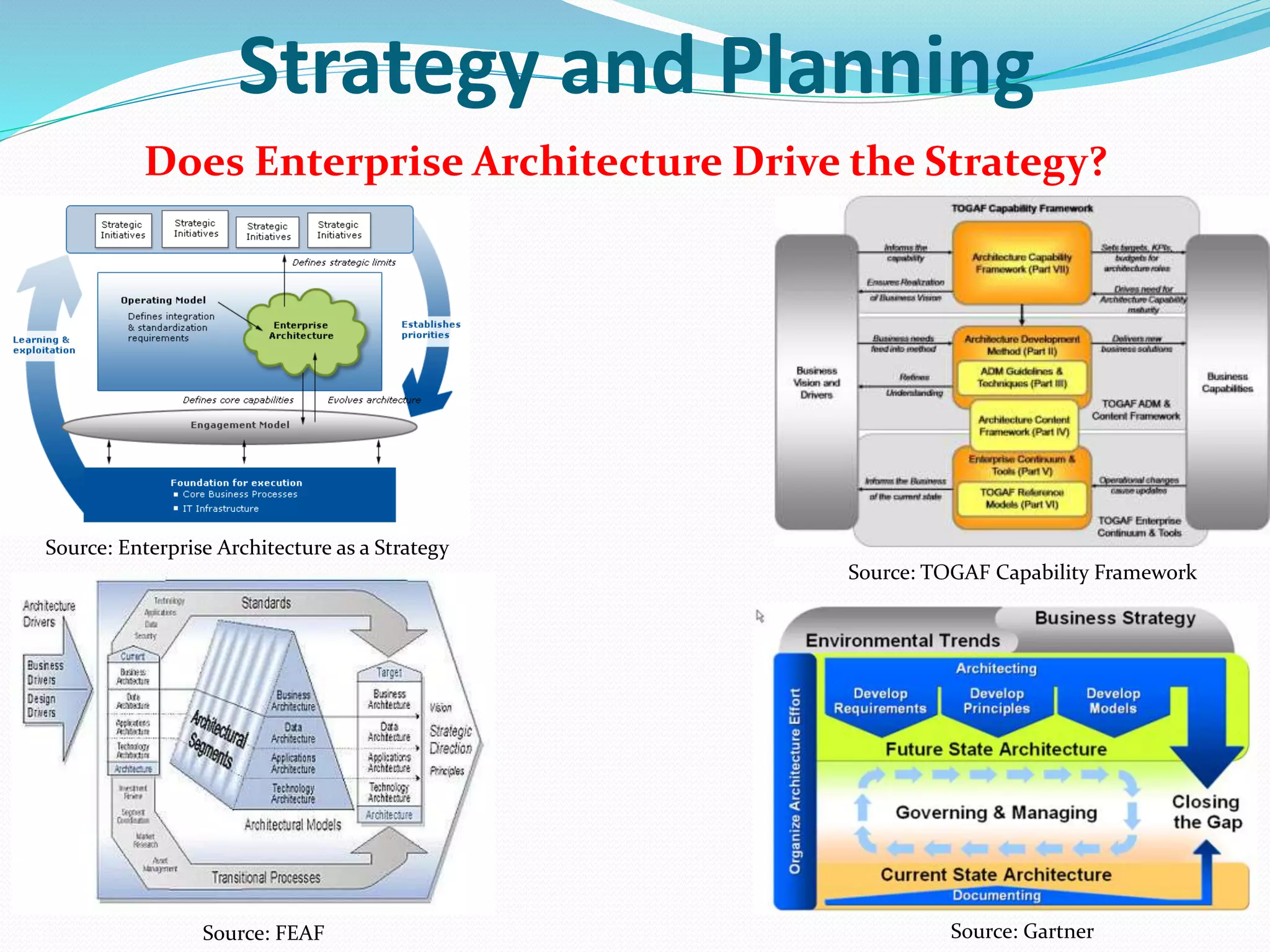
Does Enterprise Architecture Drive the Strategy?
Source: Enterprise Architecture as a Strategy
Source: TOGAF Capability Framework
Source: FEAF Source: Gartner
Architecture Supports Strategy
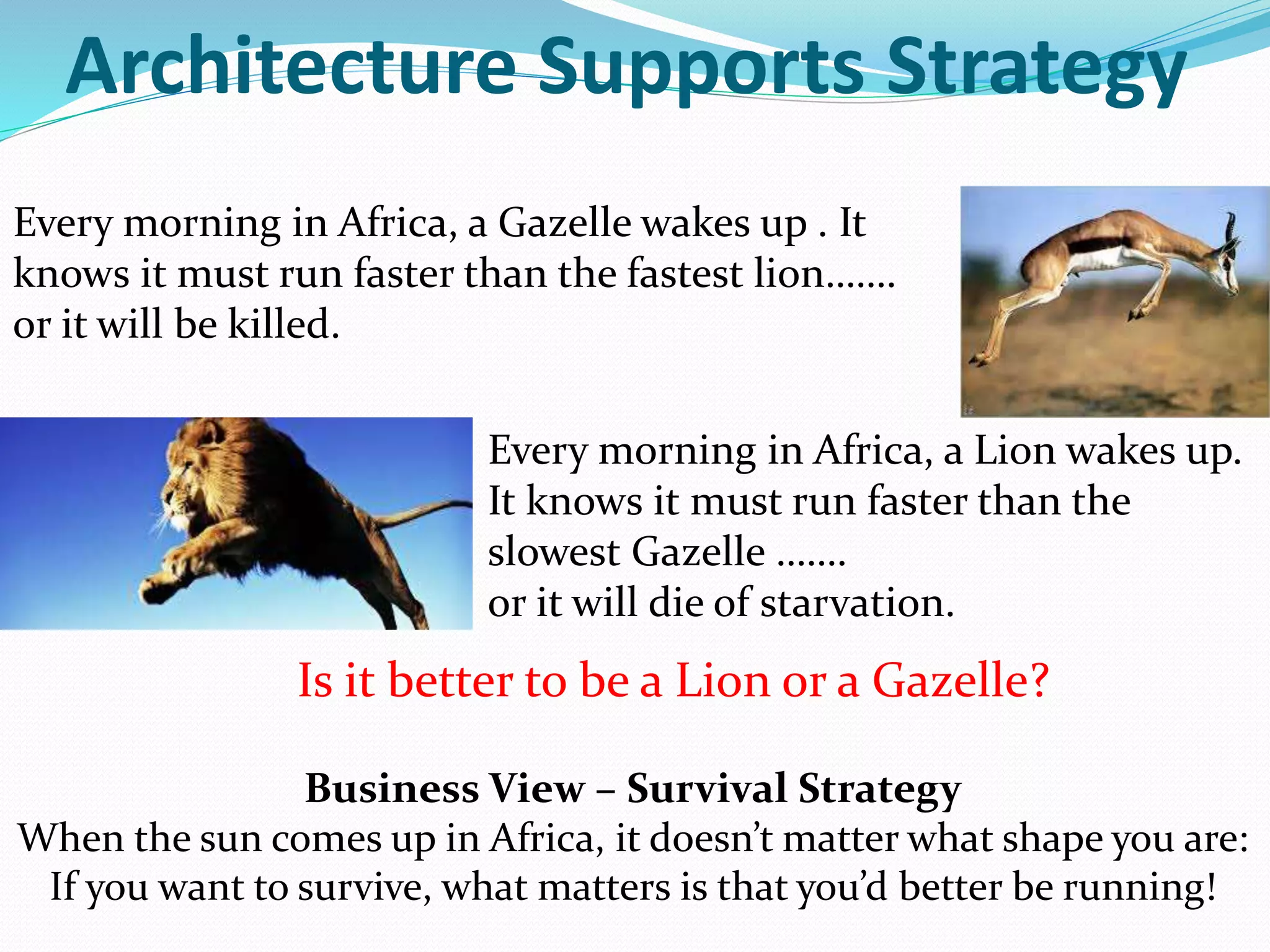
Every morning in Africa, a Gazelle wakes up . It
knows it must run faster than the fastest lion…….
or it will be killed.
Business View – Survival Strategy
When the sun comes up in Africa, it doesn’t matter what shape you are:
If you want to survive, what matters is that you’d better be running!
Every morning in Africa, a Lion wakes up.
It knows it must run faster than the
slowest Gazelle …….
or it will die of starvation.
Is it better to be a Lion or a Gazelle?
Strategy and Planning
Security in Context?
The Business
Prevention
Department
Security is Complex to Define
Security Does not
exist in Isolation
SECURE’ has no
intrinsic meaning
To much
emphasis on
Technology
Silo Approach to
Security
Strategy and Planning
Enterprise Security Architecture?
Layered
Framework
Integrated System Approach
Security meets
the Needs of
Business
Strategy and Planning
Feature Advantages Chairman / Board View
Business-Driven Value-Assured Protects shareholder value
Risk Focused Prioritised and Proportional Optimizes shareholder risk & aligns with
risk appetite
Comprehensive Scalable Scope Addresses all shareholder concerns
Modular Agility Enables flexibility to meet dynamic
market & economic conditions
Open Source Free use, Standard Guarantees perpetuity of return on
investment
Auditable Demonstrates Compliance Demonstrates compliance to regulators
& external auditors
Transparent Two Way Traceability Supports market transparency &
disclosure
Enterprise Security Architecture Framework?
Strategy and Planning
Feature Advantages CEO View
Business-Driven Value-Assured Protects corporate reputation
Risk Focused Prioritised and Proportional Meets corporate governance
requirements
Comprehensive Scalable Scope Meets enterprise-wide requirements
Modular Agility Enables fast time to market with
business solutions
Open Source Free use, Standard Provides assurance through industry
standard
Auditable Demonstrates Compliance Ensures a smooth & successful external
& regulatory audit process
Transparent Two Way Traceability Provides a clear view of expenditure and
value returned
Enterprise Security Architecture Framework?
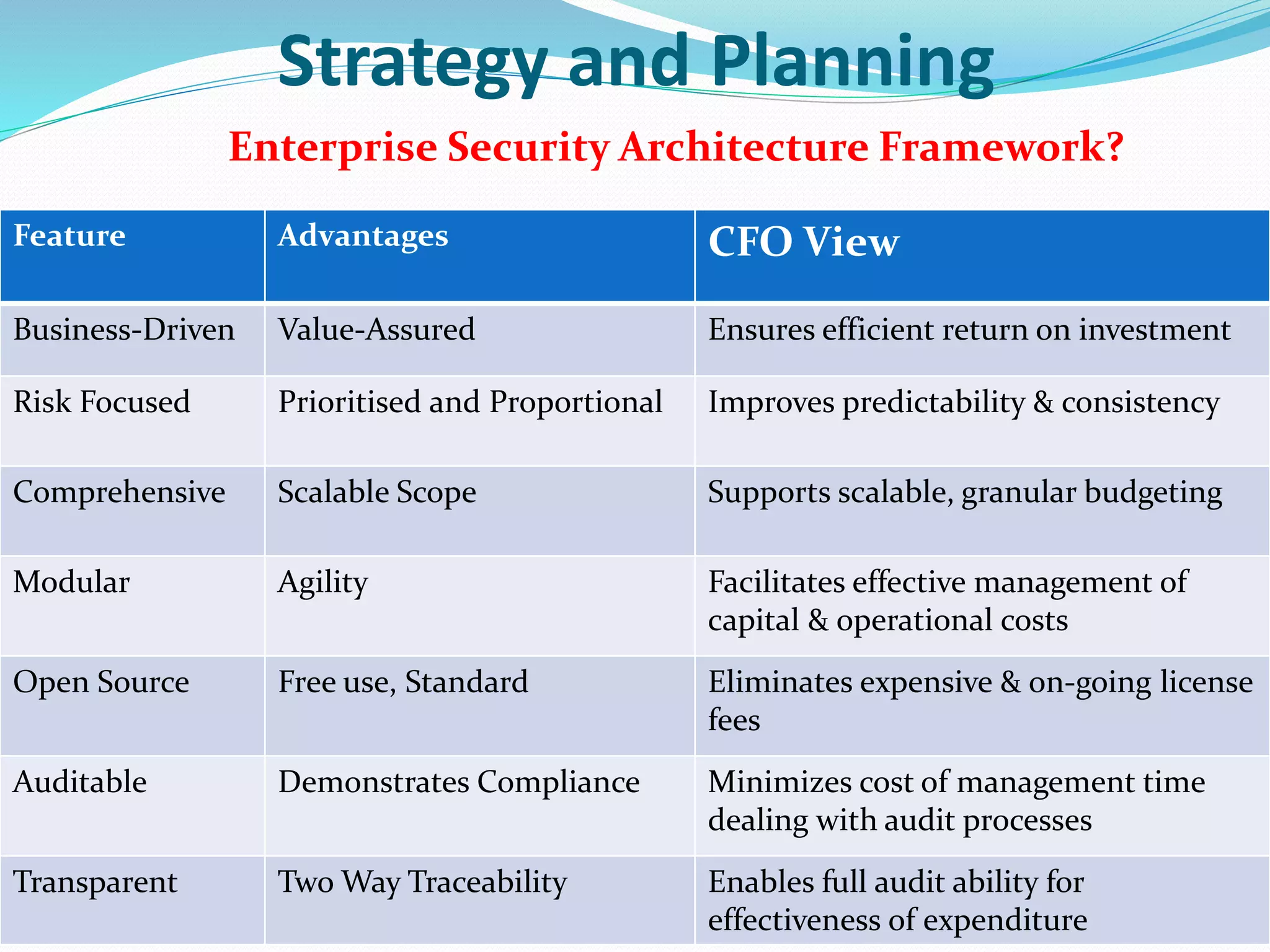
Strategy and Planning
Feature Advantages CFO View
Business-Driven Value-Assured Ensures efficient return on investment
Risk Focused Prioritised and Proportional Improves predictability & consistency
Comprehensive Scalable Scope Supports scalable, granular budgeting
Modular Agility Facilitates effective management of
capital & operational costs
Open Source Free use, Standard Eliminates expensive & on-going license
fees
Auditable Demonstrates Compliance Minimizes cost of management time
dealing with audit processes
Transparent Two Way Traceability Enables full audit ability for
effectiveness of expenditure
Enterprise Security Architecture Framework?
Strategy and Planning
Feature Advantages COO View
Business-Driven Value-Assured Focuses on performance management
Risk Focused Prioritised and Proportional Enables process improvement
Comprehensive Scalable Scope Provides end-to-end process coverage
Modular Agility Integrates legacy and future
environments
Open Source Free use, Standard Simplifies recruitment and training
Auditable Demonstrates Compliance Minimises adverse effect of audit
findings on performance targets
Transparent Two Way Traceability Measures efficiency & effectiveness of
processes & resources
Enterprise Security Architecture Framework?
Strategy and Planning
Feature Advantages CRO View
Business-Driven Value-Assured Enables flexible fit with industry
regulations
Risk Focused Prioritised and Proportional Supports enterprise risk & opportunity
management
Comprehensive Scalable Scope Enables a fully-integrated risk
management strategy
Modular Agility Enables incrementally increasing
maturity
Open Source Free use, Standard Provides global acceptability for auditors
& regulators
Auditable Demonstrates Compliance Ensures that compliance risk is effectively
managed
Transparent Two Way Traceability Demonstrates current state, desired state
of compliance levels
Enterprise Security Architecture Framework?
Strategy and Planning
Feature Advantages CIO View
Business-Driven Value-Assured Enables a digital information-age
business
Risk Focused Prioritised and Proportional Identifies information exploitation
opportunities
Comprehensive Scalable Scope Sustains through-life information
architecture
Modular Agility Enables technology-neutral information
management strategies
Open Source Free use, Standard Provides a future-proof framework for
information management
Auditable Demonstrates Compliance Facilitates smooth & successful audits of
systems & processes
Transparent Two Way Traceability Encourages fully integrated people-
process-technology solutions
Enterprise Security Architecture Framework?
Strategy and Planning
Feature Advantages CISO View
Business-Driven Value-Assured Facilitates alignment of security
strategy with business goals
Risk Focused Prioritised and Proportional Facilitates prioritization of security
and risk-control solutions
Comprehensive Scalable Scope Ensures all business security &
control concerns are addressed
Modular Agility Enables a project-focused approach
to security development
Open Source Free use, Standard Provides a sustainable framework for
security integration
Auditable Demonstrates Compliance Supports security, risk & opportunity
review processes
Transparent Two Way Traceability Provides traceability of business-
aligned security implementations
Enterprise Security Architecture Framework?
Strategy and Planning
Feature Advantages CTO / Architect View
Business-Driven Value-Assured Leverages the full power of information
technology
Risk Focused Prioritised and Proportional Manages information system risk
Comprehensive Scalable Scope Applies at any project size or level of
complexity
Modular Agility Provides a holistic and integrated
architectural approach
Open Source Free use, Standard Avoids vendor-dependence and lock-in
Auditable Demonstrates Compliance Improves relationship and interactions
with auditors & reviewers
Transparent Two Way Traceability Verifies justification and completeness
of technical solutions
Enterprise Security Architecture Framework?
Strategy and Planning
Sherwood Applied Business Security Architecture (SABSA)
SABSA META MODEL
SABSA Matrix
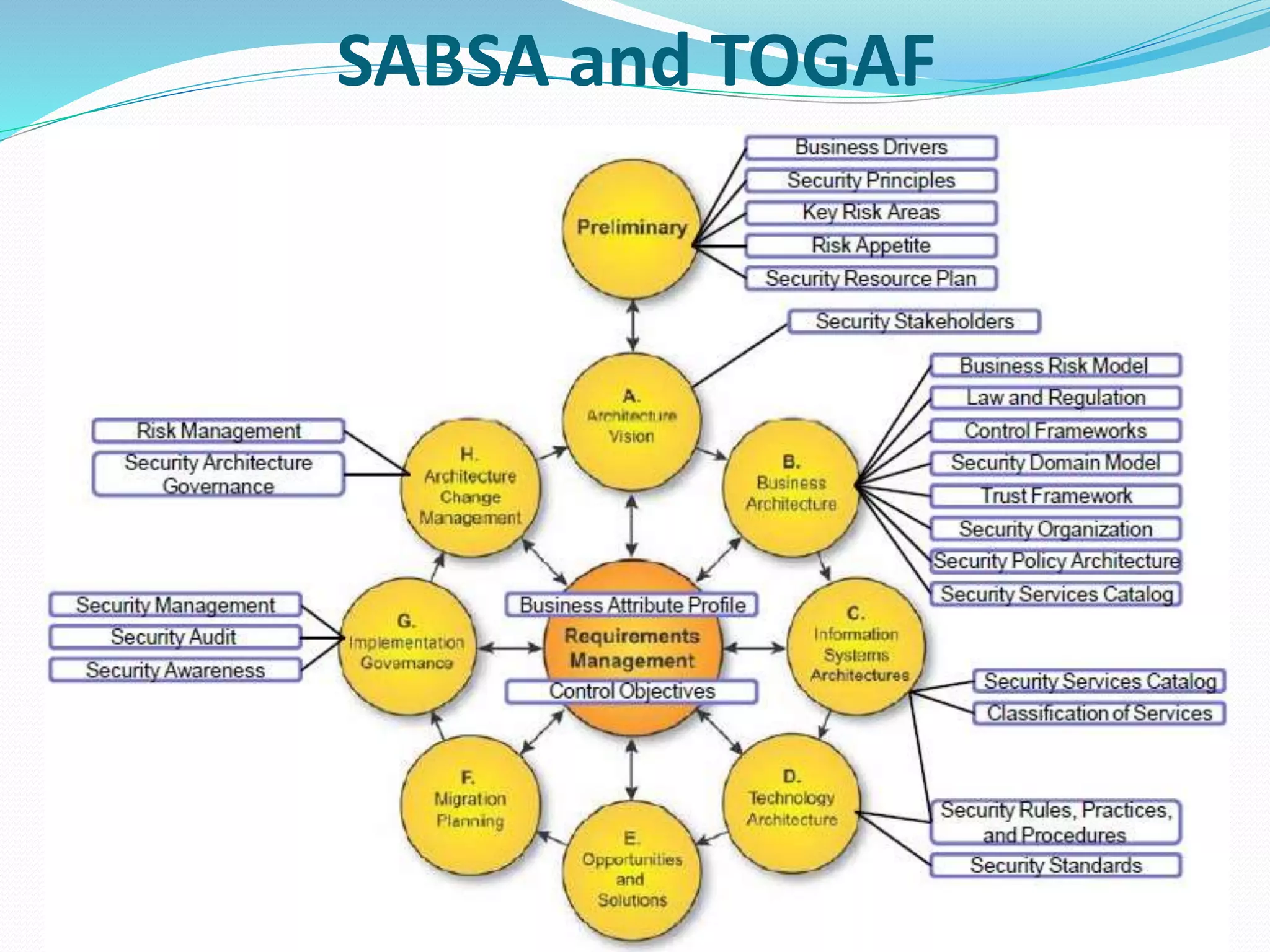
SABSA and TOGAF
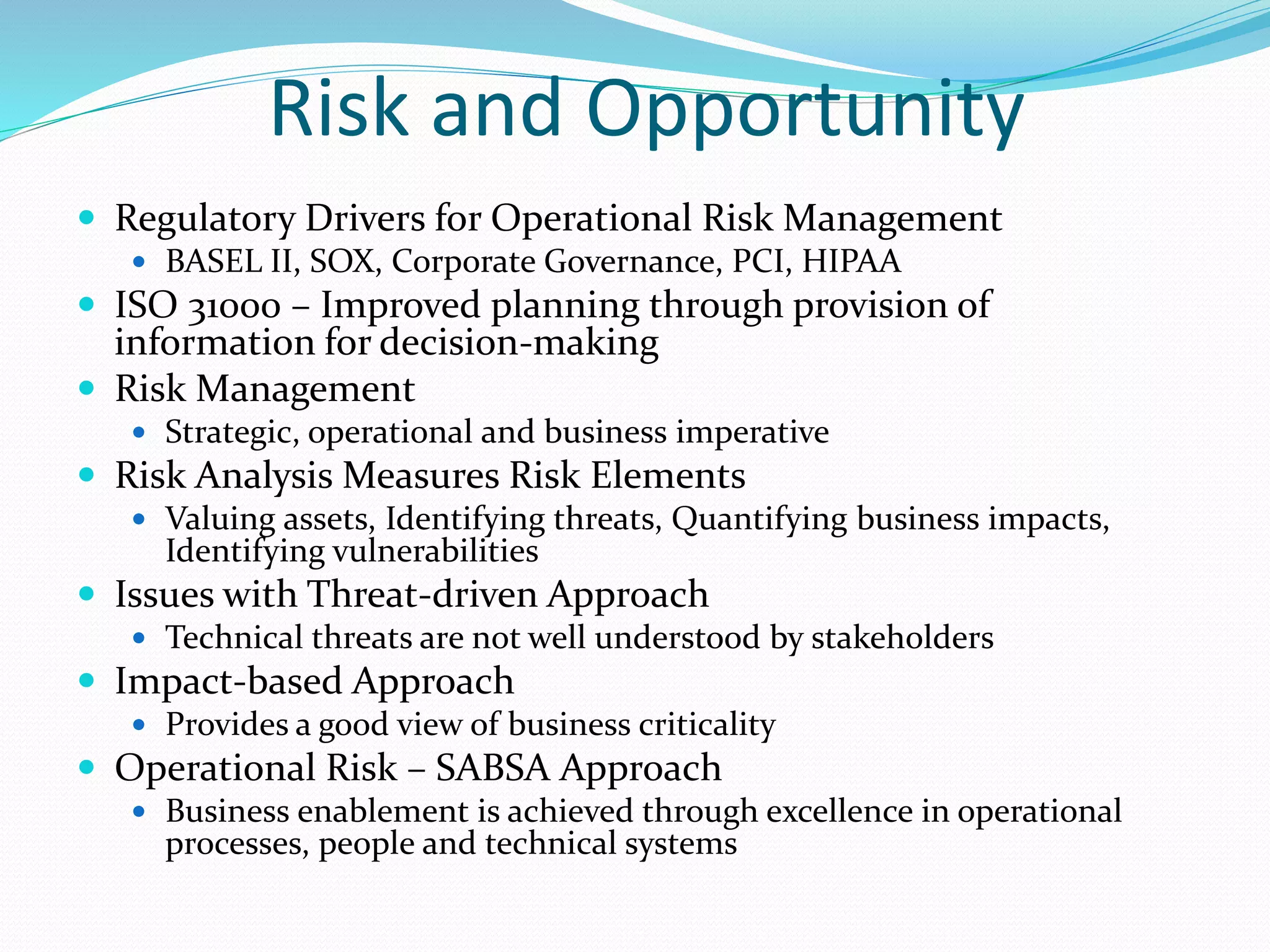
Risk and Opportunity
 Regulatory Drivers for Operational Risk Management
 BASEL II, SOX, Corporate Governance, PCI, HIPAA
 ISO 31000 – Improved planning through provision of
information for decision-making
 Risk Management
 Strategic, operational and business imperative
 Risk Analysis Measures Risk Elements
 Valuing assets, Identifying threats, Quantifying business impacts,
Identifying vulnerabilities
 Issues with Threat-driven Approach
 Technical threats are not well understood by stakeholders
 Impact-based Approach
 Provides a good view of business criticality
 Operational Risk – SABSA Approach
 Business enablement is achieved through excellence in operational
processes, people and technical systems
Risk and Opportunity
SABSA Risk & Opportunity Model
Business Context and Requirements
 Business-Driven means never losing site of the
organisation’s goals, objectives, success factors and
targets.
 Ensuring that the security strategy demonstrably
supports, enhances and protects this.
 Contextual Architecture Layer
 Full Set of Requirements, including conflicts in
Business Strategy, Risks & Priorities
 Conceptual Architecture Layer
 Resolve these conflicts by delivering an appropriate,
measurable security strategy
Business Driven Architecture
Business Context and Requirements
 Each Organisations Business Needs are Unique
 Meaningful traceability is enabled by credible
abstraction from business context (assets, goals &
objectives) to a business security context
Business Driven Architecture
Business Context and Requirements
 An Attribute is a conceptual abstraction of a
real business requirement (the goals,
objectives, drivers, targets, and assets
confirmed as part of the business contextual
architecture)
 The Attributes Profiling technique enables
any unique set of business requirements to be
engineered as a standardised and re-usable
set of specifications
 The Attributes are modeled into a normalised
language that articulates requirements and
measures performance in a way that is
instinctive to all stakeholders
Defining Business Attributes
Business Context and Requirements
 Attributes can be tangible or intangible
 Each attribute requires a meaningful name and detailed
definition customised specifically for a particular organisation
 Each attribute requires a measurement approach and metric to
be defined during the SABSA Strategy & Planning phase to set
performance targets for security
 Attributes must be validated (and preferably created) by senior
management & the business stake-holders by report, interview
or facilitated workshop
 The performance targets are then used as the basis for reporting
and/or SLAs in the SABSA Manage & Measure phase
 Powerful requirements engineering technique
 Populates the vital ‘missing link’ between business
requirements and technology / process design
Attributes Profiling Rules & Features
Business Context and Requirements
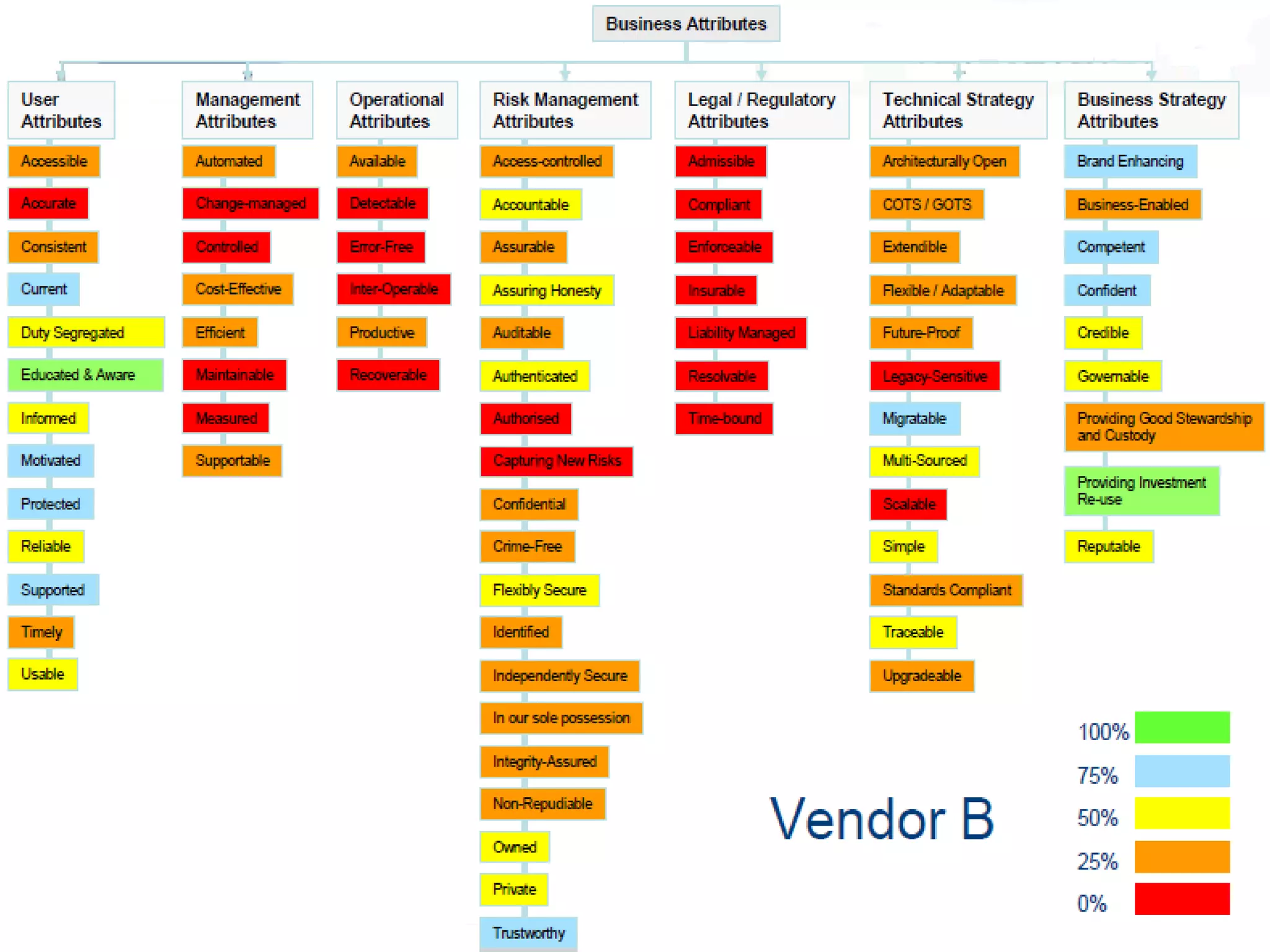
Sample Taxonomy of Attributes
Architectural Strategies
 Define the Business Drivers for the Industry
Driver
#
Business Drivers
BD1
Protecting the reputation of the Organization, ensuring that it is
perceived as competent in its sector
BD2
Providing support to the claims made by the Organization about its
competence to carry out its intended functions
BD3
Protecting the trust that exists in business relationships and
propagating that trust across remote electronic business
communications links and distributed information systems
BD4
Maintaining the confidence of other key parties in their
relationships with the Organization
BD5
Maintaining the operational capability of the Organization’s
systems
BD6
Maintaining the continuity of service delivery, including the ability
to meet the requirements of service level agreements where these
exist
BD7
Maintaining the accuracy of information
BD8
Maintaining the ability to govern
BD9
Preventing losses through financial fraud
BD33
Ensuring that security services can be extended to all user locations, to all
interface types and across all network types that will be used to support
delivery
BD34
Maximize the economic advantage of the Enterprise Security
Architecture
BD35
Security services to be supported through electronic communications,
without the need for physical transfer of documents or storage media.
BD36
System security solutions should as far as possible comply with internal
and external standards and best practices
BD37
The Security Architecture should be independent of any specific vendor
or product, and should be capable of supporting multiple products from
multiple vendors
BD38
The Security Architecture must remain compatible with new technical
solutions as these evolve and become available, and with new business
requirements as these emerge, with a minimum of redesign
BD39
The Security Architecture must be able to be adapted to counter new
threats and vulnerabilities as they are discovered
BD40
Ensure that the required internal and external cultural shift is achieved
to support the Security Architecture
BD41
Ensuring accurate information is available when needed
BD42
Minimise the risk of loss of key customer relationships
BD43
Minimize the risk of excessive loading on insurance premiums due to
negligence on the
Organization’s behalf or lack of due diligence
Architectural Strategies
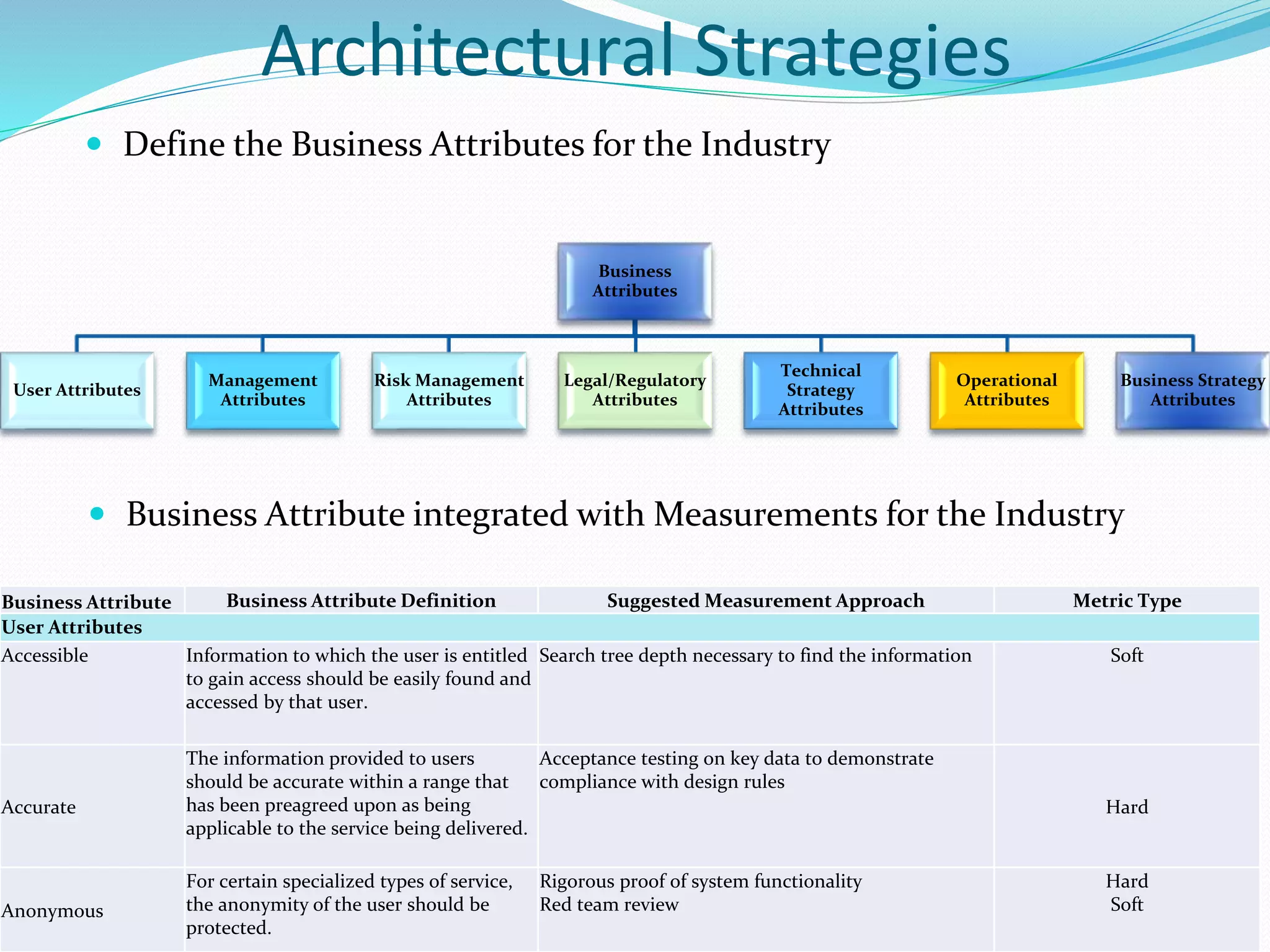
 Define the Business Attributes for the Industry
Business
Attributes
User Attributes
Management
Attributes
Risk Management
Attributes
Legal/Regulatory
Attributes
Technical
Strategy
Attributes
Operational
Attributes
Business Strategy
Attributes
Business Attribute Business Attribute Definition Suggested Measurement Approach Metric Type
User Attributes
Accessible Information to which the user is entitled
to gain access should be easily found and
accessed by that user.
Search tree depth necessary to find the information Soft
Accurate
The information provided to users
should be accurate within a range that
has been preagreed upon as being
applicable to the service being delivered.
Acceptance testing on key data to demonstrate
compliance with design rules
Hard
Anonymous
For certain specialized types of service,
the anonymity of the user should be
protected.
Rigorous proof of system functionality
Red team review
Hard
Soft
 Business Attribute integrated with Measurements for the Industry
Architectural Strategies
 Integrate the Business Drivers and Business Attributes for the Industry
 Business Attribute integrated with Measurements for the Industry
Business
Attribute
Business
Driver
Business Attribute Definition Measurement Approach Metric Performance
Target
User Attributes
Accessible 5 Information to which the user is entitled to gain
access should be easily found and accessed by that
user.
Search tree depth necessary to find the information Soft
Accurate 7 The information provided to users should be accurate
within a range that has been preagreed upon as being
applicable to the service being delivered.
Acceptance testing on key data to demonstrate
compliance with design rules
Hard
Anonymous 4 For certain specialized types of service, the
anonymity of the user should be protected.
Rigorous proof of system functionality
Red team review
Hard
Soft
Architectural Strategies
Internet of Things / Everything
Architectural Strategies
Data
Sovereignty
Data
Protection
Provider
Trust
Management
Business
Continuity
Management
Risk
Management
Cloud
Computing
Architectural Strategies
Source: An Enterprise Architecture Practitioner’s Notes: Volume 3 Solution Level Architecture
Bimodal
Architectural Strategies
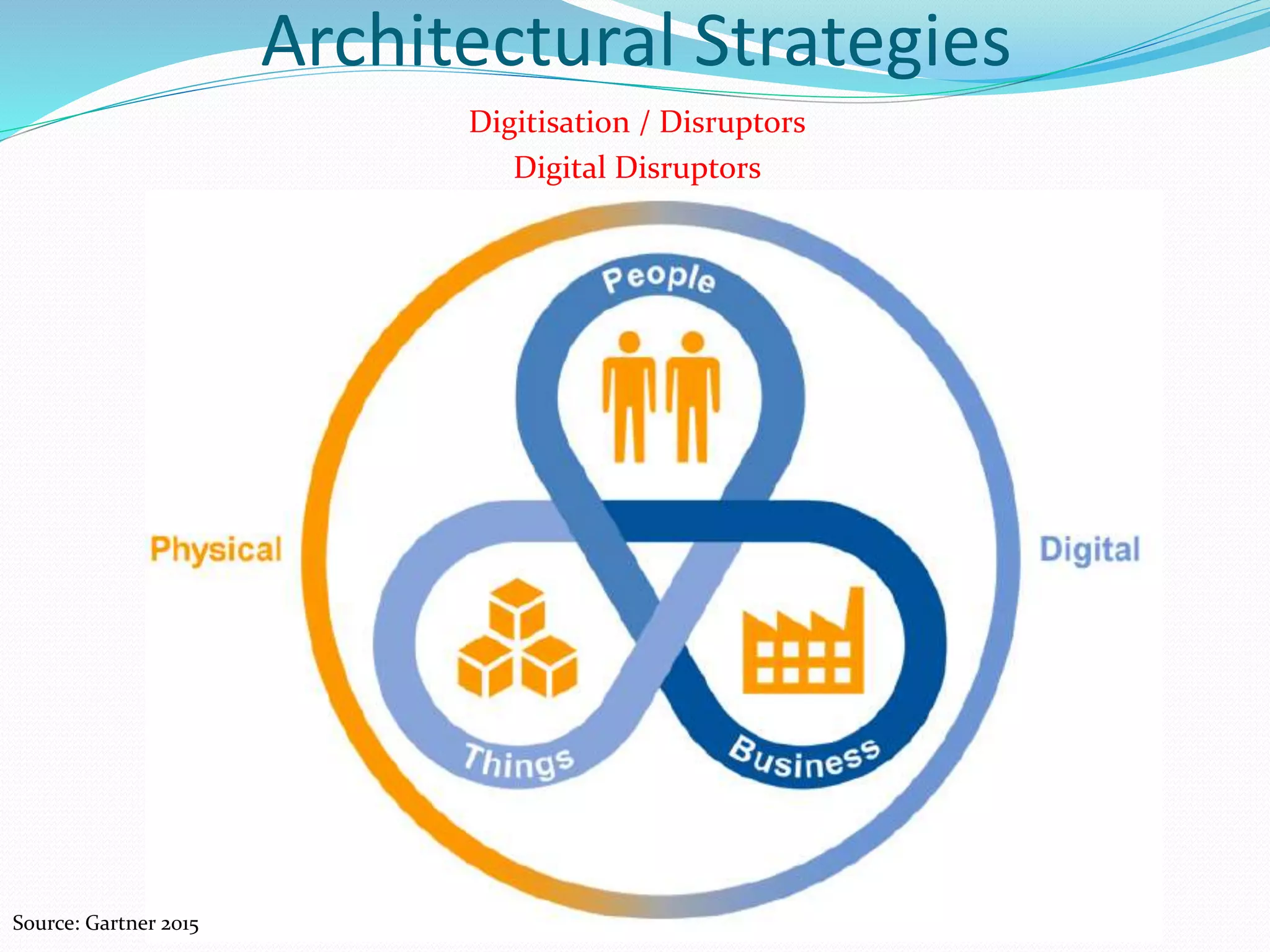
Digitisation / Disruptors
Digital Disruptors
Source: Gartner 2015
Architectural Strategies
Digitisation / Disruptors
Digital Disruptors
Architectural Strategies
Bring Your Own Identity (BYOID)
Security Risk? or
Business Advantage?
What is the
Business Value?
Is it part of the
Corporate Strategy?
Loss of Control vs
Cost
Architectural Strategies
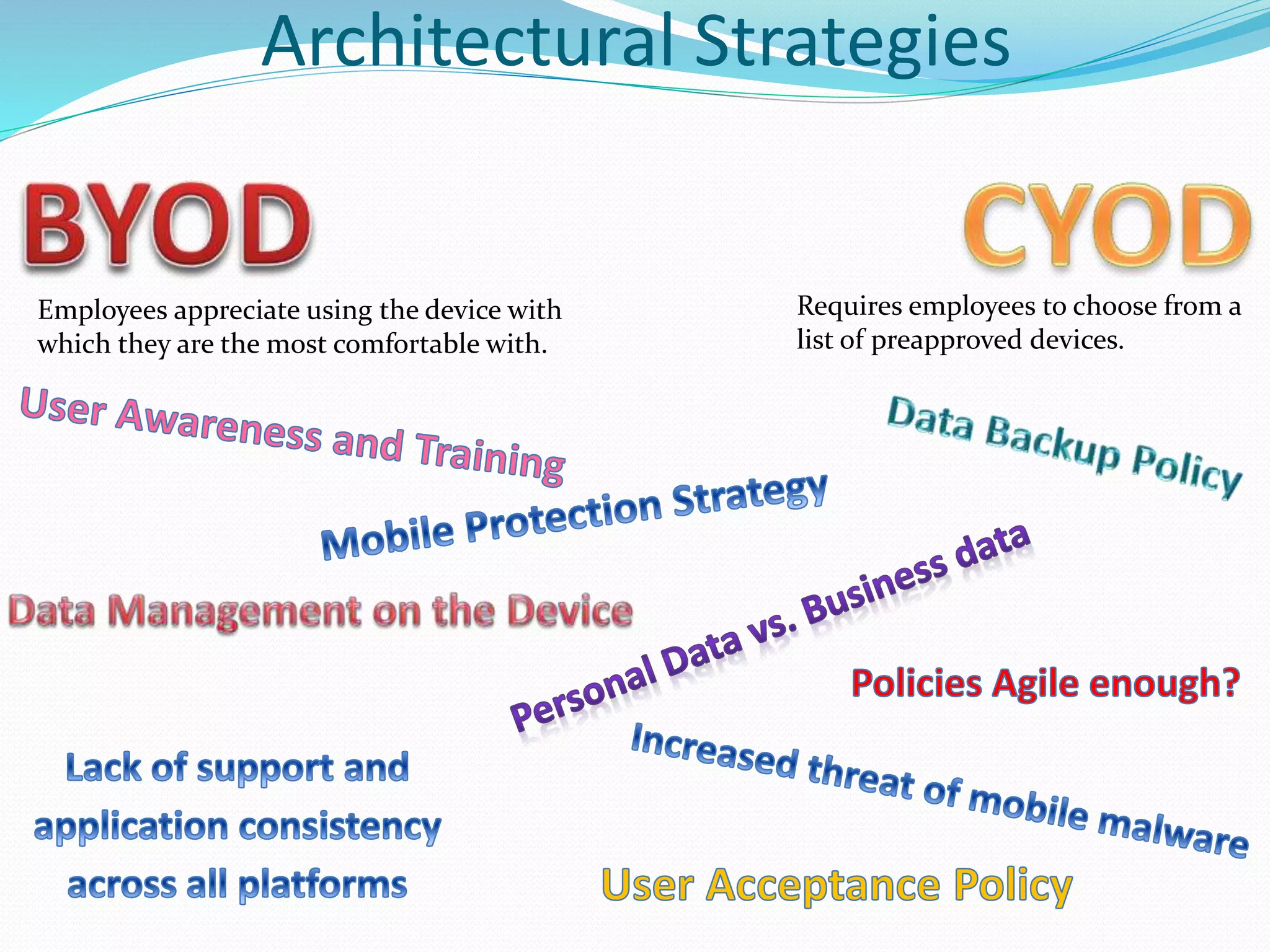
Employees appreciate using the device with
which they are the most comfortable with.
Requires employees to choose from a
list of preapproved devices.
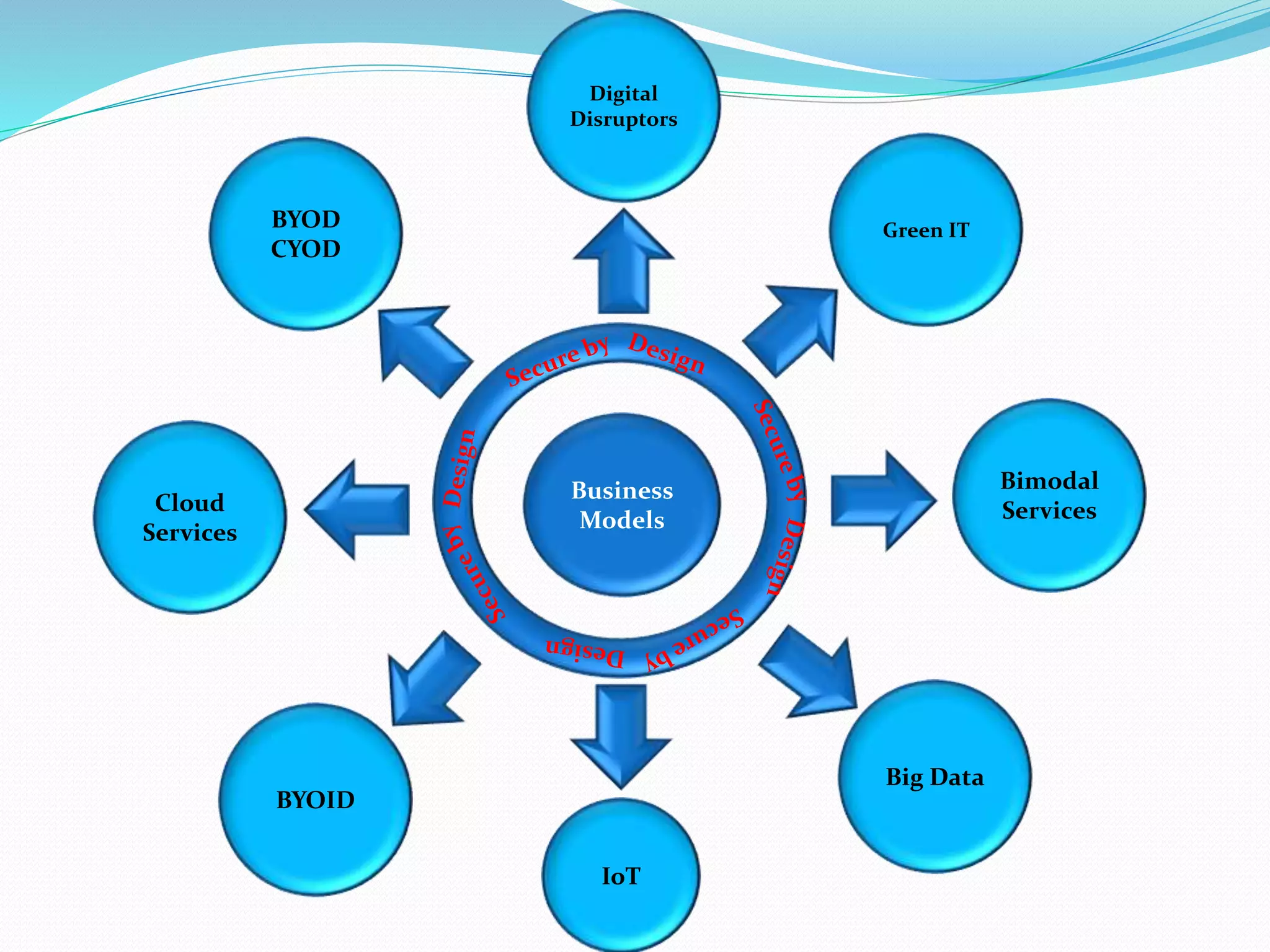
Business
Models
Cloud
Services
Bimodal
Services
Digital
Disruptors
IoT
Green ITBYOD
CYOD
BYOID
Big Data
The Journey is the Reward ~ Chinese Proverb

ESA for Business

  • 1.
  • 2.
    Agenda  Strategy andPlanning  Risk and Opportunity  Business Context and Requirements  Architectural Strategies  Internet of Things / Everything  Cloud  Bi-Modal  Digitisation / Disruptors  Bring Your Own Identity (BYOID)  Choose Your Own Device (CYOD)
  • 4.
    Strategy and Planning DoesEnterprise Architecture Drive the Strategy? Source: Enterprise Architecture as a Strategy Source: TOGAF Capability Framework Source: FEAF Source: Gartner
  • 5.
    Architecture Supports Strategy Everymorning in Africa, a Gazelle wakes up . It knows it must run faster than the fastest lion……. or it will be killed. Business View – Survival Strategy When the sun comes up in Africa, it doesn’t matter what shape you are: If you want to survive, what matters is that you’d better be running! Every morning in Africa, a Lion wakes up. It knows it must run faster than the slowest Gazelle ……. or it will die of starvation. Is it better to be a Lion or a Gazelle?
  • 6.
    Strategy and Planning Securityin Context? The Business Prevention Department Security is Complex to Define Security Does not exist in Isolation SECURE’ has no intrinsic meaning To much emphasis on Technology Silo Approach to Security
  • 7.
    Strategy and Planning EnterpriseSecurity Architecture? Layered Framework Integrated System Approach Security meets the Needs of Business
  • 8.
    Strategy and Planning FeatureAdvantages Chairman / Board View Business-Driven Value-Assured Protects shareholder value Risk Focused Prioritised and Proportional Optimizes shareholder risk & aligns with risk appetite Comprehensive Scalable Scope Addresses all shareholder concerns Modular Agility Enables flexibility to meet dynamic market & economic conditions Open Source Free use, Standard Guarantees perpetuity of return on investment Auditable Demonstrates Compliance Demonstrates compliance to regulators & external auditors Transparent Two Way Traceability Supports market transparency & disclosure Enterprise Security Architecture Framework?
  • 9.
    Strategy and Planning FeatureAdvantages CEO View Business-Driven Value-Assured Protects corporate reputation Risk Focused Prioritised and Proportional Meets corporate governance requirements Comprehensive Scalable Scope Meets enterprise-wide requirements Modular Agility Enables fast time to market with business solutions Open Source Free use, Standard Provides assurance through industry standard Auditable Demonstrates Compliance Ensures a smooth & successful external & regulatory audit process Transparent Two Way Traceability Provides a clear view of expenditure and value returned Enterprise Security Architecture Framework?
  • 10.
    Strategy and Planning FeatureAdvantages CFO View Business-Driven Value-Assured Ensures efficient return on investment Risk Focused Prioritised and Proportional Improves predictability & consistency Comprehensive Scalable Scope Supports scalable, granular budgeting Modular Agility Facilitates effective management of capital & operational costs Open Source Free use, Standard Eliminates expensive & on-going license fees Auditable Demonstrates Compliance Minimizes cost of management time dealing with audit processes Transparent Two Way Traceability Enables full audit ability for effectiveness of expenditure Enterprise Security Architecture Framework?
  • 11.
    Strategy and Planning FeatureAdvantages COO View Business-Driven Value-Assured Focuses on performance management Risk Focused Prioritised and Proportional Enables process improvement Comprehensive Scalable Scope Provides end-to-end process coverage Modular Agility Integrates legacy and future environments Open Source Free use, Standard Simplifies recruitment and training Auditable Demonstrates Compliance Minimises adverse effect of audit findings on performance targets Transparent Two Way Traceability Measures efficiency & effectiveness of processes & resources Enterprise Security Architecture Framework?
  • 12.
    Strategy and Planning FeatureAdvantages CRO View Business-Driven Value-Assured Enables flexible fit with industry regulations Risk Focused Prioritised and Proportional Supports enterprise risk & opportunity management Comprehensive Scalable Scope Enables a fully-integrated risk management strategy Modular Agility Enables incrementally increasing maturity Open Source Free use, Standard Provides global acceptability for auditors & regulators Auditable Demonstrates Compliance Ensures that compliance risk is effectively managed Transparent Two Way Traceability Demonstrates current state, desired state of compliance levels Enterprise Security Architecture Framework?
  • 13.
    Strategy and Planning FeatureAdvantages CIO View Business-Driven Value-Assured Enables a digital information-age business Risk Focused Prioritised and Proportional Identifies information exploitation opportunities Comprehensive Scalable Scope Sustains through-life information architecture Modular Agility Enables technology-neutral information management strategies Open Source Free use, Standard Provides a future-proof framework for information management Auditable Demonstrates Compliance Facilitates smooth & successful audits of systems & processes Transparent Two Way Traceability Encourages fully integrated people- process-technology solutions Enterprise Security Architecture Framework?
  • 14.
    Strategy and Planning FeatureAdvantages CISO View Business-Driven Value-Assured Facilitates alignment of security strategy with business goals Risk Focused Prioritised and Proportional Facilitates prioritization of security and risk-control solutions Comprehensive Scalable Scope Ensures all business security & control concerns are addressed Modular Agility Enables a project-focused approach to security development Open Source Free use, Standard Provides a sustainable framework for security integration Auditable Demonstrates Compliance Supports security, risk & opportunity review processes Transparent Two Way Traceability Provides traceability of business- aligned security implementations Enterprise Security Architecture Framework?
  • 15.
    Strategy and Planning FeatureAdvantages CTO / Architect View Business-Driven Value-Assured Leverages the full power of information technology Risk Focused Prioritised and Proportional Manages information system risk Comprehensive Scalable Scope Applies at any project size or level of complexity Modular Agility Provides a holistic and integrated architectural approach Open Source Free use, Standard Avoids vendor-dependence and lock-in Auditable Demonstrates Compliance Improves relationship and interactions with auditors & reviewers Transparent Two Way Traceability Verifies justification and completeness of technical solutions Enterprise Security Architecture Framework?
  • 16.
    Strategy and Planning SherwoodApplied Business Security Architecture (SABSA)
  • 17.
  • 18.
  • 19.
  • 21.
    Risk and Opportunity Regulatory Drivers for Operational Risk Management  BASEL II, SOX, Corporate Governance, PCI, HIPAA  ISO 31000 – Improved planning through provision of information for decision-making  Risk Management  Strategic, operational and business imperative  Risk Analysis Measures Risk Elements  Valuing assets, Identifying threats, Quantifying business impacts, Identifying vulnerabilities  Issues with Threat-driven Approach  Technical threats are not well understood by stakeholders  Impact-based Approach  Provides a good view of business criticality  Operational Risk – SABSA Approach  Business enablement is achieved through excellence in operational processes, people and technical systems
  • 22.
    Risk and Opportunity SABSARisk & Opportunity Model
  • 24.
    Business Context andRequirements  Business-Driven means never losing site of the organisation’s goals, objectives, success factors and targets.  Ensuring that the security strategy demonstrably supports, enhances and protects this.  Contextual Architecture Layer  Full Set of Requirements, including conflicts in Business Strategy, Risks & Priorities  Conceptual Architecture Layer  Resolve these conflicts by delivering an appropriate, measurable security strategy Business Driven Architecture
  • 25.
    Business Context andRequirements  Each Organisations Business Needs are Unique  Meaningful traceability is enabled by credible abstraction from business context (assets, goals & objectives) to a business security context Business Driven Architecture
  • 26.
    Business Context andRequirements  An Attribute is a conceptual abstraction of a real business requirement (the goals, objectives, drivers, targets, and assets confirmed as part of the business contextual architecture)  The Attributes Profiling technique enables any unique set of business requirements to be engineered as a standardised and re-usable set of specifications  The Attributes are modeled into a normalised language that articulates requirements and measures performance in a way that is instinctive to all stakeholders Defining Business Attributes
  • 27.
    Business Context andRequirements  Attributes can be tangible or intangible  Each attribute requires a meaningful name and detailed definition customised specifically for a particular organisation  Each attribute requires a measurement approach and metric to be defined during the SABSA Strategy & Planning phase to set performance targets for security  Attributes must be validated (and preferably created) by senior management & the business stake-holders by report, interview or facilitated workshop  The performance targets are then used as the basis for reporting and/or SLAs in the SABSA Manage & Measure phase  Powerful requirements engineering technique  Populates the vital ‘missing link’ between business requirements and technology / process design Attributes Profiling Rules & Features
  • 28.
    Business Context andRequirements Sample Taxonomy of Attributes
  • 32.
    Architectural Strategies  Definethe Business Drivers for the Industry Driver # Business Drivers BD1 Protecting the reputation of the Organization, ensuring that it is perceived as competent in its sector BD2 Providing support to the claims made by the Organization about its competence to carry out its intended functions BD3 Protecting the trust that exists in business relationships and propagating that trust across remote electronic business communications links and distributed information systems BD4 Maintaining the confidence of other key parties in their relationships with the Organization BD5 Maintaining the operational capability of the Organization’s systems BD6 Maintaining the continuity of service delivery, including the ability to meet the requirements of service level agreements where these exist BD7 Maintaining the accuracy of information BD8 Maintaining the ability to govern BD9 Preventing losses through financial fraud BD33 Ensuring that security services can be extended to all user locations, to all interface types and across all network types that will be used to support delivery BD34 Maximize the economic advantage of the Enterprise Security Architecture BD35 Security services to be supported through electronic communications, without the need for physical transfer of documents or storage media. BD36 System security solutions should as far as possible comply with internal and external standards and best practices BD37 The Security Architecture should be independent of any specific vendor or product, and should be capable of supporting multiple products from multiple vendors BD38 The Security Architecture must remain compatible with new technical solutions as these evolve and become available, and with new business requirements as these emerge, with a minimum of redesign BD39 The Security Architecture must be able to be adapted to counter new threats and vulnerabilities as they are discovered BD40 Ensure that the required internal and external cultural shift is achieved to support the Security Architecture BD41 Ensuring accurate information is available when needed BD42 Minimise the risk of loss of key customer relationships BD43 Minimize the risk of excessive loading on insurance premiums due to negligence on the Organization’s behalf or lack of due diligence
  • 33.
    Architectural Strategies  Definethe Business Attributes for the Industry Business Attributes User Attributes Management Attributes Risk Management Attributes Legal/Regulatory Attributes Technical Strategy Attributes Operational Attributes Business Strategy Attributes Business Attribute Business Attribute Definition Suggested Measurement Approach Metric Type User Attributes Accessible Information to which the user is entitled to gain access should be easily found and accessed by that user. Search tree depth necessary to find the information Soft Accurate The information provided to users should be accurate within a range that has been preagreed upon as being applicable to the service being delivered. Acceptance testing on key data to demonstrate compliance with design rules Hard Anonymous For certain specialized types of service, the anonymity of the user should be protected. Rigorous proof of system functionality Red team review Hard Soft  Business Attribute integrated with Measurements for the Industry
  • 34.
    Architectural Strategies  Integratethe Business Drivers and Business Attributes for the Industry  Business Attribute integrated with Measurements for the Industry Business Attribute Business Driver Business Attribute Definition Measurement Approach Metric Performance Target User Attributes Accessible 5 Information to which the user is entitled to gain access should be easily found and accessed by that user. Search tree depth necessary to find the information Soft Accurate 7 The information provided to users should be accurate within a range that has been preagreed upon as being applicable to the service being delivered. Acceptance testing on key data to demonstrate compliance with design rules Hard Anonymous 4 For certain specialized types of service, the anonymity of the user should be protected. Rigorous proof of system functionality Red team review Hard Soft
  • 35.
  • 36.
  • 37.
  • 38.
  • 39.
    Architectural Strategies Source: AnEnterprise Architecture Practitioner’s Notes: Volume 3 Solution Level Architecture Bimodal
  • 40.
    Architectural Strategies Digitisation /Disruptors Digital Disruptors Source: Gartner 2015
  • 41.
    Architectural Strategies Digitisation /Disruptors Digital Disruptors
  • 42.
    Architectural Strategies Bring YourOwn Identity (BYOID) Security Risk? or Business Advantage? What is the Business Value? Is it part of the Corporate Strategy? Loss of Control vs Cost
  • 43.
    Architectural Strategies Employees appreciateusing the device with which they are the most comfortable with. Requires employees to choose from a list of preapproved devices.
  • 44.
  • 45.
    The Journey isthe Reward ~ Chinese Proverb

Editor's Notes

  • #5 All Enterprise Architectures refer to the Strategy and how it will be driving this Strategy within the organisation
  • #7 The Legacy of Security within the Organisation
  • #9 Requires a ESA that can cater for different views from a CXO perspective
  • #37 The IoT comprises an ecosystem that includes things, communication, applications and data analysis As IoT use grows, ensuring IoT device authentication is crucial. A lack of authentication standards for most IoT devices has led to highly customized authentication methods in the industry.
  • #38 Data Sovereignty – Are you allowed to store your data outside of the country – what laws allow / deny this? Data Protection – Data Privacy, Data Location, Data Management and Protection, Tenancy
  • #41 Digital business is the creation of new business designs that not only connect people and businesses, but also connect people and businesses with things to drive revenue and efficiency. Digital business helps to eliminate barriers that now exist among industry segments, while creating new value chains and business opportunities that traditional businesses cannot offer.
  • #42 Maintaining effective security starts with knowing what effect you need to achieve. This means you need to start by focusing on risk. Through risk assessment and risk management practices we can identify the critical outcomes for the enterprise and transform those outcomes into security tactics.
  • #43 Identity and Access Management – accessing anything from anywhere