Introduction to 
the study area 
Design 
criteria 
Landuse 
Activity 
patterns of 
street 
Nature of street 
Cross section of 
Ranganathan st 
Connectivity 
Pattern 
Building usage and 
plan 
Bill boards/ 
signage 
Activity pattern of 
the day 
Activities on 
Edges 
Methodology 2 
Building 
Characte-ristics 
Pedestrian flow
Chennai 
History of Ranganathan Street 
Ranganathan Street was named after the Rangaswamy Iyengar Street, since there was this 
usual tradition to name the streets after the resident who has its first house at the street, 
irrespective of the contribution, caste or class. He constructed his house in the early 20s. 
The Street is one the best options to shop around to purchase comparatively cheap household goods, 
vessels, electronics and merchandise. 
Location of Ranganathan Street 
Ranganathan Street 
Tamil Nadu 
INDIA 
Ranganathan Street is a major commercial street in the neighborhood of T. Nagar, located 
in Chennai. The street houses several commercial establishments, primarily those involved in 
the clothing and jewelry industry. It has often been referred to as the most crowded street in 
Chennai 
Ranganathan 
Street at 
present 
context 
Ranganathan 
Street 
surrounding 
area at 1960’s 
Usman Road is on one end of the street. At the other end is the Mambalam train station. On the 
street can be found many commercial establishments ranging from street hawkers selling to big 
stores selling . Many vegetable vendors also sell their wares on Ranganathan Street. 
3
Ice cream shop Fancy items 
Vegetable/ fruit market 
Informal shops 
Footwear shop 
Snacks items 
Fancy items 
Bag shops 
Activity patterns of street 4
Total area =30,204.75 Sq.m 
Total stretch of street = 0.3km 
Total built-up area= 2423,67 Sq.ft 
FSI = 2.5 
Majority of the building are commercial in nature. 
Important Landmark of the street is called saravana store which is G+7(textile shop) 
In study area (G) have 33% is maximum; (G+2) and (G+3) have 14% 
Built-up map 
Building height map 
Nature of street - Building heights 5
Commercial96% 
Mixed residential2.50% 
heritage0.50% 
public and semi public1% 
Land use map 
Throughout the year the street is FULL of people. Traditionally, it is busiest during Deepavali by 
nature of this street offering consumers the opportunity to purchase a variety of commodities. 
Morning peak = 10.30 to 12 pm 
Afternoon Peak = 
2 to 4 pm 
Evening peak = 6 to 8.30 pm 
Landuse Pattern And Peak hour 6
Mambalam 
Railway 
station 
Commercial area 
` 
Bus 
stop 
Bus 
stop 
Connectivity Pattern 7 
Mambalam 
railway 
station which 
connects 
Chennai 
Central 
terminal in 
north and 
Guindy in 
south. 
North Usman 
road and 
ranganathan 
street 
intersection 
point. 
Study area 
ranganathan 
street one of 
the crowdest 
place in 
Chennai. 
T Nagar bus 
terminal
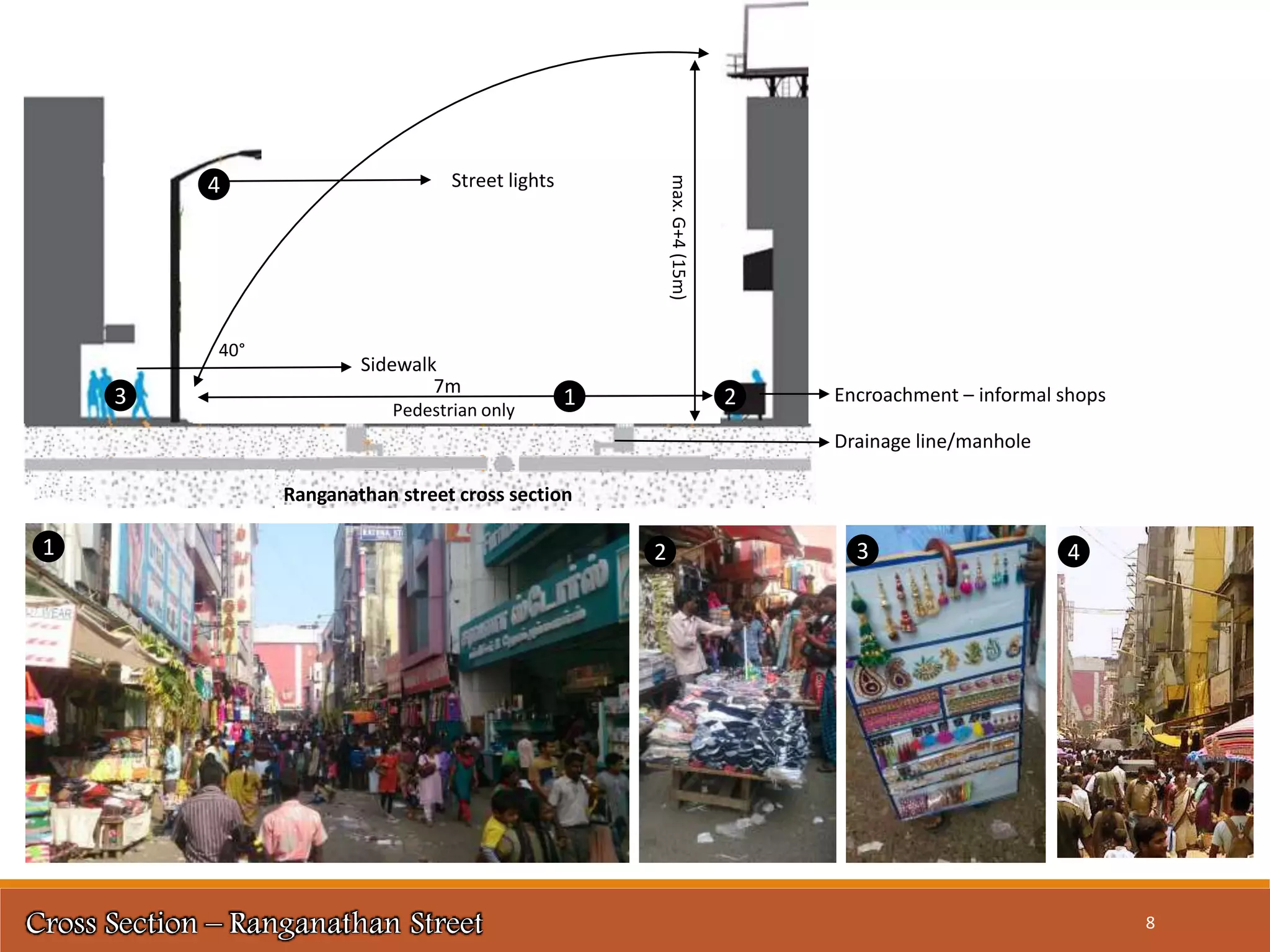
7m 
Encroachment – informal shops 
Drainage line/manhole 
Sidewalk 
Street lights 
3 1 2 
Pedestrian only 
Ranganathan street cross section 
8 
4 
1 2 3 4 
Cross Section – Ranganathan Street 
max. G+4 (15m) 
40°
9 
3m 2m 7m 1m 7m 2m 3m 
Usman Road cross section – approach road of ranganathan street 
Different 
types 
Informal 
Activities 
On the 
Edges 
1 
1 
1 
Informal activities near Edges
Fruit shop 
near the 
sidewalk 
Various informal activities 
near the sidewalk 
People use steps for waiting and sitting purpose 
Building design at 
Ranganathan St. 
Usage of edges 10
G+5 
G+4 
G+3 
G+2 
G+1 
G 
Storage place/ Godown 
Food court 
Electronic and furniture 
Kids section/toys 
Jewellery shop 
Entrance/ textile 
Basement Basement 
Floor Usage 
Steps Staircase pattern Building - Side view 
Building usage 11
It attracts many people from different parts of the city and its suburbs, owing to its location 
and transportation links. T.Nagar has the highest commercial catchment population when 
compared with other commercial centers of the city like Adyar, Nungambakkam, 
Purusawakkam, etc. 
Commercial activity has spread over the years on all the major roads, in a linear pattern. Now 
it is slowly encroaching on the by lanes of the major commercial streets. Single storey shops 
have given way to multi storey shopping malls, but with little change in the infrastructure. 
This sketch uses the same graphical representation for Ranganathan Street, employing the 
personal space bubble and the moving space bubble. There are no sidewalks. Vehicular 
movement is restricted so the entire stretch is used by pedestrians. 
The entire sidewalk is taken up by 
hawkers. Unauthorized parking of two 
wheelers and auto rickshaws also push 
the pedestrian farther out into the 
vehicular carriageway. 
Typical pedestrian spacing Waiting at curbs at an intersection 
Gazing at the wares displayed by street vendors 
Pedestrian flow and activity 12
Building 
Signage 
Portico 
Cross section of street 
Bill boards/ signage design 13
Garbage thrown on the street Broken drainage pipes Congested place 
• Lack of parking facilities. 
• Sidewalk is occupied by informal activities. 
• Lack of proper footpath. 
• Illegal rise of buildings. 
Issues 14
• Urban Design addresses the character and quality of the built environment in 
relation to the human scale. 
• Human scale can be defined as the proportional relationship of the physical 
environment (buildings, trees, parking lots, streets, etc.) to human 
dimensions. 
• As the study of intentions of making people communicate with a place of 
interest . 
• To understand the urban design process of an extension to a ranganathan St. 
as CBD 
• The pattern of the street network is part of what defines a city and what 
makes city unique. 
Urban Design definition as per my case study 15

Ranganthan street,T.Nagar - Urban Design

  • 2.
    Introduction to thestudy area Design criteria Landuse Activity patterns of street Nature of street Cross section of Ranganathan st Connectivity Pattern Building usage and plan Bill boards/ signage Activity pattern of the day Activities on Edges Methodology 2 Building Characte-ristics Pedestrian flow
  • 3.
    Chennai History ofRanganathan Street Ranganathan Street was named after the Rangaswamy Iyengar Street, since there was this usual tradition to name the streets after the resident who has its first house at the street, irrespective of the contribution, caste or class. He constructed his house in the early 20s. The Street is one the best options to shop around to purchase comparatively cheap household goods, vessels, electronics and merchandise. Location of Ranganathan Street Ranganathan Street Tamil Nadu INDIA Ranganathan Street is a major commercial street in the neighborhood of T. Nagar, located in Chennai. The street houses several commercial establishments, primarily those involved in the clothing and jewelry industry. It has often been referred to as the most crowded street in Chennai Ranganathan Street at present context Ranganathan Street surrounding area at 1960’s Usman Road is on one end of the street. At the other end is the Mambalam train station. On the street can be found many commercial establishments ranging from street hawkers selling to big stores selling . Many vegetable vendors also sell their wares on Ranganathan Street. 3
  • 4.
    Ice cream shopFancy items Vegetable/ fruit market Informal shops Footwear shop Snacks items Fancy items Bag shops Activity patterns of street 4
  • 5.
    Total area =30,204.75Sq.m Total stretch of street = 0.3km Total built-up area= 2423,67 Sq.ft FSI = 2.5 Majority of the building are commercial in nature. Important Landmark of the street is called saravana store which is G+7(textile shop) In study area (G) have 33% is maximum; (G+2) and (G+3) have 14% Built-up map Building height map Nature of street - Building heights 5
  • 6.
    Commercial96% Mixed residential2.50% heritage0.50% public and semi public1% Land use map Throughout the year the street is FULL of people. Traditionally, it is busiest during Deepavali by nature of this street offering consumers the opportunity to purchase a variety of commodities. Morning peak = 10.30 to 12 pm Afternoon Peak = 2 to 4 pm Evening peak = 6 to 8.30 pm Landuse Pattern And Peak hour 6
  • 7.
    Mambalam Railway station Commercial area ` Bus stop Bus stop Connectivity Pattern 7 Mambalam railway station which connects Chennai Central terminal in north and Guindy in south. North Usman road and ranganathan street intersection point. Study area ranganathan street one of the crowdest place in Chennai. T Nagar bus terminal
  • 8.
    7m Encroachment –informal shops Drainage line/manhole Sidewalk Street lights 3 1 2 Pedestrian only Ranganathan street cross section 8 4 1 2 3 4 Cross Section – Ranganathan Street max. G+4 (15m) 40°
  • 9.
    9 3m 2m7m 1m 7m 2m 3m Usman Road cross section – approach road of ranganathan street Different types Informal Activities On the Edges 1 1 1 Informal activities near Edges
  • 10.
    Fruit shop nearthe sidewalk Various informal activities near the sidewalk People use steps for waiting and sitting purpose Building design at Ranganathan St. Usage of edges 10
  • 11.
    G+5 G+4 G+3 G+2 G+1 G Storage place/ Godown Food court Electronic and furniture Kids section/toys Jewellery shop Entrance/ textile Basement Basement Floor Usage Steps Staircase pattern Building - Side view Building usage 11
  • 12.
    It attracts manypeople from different parts of the city and its suburbs, owing to its location and transportation links. T.Nagar has the highest commercial catchment population when compared with other commercial centers of the city like Adyar, Nungambakkam, Purusawakkam, etc. Commercial activity has spread over the years on all the major roads, in a linear pattern. Now it is slowly encroaching on the by lanes of the major commercial streets. Single storey shops have given way to multi storey shopping malls, but with little change in the infrastructure. This sketch uses the same graphical representation for Ranganathan Street, employing the personal space bubble and the moving space bubble. There are no sidewalks. Vehicular movement is restricted so the entire stretch is used by pedestrians. The entire sidewalk is taken up by hawkers. Unauthorized parking of two wheelers and auto rickshaws also push the pedestrian farther out into the vehicular carriageway. Typical pedestrian spacing Waiting at curbs at an intersection Gazing at the wares displayed by street vendors Pedestrian flow and activity 12
  • 13.
    Building Signage Portico Cross section of street Bill boards/ signage design 13
  • 14.
    Garbage thrown onthe street Broken drainage pipes Congested place • Lack of parking facilities. • Sidewalk is occupied by informal activities. • Lack of proper footpath. • Illegal rise of buildings. Issues 14
  • 15.
    • Urban Designaddresses the character and quality of the built environment in relation to the human scale. • Human scale can be defined as the proportional relationship of the physical environment (buildings, trees, parking lots, streets, etc.) to human dimensions. • As the study of intentions of making people communicate with a place of interest . • To understand the urban design process of an extension to a ranganathan St. as CBD • The pattern of the street network is part of what defines a city and what makes city unique. Urban Design definition as per my case study 15