REST and linked data
A match made for domain driven development?

Kevin Page
Oxford e-Research Centre, University of Oxford, UK
Electronics & Computer Science, University of Southampton, UK


WS-REST 2011, Hyderabad, 28/03/2011


                                                                1
Context


 ●
     Building systems and tools for e-Science and
     e-Research in several domains
 ●
     All could be considered data-centric (though that's not
     to forget method)
        ●
           Computational musicology, Music Information
           Retrieval
        ●
           Geographers, oceanographers
        ●
           Scientific workflow (bioinformaticians etc.)


                                                               2
Context (continued)


 ●
     Common requirements
       ●
         Structure information for the domain
       ●
         Expose data for use (and re-use)
 ●
     Have had some success with
       ●
         RESTful APIs
       ●
         Linked Data


                                                3
Context (continued)


 ●
     Common requirements:
       ●
         Structure information for the domain
       ●
         Expose data for use (and re-use)
 ●
     Have had some success with
       ●
         RESTful APIs
       ●
         Linked Data
       ●
         But not necessarily at the same time (why?)


                                                       4
Commonality


              5
Commonalities

 ●
     The Primacy of Resources
       ●
           Identification of resources is the key abstraction in
           REST and RDF where it is also the means to express
           relationships


                                                                   6
Commonalities

 ●
     The Primacy of Resources
       ●
           Identification of resources is the key abstraction in
           REST and RDF where it is also the means to express
           relationships
 ●
     Linking is not optional
       ●
           Links to other URIs to discover more things (Linked
           Data); and as the engine of application state (REST)


                                                                   7
Commonalities

 ●
     The Primacy of Resources
       ●
           Identification of resources is the key abstraction in
           REST and RDF where it is also the means to express
           relationships
 ●
     Linking is not optional
       ●
           Links to other URIs to discover more things (Linked
           Data); and as the engine of application state (REST)
 ●
     Segregation of Semantics
       ●
           Semantics have their place (and it's not in the resource
           addressing/URIs)


                                                                      8
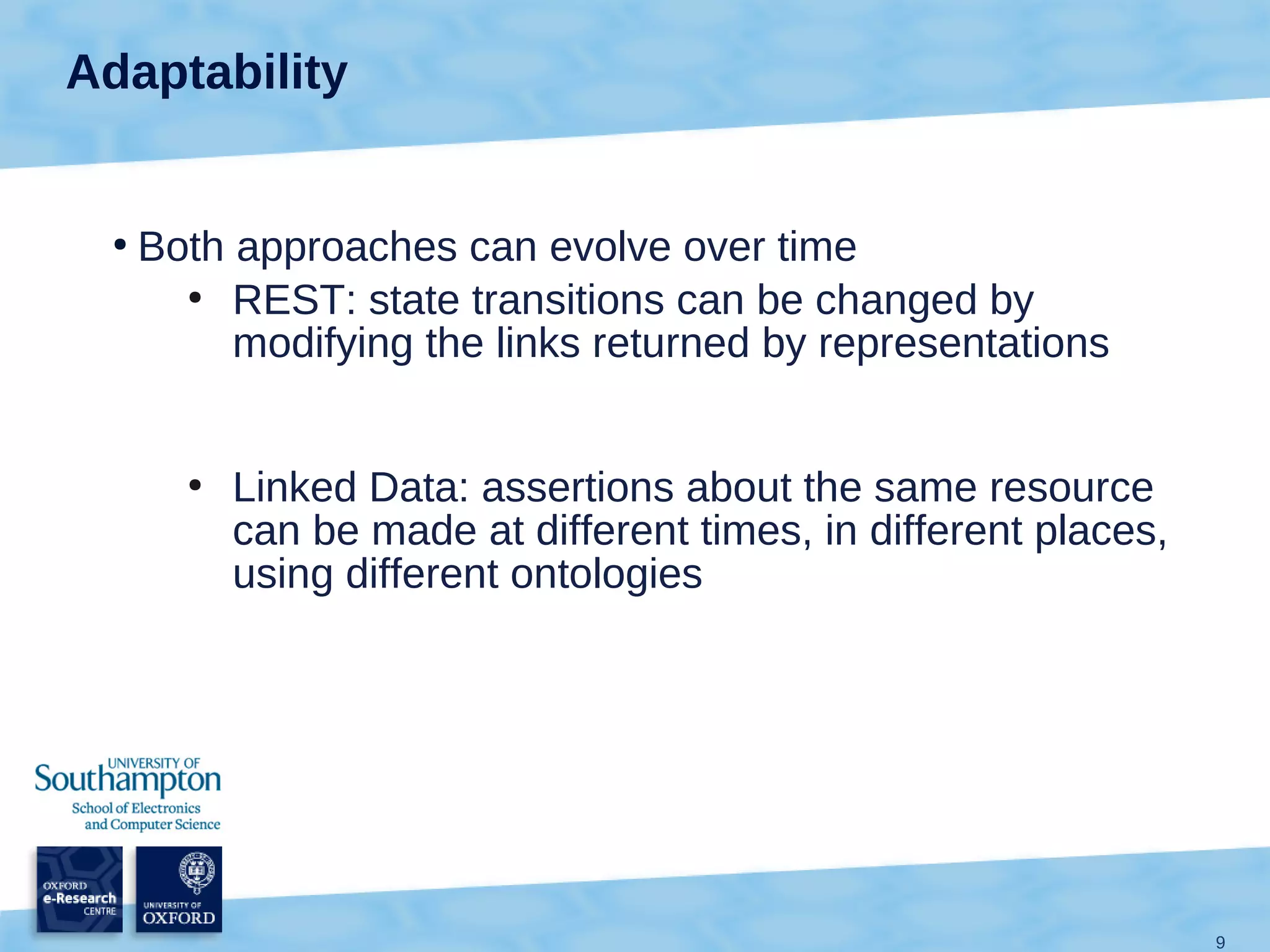
Adaptability


 ●
     Both approaches can evolve over time
       ●
          REST: state transitions can be changed by
          modifying the links returned by representations


       ●
           Linked Data: assertions about the same resource
           can be made at different times, in different places,
           using different ontologies


                                                                  9
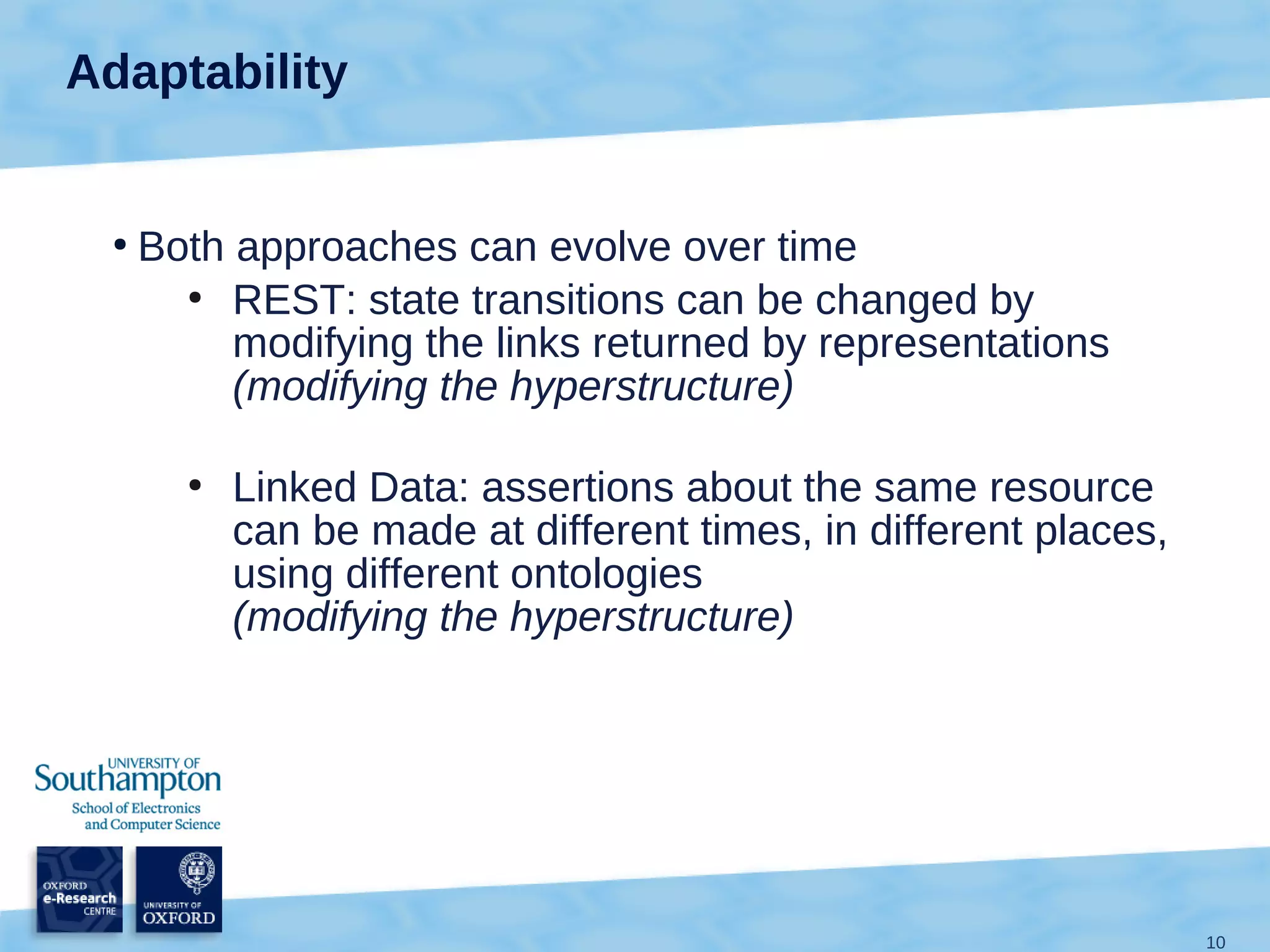
Adaptability


 ●
     Both approaches can evolve over time
       ●
          REST: state transitions can be changed by
          modifying the links returned by representations
          (modifying the hyperstructure)

       ●
           Linked Data: assertions about the same resource
           can be made at different times, in different places,
           using different ontologies
           (modifying the hyperstructure)


                                                                  10
Differences


              11
Differences or
Complementarity?


                   12
Model or API


 ●
     What purpose are the commonalities put to?
 ●
     Resources and their relationships are used to:
       ●
         REST: identify data and transition to other
         resources; the means to develop an application;
         an API
       ●
         Semantic Web: encapsulate the underlying data
         model; move to more data related using the model


                                                            13
Domain Driven Design


 ●
     Both the information model and API design are driven
     by the domain requirements
 ●
     This focusses differentiation and complexity where it
     should be: around those issues specific to the domain
       ●
          A common model can be shared between the data
          and the API


                                                             14
So...


  ●
      Are all Linked Data applications today RESTful?
  ●
      Are there lots of RESTful systems using Linked Data?


                                                             15
Tensions


 ●
     Are the remaining differences fundamental mismatches
     or artefacts of current use?
 ●
     SPARQL
 ●
     Content negotiation
       ●
         Information and non-information resources
       ●
         303 overhead


                                                            16
In Summary


 ●
     REST and Linked Data are complementary in the
     domain
 ●
     An opportunity to build powerful domain centric systems
     with a common API and data model
 ●
     Questions?


                                                               17
Acknowledgements

 Authors
   Kevin Page, David De Roure
       Oxford e-Research Centre, University of Oxford, and
       Electronics & Computer Science, University of Southampton
   Kirk Martinez
       Electronics & Computer Science, University of Southampton
 Thanks
      Colleagues from the SemsorGrid4Env, SALAMI, NEMA and
      myExperiment projects
 Funding
      European Commission IST FP7-223913 (SemsorGrid4Env)
      JISC Digitisation and e-Content, Digging into Data (SALAMI)


                                                                    18
19

REST and Linked Data: a match made for domain driven development?

  • 1.
    REST and linkeddata A match made for domain driven development? Kevin Page Oxford e-Research Centre, University of Oxford, UK Electronics & Computer Science, University of Southampton, UK WS-REST 2011, Hyderabad, 28/03/2011 1
  • 2.
    Context ● Building systems and tools for e-Science and e-Research in several domains ● All could be considered data-centric (though that's not to forget method) ● Computational musicology, Music Information Retrieval ● Geographers, oceanographers ● Scientific workflow (bioinformaticians etc.) 2
  • 3.
    Context (continued) ● Common requirements ● Structure information for the domain ● Expose data for use (and re-use) ● Have had some success with ● RESTful APIs ● Linked Data 3
  • 4.
    Context (continued) ● Common requirements: ● Structure information for the domain ● Expose data for use (and re-use) ● Have had some success with ● RESTful APIs ● Linked Data ● But not necessarily at the same time (why?) 4
  • 5.
  • 6.
    Commonalities ● The Primacy of Resources ● Identification of resources is the key abstraction in REST and RDF where it is also the means to express relationships 6
  • 7.
    Commonalities ● The Primacy of Resources ● Identification of resources is the key abstraction in REST and RDF where it is also the means to express relationships ● Linking is not optional ● Links to other URIs to discover more things (Linked Data); and as the engine of application state (REST) 7
  • 8.
    Commonalities ● The Primacy of Resources ● Identification of resources is the key abstraction in REST and RDF where it is also the means to express relationships ● Linking is not optional ● Links to other URIs to discover more things (Linked Data); and as the engine of application state (REST) ● Segregation of Semantics ● Semantics have their place (and it's not in the resource addressing/URIs) 8
  • 9.
    Adaptability ● Both approaches can evolve over time ● REST: state transitions can be changed by modifying the links returned by representations ● Linked Data: assertions about the same resource can be made at different times, in different places, using different ontologies 9
  • 10.
    Adaptability ● Both approaches can evolve over time ● REST: state transitions can be changed by modifying the links returned by representations (modifying the hyperstructure) ● Linked Data: assertions about the same resource can be made at different times, in different places, using different ontologies (modifying the hyperstructure) 10
  • 11.
  • 12.
  • 13.
    Model or API ● What purpose are the commonalities put to? ● Resources and their relationships are used to: ● REST: identify data and transition to other resources; the means to develop an application; an API ● Semantic Web: encapsulate the underlying data model; move to more data related using the model 13
  • 14.
    Domain Driven Design ● Both the information model and API design are driven by the domain requirements ● This focusses differentiation and complexity where it should be: around those issues specific to the domain ● A common model can be shared between the data and the API 14
  • 15.
    So... ● Are all Linked Data applications today RESTful? ● Are there lots of RESTful systems using Linked Data? 15
  • 16.
    Tensions ● Are the remaining differences fundamental mismatches or artefacts of current use? ● SPARQL ● Content negotiation ● Information and non-information resources ● 303 overhead 16
  • 17.
    In Summary ● REST and Linked Data are complementary in the domain ● An opportunity to build powerful domain centric systems with a common API and data model ● Questions? 17
  • 18.
    Acknowledgements Authors Kevin Page, David De Roure Oxford e-Research Centre, University of Oxford, and Electronics & Computer Science, University of Southampton Kirk Martinez Electronics & Computer Science, University of Southampton Thanks Colleagues from the SemsorGrid4Env, SALAMI, NEMA and myExperiment projects Funding European Commission IST FP7-223913 (SemsorGrid4Env) JISC Digitisation and e-Content, Digging into Data (SALAMI) 18
  • 19.