Teaching Old Services New
Tricks: Adding HATEOAS Support
        as an Afterthought
   Olga Liskin, Leif Singer, Kurt Schneider
   {olga.liskin, leif.singer, kurt.schneider}
            @inf.uni-hannover.de
                    28.03.2011
Content
    Motivation
    Main Goals
    Service Example
    Terminology
    Notation for Application Models
    Conception of Wrapper Component
    Comparison
    Conclusions & Outlook


            Teaching Old Services New Tricks – Olga Liskin, Leif Singer, Kurt Schneider   28.03.2011   2
Motivation
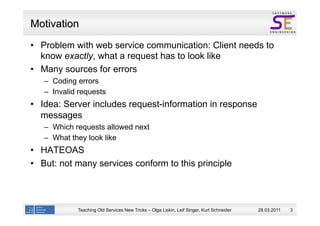
  Problem with web service communication: Client needs to
  know exactly, what a request has to look like
  Many sources for errors
  –  Coding errors
  –  Invalid requests
  Idea: Server includes request-information in response
  messages
  –  Which requests allowed next
  –  What they look like
  HATEOAS
  But: not many services conform to this principle


            Teaching Old Services New Tricks – Olga Liskin, Leif Singer, Kurt Schneider   28.03.2011   3
Motivation
Example:


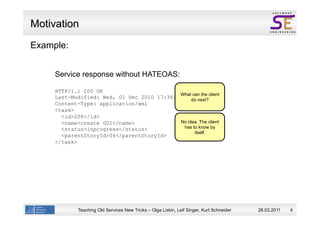
     Service response without HATEOAS:

     HTTP/1.1 200 OK
                                            What can the client
     Last-Modified: Wed, 01 Dec 2010 17:36:02 GMT next?
                                                 do
     Content-Type: application/xml
     <task>
       <id>208</id>
       <name>create GUI</name>              No idea. The client
       <status>inprogress</status>            has to know by
                                                   itself.
       <parentStoryId>04</parentStoryId>
     </task>


             Teaching Old Services New Tricks – Olga Liskin, Leif Singer, Kurt Schneider   28.03.2011   4
Motivation
Example:
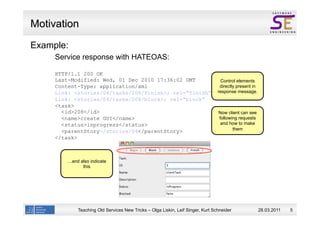
     Service response with HATEOAS:

     HTTP/1.1 200 OK
     Last-Modified: Wed, 01 Dec 2010 17:36:02 GMT                                Control elements
     Content-Type: application/xml                                               directly present in
     Link: <stories/04/tasks/208/finish>; rel=“finish”                          response message.
     Link: <stories/04/tasks/208/block>; rel=“block”
     <task>
       <id>208</id>                                                             Now client can see
       <name>create GUI</name>                                                  following requests
       <status>inprogress</status>                                               and how to make
                                                                                       them
       <parentStory>/stories/04</parentStory>
     </task>


        …and also indicate
              this


            Teaching Old Services New Tricks – Olga Liskin, Leif Singer, Kurt Schneider                28.03.2011   5
Main Goals
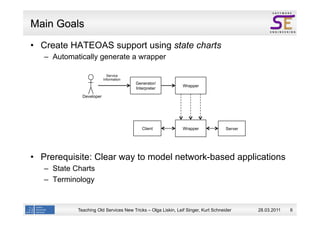
  Create HATEOAS support using state charts
  –  Automatically generate a wrapper

                           Service
                         Information
                                       Generator/
                                                              Wrapper
                                       Interpreter
             Developer


                                          Client              Wrapper              Server


  Prerequisite: Clear way to model network-based applications
  –  State Charts
  –  Terminology


           Teaching Old Services New Tricks – Olga Liskin, Leif Singer, Kurt Schneider      28.03.2011   6
Service Example
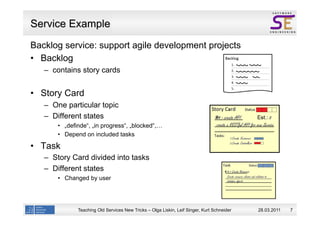
Backlog service: support agile development projects
   Backlog
   –  contains story cards


  Story Card
   –  One particular topic
   –  Different states
         „definde“, „in progress“, „blocked“,…
         Depend on included tasks

  Task
   –  Story Card divided into tasks
   –  Different states
         Changed by user


             Teaching Old Services New Tricks – Olga Liskin, Leif Singer, Kurt Schneider   28.03.2011   7
1 Modelling Network-Based
Applications

   Teaching Old Services New Tricks – Olga Liskin, Leif Singer, Kurt Schneider   28.03.2011   8
Terminology
  Valid requests depend on current application state
  What exactly is application state?

  Relevant terminology:
  –  application
         „representation of the business-aware functionality of a system“ (Fielding)
  –  resource state
         Values of a resource‘s attributes
  –  application state
         Requests, responses and the processing of those
         E.g.: „process detail view of a story card“


             Teaching Old Services New Tricks – Olga Liskin, Leif Singer, Kurt Schneider   28.03.2011   9
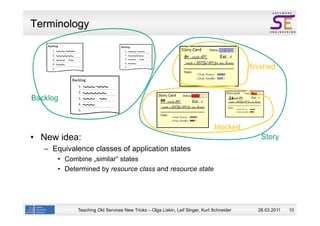
Terminology

                                                                   31

                                                                                             finished


Backlog                                                08
                                                                                        24


                                                                                 blocked
  New idea:                                                                                     Story
   –  Equivalence classes of application states
            Combine „similar“ states
            Determined by resource class and resource state


               Teaching Old Services New Tricks – Olga Liskin, Leif Singer, Kurt Schneider     28.03.2011   10
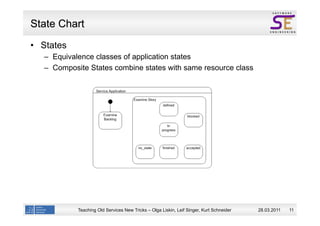
State Chart
  States
  –  Equivalence classes of application states
  –  Composite States combine states with same resource class


           Teaching Old Services New Tricks – Olga Liskin, Leif Singer, Kurt Schneider   28.03.2011   11
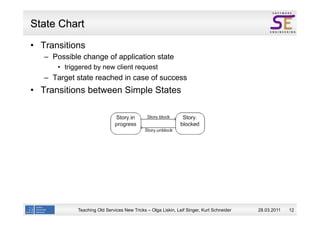
State Chart
  Transitions
  –  Possible change of application state
        triggered by new client request
  –  Target state reached in case of success
  Transitions between Simple States


            Teaching Old Services New Tricks – Olga Liskin, Leif Singer, Kurt Schneider   28.03.2011   12
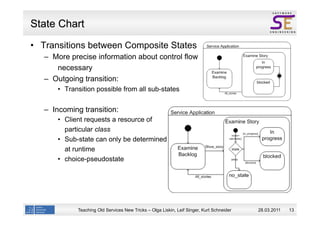
State Chart
  Transitions between Composite States
  –  More precise information about control flow
      necessary
  –  Outgoing transition:
        Transition possible from all sub-states


  –  Incoming transition:
        Client requests a resource of
        particular class
        Sub-state can only be determined
        at runtime
        choice-pseudostate


            Teaching Old Services New Tricks – Olga Liskin, Leif Singer, Kurt Schneider   28.03.2011   13
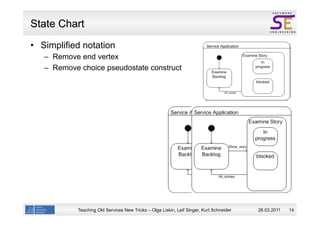
State Chart
  Simplified notation
  –  Remove end vertex
  –  Remove choice pseudostate construct


           Teaching Old Services New Tricks – Olga Liskin, Leif Singer, Kurt Schneider   28.03.2011   14
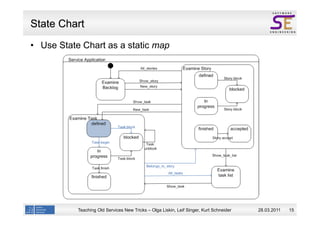
State Chart
  Use State Chart as a static map


          Teaching Old Services New Tricks – Olga Liskin, Leif Singer, Kurt Schneider   28.03.2011   15
2 Constructing A Wrapper


   Teaching Old Services New Tricks – Olga Liskin, Leif Singer, Kurt Schneider   28.03.2011   16
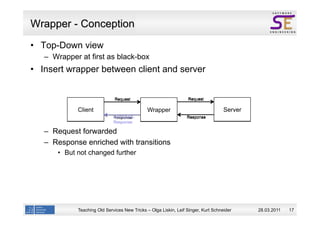
Wrapper - Conception
  Top-Down view
  –  Wrapper at first as black-box
  Insert wrapper between client and server


                             Request                             Request

            Client                           Wrapper                               Server
                             HATEOAS-
                             Response                            Response
                             Response

  –  Request forwarded
  –  Response enriched with transitions
        But not changed further


            Teaching Old Services New Tricks – Olga Liskin, Leif Singer, Kurt Schneider     28.03.2011   17
Wrapper - Conception
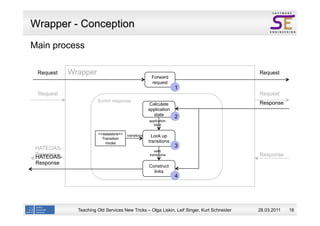
Main process

 Request    Wrapper                                                                         Request
                                                      Forward
                                                      request
                                                                   1
 Request                                                                                    Request
                       Enrich response                                                      Response
                                                      Calculate
                                                     application
                                                        state      2
                                                     application
                                                       state

                       <<datastore>>   transitions     Look up
                         Transition
                           model                     transitions
 HATEOAS-                                                          3
                                                        valid
 Response
 HATEOAS-                                            transitions                            Response
 Response
                                                     Construct
                                                       links
                                                                   4


              Teaching Old Services New Tricks – Olga Liskin, Leif Singer, Kurt Schneider   28.03.2011   18
Wrapper - Concrete Process Steps
Full process cycle
    HTTP/1.1 200 OK 	
  
    Last-Modified: Wed, 01 Dec 2010 	
  
                                           Local-name(/*[1]) = task
    Content-Type: application/xml	
        /task/status/text() = defined
    <task>	
  
      <id>04</id>	
  
      <name>Update Database</name>	
  
      <status>defined</status>	
  
      <parentStory>08</parentStory>	
  
    </task>


     HTTP/1.1 200 OK 	
                                                                                /task/id/text() = 04
     Last-Modified: Wed, 01 Dec 2010 	
                                          URI-Templates         /task/parentStory/text() = 08
     Content-Type: application/xml
     Link: </stories/08/tasks/04/block>;rel=”Task.block”
     Link: </stories/08/tasks/04/begin>;rel=”Task.begin”
     Link: </stories/08/tasks>; rel=”Task.allTasks”
     Link: </stories/08>; rel=”belongs_to_story”
                                                                           Task.block:    </stories/08/tasks/04/block>
     <task>	
  
                                                                           Task.begin:     </stories/08/tasks/04/begin>
       <id>04</id>	
                                                       Task.allTasks:    </stories/08/tasks>
       <name>Update Database</name>	
                                      Belongs_To_Story: </stories/08>
       <status>defined</status>	
  
       <parentStory>08</parentStory>	
  
     </task>


                  Teaching Old Services New Tricks – Olga Liskin, Leif Singer, Kurt Schneider                     28.03.2011           19
Comparison
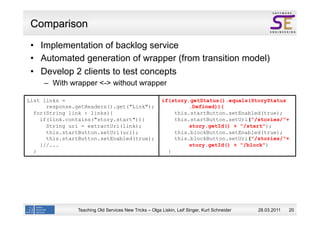
    Implementation of backlog service
    Automated generation of wrapper (from transition model)
    Develop 2 clients to test concepts
     –  With wrapper <-> without wrapper

List links =                                           if(story.getStatus().equals(StoryStatus
      response.getHeaders().get("Link");                        .Defined)){
  for(String link : links){                                this.startButton.setEnabled(true);
    if(link.contains("story.start")){                      this.startButton.setUri("/stories/"+
      String uri = extractUri(link);                            story.getId() + "/start");
      this.startButton.setUri(uri);                        this.blockButton.setEnabled(true);
      this.startButton.setEnabled(true);                   this.blockButton.setUri("/stories/"+
    }//...                                                      story.getId() + "/block")
  }                                                      }


               Teaching Old Services New Tricks – Olga Liskin, Leif Singer, Kurt Schneider   28.03.2011   20
Conclusions
  Creation of theoretical concepts
  Development of wrapper process
  Check the concept

  Is working
  Generic
  Improves development and maintainance of clients

  Errors in model lead to invalid/missing links
  Input data is complex


           Teaching Old Services New Tricks – Olga Liskin, Leif Singer, Kurt Schneider   28.03.2011   21
Outlook
  Further research on input of data
  –  Project environment
  –  Interface descriptions (e.g. WADL) as additional source
  Allow changes of whole service API
  –  Can improve more REST aspects
  Use state charts for creation of services (not only wrappers)


            Teaching Old Services New Tricks – Olga Liskin, Leif Singer, Kurt Schneider   28.03.2011   22
Content
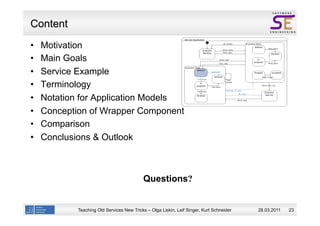
    Motivation
    Main Goals
    Service Example
    Terminology
    Notation for Application Models
    Conception of Wrapper Component
    Comparison
    Conclusions & Outlook


                                           Questions?


            Teaching Old Services New Tricks – Olga Liskin, Leif Singer, Kurt Schneider   28.03.2011   23

Teaching Old Services New Tricks: Adding HATEOAS Support as an Afterthought

  • 1.
    Teaching Old ServicesNew Tricks: Adding HATEOAS Support as an Afterthought Olga Liskin, Leif Singer, Kurt Schneider {olga.liskin, leif.singer, kurt.schneider} @inf.uni-hannover.de 28.03.2011
  • 2.
    Content   Motivation   Main Goals   Service Example   Terminology   Notation for Application Models   Conception of Wrapper Component   Comparison   Conclusions & Outlook Teaching Old Services New Tricks – Olga Liskin, Leif Singer, Kurt Schneider 28.03.2011 2
  • 3.
    Motivation   Problem withweb service communication: Client needs to know exactly, what a request has to look like   Many sources for errors –  Coding errors –  Invalid requests   Idea: Server includes request-information in response messages –  Which requests allowed next –  What they look like   HATEOAS   But: not many services conform to this principle Teaching Old Services New Tricks – Olga Liskin, Leif Singer, Kurt Schneider 28.03.2011 3
  • 4.
    Motivation Example: Service response without HATEOAS: HTTP/1.1 200 OK What can the client Last-Modified: Wed, 01 Dec 2010 17:36:02 GMT next? do Content-Type: application/xml <task> <id>208</id> <name>create GUI</name> No idea. The client <status>inprogress</status> has to know by itself. <parentStoryId>04</parentStoryId> </task> Teaching Old Services New Tricks – Olga Liskin, Leif Singer, Kurt Schneider 28.03.2011 4
  • 5.
    Motivation Example: Service response with HATEOAS: HTTP/1.1 200 OK Last-Modified: Wed, 01 Dec 2010 17:36:02 GMT Control elements Content-Type: application/xml directly present in Link: <stories/04/tasks/208/finish>; rel=“finish” response message. Link: <stories/04/tasks/208/block>; rel=“block” <task> <id>208</id> Now client can see <name>create GUI</name> following requests <status>inprogress</status> and how to make them <parentStory>/stories/04</parentStory> </task> …and also indicate this Teaching Old Services New Tricks – Olga Liskin, Leif Singer, Kurt Schneider 28.03.2011 5
  • 6.
    Main Goals   CreateHATEOAS support using state charts –  Automatically generate a wrapper Service Information Generator/ Wrapper Interpreter Developer Client Wrapper Server   Prerequisite: Clear way to model network-based applications –  State Charts –  Terminology Teaching Old Services New Tricks – Olga Liskin, Leif Singer, Kurt Schneider 28.03.2011 6
  • 7.
    Service Example Backlog service:support agile development projects   Backlog –  contains story cards   Story Card –  One particular topic –  Different states   „definde“, „in progress“, „blocked“,…   Depend on included tasks   Task –  Story Card divided into tasks –  Different states   Changed by user Teaching Old Services New Tricks – Olga Liskin, Leif Singer, Kurt Schneider 28.03.2011 7
  • 8.
    1 Modelling Network-Based Applications Teaching Old Services New Tricks – Olga Liskin, Leif Singer, Kurt Schneider 28.03.2011 8
  • 9.
    Terminology   Valid requestsdepend on current application state   What exactly is application state?   Relevant terminology: –  application   „representation of the business-aware functionality of a system“ (Fielding) –  resource state   Values of a resource‘s attributes –  application state   Requests, responses and the processing of those   E.g.: „process detail view of a story card“ Teaching Old Services New Tricks – Olga Liskin, Leif Singer, Kurt Schneider 28.03.2011 9
  • 10.
    Terminology 31 finished Backlog 08 24 blocked   New idea: Story –  Equivalence classes of application states   Combine „similar“ states   Determined by resource class and resource state Teaching Old Services New Tricks – Olga Liskin, Leif Singer, Kurt Schneider 28.03.2011 10
  • 11.
    State Chart   States –  Equivalence classes of application states –  Composite States combine states with same resource class Teaching Old Services New Tricks – Olga Liskin, Leif Singer, Kurt Schneider 28.03.2011 11
  • 12.
    State Chart   Transitions –  Possible change of application state   triggered by new client request –  Target state reached in case of success   Transitions between Simple States Teaching Old Services New Tricks – Olga Liskin, Leif Singer, Kurt Schneider 28.03.2011 12
  • 13.
    State Chart   Transitionsbetween Composite States –  More precise information about control flow necessary –  Outgoing transition:   Transition possible from all sub-states –  Incoming transition:   Client requests a resource of particular class   Sub-state can only be determined at runtime   choice-pseudostate Teaching Old Services New Tricks – Olga Liskin, Leif Singer, Kurt Schneider 28.03.2011 13
  • 14.
    State Chart   Simplifiednotation –  Remove end vertex –  Remove choice pseudostate construct Teaching Old Services New Tricks – Olga Liskin, Leif Singer, Kurt Schneider 28.03.2011 14
  • 15.
    State Chart   UseState Chart as a static map Teaching Old Services New Tricks – Olga Liskin, Leif Singer, Kurt Schneider 28.03.2011 15
  • 16.
    2 Constructing AWrapper Teaching Old Services New Tricks – Olga Liskin, Leif Singer, Kurt Schneider 28.03.2011 16
  • 17.
    Wrapper - Conception  Top-Down view –  Wrapper at first as black-box   Insert wrapper between client and server Request Request Client Wrapper Server HATEOAS- Response Response Response –  Request forwarded –  Response enriched with transitions   But not changed further Teaching Old Services New Tricks – Olga Liskin, Leif Singer, Kurt Schneider 28.03.2011 17
  • 18.
    Wrapper - Conception Mainprocess Request Wrapper Request Forward request 1 Request Request Enrich response Response Calculate application state 2 application state <<datastore>> transitions Look up Transition model transitions HATEOAS- 3 valid Response HATEOAS- transitions Response Response Construct links 4 Teaching Old Services New Tricks – Olga Liskin, Leif Singer, Kurt Schneider 28.03.2011 18
  • 19.
    Wrapper - ConcreteProcess Steps Full process cycle HTTP/1.1 200 OK   Last-Modified: Wed, 01 Dec 2010   Local-name(/*[1]) = task Content-Type: application/xml   /task/status/text() = defined <task>   <id>04</id>   <name>Update Database</name>   <status>defined</status>   <parentStory>08</parentStory>   </task> HTTP/1.1 200 OK   /task/id/text() = 04 Last-Modified: Wed, 01 Dec 2010   URI-Templates /task/parentStory/text() = 08 Content-Type: application/xml Link: </stories/08/tasks/04/block>;rel=”Task.block” Link: </stories/08/tasks/04/begin>;rel=”Task.begin” Link: </stories/08/tasks>; rel=”Task.allTasks” Link: </stories/08>; rel=”belongs_to_story” Task.block: </stories/08/tasks/04/block> <task>   Task.begin: </stories/08/tasks/04/begin> <id>04</id>   Task.allTasks: </stories/08/tasks> <name>Update Database</name>   Belongs_To_Story: </stories/08> <status>defined</status>   <parentStory>08</parentStory>   </task> Teaching Old Services New Tricks – Olga Liskin, Leif Singer, Kurt Schneider 28.03.2011 19
  • 20.
    Comparison  Implementation of backlog service   Automated generation of wrapper (from transition model)   Develop 2 clients to test concepts –  With wrapper <-> without wrapper List links = if(story.getStatus().equals(StoryStatus response.getHeaders().get("Link"); .Defined)){ for(String link : links){ this.startButton.setEnabled(true); if(link.contains("story.start")){ this.startButton.setUri("/stories/"+ String uri = extractUri(link); story.getId() + "/start"); this.startButton.setUri(uri); this.blockButton.setEnabled(true); this.startButton.setEnabled(true); this.blockButton.setUri("/stories/"+ }//... story.getId() + "/block") } } Teaching Old Services New Tricks – Olga Liskin, Leif Singer, Kurt Schneider 28.03.2011 20
  • 21.
    Conclusions   Creation oftheoretical concepts   Development of wrapper process   Check the concept   Is working   Generic   Improves development and maintainance of clients   Errors in model lead to invalid/missing links   Input data is complex Teaching Old Services New Tricks – Olga Liskin, Leif Singer, Kurt Schneider 28.03.2011 21
  • 22.
    Outlook   Further researchon input of data –  Project environment –  Interface descriptions (e.g. WADL) as additional source   Allow changes of whole service API –  Can improve more REST aspects   Use state charts for creation of services (not only wrappers) Teaching Old Services New Tricks – Olga Liskin, Leif Singer, Kurt Schneider 28.03.2011 22
  • 23.
    Content   Motivation   Main Goals   Service Example   Terminology   Notation for Application Models   Conception of Wrapper Component   Comparison   Conclusions & Outlook Questions? Teaching Old Services New Tricks – Olga Liskin, Leif Singer, Kurt Schneider 28.03.2011 23