Fulfilling the Hypermedia Constraint
Via HTTP OPTIONS, the HTTP
Vocabulary In RDF, And Link Headers
Second International Workshop on RESTful Design
WWW 2011, 28 March 2011, Hyderabad, India

Thomas Steiner, @tomayac
Google Germany GmbH, Universitat Politècnica de Catalunya

Jan Algermissen, @algermissen
NORD Software Consulting
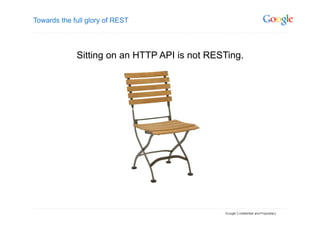
Towards the full glory of REST


             Sitting on an HTTP API is not RESTing.
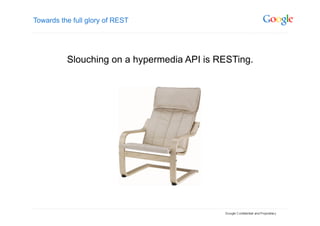
Towards the full glory of REST


          Slouching on a hypermedia API is RESTing.
Towards the full glory of REST


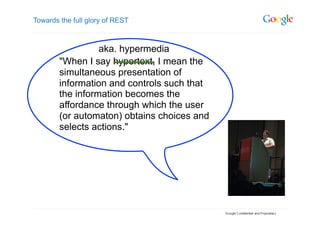
                  aka. hypermedia
        "When I say hypertext, I mean the
        simultaneous presentation of
        information and controls such that
        the information becomes the
        affordance through which the user
        (or automaton) obtains choices and
        selects actions."
Towards the full glory of REST


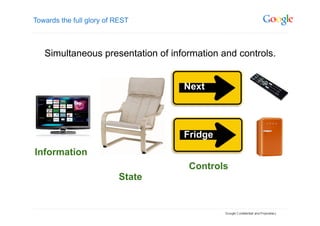
   Simultaneous presentation of information and controls.


                                   Next


                                   Fridge
Information
                                    Controls
                          State
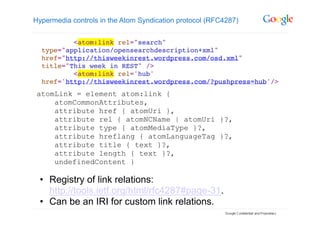
Hypermedia controls in the Atom Syndication protocol (RFC4287)


 atomLink = element atom:link {
     atomCommonAttributes,
     attribute href { atomUri },
     attribute rel { atomNCName | atomUri }?,
     attribute type { atomMediaType }?,
     attribute hreflang { atomLanguageTag }?,
     attribute title { text }?,
     attribute length { text }?,
     undefinedContent }

 •  Registry of link relations:
    http://tools.ietf.org/html/rfc4287#page-31.
 •  Can be an IRI for custom link relations.
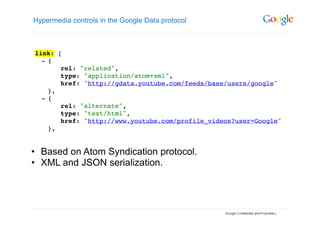
Hypermedia controls in the Google Data protocol


•  Based on Atom Syndication protocol.
•  XML and JSON serialization.
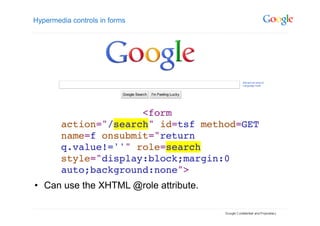
Hypermedia controls in forms


•  Can use the XHTML @role attribute.
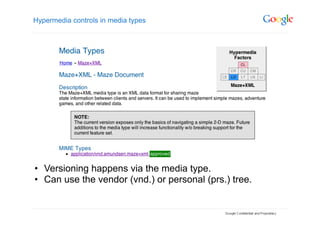
Hypermedia controls in media types


•  Versioning happens via the media type.
•  Can use the vendor (vnd.) or personal (prs.) tree.
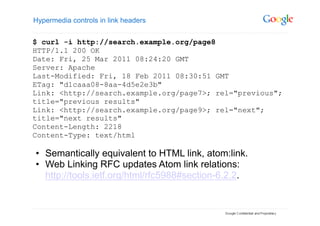
Hypermedia controls in link headers


$ curl -i http://search.example.org/page8
HTTP/1.1 200 OK
Date: Fri, 25 Mar 2011 08:24:20 GMT
Server: Apache
Last-Modified: Fri, 18 Feb 2011 08:30:51 GMT
ETag: "d1caaa08-8aa-4d5e2e3b"
Link: <http://search.example.org/page7>; rel="previous";
title="previous results"
Link: <http://search.example.org/page9>; rel="next";
title="next results"
Content-Length: 2218
Content-Type: text/html

•  Semantically equivalent to HTML link, atom:link.
•  Web Linking RFC updates Atom link relations:
   http://tools.ietf.org/html/rfc5988#section-6.2.2.
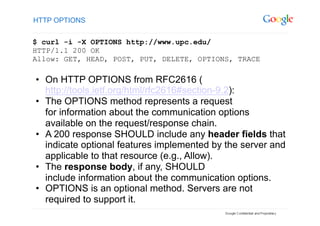
HTTP OPTIONS


$ curl -i -X OPTIONS http://www.upc.edu/
HTTP/1.1 200 OK
Allow: GET, HEAD, POST, PUT, DELETE, OPTIONS, TRACE

•  On HTTP OPTIONS from RFC2616 (
   http://tools.ietf.org/html/rfc2616#section-9.2):
•  The OPTIONS method represents a request
   for information about the communication options
   available on the request/response chain.
•  A 200 response SHOULD include any header fields that
   indicate optional features implemented by the server and
   applicable to that resource (e.g., Allow).
•  The response body, if any, SHOULD
   include information about the communication options.
•  OPTIONS is an optional method. Servers are not
   required to support it.
Building the bridge to Linked Data


•  Atom, Google Data, HTML Link, XHTML @role, Link
   headers can use extension relation types via URIs†.
•  With Linked Data, when you have some of it, you can find
   other, related, data.
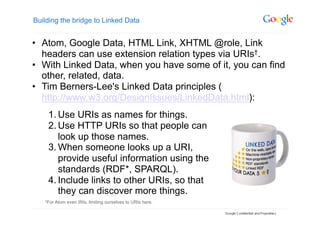
•  Tim Berners-Lee's Linked Data principles (
   http://www.w3.org/DesignIssues/LinkedData.html):
    1. Use URIs as names for things.
    2. Use HTTP URIs so that people can
       look up those names.
    3. When someone looks up a URI,
       provide useful information using the
       standards (RDF*, SPARQL).
    4. Include links to other URIs, so that
       they can discover more things.
   †For   Atom even IRIs, limiting ourselves to URIs here.
Modeling HTTP in RDF


•  HTTP Vocabulary in RDF intended to record HTTP(S)
   request and response messages, including the various
   headers (http://www.w3.org/TR/HTTP-in-RDF10/).

$ curl -H "Accept: text/turtle" http://dbpedia.org

_:req a http:Request ;
  http:httpVersion "1.1" ;
  http:methodName "GET" ;
  http:mthd <http://www.w3.org/2008/http-methods#GET> ;
  http:headers (
    [ http:fieldName "Host" ;
      http:fieldValue "dbpedia.org" ;
      http:hdrName <[…]w3.org/2008/http-header#host> ]
    [ http:fieldName "Accept" ;
      http:fieldValue "text/turtle" ;
      http:hdrName <[…]w3.org/2008/http-header#accept> ]
  ) .
Bringing it all together


1. Link headers to transparently inject data into an HTTP
   response without touching the body.
2. HTTP OPTIONS as a means of requesting communication
   options information.
3. HTTP Vocabulary in RDF for modeling HTTP
   communication.

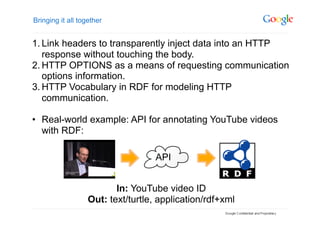
•  Real-world example: API for annotating YouTube videos
   with RDF:

                                    API


                          In: YouTube video ID
                   Out: text/turtle, application/rdf+xml
Bringing it all together


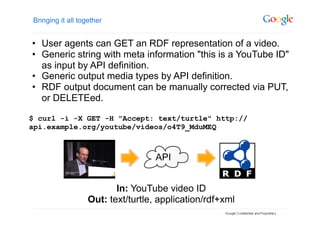
•  User agents can GET an RDF representation of a video.
•  Generic string with meta information "this is a YouTube ID"
   as input by API definition.
•  Generic output media types by API definition.
•  RDF output document can be manually corrected via PUT,
   or DELETEed.

$ curl -i -X GET -H "Accept: text/turtle" http://
api.example.org/youtube/videos/o4T9_MduMEQ


                                    API


                          In: YouTube video ID
                   Out: text/turtle, application/rdf+xml
Bringing it all together


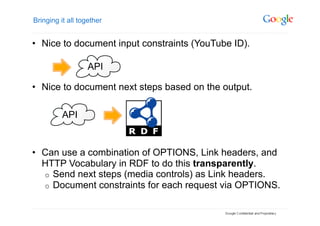
•  Nice to document input constraints (YouTube ID).

                   API

•  Nice to document next steps based on the output.

          API


•  Can use a combination of OPTIONS, Link headers, and
   HTTP Vocabulary in RDF to do this transparently.
   o  Send next steps (media controls) as Link headers.
   o  Document constraints for each request via OPTIONS.
Bringing it all together

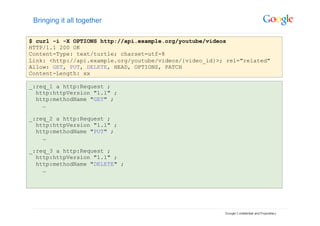
$ curl -i -X OPTIONS http://api.example.org/youtube/videos
HTTP/1.1 200 OK
Content-Type: text/turtle; charset=utf-8
Link: <http://api.example.org/youtube/videos/{video_id}>; rel="related"
Allow: GET, PUT, DELETE, HEAD, OPTIONS, PATCH
Content-Length: xx

_:req_1 a http:Request ;
  http:httpVersion "1.1" ;
  http:methodName "GET" ;
    …

_:req_2 a http:Request ;
  http:httpVersion "1.1" ;
  http:methodName "PUT" ;
    …

_:req_3 a http:Request ;
  http:httpVersion "1.1" ;
  http:methodName "DELETE" ;
    …
Bringing it all together

$ curl -i -X OPTIONS http://api.example.org/youtube/videos
…
Link: <http://api.example.org/youtube/videos/{video_id}>; rel="related"
Allow: GET, HEAD, PUT, DELETE, OPTIONS, PATCH
…


_:req_1 a http:Request ;
  http:httpVersion "1.1" ;
  http:methodName "GET" ;
  http:mthd <http://www.w3.org/2008/http-methods#GET> ;
  exHttp:prefixPath "/youtube/" ;
  exHttp:suffixPath [
    a api:uriTemplate ;
    a yt:videoid ;
  ] ;
  http:headers (
    [ http:fieldName "Host" ;
      http:fieldValue "api.example.org" ;
      http:hdrName <http://www.w3.org/2008/http-header#host>
    ]
  ) .
Bringing it all together

_:req_1 a http:Request ;
  http:httpVersion "1.1" ;
  http:methodName "GET" ;
  http:mthd <http://www.w3.org/2008/http-methods#GET> ;
  exHttp:prefixPath "/youtube/" ;
  exHttp:suffixPath [
    a api:uriTemplate ;
    a yt:videoid ;
  ] ;
  http:headers (
    [ http:fieldName "Host" ;
      http:fieldValue "api.example.org" ;
      http:hdrName <http://www.w3.org/2008/http-header#host>
    ]
  ) .

exHttp: Suggested extension of the HTTP Vocabulary in
RDF for splitting http:abs_path (/foo/bar) in
exHttp:prefixPath (/foo) and exHttp:suffixPath
(/bar).
Bringing it all together

_:req_1 a http:Request ;
  http:httpVersion "1.1" ;
  http:methodName "GET" ;
  http:mthd <http://www.w3.org/2008/http-methods#GET> ;
  exHttp:prefixPath "/youtube/" ;
  exHttp:suffixPath [
    a api:uriTemplate ;
    a yt:videoid ;
  ] ;
  http:headers (
    [ http:fieldName "Host" ;
      http:fieldValue "api.example.org" ;
      http:hdrName <http://www.w3.org/2008/http-header#host>
    ]
  ) .

api:uriTemplate: Borrowed from
http://purl.org/linked-data/api/vocab# in order to model URI
templates.
Bringing it all together

_:req_1 a http:Request ;
  http:httpVersion "1.1" ;
  http:methodName "GET" ;
  http:mthd <http://www.w3.org/2008/http-methods#GET> ;
  exHttp:prefixPath "/youtube/" ;
  exHttp:suffixPath [
    a api:uriTemplate ;
    a yt:videoid ;
  ] ;
  http:headers (
    [ http:fieldName "Host" ;
      http:fieldValue "api.example.org" ;
      http:hdrName <http://www.w3.org/2008/http-header#host>
    ]
  ) .

yt:videoid: Defines the URI template to be a YouTube
video ID (http://gdata.youtube.com/schemas/2007/videoid).
Criticism


•  The approach might encourage tight coupling. Evil?
   Depends. Might be OK if user agents evaluate their
   OPTIONS at runtime.
•  HTTP Vocabulary in RDF might be too verbose, but it's a
   standard, and usually a bad standard is better than no
   standard.
•  Total freedom (=chaos?) with regards to the RDF triples.
   Fair enough. However, extension relation types via URLs
   require human interaction as well.
Thanks for your attention


•  Thomas Steiner
    o  tomac@google.com
    o  @tomayac
Image credits

Lawn chair - http://www.cp-objekt.de/hundemoebel/Klappstuhl-Montana-st-426710-gr.jpg
Poäng - http://www.ikea.com/au/en/catalog/products/10157948
Roy Fielding - http://upload.wikimedia.org/wikipedia/commons/thumb/c/cd/Roy_Fielding.jpg/450px-Roy_Fielding.jpg
Direction sign - http://www.myparkingsign.com/img/lg/X/One-Direction-Arrow-Sign-X-W1-6L.gif
Remote control - http://www.faqs.org/photo-dict/photofiles/list/824/1251remote_control.jpg
LCD TV - http://www.slashgear.com/wp-content/uploads/2009/02/philips_nettv-480x370.jpg
Fridge - http://modculture.typepad.com/photos/uncategorized/2008/06/13/smeg_mini.jpg
Linked Data mug - http://www.w3.org/DesignIssues/diagrams/lod/480759174v0_350x350_Back.jpg
Cloud - http://www.clipart.clipartist.net/openclipart/clipart/signs_and_symbols/weather/w_cloud_xxl.png
Dr. Evil - http://upload.wikimedia.org/wikipedia/en/1/16/Drevil_million_dollars.jpg


                                                                        Fridge

Fulfilling the Hypermedia Constraint via HTTP OPTIONS, The HTTP Vocabulary In RDF, And Link Headers

  • 1.
    Fulfilling the HypermediaConstraint Via HTTP OPTIONS, the HTTP Vocabulary In RDF, And Link Headers Second International Workshop on RESTful Design WWW 2011, 28 March 2011, Hyderabad, India Thomas Steiner, @tomayac Google Germany GmbH, Universitat Politècnica de Catalunya Jan Algermissen, @algermissen NORD Software Consulting
  • 2.
    Towards the fullglory of REST Sitting on an HTTP API is not RESTing.
  • 3.
    Towards the fullglory of REST Slouching on a hypermedia API is RESTing.
  • 4.
    Towards the fullglory of REST aka. hypermedia "When I say hypertext, I mean the simultaneous presentation of information and controls such that the information becomes the affordance through which the user (or automaton) obtains choices and selects actions."
  • 5.
    Towards the fullglory of REST Simultaneous presentation of information and controls. Next Fridge Information Controls State
  • 6.
    Hypermedia controls inthe Atom Syndication protocol (RFC4287) atomLink = element atom:link { atomCommonAttributes, attribute href { atomUri }, attribute rel { atomNCName | atomUri }?, attribute type { atomMediaType }?, attribute hreflang { atomLanguageTag }?, attribute title { text }?, attribute length { text }?, undefinedContent } •  Registry of link relations: http://tools.ietf.org/html/rfc4287#page-31. •  Can be an IRI for custom link relations.
  • 7.
    Hypermedia controls inthe Google Data protocol •  Based on Atom Syndication protocol. •  XML and JSON serialization.
  • 8.
    Hypermedia controls informs •  Can use the XHTML @role attribute.
  • 9.
    Hypermedia controls inmedia types •  Versioning happens via the media type. •  Can use the vendor (vnd.) or personal (prs.) tree.
  • 10.
    Hypermedia controls inlink headers $ curl -i http://search.example.org/page8 HTTP/1.1 200 OK Date: Fri, 25 Mar 2011 08:24:20 GMT Server: Apache Last-Modified: Fri, 18 Feb 2011 08:30:51 GMT ETag: "d1caaa08-8aa-4d5e2e3b" Link: <http://search.example.org/page7>; rel="previous"; title="previous results" Link: <http://search.example.org/page9>; rel="next"; title="next results" Content-Length: 2218 Content-Type: text/html •  Semantically equivalent to HTML link, atom:link. •  Web Linking RFC updates Atom link relations: http://tools.ietf.org/html/rfc5988#section-6.2.2.
  • 11.
    HTTP OPTIONS $ curl-i -X OPTIONS http://www.upc.edu/ HTTP/1.1 200 OK Allow: GET, HEAD, POST, PUT, DELETE, OPTIONS, TRACE •  On HTTP OPTIONS from RFC2616 ( http://tools.ietf.org/html/rfc2616#section-9.2): •  The OPTIONS method represents a request for information about the communication options available on the request/response chain. •  A 200 response SHOULD include any header fields that indicate optional features implemented by the server and applicable to that resource (e.g., Allow). •  The response body, if any, SHOULD include information about the communication options. •  OPTIONS is an optional method. Servers are not required to support it.
  • 12.
    Building the bridgeto Linked Data •  Atom, Google Data, HTML Link, XHTML @role, Link headers can use extension relation types via URIs†. •  With Linked Data, when you have some of it, you can find other, related, data. •  Tim Berners-Lee's Linked Data principles ( http://www.w3.org/DesignIssues/LinkedData.html): 1. Use URIs as names for things. 2. Use HTTP URIs so that people can look up those names. 3. When someone looks up a URI, provide useful information using the standards (RDF*, SPARQL). 4. Include links to other URIs, so that they can discover more things. †For Atom even IRIs, limiting ourselves to URIs here.
  • 13.
    Modeling HTTP inRDF •  HTTP Vocabulary in RDF intended to record HTTP(S) request and response messages, including the various headers (http://www.w3.org/TR/HTTP-in-RDF10/). $ curl -H "Accept: text/turtle" http://dbpedia.org _:req a http:Request ; http:httpVersion "1.1" ; http:methodName "GET" ; http:mthd <http://www.w3.org/2008/http-methods#GET> ; http:headers ( [ http:fieldName "Host" ; http:fieldValue "dbpedia.org" ; http:hdrName <[…]w3.org/2008/http-header#host> ] [ http:fieldName "Accept" ; http:fieldValue "text/turtle" ; http:hdrName <[…]w3.org/2008/http-header#accept> ] ) .
  • 14.
    Bringing it alltogether 1. Link headers to transparently inject data into an HTTP response without touching the body. 2. HTTP OPTIONS as a means of requesting communication options information. 3. HTTP Vocabulary in RDF for modeling HTTP communication. •  Real-world example: API for annotating YouTube videos with RDF: API In: YouTube video ID Out: text/turtle, application/rdf+xml
  • 15.
    Bringing it alltogether •  User agents can GET an RDF representation of a video. •  Generic string with meta information "this is a YouTube ID" as input by API definition. •  Generic output media types by API definition. •  RDF output document can be manually corrected via PUT, or DELETEed. $ curl -i -X GET -H "Accept: text/turtle" http:// api.example.org/youtube/videos/o4T9_MduMEQ API In: YouTube video ID Out: text/turtle, application/rdf+xml
  • 16.
    Bringing it alltogether •  Nice to document input constraints (YouTube ID). API •  Nice to document next steps based on the output. API •  Can use a combination of OPTIONS, Link headers, and HTTP Vocabulary in RDF to do this transparently. o  Send next steps (media controls) as Link headers. o  Document constraints for each request via OPTIONS.
  • 17.
    Bringing it alltogether $ curl -i -X OPTIONS http://api.example.org/youtube/videos HTTP/1.1 200 OK Content-Type: text/turtle; charset=utf-8 Link: <http://api.example.org/youtube/videos/{video_id}>; rel="related" Allow: GET, PUT, DELETE, HEAD, OPTIONS, PATCH Content-Length: xx _:req_1 a http:Request ; http:httpVersion "1.1" ; http:methodName "GET" ; … _:req_2 a http:Request ; http:httpVersion "1.1" ; http:methodName "PUT" ; … _:req_3 a http:Request ; http:httpVersion "1.1" ; http:methodName "DELETE" ; …
  • 18.
    Bringing it alltogether $ curl -i -X OPTIONS http://api.example.org/youtube/videos … Link: <http://api.example.org/youtube/videos/{video_id}>; rel="related" Allow: GET, HEAD, PUT, DELETE, OPTIONS, PATCH … _:req_1 a http:Request ; http:httpVersion "1.1" ; http:methodName "GET" ; http:mthd <http://www.w3.org/2008/http-methods#GET> ; exHttp:prefixPath "/youtube/" ; exHttp:suffixPath [ a api:uriTemplate ; a yt:videoid ; ] ; http:headers ( [ http:fieldName "Host" ; http:fieldValue "api.example.org" ; http:hdrName <http://www.w3.org/2008/http-header#host> ] ) .
  • 19.
    Bringing it alltogether _:req_1 a http:Request ; http:httpVersion "1.1" ; http:methodName "GET" ; http:mthd <http://www.w3.org/2008/http-methods#GET> ; exHttp:prefixPath "/youtube/" ; exHttp:suffixPath [ a api:uriTemplate ; a yt:videoid ; ] ; http:headers ( [ http:fieldName "Host" ; http:fieldValue "api.example.org" ; http:hdrName <http://www.w3.org/2008/http-header#host> ] ) . exHttp: Suggested extension of the HTTP Vocabulary in RDF for splitting http:abs_path (/foo/bar) in exHttp:prefixPath (/foo) and exHttp:suffixPath (/bar).
  • 20.
    Bringing it alltogether _:req_1 a http:Request ; http:httpVersion "1.1" ; http:methodName "GET" ; http:mthd <http://www.w3.org/2008/http-methods#GET> ; exHttp:prefixPath "/youtube/" ; exHttp:suffixPath [ a api:uriTemplate ; a yt:videoid ; ] ; http:headers ( [ http:fieldName "Host" ; http:fieldValue "api.example.org" ; http:hdrName <http://www.w3.org/2008/http-header#host> ] ) . api:uriTemplate: Borrowed from http://purl.org/linked-data/api/vocab# in order to model URI templates.
  • 21.
    Bringing it alltogether _:req_1 a http:Request ; http:httpVersion "1.1" ; http:methodName "GET" ; http:mthd <http://www.w3.org/2008/http-methods#GET> ; exHttp:prefixPath "/youtube/" ; exHttp:suffixPath [ a api:uriTemplate ; a yt:videoid ; ] ; http:headers ( [ http:fieldName "Host" ; http:fieldValue "api.example.org" ; http:hdrName <http://www.w3.org/2008/http-header#host> ] ) . yt:videoid: Defines the URI template to be a YouTube video ID (http://gdata.youtube.com/schemas/2007/videoid).
  • 22.
    Criticism •  The approachmight encourage tight coupling. Evil? Depends. Might be OK if user agents evaluate their OPTIONS at runtime. •  HTTP Vocabulary in RDF might be too verbose, but it's a standard, and usually a bad standard is better than no standard. •  Total freedom (=chaos?) with regards to the RDF triples. Fair enough. However, extension relation types via URLs require human interaction as well.
  • 23.
    Thanks for yourattention •  Thomas Steiner o  tomac@google.com o  @tomayac
  • 24.
    Image credits Lawn chair- http://www.cp-objekt.de/hundemoebel/Klappstuhl-Montana-st-426710-gr.jpg Poäng - http://www.ikea.com/au/en/catalog/products/10157948 Roy Fielding - http://upload.wikimedia.org/wikipedia/commons/thumb/c/cd/Roy_Fielding.jpg/450px-Roy_Fielding.jpg Direction sign - http://www.myparkingsign.com/img/lg/X/One-Direction-Arrow-Sign-X-W1-6L.gif Remote control - http://www.faqs.org/photo-dict/photofiles/list/824/1251remote_control.jpg LCD TV - http://www.slashgear.com/wp-content/uploads/2009/02/philips_nettv-480x370.jpg Fridge - http://modculture.typepad.com/photos/uncategorized/2008/06/13/smeg_mini.jpg Linked Data mug - http://www.w3.org/DesignIssues/diagrams/lod/480759174v0_350x350_Back.jpg Cloud - http://www.clipart.clipartist.net/openclipart/clipart/signs_and_symbols/weather/w_cloud_xxl.png Dr. Evil - http://upload.wikimedia.org/wikipedia/en/1/16/Drevil_million_dollars.jpg Fridge