Linked Data Principles for Services and
  Streams
  Andreas Harth
Institute AIFB, Group Prof. Studer, Knowledge Management


 KIT – University of the State of Baden-Wuerttemberg and
 National Research Center of the Helmholtz Association     www.kit.edu
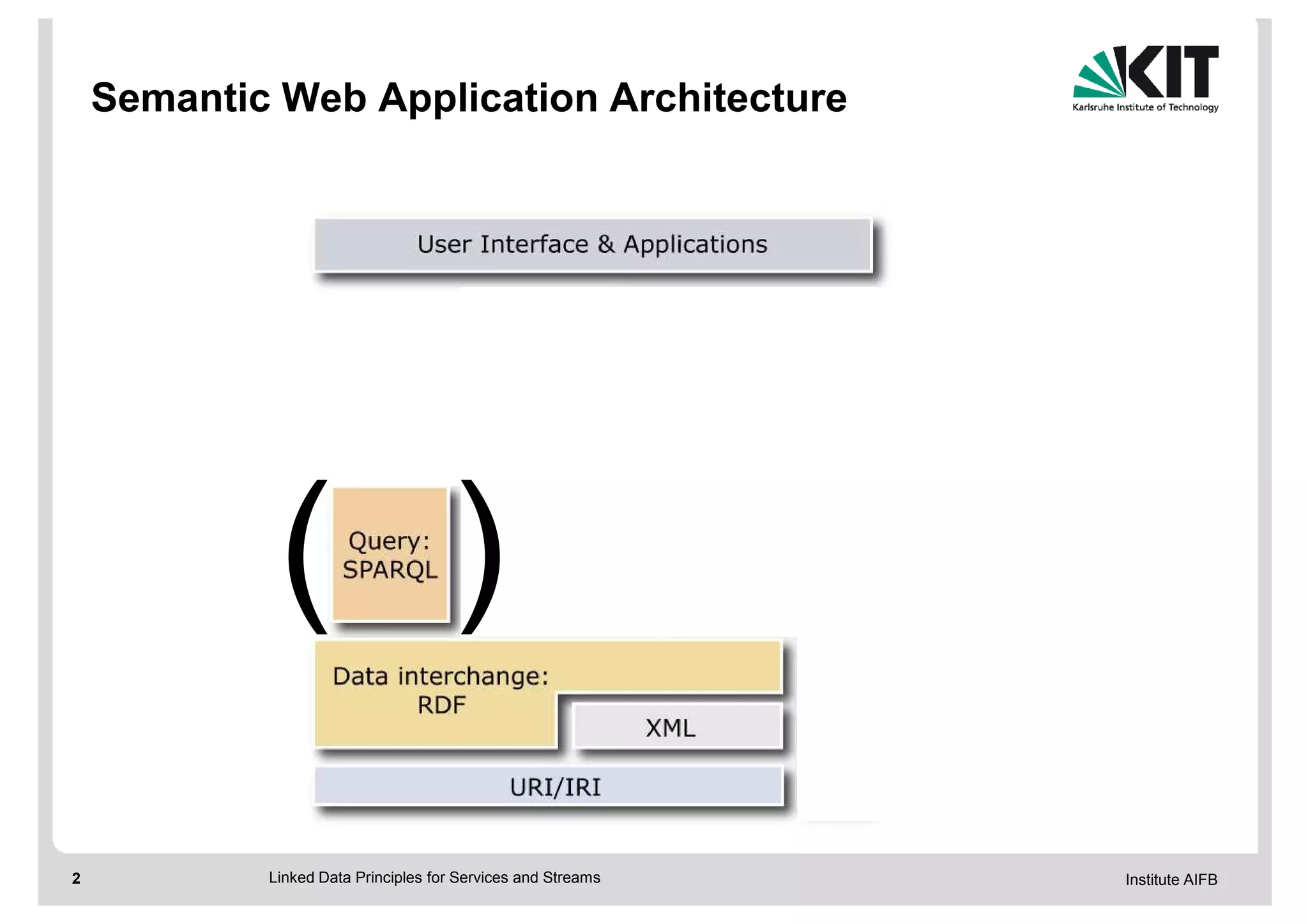
Semantic Web Application Architecture


             ( )
2           Linked Data Principles for Services and Streams   Institute AIFB
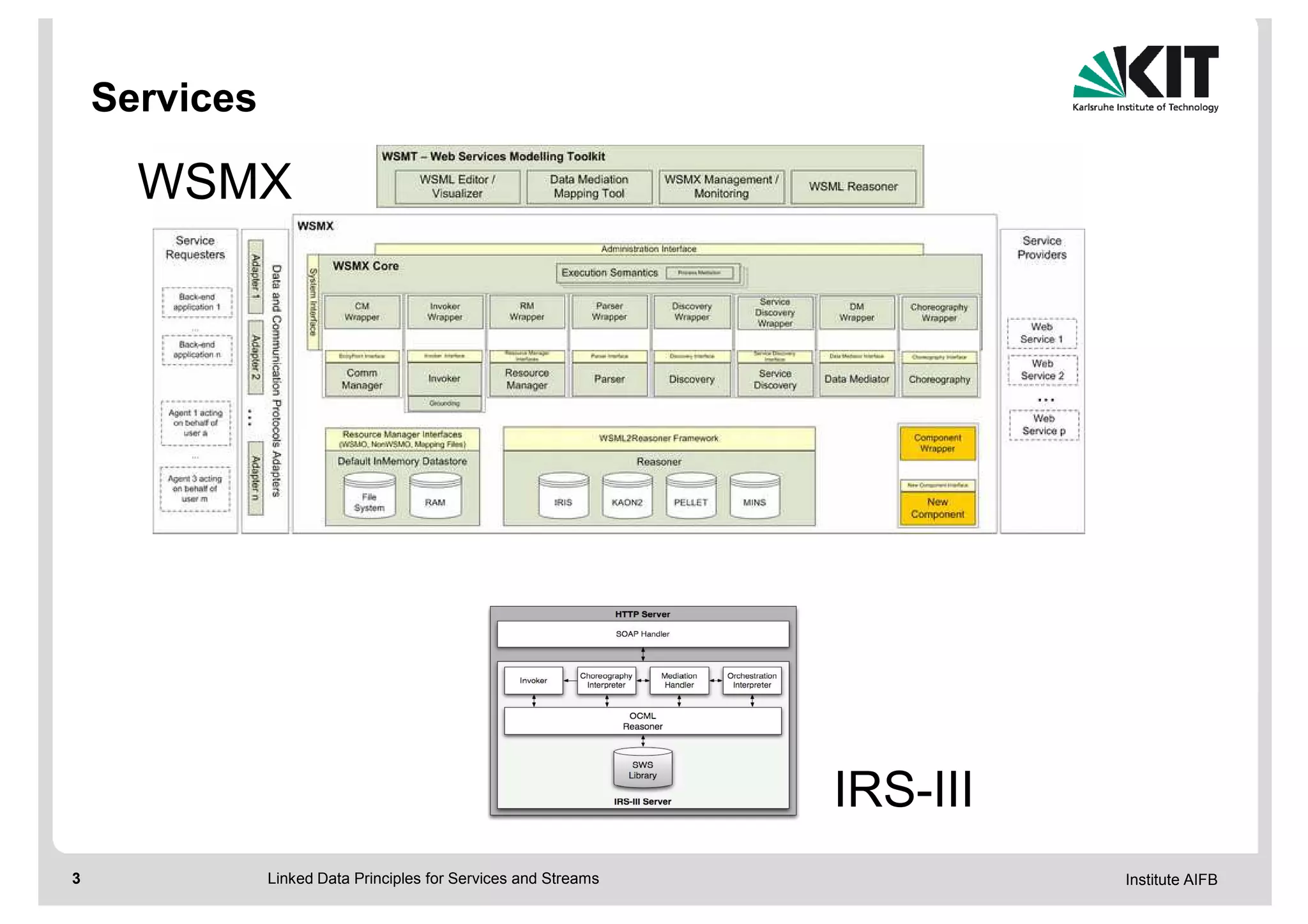
Services

      WSMX


                                                                 IRS-III
3              Linked Data Principles for Services and Streams             Institute AIFB
Motivation

      Linked Data (LD) makes a lot of data available in the Web
      Applications typically rely on data from different sources
      With LD, integration of data sources is easy:
          <http://data.semanticweb.org/conference/eswc/2010>
                    foaf:based_near
                         <http://dbpedia.org/resource/Heraklion>


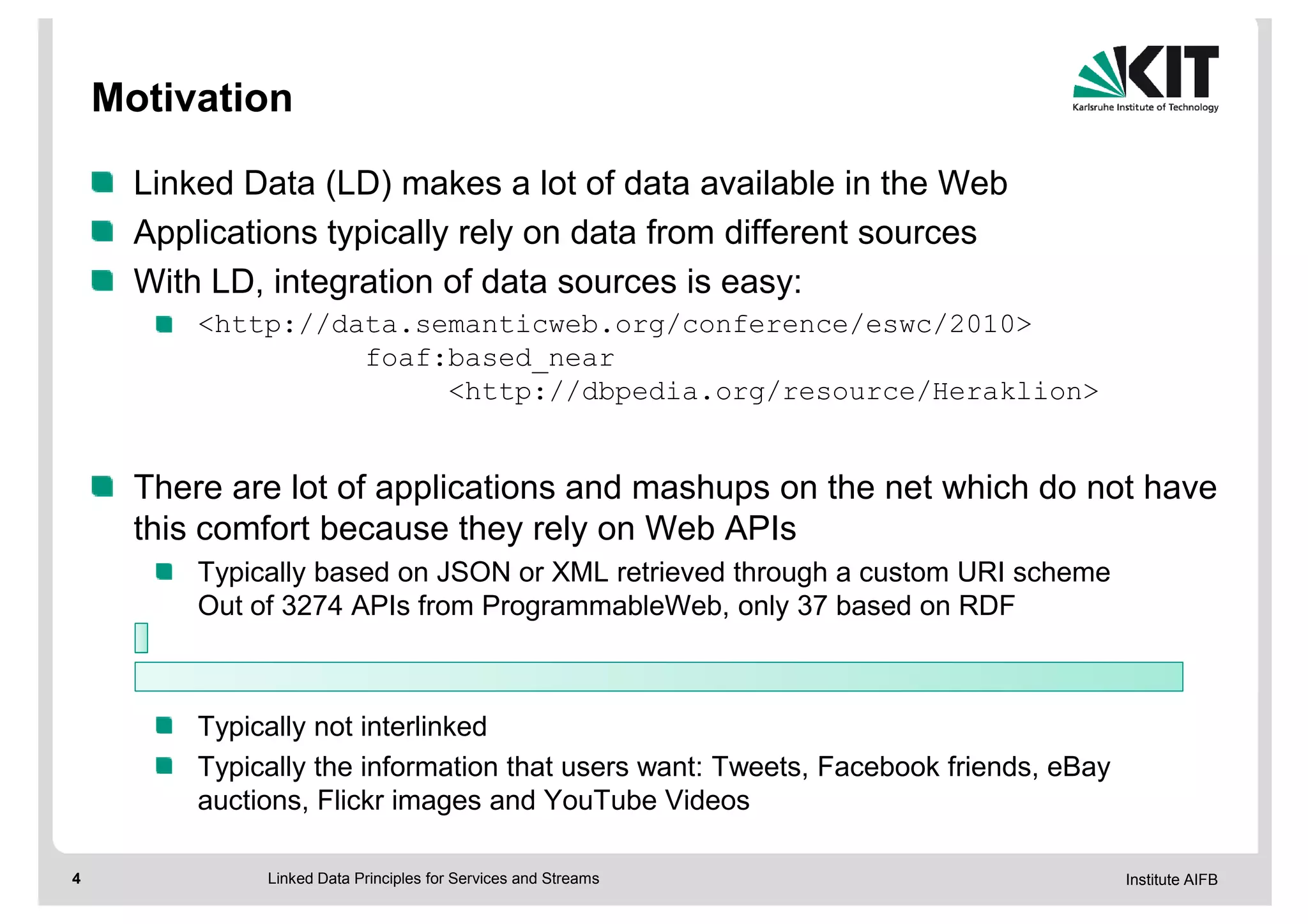
      There are lot of applications and mashups on the net which do not have
      this comfort because they rely on Web APIs
          Typically based on JSON or XML retrieved through a custom URI scheme
          Out of 3274 APIs from ProgrammableWeb, only 37 based on RDF


          Typically not interlinked
          Typically the information that users want: Tweets, Facebook friends, eBay
          auctions, Flickr images and YouTube Videos

4              Linked Data Principles for Services and Streams                        Institute AIFB
Example

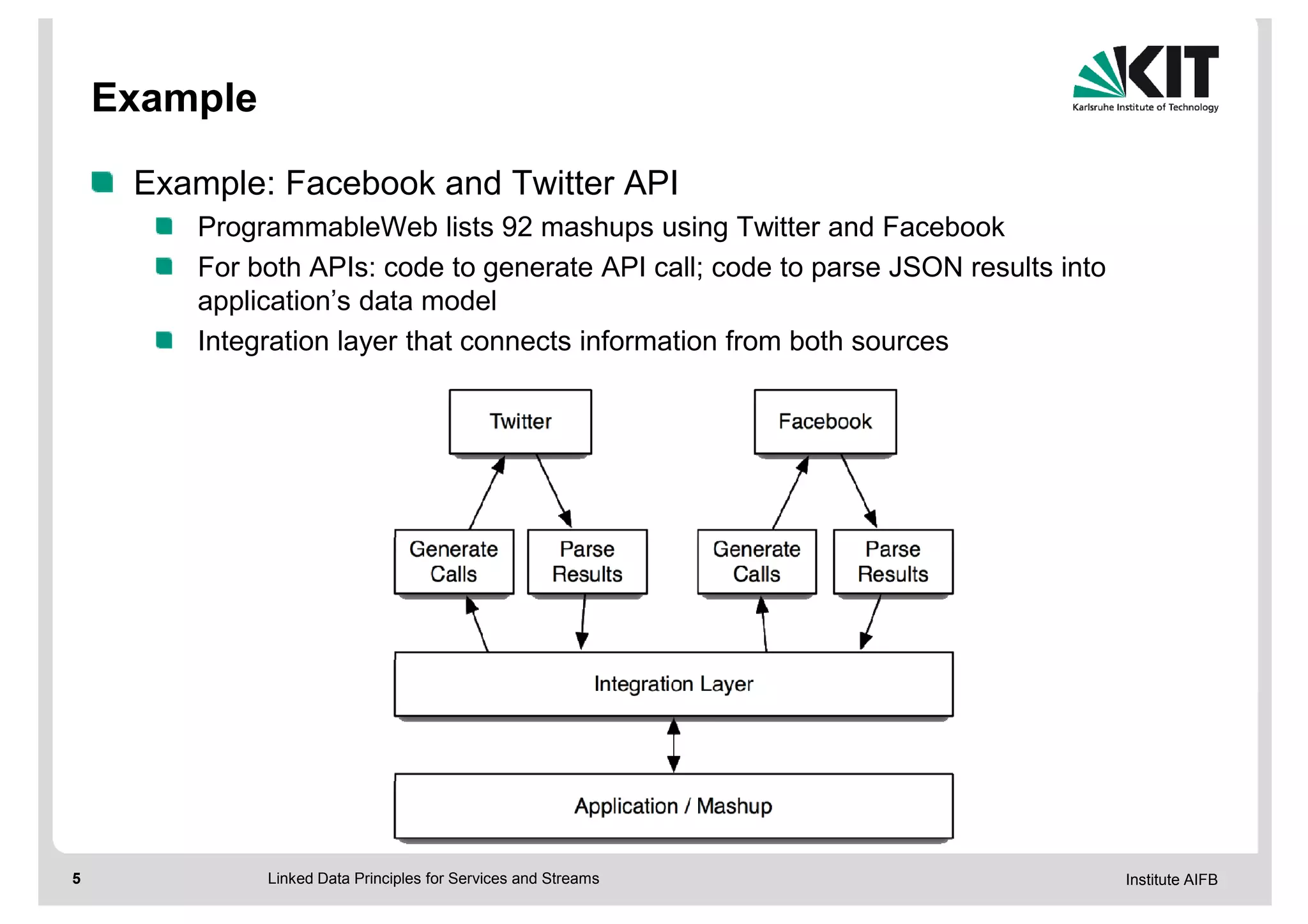
     Example: Facebook and Twitter API
        ProgrammableWeb lists 92 mashups using Twitter and Facebook
        For both APIs: code to generate API call; code to parse JSON results into
        application’s data model
        Integration layer that connects information from both sources


5             Linked Data Principles for Services and Streams                       Institute AIFB
Example

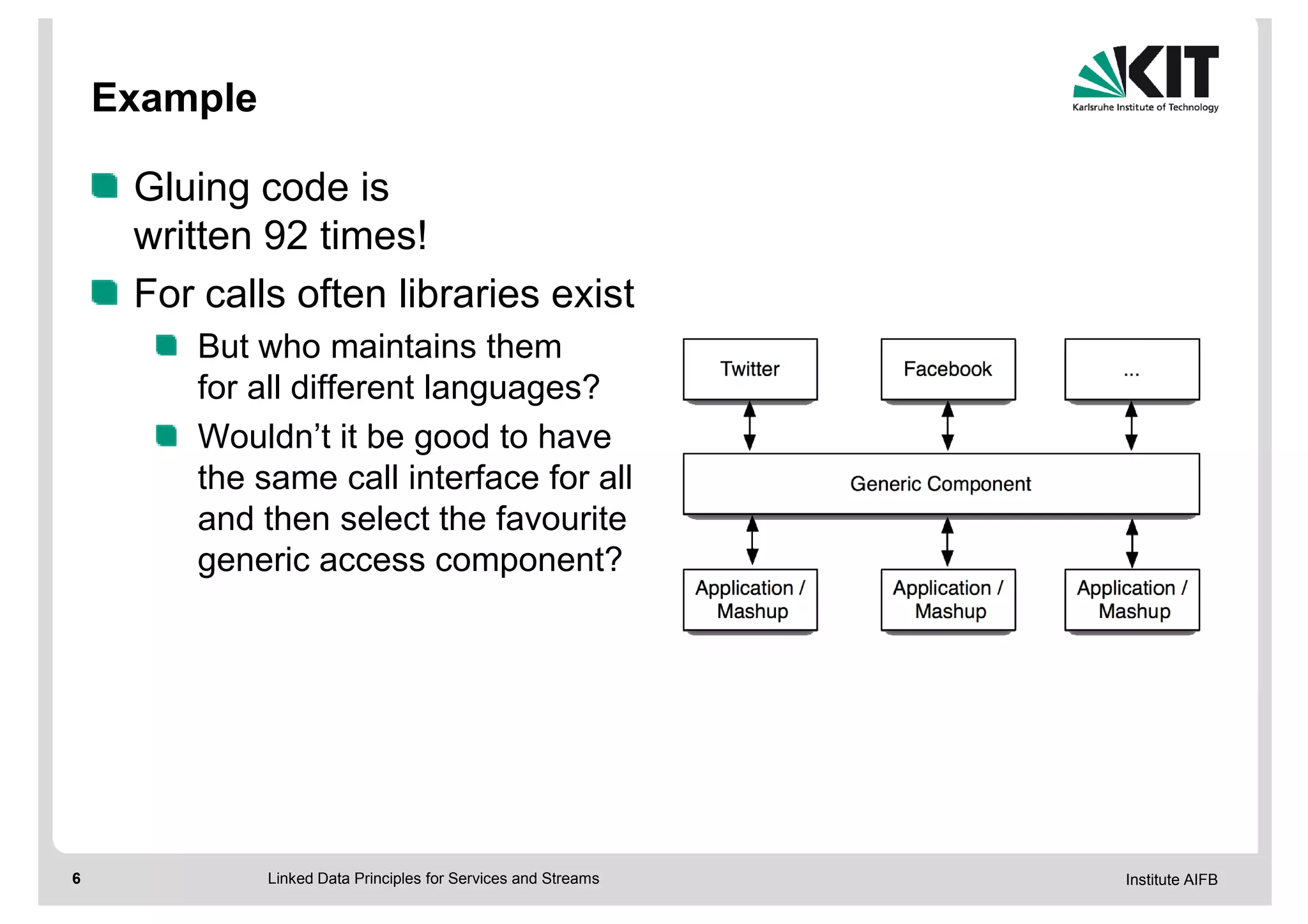
     Gluing code is
     written 92 times!
     For calls often libraries exist
        But who maintains them
        for all different languages?
        Wouldn’t it be good to have
        the same call interface for all
        and then select the favourite
        generic access component?


6             Linked Data Principles for Services and Streams   Institute AIFB
Data Services

      Not all data sources will be published as fully materialised data sets
      Reasons include:
          Data is changing constantly (e.g. sensor data or stock quotes)
          Data is calculated based on infinitely many inputs (e.g. route between two
          geographical locations)
          Provider does not want arbitrary access (e.g. flight ticket prices, social networks)


      LIDS: Method to publish information services as Linked Data
          SPARQL patterns describe input and output
          URIs for service calls can be automatically created
          Service calls can be directly interlinked with other data


7              Linked Data Principles for Services and Streams                          Institute AIFB
Data Services Overview

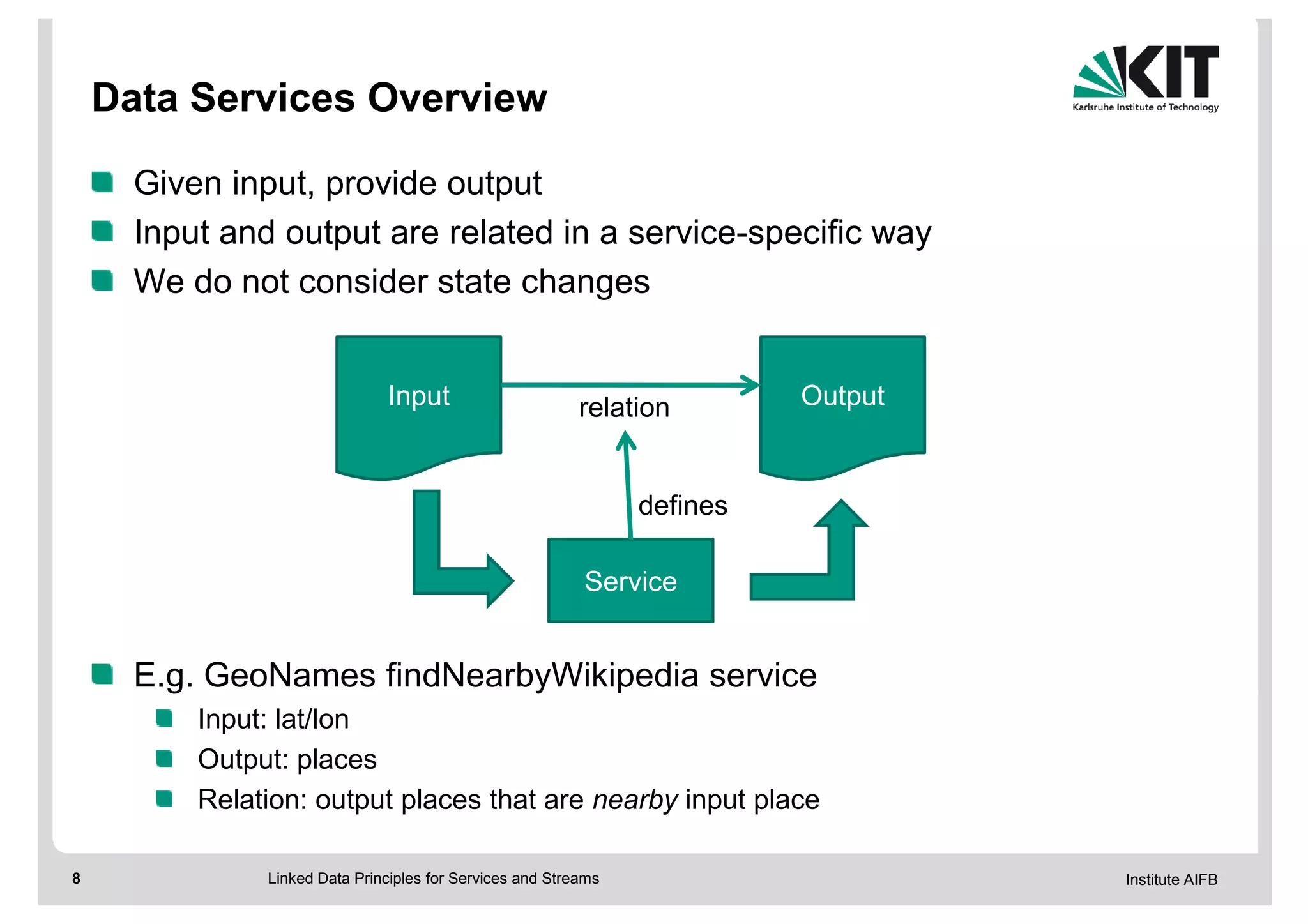
      Given input, provide output
      Input and output are related in a service-specific way
      We do not consider state changes


                               Input                       relation        Output


                                                                 defines

                                                           Service


      E.g. GeoNames findNearbyWikipedia service
          Input: lat/lon
          Output: places
          Relation: output places that are nearby input place

8              Linked Data Principles for Services and Streams                      Institute AIFB
Enter LIDS: Linked Data Services

      We’d like to integrate data services with Linked Data
    1. LIDS need to adhere to Linked Data principles

      We’d like to use data services in software programs
    2. LIDS need machine-readable descriptions of input and output


9              Linked Data Principles for Services and Streams       Institute AIFB
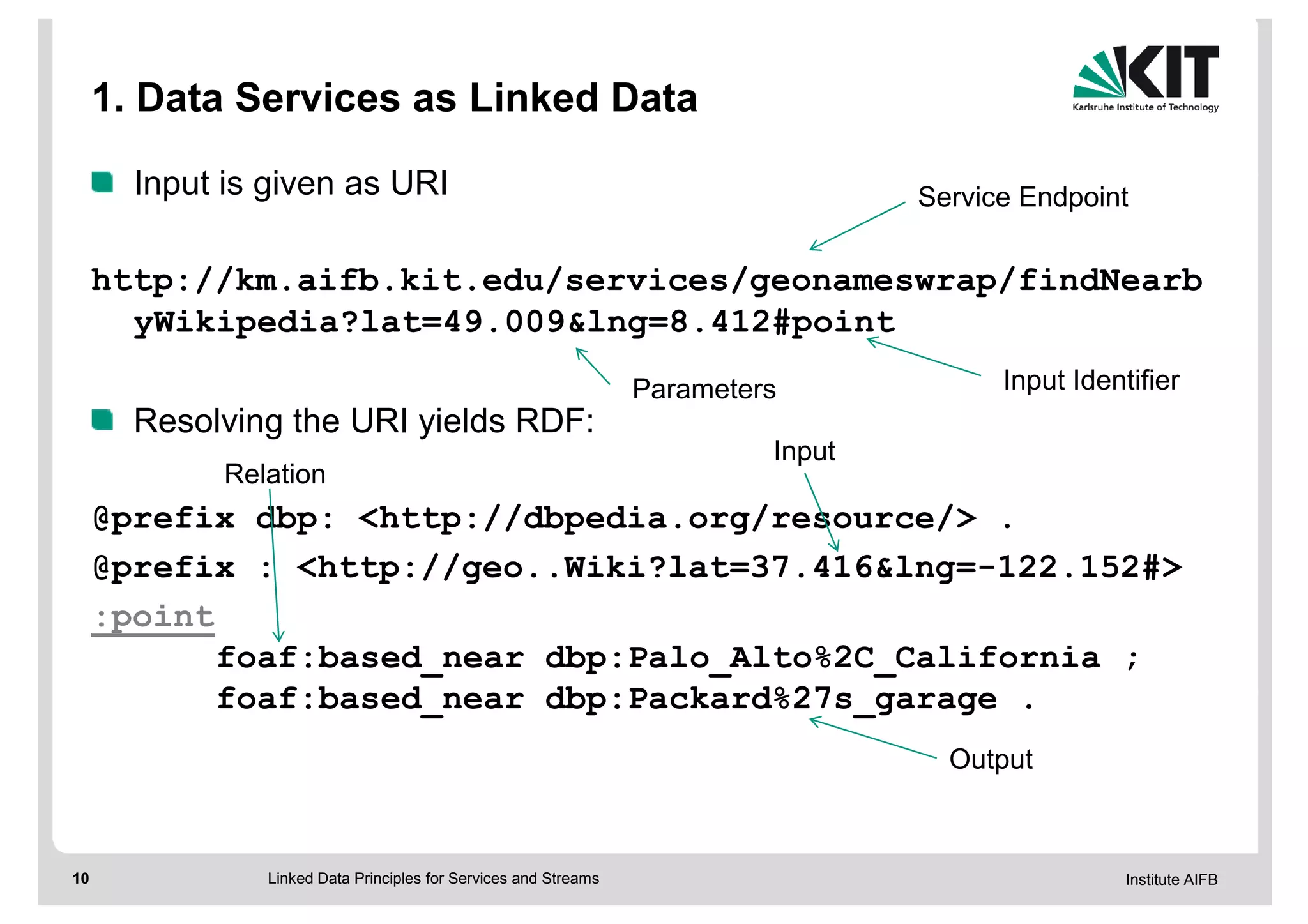
1. Data Services as Linked Data

       Input is given as URI                                                       Service Endpoint

     http://km.aifb.kit.edu/services/geonameswrap/findNearb
       yWikipedia?lat=49.009&lng=8.412#point
                                                                  Parameters             Input Identifier
       Resolving the URI yields RDF:
                                                                           Input
             Relation
     @prefix dbp: <http://dbpedia.org/resource/> .
     @prefix : <http://geo..Wiki?lat=37.416&lng=-122.152#>
     :point
            foaf:based_near dbp:Palo_Alto%2C_California ;
            foaf:based_near dbp:Packard%27s_garage .
                                                                                     Output


10              Linked Data Principles for Services and Streams                                     Institute AIFB
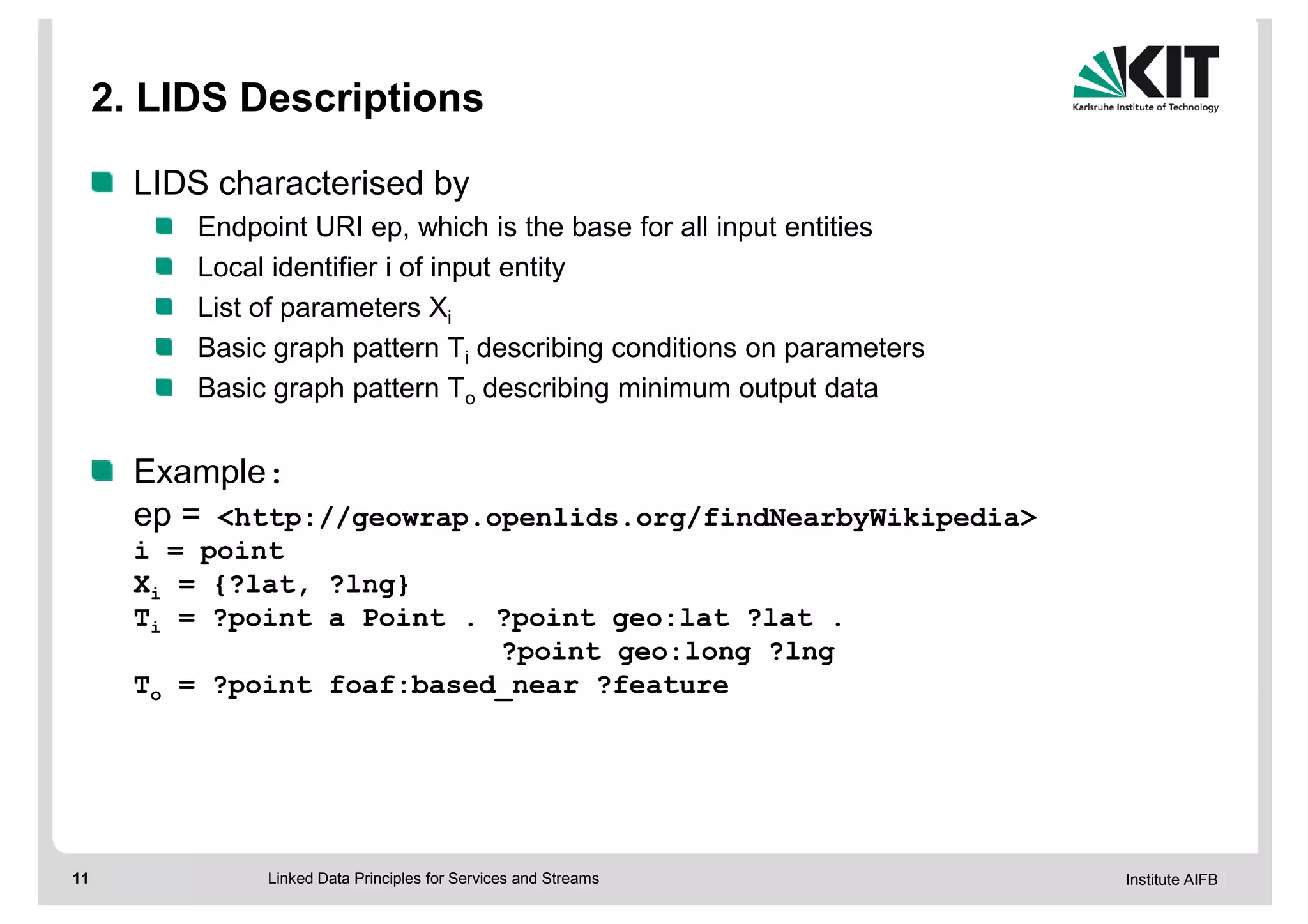
2. LIDS Descriptions

       LIDS characterised by
           Endpoint URI ep, which is the base for all input entities
           Local identifier i of input entity
           List of parameters Xi
           Basic graph pattern Ti describing conditions on parameters
           Basic graph pattern To describing minimum output data


       Example:
       ep = <http://geowrap.openlids.org/findNearbyWikipedia>
       i = point
       Xi = {?lat, ?lng}
       Ti = ?point a Point . ?point geo:lat ?lat .
                             ?point geo:long ?lng
       To = ?point foaf:based_near ?feature


11              Linked Data Principles for Services and Streams         Institute AIFB
Semantic Sensor Networks

      SSN ontology provides descriptions of sensors and observations
      Several stream engines (e.g., C-SPARQL) provide access to
      streams via SPARQL
      GSN (in combination with relational mapping tools such as D2R)
      provides access to archived sensor data
      Linked Sensor Data project provides historical data
      However, there is no defined protocol for live access to streams


12           Linked Data Principles for Services and Streams    Institute AIFB
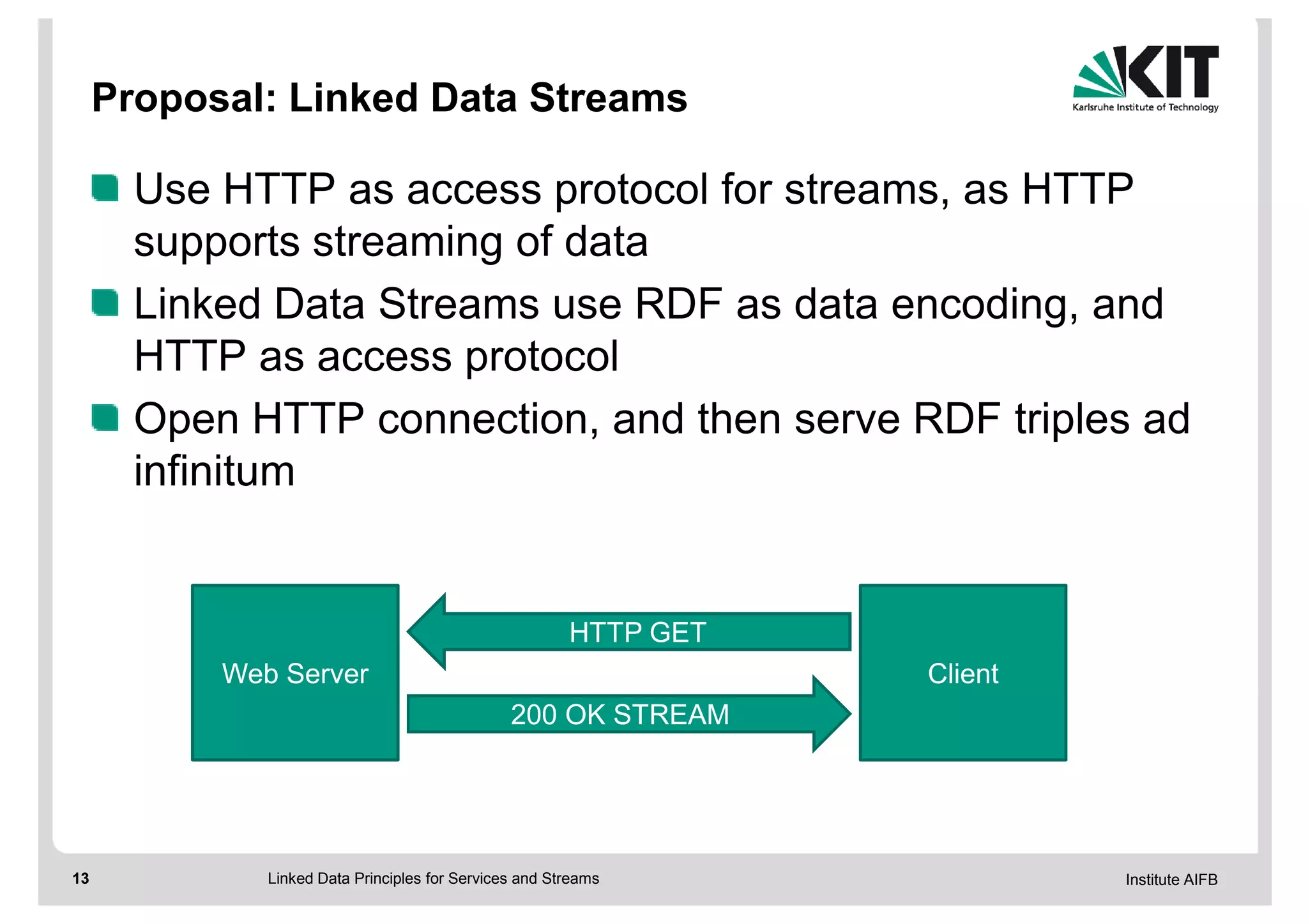
Proposal: Linked Data Streams

       Use HTTP as access protocol for streams, as HTTP
       supports streaming of data
       Linked Data Streams use RDF as data encoding, and
       HTTP as access protocol
       Open HTTP connection, and then serve RDF triples ad
       infinitum


                                                        HTTP GET
           Web Server                                              Client
                                                200 OK STREAM


13            Linked Data Principles for Services and Streams               Institute AIFB
Example

       Source of stream
     http://events.play-project.eu/e1
       Data (stream of triples)

     e1:event   a :avgTempEvent .
     e1:event   :startTime "2011-01-29"^^xsd:date .
     e1:event   :endTime "2011-01-31"^^xsd:date .
     loc:Nice   :avgTemp [ rdf:value "25" ; :event e1:event ] .
     …


     Spec draft at http://km.aifb.kit.edu/sites/lodstream


14               Linked Data Principles for Services and Streams   Institute AIFB
Pro’s and Con’s

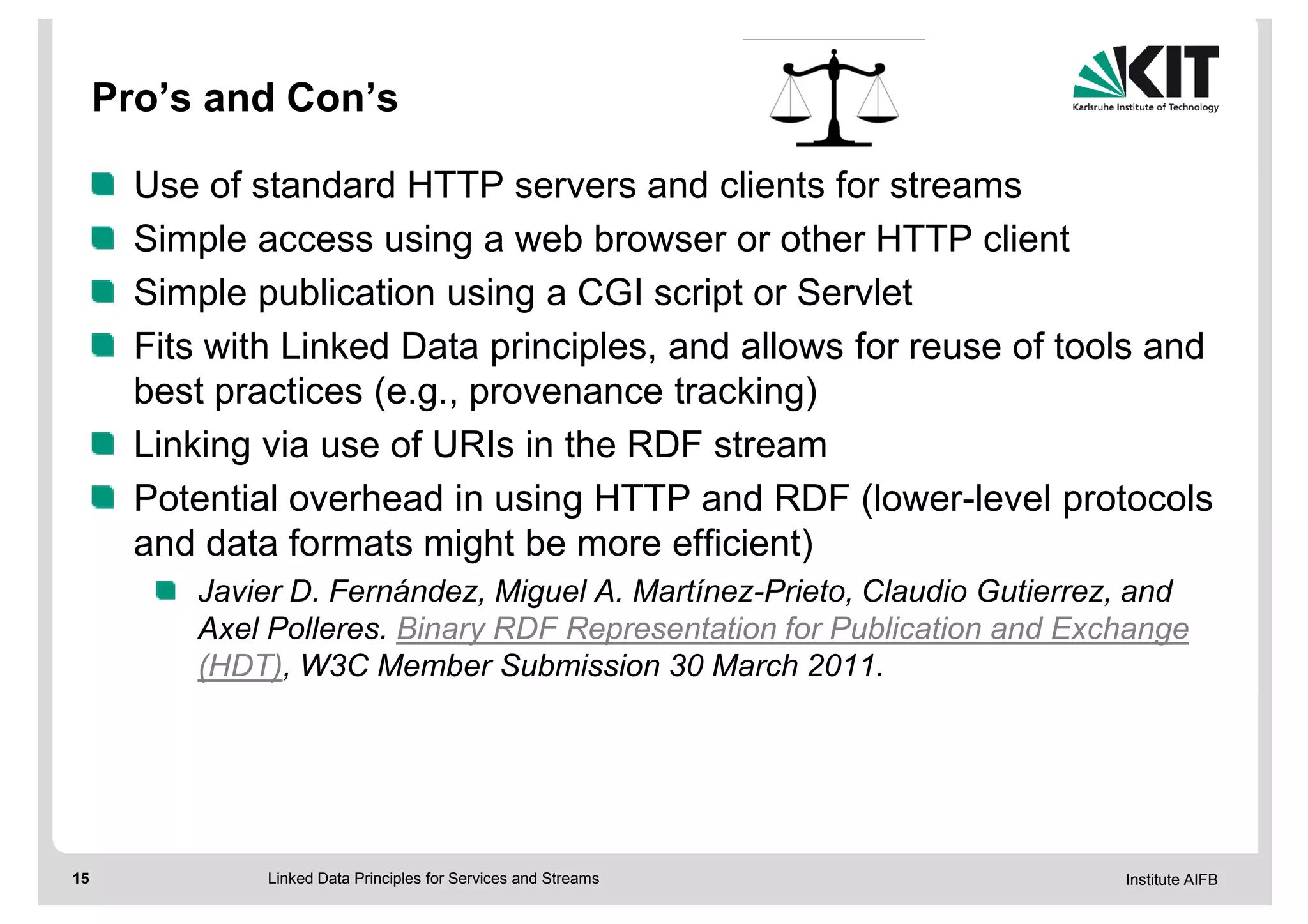
       Use of standard HTTP servers and clients for streams
       Simple access using a web browser or other HTTP client
       Simple publication using a CGI script or Servlet
       Fits with Linked Data principles, and allows for reuse of tools and
       best practices (e.g., provenance tracking)
       Linking via use of URIs in the RDF stream
       Potential overhead in using HTTP and RDF (lower-level protocols
       and data formats might be more efficient)
          Javier D. Fernández, Miguel A. Martínez-Prieto, Claudio Gutierrez, and
          Axel Polleres. Binary RDF Representation for Publication and Exchange
          (HDT), W3C Member Submission 30 March 2011.


15             Linked Data Principles for Services and Streams             Institute AIFB
Conclusion

      Increasing interest in real-time access to data
      Services and streams form the underlying mechanisms
      K.I.S.S. to keep barrier of entry low

      Encode parameters for services in URIs
      Stream data via HTTP
      Use RDF for returning data


16            Linked Data Principles for Services and Streams   Institute AIFB
Acknowledgements

      Joint work with Sebastian Speiser on Linked Data Services and Roland
      Stuehmer on Linked Data Streams
      Title slide image from
      http://www.flickr.com/photos/23209605@N00/2786126623/


17            Linked Data Principles for Services and Streams       Institute AIFB

STI Summit 2011 - Linked data-services-streams

  • 1.
    Linked Data Principlesfor Services and Streams Andreas Harth Institute AIFB, Group Prof. Studer, Knowledge Management KIT – University of the State of Baden-Wuerttemberg and National Research Center of the Helmholtz Association www.kit.edu
  • 2.
    Semantic Web ApplicationArchitecture ( ) 2 Linked Data Principles for Services and Streams Institute AIFB
  • 3.
    Services WSMX IRS-III 3 Linked Data Principles for Services and Streams Institute AIFB
  • 4.
    Motivation Linked Data (LD) makes a lot of data available in the Web Applications typically rely on data from different sources With LD, integration of data sources is easy: <http://data.semanticweb.org/conference/eswc/2010> foaf:based_near <http://dbpedia.org/resource/Heraklion> There are lot of applications and mashups on the net which do not have this comfort because they rely on Web APIs Typically based on JSON or XML retrieved through a custom URI scheme Out of 3274 APIs from ProgrammableWeb, only 37 based on RDF Typically not interlinked Typically the information that users want: Tweets, Facebook friends, eBay auctions, Flickr images and YouTube Videos 4 Linked Data Principles for Services and Streams Institute AIFB
  • 5.
    Example Example: Facebook and Twitter API ProgrammableWeb lists 92 mashups using Twitter and Facebook For both APIs: code to generate API call; code to parse JSON results into application’s data model Integration layer that connects information from both sources 5 Linked Data Principles for Services and Streams Institute AIFB
  • 6.
    Example Gluing code is written 92 times! For calls often libraries exist But who maintains them for all different languages? Wouldn’t it be good to have the same call interface for all and then select the favourite generic access component? 6 Linked Data Principles for Services and Streams Institute AIFB
  • 7.
    Data Services Not all data sources will be published as fully materialised data sets Reasons include: Data is changing constantly (e.g. sensor data or stock quotes) Data is calculated based on infinitely many inputs (e.g. route between two geographical locations) Provider does not want arbitrary access (e.g. flight ticket prices, social networks) LIDS: Method to publish information services as Linked Data SPARQL patterns describe input and output URIs for service calls can be automatically created Service calls can be directly interlinked with other data 7 Linked Data Principles for Services and Streams Institute AIFB
  • 8.
    Data Services Overview Given input, provide output Input and output are related in a service-specific way We do not consider state changes Input relation Output defines Service E.g. GeoNames findNearbyWikipedia service Input: lat/lon Output: places Relation: output places that are nearby input place 8 Linked Data Principles for Services and Streams Institute AIFB
  • 9.
    Enter LIDS: LinkedData Services We’d like to integrate data services with Linked Data 1. LIDS need to adhere to Linked Data principles We’d like to use data services in software programs 2. LIDS need machine-readable descriptions of input and output 9 Linked Data Principles for Services and Streams Institute AIFB
  • 10.
    1. Data Servicesas Linked Data Input is given as URI Service Endpoint http://km.aifb.kit.edu/services/geonameswrap/findNearb yWikipedia?lat=49.009&lng=8.412#point Parameters Input Identifier Resolving the URI yields RDF: Input Relation @prefix dbp: <http://dbpedia.org/resource/> . @prefix : <http://geo..Wiki?lat=37.416&lng=-122.152#> :point foaf:based_near dbp:Palo_Alto%2C_California ; foaf:based_near dbp:Packard%27s_garage . Output 10 Linked Data Principles for Services and Streams Institute AIFB
  • 11.
    2. LIDS Descriptions LIDS characterised by Endpoint URI ep, which is the base for all input entities Local identifier i of input entity List of parameters Xi Basic graph pattern Ti describing conditions on parameters Basic graph pattern To describing minimum output data Example: ep = <http://geowrap.openlids.org/findNearbyWikipedia> i = point Xi = {?lat, ?lng} Ti = ?point a Point . ?point geo:lat ?lat . ?point geo:long ?lng To = ?point foaf:based_near ?feature 11 Linked Data Principles for Services and Streams Institute AIFB
  • 12.
    Semantic Sensor Networks SSN ontology provides descriptions of sensors and observations Several stream engines (e.g., C-SPARQL) provide access to streams via SPARQL GSN (in combination with relational mapping tools such as D2R) provides access to archived sensor data Linked Sensor Data project provides historical data However, there is no defined protocol for live access to streams 12 Linked Data Principles for Services and Streams Institute AIFB
  • 13.
    Proposal: Linked DataStreams Use HTTP as access protocol for streams, as HTTP supports streaming of data Linked Data Streams use RDF as data encoding, and HTTP as access protocol Open HTTP connection, and then serve RDF triples ad infinitum HTTP GET Web Server Client 200 OK STREAM 13 Linked Data Principles for Services and Streams Institute AIFB
  • 14.
    Example Source of stream http://events.play-project.eu/e1 Data (stream of triples) e1:event a :avgTempEvent . e1:event :startTime "2011-01-29"^^xsd:date . e1:event :endTime "2011-01-31"^^xsd:date . loc:Nice :avgTemp [ rdf:value "25" ; :event e1:event ] . … Spec draft at http://km.aifb.kit.edu/sites/lodstream 14 Linked Data Principles for Services and Streams Institute AIFB
  • 15.
    Pro’s and Con’s Use of standard HTTP servers and clients for streams Simple access using a web browser or other HTTP client Simple publication using a CGI script or Servlet Fits with Linked Data principles, and allows for reuse of tools and best practices (e.g., provenance tracking) Linking via use of URIs in the RDF stream Potential overhead in using HTTP and RDF (lower-level protocols and data formats might be more efficient) Javier D. Fernández, Miguel A. Martínez-Prieto, Claudio Gutierrez, and Axel Polleres. Binary RDF Representation for Publication and Exchange (HDT), W3C Member Submission 30 March 2011. 15 Linked Data Principles for Services and Streams Institute AIFB
  • 16.
    Conclusion Increasing interest in real-time access to data Services and streams form the underlying mechanisms K.I.S.S. to keep barrier of entry low Encode parameters for services in URIs Stream data via HTTP Use RDF for returning data 16 Linked Data Principles for Services and Streams Institute AIFB
  • 17.
    Acknowledgements Joint work with Sebastian Speiser on Linked Data Services and Roland Stuehmer on Linked Data Streams Title slide image from http://www.flickr.com/photos/23209605@N00/2786126623/ 17 Linked Data Principles for Services and Streams Institute AIFB