Linked Data to enhance users experience with Open Education ResourcesEdmundo Tovar (UPM etovar@fi.upm.es )  -   Nelson Piedra (UTPL, nopiedra@utpl.edu.ec)Jorge López, JannethChicaiza, Oscar MartinezOCWC Global 2011: Celebrating 10 years of OpenCourseWareCambridge, Massachusetts, USAMay 4, 2011 – May 6, 2011this work is licensed under a Creative Commons Attribution 3.0 License http://creativecommons.org/licenses/by/3.0/ec/
some motivations
Status of the Current WebWeb Content:Diversity of Platforms and systems (CMS, APIs); Web silos of content.A lot of Data contained in millions of web-documents (embedded within Content Management Systems).Discoverability and reusability:Not possible to reuse data outside the CMS/WebAppsNot data available as unified machine readable formatDiversity of APIs
Silos of data/relations/informations: Walled Social Networks Cartoon
The World Wide Web is defined as the universal, all-encompassing space containing all Internet - and other - resources referenced by Uniform Resource Identifiers (URIs, sometimes commonly called "URLs").
The Web was designed as an information space, with the goal that it should be useful not only for human-human communication, but also that machines would be able to participate and help. [Tim Berners-Lee]
One of the major obstacles to this has been the fact that most information on the Web is designed for human consumption, and even if it was derived from a database with well defined meanings (in at least some terms) for its columns, that the structure of the data is not evident to a robot browsing the web. [TBL]
Leaving aside the artificial intelligence problem of training machines to behave like people, the Semantic Web approach instead develops languages for expressing information in a machine processable form. [TBL]
Web of Documentwhere links are relationships anchors in hypertext documents written in HTMLfrom humans for humansand machines? no really welcome....
Web of DataDiscovery,  Access, and Usages of Resources in the Web
Web of Data,Link DATA rather than DOCUMENTS Linked Data is about using the Web to connect related data that wasn't previously linked, or using the Web to lower the barriers to linking data currently linked using other methods. Linked Data as a best practice for exposing, sharing, and connecting pieces of data, information, and knowledge on the Semantic Web using URIs and RDF. Links  between arbitrary things described by RDF
Semantic WEBThe Semantic Web isn't just about putting data on the web. It is about making links, so that a person or machine can explore the web of data.  With linked data, when you have some of it, you can find other, related, data.
Linked-Data PrinciplesLike the web of hypertext, the web of data is constructed with documents on the web. http://www.w3.org/DesignIssues/LinkedDataUse URIs to name things on the Web (for naming everything real or abstract you could think of)Use HTTP URIs so that people can look up those names. When someone looks up a URI, provide useful information, using the standards (RDF*, SPARQL) Include links to other URIs. so that they can discover more things.
Linked Data Key Conceptsresource -- an thing of interest (OCW, syllabus, test, lecture, presentation, document, OER, ... )URI -- global identifier for a resource. The URIs identify any kind of object or  concept. representation -- data corresponding to the state of a resource information resource -- a “document” containing information non-information resource -- anything else associated description -- representation describing a Semantic Web resource
The Resource Description Framework (RDF)RDF: The Resource Description Framework (RDF) is a family of World Wide Web Consortium (W3C) specifications originally designed as a metadatadata model. It has come to be used as a general method for conceptual description or modeling of information that is implemented in web resources, using a variety of syntax formats.Resource - everything with a URIDescription - properties of these resourcesFramework - a system to build on
The RDF Data ModelRDF TriplesResource Description Framework"subject<uri>traits or aspects of the resourcepredicatetyped-linktraits or aspects of the resourceobject<uri> or “literal”traits or aspects of the resource
Linked Data core stackSPARQLRDFHTTPURI
Linked Data Core Stack, SpecificationsRFC 2616 Hypertext Transfer Protocol -- HTTP/1.1: Defines HTTP, a generic and stateless application-level protocol for distributed, collaborative, hypermedia information systems.RFC 3986 Uniform Resource Identifier (URI): Generic Syntax: Defines a generic URI syntax and a process for resolving URI references that might be in relative form, along with guidelines and security considerations for the use of URIs on the Internet.RDF Concepts and Abstract Syntax: Defines the RDF graph data model and key concepts.SPARQL Query Language for RDF: Defines defines the syntax and semantics of the SPARQL query language for RDF.
The Linking Open Data cloud diagram, evolution“Linking Open Data cloud diagram, by Richard Cyganiak and Anja Jentzsch. http://lod-cloud.net/”Next images sequence shows datasets that have been published in Linked Data format, by contributors to the Linking Open Data community project and other individuals and organisations. It is based on metadata collected and curated by contributors to the CKAN directory. Last updated: 2010-09-22.
25 datasets20071008http://richard.cyganiak.de/2007/10/lod/lod-datasets_2007-10-08.png“Linking Open Data cloud diagram, by Richard Cyganiak and Anja Jentzsch. http://lod-cloud.net/” This work is available under a CC-BY-SA license.
28 datasets20071107http://richard.cyganiak.de/2007/10/lod/lod-datasets_2007-11-07.png“Linking Open Data cloud diagram, by Richard Cyganiak and Anja Jentzsch. http://lod-cloud.net/” This work is available under a CC-BY-SA license.
28 datasets20071110http://richard.cyganiak.de/2007/10/lod/lod-datasets_2007-11-10.png“Linking Open Data cloud diagram, by Richard Cyganiak and Anja Jentzsch. http://lod-cloud.net/” This work is available under a CC-BY-SA license.
32 datasets20080228http://richard.cyganiak.de/2007/10/lod/lod-datasets_2008-02-28.png“Linking Open Data cloud diagram, by Richard Cyganiak and Anja Jentzsch. http://lod-cloud.net/” This work is available under a CC-BY-SA license.
TED2009 Tim Berners-Lee on the next WebLinked Data is Real
34 datasets20080331http://richard.cyganiak.de/2007/10/lod/lod-datasets_2008-03-31.png“Linking Open Data cloud diagram, by Richard Cyganiak and Anja Jentzsch. http://lod-cloud.net/” This work is available under a CC-BY-SA license.
45 datasets20080919http://richard.cyganiak.de/2007/10/lod/lod-datasets_2008-09-18.png“Linking Open Data cloud diagram, by Richard Cyganiak and Anja Jentzsch. http://lod-cloud.net/” This work is available under a CC-BY-SA license.
89 datasets20090305http://richard.cyganiak.de/2007/10/lod/lod-datasets_2009-03-05.png“Linking Open Data cloud diagram, by Richard Cyganiak and Anja Jentzsch. http://lod-cloud.net/” This work is available under a CC-BY-SA license.
93 datasets20090327http://richard.cyganiak.de/2007/10/lod/lod-datasets_2009-03-27.png“Linking Open Data cloud diagram, by Richard Cyganiak and Anja Jentzsch. http://lod-cloud.net/” This work is available under a CC-BY-SA license.
95 datasets20090714http://richard.cyganiak.de/2007/10/lod/lod-datasets_2009-07-14.png“Linking Open Data cloud diagram, by Richard Cyganiak and Anja Jentzsch. http://lod-cloud.net/” This work is available under a CC-BY-SA license.
203 datasets20100922http://richard.cyganiak.de/2007/10/lod/lod-datasets_2010-09-22_colored.png“Linking Open Data cloud diagram, by Richard Cyganiak and Anja Jentzsch. http://lod-cloud.net/” This work is available under a CC-BY-SA license.
LinkedOCWData Project
GOAL LinkedOCWData ProjectOur Goal: One of the main objectives of our team is:to connect Linked Data with Open Educational Resources, aiming to improve users’ experience of OERs and OCWs.To explore how the principles of Linked Data can be used to help teachers, students and self-learners find open content.Motivation: There is an enormous amount of information and digital resources that our OCWs Officess produce in their respective universities. We must find a way to exchange quick and easy access; we must put all information in one place and under the same principles of design.
ABOUT LinkedOCWData ProjectAbout Project: LinkedOCWData project is to make the OpenCourseWare (OCW) and OpenEducationalResources(OER) datasets easily available as RDF. Additionally, we are providing interlinking with DBpedia, GeoNames and Univerisities Linked Datasets.Expected outcome: The result is a rich, open and integrated dataset which we hope to be useful for research and application development. The datasets can be publicly accessed via downloads, Linked Data, and SPARQL-endpoints. We have also launched an experimental “Live-SPARQL-endpoint” that is synchronized with the minutely updates from OCW/OER initiatives whereas the changes to our store are republished as RDF.
Solutions:The key to achieving these objectives is the disambiguation of open educational materials with unique identifiers through a consensual vocabulary. That is, permanent links which contain structured data that can be read automatically by computers.In resolving a URI, data may be obtained on the course/open resource -author, content, licensing, data on the principles of design and content localization-. Development Cycle: LinkedOCWData Project
Life Cycle: LinkedOCWData ProjectLinked Data requires you to assign URLs to identify things: people, places, events, whatever.
Consensual vocabulary to assess the advantages of using Linked Data in Open Educational Materials.1. Deciding what content to look for. Faced with a wide range of open content, it is difficult to decide between materials of the same subject. Thus, it will be possible to anticipate some of the interests of OCW users. 2. We can help people get more information by using the URL of an open educational resource, and connecting it automatically to related information found in the internet cloud, conveniently and unobtrusively. It consequently adds context to knowledge and open educational materialsA challenging task: LinkedOCWData Project
A Best Practice: Linked Open Data star scheme by exampleTim Berners-Lee suggested a 5-star deployment scheme for Linked Open Data and Ed Summers provided a nice rendering of it. ★ make your stuff available on the Web (whatever format) under an open license★★ make it available as structured data (e.g., Excel instead of image scan of a table)★★★ use non-proprietary formats (e.g., CSV instead of Excel)★★★★ use URIs to identify things, so that people can point at your stuff★★★★★ link your data to other data to provide contextfrom: http://lab.linkeddata.deri.ie/2010/star-scheme-by
Example: Linked Data applied to OpenCourseWareOpencourseware description:Ontologies and Semantic Web, 2008The general objective is to provide students with a sound grounding of scientific, methodological and technological fundamentals in Ontological Engineering and the Semantic Web areas. This knowledge will be later used to build applications that can integrate, combine and infer heterogeneous and distributed information.Guadalupe Aguado;  Oscar Corcho; Asunción GómezDepartamento de Inteligencia Artificial.Facultad de Informática.A four-monthly subject in the following official master programs: Master in Information TechnologiesEuropean Master in Logic Computation (ERASMUS Mundus Program)Master in Research in Artificial IntelligenceOntology Network Last revision: April 2008. It is credited 6 ECTS.Presential classes: 2 hours/week.Total learning time: 32 hours.http://ocw.upm.es/ciencia-de-la-computacion-e-inteligencia-artificial/ontologies-and-semantic-web
raw data within UPM opencourseware web pageOCW Universityknowledge areaTitleAuthor(s)Departmentsyllabusbibliographyyearects creditstime autoselfdescription
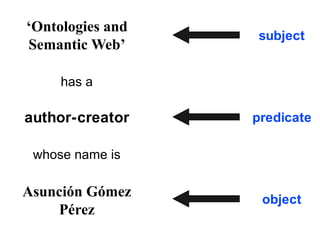
‘Ontologies and Semantic Web’subjecthas aauthor-creatorpredicatewhose name isAsunción Gómez Pérezobject
http://ocw.upm.es/ciencia-de-la-computacion-e-inteligencia-artificial/ontologies-and-semantic-websubjecthas ahttp://purl.org/dc/elements/1.1//creatorpredicatewhose name isAsunción Gómez Pérezobject
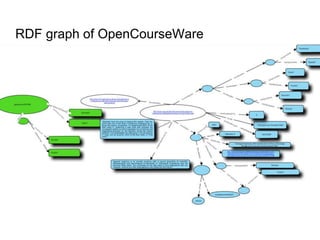
RDF graph of OpenCourseWare

Linked Data to Improve the OER Experience

  • 1.
    Linked Data toenhance users experience with Open Education ResourcesEdmundo Tovar (UPM etovar@fi.upm.es ) - Nelson Piedra (UTPL, nopiedra@utpl.edu.ec)Jorge López, JannethChicaiza, Oscar MartinezOCWC Global 2011: Celebrating 10 years of OpenCourseWareCambridge, Massachusetts, USAMay 4, 2011 – May 6, 2011this work is licensed under a Creative Commons Attribution 3.0 License http://creativecommons.org/licenses/by/3.0/ec/
  • 2.
  • 3.
    Status of theCurrent WebWeb Content:Diversity of Platforms and systems (CMS, APIs); Web silos of content.A lot of Data contained in millions of web-documents (embedded within Content Management Systems).Discoverability and reusability:Not possible to reuse data outside the CMS/WebAppsNot data available as unified machine readable formatDiversity of APIs
  • 4.
    Silos of data/relations/informations:Walled Social Networks Cartoon
  • 5.
    The World WideWeb is defined as the universal, all-encompassing space containing all Internet - and other - resources referenced by Uniform Resource Identifiers (URIs, sometimes commonly called "URLs").
  • 6.
    The Web wasdesigned as an information space, with the goal that it should be useful not only for human-human communication, but also that machines would be able to participate and help. [Tim Berners-Lee]
  • 7.
    One of themajor obstacles to this has been the fact that most information on the Web is designed for human consumption, and even if it was derived from a database with well defined meanings (in at least some terms) for its columns, that the structure of the data is not evident to a robot browsing the web. [TBL]
  • 8.
    Leaving aside theartificial intelligence problem of training machines to behave like people, the Semantic Web approach instead develops languages for expressing information in a machine processable form. [TBL]
  • 9.
    Web of Documentwhere linksare relationships anchors in hypertext documents written in HTMLfrom humans for humansand machines? no really welcome....
  • 10.
    Web of DataDiscovery, Access, and Usages of Resources in the Web
  • 11.
    Web of Data,LinkDATA rather than DOCUMENTS Linked Data is about using the Web to connect related data that wasn't previously linked, or using the Web to lower the barriers to linking data currently linked using other methods. Linked Data as a best practice for exposing, sharing, and connecting pieces of data, information, and knowledge on the Semantic Web using URIs and RDF. Links  between arbitrary things described by RDF
  • 12.
    Semantic WEBThe SemanticWeb isn't just about putting data on the web. It is about making links, so that a person or machine can explore the web of data.  With linked data, when you have some of it, you can find other, related, data.
  • 13.
    Linked-Data PrinciplesLike theweb of hypertext, the web of data is constructed with documents on the web. http://www.w3.org/DesignIssues/LinkedDataUse URIs to name things on the Web (for naming everything real or abstract you could think of)Use HTTP URIs so that people can look up those names. When someone looks up a URI, provide useful information, using the standards (RDF*, SPARQL) Include links to other URIs. so that they can discover more things.
  • 14.
    Linked Data KeyConceptsresource -- an thing of interest (OCW, syllabus, test, lecture, presentation, document, OER, ... )URI -- global identifier for a resource. The URIs identify any kind of object or  concept. representation -- data corresponding to the state of a resource information resource -- a “document” containing information non-information resource -- anything else associated description -- representation describing a Semantic Web resource
  • 15.
    The Resource DescriptionFramework (RDF)RDF: The Resource Description Framework (RDF) is a family of World Wide Web Consortium (W3C) specifications originally designed as a metadatadata model. It has come to be used as a general method for conceptual description or modeling of information that is implemented in web resources, using a variety of syntax formats.Resource - everything with a URIDescription - properties of these resourcesFramework - a system to build on
  • 16.
    The RDF DataModelRDF TriplesResource Description Framework"subject<uri>traits or aspects of the resourcepredicatetyped-linktraits or aspects of the resourceobject<uri> or “literal”traits or aspects of the resource
  • 17.
    Linked Data corestackSPARQLRDFHTTPURI
  • 18.
    Linked Data CoreStack, SpecificationsRFC 2616 Hypertext Transfer Protocol -- HTTP/1.1: Defines HTTP, a generic and stateless application-level protocol for distributed, collaborative, hypermedia information systems.RFC 3986 Uniform Resource Identifier (URI): Generic Syntax: Defines a generic URI syntax and a process for resolving URI references that might be in relative form, along with guidelines and security considerations for the use of URIs on the Internet.RDF Concepts and Abstract Syntax: Defines the RDF graph data model and key concepts.SPARQL Query Language for RDF: Defines defines the syntax and semantics of the SPARQL query language for RDF.
  • 19.
    The Linking OpenData cloud diagram, evolution“Linking Open Data cloud diagram, by Richard Cyganiak and Anja Jentzsch. http://lod-cloud.net/”Next images sequence shows datasets that have been published in Linked Data format, by contributors to the Linking Open Data community project and other individuals and organisations. It is based on metadata collected and curated by contributors to the CKAN directory. Last updated: 2010-09-22.
  • 20.
    25 datasets20071008http://richard.cyganiak.de/2007/10/lod/lod-datasets_2007-10-08.png“Linking OpenData cloud diagram, by Richard Cyganiak and Anja Jentzsch. http://lod-cloud.net/” This work is available under a CC-BY-SA license.
  • 21.
    28 datasets20071107http://richard.cyganiak.de/2007/10/lod/lod-datasets_2007-11-07.png“Linking OpenData cloud diagram, by Richard Cyganiak and Anja Jentzsch. http://lod-cloud.net/” This work is available under a CC-BY-SA license.
  • 22.
    28 datasets20071110http://richard.cyganiak.de/2007/10/lod/lod-datasets_2007-11-10.png“Linking OpenData cloud diagram, by Richard Cyganiak and Anja Jentzsch. http://lod-cloud.net/” This work is available under a CC-BY-SA license.
  • 23.
    32 datasets20080228http://richard.cyganiak.de/2007/10/lod/lod-datasets_2008-02-28.png“Linking OpenData cloud diagram, by Richard Cyganiak and Anja Jentzsch. http://lod-cloud.net/” This work is available under a CC-BY-SA license.
  • 24.
    TED2009 Tim Berners-Leeon the next WebLinked Data is Real
  • 25.
    34 datasets20080331http://richard.cyganiak.de/2007/10/lod/lod-datasets_2008-03-31.png“Linking OpenData cloud diagram, by Richard Cyganiak and Anja Jentzsch. http://lod-cloud.net/” This work is available under a CC-BY-SA license.
  • 26.
    45 datasets20080919http://richard.cyganiak.de/2007/10/lod/lod-datasets_2008-09-18.png“Linking OpenData cloud diagram, by Richard Cyganiak and Anja Jentzsch. http://lod-cloud.net/” This work is available under a CC-BY-SA license.
  • 27.
    89 datasets20090305http://richard.cyganiak.de/2007/10/lod/lod-datasets_2009-03-05.png“Linking OpenData cloud diagram, by Richard Cyganiak and Anja Jentzsch. http://lod-cloud.net/” This work is available under a CC-BY-SA license.
  • 28.
    93 datasets20090327http://richard.cyganiak.de/2007/10/lod/lod-datasets_2009-03-27.png“Linking OpenData cloud diagram, by Richard Cyganiak and Anja Jentzsch. http://lod-cloud.net/” This work is available under a CC-BY-SA license.
  • 29.
    95 datasets20090714http://richard.cyganiak.de/2007/10/lod/lod-datasets_2009-07-14.png“Linking OpenData cloud diagram, by Richard Cyganiak and Anja Jentzsch. http://lod-cloud.net/” This work is available under a CC-BY-SA license.
  • 30.
    203 datasets20100922http://richard.cyganiak.de/2007/10/lod/lod-datasets_2010-09-22_colored.png“Linking OpenData cloud diagram, by Richard Cyganiak and Anja Jentzsch. http://lod-cloud.net/” This work is available under a CC-BY-SA license.
  • 31.
  • 32.
    GOAL LinkedOCWData ProjectOurGoal: One of the main objectives of our team is:to connect Linked Data with Open Educational Resources, aiming to improve users’ experience of OERs and OCWs.To explore how the principles of Linked Data can be used to help teachers, students and self-learners find open content.Motivation: There is an enormous amount of information and digital resources that our OCWs Officess produce in their respective universities. We must find a way to exchange quick and easy access; we must put all information in one place and under the same principles of design.
  • 33.
    ABOUT LinkedOCWData ProjectAboutProject: LinkedOCWData project is to make the OpenCourseWare (OCW) and OpenEducationalResources(OER) datasets easily available as RDF. Additionally, we are providing interlinking with DBpedia, GeoNames and Univerisities Linked Datasets.Expected outcome: The result is a rich, open and integrated dataset which we hope to be useful for research and application development. The datasets can be publicly accessed via downloads, Linked Data, and SPARQL-endpoints. We have also launched an experimental “Live-SPARQL-endpoint” that is synchronized with the minutely updates from OCW/OER initiatives whereas the changes to our store are republished as RDF.
  • 34.
    Solutions:The key toachieving these objectives is the disambiguation of open educational materials with unique identifiers through a consensual vocabulary. That is, permanent links which contain structured data that can be read automatically by computers.In resolving a URI, data may be obtained on the course/open resource -author, content, licensing, data on the principles of design and content localization-. Development Cycle: LinkedOCWData Project
  • 35.
    Life Cycle: LinkedOCWDataProjectLinked Data requires you to assign URLs to identify things: people, places, events, whatever.
  • 36.
    Consensual vocabulary toassess the advantages of using Linked Data in Open Educational Materials.1. Deciding what content to look for. Faced with a wide range of open content, it is difficult to decide between materials of the same subject. Thus, it will be possible to anticipate some of the interests of OCW users. 2. We can help people get more information by using the URL of an open educational resource, and connecting it automatically to related information found in the internet cloud, conveniently and unobtrusively. It consequently adds context to knowledge and open educational materialsA challenging task: LinkedOCWData Project
  • 38.
    A Best Practice:Linked Open Data star scheme by exampleTim Berners-Lee suggested a 5-star deployment scheme for Linked Open Data and Ed Summers provided a nice rendering of it. ★ make your stuff available on the Web (whatever format) under an open license★★ make it available as structured data (e.g., Excel instead of image scan of a table)★★★ use non-proprietary formats (e.g., CSV instead of Excel)★★★★ use URIs to identify things, so that people can point at your stuff★★★★★ link your data to other data to provide contextfrom: http://lab.linkeddata.deri.ie/2010/star-scheme-by
  • 39.
    Example: Linked Dataapplied to OpenCourseWareOpencourseware description:Ontologies and Semantic Web, 2008The general objective is to provide students with a sound grounding of scientific, methodological and technological fundamentals in Ontological Engineering and the Semantic Web areas. This knowledge will be later used to build applications that can integrate, combine and infer heterogeneous and distributed information.Guadalupe Aguado;  Oscar Corcho; Asunción GómezDepartamento de Inteligencia Artificial.Facultad de Informática.A four-monthly subject in the following official master programs: Master in Information TechnologiesEuropean Master in Logic Computation (ERASMUS Mundus Program)Master in Research in Artificial IntelligenceOntology Network Last revision: April 2008. It is credited 6 ECTS.Presential classes: 2 hours/week.Total learning time: 32 hours.http://ocw.upm.es/ciencia-de-la-computacion-e-inteligencia-artificial/ontologies-and-semantic-web
  • 40.
    raw data withinUPM opencourseware web pageOCW Universityknowledge areaTitleAuthor(s)Departmentsyllabusbibliographyyearects creditstime autoselfdescription
  • 41.
    ‘Ontologies and SemanticWeb’subjecthas aauthor-creatorpredicatewhose name isAsunción Gómez Pérezobject
  • 42.
  • 43.
    RDF graph ofOpenCourseWare