RestFS: Resources and
Services are Filesystems, Too

    Joe Kaylor, Konstantin Läufer,
      George K. Thiruvathukal
Presentation Outline
Motivation
Web service composition
Local machine software composition
Inter Process Communication
Bridging the Gap: RestFS
The Filesystem as a Connector Layer
Examples and exploration
Motivation
Currently, web services can be accessed through HTTP
clients and HTTP libraries over network sockets
While some web services are accessible over filesystem
interfaces, there is no general support or uniform filesystem
interface
RestFS's goal is to provide a general filesystem interface to
manage configuration, authentication, and interaction with
RESTful web services
Service Composition
Mashups / Remixes
WS-BPEL - Web Services Business Process Execution
Language
CORBA - Common Object Request Broker Architecture
Local Software Composition
Libraries
Shared files
Pipes
Domain Sockets
Shared memory pages / memory mapped files
Filesystems That Abstract a Web
              Service
GmailFS - stores data in a GMail webmail account
FlickrFS - abstracts the Flickr photo service as a filesystem
(available on Ubuntu)
davfs2 - a WebDAV filesystem
Types of Web Service Filesystems
Application Filesystems - filesystems that provide
convenient interfaces for programs to interact. A good
example is FlickrFS presenting image files
Object or storage abstraction - Using a web service as a
storage location for a filesystem. Two good examples are
GMailFS and SSHFS
Connector filesystems - Filesystems that abstract a method
of IPC or a network protocol. Two good examples are Plan
9's netfs and RestFS
RestFS

A connector filesystem that provides a filesystem abstraction
for RESTful web services
Requests to and responses from web services are made
through filesystem system calls
Connections are initiated through manipulation of
configuration files in the filesystem
OAuth authentication can be established by manipulating
authentication files
RestFS - Configuration Files
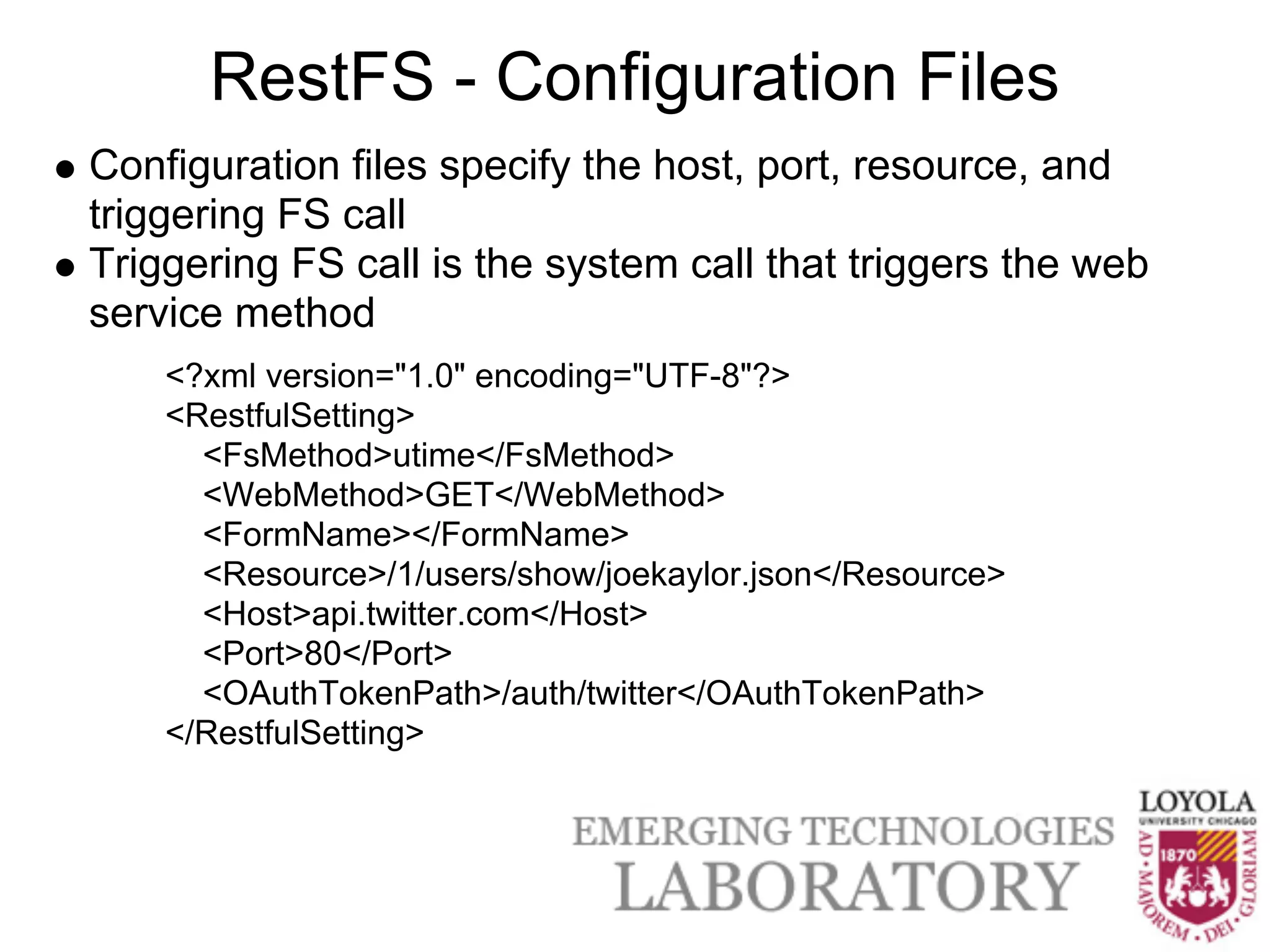
Configuration files specify the host, port, resource, and
triggering FS call
Triggering FS call is the system call that triggers the web
service method
    <?xml version="1.0" encoding="UTF-8"?>
    <RestfulSetting>
      <FsMethod>utime</FsMethod>
      <WebMethod>GET</WebMethod>
      <FormName></FormName>
      <Resource>/1/users/show/joekaylor.json</Resource>
      <Host>api.twitter.com</Host>
      <Port>80</Port>
      <OAuthTokenPath>/auth/twitter</OAuthTokenPath>
    </RestfulSetting>
RestFS - Resource Files
Programs can read and write to resource files in a normal
way
When the triggering filesystem system call is issued on the
resource file a HTTP method call will be issued.
If the resource file contains data, it will be sent along with
the call
The response will be written back to the resource file
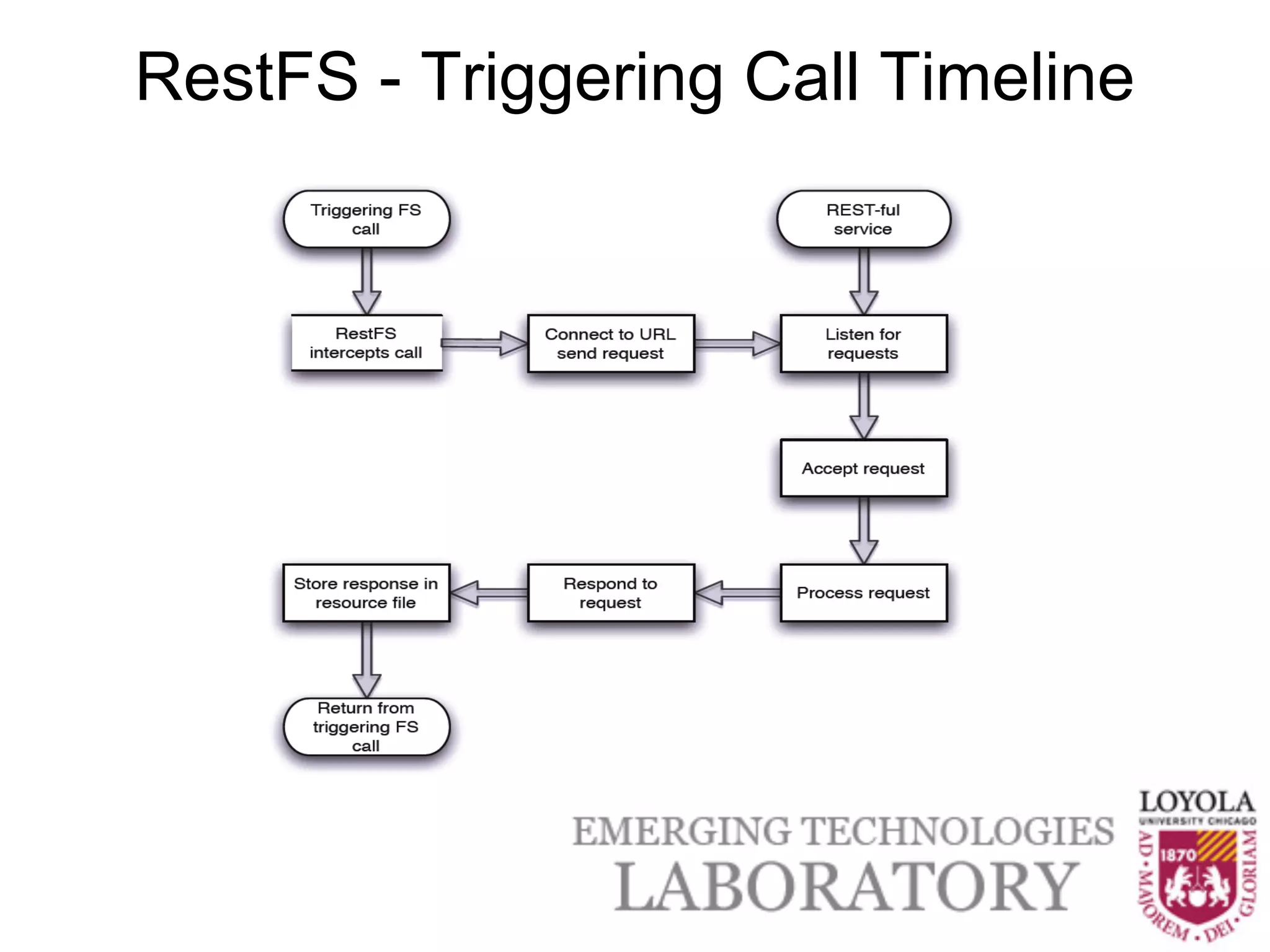
RestFS - Triggering Call Timeline
OAuth Authentication in RestFS
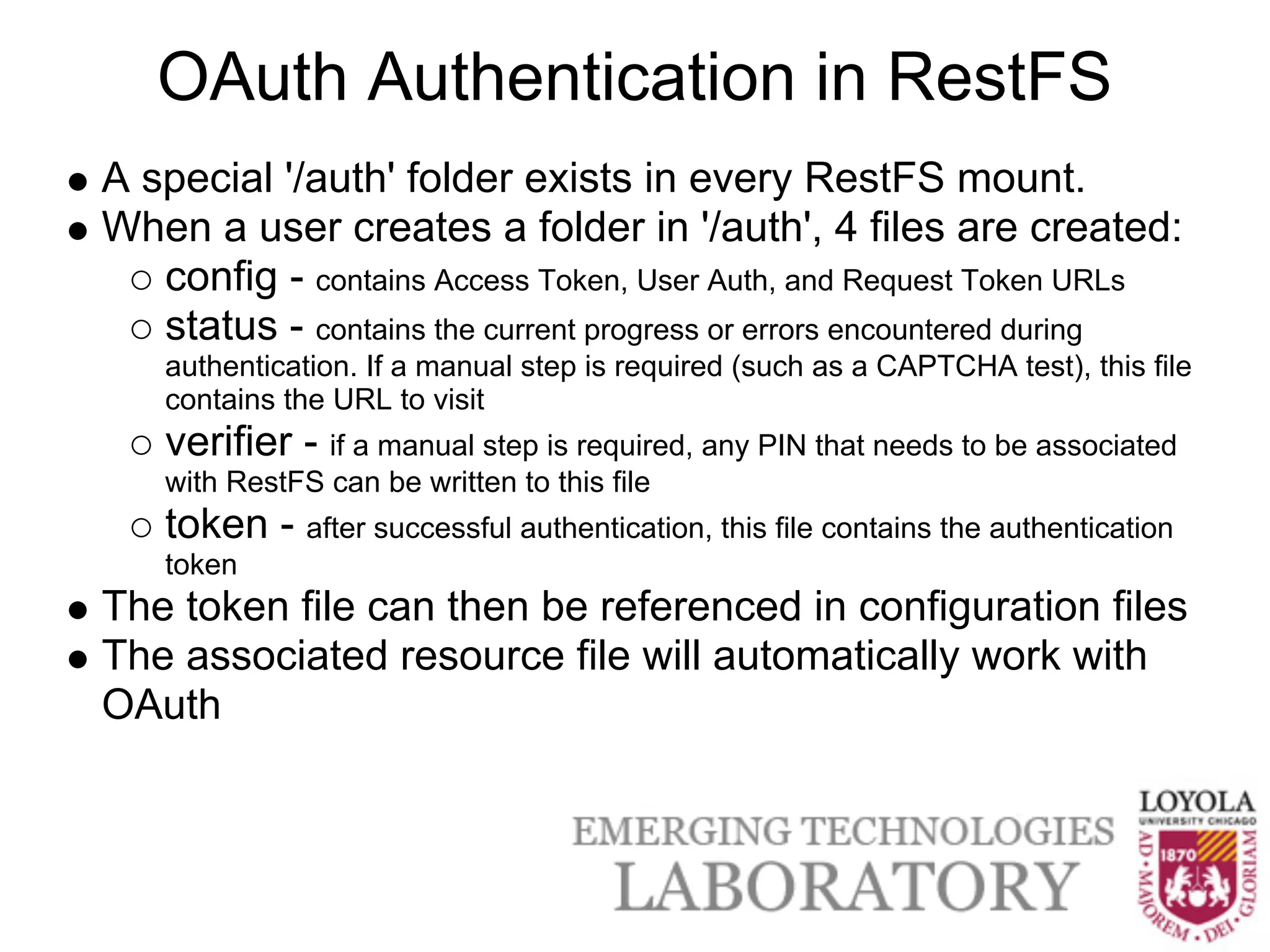
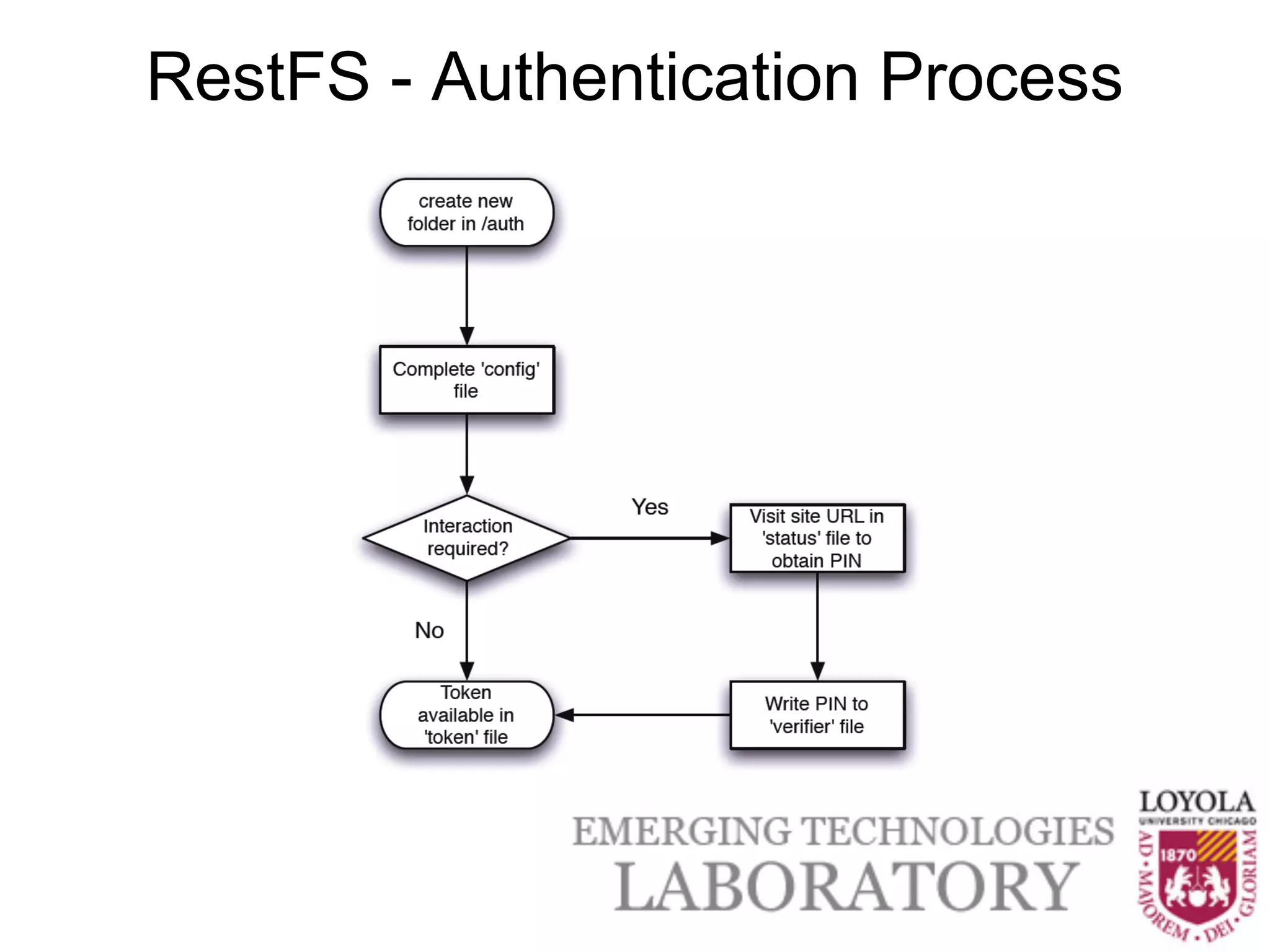
A special '/auth' folder exists in every RestFS mount.
When a user creates a folder in '/auth', 4 files are created:
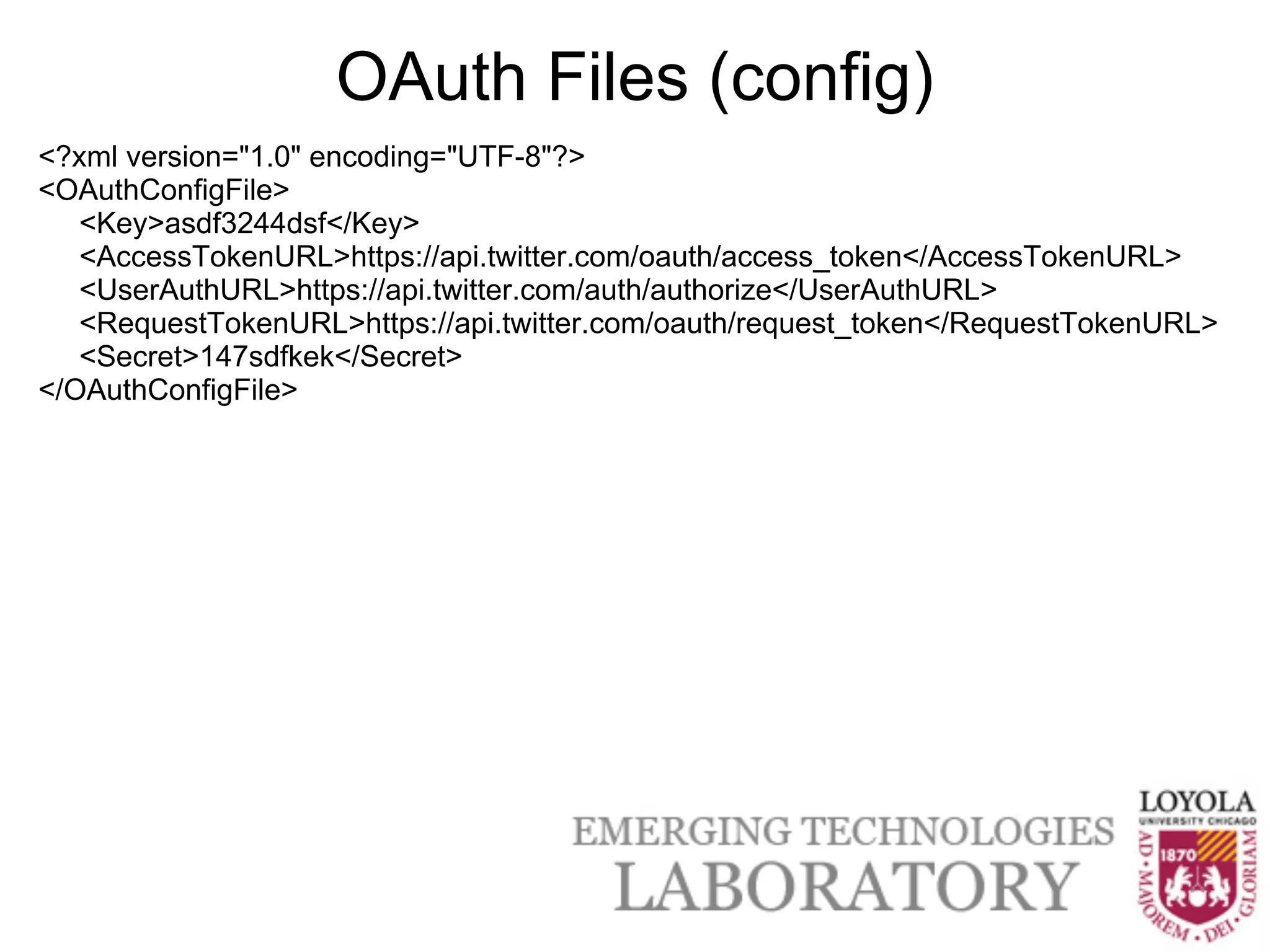
   config - contains Access Token, User Auth, and Request Token URLs
   status - contains the current progress or errors encountered during
    authentication. If a manual step is required (such as a CAPTCHA test), this file
    contains the URL to visit
    verifier - if a manual step is required, any PIN that needs to be associated
    with RestFS can be written to this file
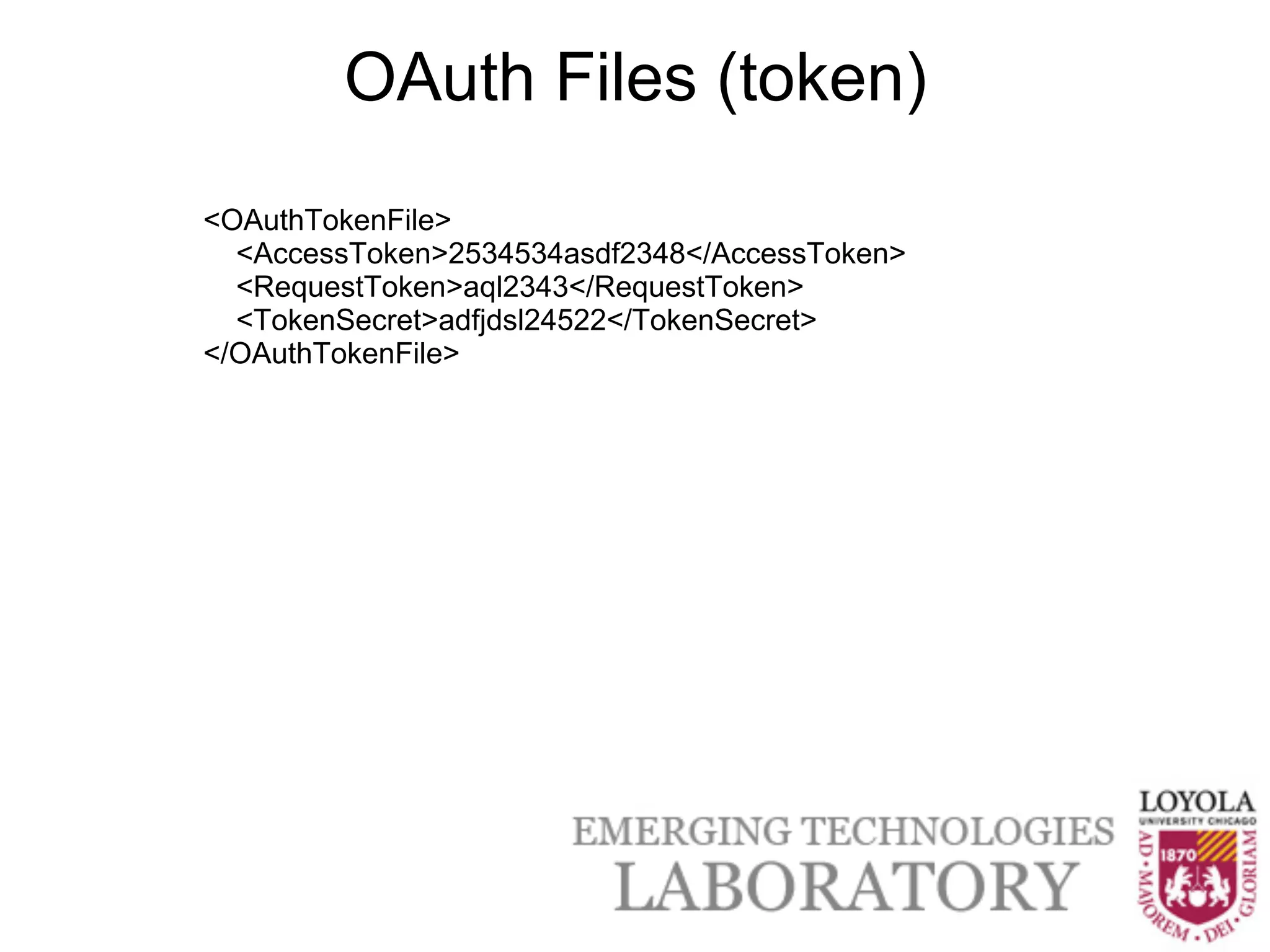
    token - after successful authentication, this file contains the authentication
    token
The token file can then be referenced in configuration files
The associated resource file will automatically work with
OAuth
RestFS - Authentication Process
OAuth Files (config)
<?xml version="1.0" encoding="UTF-8"?>
<OAuthConfigFile>
   <Key>asdf3244dsf</Key>
   <AccessTokenURL>https://api.twitter.com/oauth/access_token</AccessTokenURL>
   <UserAuthURL>https://api.twitter.com/auth/authorize</UserAuthURL>
   <RequestTokenURL>https://api.twitter.com/oauth/request_token</RequestTokenURL>
   <Secret>147sdfkek</Secret>
</OAuthConfigFile>
OAuth Files (token)
<OAuthTokenFile>
  <AccessToken>2534534asdf2348</AccessToken>
  <RequestToken>aql2343</RequestToken>
  <TokenSecret>adfjdsl24522</TokenSecret>
</OAuthTokenFile>
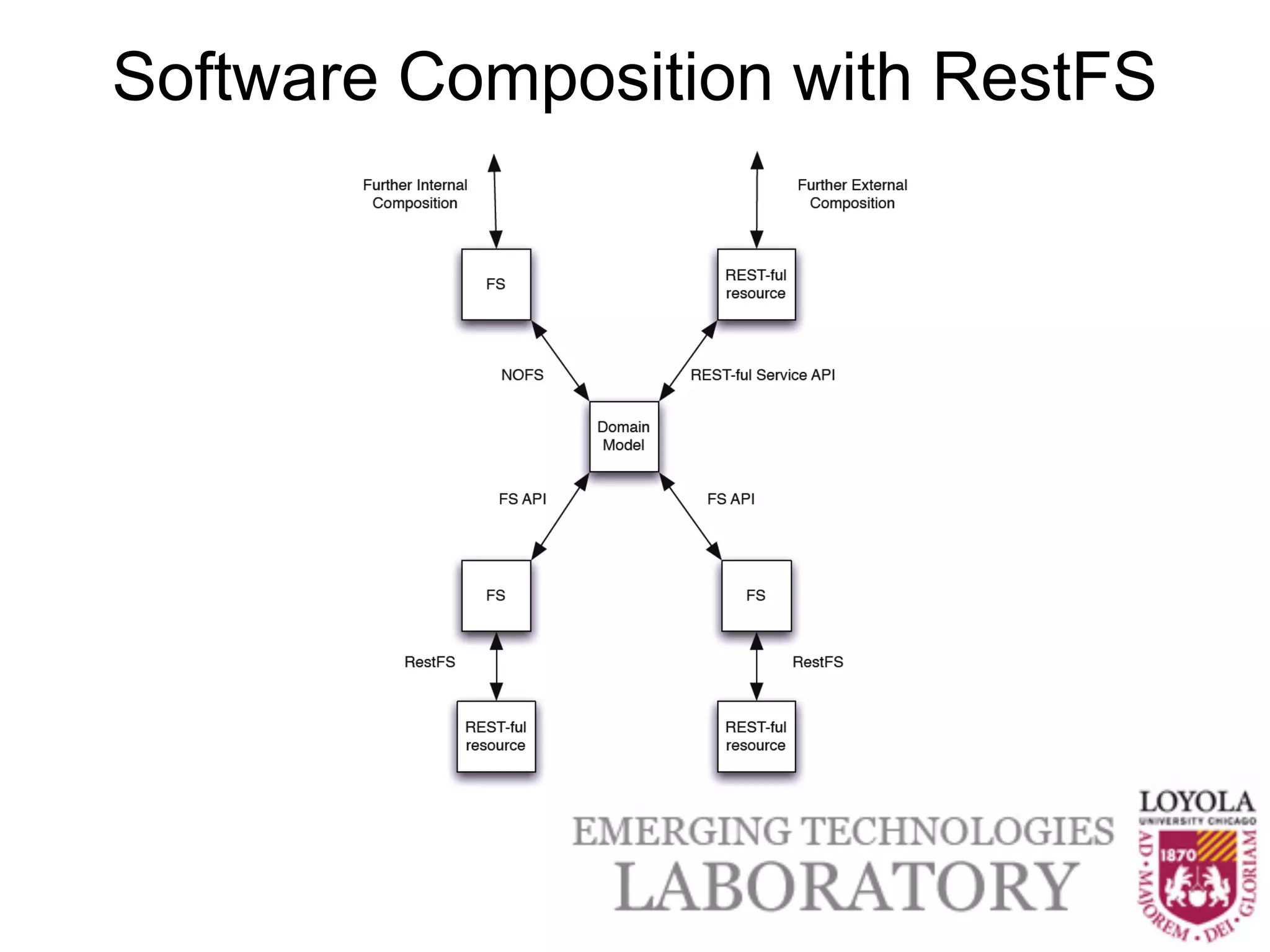
Software Composition with RestFS
With RestFS, it is possible to compose remote web services
with local software
This software can then be recomposed into new RESTful
web services or other local software compositions
Can allow many computers to participate in local software
compositions of a RESTful service by mounting a RestFS
volume as a network filesystem over Samba or NFS
Software Composition with RestFS
Demonstrations
Google Search
Yahoo! Place Finder
Twitter

RestFS: Resources and Services are Filesystems, Too

  • 1.
    RestFS: Resources and Servicesare Filesystems, Too Joe Kaylor, Konstantin Läufer, George K. Thiruvathukal
  • 2.
    Presentation Outline Motivation Web servicecomposition Local machine software composition Inter Process Communication Bridging the Gap: RestFS The Filesystem as a Connector Layer Examples and exploration
  • 3.
    Motivation Currently, web servicescan be accessed through HTTP clients and HTTP libraries over network sockets While some web services are accessible over filesystem interfaces, there is no general support or uniform filesystem interface RestFS's goal is to provide a general filesystem interface to manage configuration, authentication, and interaction with RESTful web services
  • 4.
    Service Composition Mashups /Remixes WS-BPEL - Web Services Business Process Execution Language CORBA - Common Object Request Broker Architecture
  • 5.
    Local Software Composition Libraries Sharedfiles Pipes Domain Sockets Shared memory pages / memory mapped files
  • 6.
    Filesystems That Abstracta Web Service GmailFS - stores data in a GMail webmail account FlickrFS - abstracts the Flickr photo service as a filesystem (available on Ubuntu) davfs2 - a WebDAV filesystem
  • 7.
    Types of WebService Filesystems Application Filesystems - filesystems that provide convenient interfaces for programs to interact. A good example is FlickrFS presenting image files Object or storage abstraction - Using a web service as a storage location for a filesystem. Two good examples are GMailFS and SSHFS Connector filesystems - Filesystems that abstract a method of IPC or a network protocol. Two good examples are Plan 9's netfs and RestFS
  • 8.
    RestFS A connector filesystemthat provides a filesystem abstraction for RESTful web services Requests to and responses from web services are made through filesystem system calls Connections are initiated through manipulation of configuration files in the filesystem OAuth authentication can be established by manipulating authentication files
  • 9.
    RestFS - ConfigurationFiles Configuration files specify the host, port, resource, and triggering FS call Triggering FS call is the system call that triggers the web service method <?xml version="1.0" encoding="UTF-8"?> <RestfulSetting> <FsMethod>utime</FsMethod> <WebMethod>GET</WebMethod> <FormName></FormName> <Resource>/1/users/show/joekaylor.json</Resource> <Host>api.twitter.com</Host> <Port>80</Port> <OAuthTokenPath>/auth/twitter</OAuthTokenPath> </RestfulSetting>
  • 10.
    RestFS - ResourceFiles Programs can read and write to resource files in a normal way When the triggering filesystem system call is issued on the resource file a HTTP method call will be issued. If the resource file contains data, it will be sent along with the call The response will be written back to the resource file
  • 11.
    RestFS - TriggeringCall Timeline
  • 12.
    OAuth Authentication inRestFS A special '/auth' folder exists in every RestFS mount. When a user creates a folder in '/auth', 4 files are created: config - contains Access Token, User Auth, and Request Token URLs status - contains the current progress or errors encountered during authentication. If a manual step is required (such as a CAPTCHA test), this file contains the URL to visit verifier - if a manual step is required, any PIN that needs to be associated with RestFS can be written to this file token - after successful authentication, this file contains the authentication token The token file can then be referenced in configuration files The associated resource file will automatically work with OAuth
  • 13.
  • 14.
    OAuth Files (config) <?xmlversion="1.0" encoding="UTF-8"?> <OAuthConfigFile> <Key>asdf3244dsf</Key> <AccessTokenURL>https://api.twitter.com/oauth/access_token</AccessTokenURL> <UserAuthURL>https://api.twitter.com/auth/authorize</UserAuthURL> <RequestTokenURL>https://api.twitter.com/oauth/request_token</RequestTokenURL> <Secret>147sdfkek</Secret> </OAuthConfigFile>
  • 15.
    OAuth Files (token) <OAuthTokenFile> <AccessToken>2534534asdf2348</AccessToken> <RequestToken>aql2343</RequestToken> <TokenSecret>adfjdsl24522</TokenSecret> </OAuthTokenFile>
  • 16.
    Software Composition withRestFS With RestFS, it is possible to compose remote web services with local software This software can then be recomposed into new RESTful web services or other local software compositions Can allow many computers to participate in local software compositions of a RESTful service by mounting a RestFS volume as a network filesystem over Samba or NFS
  • 17.
  • 18.