Coalition Building In Real Communities Virginia Health Equity Conference, September 11, 2009 Amy Paulson Consortium for Infant & Child Health Eastern Virginia Medical School
Describe community-based participatory approaches & application in communities Differentiate between coalition approach & other types of partnership approaches Explain challenges & benefits of coalition building in real world Discuss impact of individual & community factors on coalition building


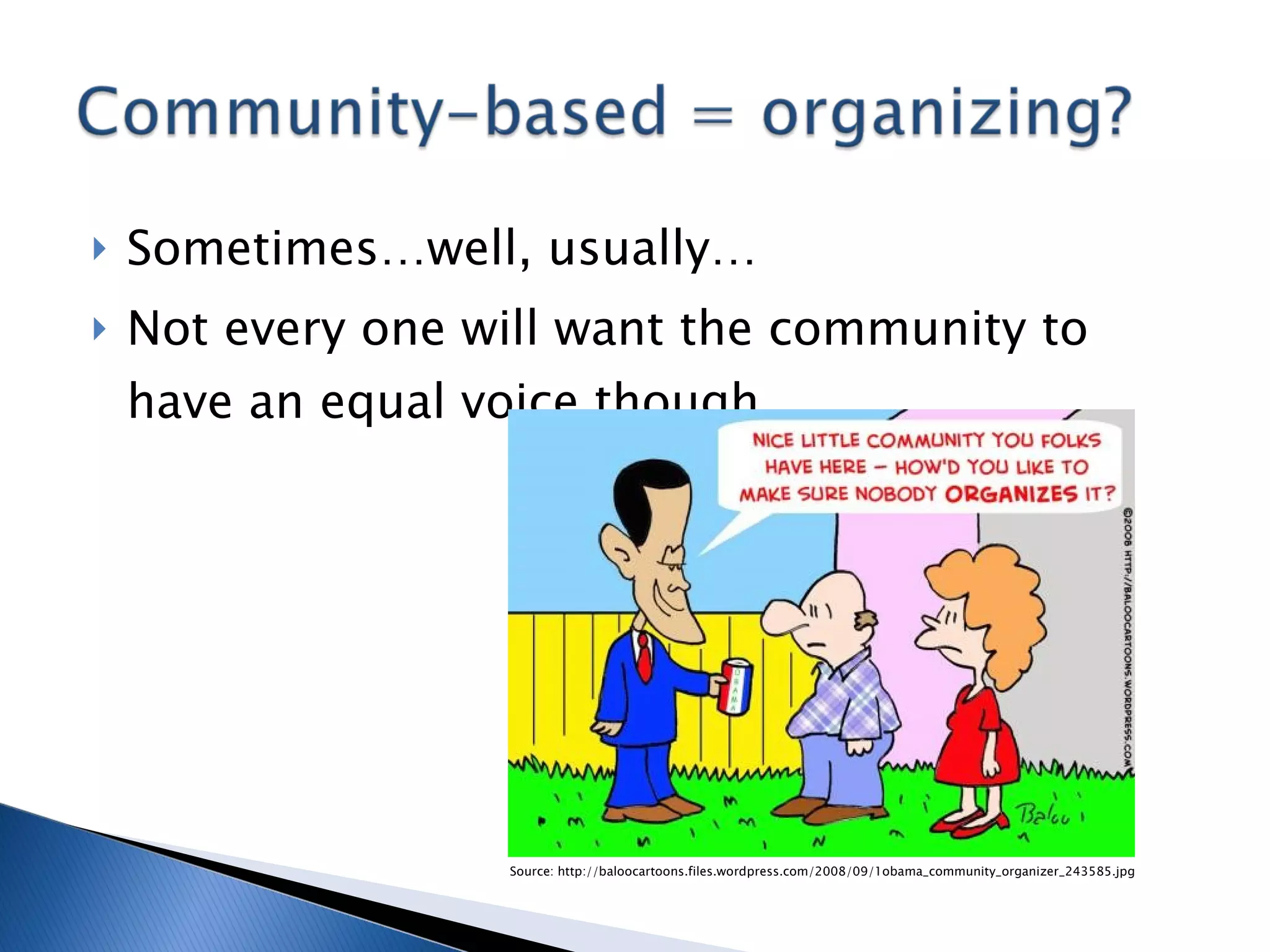
Sometimes…well, usually… Not every one will want the community to have an equal voice though Source: http://baloocartoons.files.wordpress.com/2008/09/1obama_community_organizer_243585.jpg
Equal partnership b/t “trained experts” & members of community in working on community health problems Community-based participatory research is a  "collaborative approach to research that equitably involves all partners in the research process and recognizes the unique strengths that each brings. CBPR begins with a research topic of importance to the community, has the aim of combining knowledge with action and achieving social change to improve health outcomes and eliminate health disparities."  ~ WK Kellogg Foundation Community Health Scholars Program
Recognizes community as unit of identity Builds on strengths & resources of community Facilitates collaborative, equitable partnerships, learning, & capacity building throughout process Emphasizes local relevance of public health problems and ecological perspectives that recognize the multiple determinants of health Disseminates and involves all partners in findings & knowledge gained Includes a long term process and focus on systems development Source: Israel, et al (2003), Community-Based Participatory Research for Health
Involve the community in all phases Shared responsibility & ownership Action oriented Community-focused & relevant Tangible outcomes Development of knowledge linked to action, change, or advocacy Recognize that  EVERYONE  has something to give to the process
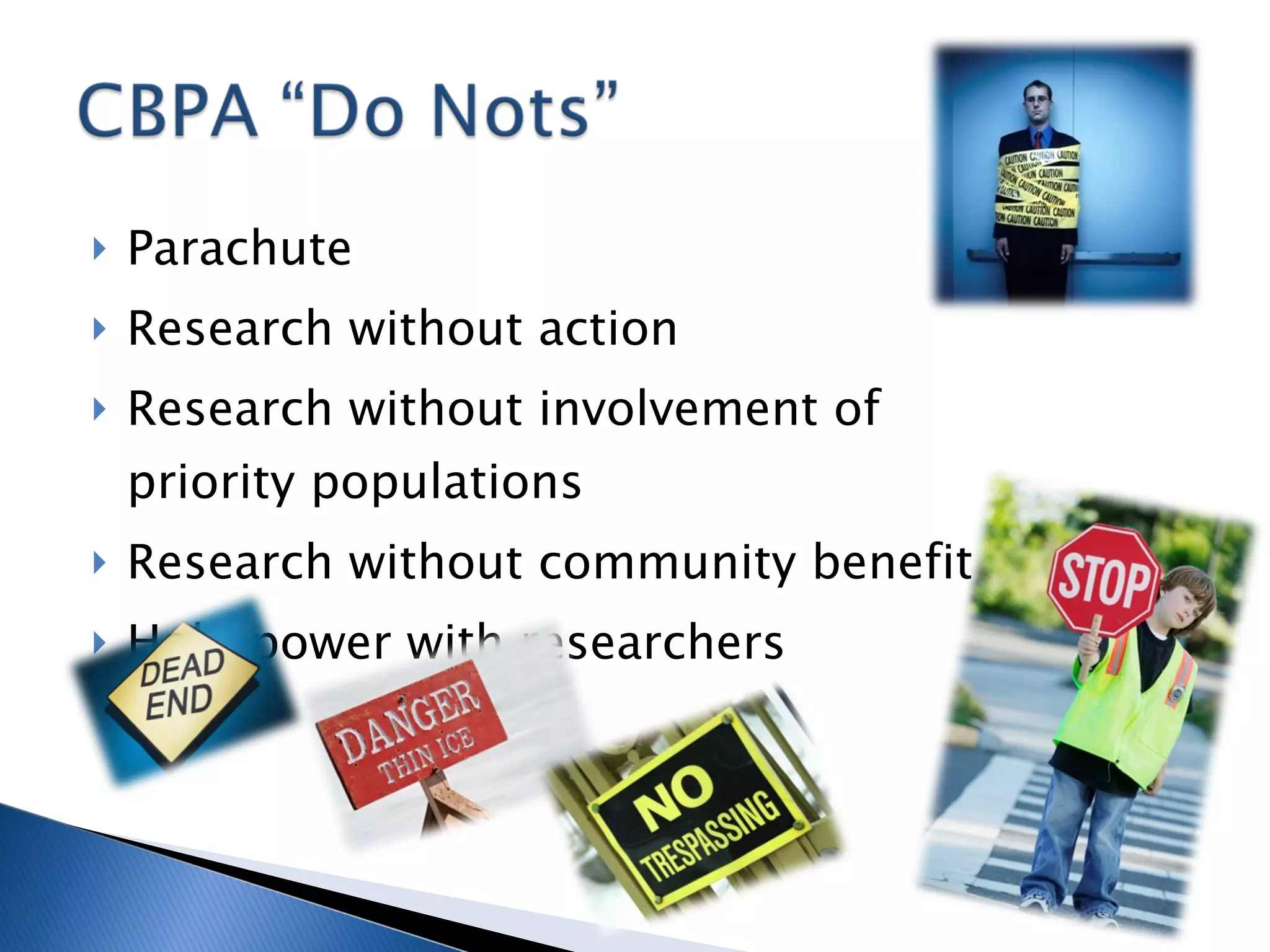
Parachute Research without action Research without involvement of priority populations Research without community benefit Hold power with researchers
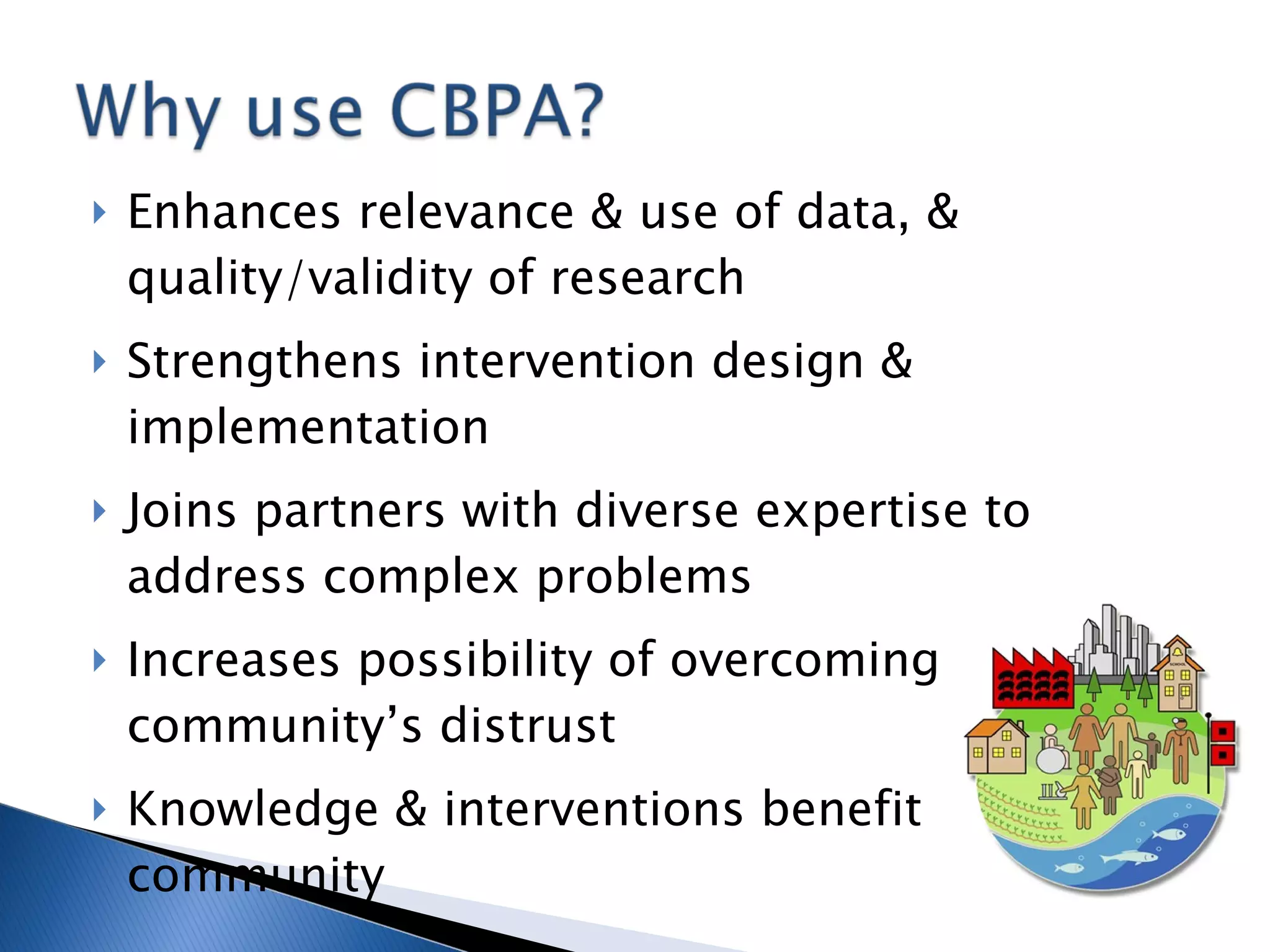
Enhances relevance & use of data, & quality/validity of research Strengthens intervention design & implementation Joins partners with diverse expertise to address complex problems Increases possibility of overcoming community’s distrust Knowledge & interventions benefit community
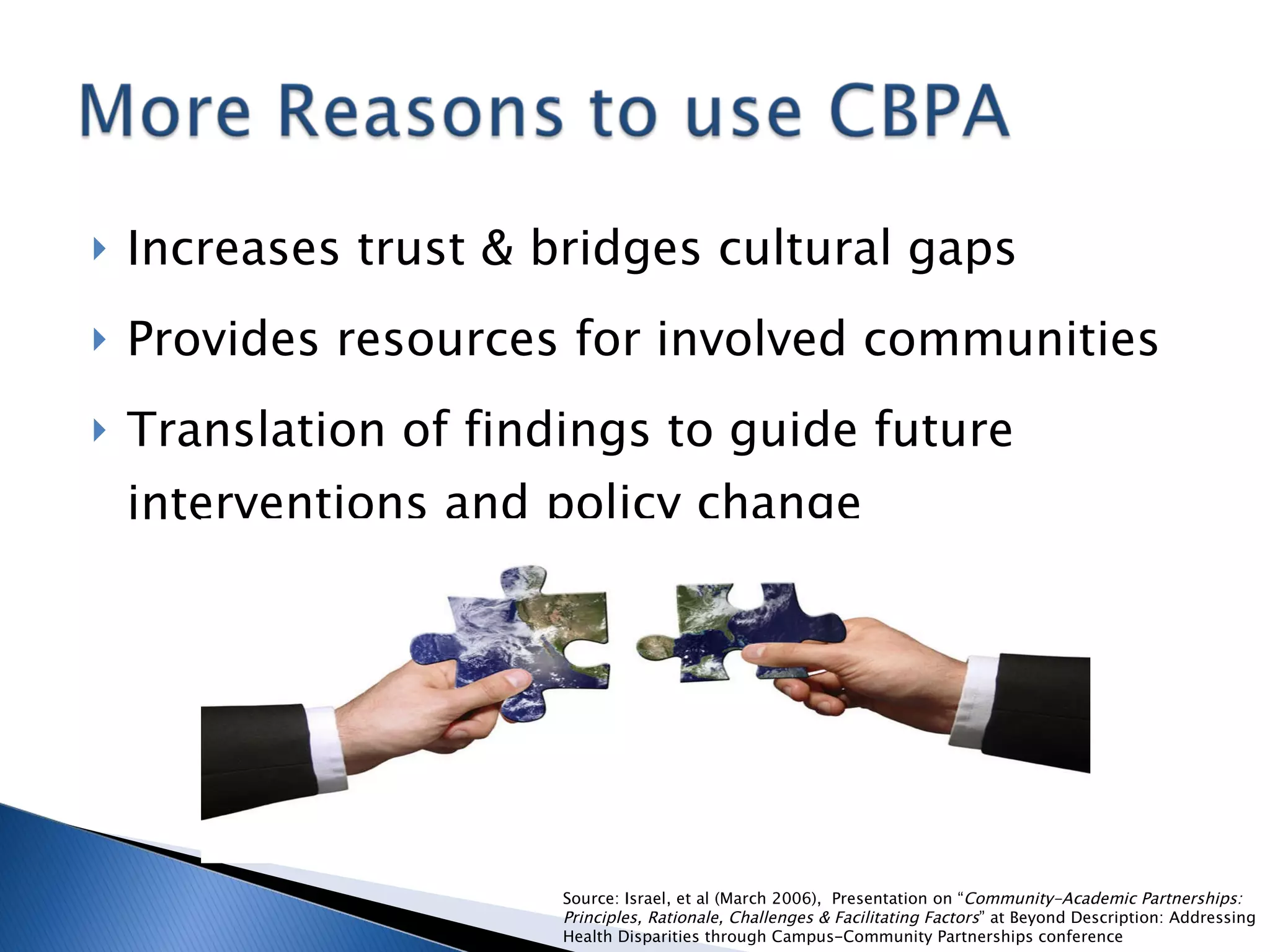
Increases trust & bridges cultural gaps Provides resources for involved communities Translation of findings to guide future interventions and policy change Source: Israel, et al (March 2006),  Presentation on “ Community-Academic Partnerships:  Principles, Rationale, Challenges & Facilitating Factors ” at Beyond Description: Addressing Health Disparities through Campus-Community Partnerships conference
Historical context Cultural respect & trust building Identifying & overcoming obstacles Power exchange Differing agendas Personalities
 
 
Coalitions bring people together Coalitions negotiate through agendas, personalities, and competing interests Coalitions can be used to successfully move forward CBPA Coalitions respect & utilize the key principles of CPBA
 
Union of people & organizations working to influence outcomes on specific problem “Organization of Organizations” united around common issue & clear goals Group of concerned citizens &/or organizations working together to facilitate community change
People with common interest Purpose is specific, yet inclusive It’s about systems change Diverse groups combining resources to create change Usually has formal structure, but doesn’t always start that way Has a lifecycle – like a business
Community investment creates action It’s about systems & policy change Diverse groups combining resource Usually impacts populations not “just individuals” Theory & literature supports coalition approaches! Best outcomes with evidence-based approaches
Are not usually coalitions Sometimes have unequal power More limited community involvement Predetermined agenda Limited shared decision making Appointed memberships as opposed to open Usually time limited & action oriented to detriment of community involvement  Can accomplish many of same goals – often look & function a lot like coalitions
Time involved Action directed – usually – by majority or consensus Success often tied to effective leadership Success can sometimes happen DESPITE ineffective leadership Members MUST be invested
Strength in numbers – unified voice Bigger reach Resources Increased variety Sharing conserves & increases Diversity in experience & expertise Credibility & trust "The achievements of an organization are the result of the combined effort of each individual." Vincent T. Lombardi
Lack of direction or focus Turf battles & competition History Failure to plan &/or act Dominance by professionals Poor links to the community Minimal organizational capacity
Funding - too much or too little Failure to develop, maintain, rotate leadership Unequal sharing of responsibility & decision-making Time & loyalty conflicts Lack of on-going staff/member training Burnout or unrealistic demands on members/staff Source: Butterfoss, 1995; Kaye & Wolfe, 1995 .
Source: http://www.metacafe.com/watch/66347/cat_herding/
Don’t feel included Disagree with leadership style Group personality Group productivity Conflict with individuals within group
Feel included Are making contribution to group Feel comfortable with group personality, leadership, & members Feel group is accomplishing goals Group meets personal need
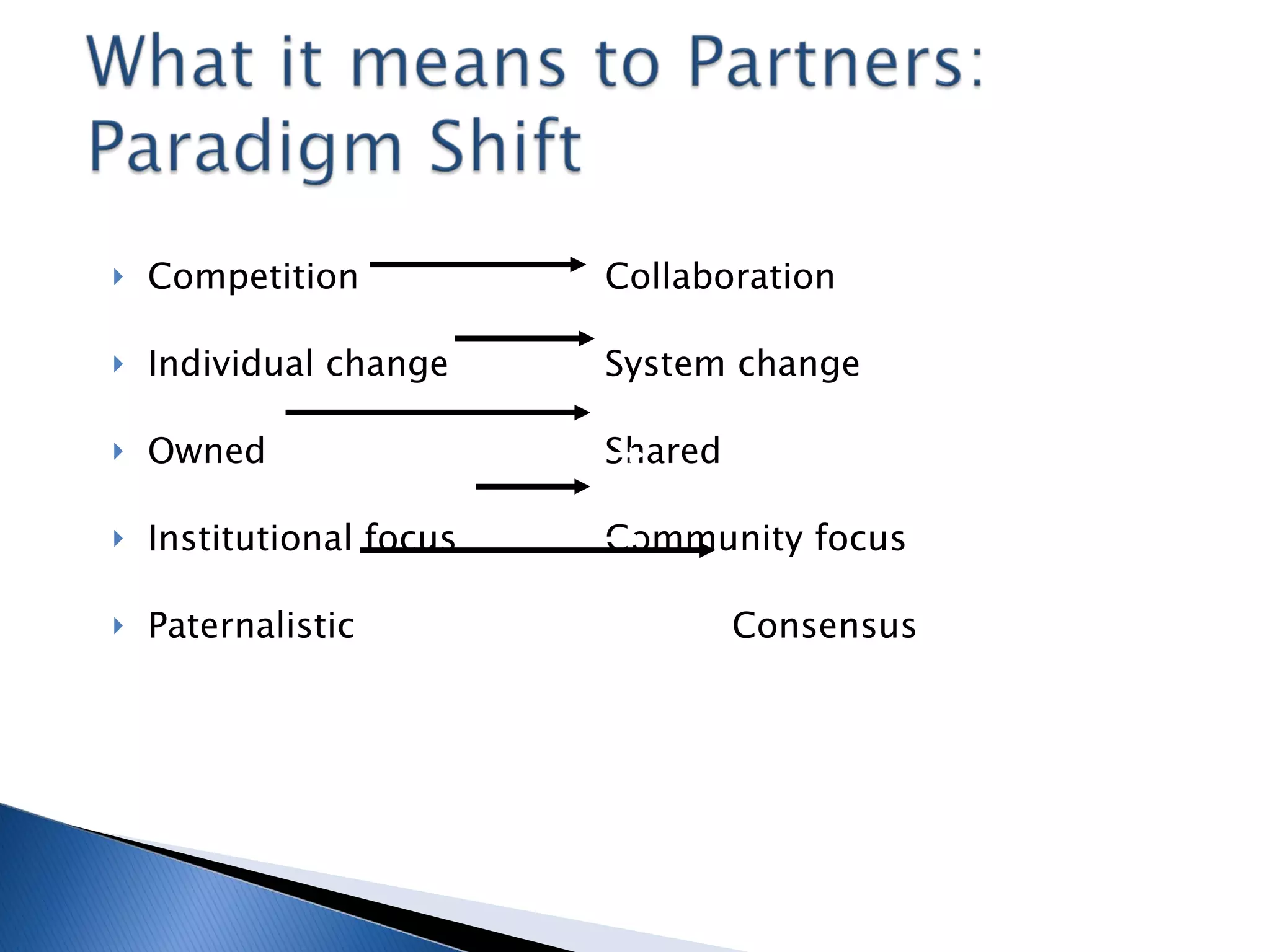
Competition  Collaboration Individual change System change Owned  Shared Institutional focus Community focus Paternalistic Consensus
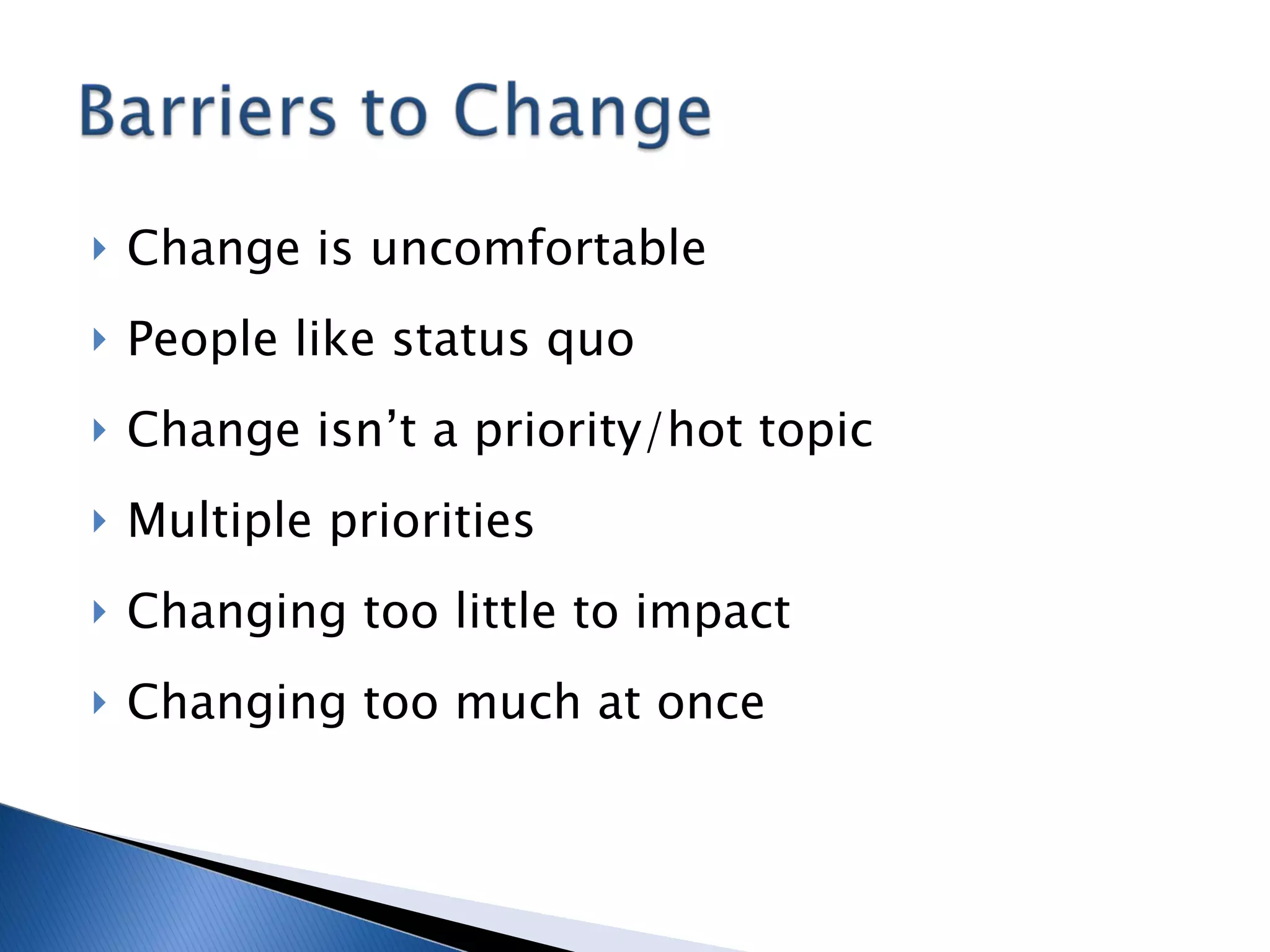
Change is uncomfortable People like status quo Change isn’t a priority/hot topic Multiple priorities Changing too little to impact Changing too much at once
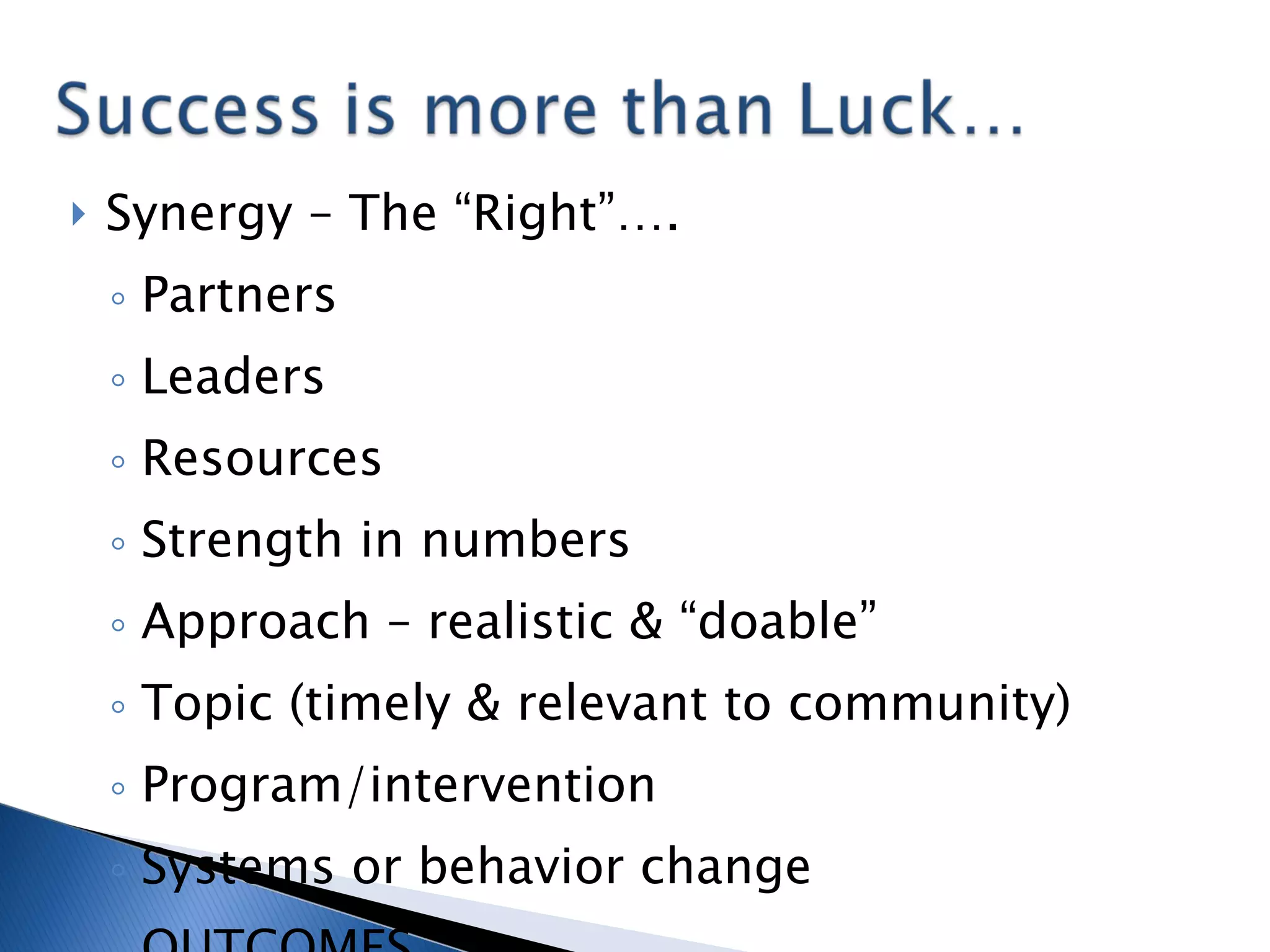
Synergy – The “Right”….  Partners Leaders Resources Strength in numbers Approach – realistic & “doable” Topic (timely & relevant to community) Program/intervention Systems or behavior change OUTCOMES
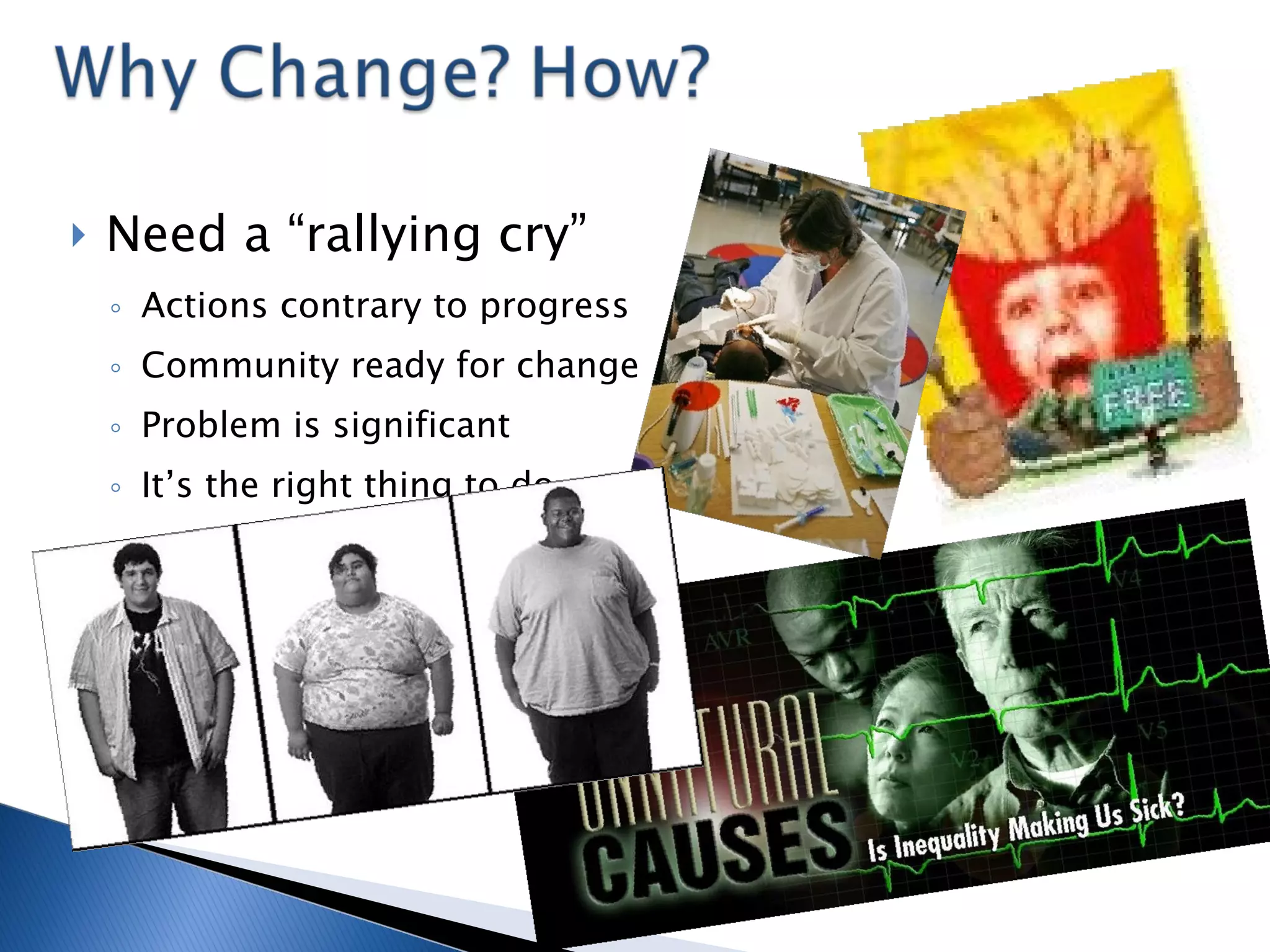
Need a “rallying cry” Actions contrary to progress Community ready for change Problem is significant It’s the right thing to do
Individuals Groups Organizations Systems/Policy
 
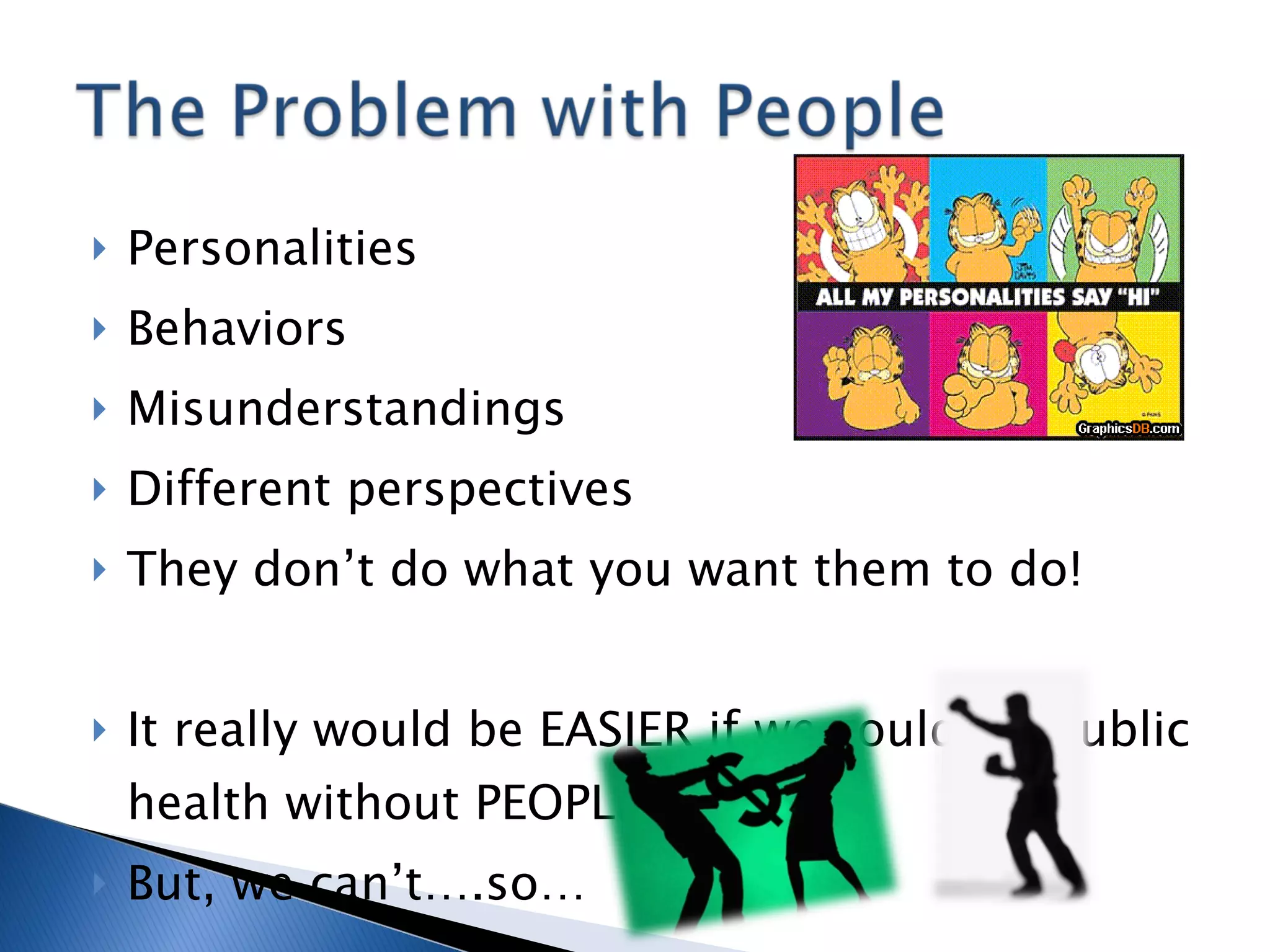
Personalities Behaviors Misunderstandings Different perspectives They don’t do what you want them to do! It really would be EASIER if we could do public health without PEOPLE! But, we can’t….so…
 
 
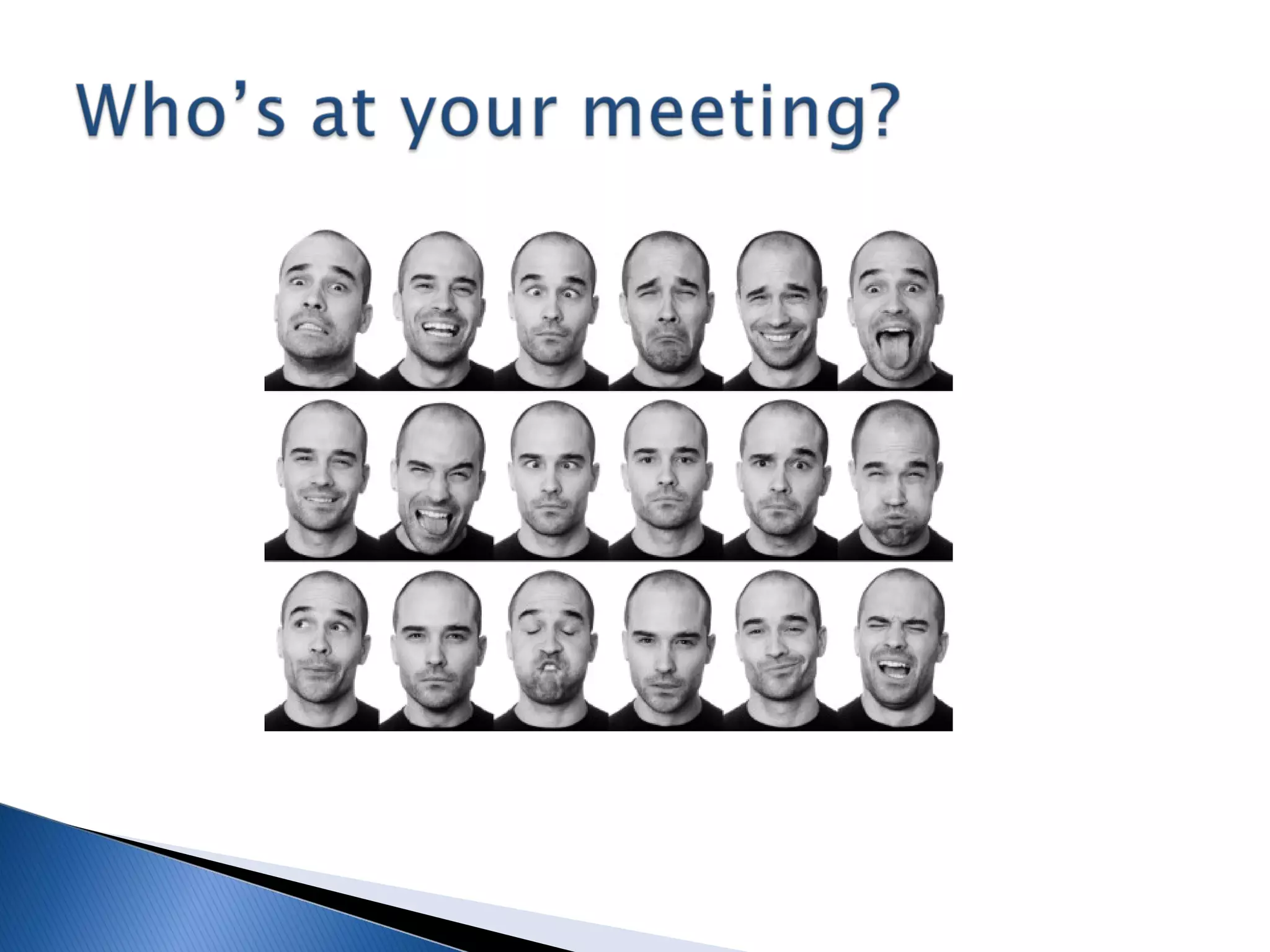
The member who wouldn’t shut up The member who was crazy The member who wanted to be in charge, but wasn’t The leader who wasn’t leading The member who never says anything The member who thinks all ideas are bad The member that wanted to get paid
Coalition experiences are people intensive Personalities make or break coalitions People leave or stay based on dynamics Healthy dynamics promote good outcomes Healthy dynamics produce lasting partnerships
Members must understand role Members must understand mission Unfulfilled expectations can impact experience & dynamics Misunderstanding expectations can lead to disruptive group interactions
Recruitment Referral Resource development, distribution & access Networking Collaboration for access to populations, funds, services, or resources
Advocacy  Systems Change Resource identification, development, dissemination Gaps in service/education Tasks needing collaboration or agreement among partners Communication campaigns – public awareness
Understand all members will not participate at same level Individual participation may fluctuate Members with lower levels of participation may be specialists, gatekeepers, or people with influence or power who are helpful when asked Shifting membership WILL impact dynamics Goal: Move Members to “Core”
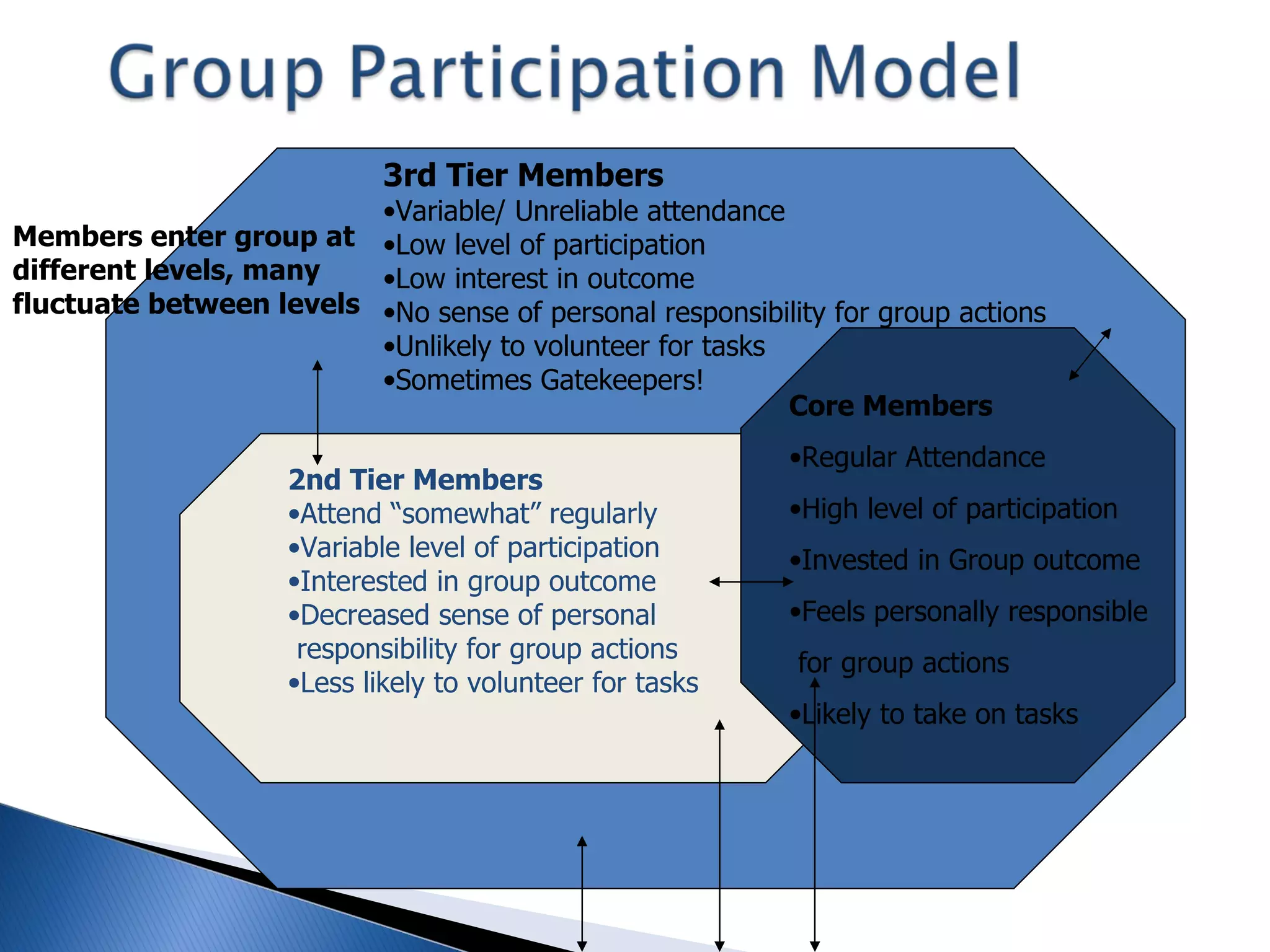
2nd Tier Members Attend “somewhat” regularly Variable level of participation Interested in group outcome  Decreased sense of personal  responsibility for group actions Less likely to volunteer for tasks Core Members Regular Attendance High level of participation Invested in Group outcome Feels personally responsible for group actions Likely to take on tasks Members enter group at different levels, many fluctuate between levels 3rd Tier Members Variable/ Unreliable attendance Low level of participation Low interest in outcome No sense of personal responsibility for group actions Unlikely to volunteer for tasks Sometimes Gatekeepers!
Find group whose “personality” does not run contrary to your own Be prepared to “shake things up” if you feel nothing is being accomplished Address group habits early, before problems arise “ I would never belong to a group that would accept someone like me as a member.”  ~Groucho Marx
Are we all on the same page? Can we all come behind one agenda? Do we all agree with the mission? Are there ground rules?  Can we follow them? What do we do when rules aren’t followed? Are leaders leading? Are members participating appropriately? Do we know who is responsible for what? Do we know our role?
Staff Elected leaders Informal leaders Lead agency Member organizations Members – Reps vs. Individuals Need balance of power for success “ You do not lead by hitting people over the head - that's assault, not leadership.” ~Dwight D. Eisenhower
Leader Member Advisory Staff Trouble Maker  Other?
Leaders Members Advisory Staff Other?
Members Participate Influence Take on tasks Provide advice “ Do the work” Leaders Members Guide Keep people on task Adhere to agenda Provide feedback to staff Set the example Summarize Referee  
Will attend coalition meetings Formally agree with coalition mission Put coalition issues on own agenda, if an organization Commit financial resources, time or other in-kind services
Organizations have responsibility in regard to experience of members Members also have responsibly in regard to their participation in organization
Leave each meeting having contributed to group Follow basic etiquette in regards to participation Participating includes taking personal responsibility for outcomes of group
If you want members & leaders – develop them Use retreats, fun events, & small tasks to bring members to action Share wealth & ask good leaders to mentor other members Offer formal membership & leadership development sessions
Remember – coalitions are only as effective as their members are willing to invest of themselves in the work “ A child of five would understand this.  Send someone to fetch a child of five”   ~Groucho Marx
Members have rights – so do coalitions Encourage participation Defining membership & participation Individual & group personality types Sustainability (members & leaders) Conflict resolution
Leading is more than showing up Leaders have increased responsibility as member in terms of attendance, task assignment, & setting examples Leaders can be hard to find Good leaders are even harder to find  Some leaders are informal leaders
Facilitate Meetings Set Agendas Review Minutes Mediate conflicts Keep group on task Identify big picture issues and next steps Summarize LONG discussion and verbal agreements for decisions
Meeting management is VERY important Start on time/End on time ALWAYS Formal agenda with TIMES – stick to times! Send out agenda before meeting Rotate locations Minutes Review tasks from last meeting at start Review assignments before close Reminder to complete assignments sent before next meeting Elected leaders lead – not STAFF! Meeting effectiveness evaluations
Letting a member run away with your meeting Not starting/ending on time Too passive/dominating Avoids addressing “bad habits” Has bad habits & sets bad example Isn’t prepared for meeting “ I start with the premise that the function of leadership is to produce more leaders, not more followers.” ~Ralph Nader
Written guide for all reports required Leadership “job descriptions” Website with free guide to successful facilitation:  http://www.thiagi.com/tips.html Website with free leadership development tools, materials, & guides   http:// www.managementhelp.org / http://www.fullcirc.com/rlc/deveffectcoalitions.htm
Do you know your Mission/Goals? Do you understand your “rules”? Do people know what their role is? Is the group accomplishing anything? Has anyone asked the group what they like or dislike?
Promoting organizations Promoting self or pushing their “ideas” Trying to get paid from coalition work Competing partners Different ideas/perspectives Coalition “ownership”
Have Mission/Goals everyone can “buy into” Revisit mission when conflict arises Be clear about coalition ownership BEFORE you develop things – including publicity and products Use your agenda - Table discussions not relevant to “off line” Have your leader talk to the person 1:1
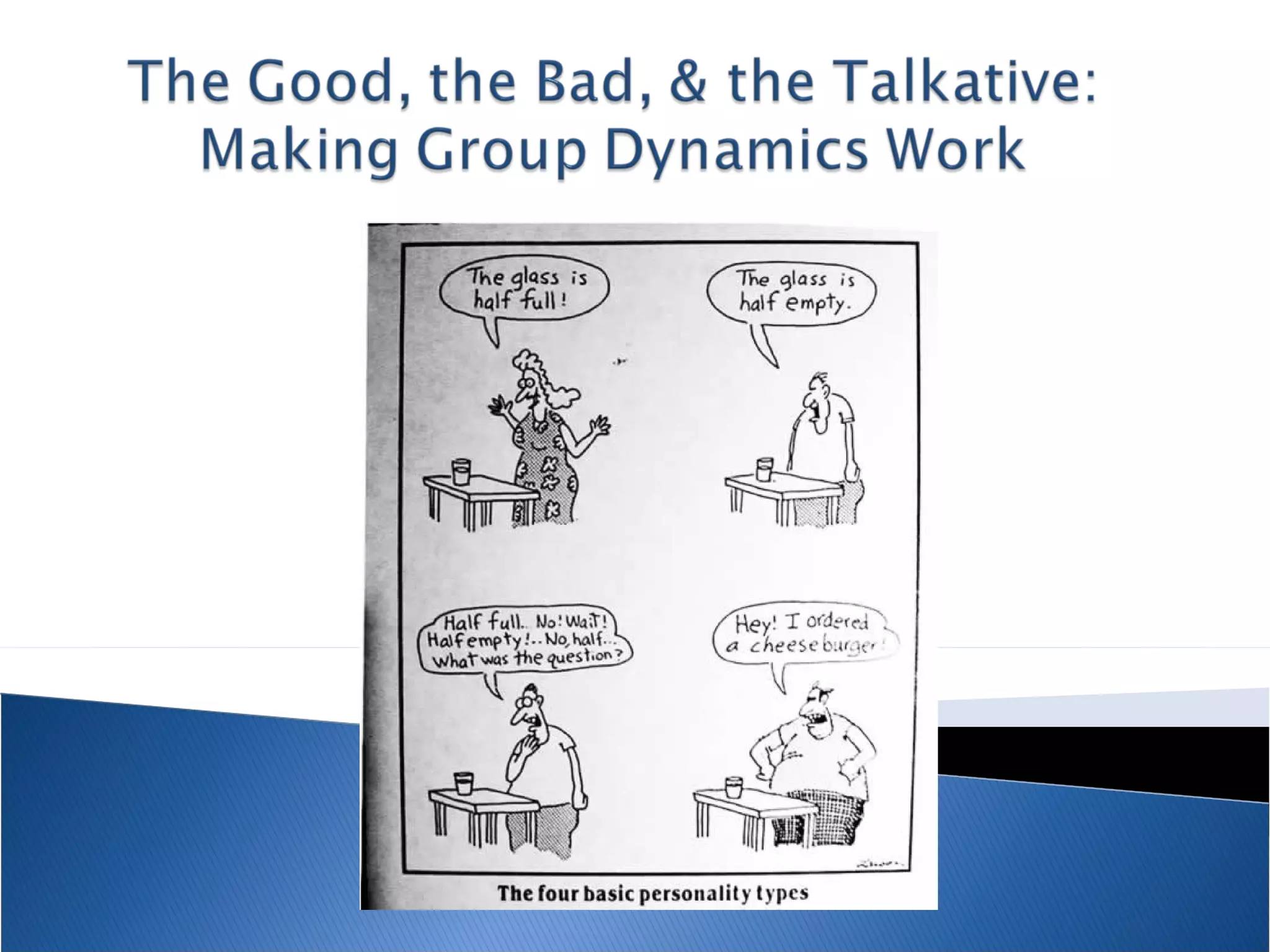
Member personalities play important role in “personality of group” All members are important, regardless of their strengths & weaknesses Identifying your member “type” may help to temper your more difficult attributes
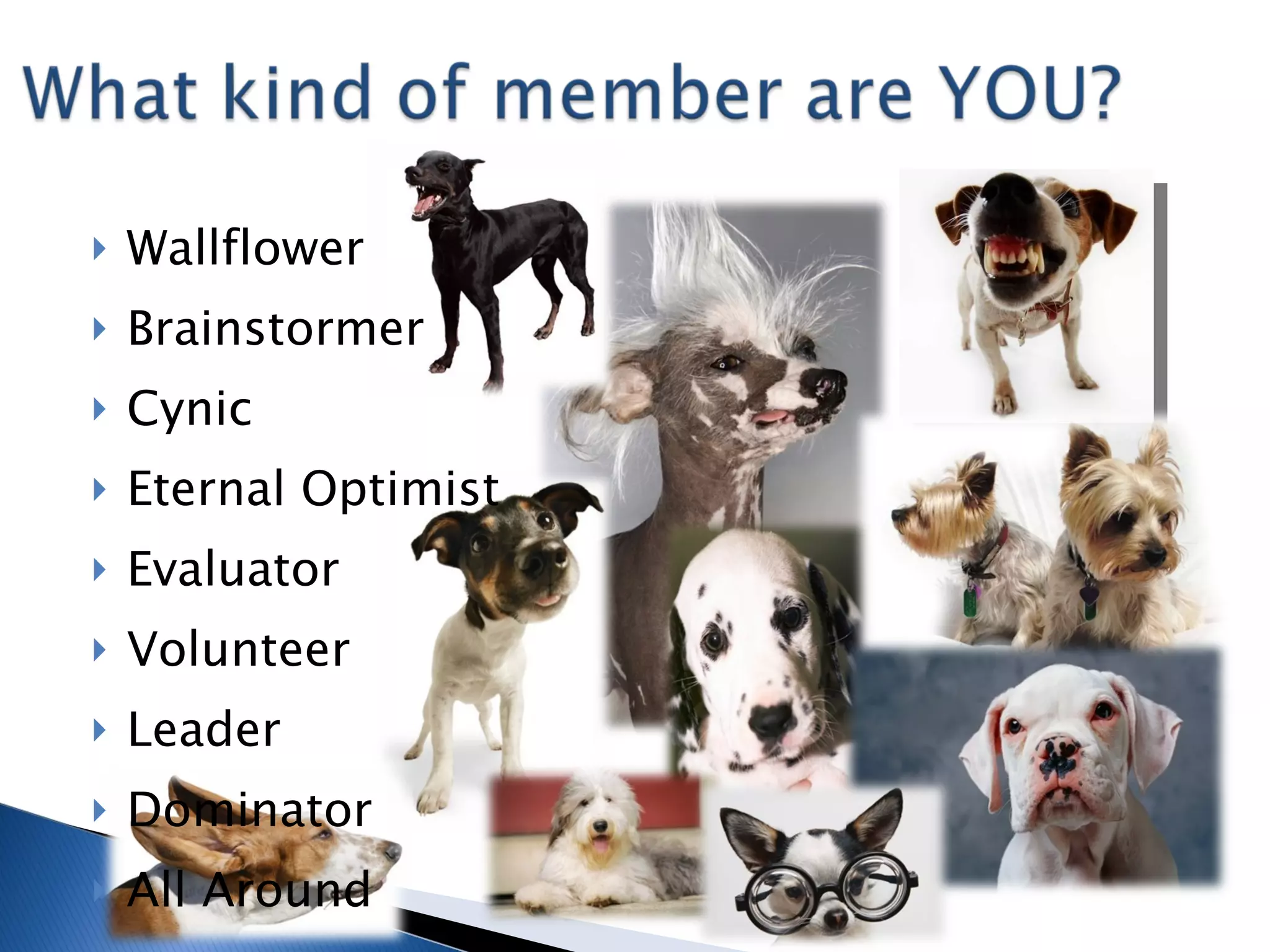
Wallflower Brainstormer Cynic Eternal Optimist Evaluator Volunteer Leader Dominator All Around
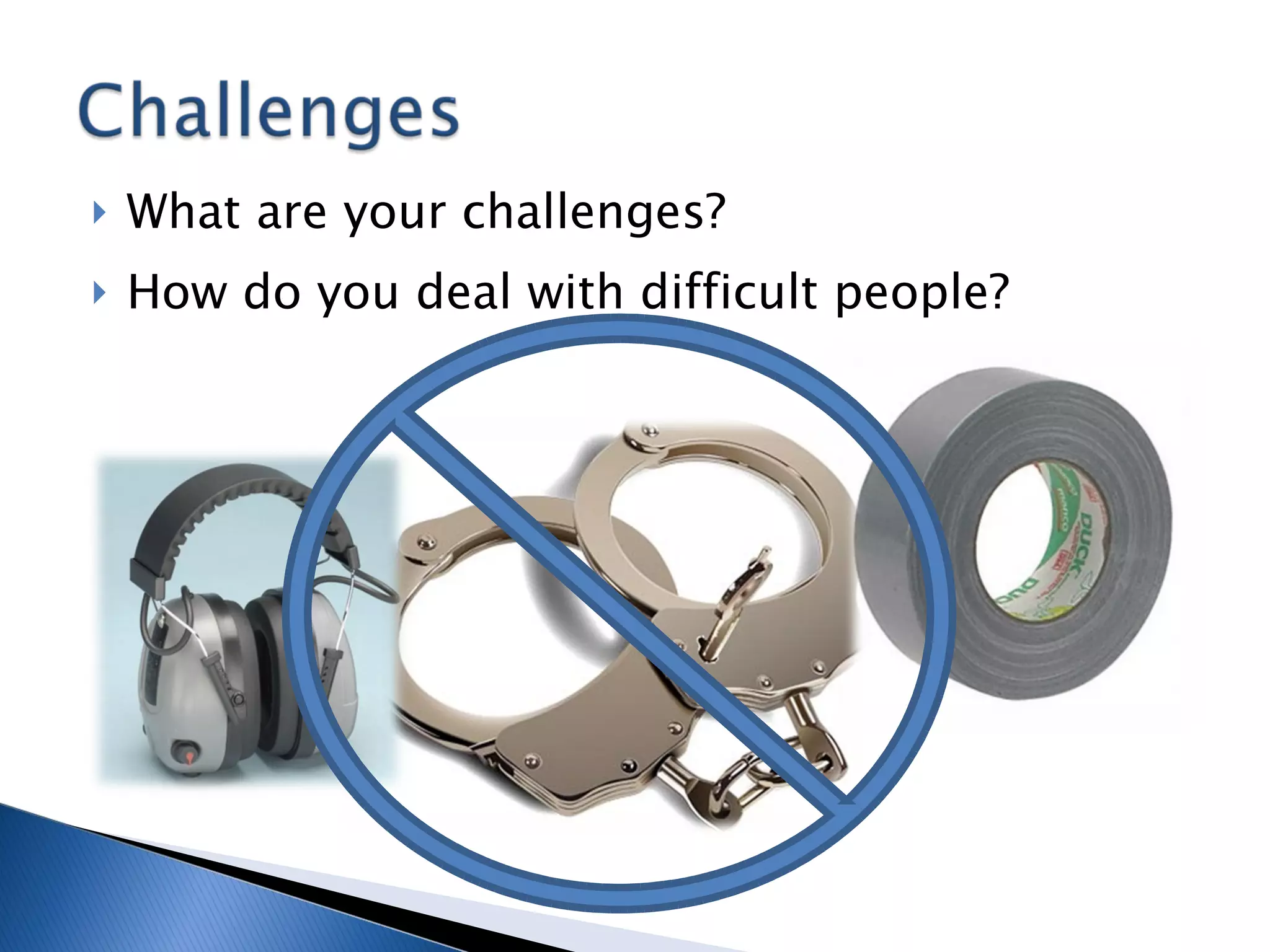
What are your challenges? How do you deal with difficult people?
Role plays! Discussion Ideas for dealing with “difficult people” “ Eventually we will find (mostly in retrospect, of course) that we can be very grateful to those people who have made life most difficult for us.” ~Ayya Khema
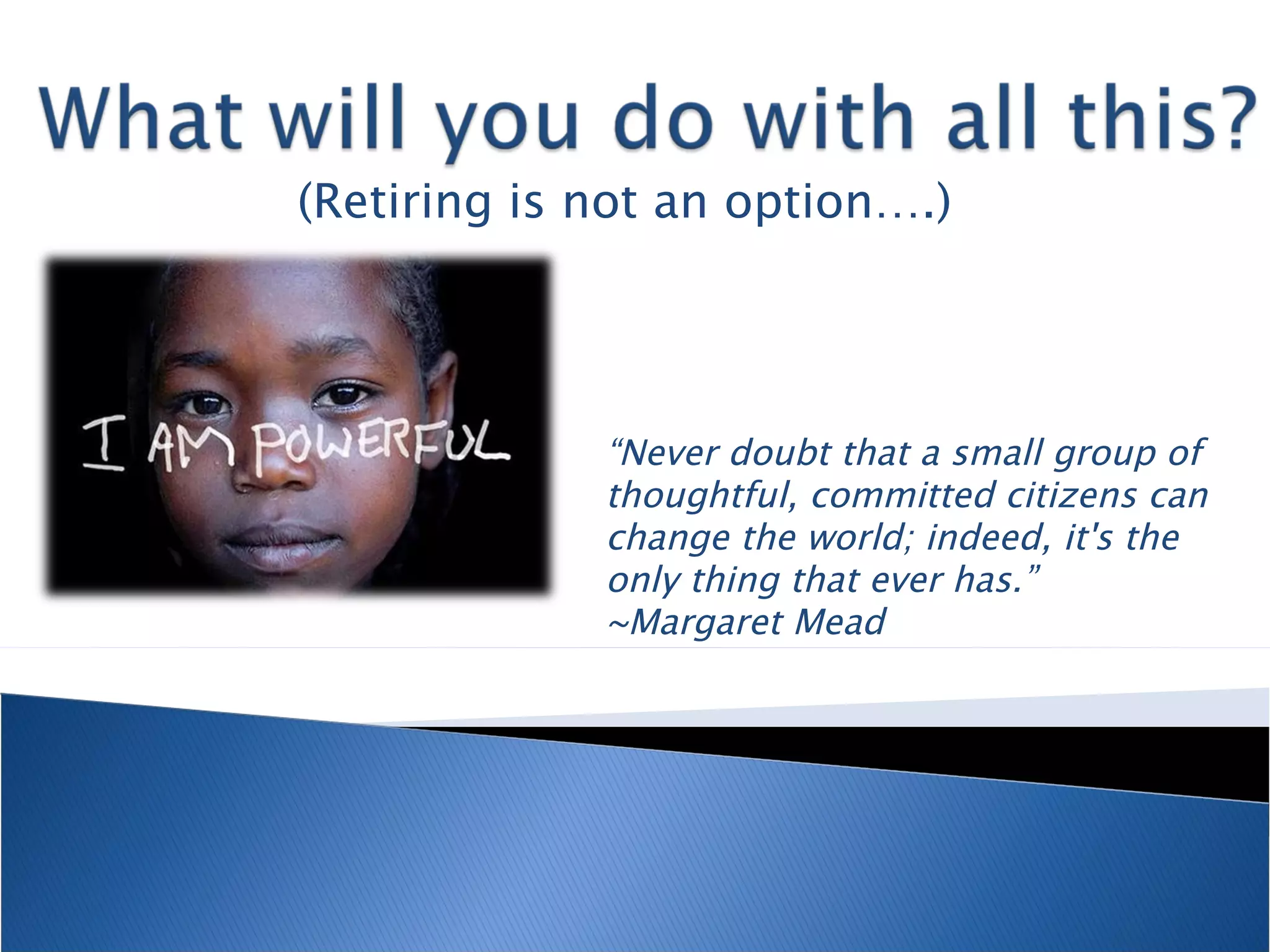
(Retiring is not an option….) “ Never doubt that a small group of thoughtful, committed citizens can change the world; indeed, it's the only thing that ever has.”  ~Margaret Mead
 
Coalitions Work www.coalitionswork.com   Community-Campus Partnerships for Health http:// depts.washington.edu/ccph/index.html   Annotated listing of CBPR articles, reports and websites was prepared by Community-Campus Partnerships for Health for the Robert Wood Johnson Clinical Scholars Program http://depts.washington.edu/ccph/pdf_files/rwjcsp-cbpr-resources.pdf   Speaking Truth, Creating Power: A Guide to Policy Work for Community-Based Participatory Research Practitioners http:// depts.washington.edu/ccph/pdf_files/ritas.pdf
Amy Paulson Director, Consortium for Infant & Child Health Instructor, Department of Pediatrics Eastern Virginia Medical School [email_address] 757-668-6458

Community-Based Participatory Approaches: Coalition Building in Real Communities

  • 1.
    Coalition Building InReal Communities Virginia Health Equity Conference, September 11, 2009 Amy Paulson Consortium for Infant & Child Health Eastern Virginia Medical School
  • 2.
    Describe community-based participatoryapproaches & application in communities Differentiate between coalition approach & other types of partnership approaches Explain challenges & benefits of coalition building in real world Discuss impact of individual & community factors on coalition building
  • 3.
  • 4.
  • 5.
  • 6.
    Sometimes…well, usually… Notevery one will want the community to have an equal voice though Source: http://baloocartoons.files.wordpress.com/2008/09/1obama_community_organizer_243585.jpg
  • 7.
    Equal partnership b/t“trained experts” & members of community in working on community health problems Community-based participatory research is a "collaborative approach to research that equitably involves all partners in the research process and recognizes the unique strengths that each brings. CBPR begins with a research topic of importance to the community, has the aim of combining knowledge with action and achieving social change to improve health outcomes and eliminate health disparities." ~ WK Kellogg Foundation Community Health Scholars Program
  • 8.
    Recognizes community asunit of identity Builds on strengths & resources of community Facilitates collaborative, equitable partnerships, learning, & capacity building throughout process Emphasizes local relevance of public health problems and ecological perspectives that recognize the multiple determinants of health Disseminates and involves all partners in findings & knowledge gained Includes a long term process and focus on systems development Source: Israel, et al (2003), Community-Based Participatory Research for Health
  • 9.
    Involve the communityin all phases Shared responsibility & ownership Action oriented Community-focused & relevant Tangible outcomes Development of knowledge linked to action, change, or advocacy Recognize that EVERYONE has something to give to the process
  • 10.
    Parachute Research withoutaction Research without involvement of priority populations Research without community benefit Hold power with researchers
  • 11.
    Enhances relevance &use of data, & quality/validity of research Strengthens intervention design & implementation Joins partners with diverse expertise to address complex problems Increases possibility of overcoming community’s distrust Knowledge & interventions benefit community
  • 12.
    Increases trust &bridges cultural gaps Provides resources for involved communities Translation of findings to guide future interventions and policy change Source: Israel, et al (March 2006), Presentation on “ Community-Academic Partnerships: Principles, Rationale, Challenges & Facilitating Factors ” at Beyond Description: Addressing Health Disparities through Campus-Community Partnerships conference
  • 13.
    Historical context Culturalrespect & trust building Identifying & overcoming obstacles Power exchange Differing agendas Personalities
  • 14.
  • 15.
  • 16.
    Coalitions bring peopletogether Coalitions negotiate through agendas, personalities, and competing interests Coalitions can be used to successfully move forward CBPA Coalitions respect & utilize the key principles of CPBA
  • 17.
  • 18.
    Union of people& organizations working to influence outcomes on specific problem “Organization of Organizations” united around common issue & clear goals Group of concerned citizens &/or organizations working together to facilitate community change
  • 19.
    People with commoninterest Purpose is specific, yet inclusive It’s about systems change Diverse groups combining resources to create change Usually has formal structure, but doesn’t always start that way Has a lifecycle – like a business
  • 20.
    Community investment createsaction It’s about systems & policy change Diverse groups combining resource Usually impacts populations not “just individuals” Theory & literature supports coalition approaches! Best outcomes with evidence-based approaches
  • 21.
    Are not usuallycoalitions Sometimes have unequal power More limited community involvement Predetermined agenda Limited shared decision making Appointed memberships as opposed to open Usually time limited & action oriented to detriment of community involvement Can accomplish many of same goals – often look & function a lot like coalitions
  • 22.
    Time involved Actiondirected – usually – by majority or consensus Success often tied to effective leadership Success can sometimes happen DESPITE ineffective leadership Members MUST be invested
  • 23.
    Strength in numbers– unified voice Bigger reach Resources Increased variety Sharing conserves & increases Diversity in experience & expertise Credibility & trust "The achievements of an organization are the result of the combined effort of each individual." Vincent T. Lombardi
  • 24.
    Lack of directionor focus Turf battles & competition History Failure to plan &/or act Dominance by professionals Poor links to the community Minimal organizational capacity
  • 25.
    Funding - toomuch or too little Failure to develop, maintain, rotate leadership Unequal sharing of responsibility & decision-making Time & loyalty conflicts Lack of on-going staff/member training Burnout or unrealistic demands on members/staff Source: Butterfoss, 1995; Kaye & Wolfe, 1995 .
  • 26.
  • 27.
    Don’t feel includedDisagree with leadership style Group personality Group productivity Conflict with individuals within group
  • 28.
    Feel included Aremaking contribution to group Feel comfortable with group personality, leadership, & members Feel group is accomplishing goals Group meets personal need
  • 29.
    Competition CollaborationIndividual change System change Owned Shared Institutional focus Community focus Paternalistic Consensus
  • 30.
    Change is uncomfortablePeople like status quo Change isn’t a priority/hot topic Multiple priorities Changing too little to impact Changing too much at once
  • 31.
    Synergy – The“Right”…. Partners Leaders Resources Strength in numbers Approach – realistic & “doable” Topic (timely & relevant to community) Program/intervention Systems or behavior change OUTCOMES
  • 32.
    Need a “rallyingcry” Actions contrary to progress Community ready for change Problem is significant It’s the right thing to do
  • 33.
  • 34.
  • 35.
    Personalities Behaviors MisunderstandingsDifferent perspectives They don’t do what you want them to do! It really would be EASIER if we could do public health without PEOPLE! But, we can’t….so…
  • 36.
  • 37.
  • 38.
    The member whowouldn’t shut up The member who was crazy The member who wanted to be in charge, but wasn’t The leader who wasn’t leading The member who never says anything The member who thinks all ideas are bad The member that wanted to get paid
  • 39.
    Coalition experiences arepeople intensive Personalities make or break coalitions People leave or stay based on dynamics Healthy dynamics promote good outcomes Healthy dynamics produce lasting partnerships
  • 40.
    Members must understandrole Members must understand mission Unfulfilled expectations can impact experience & dynamics Misunderstanding expectations can lead to disruptive group interactions
  • 41.
    Recruitment Referral Resourcedevelopment, distribution & access Networking Collaboration for access to populations, funds, services, or resources
  • 42.
    Advocacy SystemsChange Resource identification, development, dissemination Gaps in service/education Tasks needing collaboration or agreement among partners Communication campaigns – public awareness
  • 43.
    Understand all memberswill not participate at same level Individual participation may fluctuate Members with lower levels of participation may be specialists, gatekeepers, or people with influence or power who are helpful when asked Shifting membership WILL impact dynamics Goal: Move Members to “Core”
  • 44.
    2nd Tier MembersAttend “somewhat” regularly Variable level of participation Interested in group outcome Decreased sense of personal responsibility for group actions Less likely to volunteer for tasks Core Members Regular Attendance High level of participation Invested in Group outcome Feels personally responsible for group actions Likely to take on tasks Members enter group at different levels, many fluctuate between levels 3rd Tier Members Variable/ Unreliable attendance Low level of participation Low interest in outcome No sense of personal responsibility for group actions Unlikely to volunteer for tasks Sometimes Gatekeepers!
  • 45.
    Find group whose“personality” does not run contrary to your own Be prepared to “shake things up” if you feel nothing is being accomplished Address group habits early, before problems arise “ I would never belong to a group that would accept someone like me as a member.” ~Groucho Marx
  • 46.
    Are we allon the same page? Can we all come behind one agenda? Do we all agree with the mission? Are there ground rules? Can we follow them? What do we do when rules aren’t followed? Are leaders leading? Are members participating appropriately? Do we know who is responsible for what? Do we know our role?
  • 47.
    Staff Elected leadersInformal leaders Lead agency Member organizations Members – Reps vs. Individuals Need balance of power for success “ You do not lead by hitting people over the head - that's assault, not leadership.” ~Dwight D. Eisenhower
  • 48.
    Leader Member AdvisoryStaff Trouble Maker Other?
  • 49.
  • 50.
    Members Participate InfluenceTake on tasks Provide advice “ Do the work” Leaders Members Guide Keep people on task Adhere to agenda Provide feedback to staff Set the example Summarize Referee 
  • 51.
    Will attend coalitionmeetings Formally agree with coalition mission Put coalition issues on own agenda, if an organization Commit financial resources, time or other in-kind services
  • 52.
    Organizations have responsibilityin regard to experience of members Members also have responsibly in regard to their participation in organization
  • 53.
    Leave each meetinghaving contributed to group Follow basic etiquette in regards to participation Participating includes taking personal responsibility for outcomes of group
  • 54.
    If you wantmembers & leaders – develop them Use retreats, fun events, & small tasks to bring members to action Share wealth & ask good leaders to mentor other members Offer formal membership & leadership development sessions
  • 55.
    Remember – coalitionsare only as effective as their members are willing to invest of themselves in the work “ A child of five would understand this. Send someone to fetch a child of five” ~Groucho Marx
  • 56.
    Members have rights– so do coalitions Encourage participation Defining membership & participation Individual & group personality types Sustainability (members & leaders) Conflict resolution
  • 57.
    Leading is morethan showing up Leaders have increased responsibility as member in terms of attendance, task assignment, & setting examples Leaders can be hard to find Good leaders are even harder to find Some leaders are informal leaders
  • 58.
    Facilitate Meetings SetAgendas Review Minutes Mediate conflicts Keep group on task Identify big picture issues and next steps Summarize LONG discussion and verbal agreements for decisions
  • 59.
    Meeting management isVERY important Start on time/End on time ALWAYS Formal agenda with TIMES – stick to times! Send out agenda before meeting Rotate locations Minutes Review tasks from last meeting at start Review assignments before close Reminder to complete assignments sent before next meeting Elected leaders lead – not STAFF! Meeting effectiveness evaluations
  • 60.
    Letting a memberrun away with your meeting Not starting/ending on time Too passive/dominating Avoids addressing “bad habits” Has bad habits & sets bad example Isn’t prepared for meeting “ I start with the premise that the function of leadership is to produce more leaders, not more followers.” ~Ralph Nader
  • 61.
    Written guide forall reports required Leadership “job descriptions” Website with free guide to successful facilitation: http://www.thiagi.com/tips.html Website with free leadership development tools, materials, & guides http:// www.managementhelp.org / http://www.fullcirc.com/rlc/deveffectcoalitions.htm
  • 62.
    Do you knowyour Mission/Goals? Do you understand your “rules”? Do people know what their role is? Is the group accomplishing anything? Has anyone asked the group what they like or dislike?
  • 63.
    Promoting organizations Promotingself or pushing their “ideas” Trying to get paid from coalition work Competing partners Different ideas/perspectives Coalition “ownership”
  • 64.
    Have Mission/Goals everyonecan “buy into” Revisit mission when conflict arises Be clear about coalition ownership BEFORE you develop things – including publicity and products Use your agenda - Table discussions not relevant to “off line” Have your leader talk to the person 1:1
  • 65.
    Member personalities playimportant role in “personality of group” All members are important, regardless of their strengths & weaknesses Identifying your member “type” may help to temper your more difficult attributes
  • 66.
    Wallflower Brainstormer CynicEternal Optimist Evaluator Volunteer Leader Dominator All Around
  • 67.
    What are yourchallenges? How do you deal with difficult people?
  • 68.
    Role plays! DiscussionIdeas for dealing with “difficult people” “ Eventually we will find (mostly in retrospect, of course) that we can be very grateful to those people who have made life most difficult for us.” ~Ayya Khema
  • 69.
    (Retiring is notan option….) “ Never doubt that a small group of thoughtful, committed citizens can change the world; indeed, it's the only thing that ever has.” ~Margaret Mead
  • 70.
  • 71.
    Coalitions Work www.coalitionswork.com Community-Campus Partnerships for Health http:// depts.washington.edu/ccph/index.html Annotated listing of CBPR articles, reports and websites was prepared by Community-Campus Partnerships for Health for the Robert Wood Johnson Clinical Scholars Program http://depts.washington.edu/ccph/pdf_files/rwjcsp-cbpr-resources.pdf Speaking Truth, Creating Power: A Guide to Policy Work for Community-Based Participatory Research Practitioners http:// depts.washington.edu/ccph/pdf_files/ritas.pdf
  • 72.
    Amy Paulson Director,Consortium for Infant & Child Health Instructor, Department of Pediatrics Eastern Virginia Medical School [email_address] 757-668-6458

Editor's Notes

  • #3 Some of you are probably here because you have questions about the CBPA – some of you are probably here because you don’t know what direction to go in with your public health work …some of you are probably lost and in the wrong room…
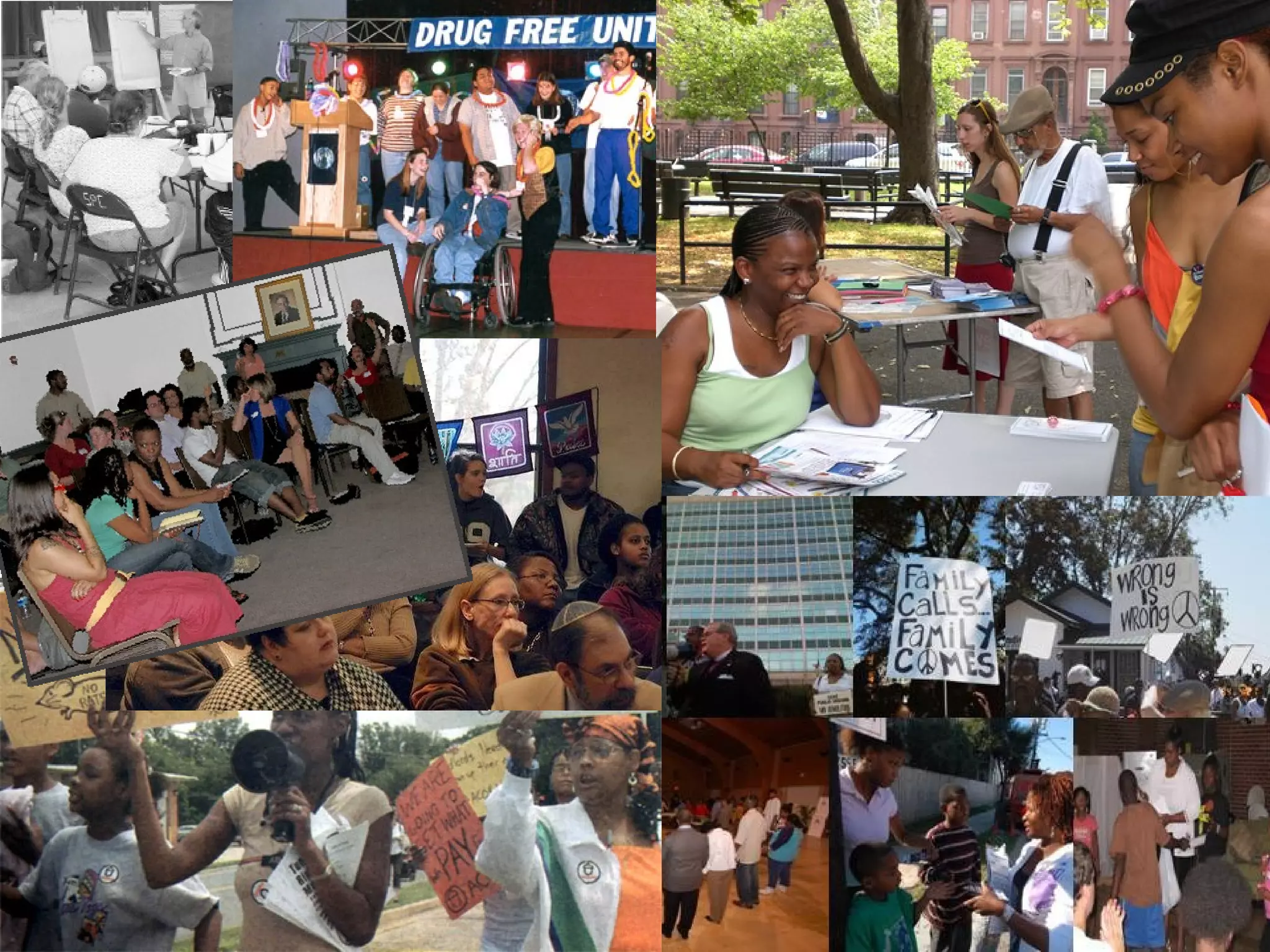
  • #4 It isn’t all about meetings or smiling people….you can’t call it community-based just because you manage to get a diverse group together.
  • #5 It isn’t all about place although place is important
  • #6 Community-based participatory approaches really is all about community – and giving them a voice along side of traditional researchers that lends to an active partnership role in community approaches to biomedical, behavioral, and public health research.
  • #7 Sometimes community-based participatory approaches can include community organizing. Usually, it does involve some level of organizing whether it be mobilizing a group of respected community leaders to take part in a program or organizing a large population to action. Some community leader and researchers may not want their project to be “community-based” or “participatory” for a variety of reasons, the main usually being control – when you invite community participation you turn over a good deal of control to the community itself. If you aren’t prepared to follow their lead this may not be the right approach for you or your project.
  • #8 Among the terms used to describe CBPR and its analogues are community action research , participatory action research , community-based action research , participatory rapid appraisal , and empowerment evaluation . Minkler (5) described CBPR as “a process that involves community members or recipients of interventions in all phases of the research process.” Green and Mercer (6) defined CBPR as “a systematic inquiry, with the collaboration of those affected by the issue being studied, for purposes of education and taking action or effecting change.” Sometimes the term is applied to community-based participatory efforts to implement health enhancement programs that do not include research components at all (7). CBPR is necessarily action research. For community members to invest in research, the process must have tangible results. For this reason, development of knowledge not linked to action, change, or advocacy does not fall into the realm of CBPR. Every partnership is unique. At the same time there are some common principles that many partnerships share. (Source: http://depts.washington.edu/ccph/pdf_files/ritas.pdf p5)
  • #9 According to Barbara A. Israel, Department of Health Behavior and Health Education, School of Public Health – University of Michigan, CBPA is based on principles that include: Recognizing the community as a unit of identity Building on collective strengths and shared resources Facilitating partnership and capacity building throughout the process Disseminating pertinent information, data and other findings to all participants Involving a long-term process and commitment Seeking balance between research and action It is important to engage the most trusted members of the community, “gatekeepers,” right from the beginning of the project to ensure the promotion of an intervention. By empowering community leaders through the CBPA, the entire community can help steer the project towards goal achievement.
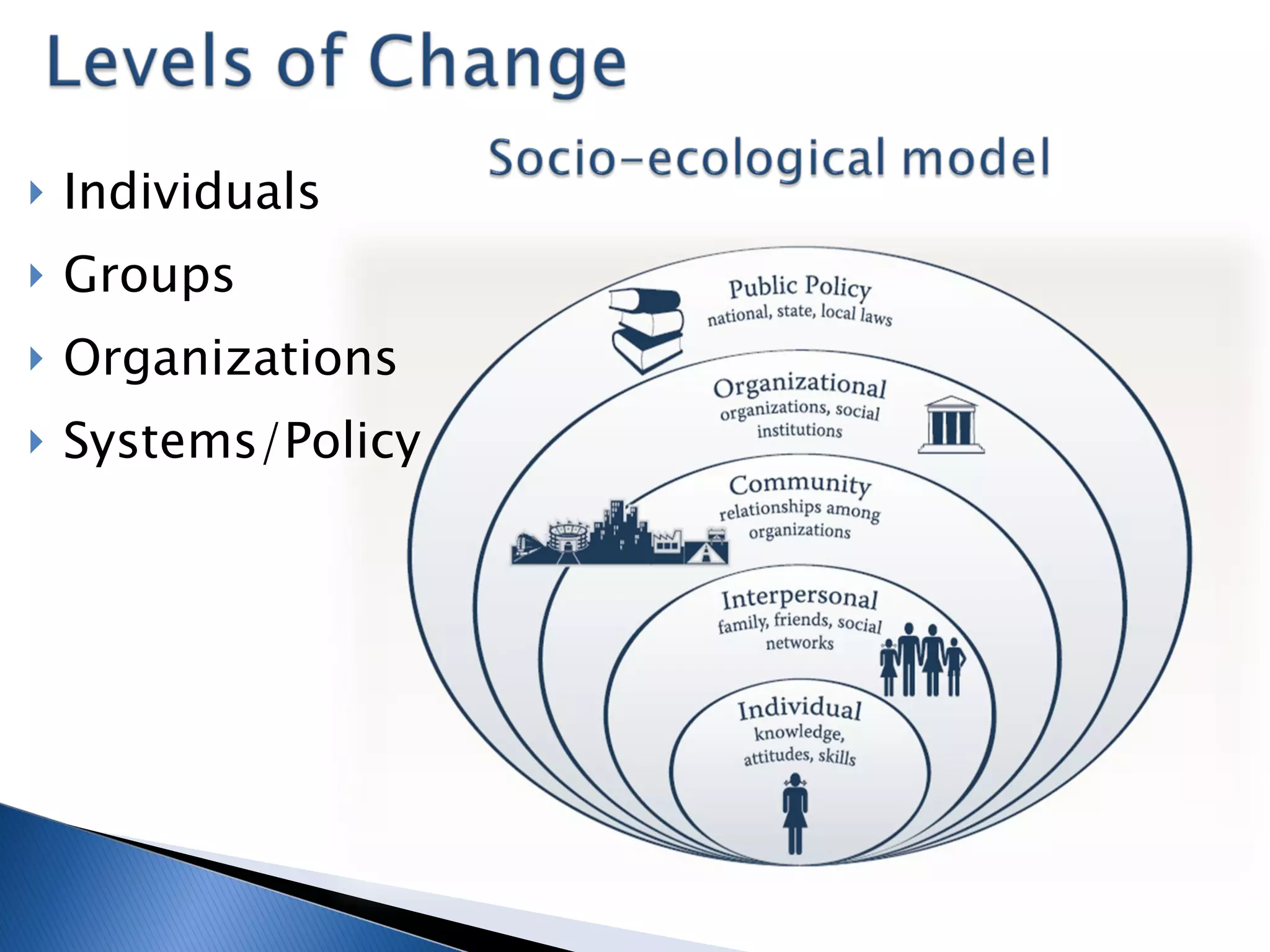
  • #10 CBPA is really about helping everyone to understand that we all hold a piece of the puzzle and that only by working together do we truly understand problems and develop the best solutions.
  • #11 The community must own at least some of the project, process or outcomes – this means the researcher or lead expert MUST relinquish control of the agenda and project to the community. This can be very hard for some people!
  • #19 How is this different from other groups?
  • #21 *Purpose is specific, yet inclusive – using immunization coalition as example, addressing specific aspects of immunization but keeping it broad enough so that there is still a variety of stakeholders *It’s about systems change – this is one of my own personal mantras. The coalition needs to mean something. This may be a good time to ask some preliminary leading questions about lifecycles – what is a lifecycle, how can a coalition have one, etc.
  • #23 Coalitions aren’t perfect…there are some downsides which must be considered so that success is achieved that wouldn’t have been possible without the coalition, yet members aren’t disappointed with the “speed” of things and the actual work gets done… First, coalitions take more time…bottom line, no way around it…however, the sum of what the coalition usually ends up with is much more valuable compared to a fast solution developed by one or two people in a room by themselves. leadership is key, but remember that leadership often exists beyond the “formal” titles. So if your chairperson turns out to not have been the best choice, often the work still gets done because the informal leaders take charge… Lastly…member investment is critical. If your members don’t care and/or don’t contribute, you might as well go back to that little room with one or two people and get busy…
  • #24 *Perhaps we could each share specific examples of how these three attributes have contributed to the success of our respective coalitions. Using coalitions to move community change works because of the investment made by community partners Partners can access a variety of resources that no one individual organization could access on their own The cumulative ideas of many are almost always better than the ideas of a few…
  • #32 Coalitions are successful not because you have partners at the table – but because you have a “synergy” of the “right stuff” at the table. Part of it is convening the right structure and resources, and part is finding a topic that resonates with the community. A good topic that doesn’t have the right intervention isn’t going to excite the community and develop stakeholders interest. Critical success factors include: Commitment, Vision, having a strategic plan, realistic expectations and determination, winnable issues, broad enough to be relevant to a large enough support base, equitable, culturally sensitive, MEASURABLE Outcomes… Talk also about the “Bad” experiences people have had with coalitions – i.e., what DOESN’T work…
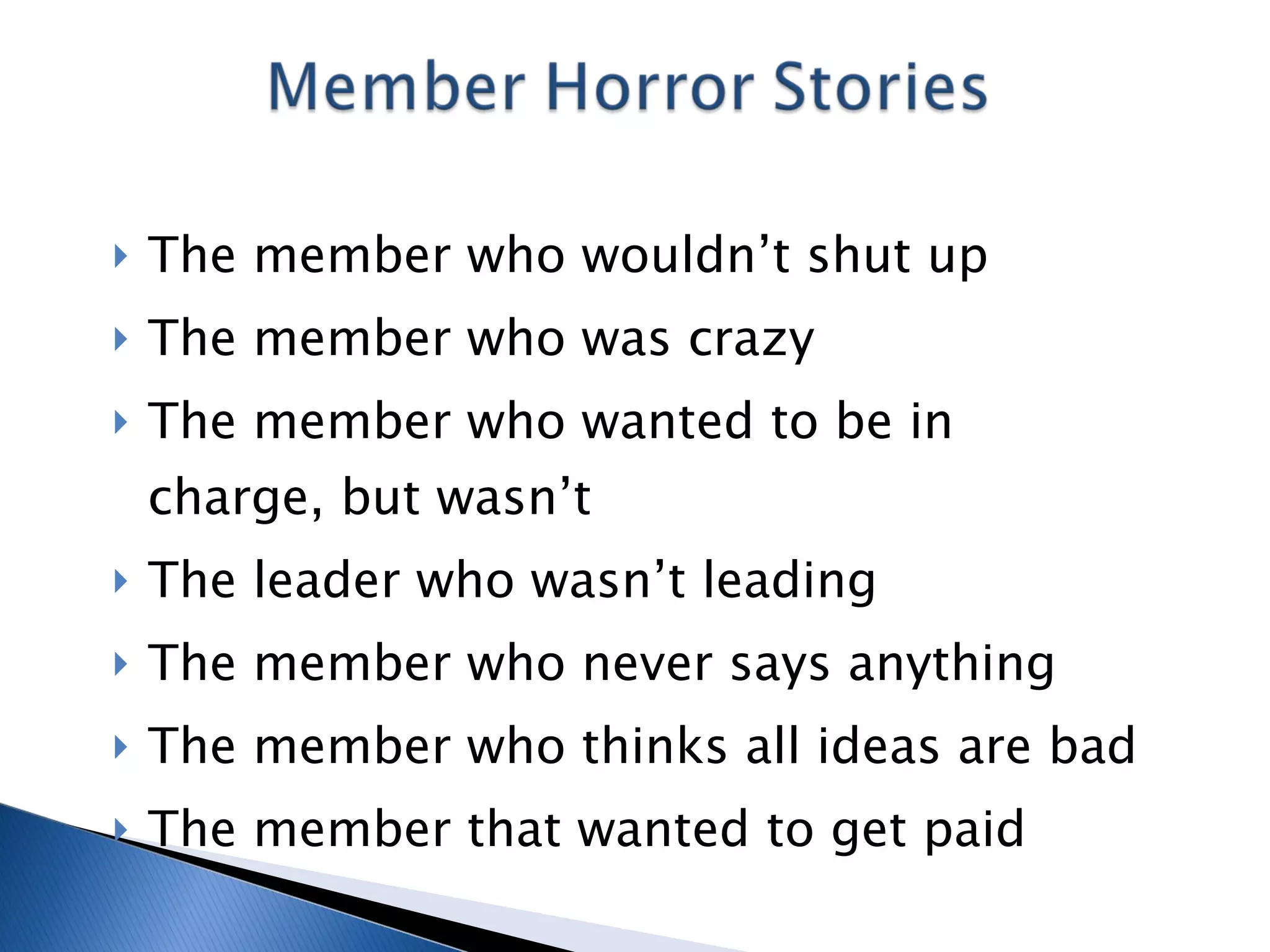
  • #33 Negative Action Lack of Action Not enough Action
  • #39 We’ll give people time to share here….
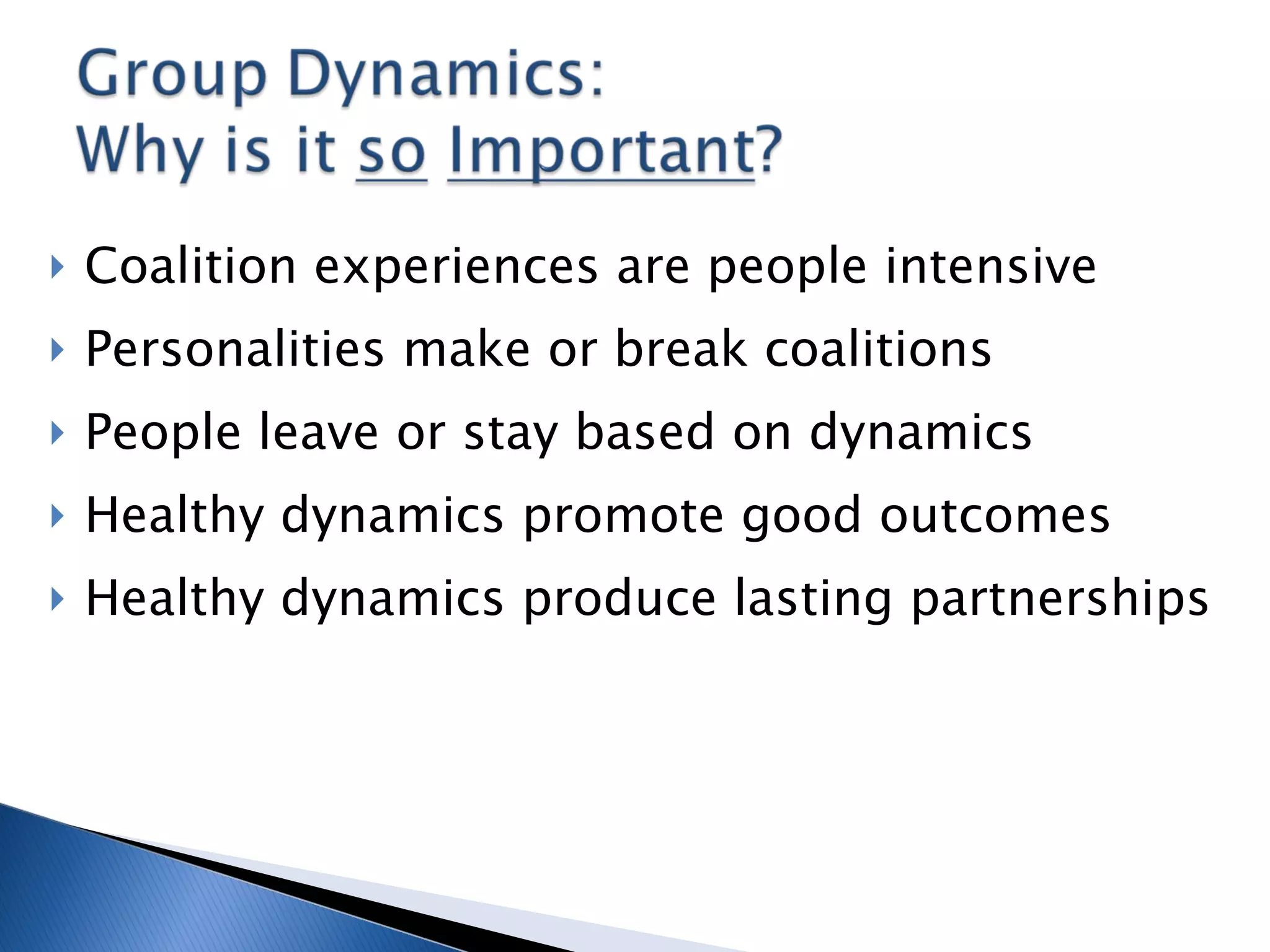
  • #44 See model handout.
  • #48 There are a variety of positions and leaders within coalitions – and sometimes whether a coalition has staff or not can partially define their “type”. In general, staffed coalitions have better outcomes. This means that in general there is someone whose job is in whole or part responsible for coordinating and facilitating the work of the coalition. Talk about drawbacks & benefits of staff Talk about leaders elected willing vs coerced! Talk about informal leaders pros and cons Need balance of “power” in order to have members feel their contribution is appropriate and appreciated.
  • #55 Leaders are not always found…sometimes you have to develop them. Some words of wisdom Leading is more than showing up, Leaders have increased responsibility as a member in terms of attendance, task assignment, and setting an example, Leaders can be hard to find, Good leaders are even harder to find , Some leaders are informal leaders. Ask your members what would be helpful to them in terms of skill building to make them more productive members. CINCH EXAMPLE.
  • #57 Organizations have a responsibility in regard to the experience of members Members also have a responsibly in regard to their participation in an organization – talk here about Member Rights and Organization rights which is in ToolKit. Members must participate in order to be of benefit, as well as to feel they are making an impact. Members who don’t feel included or useful will leave. Members should leave each meeting having contributed to the group Encourage members to follow basic etiquette in regards participation – i.e., do what you say you will do, respond to requests for information, be on time, etc. This creates trust in the group and reduces conflict between the doers and the talkers.. Participating includes taking personal responsible for the outcomes of the group - be willing to take on tasks and not just sit there talking. Personality counts…Refer to handout in toolkit. Member personalities play an important role within the “personality of the group” All members are important, regardless of their strengths and weaknesses Identifying your member “type” may help you to temper your more difficult attributes Find a group whose “personality” does not run contrary to your own – members who don’t do this will ultimately not stay anyway. Encourage members to “shake things up” if they feel nothing is being accomplished. Address group habits early, before a problem arises. Recognize why members stay and leave. They leave because: Don’t feel included, Disagree with leadership style, Group personality, Conflict with individuals within the group Why members stay: Feel included, Are making a contribution to the group, Feel comfortable with the group personality, leadership, and members, Feel the group is accomplishing goals, The group meets a personal need,
  • #62 Dr. Sivasailam "Thiagi" Thiagarajan is the Resident Mad Scientist at Workshops by Thiagi, Inc., an organization with the mission of helping people improve their performance effectively and enjoyably. **The Role of the Leader as Successful Facilitators** Reference website for free leadership materials. **Show Leadership Job Descriptions**
  • #66 Pass out “What kind of Member Are you” Handout….discuss….Have everyone self identify – place “card” on the table in front of them….
  • #68 we ask the participants to “shout out” their top challenges and we’ll right them down. Hopefully, we’ll address most of them in the workshop. What not to do – get angry, stop attending, be rude… And no handcuffs, ear muffs, or duct tape allowed! 
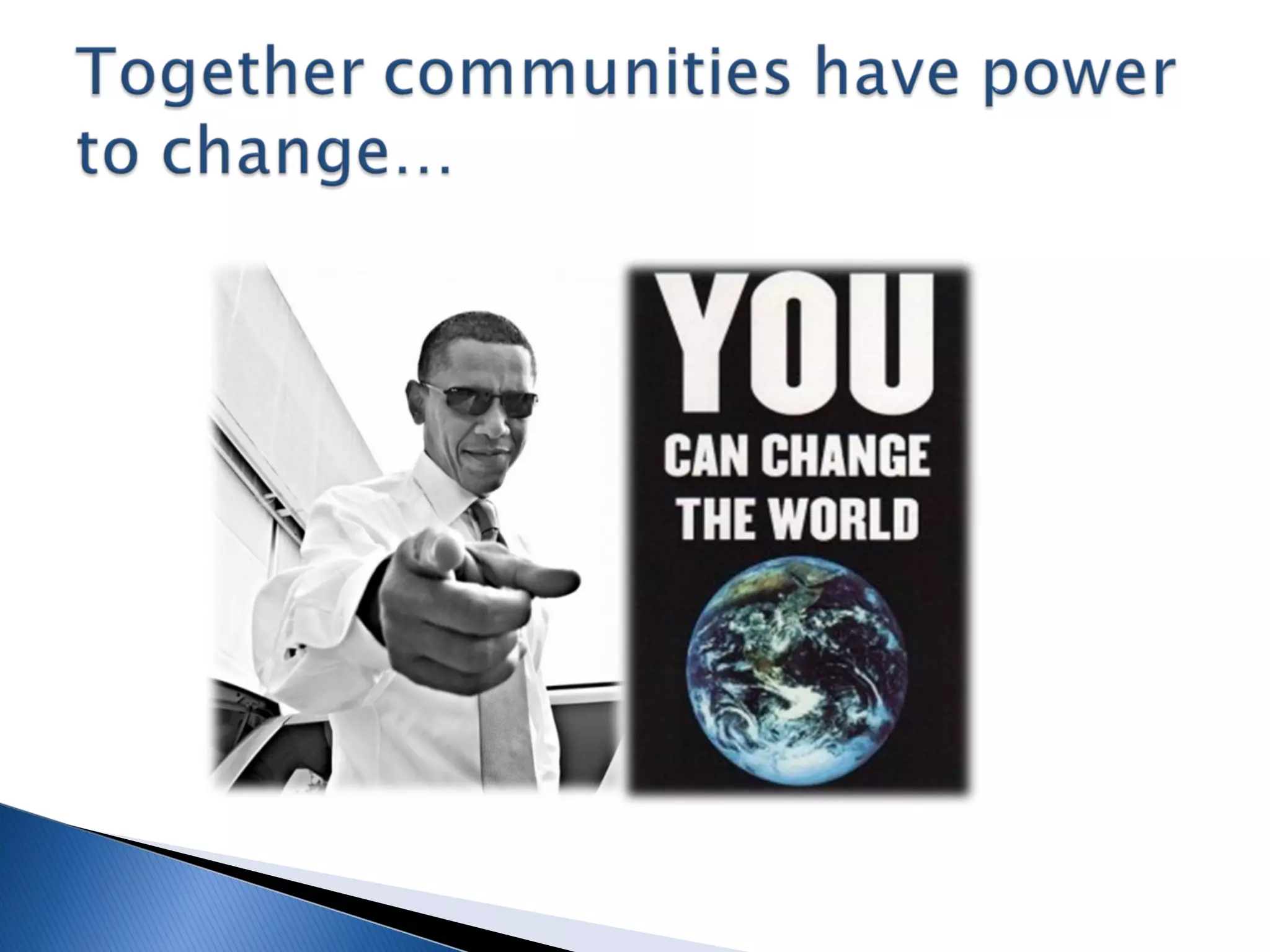
  • #71 We are not just the sum of our parts – groups are exponentially powerful… However, to prompt change individuals must be willing to become parts of groups and to give over their individual power to the will of the collective community. Will you?