The final stage of the policy process is the evaluation of
 policy. Actually, it occurs throughout the policy process
 as we have to estimate, assesssment, or appraisal of
 policy which include its content, implementation and
 effect.
- Evaluation is usually to estimate the
consequences of various policy alternatives for
dealing with a problem prior to adopting.

-Evaluation activities may restart the policy
process in order to continue, modify,
strengthen, or terminate a policy.

-Many of these judgments often based on
anecdotal or fragmentary evidences at best and
strongly influenced by ideological, partisan self-
interest and other evaluational criteria.

-Another common variety of evaluation centers
on the operation or administration of a policy.
Questions asked may include:
Is the program honestly run?
What are its financial cost?
Who receives benefits and in what
amount?
Were legal standards and procedure
followed?
This kind of evaluation may tell us
something about honesty or efficiency in
the conduct of a program.
 New type of policy evaluation is the systematic, objective
  evaluation of programs to measure their societal impact and
  the extent to which they are achieving their stated objectives.
  We refer this type of evaluation as
                       “Systematic Evaluation”.
 Systematic evaluation directs attention to the effects a policy
  has on the public need or problem to which it is directed.
 Systematic evaluation gives policymakers and the general
  public some notion about the actual impact of policy and
  provides discussions of policy with some grounding in reality.
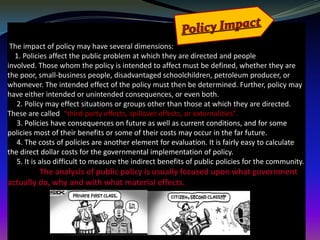
The impact of policy may have several dimensions:
  1. Policies affect the public problem at which they are directed and people
involved. Those whom the policy is intended to affect must be defined, whether they are
the poor, small-business people, disadvantaged schoolchildren, petroleum producer, or
whomever. The intended effect of the policy must then be determined. Further, policy may
have either intended or unintended consequences, or even both.
   2. Policy may effect situations or groups other than those at which they are directed.
These are called “third-party effects, spillover effects, or externalities”.
   3. Policies have consequences on future as well as current conditions, and for some
policies most of their benefits or some of their costs may occur in the far future.
   4. The costs of policies are another element for evaluation. It is fairly easy to calculate
the direct dollar costs for the governmental implementation of policy.
   5. It is also difficult to measure the indirect benefits of public policies for the community.
         The analysis of public policy is usually focused upon what government
actually do, why and with what material effects.
Problems in
                    Policy Evaluation
The most useful form of policy evaluation is systematic evaluation
 that tries to determine cause-and-effect relationships and
 rigorously measure the results of policy.
“ measure rigorously” means to seek to assess policy impacts as
 carefully and objectively as possible.
 Determining whether a policy is doing what it is supposed to do,
 is not an easy task as a number of conditions create obstacles or
 problems for effective accomplishment of policy evaluation.
 These problems include:
  - Uncertainty over policy goals
  - Difficulty in Determining Causality
  - Diffuse Policy Impacts
  - Difficulty in Data Acquisition
  - Official Resistance
  - A Limited Time Perspective
  - Evaluation Lacks Influence
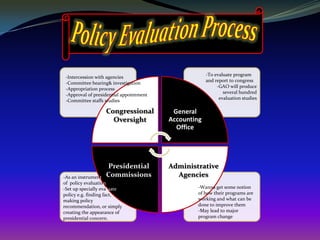
-To evaluate program
 -Intercession with agencies
                                                      and report to congress
 -Committee hearing& investigation
                                                           -GAO will produce
 -Appropriation process
                                                              several hundred
 -Approval of presidential appointment
                                                            evaluation studies
 -Committee staffs studies

                   Congressional          General
                     Oversight           Accounting
                                           Office


                   Presidential          Administrative
-As an instrument  Commissions             Agencies
of policy evaluation
-Set up specially evaluate                       -Wanna get some notion
policy e.g. finding fact,                        of how their programs are
making policy                                    working and what can be
recommendation, or simply                        done to improve them
creating the appearance of                       -May lead to major
presidential concern.                            program change
The Politics of Evaluation:
           The Case of Head Start
Head Start program was intended to help overcome
the effects of poverty on the educational
achievement of poor children. Head Start program
was highly popular, undoubtedly because it directed
attention to poor preschool children.
It was designed to provide poor children with
physical and mental health services together with
meals to improve their diet. However, this case
study can be considered as a good one because in
terms of its methodological and conceptual base.
I suggest you all to look for its whole story for your
more understanding.
There are suggestive reasons why public policies either do not achieve
   their goals or do not have impact on public problems that they are
   expected to have, as followings:
1. Inadequate resources may be provided for implementating a policy.
2. Policies may be administered so as to lessen their potential effect.
3. Public problems are often caused by multiple factors, but policy may
     be directed at only one or a few of them.
4. People may respond or adapt to public policies in a manner that
     negates some of their influence.
5. Policy may have incompatible goals that bring them to conflict with
     one another.
6. Solutions for some problems may involve cost and consequences
     greater than people are willing to accept.
7. Public problems can not be solved or at least not completely.
8. New problems may araise that distract attention and action from a
     problem.
9. Many national policies and programs in such as education,
   environmental protection, economic development and social welfare,
   are actually implemented by state- and local-government agencies.
. The proposition here advanced is that the response to policies,
and demands for changes will be affected by the way in which their
benefits and costs are distributed or are perceived to be distributed.


             -Broad benefits and Broad Costs
             Policies that involve broad distribution of costs and
             benefits e.g. Social security, Highway construction,
             Police & Fire protection, Public education and
             National defense.
             -Broad Benefits and Narrow Costs
             Policies that provide benefits for large no. of people
              but costs at least initially fall primarily upon fairly
               distinct e.g. control of environmental pollution,
               automobile safety, inspection of food and meat,
                    regulation of public utilities and safety,
                      policies for industry and coal mine.
CONT’D

-Narrow Benefits and Broad Costs
-Policies benefit readily identifiable interest groups, though
the burden of their costs falls upon taxpayers e.g. veterans’
benefits, agricultural subsidies, hospital-construction grants,
rivers and harbors projects and special tax provisions.
-Narrow Benefits and Narrow Costs
Policies that provide benefit to a well-defined group but at the
cost of another distint group tend to product continuing
organized conflict among groups and their partisans
e.g. commercial banks and saving and loan associations over
banking policies.
- Policy termination is a severe action with unpleasant
and negative connotation.
- The evaluation and appraisal of a policy ,
dissatisfaction with its cost and consequences, and
development and proliferation of political opposition
may lead to its termination.
- Policy termination is difficult for a number of
reasons.
However, problems in connection with current policies
may be identified, alternatives formulated, and so on,
until the policy is modified in some way. The policy
may also be so administered as to make it more
acceptable. Whether legislative or administrative in
origin, policy change is more likely than termination.
Policy Impact,Evaluation and Change (CoOL J)

Policy Impact,Evaluation and Change (CoOL J)

  • 4.
    The final stageof the policy process is the evaluation of policy. Actually, it occurs throughout the policy process as we have to estimate, assesssment, or appraisal of policy which include its content, implementation and effect.
  • 5.
    - Evaluation isusually to estimate the consequences of various policy alternatives for dealing with a problem prior to adopting. -Evaluation activities may restart the policy process in order to continue, modify, strengthen, or terminate a policy. -Many of these judgments often based on anecdotal or fragmentary evidences at best and strongly influenced by ideological, partisan self- interest and other evaluational criteria. -Another common variety of evaluation centers on the operation or administration of a policy.
  • 6.
    Questions asked mayinclude: Is the program honestly run? What are its financial cost? Who receives benefits and in what amount? Were legal standards and procedure followed? This kind of evaluation may tell us something about honesty or efficiency in the conduct of a program.
  • 7.
     New typeof policy evaluation is the systematic, objective evaluation of programs to measure their societal impact and the extent to which they are achieving their stated objectives. We refer this type of evaluation as “Systematic Evaluation”.  Systematic evaluation directs attention to the effects a policy has on the public need or problem to which it is directed.  Systematic evaluation gives policymakers and the general public some notion about the actual impact of policy and provides discussions of policy with some grounding in reality.
  • 9.
    The impact ofpolicy may have several dimensions: 1. Policies affect the public problem at which they are directed and people involved. Those whom the policy is intended to affect must be defined, whether they are the poor, small-business people, disadvantaged schoolchildren, petroleum producer, or whomever. The intended effect of the policy must then be determined. Further, policy may have either intended or unintended consequences, or even both. 2. Policy may effect situations or groups other than those at which they are directed. These are called “third-party effects, spillover effects, or externalities”. 3. Policies have consequences on future as well as current conditions, and for some policies most of their benefits or some of their costs may occur in the far future. 4. The costs of policies are another element for evaluation. It is fairly easy to calculate the direct dollar costs for the governmental implementation of policy. 5. It is also difficult to measure the indirect benefits of public policies for the community. The analysis of public policy is usually focused upon what government actually do, why and with what material effects.
  • 10.
    Problems in Policy Evaluation The most useful form of policy evaluation is systematic evaluation that tries to determine cause-and-effect relationships and rigorously measure the results of policy. “ measure rigorously” means to seek to assess policy impacts as carefully and objectively as possible. Determining whether a policy is doing what it is supposed to do, is not an easy task as a number of conditions create obstacles or problems for effective accomplishment of policy evaluation. These problems include: - Uncertainty over policy goals - Difficulty in Determining Causality - Diffuse Policy Impacts - Difficulty in Data Acquisition - Official Resistance - A Limited Time Perspective - Evaluation Lacks Influence
  • 11.
    -To evaluate program -Intercession with agencies and report to congress -Committee hearing& investigation -GAO will produce -Appropriation process several hundred -Approval of presidential appointment evaluation studies -Committee staffs studies Congressional General Oversight Accounting Office Presidential Administrative -As an instrument Commissions Agencies of policy evaluation -Set up specially evaluate -Wanna get some notion policy e.g. finding fact, of how their programs are making policy working and what can be recommendation, or simply done to improve them creating the appearance of -May lead to major presidential concern. program change
  • 13.
    The Politics ofEvaluation: The Case of Head Start Head Start program was intended to help overcome the effects of poverty on the educational achievement of poor children. Head Start program was highly popular, undoubtedly because it directed attention to poor preschool children. It was designed to provide poor children with physical and mental health services together with meals to improve their diet. However, this case study can be considered as a good one because in terms of its methodological and conceptual base. I suggest you all to look for its whole story for your more understanding.
  • 14.
    There are suggestivereasons why public policies either do not achieve their goals or do not have impact on public problems that they are expected to have, as followings: 1. Inadequate resources may be provided for implementating a policy. 2. Policies may be administered so as to lessen their potential effect. 3. Public problems are often caused by multiple factors, but policy may be directed at only one or a few of them. 4. People may respond or adapt to public policies in a manner that negates some of their influence. 5. Policy may have incompatible goals that bring them to conflict with one another. 6. Solutions for some problems may involve cost and consequences greater than people are willing to accept. 7. Public problems can not be solved or at least not completely. 8. New problems may araise that distract attention and action from a problem. 9. Many national policies and programs in such as education, environmental protection, economic development and social welfare, are actually implemented by state- and local-government agencies.
  • 15.
    . The propositionhere advanced is that the response to policies, and demands for changes will be affected by the way in which their benefits and costs are distributed or are perceived to be distributed. -Broad benefits and Broad Costs Policies that involve broad distribution of costs and benefits e.g. Social security, Highway construction, Police & Fire protection, Public education and National defense. -Broad Benefits and Narrow Costs Policies that provide benefits for large no. of people but costs at least initially fall primarily upon fairly distinct e.g. control of environmental pollution, automobile safety, inspection of food and meat, regulation of public utilities and safety, policies for industry and coal mine.
  • 16.
    CONT’D -Narrow Benefits andBroad Costs -Policies benefit readily identifiable interest groups, though the burden of their costs falls upon taxpayers e.g. veterans’ benefits, agricultural subsidies, hospital-construction grants, rivers and harbors projects and special tax provisions. -Narrow Benefits and Narrow Costs Policies that provide benefit to a well-defined group but at the cost of another distint group tend to product continuing organized conflict among groups and their partisans e.g. commercial banks and saving and loan associations over banking policies.
  • 17.
    - Policy terminationis a severe action with unpleasant and negative connotation. - The evaluation and appraisal of a policy , dissatisfaction with its cost and consequences, and development and proliferation of political opposition may lead to its termination. - Policy termination is difficult for a number of reasons. However, problems in connection with current policies may be identified, alternatives formulated, and so on, until the policy is modified in some way. The policy may also be so administered as to make it more acceptable. Whether legislative or administrative in origin, policy change is more likely than termination.