Moneycation
Published by Moneycation™
Newsletter: January 20, 2015
Volume 3, Issue 2
Corporate cash and treasury solutions
Cash and treasury solutions provide money related alternatives to
businesses seeking greater access to capital, lower cost of debt and
efficient internal financial operations; they are a part of the formula that determines how well run a
business is. As businesses develop, simplified internal policies do not necessarily benefit investors
as much as elaborate, sophisticated and fluid financial decision making allows for. Additionally,
corporate finance tends to get more complicated as companies become larger. This is because
expanded operations require greater financial management.
Cash solutions differ from treasury solutions because they represent two different areas of finance.
The former tends to concern business operations, while the latter is more focused on the result of
financing and investment related activities. In terms of the statement of cash flow, cash
management deals with cash from operations whereas treasury management pertains to cash flow
from financing and investments.
Sometimes, cash and treasury management are used interchangeably when the functions of both are
classified under one or another of the two terms. The meaning of these two terms also changes
based on the industry it pertains to. For example, in banking treasury management involves
regulatory oversight that does not apply to corporations, but the functions remain similar.
A few of the objectives of cash and treasury solutions are the following:
• Risk management
• Fiscal strategy
• Transaction coordination
• Investment oversight
• Financial operations
Since small changes in financial management often lead to large effects, proper cash management
and treasury management is a key aspect of business performance. For instance, if financing option
A costs just .2% less than financing option B, the cost of a million dollars has a nominal difference
of $2,000. When compounding, underwriting costs and banking fees are involved, this number can
increase even more. Since finance seeks to optimize the use of money, that $2,000 is important
because it can be used in a number of ways. It can become collateral for a lower cost loan, it can be
used to purchase a piece of business equipment that will increase operational efficiency and profit
margin or it can be held in a cash account to help maintain cash flow and company credit rating.
Those are a lot of potential benefits that would not be available had a less desirable treasury
management solution been utilized. Thus, cash and treasury management solutions represent
financial opportunities that are valuable to businesses and their shareholders.
Cash management
Cash management optimizes available liquid capital in addition to the income producing
possibilities of that money, but techniques differ based on business size. Factors that influence
available options include predictability of cash flow, consistency of revenue, and cash account
value. According to Inc., overnight sweep accounts offer businesses a chance to convert cash into
yield at the end of each day rather than not earning via a business checking account. However,
depending on the stability of cash flow, investment options for excess cash are a notable
consideration.
Another aspect of improving cash flow involves expediting cash-conversion or the speed at which
accounts receivable are collected. This is because, money held up in slow receivables reduces
available cash flow and potential return on investment from that cash. Entrepreneur magazine
recommends extending liability payments to the full extent that creditor terms allow as well as
carefully considering how creditor terms, price agreements and communication affect overall cash
flow. In other words, the net benefit of financial decisions such as discounts on earlier payments
should be weighed against the advantages of delaying payment to the due date via electronic
withdrawal.
Projecting cash flow
A key part of effective cash management is creating accurate cash flow projections. Doing so
ensures sufficient available cash for unhindered daily operations. If cash flow is likely to, or
suddenly undergoes a deficit, then knowing the best available financing options ahead of time helps
minimize cash related operating costs from fees, interest charges and asset related opportunity cost.
For instance, if a vendor offers a line of credit that costs 2 percent of the balance charged in full
over a period of one month, but a business line of credit costs 3 percent compounded periodically
over a year, then the total cost would be higher for the vendor due to the speed at which the
financing cost is calculated.
Forecasting sales
Numerous forms of cash management offer businesses a wide array of financial tools, techniques
and options. Inventory management is another way to streamline cash availability and potentially
reduce operating costs. For example, if sales of widgets have never exceeded 1,000 units per
month, nor are forecasted to based on market demand, past sales, competitor sales etc., then paying
for overstock may not be worth the cost of having extra inventory on hand for the possibility of
increased sales. Comparing vendors and service suppliers, negotiating new terms and locking in to
lower prices for longer-term contracts are additional ways to improve inventory management for
better cash flow.
Evaluating POS systems
Analyzing or evaluating point-of-sale conversion and work order process also helps ensure no
costly redundancy is reducing cash management potential. For example, if a sales procedure can be
automated with no negative effect to sales, or if A/B split testing demonstrates online sale
conversions can be increased via website alteration, then an operational audit is worthwhile,
especially if not costs are incurred from carrying out the assessment. Moreover, a speedier online
payment system may prove to be beneficial for a slightly higher cost than a slightly less effective
service provider; this is particularly relevant in the case of small-unit sales that occur on a frequent
basis.
Factoring accounts receivable
Sometimes not enough cash is on hand to meet day-to-day operations; this may be due to slow
payment of credit revenue, expenditures and investments. One way to mitigate this problem is via
accounts receivable factoring, a form of collection for accounts that are generally non-delinquent or
not in default. This is a way of liquidating or expediting credit payments in exchange for a fee. The
Wall Street Journal summarizes the key features of factoring in the excerpt below:
"Companies that use factoring like it because they get money quickly rather than waiting the
usual 30 or 60 days for payment. After sending an invoice to a factoring firm, a business can
have money in its hands within 24 to 48 hours…Some businesses use factoring to get
started...Some companies use it to meet cash-flow needs as a stop-gap measure. Others prefer
factoring to banks, which often require more paperwork, or other outside investors, who may
want a piece of the business…Factoring isn’t likely to be economical for a firm that sends out
thousands of small-denomination invoices, because of the service fees a factor may assess for
reviewing each one for risk."
Accounts receivable factoring has its advantages and disadvantages and is not the only method of
managing cash flow. Since it is more suitable for larger accounts, the cost of revolving a line-of-
credit at a financial institution may cost less than factoring and also establishes business credit in a
way that factoring is not capable of.
Tax strategies
Tax strategy is an important aspect of cash management that can substantially effect available cash
for operations and investments. Numerous business activities involve taxation and are complicated
by differences in tax account versus accounting under generally accepted accounting principles,
employee turnover and ongoing adjustments to benefits items such as 401(K)s. The following list
indicates just a few of the business related functions that influence tax expenses.
• Payroll tax management
• Corporate income tax allocations
• Tax deductible transactions
• Tax deferred financial instruments
• Tax avoidance mechanisms
• Tax accounting techniques
Effective tax strategy not only saves money, but also frees up money. Since tax is a significant
aspect of business financial management, being aware of the methods used to minimize tax and
maximize financial opportunity is a vital component of cash management. Fortunately, many
different tax planning mechanisms exist to assist chief financial officers with their design and
implementation of tax management strategy. A few of those tools are pointed out below:
• Investment in tax-free bonds
• Capital loss carryover from previous years
• Charitable contributions
• Placing corporate funds in tax deferred trusts
• Creation of subsidiary companies
The number of tax management solutions are as numerous as creative accounting within the
Internal Revenue Code and generally accepted accounting principles allow. Furthermore, in effect,
the difference between tax and book accounting allow for two benefits instead of one. For instance,
since depreciation is deductible from taxable income in a more generous way via revenue code than
GAAP, a corporation may weight its asset portfolio with real estate in order to take advantage of the
tax reducing advantages it has while retaining a significantly less depreciated asset via GAAP that
itself has financial benefits such as collateral, overhead reduction and risk management.
Accounting practices
Accounting techniques are another way to improve cash and treasury management, especially when
it comes to enhancing a company's financial performance on paper. For example, a special purpose
entity registered in a foreign country may be used to transfer liability. Moreover, if that liability
lowers credit utilization or total debt-to-income, then not only may financing options be expanded,
but also cost less. Several potentially advantageous accounting techniques are described below:
“...Decisions regarding the capitalization of expenses, the recognition of revenue, the
creation of reserves against losses, and write-off of assets are examples of just a few of the
factors that may vary from firm to firm. Many of these issues are factors that relate to the
“quality” of a firm’s earnings. For example, cash used to build up inventory will not be
reflected as an expense on the income statement until the inventory is sold...Prepaid expenses
such as income taxes and software development costs may not flow through the income
statement when the payments are actually made.”
In terms of cash management, the cost and availability of financing will reflect the accounting
criteria used by lenders be they hard money lenders, securities underwriters, investors or financial
institutions. For instance, an investment bank assisting with the issuance of equity may be more
concerned with projected revenue and income than how liquid a company's operating cash flow is
due to the nature of stock as an investment product.
Fixed income investments
Depending on how business responsibilities are structured, fixed income investing is either part of
the cash management or treasury management function. An advantage of fixed income investments
such as annuities and bonds are that they often provide a stable cash flow from investments with
relatively low risk. A disadvantage is that the return on investment is quite possibly lower than
alternative investments.
Depending on how necessary the fixed income cash flow is to daily operations should indicate the
level of risk taken on. For example, if a business A depends on its cash flow from investments to
finance monthly liability payments, then a low risk, guaranteed yield fixed income investment is
more suitable than bi-annual dividends from stocks.
Dividends
Dividends are another form of income investing that allow for cash flow without having to sell
financial instruments and incur capital gains or losses. Dividends are paid via multiple investments
such as real estate investment trusts, exchange traded funds, index funds, company stock in addition
to certificates of deposits and bonds. Dividends have the potential to yield a higher ROI than
dividends from government treasuries, investment grade corporate bonds and CDs, and if they are
chosen well, they can do so with minimal risk and even capital appreciation.
Leasing vs buying
In the past, assets and liabilities from leases were not required to be reported as such under
generally accepted accounting principles. This has been under review by the Financial Accounting
Standards Board and the International Accounting Standards Board and may change in the future.
Until then, the accounting rules for leases provide an advantage to businesses seeking to improve
their financial metrics while gaining the benefits of leases simultaneously. Even with revised
accounting standards, there are several advantages to leasing. Some of these benefits are listed
below:
• Lower capital outlays
• Deductible operating expensing
• Investment tax credit
• Technical assistance
• Reduced or no investment risk
For companies that prefer to utilize assets for project management, non-depreciable investments or
lower cash flow costs, leasing is a viable option. What is more, the money saved from interest on a
line of credit, or gained from return on investment may outweigh the benefits of depreciating assets
in terms of taxable income, especially when leased equipment is also deducted as an operating
expense.
Although leasing may lower total asset value and/or raise liabilities, the effect on financial metrics
are negligible under current accounting reporting requirements. Even without the benefits of
recording leases as assets, with or without disclosure of such, the leasing of equipment or property
that is not likely to resell at a higher price than purchased or that is from a fast evolving technology
soon to become obsolete is notable.
Treasury management
Some companies are more likely to engage in treasury management more than others. Specifically,
companies with more liquid assets and extra cash for investing are not only more likely to want to
grow, but are also more likely to grow. This makes having a more objective focused long-term
financial strategy all the more important. Treasury management helps with that. Depending on the
type of industry a specific company is in, available financial options vary. There are a wide array of
choices, some of which involve low cost financing, and others that have high growth potential.
Financing
Financing is an important aspect of treasury management because it affects operating costs, debt
structure and other financing choices such as equity underwriting. As with other aspects of treasury
management, the best financing solution, if any, will vary based on available options, financial
needs and strategic consequences such as mergers and acquisitions, project management and
investments. In any case, the need for financing or the use of financing as a method to retain cash
for other purposes is a value judgment made by treasurers. The resulting financial decisions will
either improve company performance or fall short of optimal outcomes. The table below illustrates
the range of financing and investing activities that help generate money for cash flow, asset
building, strategic planning project management and investing.
Sample Financial Management Matrix
Transaction 1 Benefit Transaction 2 Benefit
Financing Loan swap Net free cash flow Line-of-credit Free/low-cost short-
term financing
Investing Fixed-income Guaranteed income Acquisition Horizontal integration
Trading Carry trade Leveraged risk Stock option
collar
Leveraged risk
management
Alternative Employee insurance Risk management Risk purchasing
group
Lower cost insurance
Asset securitization
Asset securitization is a method of generating corporate cash flow for purposes such as expansion,
lowering the cost of debt and increasing shareholder returns on investment. The reason why this
method of financial management is used is because of the advantages it has over other forms of
business financing. A primary benefit is the effect on business balance sheets per Deloitte & Touche
LLP.
“The desired alternative in most securitization transactions is to structure the transaction
that will result in off-balance sheet treatment for the existing assets. If the securitization is a
sale under FASB 125 - Accounting for Transfers and Servicing of Financial Assets and
Extinguishments of Liabilities, cash and proceeds are added to the assets and the transferred
or sold assets are taken off balance sheet.”
The advantages of off-balance sheet transactions are that liability arising from the securitization of
assets will not be recorded as a debit to liability accounts. This helps keep the debt-to-equity ratio
low, which affects corporate credit rating, and therefore the cost of debt, equity investing and future
financing opportunities.
Alternative financing and securities
In addition to inter-company loans and factoring, corporations may find commercial paper,
derivative securities and business lines of credit to be preferable. Businesses in high risk industries
such as full-load logistics can also take out employee life insurance policies with themselves as
beneficiaries. The compensation for which serves as a business hedge or financial security to cover
disruptions in labor supply and contracts related to that workforce.
Differences between revolving credit and periodic loans, interest rates, duration, term and pricing
all influence how worthwhile a particular type of financing is. For instance, a line-of-credit is
typically useful for purchases not intended to effect cash flow. Moreover, taking advantage of
monthly grace period on such debt is a way to achieve short-term financing at little or no cost.
To woo investors who seek the same return on investment for less risk, corporate notes or preferred
shares provide an alternative to common stock and bonds. Collateralized debt obligations or CDOs
are another security that's risk is ameliorated with underlying assets. However, the cost of
underwriting such securities should also be factored in to the overall benefit formula. For example,
a company seeking to go public may be able to include underwriting costs as a premium on the
initial public offering price, especially if the securities issuance is guaranteed to be filled.
Financing from a wide range of investing activities provide additional treasury management
alternatives. For instance, a company investment portfolio with fixed-income investments, higher
risk derivative contracts and active trading profiles in addition to strategic investments, mergers and
acquisitions may be able to provide cash-flow for financing. Additionally, financing swaps where a
company takes out loans, but also issues loans with higher net returns may use the difference in
financing to provide in-house financing for cash flow, expenditures or investments.
Carry trades
Carry trades are a form of forex market transaction that involves purchasing one currency with
money obtained from the sale of another currency. The difference in values helps leverage
investment opportunities at no cost unless those investments lose value. This process can be
described as currency market arbitrage, which means buying low and selling high within a market.
High frequency trades and other transactions such as carry trades also occur with time intervals in
between. The makings of an ideal carry trade are described by the Investopedia excerpt below.
“For an ideal carry trade, you should be long a currency with an interest rate that is in the
process of expanding against a currency with a stationary or contracting interest rate. This
dynamic can be true if the central bank of the country in which you are long is looking to
raise interest rates or if the central bank of the country in which you are short is looking to
lower interest rates.”
For a scenario such as the above to occur, global economies would have to be less integrated or
unpegged. This is because more connected currencies or currencies pegged to the dollar such as the
would also be more likely to have values that move in tandem or with more correlated beta
coefficients. An example of a resource with which carry trades are carried out include brokers with
multi-functional banking services. Companies adept at and knowledgeable of the effect of macro-
economic policies on currency values may be able to leverage such opportunities.
Risk management
Risk management is very important to businesses because a company can fail if it does not properly
mitigate any number of risks including financial risk. Examples of financial risk include,
investment risk, liquidity risk and market risk. If risk is too high, then company worth may declines
via capital loss or unanticipated revenue shortfalls. Being prepared for these risks is the role of
treasury management and in terms of operational risk, cash management. According to Treasury
and Risk, overly-complicated or inefficient banking services, data storage, financial analysis and
reporting systems are all risks. This is because of the potential for repeated work, reporting error
and even fraud.
Treasury risk related to inaccurate forecasting and quantification of investment portfolio risk can be
mitigated via more robust and comprehensive data storage and analysis systems. This type of
software package or treasury management system, whether customized for specific company needs
or standardized for primary financial management tasks may be well worth the cost in terms of
better evaluating counter-party risk, reducing inaccurate financial analysis and increasing
operational efficiency. SunGard, a financial software corporation, states the advantages of a
treasury management system (TMS) by contrasting it to traditional spreadsheet and task based
methods:
“The use of spreadsheets for risk measurement and monitoring, while widely prevalent, can
introduce an element of operational risk into the system and open the door to user error.
Corporations using a TMS can not only reduce operational risk, but also increase accuracy
and efficiency by managing risk across the organization rather than on a piecemeal basis.”
To illustrate further, financial risk is measured using financial models such as Monte Carlo
simulations, the Black-Scholes model and the capital asset pricing model. Depending on the
financial management tasks being carried out, some models are better suited to specific situations
than others. Thus, identifying the correct and most accurate model to use is a relevant aspect of
treasury management.
To illustrate the use of financial modeling in treasury risk management, in an industry such as
utility services, where revenue is typically consistent and based on relatively predicable
demographics, historical data is suitable for forecasting future financial risk. However, for
businesses that are in highly volatile markets or that have not yet established a steady revenue base,
different analytic models are not only necessary, but helpful in determining the best course of
action.
Randomized simulations that contrast a range of possible outcomes against dependent variables is
one way to forecast and evaluate future financial scenarios for less predictable industries. In other
words, by testing sales results under a number of simulated conditions, treasury managers can
prepare their financial strategy so as to incorporate a realistic number of adverse scenarios.
Treasury management systems that identify the best simulations to use in addition to carrying out
and interpreting the simulation results in an integrated way with other corporate financial
information provides a lot of valuable analytic horsepower to treasury management.
For smaller businesses with fewer financial variables, the use of complex and expensive TMS
software packages may not be worth the cost because forecasting with fewer factors is easier. For
instance, a tax preparation business or private office accountant is likely to have a specific range of
clients and services. Forecasting business demand is based partly on the type of service, but also the
demand for that service. Enough market data should be available for the business treasurer or
accountant to determine the most likely scenarios without a TMS.
Insurance contracts
Business insurance can mean the difference between costly litigation and even insolvency and
sustainable business practices. Numerous ways of mitigating risk, maintaining financial profile and
reducing cost exist within the world of business insurance. For example, companies within a related
industry are allowed to form or participate in a risk purchasing group. According to DeWitt Stern,
this type of insurance arrangement is beneficial because it increases coverage for less cost.
Other insurance options that may be beneficial are insurance securitization, fronting and captive
insurance. For example, according to the National Association of Insurance Commissioners, captive
insurance is an insurance company owned by insured. Since the insured parties own the insurance
company, the costs of insurance are preserved within the insurance subsidiary and used only if
necessary. This type of insurance arrangement improves liability or expense ratios for businesses
that treat such insurance costs as off-balance sheet items. If sufficient capital is not available,
fronting provides an added off-balance sheet mechanism that transfers credit risk in a similar way to
a co-signer on a loan does.
Making sure a business is properly insured involves assessing and prioritizing risks and then
ranking them among other expenditures by order of importance to business continuity. After risk
has been appropriately categorized, finding the optimal financial instrument helps ensure the best
deal.
To explain further, in an era of increasing reliance on technology, data breach insurance is gaining
relevance as a real consideration, especially if the price of information system re-design is not
worth the cost in terms of risk reduction over more affordable network monitoring software. In
other words, data breach insurance bridges the gap between security software and technological
infrastructure such as a privately owned virtual private network cluster. This is because the potential
for lost revenue, customer lawsuits and internal financial loss is closer to an all-or-nothing prospect
than a low gradient risk. Naturally, the extensiveness of insurance will vary between businesses and
should focus on the risks or threats with the highest likelihood and potential loss.
Insurance contracts also provide an opportunity to hedge finances. More specifically, just as with
individual insurance policies, business insurance polices with cash value are not only creditor
protected, but can be used to raise coverage alongside inflation without additional cost if the cash
value portion of the policy can be applied to paying for premium and/or coverage increases.
Treasury and cash management architecture
Since each business entity is likely to be different, the cash and treasury management solutions that
will have the best financial effect are not necessarily the same. Even if the same method is used,
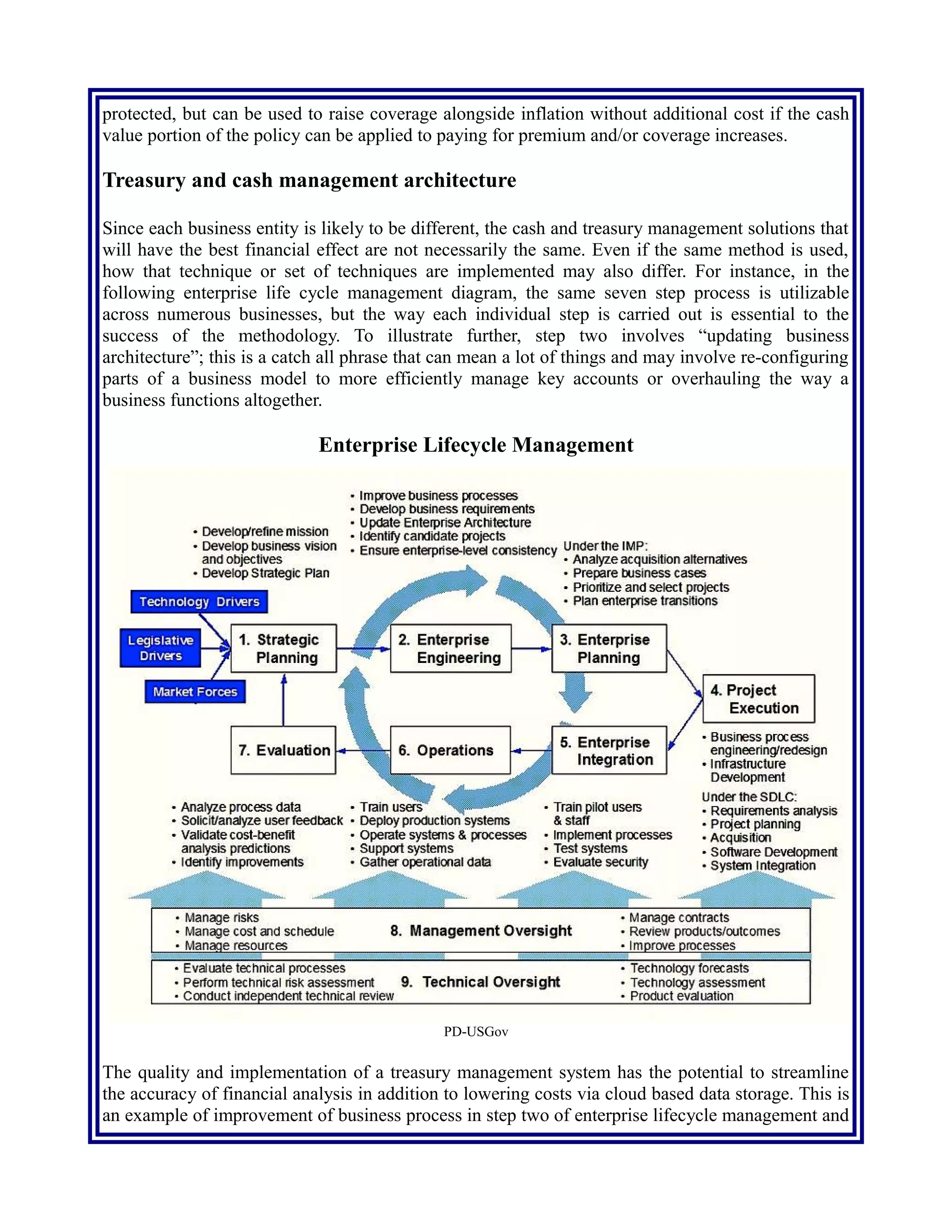
how that technique or set of techniques are implemented may also differ. For instance, in the
following enterprise life cycle management diagram, the same seven step process is utilizable
across numerous businesses, but the way each individual step is carried out is essential to the
success of the methodology. To illustrate further, step two involves “updating business
architecture”; this is a catch all phrase that can mean a lot of things and may involve re-configuring
parts of a business model to more efficiently manage key accounts or overhauling the way a
business functions altogether.
Enterprise Lifecycle Management
PD-USGov
The quality and implementation of a treasury management system has the potential to streamline
the accuracy of financial analysis in addition to lowering costs via cloud based data storage. This is
an example of improvement of business process in step two of enterprise lifecycle management and
may also be defined as system(s) development. Essentially, as long as steady revenue exists within
a corporation, problem solving and troubleshooting financial issues is more a matter of cleaning
house. A greater challenge for any business is maintaining revenue and profit margin, and not
necessarily financial management strategy.
Capital structure
The capital structure of a company affects the ability and price with which securities such as equity
can be financed. This influenced by information symmetry or how investors are informed about the
company via the financing choice. Thus, at times issuing bonds before equity is often less ideal than
the other way around since bonds affect corporate debt ratios whereas equity shows investor
confidence in a company.
To restate the above in different terms or in other words, when the cost of financial information
associated with equity issuance or certain underwriting expenses are higher, the potential
equilibrium price, or the maximum price which securities can be issued and bought will decline. In
a separate study in the Journal of Political Economy, bank lending is considered to have higher
intermediary or financing costs than bonds, which makes it the least desirable option of equity,
bond and loan financing in some cases.
“Firms face informational dilution costs when they issue equity; they attempt to reduce that
cost by issuing bonds or taking out a bank loan. (ii) Bank lending is more flexible and more
expensive than bond financing (because of intermediation costs); as a result, only those firms
with a sufficiently high demand for flexibility choose bank lending over bond financing.”
What this means is that a balance of bonds and equity help reduce financing costs based on the
perceived affect or informational symmetry of the quality of investment; naturally the accuracy of
this perception is more likely to be higher for informational asymmetry. In both cases, this makes
an equilibrium of the two forms of obtaining capital all the more important. Moreover, too much
equity financing and not enough bond financing is sometimes considered more of an investment
hazard than a balance of the two. However, when a high quality firm with strong financial
fundamentals issues equity in an information sensitive market, then equity weighted financing is the
better choice per the Journal of Financial Economics:
“...when investors may produce information on the quality of the underlying firm, insiders
may prefer to issue a more information-sensitive security such as equity, rather than a less
information-sensitive one such as risky debt. The use of an information-sensitive security
increases the amount of informed trading in the market, making security prices more
informative about the value of the underlying firm.”
Bond and equity financing is generally for larger corporations, and even bigger firms may have
other options that may be more manageable, fiscally sustainable, and affordable. For instance, low
cost inter-corporate loans and even crowd-funding may be viable alternatives. Instead of seeking
financing, additional sources of revenue could serve the same purpose with no interest.
Examples of revenue generating alternatives to financing are opportunities within horizontal
integration. To illustrate, an accounting services firm that specializes in corporate tax accounting
could expand its service scope to include GAAP compliance audits for a net gain over any
additional costs incurred from the expansion. Although revenue generation may be more a product
of marketing efforts than treasury management, a coordinated or inter-departmental arrangement is
possible via the appropriate executive authorization of such.
Capital management
Capital structure is an aspect of broader capital management. Many factors integral to a business'
financial success are related to the effectiveness of capital management. These include the impact
of financing on valuation, the affect on on free-cash flow and corporate credit rating. For instance,
according to Matt H. Evans, CPA, CMA, CFM and in reference to the Journal of Financial
Economics, changes in capital structure send market signals to investors.
The nature of capital management signals are capable of inspiring positive or negative sentiment
among investors and influence equity valuation. In other words, financial management has a
domino effect where efficient markets evaluate performance via the strength of financial decision
making. This however, would require substantially intimate financial awareness and knowledge
about the inner workings of a company. Additionally, financial decision making is potentially
subject to inclusion, exclusion or adaptation in terms of disclosures to potential private equity
investors in the case of private companies. This allows some opportunity to frame capital
management decisions in the best possible way.
Capital costs costs are another factor of capital management that is not only attributable to an
investor signal, but also corporate valuation. If the weighted average cost of capital is used to
evaluate capital structure or financial decisions, multiple financing simulations can be compared
side by side in terms of resulting WACC. An advantage of using this approach to financing prior to
making financial decisions includes the identification of the lowest cost structure and a chance to
integrate financial management ideas into a presentable and adaptable model for future use.
Simulating financial structure also helps reduce errors in financial decision making and serves as a
quality control mechanism to ensure better capital cost structuring. The consideration of capital cost
in financial decision making places further emphasis on the potential benefits of an effective
treasury management system.
Conclusion
Cash and treasury management is about optimizing financial resources so they provide the best
return on capital in terms of cash flow, financing and investing. Ensuring sufficient cash flow and
generating extra free cash flow are possible results of improved cash management techniques.
Lower cost or reduced need for financing and capital expenditures into financial operations that
streamline processes such as workflow management have short term and long term benefits.
Utilization of financial instruments, financial management techniques and market opportunities
provide additional ways by which cash and treasury managers can maximize the availability,
utilization and functionality of financial resources.
Businesses are unique entities despite having similar legal structures. Capital management
approaches, creditor relationships and financial health all play a role in how to best oversee cash
and treasury solutions. Effective identification of financial problems, analysis of them and testing
solutions provide financial managers with the raw data and mechanisms to boost performance. Wise
use of tools and resources, whether they be information technology systems, corporate strategy or
in-house consultation are also valuable in the productive use of cash and capital.
In any case, cash and treasury management, whether it be small business tax planning or large scale
subsidiary accounting and valuation techniques, is often vital to businesses' fiscal sustainability.
Without acknowledgment of this and the potential benefits improvements to financial operations
and structuring have, companies risk opportunity cost, market risk and leaner operations at the
expense of maintaining a financial status quo. This is the case no matter how stable or efficient and
existing financial management operation is because there is always room for improvement via
collaborative project management, debt and capital restructuring and updates or adaptations to
changing market and regulatory conditions.
Sources:
1. “Cornell University Law School”; 12 U.S. Code § 183 – Accounting Objectives, Standards, and Requirements
2. “ U.S. Securities and Exchange Commission”; Securities Exchange Act of 1934
3. “Federal Accounting Standards Board”; Facts About FASB
4. “Treasury Management”; Difference Between Treasury and Cash Management; April 9, 2013
5. “New York University: Stern School of Business”; Securitization 101; Deloitte and Touche LLP, “Speaking of
Securitization, Vol. 1, Issue 4 -1; Sanil Gangwani; July 20 1998
6. “GBA Consulting Ltd”; Asset Securitization; Knowledge Management Series; Issue 5, Volume 1; August 2012
7. “Inc.”; Cash Management
8. “Accounting Tools”; Treasury Functions: Overview of Treasury Functions
9. “Comptroller of the Currency: Administrator of National Banks”; Asset Securitization: Comptroller's Handbook;
November 1997
10. “Fifth third bank”;
11. “Inc.”; The Art of Cash Management; October, 2000
12. “Entrepreneur”; How to Better Manage Your Cash Flow
13. “Sage Works”; Managing Your Cash Position- 4 Methods; June 21, 2011
14. “Bank of Hawaii”; Tax Efficient Strategies
15. “Wall Street Journal”; How to Use Factoring for Cash Flow
16. “American Association of Individual Investors”; Fundamentals: A Look At The Corporate Cashflow Statement;
John Bajkowski
17. “Tax Foundation”; Three Differences Between Tax and Book Accounting that Legislators Need to Know; David S.
Logan; July 27, 2011
18. “ Northwestern University-Kellogg School of Management”; Carry Trade and Momentum in Currency Markets;
Craig Burnside and Martin Eichenbaum; April 2011
19. “Treasury and Risk”; CFOs Taking the Heat; Berl Kaufman; September 4, 2014
20. “Sungard”; White Paper: Financial Risk Management In Treasury; 2012
21. “Forbes”; 13 Types of Insurance A Small Business Should Have; January 19, 2012
22. “DeWitt Sten”; Risk Purchasing Group
23. “National Association of Insurance Commissioners”; Captive Insurance Companies; August 8, 2014
24. “Wilmington Trust”; Captive Insurance Companies; What to Consider When Establishing and Operating Captives;
Richard F. Klumpp, JD, CPA
25. “Score Association”; Should You Lease or Buy Equipment?; U.S. Small Business Administration; Paul Lerman
26. “Financial Accounting Standards Board”; Project Update: Leases-Joint Project of the FASB and the IASB;
September 8, 2014
27. “Columbia University”; Equity, Bonds and Bank Debt: Capital Structure and Financial Market Equilibrium Under
Asymmetric Information; Journal of Political Economy, Volume 108, Number 2; Patrick Bolton and Xavier Freixas
28. “University of Houston, Bauer College of Business”; Information Production, Dilution Costs, and Optimal Security
Design; Journal of Financial Economics, 61; Paolo Fulghieri and Dmitry Lukin, 2001.
29. “Matt H. Evans, CPA, CMA, CFM”; Course 6: The Management of Capital; Excellence in Financial Management;
Matt H. Evans.
30. “KPMG Holding AG/SA”; Treasury Management Services
Disclaimer: The content in this newsletter is for informational purposes only, and does not constitute financial planning
or any other kind of advice, and should not be construed as such. Any opinions or statements expressed by cited third
parties do not necessarily reflect those of Moneycation™. All information within this newsletter is to be used or not
used at the sole discretion of the reader and its authenticity and accuracy are not guaranteed. The author of this
newsletter assumes no liability for actions, decisions or events relating in any way to this newsletter's content.
Copyright © 2014 Moneycation™; All Rights Reserved

Corporate cash and treasury solutions

  • 1.
    Moneycation Published by Moneycation™ Newsletter:January 20, 2015 Volume 3, Issue 2 Corporate cash and treasury solutions Cash and treasury solutions provide money related alternatives to businesses seeking greater access to capital, lower cost of debt and efficient internal financial operations; they are a part of the formula that determines how well run a business is. As businesses develop, simplified internal policies do not necessarily benefit investors as much as elaborate, sophisticated and fluid financial decision making allows for. Additionally, corporate finance tends to get more complicated as companies become larger. This is because expanded operations require greater financial management. Cash solutions differ from treasury solutions because they represent two different areas of finance. The former tends to concern business operations, while the latter is more focused on the result of financing and investment related activities. In terms of the statement of cash flow, cash management deals with cash from operations whereas treasury management pertains to cash flow from financing and investments. Sometimes, cash and treasury management are used interchangeably when the functions of both are classified under one or another of the two terms. The meaning of these two terms also changes based on the industry it pertains to. For example, in banking treasury management involves regulatory oversight that does not apply to corporations, but the functions remain similar. A few of the objectives of cash and treasury solutions are the following: • Risk management • Fiscal strategy • Transaction coordination • Investment oversight • Financial operations Since small changes in financial management often lead to large effects, proper cash management and treasury management is a key aspect of business performance. For instance, if financing option A costs just .2% less than financing option B, the cost of a million dollars has a nominal difference of $2,000. When compounding, underwriting costs and banking fees are involved, this number can increase even more. Since finance seeks to optimize the use of money, that $2,000 is important because it can be used in a number of ways. It can become collateral for a lower cost loan, it can be
  • 2.
    used to purchasea piece of business equipment that will increase operational efficiency and profit margin or it can be held in a cash account to help maintain cash flow and company credit rating. Those are a lot of potential benefits that would not be available had a less desirable treasury management solution been utilized. Thus, cash and treasury management solutions represent financial opportunities that are valuable to businesses and their shareholders. Cash management Cash management optimizes available liquid capital in addition to the income producing possibilities of that money, but techniques differ based on business size. Factors that influence available options include predictability of cash flow, consistency of revenue, and cash account value. According to Inc., overnight sweep accounts offer businesses a chance to convert cash into yield at the end of each day rather than not earning via a business checking account. However, depending on the stability of cash flow, investment options for excess cash are a notable consideration. Another aspect of improving cash flow involves expediting cash-conversion or the speed at which accounts receivable are collected. This is because, money held up in slow receivables reduces available cash flow and potential return on investment from that cash. Entrepreneur magazine recommends extending liability payments to the full extent that creditor terms allow as well as carefully considering how creditor terms, price agreements and communication affect overall cash flow. In other words, the net benefit of financial decisions such as discounts on earlier payments should be weighed against the advantages of delaying payment to the due date via electronic withdrawal. Projecting cash flow A key part of effective cash management is creating accurate cash flow projections. Doing so ensures sufficient available cash for unhindered daily operations. If cash flow is likely to, or suddenly undergoes a deficit, then knowing the best available financing options ahead of time helps minimize cash related operating costs from fees, interest charges and asset related opportunity cost. For instance, if a vendor offers a line of credit that costs 2 percent of the balance charged in full over a period of one month, but a business line of credit costs 3 percent compounded periodically over a year, then the total cost would be higher for the vendor due to the speed at which the financing cost is calculated. Forecasting sales Numerous forms of cash management offer businesses a wide array of financial tools, techniques and options. Inventory management is another way to streamline cash availability and potentially reduce operating costs. For example, if sales of widgets have never exceeded 1,000 units per month, nor are forecasted to based on market demand, past sales, competitor sales etc., then paying for overstock may not be worth the cost of having extra inventory on hand for the possibility of increased sales. Comparing vendors and service suppliers, negotiating new terms and locking in to lower prices for longer-term contracts are additional ways to improve inventory management for better cash flow.
  • 3.
    Evaluating POS systems Analyzingor evaluating point-of-sale conversion and work order process also helps ensure no costly redundancy is reducing cash management potential. For example, if a sales procedure can be automated with no negative effect to sales, or if A/B split testing demonstrates online sale conversions can be increased via website alteration, then an operational audit is worthwhile, especially if not costs are incurred from carrying out the assessment. Moreover, a speedier online payment system may prove to be beneficial for a slightly higher cost than a slightly less effective service provider; this is particularly relevant in the case of small-unit sales that occur on a frequent basis. Factoring accounts receivable Sometimes not enough cash is on hand to meet day-to-day operations; this may be due to slow payment of credit revenue, expenditures and investments. One way to mitigate this problem is via accounts receivable factoring, a form of collection for accounts that are generally non-delinquent or not in default. This is a way of liquidating or expediting credit payments in exchange for a fee. The Wall Street Journal summarizes the key features of factoring in the excerpt below: "Companies that use factoring like it because they get money quickly rather than waiting the usual 30 or 60 days for payment. After sending an invoice to a factoring firm, a business can have money in its hands within 24 to 48 hours…Some businesses use factoring to get started...Some companies use it to meet cash-flow needs as a stop-gap measure. Others prefer factoring to banks, which often require more paperwork, or other outside investors, who may want a piece of the business…Factoring isn’t likely to be economical for a firm that sends out thousands of small-denomination invoices, because of the service fees a factor may assess for reviewing each one for risk." Accounts receivable factoring has its advantages and disadvantages and is not the only method of managing cash flow. Since it is more suitable for larger accounts, the cost of revolving a line-of- credit at a financial institution may cost less than factoring and also establishes business credit in a way that factoring is not capable of. Tax strategies Tax strategy is an important aspect of cash management that can substantially effect available cash for operations and investments. Numerous business activities involve taxation and are complicated by differences in tax account versus accounting under generally accepted accounting principles, employee turnover and ongoing adjustments to benefits items such as 401(K)s. The following list indicates just a few of the business related functions that influence tax expenses. • Payroll tax management • Corporate income tax allocations • Tax deductible transactions • Tax deferred financial instruments • Tax avoidance mechanisms • Tax accounting techniques
  • 4.
    Effective tax strategynot only saves money, but also frees up money. Since tax is a significant aspect of business financial management, being aware of the methods used to minimize tax and maximize financial opportunity is a vital component of cash management. Fortunately, many different tax planning mechanisms exist to assist chief financial officers with their design and implementation of tax management strategy. A few of those tools are pointed out below: • Investment in tax-free bonds • Capital loss carryover from previous years • Charitable contributions • Placing corporate funds in tax deferred trusts • Creation of subsidiary companies The number of tax management solutions are as numerous as creative accounting within the Internal Revenue Code and generally accepted accounting principles allow. Furthermore, in effect, the difference between tax and book accounting allow for two benefits instead of one. For instance, since depreciation is deductible from taxable income in a more generous way via revenue code than GAAP, a corporation may weight its asset portfolio with real estate in order to take advantage of the tax reducing advantages it has while retaining a significantly less depreciated asset via GAAP that itself has financial benefits such as collateral, overhead reduction and risk management. Accounting practices Accounting techniques are another way to improve cash and treasury management, especially when it comes to enhancing a company's financial performance on paper. For example, a special purpose entity registered in a foreign country may be used to transfer liability. Moreover, if that liability lowers credit utilization or total debt-to-income, then not only may financing options be expanded, but also cost less. Several potentially advantageous accounting techniques are described below: “...Decisions regarding the capitalization of expenses, the recognition of revenue, the creation of reserves against losses, and write-off of assets are examples of just a few of the factors that may vary from firm to firm. Many of these issues are factors that relate to the “quality” of a firm’s earnings. For example, cash used to build up inventory will not be reflected as an expense on the income statement until the inventory is sold...Prepaid expenses such as income taxes and software development costs may not flow through the income statement when the payments are actually made.” In terms of cash management, the cost and availability of financing will reflect the accounting criteria used by lenders be they hard money lenders, securities underwriters, investors or financial institutions. For instance, an investment bank assisting with the issuance of equity may be more concerned with projected revenue and income than how liquid a company's operating cash flow is due to the nature of stock as an investment product. Fixed income investments Depending on how business responsibilities are structured, fixed income investing is either part of the cash management or treasury management function. An advantage of fixed income investments such as annuities and bonds are that they often provide a stable cash flow from investments with
  • 5.
    relatively low risk.A disadvantage is that the return on investment is quite possibly lower than alternative investments. Depending on how necessary the fixed income cash flow is to daily operations should indicate the level of risk taken on. For example, if a business A depends on its cash flow from investments to finance monthly liability payments, then a low risk, guaranteed yield fixed income investment is more suitable than bi-annual dividends from stocks. Dividends Dividends are another form of income investing that allow for cash flow without having to sell financial instruments and incur capital gains or losses. Dividends are paid via multiple investments such as real estate investment trusts, exchange traded funds, index funds, company stock in addition to certificates of deposits and bonds. Dividends have the potential to yield a higher ROI than dividends from government treasuries, investment grade corporate bonds and CDs, and if they are chosen well, they can do so with minimal risk and even capital appreciation. Leasing vs buying In the past, assets and liabilities from leases were not required to be reported as such under generally accepted accounting principles. This has been under review by the Financial Accounting Standards Board and the International Accounting Standards Board and may change in the future. Until then, the accounting rules for leases provide an advantage to businesses seeking to improve their financial metrics while gaining the benefits of leases simultaneously. Even with revised accounting standards, there are several advantages to leasing. Some of these benefits are listed below: • Lower capital outlays • Deductible operating expensing • Investment tax credit • Technical assistance • Reduced or no investment risk For companies that prefer to utilize assets for project management, non-depreciable investments or lower cash flow costs, leasing is a viable option. What is more, the money saved from interest on a line of credit, or gained from return on investment may outweigh the benefits of depreciating assets in terms of taxable income, especially when leased equipment is also deducted as an operating expense. Although leasing may lower total asset value and/or raise liabilities, the effect on financial metrics are negligible under current accounting reporting requirements. Even without the benefits of recording leases as assets, with or without disclosure of such, the leasing of equipment or property that is not likely to resell at a higher price than purchased or that is from a fast evolving technology soon to become obsolete is notable.
  • 6.
    Treasury management Some companiesare more likely to engage in treasury management more than others. Specifically, companies with more liquid assets and extra cash for investing are not only more likely to want to grow, but are also more likely to grow. This makes having a more objective focused long-term financial strategy all the more important. Treasury management helps with that. Depending on the type of industry a specific company is in, available financial options vary. There are a wide array of choices, some of which involve low cost financing, and others that have high growth potential. Financing Financing is an important aspect of treasury management because it affects operating costs, debt structure and other financing choices such as equity underwriting. As with other aspects of treasury management, the best financing solution, if any, will vary based on available options, financial needs and strategic consequences such as mergers and acquisitions, project management and investments. In any case, the need for financing or the use of financing as a method to retain cash for other purposes is a value judgment made by treasurers. The resulting financial decisions will either improve company performance or fall short of optimal outcomes. The table below illustrates the range of financing and investing activities that help generate money for cash flow, asset building, strategic planning project management and investing. Sample Financial Management Matrix Transaction 1 Benefit Transaction 2 Benefit Financing Loan swap Net free cash flow Line-of-credit Free/low-cost short- term financing Investing Fixed-income Guaranteed income Acquisition Horizontal integration Trading Carry trade Leveraged risk Stock option collar Leveraged risk management Alternative Employee insurance Risk management Risk purchasing group Lower cost insurance Asset securitization Asset securitization is a method of generating corporate cash flow for purposes such as expansion, lowering the cost of debt and increasing shareholder returns on investment. The reason why this method of financial management is used is because of the advantages it has over other forms of business financing. A primary benefit is the effect on business balance sheets per Deloitte & Touche LLP. “The desired alternative in most securitization transactions is to structure the transaction that will result in off-balance sheet treatment for the existing assets. If the securitization is a sale under FASB 125 - Accounting for Transfers and Servicing of Financial Assets and Extinguishments of Liabilities, cash and proceeds are added to the assets and the transferred or sold assets are taken off balance sheet.”
  • 7.
    The advantages ofoff-balance sheet transactions are that liability arising from the securitization of assets will not be recorded as a debit to liability accounts. This helps keep the debt-to-equity ratio low, which affects corporate credit rating, and therefore the cost of debt, equity investing and future financing opportunities. Alternative financing and securities In addition to inter-company loans and factoring, corporations may find commercial paper, derivative securities and business lines of credit to be preferable. Businesses in high risk industries such as full-load logistics can also take out employee life insurance policies with themselves as beneficiaries. The compensation for which serves as a business hedge or financial security to cover disruptions in labor supply and contracts related to that workforce. Differences between revolving credit and periodic loans, interest rates, duration, term and pricing all influence how worthwhile a particular type of financing is. For instance, a line-of-credit is typically useful for purchases not intended to effect cash flow. Moreover, taking advantage of monthly grace period on such debt is a way to achieve short-term financing at little or no cost. To woo investors who seek the same return on investment for less risk, corporate notes or preferred shares provide an alternative to common stock and bonds. Collateralized debt obligations or CDOs are another security that's risk is ameliorated with underlying assets. However, the cost of underwriting such securities should also be factored in to the overall benefit formula. For example, a company seeking to go public may be able to include underwriting costs as a premium on the initial public offering price, especially if the securities issuance is guaranteed to be filled. Financing from a wide range of investing activities provide additional treasury management alternatives. For instance, a company investment portfolio with fixed-income investments, higher risk derivative contracts and active trading profiles in addition to strategic investments, mergers and acquisitions may be able to provide cash-flow for financing. Additionally, financing swaps where a company takes out loans, but also issues loans with higher net returns may use the difference in financing to provide in-house financing for cash flow, expenditures or investments. Carry trades Carry trades are a form of forex market transaction that involves purchasing one currency with money obtained from the sale of another currency. The difference in values helps leverage investment opportunities at no cost unless those investments lose value. This process can be described as currency market arbitrage, which means buying low and selling high within a market. High frequency trades and other transactions such as carry trades also occur with time intervals in between. The makings of an ideal carry trade are described by the Investopedia excerpt below. “For an ideal carry trade, you should be long a currency with an interest rate that is in the process of expanding against a currency with a stationary or contracting interest rate. This dynamic can be true if the central bank of the country in which you are long is looking to raise interest rates or if the central bank of the country in which you are short is looking to lower interest rates.”
  • 8.
    For a scenariosuch as the above to occur, global economies would have to be less integrated or unpegged. This is because more connected currencies or currencies pegged to the dollar such as the would also be more likely to have values that move in tandem or with more correlated beta coefficients. An example of a resource with which carry trades are carried out include brokers with multi-functional banking services. Companies adept at and knowledgeable of the effect of macro- economic policies on currency values may be able to leverage such opportunities. Risk management Risk management is very important to businesses because a company can fail if it does not properly mitigate any number of risks including financial risk. Examples of financial risk include, investment risk, liquidity risk and market risk. If risk is too high, then company worth may declines via capital loss or unanticipated revenue shortfalls. Being prepared for these risks is the role of treasury management and in terms of operational risk, cash management. According to Treasury and Risk, overly-complicated or inefficient banking services, data storage, financial analysis and reporting systems are all risks. This is because of the potential for repeated work, reporting error and even fraud. Treasury risk related to inaccurate forecasting and quantification of investment portfolio risk can be mitigated via more robust and comprehensive data storage and analysis systems. This type of software package or treasury management system, whether customized for specific company needs or standardized for primary financial management tasks may be well worth the cost in terms of better evaluating counter-party risk, reducing inaccurate financial analysis and increasing operational efficiency. SunGard, a financial software corporation, states the advantages of a treasury management system (TMS) by contrasting it to traditional spreadsheet and task based methods: “The use of spreadsheets for risk measurement and monitoring, while widely prevalent, can introduce an element of operational risk into the system and open the door to user error. Corporations using a TMS can not only reduce operational risk, but also increase accuracy and efficiency by managing risk across the organization rather than on a piecemeal basis.” To illustrate further, financial risk is measured using financial models such as Monte Carlo simulations, the Black-Scholes model and the capital asset pricing model. Depending on the financial management tasks being carried out, some models are better suited to specific situations than others. Thus, identifying the correct and most accurate model to use is a relevant aspect of treasury management. To illustrate the use of financial modeling in treasury risk management, in an industry such as utility services, where revenue is typically consistent and based on relatively predicable demographics, historical data is suitable for forecasting future financial risk. However, for businesses that are in highly volatile markets or that have not yet established a steady revenue base, different analytic models are not only necessary, but helpful in determining the best course of action. Randomized simulations that contrast a range of possible outcomes against dependent variables is one way to forecast and evaluate future financial scenarios for less predictable industries. In other
  • 9.
    words, by testingsales results under a number of simulated conditions, treasury managers can prepare their financial strategy so as to incorporate a realistic number of adverse scenarios. Treasury management systems that identify the best simulations to use in addition to carrying out and interpreting the simulation results in an integrated way with other corporate financial information provides a lot of valuable analytic horsepower to treasury management. For smaller businesses with fewer financial variables, the use of complex and expensive TMS software packages may not be worth the cost because forecasting with fewer factors is easier. For instance, a tax preparation business or private office accountant is likely to have a specific range of clients and services. Forecasting business demand is based partly on the type of service, but also the demand for that service. Enough market data should be available for the business treasurer or accountant to determine the most likely scenarios without a TMS. Insurance contracts Business insurance can mean the difference between costly litigation and even insolvency and sustainable business practices. Numerous ways of mitigating risk, maintaining financial profile and reducing cost exist within the world of business insurance. For example, companies within a related industry are allowed to form or participate in a risk purchasing group. According to DeWitt Stern, this type of insurance arrangement is beneficial because it increases coverage for less cost. Other insurance options that may be beneficial are insurance securitization, fronting and captive insurance. For example, according to the National Association of Insurance Commissioners, captive insurance is an insurance company owned by insured. Since the insured parties own the insurance company, the costs of insurance are preserved within the insurance subsidiary and used only if necessary. This type of insurance arrangement improves liability or expense ratios for businesses that treat such insurance costs as off-balance sheet items. If sufficient capital is not available, fronting provides an added off-balance sheet mechanism that transfers credit risk in a similar way to a co-signer on a loan does. Making sure a business is properly insured involves assessing and prioritizing risks and then ranking them among other expenditures by order of importance to business continuity. After risk has been appropriately categorized, finding the optimal financial instrument helps ensure the best deal. To explain further, in an era of increasing reliance on technology, data breach insurance is gaining relevance as a real consideration, especially if the price of information system re-design is not worth the cost in terms of risk reduction over more affordable network monitoring software. In other words, data breach insurance bridges the gap between security software and technological infrastructure such as a privately owned virtual private network cluster. This is because the potential for lost revenue, customer lawsuits and internal financial loss is closer to an all-or-nothing prospect than a low gradient risk. Naturally, the extensiveness of insurance will vary between businesses and should focus on the risks or threats with the highest likelihood and potential loss. Insurance contracts also provide an opportunity to hedge finances. More specifically, just as with individual insurance policies, business insurance polices with cash value are not only creditor protected, but can be used to raise coverage alongside inflation without additional cost if the cash
  • 10.
    value portion ofthe policy can be applied to paying for premium and/or coverage increases. Treasury and cash management architecture Since each business entity is likely to be different, the cash and treasury management solutions that will have the best financial effect are not necessarily the same. Even if the same method is used, how that technique or set of techniques are implemented may also differ. For instance, in the following enterprise life cycle management diagram, the same seven step process is utilizable across numerous businesses, but the way each individual step is carried out is essential to the success of the methodology. To illustrate further, step two involves “updating business architecture”; this is a catch all phrase that can mean a lot of things and may involve re-configuring parts of a business model to more efficiently manage key accounts or overhauling the way a business functions altogether. Enterprise Lifecycle Management PD-USGov The quality and implementation of a treasury management system has the potential to streamline the accuracy of financial analysis in addition to lowering costs via cloud based data storage. This is an example of improvement of business process in step two of enterprise lifecycle management and may also be defined as system(s) development. Essentially, as long as steady revenue exists within
  • 11.
    a corporation, problemsolving and troubleshooting financial issues is more a matter of cleaning house. A greater challenge for any business is maintaining revenue and profit margin, and not necessarily financial management strategy. Capital structure The capital structure of a company affects the ability and price with which securities such as equity can be financed. This influenced by information symmetry or how investors are informed about the company via the financing choice. Thus, at times issuing bonds before equity is often less ideal than the other way around since bonds affect corporate debt ratios whereas equity shows investor confidence in a company. To restate the above in different terms or in other words, when the cost of financial information associated with equity issuance or certain underwriting expenses are higher, the potential equilibrium price, or the maximum price which securities can be issued and bought will decline. In a separate study in the Journal of Political Economy, bank lending is considered to have higher intermediary or financing costs than bonds, which makes it the least desirable option of equity, bond and loan financing in some cases. “Firms face informational dilution costs when they issue equity; they attempt to reduce that cost by issuing bonds or taking out a bank loan. (ii) Bank lending is more flexible and more expensive than bond financing (because of intermediation costs); as a result, only those firms with a sufficiently high demand for flexibility choose bank lending over bond financing.” What this means is that a balance of bonds and equity help reduce financing costs based on the perceived affect or informational symmetry of the quality of investment; naturally the accuracy of this perception is more likely to be higher for informational asymmetry. In both cases, this makes an equilibrium of the two forms of obtaining capital all the more important. Moreover, too much equity financing and not enough bond financing is sometimes considered more of an investment hazard than a balance of the two. However, when a high quality firm with strong financial fundamentals issues equity in an information sensitive market, then equity weighted financing is the better choice per the Journal of Financial Economics: “...when investors may produce information on the quality of the underlying firm, insiders may prefer to issue a more information-sensitive security such as equity, rather than a less information-sensitive one such as risky debt. The use of an information-sensitive security increases the amount of informed trading in the market, making security prices more informative about the value of the underlying firm.” Bond and equity financing is generally for larger corporations, and even bigger firms may have other options that may be more manageable, fiscally sustainable, and affordable. For instance, low cost inter-corporate loans and even crowd-funding may be viable alternatives. Instead of seeking financing, additional sources of revenue could serve the same purpose with no interest. Examples of revenue generating alternatives to financing are opportunities within horizontal integration. To illustrate, an accounting services firm that specializes in corporate tax accounting could expand its service scope to include GAAP compliance audits for a net gain over any
  • 12.
    additional costs incurredfrom the expansion. Although revenue generation may be more a product of marketing efforts than treasury management, a coordinated or inter-departmental arrangement is possible via the appropriate executive authorization of such. Capital management Capital structure is an aspect of broader capital management. Many factors integral to a business' financial success are related to the effectiveness of capital management. These include the impact of financing on valuation, the affect on on free-cash flow and corporate credit rating. For instance, according to Matt H. Evans, CPA, CMA, CFM and in reference to the Journal of Financial Economics, changes in capital structure send market signals to investors. The nature of capital management signals are capable of inspiring positive or negative sentiment among investors and influence equity valuation. In other words, financial management has a domino effect where efficient markets evaluate performance via the strength of financial decision making. This however, would require substantially intimate financial awareness and knowledge about the inner workings of a company. Additionally, financial decision making is potentially subject to inclusion, exclusion or adaptation in terms of disclosures to potential private equity investors in the case of private companies. This allows some opportunity to frame capital management decisions in the best possible way. Capital costs costs are another factor of capital management that is not only attributable to an investor signal, but also corporate valuation. If the weighted average cost of capital is used to evaluate capital structure or financial decisions, multiple financing simulations can be compared side by side in terms of resulting WACC. An advantage of using this approach to financing prior to making financial decisions includes the identification of the lowest cost structure and a chance to integrate financial management ideas into a presentable and adaptable model for future use. Simulating financial structure also helps reduce errors in financial decision making and serves as a quality control mechanism to ensure better capital cost structuring. The consideration of capital cost in financial decision making places further emphasis on the potential benefits of an effective treasury management system. Conclusion Cash and treasury management is about optimizing financial resources so they provide the best return on capital in terms of cash flow, financing and investing. Ensuring sufficient cash flow and generating extra free cash flow are possible results of improved cash management techniques. Lower cost or reduced need for financing and capital expenditures into financial operations that streamline processes such as workflow management have short term and long term benefits. Utilization of financial instruments, financial management techniques and market opportunities provide additional ways by which cash and treasury managers can maximize the availability, utilization and functionality of financial resources. Businesses are unique entities despite having similar legal structures. Capital management approaches, creditor relationships and financial health all play a role in how to best oversee cash and treasury solutions. Effective identification of financial problems, analysis of them and testing solutions provide financial managers with the raw data and mechanisms to boost performance. Wise
  • 13.
    use of toolsand resources, whether they be information technology systems, corporate strategy or in-house consultation are also valuable in the productive use of cash and capital. In any case, cash and treasury management, whether it be small business tax planning or large scale subsidiary accounting and valuation techniques, is often vital to businesses' fiscal sustainability. Without acknowledgment of this and the potential benefits improvements to financial operations and structuring have, companies risk opportunity cost, market risk and leaner operations at the expense of maintaining a financial status quo. This is the case no matter how stable or efficient and existing financial management operation is because there is always room for improvement via collaborative project management, debt and capital restructuring and updates or adaptations to changing market and regulatory conditions. Sources: 1. “Cornell University Law School”; 12 U.S. Code § 183 – Accounting Objectives, Standards, and Requirements 2. “ U.S. Securities and Exchange Commission”; Securities Exchange Act of 1934 3. “Federal Accounting Standards Board”; Facts About FASB 4. “Treasury Management”; Difference Between Treasury and Cash Management; April 9, 2013 5. “New York University: Stern School of Business”; Securitization 101; Deloitte and Touche LLP, “Speaking of Securitization, Vol. 1, Issue 4 -1; Sanil Gangwani; July 20 1998 6. “GBA Consulting Ltd”; Asset Securitization; Knowledge Management Series; Issue 5, Volume 1; August 2012 7. “Inc.”; Cash Management 8. “Accounting Tools”; Treasury Functions: Overview of Treasury Functions 9. “Comptroller of the Currency: Administrator of National Banks”; Asset Securitization: Comptroller's Handbook; November 1997 10. “Fifth third bank”; 11. “Inc.”; The Art of Cash Management; October, 2000 12. “Entrepreneur”; How to Better Manage Your Cash Flow 13. “Sage Works”; Managing Your Cash Position- 4 Methods; June 21, 2011 14. “Bank of Hawaii”; Tax Efficient Strategies 15. “Wall Street Journal”; How to Use Factoring for Cash Flow 16. “American Association of Individual Investors”; Fundamentals: A Look At The Corporate Cashflow Statement; John Bajkowski 17. “Tax Foundation”; Three Differences Between Tax and Book Accounting that Legislators Need to Know; David S. Logan; July 27, 2011 18. “ Northwestern University-Kellogg School of Management”; Carry Trade and Momentum in Currency Markets; Craig Burnside and Martin Eichenbaum; April 2011 19. “Treasury and Risk”; CFOs Taking the Heat; Berl Kaufman; September 4, 2014 20. “Sungard”; White Paper: Financial Risk Management In Treasury; 2012 21. “Forbes”; 13 Types of Insurance A Small Business Should Have; January 19, 2012 22. “DeWitt Sten”; Risk Purchasing Group 23. “National Association of Insurance Commissioners”; Captive Insurance Companies; August 8, 2014 24. “Wilmington Trust”; Captive Insurance Companies; What to Consider When Establishing and Operating Captives; Richard F. Klumpp, JD, CPA 25. “Score Association”; Should You Lease or Buy Equipment?; U.S. Small Business Administration; Paul Lerman 26. “Financial Accounting Standards Board”; Project Update: Leases-Joint Project of the FASB and the IASB; September 8, 2014 27. “Columbia University”; Equity, Bonds and Bank Debt: Capital Structure and Financial Market Equilibrium Under Asymmetric Information; Journal of Political Economy, Volume 108, Number 2; Patrick Bolton and Xavier Freixas 28. “University of Houston, Bauer College of Business”; Information Production, Dilution Costs, and Optimal Security Design; Journal of Financial Economics, 61; Paolo Fulghieri and Dmitry Lukin, 2001. 29. “Matt H. Evans, CPA, CMA, CFM”; Course 6: The Management of Capital; Excellence in Financial Management; Matt H. Evans.
  • 14.
    30. “KPMG HoldingAG/SA”; Treasury Management Services Disclaimer: The content in this newsletter is for informational purposes only, and does not constitute financial planning or any other kind of advice, and should not be construed as such. Any opinions or statements expressed by cited third parties do not necessarily reflect those of Moneycation™. All information within this newsletter is to be used or not used at the sole discretion of the reader and its authenticity and accuracy are not guaranteed. The author of this newsletter assumes no liability for actions, decisions or events relating in any way to this newsletter's content. Copyright © 2014 Moneycation™; All Rights Reserved