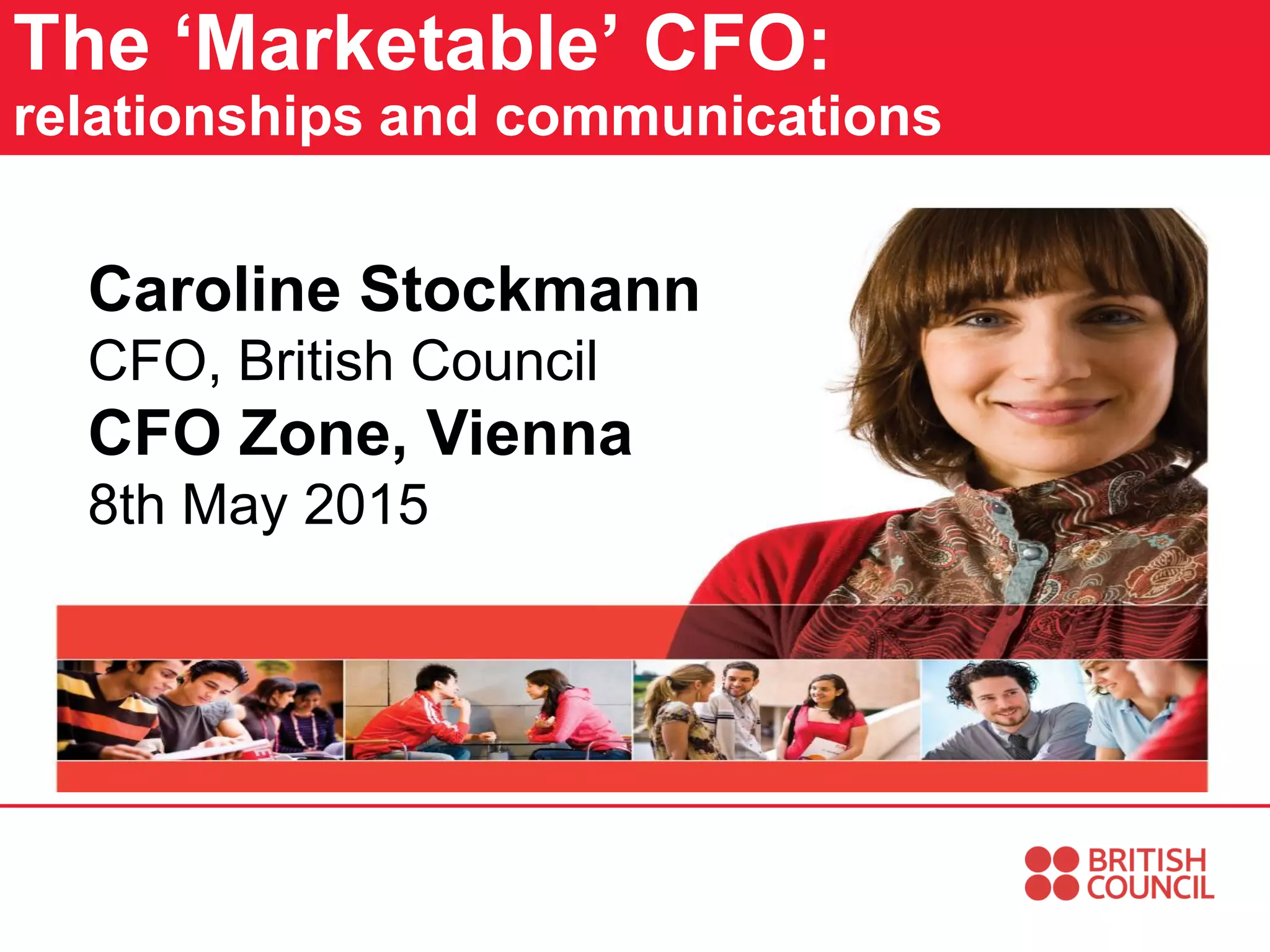
The ‘Marketable’ CFO:
relationships and communications
Caroline Stockmann
CFO, British Council
CFO Zone, Vienna
8th May 2015
British Council: Purpose
“The British Council creates international
opportunities for the people of the UK
and other countries and builds trust
between them worldwide.”
• English & Exams
• Education & Society
• Arts
What is expected of today’s CFO?
In our fast-moving, demanding business world, where there
is no shortage of talent and education, finance leaders
need to have the following skills:
• technical
• business acumen
• leadership
• developed relationship-building
• … and (excellent) communication skills.
(Only one of these is actually about specific professional
skills…)
Communication
If you cannot communicate well, and if you cannot market
yourself and your ideas, you will not be successful in any
leadership role.
An ‘either/or’ question for you:
Do you:
• communicate well with senior leadership? Or…
• communicate well with your team/subordinates? Peers?
Often it is one or the other, but the best leaders can cover
off all bases.
Relationships
If you cannot build successful relationships, and thereby
have people wanting to understand your point of view, you
also will not be successful in any leadership role.
Without a relationship there is often no trust.
Without trust there is no mutual understanding.
Without mutual understanding there is little possibility of
creating win-win situations, and getting the best results.
Some Challenges
• not all those attracted to our profession are extroverts,
i.e. getting their energy from others
• often we are communicating with more than one person
– and they all have different needs/ways of hearing
• the subject matter can be found ‘dry’ by others, and it is
tempting to overplay the detail
• we work in a service function, and therefore will often be
on the receiving end of criticism/feedback/challenge –
and success can be measured in how well these are
dealt with
• sometimes we see ‘networking’ as a forced activity, and
professional relationships as cronyism or favouritism
One Answer: Developing Your Own
Communications Strategy
• treat this as a project, like any other piece of work to be
taken seriously
• make sure you know your strengths and your
weaknesses – ask if in doubt!
• focus on exploiting your strengths: brings most rewards
• also work on weaknesses and specifically develop a
strategy to focus on what you might not ‘naturally’ tend
towards (eg ‘introvert’ → more personable, strategically
influential; ‘extrovert’ → more content-focussed
• remain ‘authentic’ - this has still to be you, or there will
be no trust
Developing Your Own Communications Strategy
Take this project seriously, identify opportunities to ‘practice’, and allow
monitoring and follow-up. This will ensure you reach your goal of being
an effective communicator.
1. Set yourself a plan (use RIVAS?)
2. Identify key meetings/occasions of potential influence
3. Research different styles, as well as your own
4. Get trusted feedback arranged
5. Try out different approaches, in a safe environment, whilst still being
yourself
6. Take time to think about your audience, and how they like to receive
information
7. Work on your presentation skills.
If you take the time to think about how to communicate effectively, you will
reap the results, and become more ‘marketable’…..
Models Which Help You to Know Your
(Potential) Audience
• know yourself (360 feedback, observer), know your
boss, and know your audience, by:
– Belbin
– Myers Briggs
– visual/kinetic/aural tendencies
– functional ‘styles’
– gender differences?
– left brain/right brain
– body (left/right position; gestures, etc)
…… and by listening…….
Other Tips
• practice makes perfect
• don’t give up – it is a continuing journey
• be authentic, but ‘use different muscles’
• the customer is always right
• play baseball (see later)
• adjust your pace of ‘reaction’ – up or down
• fill your ‘gaps’ with others
• with group communication, say things differently
Sounds Simple?
• it is – so why don’t we do it?
Relationships:
Building good relationships can transform your function, - we just
need to understand the importance of this. And it is not about
dishonest or unprofessional/non-objective relationships
Case study: forecasting in Unilever.
Again, there are tips and tricks to this, for those to whom it does
no come naturally…
And I would like to start with looking at how we see the
world…
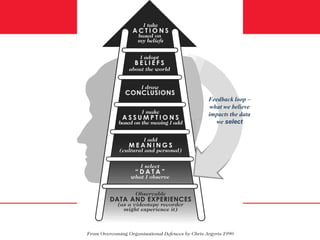
How We Perceive the World: a Blocker?
• we interpret based on experience – a good
thing when the bush is shaking and we are
not sure why…
• there are downsides too: we often
misinterpret, and therefore do not make
decisions based on sound information
• let’s look together at the ‘ladder of
inference’:
Feedback loop –
what we believe
impacts the data
we select
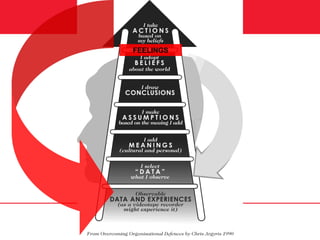
FEELINGS
So, the Learning Is:
• try to be clear on the FACTS
• be authentic/honest
• catch yourself when you are at risk of
over-interpreting (remember, other people
do not see it the same way at all)
• ignore the snake on the shoulder
• be aware everyone else is also
experiencing their own ladder…
Opening Up to Others’ Ideas
• sometimes we believe we know best…
• we say we listen to others, but we often go into
meetings with a result in mind that we want
achieved: with no room for others’ ideas or joint
thinking/creativity; conflict arises as both parties
feel the other is not seeing it the ‘right’ or only
way….
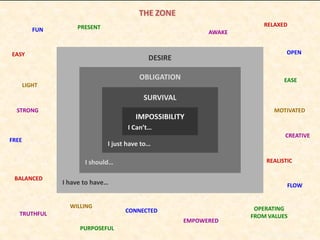
• …so, there is another model which can help us
here, and hence help build relationships:
DESIRE
OBLIGATION
SURVIVAL
IMPOSSIBILITY
THE ZONE
© Bradford K Brown© Bradford K Brown
I Can’t…
I just have to…
I should…
I have to have…
RELAXED
PURPOSEFUL
EMPOWERED
PRESENTFUN
LIGHT
EASY
CREATIVE
STRONG
FREE
OPERATING
FROM VALUES
EASE
FLOW
WILLING
BALANCED
AWAKE
REALISTIC
TRUTHFUL
OPEN
CONNECTED
MOTIVATED
Relevance to Working in a Global
Environment
Not only is there the obvious challenge of cross cultural relations (that would have to
be another presentation) but simply the fact that people are in different locations
means adjustment on several levels.
Some key learnings I have made:
- communication has to be EVEN clearer, and speech must be slower, without idioms
- contact has to be regular, otherwise trust breaks down - schedule it in/keep a log of
stakeholder contact
- you need to meet people as soon as possible, to give a platform for the relationship
(easy to be aggressive/come across as difficult through a phone 'meeting', when
you have never met personally – and people can hide behind this)
- involve people in central or regional projects, so they feel part of the whole
- develop a mentoring system or approach
Relevance to Working in a Global
Environment (cont’d)
-use technology, whether Skype, blogs, or any other form which makes and
maintains connections
- when physically together, use the time to work on relationship building
and softer skills, as opposed to technical/content learning, which can suit other
media well
- stand when speaking on the telephone...
- don’t forget the people who have dialled in
- don’t forget the social side and create some ‘traditions’.
21
Further Tips and Tricks
• ‘the greatest risk is taking no risk at all’ – or is
it?
• to be or not to be (authenticity)
• ‘do not be afraid’ (Isaiah 41)
• respect
• the greater good/pay it forward
• it’s not so bad…settling for second best?
• my way …. step into my shoes
• and I referred to a couple of resources…
RIVAS
• RIVAS is a technique which helps in
achieving results:
– Result
– Intention
– Visualisation
– Actions
– Support
©
23
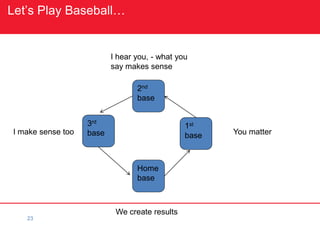
Let’s Play Baseball…
2nd
base
1st
base
3rd
base
Home
base
You matter
I hear you, - what you
say makes sense
I make sense too
We create results
The Final Word?
• these were some thoughts and learnings I
have made, over the years – I hope they
will help you
• there is far more to say on the subject of
communications and relationships, but the
main thing is…
• …giving thought to it.
© Caroline.Stockmann@britischcouncil.org
Questions?
Thank you!

The ‘Marketable’ CFO: relationships and communications - Caroline Stockmann

  • 1.
    The ‘Marketable’ CFO: relationshipsand communications Caroline Stockmann CFO, British Council CFO Zone, Vienna 8th May 2015
  • 2.
    British Council: Purpose “TheBritish Council creates international opportunities for the people of the UK and other countries and builds trust between them worldwide.” • English & Exams • Education & Society • Arts
  • 3.
    What is expectedof today’s CFO? In our fast-moving, demanding business world, where there is no shortage of talent and education, finance leaders need to have the following skills: • technical • business acumen • leadership • developed relationship-building • … and (excellent) communication skills. (Only one of these is actually about specific professional skills…)
  • 4.
    Communication If you cannotcommunicate well, and if you cannot market yourself and your ideas, you will not be successful in any leadership role. An ‘either/or’ question for you: Do you: • communicate well with senior leadership? Or… • communicate well with your team/subordinates? Peers? Often it is one or the other, but the best leaders can cover off all bases.
  • 5.
    Relationships If you cannotbuild successful relationships, and thereby have people wanting to understand your point of view, you also will not be successful in any leadership role. Without a relationship there is often no trust. Without trust there is no mutual understanding. Without mutual understanding there is little possibility of creating win-win situations, and getting the best results.
  • 6.
    Some Challenges • notall those attracted to our profession are extroverts, i.e. getting their energy from others • often we are communicating with more than one person – and they all have different needs/ways of hearing • the subject matter can be found ‘dry’ by others, and it is tempting to overplay the detail • we work in a service function, and therefore will often be on the receiving end of criticism/feedback/challenge – and success can be measured in how well these are dealt with • sometimes we see ‘networking’ as a forced activity, and professional relationships as cronyism or favouritism
  • 7.
    One Answer: DevelopingYour Own Communications Strategy • treat this as a project, like any other piece of work to be taken seriously • make sure you know your strengths and your weaknesses – ask if in doubt! • focus on exploiting your strengths: brings most rewards • also work on weaknesses and specifically develop a strategy to focus on what you might not ‘naturally’ tend towards (eg ‘introvert’ → more personable, strategically influential; ‘extrovert’ → more content-focussed • remain ‘authentic’ - this has still to be you, or there will be no trust
  • 8.
    Developing Your OwnCommunications Strategy Take this project seriously, identify opportunities to ‘practice’, and allow monitoring and follow-up. This will ensure you reach your goal of being an effective communicator. 1. Set yourself a plan (use RIVAS?) 2. Identify key meetings/occasions of potential influence 3. Research different styles, as well as your own 4. Get trusted feedback arranged 5. Try out different approaches, in a safe environment, whilst still being yourself 6. Take time to think about your audience, and how they like to receive information 7. Work on your presentation skills. If you take the time to think about how to communicate effectively, you will reap the results, and become more ‘marketable’…..
  • 9.
    Models Which HelpYou to Know Your (Potential) Audience • know yourself (360 feedback, observer), know your boss, and know your audience, by: – Belbin – Myers Briggs – visual/kinetic/aural tendencies – functional ‘styles’ – gender differences? – left brain/right brain – body (left/right position; gestures, etc) …… and by listening…….
  • 10.
    Other Tips • practicemakes perfect • don’t give up – it is a continuing journey • be authentic, but ‘use different muscles’ • the customer is always right • play baseball (see later) • adjust your pace of ‘reaction’ – up or down • fill your ‘gaps’ with others • with group communication, say things differently
  • 11.
    Sounds Simple? • itis – so why don’t we do it?
  • 12.
    Relationships: Building good relationshipscan transform your function, - we just need to understand the importance of this. And it is not about dishonest or unprofessional/non-objective relationships Case study: forecasting in Unilever. Again, there are tips and tricks to this, for those to whom it does no come naturally… And I would like to start with looking at how we see the world…
  • 13.
    How We Perceivethe World: a Blocker? • we interpret based on experience – a good thing when the bush is shaking and we are not sure why… • there are downsides too: we often misinterpret, and therefore do not make decisions based on sound information • let’s look together at the ‘ladder of inference’:
  • 14.
    Feedback loop – whatwe believe impacts the data we select
  • 15.
  • 16.
    So, the LearningIs: • try to be clear on the FACTS • be authentic/honest • catch yourself when you are at risk of over-interpreting (remember, other people do not see it the same way at all) • ignore the snake on the shoulder • be aware everyone else is also experiencing their own ladder…
  • 17.
    Opening Up toOthers’ Ideas • sometimes we believe we know best… • we say we listen to others, but we often go into meetings with a result in mind that we want achieved: with no room for others’ ideas or joint thinking/creativity; conflict arises as both parties feel the other is not seeing it the ‘right’ or only way…. • …so, there is another model which can help us here, and hence help build relationships:
  • 18.
    DESIRE OBLIGATION SURVIVAL IMPOSSIBILITY THE ZONE © BradfordK Brown© Bradford K Brown I Can’t… I just have to… I should… I have to have… RELAXED PURPOSEFUL EMPOWERED PRESENTFUN LIGHT EASY CREATIVE STRONG FREE OPERATING FROM VALUES EASE FLOW WILLING BALANCED AWAKE REALISTIC TRUTHFUL OPEN CONNECTED MOTIVATED
  • 19.
    Relevance to Workingin a Global Environment Not only is there the obvious challenge of cross cultural relations (that would have to be another presentation) but simply the fact that people are in different locations means adjustment on several levels. Some key learnings I have made: - communication has to be EVEN clearer, and speech must be slower, without idioms - contact has to be regular, otherwise trust breaks down - schedule it in/keep a log of stakeholder contact - you need to meet people as soon as possible, to give a platform for the relationship (easy to be aggressive/come across as difficult through a phone 'meeting', when you have never met personally – and people can hide behind this) - involve people in central or regional projects, so they feel part of the whole - develop a mentoring system or approach
  • 20.
    Relevance to Workingin a Global Environment (cont’d) -use technology, whether Skype, blogs, or any other form which makes and maintains connections - when physically together, use the time to work on relationship building and softer skills, as opposed to technical/content learning, which can suit other media well - stand when speaking on the telephone... - don’t forget the people who have dialled in - don’t forget the social side and create some ‘traditions’.
  • 21.
    21 Further Tips andTricks • ‘the greatest risk is taking no risk at all’ – or is it? • to be or not to be (authenticity) • ‘do not be afraid’ (Isaiah 41) • respect • the greater good/pay it forward • it’s not so bad…settling for second best? • my way …. step into my shoes • and I referred to a couple of resources…
  • 22.
    RIVAS • RIVAS isa technique which helps in achieving results: – Result – Intention – Visualisation – Actions – Support ©
  • 23.
    23 Let’s Play Baseball… 2nd base 1st base 3rd base Home base Youmatter I hear you, - what you say makes sense I make sense too We create results
  • 24.
    The Final Word? •these were some thoughts and learnings I have made, over the years – I hope they will help you • there is far more to say on the subject of communications and relationships, but the main thing is… • …giving thought to it. © Caroline.Stockmann@britischcouncil.org
  • 25.
  • 26.