Daniel Reed

CIO/CMO Convergence
The convergence of the CIO & CMO
 How can the CIO can best support Marketing & business
        leadership and drive organisation value.


1.Introduction & Context Setting

2. CMO Challenges

3. CIO Challenges & Opportunities

4. Discussion Questions
1. Introduction & Context setting....

•   IT focus has traditionally been largely in areas of .....Infrastructure,
    Hardware, networks, generic application development, maintenance and
    support etc.
•   More recently IT has been more heavily engaged in business critical
    applications that have transformed processing efficiencies and
    harmonisation in many companies around ERP,HR, CRM and logistics
    platforms .
•   Predominantly back office type functions supporting finance, Operations
    and HR where creation of shared service centres for these business support
    functions has been a priority in many large organisations driving efficiencies
    and cost savings not to mention the benefits of standardisation and
    increased agility.
•   In recent years the digital explosion and resulting business imperatives
    facing CMOs has driven an appetite and urgency to transform marketing
    protocols at a pace that many organisations have struggled with
1.    Introduction & Context setting....continued

•    The growing influence and priority of technology on key front office business
     functions has lead some organisations to seek external partners to support
     e-marketing and ecommerce rather then partnering with CIO offices...
•    In many cases Marketing functions have taken on new teams of web
     specialists around analytics, BI, reporting, web development of sites and
     EDMs, etc.
•    This leads to need for clarity between the CIO organisation and that of the
     CMO around digital marketing and e-commerce....
•    Often highlights gaps in existing CMO or CIO management team
     capabilities and skill sets....
•    Ultimately -This leads to potential remit/role conflict between the CIO and
     CMO and their key management staff.
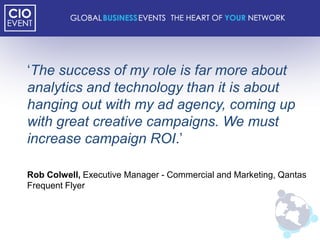
„The success of my role is far more about
analytics and technology than it is about
hanging out with my ad agency, coming up
with great creative campaigns. We must
increase campaign ROI.‟

Rob Colwell, Executive Manager - Commercial and Marketing, Qantas
Frequent Flyer
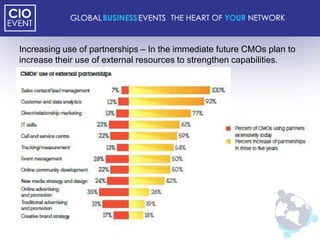
Increasing use of partnerships – In the immediate future CMOs plan to
increase their use of external resources to strengthen capabilities.
2. CMO challenges....

•   A recent extensive survey of CEOs and CMO's asked the question what are
    the most influential impacts on business next year. The CMO responses
    were very similar to the CEO's.
•   CMO's stated Market and technology factors are the two most powerful
    external forces affecting organisations today.
•   They expect them to drive increasing levels of complexity over the next five
    years in how businesses market not just products and services, but all
    dimensions of our organisations.
•   The four biggest challenges identified were 1.explosion of data, 2.social
    media, 3.the proliferation of channels and devices and 4.shifting
    consumer demographics.
•   These factors are serving as catalysts for change in the marketing function
    and the struggle we all face is how to turn those challenges into
    opportunities.
The CMO role has changed......

•   Traditional thinking saw the office of the CMO concerning its self with concepts such
    as Brand, Promotion, Products, placements, pricing leading to revenue and profits....
    channel?
•   Many current CMOs are concerned by how to digitally transform their business, how
    to leverage e-commerce, social media, create product and promotions appropriate for
    multi-channel marketing...
•   Many are struggling to determine how to improve their businesses ecommerce or
    digital marketing capabilities, or indeed BI or web analytics, reporting and selection
    strength........ Decisions often in the CMO office for investment paths for system and
    solution implementations or service partners to take them forward with digital
    capabilities.....
•   Even the more digitally transformed CMOs are still focusing on wed analytics, BI
    reporting, EDMs, digital content, digital subscriptions/memberships/orders, social
    media marketing, brand perception by bloggers/reviews........
•   Dealing with the "BIG" data that is now available and understanding what is needed,
    what to do with it all... and how best to leverage information into actions and business
    value.
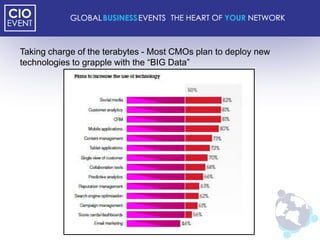
Taking charge of the terabytes - Most CMOs plan to deploy new
technologies to grapple with the “BIG Data”
The CMO role has changed......

•   Much of this is highly technology dependant and a real jump from traditional
    marketing skills, knowledge, experience... and so often leaves a gap to be
    filled to greater or lesser extents.....

•   CMO should be focused on Brand, Product, Promotion, Pricing, Placements
    etc. rather than being so distracted by the technology

•   However, CMOs who need to make decisions about technology investments
    may find themselves in unfamiliar territory.

•   This would explain why worries about implementing new technologies loom
    so large.

•   Four of the remaining eight obstacles CMOs cite are related to IT and
    marketing‟s relationship with the IT function.
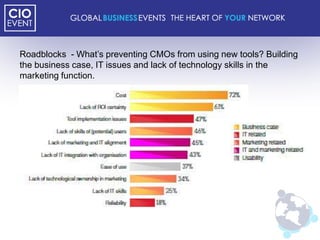
Roadblocks - What‟s preventing CMOs from using new tools? Building
the business case, IT issues and lack of technology skills in the
marketing function.
• ‘It’s easy to see the potential of many new tools, but it’s rarely
  simple to integrate them with the organisation’s existing systems,’
  a food, beverage and tobacco CMO in the United Kingdom warned.
• ‘The complexity of integrating [a new system] with other systems
  too often destroys the ROI of the new system,’ she added.
• Concerns about the level of skill and lack of technology ownership
  within the marketing function also suggest CMOs will have to work
  much more closely with CIOs in the future.
• An industrial products CMO in the United States spoke for many
  when she said: ‘I don’t see how we can go forward without
  embedding IT into marketing.’
3. CIO Challenges

• Ever increasing speed of new technologies creating digital
  marketing opportunities

• The business cannot always articulate their business requirements
  (hence the partnering and/or going it alone….)

• Business Partnering - growing need to proactively propose solutions
  and partner/lead ROI projections around technology centric
  investments…

• Integration of new tools/solutions with existing system infrastructure
3. CIO Opportunities.....
• There is a clear opportunity for the CIO to more effectively support the
    mission critical digital transformation of organisation commerce and
    customer interactions through partnering the CMO function.

•   CIO's should be key collaborators in identifying the digital business
    opportunities, defining the vision in terms of operating model and
    technology requirements, solution selection and subsequent
    implementation,

•   CIO's can bring much to this table....Leveraging technology understanding
    and in many cases existing organisation tech skills and expertise to design,
    deliver and support effective e-MKT and ecommerce platforms and where
    possible processing capabilities through BI...

•   The digital marketing holistic technology platform has already become the
    most mission critical tech stack and should therefore be a key pillar, if not
    the primary tower in any organisation enterprise architecture
‘Marketing people will need unique skills in
the near future. They’ll need to be capable
of integrating marketing and IT - like
footballers who can kick with both feet.’

Jeroen de Punder, Chief Marketing Officer, Ricoh Netherlands
4. Discussion questions:
1. How can you integrate external partners/solutions best in
   you IT organisation?
2. What components could and should be left with Marketing
   and never be transitioned to IT?
3. How can you transform IT so that IT can be proactive in all
   the digital changes, rather than be reactive ?
4. What new roles are critical in your IT organisation to
   support the digital transformation ?
5. Do digital projects require new project methodology?
4. Discussion questions:

6.   What is the digital change/trend that has impacted you most in recent
     years (or in the last year)?

7.   Is the business organisation capable of participating in the required
     projects to transform (business involvement)?

8.   What is the solution to get business to articulate their requirements in
     a better way, in this continuous changing environment?

9.   What division of roles do you propose between the whole Web based
     roles (now often Marketing) between Marketing and IT ?

10. „The complexity of integrating [a new system] with other systems
    often destroys the ROI of the new system,‟ - Is it acceptable not to
    integrate, to what degree ?

CIO / CMO Convergence

  • 1.
  • 2.
    The convergence ofthe CIO & CMO How can the CIO can best support Marketing & business leadership and drive organisation value. 1.Introduction & Context Setting 2. CMO Challenges 3. CIO Challenges & Opportunities 4. Discussion Questions
  • 3.
    1. Introduction &Context setting.... • IT focus has traditionally been largely in areas of .....Infrastructure, Hardware, networks, generic application development, maintenance and support etc. • More recently IT has been more heavily engaged in business critical applications that have transformed processing efficiencies and harmonisation in many companies around ERP,HR, CRM and logistics platforms . • Predominantly back office type functions supporting finance, Operations and HR where creation of shared service centres for these business support functions has been a priority in many large organisations driving efficiencies and cost savings not to mention the benefits of standardisation and increased agility. • In recent years the digital explosion and resulting business imperatives facing CMOs has driven an appetite and urgency to transform marketing protocols at a pace that many organisations have struggled with
  • 4.
    1. Introduction & Context setting....continued • The growing influence and priority of technology on key front office business functions has lead some organisations to seek external partners to support e-marketing and ecommerce rather then partnering with CIO offices... • In many cases Marketing functions have taken on new teams of web specialists around analytics, BI, reporting, web development of sites and EDMs, etc. • This leads to need for clarity between the CIO organisation and that of the CMO around digital marketing and e-commerce.... • Often highlights gaps in existing CMO or CIO management team capabilities and skill sets.... • Ultimately -This leads to potential remit/role conflict between the CIO and CMO and their key management staff.
  • 5.
    „The success ofmy role is far more about analytics and technology than it is about hanging out with my ad agency, coming up with great creative campaigns. We must increase campaign ROI.‟ Rob Colwell, Executive Manager - Commercial and Marketing, Qantas Frequent Flyer
  • 6.
    Increasing use ofpartnerships – In the immediate future CMOs plan to increase their use of external resources to strengthen capabilities.
  • 7.
    2. CMO challenges.... • A recent extensive survey of CEOs and CMO's asked the question what are the most influential impacts on business next year. The CMO responses were very similar to the CEO's. • CMO's stated Market and technology factors are the two most powerful external forces affecting organisations today. • They expect them to drive increasing levels of complexity over the next five years in how businesses market not just products and services, but all dimensions of our organisations. • The four biggest challenges identified were 1.explosion of data, 2.social media, 3.the proliferation of channels and devices and 4.shifting consumer demographics. • These factors are serving as catalysts for change in the marketing function and the struggle we all face is how to turn those challenges into opportunities.
  • 8.
    The CMO rolehas changed...... • Traditional thinking saw the office of the CMO concerning its self with concepts such as Brand, Promotion, Products, placements, pricing leading to revenue and profits.... channel? • Many current CMOs are concerned by how to digitally transform their business, how to leverage e-commerce, social media, create product and promotions appropriate for multi-channel marketing... • Many are struggling to determine how to improve their businesses ecommerce or digital marketing capabilities, or indeed BI or web analytics, reporting and selection strength........ Decisions often in the CMO office for investment paths for system and solution implementations or service partners to take them forward with digital capabilities..... • Even the more digitally transformed CMOs are still focusing on wed analytics, BI reporting, EDMs, digital content, digital subscriptions/memberships/orders, social media marketing, brand perception by bloggers/reviews........ • Dealing with the "BIG" data that is now available and understanding what is needed, what to do with it all... and how best to leverage information into actions and business value.
  • 9.
    Taking charge ofthe terabytes - Most CMOs plan to deploy new technologies to grapple with the “BIG Data”
  • 10.
    The CMO rolehas changed...... • Much of this is highly technology dependant and a real jump from traditional marketing skills, knowledge, experience... and so often leaves a gap to be filled to greater or lesser extents..... • CMO should be focused on Brand, Product, Promotion, Pricing, Placements etc. rather than being so distracted by the technology • However, CMOs who need to make decisions about technology investments may find themselves in unfamiliar territory. • This would explain why worries about implementing new technologies loom so large. • Four of the remaining eight obstacles CMOs cite are related to IT and marketing‟s relationship with the IT function.
  • 11.
    Roadblocks - What‟spreventing CMOs from using new tools? Building the business case, IT issues and lack of technology skills in the marketing function.
  • 12.
    • ‘It’s easyto see the potential of many new tools, but it’s rarely simple to integrate them with the organisation’s existing systems,’ a food, beverage and tobacco CMO in the United Kingdom warned. • ‘The complexity of integrating [a new system] with other systems too often destroys the ROI of the new system,’ she added. • Concerns about the level of skill and lack of technology ownership within the marketing function also suggest CMOs will have to work much more closely with CIOs in the future. • An industrial products CMO in the United States spoke for many when she said: ‘I don’t see how we can go forward without embedding IT into marketing.’
  • 13.
    3. CIO Challenges •Ever increasing speed of new technologies creating digital marketing opportunities • The business cannot always articulate their business requirements (hence the partnering and/or going it alone….) • Business Partnering - growing need to proactively propose solutions and partner/lead ROI projections around technology centric investments… • Integration of new tools/solutions with existing system infrastructure
  • 14.
    3. CIO Opportunities..... •There is a clear opportunity for the CIO to more effectively support the mission critical digital transformation of organisation commerce and customer interactions through partnering the CMO function. • CIO's should be key collaborators in identifying the digital business opportunities, defining the vision in terms of operating model and technology requirements, solution selection and subsequent implementation, • CIO's can bring much to this table....Leveraging technology understanding and in many cases existing organisation tech skills and expertise to design, deliver and support effective e-MKT and ecommerce platforms and where possible processing capabilities through BI... • The digital marketing holistic technology platform has already become the most mission critical tech stack and should therefore be a key pillar, if not the primary tower in any organisation enterprise architecture
  • 15.
    ‘Marketing people willneed unique skills in the near future. They’ll need to be capable of integrating marketing and IT - like footballers who can kick with both feet.’ Jeroen de Punder, Chief Marketing Officer, Ricoh Netherlands
  • 16.
    4. Discussion questions: 1.How can you integrate external partners/solutions best in you IT organisation? 2. What components could and should be left with Marketing and never be transitioned to IT? 3. How can you transform IT so that IT can be proactive in all the digital changes, rather than be reactive ? 4. What new roles are critical in your IT organisation to support the digital transformation ? 5. Do digital projects require new project methodology?
  • 17.
    4. Discussion questions: 6. What is the digital change/trend that has impacted you most in recent years (or in the last year)? 7. Is the business organisation capable of participating in the required projects to transform (business involvement)? 8. What is the solution to get business to articulate their requirements in a better way, in this continuous changing environment? 9. What division of roles do you propose between the whole Web based roles (now often Marketing) between Marketing and IT ? 10. „The complexity of integrating [a new system] with other systems often destroys the ROI of the new system,‟ - Is it acceptable not to integrate, to what degree ?