Examples of Tools
that supports
Learning Analytics in
MOOCs
Ruth Cobos Pérez
Universidad Autónoma de Madrid
Ruth.Cobos@uam.es
Red eMadrid, www.emadridnet.org
Outline
 Context: MOOCs
 Types of Data Analysis
 Descriptive Analytics: Open-DLAs
 Predictive Analytics: edX-MAS+
 Prescriptive Analytics: edX-WS
 Content Analytics: edX-CAS
 Conclusions
2
3
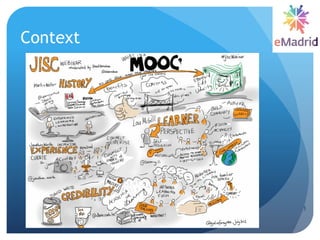
Context
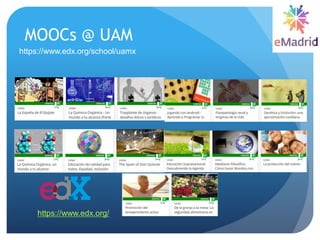
MOOCs @ UAM
https://www.edx.org/
https://www.edx.org/school/uamx
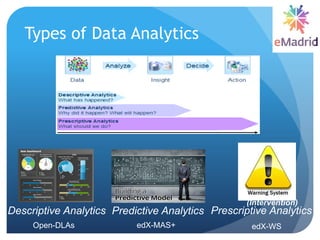
Types of Data Analytics
Descriptive Analytics Predictive Analytics
(Intervention)
Prescriptive Analytics
edX-MAS+Open-DLAs edX-WS
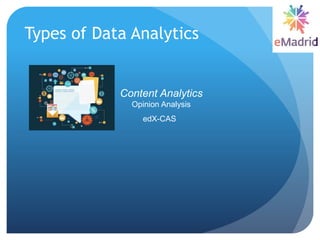
Types of Data Analytics
Content Analytics
Opinion Analysis
edX-CAS
7
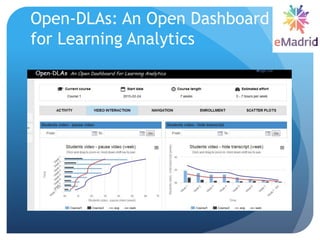
Open-DLAs: An Open Dashboard
for Learning Analytics
8
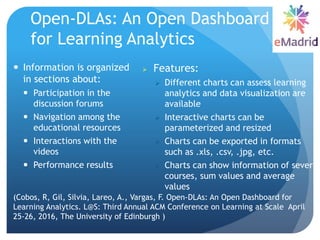
Open-DLAs: An Open Dashboard
for Learning Analytics
 Information is organized
in sections about:
 Participation in the
discussion forums
 Navigation among the
educational resources
 Interactions with the
videos
 Performance results
(Cobos, R, Gil, Silvia, Lareo, A., Vargas, F. Open-DLAs: An Open Dashboard for
Learning Analytics. L@S: Third Annual ACM Conference on Learning at Scale April
25-26, 2016, The University of Edinburgh )
 Features:
 Different charts can assess learning
analytics and data visualization are
available
 Interactive charts can be
parameterized and resized
 Charts can be exported in formats
such as .xls, .csv, .jpg, etc.
 Charts can show information of several
courses, sum values and average
values
edX-MAS+:
Model Analizer System
 edX-MAS+: it is an interactive tool for supporting the
generation of Predictive Models for edX MOOCs
 It is based on the data collected from a MOOC, allowing the
simple application of a complete Data Science process,
where Machine Learning algorithms will be applied to
predict:
 which learners are likely to leave the course (dropout)
 which learners are expected to pass the course (certificate
acquisition)
(R. Cobos, V. Macias, edX-MAS: Model Analyzer System. International Conference
Technological Ecosystems for Enhancing Multiculturality, TEEM 2017
R. Cobos, L. Olmos, A Learning Analytic Tool for Predictive Modeling of Dropout and
Certificate acquisition on MOOCs for Professional Learning, IEEE IEEM 2018)
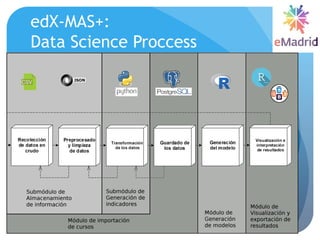
edX-MAS+:
Data Science Proccess
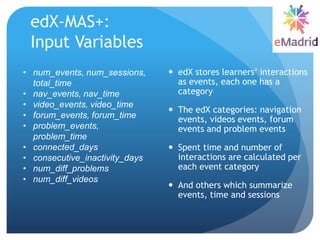
edX-MAS+:
Input Variables
 edX stores learners’ interactions
as events, each one has a
category
 The edX categories: navigation
events, videos events, forum
events and problem events
 Spent time and number of
interactions are calculated per
each event category
 And others which summarize
events, time and sessions
• num_events, num_sessions,
total_time
• nav_events, nav_time
• video_events, video_time
• forum_events, forum_time
• problem_events,
problem_time
• connected_days
• consecutive_inactivity_days
• num_diff_problems
• num_diff_videos
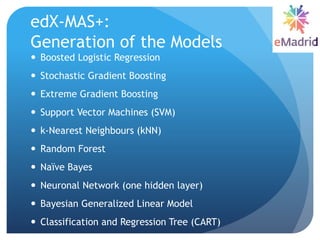
edX-MAS+:
Generation of the Models
 Boosted Logistic Regression
 Stochastic Gradient Boosting
 Extreme Gradient Boosting
 Support Vector Machines (SVM)
 k-Nearest Neighbours (kNN)
 Random Forest
 Naïve Bayes
 Neuronal Network (one hidden layer)
 Bayesian Generalized Linear Model
 Classification and Regression Tree (CART)
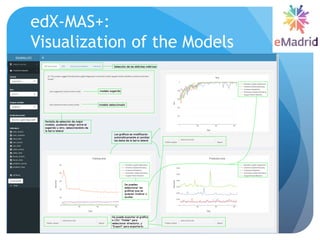
edX-MAS+:
Visualization of the Models
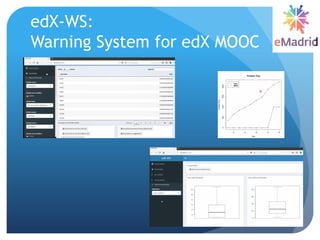
edX-WS:
Warning System for edX MOOC
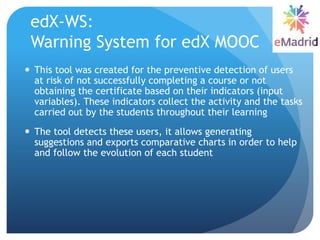
 This tool was created for the preventive detection of users
at risk of not successfully completing a course or not
obtaining the certificate based on their indicators (input
variables). These indicators collect the activity and the tasks
carried out by the students throughout their learning
 The tool detects these users, it allows generating
suggestions and exports comparative charts in order to help
and follow the evolution of each student
edX-WS:
Warning System for edX MOOC
edX-CAS: Content Analyzer
System for edX MOOC
Madrid, 2013-06-13
16
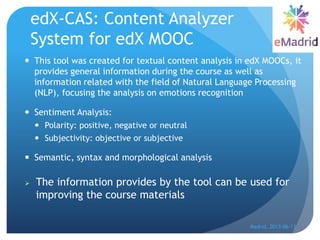
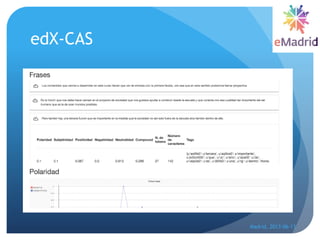
 This tool was created for textual content analysis in edX MOOCs, it
provides general information during the course as well as
information related with the field of Natural Language Processing
(NLP), focusing the analysis on emotions recognition
 Sentiment Analysis:
 Polarity: positive, negative or neutral
 Subjectivity: objective or subjective
 Semantic, syntax and morphological analysis
 The information provides by the tool can be used for
improving the course materials
edX-CAS
Madrid, 2013-06-13
17
Conclusions
 Context: Learners and Learning Environments
 Great amount of data in different formats
 Types of Data Analysis - Tools
 Descriptive Analytics: Open-DLAs
 Predictive Analytics: edX-MAS+
 Prescriptive Analytics: edX-WS
 Content Analytics: edX-CAS
 Learning Analytics are useful for:
 Detecting learners’ behaviors
 Improving learning environments
 Improving on-line learning approaches
 Improving learning materials
 Identifying learners in risk
 Providing recommendations and advices to learners
19