Graham Attwell E-portfolio  development  and implementation
What is the purpose of an e-Portfolio?
assessment portfolios
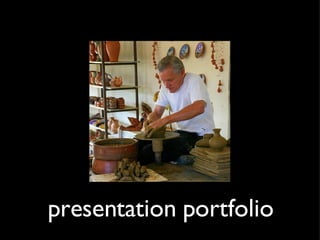
presentation portfolio
Personal Development planning
Personal learning portfolio
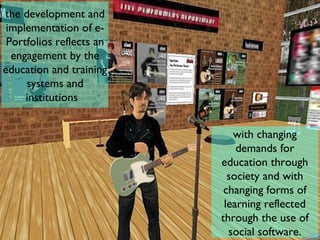
the development and implementation of e-Portfolios reflects an engagement by the education and training systems and institutions  with changing demands for education through society and with changing forms of learning reflected through the use of social software.
Drivers of change include more student centred pedagogic approaches, more flexible programme provision, a greater emphasis on lifelong learning, and a move toward competence based assessment.
issues
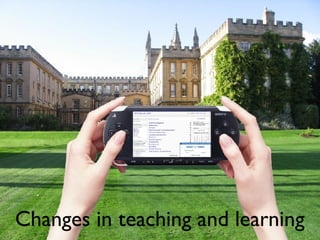
Changes in teaching and learning
Linear / slowBased on proprietary knowledgeViews ideas as strategic advantageFacilitated by mentorsLearning takes place by reverse engineeringProgresses by "shoulders of giants"Based on the wisdom of experts ‘ Old Learning’
Exponential, networked, quick Based on shared knowledge Ideas are "paid forward" Facilitated by Micromentors Lessons-learned benefit all Progress by the "mash-pit" Based on the wisdom of crowds Based on the wisdom of crowds Based on the wisdom of crowds Based on the wisdom of crowds Based on the wisdom of crowds Based on the wisdom of crowds Based on the wisdom of crowds ‘ New Learning’
who provides the e-portfolio?
who owns the  e-portfolio e-portfolio
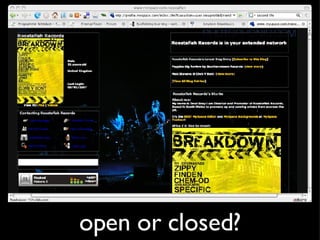
open or closed?
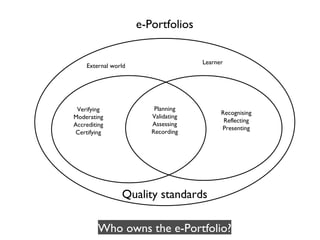
Planning Validating Assessing Recording Recognising Reflecting Presenting Verifying Moderating Accrediting Certifying External world Learner Quality standards e-Portfolios Who owns the e-Portfolio?
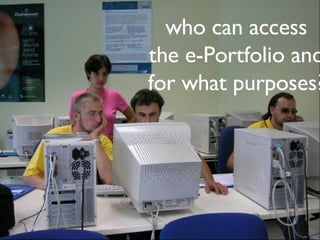
who can access the e-Portfolio and for what purposes?
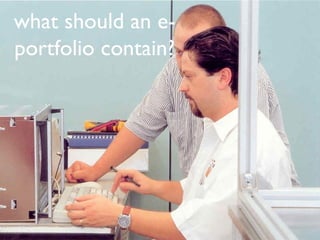
what should an e-portfolio contain?
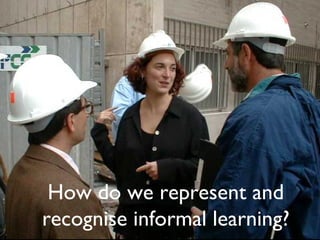
How do we represent and recognise informal learning?
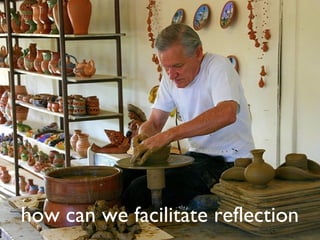
how can we facilitate reflection
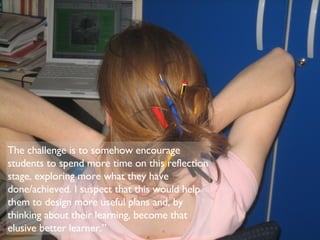
The challenge is to somehow encourage students to spend more time on this reflection stage, exploring more what they have done/achieved. I suspect that this would help them to design more useful plans and, by thinking about their learning, become that elusive better learner.”
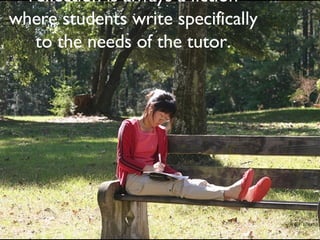
reflection is always a fiction where students write specifically to the needs of the tutor.
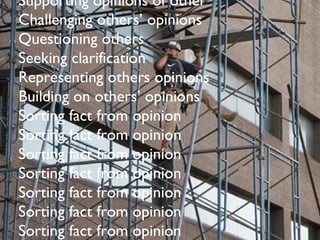
Forming an opinion Expressing and opinion Articulating and opinion Justifying an opinion Defending an opinion Supporting opinions of other Challenging others’ opinions Questioning others Seeking clarification Representing others opinions Building on others’ opinions Sorting fact from opinion Sorting fact from opinion Sorting fact from opinion Sorting fact from opinion Sorting fact from opinion Sorting fact from opinion Sorting fact from opinion Sorting fact from opinion Sorting fact from opinion Sorting fact from opinion Sorting fact from opinion Sorting fact from opinion
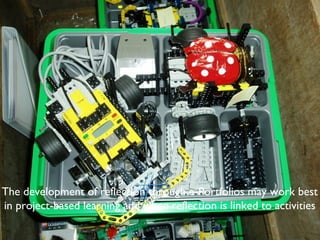
The development of reflection through e-Portfolios may work best in project-based learning and when reflection is linked to activities
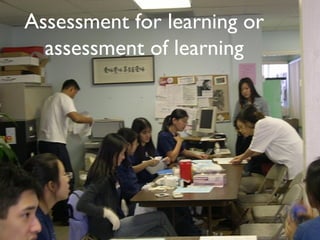
Assessment for learning or assessment of learning
group assessment and authentic assessment
 
 
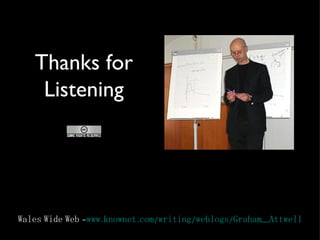
Thanks for Listening Wales Wide Web - www.knownet.com/writing/weblogs/Graham_Attwell

e-Portfolio Development and Implementation

  • 1.
    Graham Attwell E-portfolio development and implementation
  • 2.
    What is thepurpose of an e-Portfolio?
  • 3.
  • 4.
  • 5.
  • 6.
  • 7.
    the development andimplementation of e-Portfolios reflects an engagement by the education and training systems and institutions with changing demands for education through society and with changing forms of learning reflected through the use of social software.
  • 8.
    Drivers of changeinclude more student centred pedagogic approaches, more flexible programme provision, a greater emphasis on lifelong learning, and a move toward competence based assessment.
  • 9.
  • 10.
    Changes in teachingand learning
  • 11.
    Linear / slowBasedon proprietary knowledgeViews ideas as strategic advantageFacilitated by mentorsLearning takes place by reverse engineeringProgresses by "shoulders of giants"Based on the wisdom of experts ‘ Old Learning’
  • 12.
    Exponential, networked, quickBased on shared knowledge Ideas are "paid forward" Facilitated by Micromentors Lessons-learned benefit all Progress by the "mash-pit" Based on the wisdom of crowds Based on the wisdom of crowds Based on the wisdom of crowds Based on the wisdom of crowds Based on the wisdom of crowds Based on the wisdom of crowds Based on the wisdom of crowds ‘ New Learning’
  • 13.
    who provides thee-portfolio?
  • 14.
    who owns the e-portfolio e-portfolio
  • 15.
  • 16.
    Planning Validating AssessingRecording Recognising Reflecting Presenting Verifying Moderating Accrediting Certifying External world Learner Quality standards e-Portfolios Who owns the e-Portfolio?
  • 17.
    who can accessthe e-Portfolio and for what purposes?
  • 18.
    what should ane-portfolio contain?
  • 19.
    How do werepresent and recognise informal learning?
  • 20.
    how can wefacilitate reflection
  • 21.
    The challenge isto somehow encourage students to spend more time on this reflection stage, exploring more what they have done/achieved. I suspect that this would help them to design more useful plans and, by thinking about their learning, become that elusive better learner.”
  • 22.
    reflection is alwaysa fiction where students write specifically to the needs of the tutor.
  • 23.
    Forming an opinionExpressing and opinion Articulating and opinion Justifying an opinion Defending an opinion Supporting opinions of other Challenging others’ opinions Questioning others Seeking clarification Representing others opinions Building on others’ opinions Sorting fact from opinion Sorting fact from opinion Sorting fact from opinion Sorting fact from opinion Sorting fact from opinion Sorting fact from opinion Sorting fact from opinion Sorting fact from opinion Sorting fact from opinion Sorting fact from opinion Sorting fact from opinion Sorting fact from opinion
  • 24.
    The development ofreflection through e-Portfolios may work best in project-based learning and when reflection is linked to activities
  • 25.
    Assessment for learningor assessment of learning
  • 26.
    group assessment andauthentic assessment
  • 27.
  • 28.
  • 29.
    Thanks for ListeningWales Wide Web - www.knownet.com/writing/weblogs/Graham_Attwell